Quick Summary
The bucktooth tetra needs a large shoal and relentlessly attacks shiny tank mates.
🐠 Build a tank around this species
In this guide:
- Introduction
- Quick Stats
- Appearance
- Natural Habitat
- Tank Size and Setup
- Water Parameters
- Filtration and Equipment
- Diet and Feeding
- Behaviour and Temperament
- Tank Mates
- Breeding
- Common Diseases
- FAQs
- Related Guides
Introduction
The bucktooth tetra, a freshwater fish, was first described in 1844. The IUCN Red List assessed it as Least Concern in March 2021.
Quick Stats
| Scientific name | Exodon paradoxus |
|---|---|
| Family | Characidae |
| Origin | South America, Amazon and Tocantins basins (Brazil, Colombia, Guyana) |
| Adult size | 15 cm |
| Difficulty | Advanced |
| Breeding difficulty | Advanced |
| Temperature | 23–28 °C |
| pH | 5.5–7.5 |
| GH | 0–20 dGH |
| Minimum tank size | 243 L |
| Conservation status | Least Concern (IUCN, assessed 2021) |
Appearance
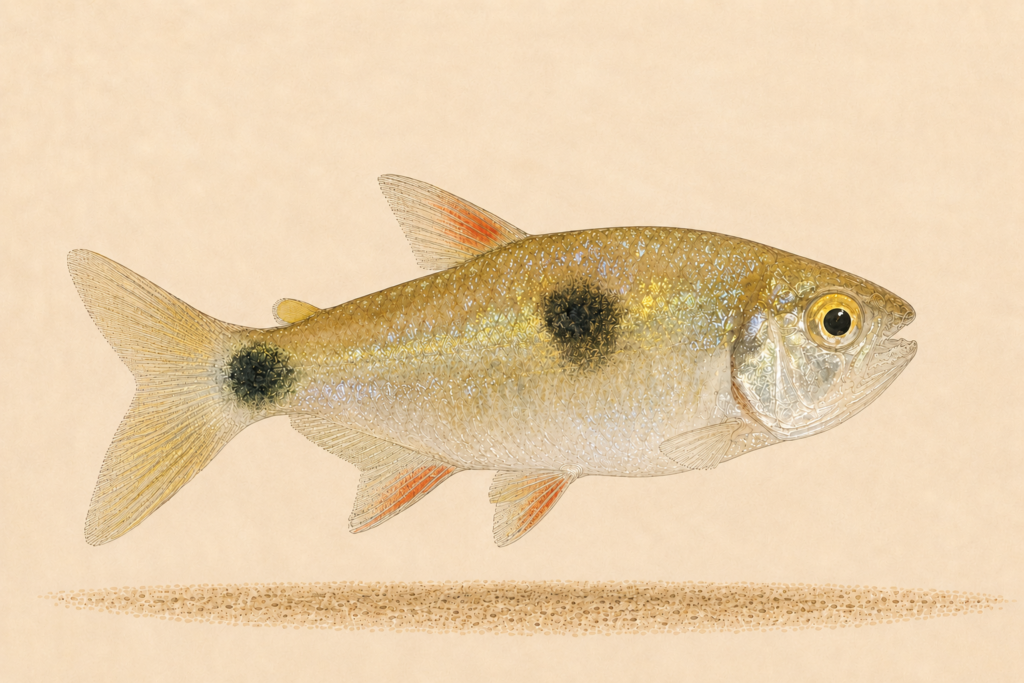
The largest adults measure 150 mm, not counting the tail fin. Its teeth are able to pull scales off other fish. To tell the sexes apart, look at the build and the fins: females are the less slender, while grown males tend to show somewhat extended rays on the back and anal fins.
Natural Habitat
The bucktooth tetra lives in Brazil, Colombia and Guyana. Its range includes the Amazon and Tocantins basins, and within Brazil it is widespread across the Amazon region, with further records from the Rio Branco. Rivers that run through grassland like savannah are where the fish is usually found.
Tank Size and Setup
We recommend a tank of at least 243 litres. A tank of at least 120 x 45 x 45 cm is large enough for a shoal, while anything smaller is likely to leave you with only a few survivors. A heavily planted tank shows the fish off best, and it also gives individuals that are being bullied somewhere to rest.
Water Parameters
Aim for a temperature of 23 to 28 °C, as suits a tropical species. The pH should be between 5.5 and 7.5.
| Temperature | 23-28 C |
| pH | 5.5-7.5 |
| General hardness (GH) | 0-20 dGH |
| Ammonia | 0 ppm |
| Nitrite | 0 ppm |
| Nitrate | Below 30 ppm |
A hardness of 0 to 20 dGH is suggested. Other published ranges for pH and hardness agree, at 5.5 to 7.5 and 0 to 20.
Filtration and Equipment
Because this species has to be housed in big groups, the filter you choose needs to work very efficiently. We recommend a filter that turns the water over four to five times an hour for a tank of at least 243 litres, and a heater to hold the temperature within 23 to 28 degrees Celsius.
Diet and Feeding
Wild fish have been found to eat mainly insects, along with scales taken from other fish. Offer a varied, mostly meaty diet that includes bloodworm, chopped prawns, mussel, earthworms and lancefish. Carnivore pellets and freeze-dried bloodworm are also recommended, and most of these fish will take dried foods.
Behaviour and Temperament
The bucktooth tetra is not a community fish, and a species setup suits it best. It generally leaves alone fish that have no scales or that do not reflect light. Anything silver or shiny in the same tank is liable to be attacked and stripped of its scales. Even larger predatory species are not safe from it, though loaches, loricariids and some larger characins have been kept with it successfully, and tank mates will always be somewhat unpredictable.
The fish needs a group, and a dozen is usually given as the least number, so you should fill the tank with as large a group as it can house. Smaller groups tend to turn on each other until just one fish is left. Buy the whole group at once, because newcomers added later are usually attacked.
Tank Mates
The only responsible recommendation for Bucktooth Tetra tank mates is: none. Exodon paradoxus should be kept in a species-only setup. Their scale-eating behaviour means that any fish housed with them – regardless of size, speed, or temperament – will be attacked. Even large, robust cichlids and catfish are not safe; Bucktooth Tetras will strip scales from fish many times their size. The attacks are relentless and will continue until the victim is severely injured, stressed, or dead. There are no reliable “safe” tank mates for this species.
Some keepers have experimented with housing Bucktooth Tetras alongside very fast, open-water species or heavily armoured catfish, but these arrangements almost always end badly. Even if the attacks do not immediately kill a tank mate, the chronic stress of being repeatedly targeted compromises the victim’s immune system and quality of life. It is simply not ethical to subject other fish to this.
Good tank mates
- Bucktooth Tetra (conspecifics) – The only truly appropriate companion; keep in a large shoal of 12 or more to distribute intraspecific aggression and maintain group stability.
Fish to avoid
- Neon Tetra – Far too small and slow; would be killed and consumed almost immediately.
- Angelfish – Large, flat body profile makes them an ideal target for scale-stripping attacks; would be severely injured within hours.
- Corydoras Catfish – Despite their bony plates, Corydoras are slow-moving bottom-dwellers that would be relentlessly harassed and injured.
- Oscar – Even a large cichlid like an Oscar will have its scales stripped; the Oscar’s retaliatory aggression will not deter a coordinated shoal of Bucktooth Tetras.
- Discus – Extremely vulnerable due to their large, exposed flanks and stress-prone nature; a catastrophic pairing.
- Guppy – Would be killed and eaten, not merely scale-stripped; completely incompatible in every respect.
- Plecostomus – Often suggested as a potential companion due to their armour, but even plecos will be stressed and attacked at vulnerable points such as the eyes and fins.
- Rummy-nose Tetra – Another tetra does not mean compatibility; these smaller shoaling fish would be destroyed in short order.
Breeding
Breeding has been achieved only rarely. The fish scatter their eggs, and the best approach is to spawn them in a separate tank. A spawning tank of around 24 x 12 x 12 inches should be enough, and it can be bare except for some fine-leaved plants to collect the eggs. Condition the adults as a shoal in a separate tank, then move a pair into the spawning tank once they are in good shape. A water change of 50 percent or more, using slightly warmer water than the tank holds, can apparently sometimes prompt spawning.
The adults will eat their spawn if given the opportunity, so remove them as soon as eggs are noticed. The eggs hatch in 2 to 3 days. Little is known about raising the fry. The fry are likely to take newly hatched brine shrimp and other small live foods. Keep several tanks ready so that differently sized fish can be moved apart as they grow, because cannibalism will probably be rife among the young.
Common Diseases
White spot (ich) can turn up in any freshwater fish, especially when a fish is stressed or when a newly added fish brings it into the tank.
FAQs
Is the bucktooth tetra a community fish?
No, it does best in a species setup rather than alongside other fish.
How many should I keep?
A dozen is the usual minimum, and a tank of at least 243 litres could hold a group of 25 to 50.
What do bucktooth tetras eat?
Meaty foods such as bloodworm, chopped prawns and mussel suit them, and most will also accept dried foods.
Can they be bred in a home aquarium?
Breeding has been achieved, but only rarely, and it is best done in a separate spawning tank.
Related Guides
- Piranha – Another aggressive South American characin requiring species-only housing and advanced husbandry knowledge.
- Congo Tetra – A larger tetra species for keepers who want a striking shoaling display without the extreme aggression of Exodon.
- Emperor Tetra – A robust, moderately sized tetra that offers visual impact in a more conventional community setting.
- Red-bellied Piranha – Shares many husbandry challenges with the Bucktooth Tetra, including the need for large groups and species-only tanks.
- Silver Dollar – A large, peaceful South American characin that provides a shoaling display without predatory complications.