Quick Summary
The Bandtail Tetra is a peaceful, hardy shoaling fish that suits most community aquariums. If you can provide a well-planted tank of at least 80 litres, stable water quality, and a group of six or more, this undemanding South American characin will reward you with active, lively behaviour and subtle good looks.
🐠 Build a tank around this species
In this guide:
- Introduction
- Quick Stats
- Appearance
- Natural Habitat
- Tank Size and Setup
- Water Parameters
- Diet and Feeding
- Tank Mates
Introduction
The Bandtail Tetra (Moenkhausia dichroura) is a member of the vast Characidae family and hails from the river systems of tropical South America. Although it lacks the eye-catching neon pigments of some of its more famous relatives, it more than makes up for this with its elegant silvery body, distinctive dark band at the base of the tail, and confident, gregarious nature. It is sometimes overlooked in the trade in favour of flashier tetras, but experienced community-tank keepers often come to appreciate its hardiness, ease of care, and reliable temperament.
First described scientifically in 1903, Moenkhausia dichroura belongs to a large genus of small to medium-sized characins found across much of South America. The genus Moenkhausia contains well over 80 described species, many of which are popular in the aquarium hobby. The Bandtail Tetra is one of the more widely distributed members, occurring across multiple river basins and adapting readily to a range of water conditions – a trait that translates well into captive care.
This guide covers everything you need to know to keep Bandtail Tetras successfully, from tank setup and water chemistry to diet, breeding, and compatible tank mates. Whether you are a beginner setting up your first community aquarium or an experienced hobbyist looking for a dependable mid-water shoaling species, the Bandtail Tetra deserves a place on your shortlist.
Quick Stats
| Scientific name | Moenkhausia dichroura |
|---|---|
| Common names | Band-tailed Tetra, Black Band Tail Tetra |
| Family | Acestrorhamphidae (formerly Characidae) |
| Origin | South America (Paraguay, Parana, Amazon, Sao Francisco basins) |
| Adult size | 12 cm |
| Difficulty | Easy |
| Breeding difficulty | Moderate |
| Temperature | 22–26 °C |
| pH | 6.5–7 |
| GH | 8–12 dGH |
| Minimum tank size | 80 L |
| Conservation status | Least Concern (IUCN, assessed 2021) |
Appearance
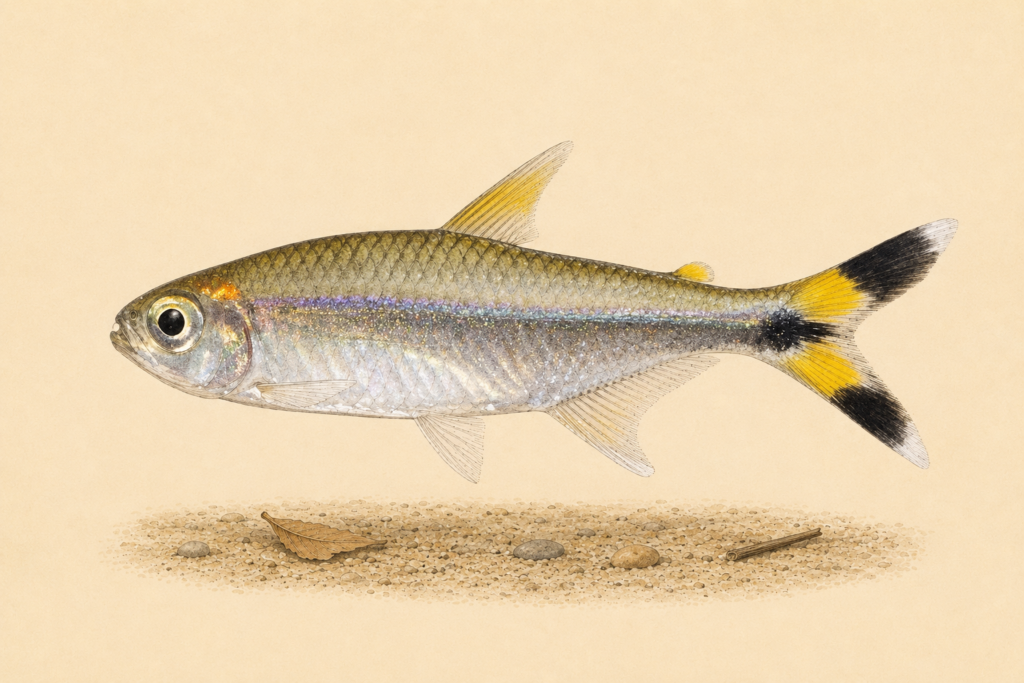
At first glance the Bandtail Tetra presents a classic tetra silhouette: laterally compressed, moderately deep-bodied, and built for agile mid-water swimming. Adults typically reach between 6 and 7 cm in total length, making them slightly larger than many of the popular nano tetras but still well within the small-community-fish bracket. The body is predominantly silver with a faint olive or greenish sheen along the dorsal surface, fading to white or pale silver on the ventral side.
The defining feature – and the source of the common name – is a bold, dark band that crosses the caudal peduncle at the very base of the tail fin. This band is deep black or very dark brown and extends vertically, creating a striking contrast against the otherwise pale body. In healthy, well-kept specimens the band is sharply defined and immediately noticeable. It continues subtly into the middle rays of the caudal fin, giving the tail a distinctive bicoloured look.
The scales are relatively large for a tetra of this size, each one outlined with a faint darker edge that creates a subtle reticulated pattern when viewed closely. Under certain lighting conditions, particularly when sidelit, the flanks can display a gentle iridescence that shifts between pale blue and silver. The eye is large, with a bright silver or gold iris that adds to the fish’s alert, lively expression.
The fins are mostly translucent to pale yellow. The dorsal fin may carry a faint dusky tip, and the anal fin often has a narrow white leading edge. Sexual dimorphism is subtle: mature females tend to be slightly deeper-bodied and rounder in the belly, especially when carrying eggs, while males are typically a touch slimmer and may display marginally more intense colouration on the fins. These differences become more apparent when the fish are in breeding condition but can be difficult to discern in younger or stressed individuals.
Natural Habitat
Moenkhausia dichroura is one of the more widely distributed tetras in South America. Its range encompasses several major river basins, including the Paraguay, Parana, upper Amazon tributaries, and the Sao Francisco system. It has been recorded in Brazil, Paraguay, Argentina, and Bolivia. This broad distribution is a strong indicator of the species’ adaptability – a characteristic that benefits aquarists, as it means the fish is not locked into a narrow set of water parameters.
In the wild, Bandtail Tetras are typically found in slow to moderately flowing rivers, streams, floodplain lakes, and marginal habitats such as flooded forests during the wet season. They gravitate towards areas with abundant vegetation, submerged roots, fallen branches, and leaf litter. These structures provide shelter from predators, surfaces for biofilm and algae growth, and a steady supply of small invertebrates and organic detritus that form the core of their diet.
Water in many of their native habitats tends to be soft to moderately hard and slightly acidic to neutral, though the species has been collected from locations with a surprisingly wide range of pH and hardness values. Temperatures in these tropical lowland environments typically sit between 22 and 28 degrees Celsius, with seasonal fluctuations linked to rainfall and flooding cycles. The substrate is often sandy or silty, overlaid with decomposing leaves that tint the water a light amber colour.
Bandtail Tetras are shoaling fish in nature, frequently found in loose aggregations numbering from a few dozen to several hundred individuals. They occupy the mid-water column, feeding opportunistically on small insects, crustaceans, algae, and organic particles carried by the current. Their gregarious nature and mid-water positioning make them an ecologically important species in their habitats, forming a link between primary producers and larger predatory fish.
Tank Size and Setup
A minimum tank size of 80 litres is recommended for a small group of Bandtail Tetras. This provides enough horizontal swimming space for a shoal of six to eight individuals while leaving room for decor and plants. If you intend to keep a larger group – which is always preferable for shoaling species – or wish to house them alongside other community fish, aim for 120 litres or more. Tanks with a longer footprint are better than tall, narrow designs, as these tetras spend most of their time swimming in the mid-water column and benefit from unobstructed lateral swimming lanes.
Aquascaping should aim to replicate the sheltered, plant-rich margins of South American rivers. A dark, sandy substrate is ideal and will show off the fish’s silver colouration to best effect. Add driftwood, bogwood, or branching roots to provide structure and visual barriers. Scattered dried leaves – Indian almond (catappa) leaves or oak leaves – will release gentle tannins into the water, mimicking the natural blackwater influence of many of the species’ habitats. These leaves also encourage the growth of biofilm and micro-organisms that supplement the tetras’ diet.
Live plants are strongly recommended. Species such as Vallisneria, Amazon sword (Echinodorus), Java fern (Microsorum pteropus), and various Cryptocoryne species all work well and tolerate the softer, slightly acidic water that Bandtail Tetras prefer. Floating plants such as Amazon frogbit (Limnobium laevigatum) or water lettuce (Pistia stratiotes) help to diffuse overhead light and create the dappled, shaded conditions that make these fish feel secure. When they feel safe, they will spend more time in the open and display bolder, more natural behaviour.
Ensure you leave a clear central swimming area free of dense planting. The shoal needs room to move and interact. A good layout places taller plants and hardscape around the sides and back of the tank, with lower-growing or carpeting plants in the foreground, and an open stretch of water in the middle third. This also makes feeding easier and lets you observe the fish’s fascinating group dynamics.
A secure, well-fitting lid is essential. Like many tetras, Bandtail Tetras are capable jumpers, especially when startled or during the first few days after introduction to a new tank. Even a small gap at the back of the tank for filter pipes or cables should be covered or blocked.
Water Parameters
One of the Bandtail Tetra’s greatest strengths as an aquarium fish is its tolerance of a reasonably broad range of water conditions. That said, consistency matters more than hitting an exact number. Stable parameters within the recommended ranges will keep these fish healthy and colourful, while sudden swings – even within acceptable limits – can cause stress and suppress the immune system.
| Temperature | 22-26 C |
| pH | 6.5-7.0 |
| General hardness (GH) | 8-12 dGH |
| Ammonia | 0 ppm |
| Nitrite | 0 ppm |
| Nitrate | Below 20 ppm |
For general community keeping, a temperature of around 24-26 C and a pH of 6.5-7.0 represents a comfortable middle ground that will also suit a wide variety of potential tank mates. If you are keeping the fish in a single-species setup or hoping to breed them, leaning towards the softer, slightly more acidic end of the ranges (pH 6.0-6.5, GH 2-6 dGH) more closely replicates their natural conditions and may encourage spawning behaviour.
Regular partial water changes of 20-30% per week are the simplest and most effective way to keep nitrate levels low and maintain overall water quality. Use a quality dechlorinator when adding tap water, and try to match the temperature and chemistry of the replacement water to that already in the tank to avoid shocking the fish. If your tap water is very hard or alkaline, consider blending it with reverse-osmosis (RO) water to bring parameters into a more suitable range.
Filtration and Equipment
Bandtail Tetras do not have any unusual filtration requirements. A standard hang-on-back (HOB) filter, internal filter, or canister filter rated for the tank volume will work well. The key objectives are efficient biological filtration to process ammonia and nitrite, gentle to moderate water flow, and good oxygenation. Avoid filters that create a very powerful current, as Bandtail Tetras come from relatively calm waters and will become stressed if they have to fight a strong flow constantly. If your filter output is too vigorous, use a spray bar or baffle to diffuse it.
Heating is necessary unless you live in a consistently warm tropical climate. A reliable, thermostatically controlled heater sized appropriately for your tank volume will maintain the stable temperatures these fish need. As a general rule, allow approximately 1 watt per litre of tank water. Always use a separate aquarium thermometer to verify the heater’s accuracy – built-in thermostats can drift over time.
Lighting should be moderate. Bandtail Tetras are not light-sensitive to the same degree as some blackwater specialists, but they do look their best and behave most naturally under subdued to moderate illumination. If you are growing live plants, choose an LED light that meets the plants’ needs but supplement with floating plants to create shaded areas where the tetras can retreat. A timer set to give 8-10 hours of light per day provides a consistent photoperiod and helps regulate the fish’s biological rhythms.
An air pump and airstone are optional but can be beneficial, particularly in warmer weather when dissolved oxygen levels drop. Sponge filters, which double as biological filtration and gentle aeration, are an excellent choice for breeding tanks or smaller setups.
Diet and Feeding
In the wild, Bandtail Tetras are omnivorous opportunists, feeding on small aquatic invertebrates, insect larvae, algae, plant matter, and organic detritus. In the aquarium they are thoroughly unfussy eaters and will accept virtually any appropriately sized food. This makes feeding straightforward, but a varied diet is still important for long-term health, colour, and breeding readiness.
A high-quality micro-pellet or flake food formulated for tropical community fish should form the staple of the diet. Look for products that list whole fish meal or insect meal as a primary ingredient rather than grain or cereal fillers. Supplement this staple with regular offerings of frozen or live foods such as bloodworm, daphnia, brine shrimp (Artemia), mosquito larvae, and cyclops. These protein-rich foods promote growth, enhance colouration, and help condition adults for breeding.
Vegetable matter is also appreciated and mirrors the plant-based portion of the wild diet. Blanched spinach, spirulina-enriched flakes, or algae wafers broken into small pieces all work well. Occasional treats of freeze-dried tubifex worms or micro-worms add further variety.
Feed small amounts two to three times per day rather than one large feed. Bandtail Tetras have small stomachs, and multiple smaller meals reduce waste and prevent overeating. Offer only what the shoal can consume within two to three minutes, and remove any uneaten food promptly to prevent it from decomposing and fouling the water. On one day per week, consider fasting the fish entirely; this is a common practice among experienced keepers and helps prevent digestive issues associated with overfeeding.
Behaviour and Temperament
Bandtail Tetras are peaceful, active shoaling fish that spend the majority of their time in the mid-water column. They are not aggressive towards other species and rarely cause fin damage to long-finned tank mates, making them one of the more reliably well-behaved members of the tetra family. Within the shoal, there may be occasional brief chasing or jostling for position – particularly among males vying for dominance or the attention of a female – but this is normal social behaviour and does not result in injury.
Always keep Bandtail Tetras in groups of six or more. A group of eight to ten or above is even better. In insufficient numbers these tetras become visibly stressed: they may hide constantly, lose colour, refuse food, or exhibit nervous darting behaviour. In a properly sized shoal they are confident, curious, and spend much of their time swimming in loose formation, exploring the tank, and interacting with one another. Watching the dynamics of a well-established group is one of the real pleasures of keeping this species.
They are diurnal fish, most active during daylight hours. When the lights go off they tend to settle quietly among plants or near the substrate. They respond readily to the approach of their keeper at feeding time and can become surprisingly tame, rising to the surface in anticipation of food within days of a consistent feeding routine being established.
Bandtail Tetras are not fin nippers as a general rule, though any tetra kept in too small a group or in a cramped, under-decorated tank may develop nippy tendencies out of frustration or stress. Providing adequate space, numbers, and environmental enrichment effectively eliminates this risk.
Tank Mates
The Bandtail Tetra’s peaceful disposition and moderate size make it compatible with a wide range of community aquarium inhabitants. Ideal tank mates are similarly sized, non-aggressive species that share comparable water parameter requirements. Avoid housing them with large, predatory, or highly territorial fish that might view the tetras as food or harass them relentlessly. Very small invertebrates such as dwarf shrimp may be at some risk, as tetras will opportunistically eat tiny shrimplets, though adult Cherry Shrimp and Amano Shrimp generally coexist without issue.
Good tank mates
- Rummy-nose Tetra – A fellow South American shoaling tetra with similar water requirements and a gentle temperament, creating a visually appealing mixed-tetra display.
- Ember Tetra – Small and peaceful, Ember Tetras occupy a similar mid-water zone and thrive in the same soft, slightly acidic conditions.
- Cardinal Tetra – Another classic Amazonian tetra that complements the Bandtail’s silver tones with vivid red and blue colouration.
- Corydoras sterbai – A bottom-dwelling catfish that peacefully shares the tank without competing for the Bandtail Tetra’s mid-water space.
- Bronze Corydoras – Hardy, sociable bottom feeders that help clean up uneaten food and pose no threat to tetras.
- Bristlenose Pleco – A manageable-sized algae eater that stays out of the tetras’ way and shares their preference for well-planted tanks.
- Kuhli Loach – A peaceful, nocturnal bottom dweller that occupies a different niche and rarely interacts with mid-water fish.
- Harlequin Rasbora – Gentle, similarly sized, and adaptable to overlapping water parameters, making an excellent co-inhabitant.
- Amano Shrimp – Large enough to avoid predation by adult Bandtail Tetras and a useful algae-eating addition to the clean-up crew.
Fish to avoid
- Oscar – A large, predatory cichlid that would readily consume Bandtail Tetras.
- Jack Dempsey – Aggressive and territorial, this cichlid would bully or eat small tetras.
- Red-bellied Piranha – An obvious predatory risk; tetras would quickly become prey items.
- Convict Cichlid – Highly territorial, especially when breeding, and prone to attacking small community fish.
- Green Terror – An aggressive, large cichlid entirely unsuitable for housing with peaceful tetras.
- Tiger Barb – While not predatory, Tiger Barbs are notorious fin nippers that can harass slower or more passive species in the tank.
- African Knifefish – Nocturnal predators that may eat smaller tank mates once they grow large enough.
Breeding
Breeding Bandtail Tetras in captivity is achievable but requires some preparation and a dedicated breeding setup. Like most Moenkhausia species, they are egg-scattering spawners with no parental care. In a community tank, any eggs laid are almost certain to be eaten by the adults or other inhabitants within minutes. A separate breeding tank is therefore essential if you want to raise fry successfully.
Set up a small breeding tank of 20-40 litres with very soft, slightly acidic water (pH 6.0-6.5, GH 2-4 dGH) and a temperature at the warmer end of the species’ range, around 26-28 C. Use a sponge filter for gentle filtration and aeration without the risk of fry being sucked into an intake. The bottom of the tank should be covered with a layer of Java moss, spawning mops, or a mesh grid that allows eggs to fall through but prevents the adults from reaching them.
Condition a breeding pair or trio (one female, two males) with generous feedings of high-protein live or frozen foods such as bloodworm, daphnia, and brine shrimp for one to two weeks before introducing them to the breeding tank. A well-conditioned female will appear noticeably plumper when viewed from above. Introduce the fish to the breeding tank in the evening; spawning often takes place at first light the following morning.
During spawning, the male will court the female with rapid fin displays and chasing. The pair align side by side and the female releases a batch of small, semi-adhesive eggs that are fertilised by the male as they scatter among the plants or substrate. A single spawning event may produce 100-300 eggs. Remove the adults immediately after spawning to prevent egg predation.
The eggs are light-sensitive, so keep the breeding tank dimly lit or cover it with a towel. Eggs typically hatch within 24-36 hours, and the tiny fry will absorb their yolk sacs over the following two to three days. Once free-swimming, feed the fry with infusoria, liquid fry food, or commercially available powdered first foods. After a week or so, they should be large enough to accept newly hatched brine shrimp (Artemia nauplii), which will accelerate their growth significantly. Maintain impeccable water quality in the fry tank with frequent, small water changes using water of matching parameters.
Common Diseases
Bandtail Tetras are generally hardy fish that are not especially prone to disease when kept in clean, stable conditions. However, like all freshwater fish, they can be affected by common aquarium ailments, especially if water quality deteriorates or the fish are subjected to stress from overcrowding, poor diet, or incompatible tank mates.
White spot disease (Ichthyophthirius multifiliis), commonly known as ich, is perhaps the most frequently encountered illness. It presents as small white spots resembling grains of salt on the fins and body, accompanied by flashing (rubbing against surfaces) and lethargy. Ich is highly treatable if caught early. Raise the tank temperature gradually to 28-30 C and treat with a commercial white spot remedy following the manufacturer’s dosage instructions. Remove any activated carbon from the filter during treatment, as it will absorb the medication.
Fin rot, caused by bacterial infection, can occur when water quality is poor or after physical damage to the fins. Symptoms include ragged, fraying, or discoloured fin edges that progressively worsen. Improving water quality through more frequent water changes often resolves mild cases. More advanced infections may require treatment with an antibacterial medication.
Columnaris (cotton wool disease) is another bacterial infection that can affect tetras, presenting as white or greyish cotton-like patches on the body, fins, or mouth. It tends to strike in warm, poorly maintained tanks. Treatment involves antibacterial medication and, critically, addressing the underlying water quality issues that allowed the infection to take hold.
Internal parasites are occasionally seen in wild-caught specimens. Symptoms can include weight loss despite normal feeding, white or stringy faeces, and a generally emaciated appearance. Anti-parasitic foods or dedicated internal parasite treatments are effective if administered promptly.
Prevention is always preferable to cure. Quarantine all new fish for at least two weeks before adding them to an established tank. Maintain consistent water parameters, avoid overfeeding, and provide a varied, nutritious diet. These simple practices will go a long way towards keeping your Bandtail Tetras healthy throughout their lifespan.
FAQs
How many Bandtail Tetras should I keep together?
A minimum of six is recommended, but groups of eight to ten or more are preferable. Larger groups result in more confident fish that display their full range of natural behaviours, including shoaling, sparring, and courtship displays. Solitary or pair-kept Bandtail Tetras will be visibly stressed and are more likely to develop health problems.
Are Bandtail Tetras good for beginners?
Yes. Their tolerance of a broad range of water parameters, unfussy feeding habits, and peaceful temperament make them an excellent choice for beginners who have completed their tank’s nitrogen cycle and are ready to stock their first community aquarium. They are forgiving of minor fluctuations in water chemistry, though consistent care will always yield the best results.
Do Bandtail Tetras nip fins?
Fin nipping is not a characteristic behaviour of this species when kept in appropriate conditions. In groups of six or more with adequate space and environmental enrichment, they are reliably peaceful. The risk of nipping increases only in understocked groups or cramped, barren tanks where stress levels are high.
Can Bandtail Tetras live with shrimp?
Adult shrimp such as Amano Shrimp and Cherry Shrimp are generally safe with Bandtail Tetras. However, very small shrimplets may be eaten, as these tetras are opportunistic feeders. If you are breeding shrimp in the same tank, providing dense plant cover such as Java moss will give baby shrimp hiding spots and improve their survival rate.
How can I tell male and female Bandtail Tetras apart?
Sexual dimorphism is subtle. Mature females tend to be slightly deeper-bodied and rounder in profile, particularly when carrying eggs. Males are generally a touch slimmer and may show slightly more colour intensity on the fins. These differences are most apparent in well-conditioned adults; in younger fish or under stressful conditions, distinguishing the sexes can be very difficult.
Related Guides
- Diamond Tetra – Another striking Moenkhausia species with similar care requirements and a beautiful iridescent shimmer.
- Black Phantom Tetra – A similarly sized, peaceful tetra that makes an excellent companion in a South American community setup.
- Cardinal Tetra – One of the most popular community tetras, sharing the Bandtail Tetra’s preference for soft, slightly acidic water.
- Rummy-nose Tetra – A tight-shoaling tetra renowned for its schooling behaviour and sensitivity to water quality changes.
- Corydoras sterbai – A warm-water-tolerant Corydoras that pairs beautifully with Bandtail Tetras as a bottom-dwelling clean-up companion.