Quick summary
The Black Military Helmet Snail is one of the best algae-eating snails you can keep in a freshwater aquarium, and it will not reproduce in your tank, making it a worry-free addition for beginners and experienced keepers alike. If you want a low-maintenance cleanup crew member that quietly does its job without overrunning your tank, this snail is an excellent choice.
🐠 Build a tank around this species
- Introduction
- Quick stats
- Appearance
- Natural habitat
- Tank size and setup
- Water parameters
- Filtration and equipment
- Diet and feeding
- Behaviour and temperament
- Tank mates
- Breeding
- Common diseases and health
- Frequently asked questions
- Related guides
Introduction
The Black Military Helmet Snail, known scientifically as Neritina pulligera, is a freshwater nerite snail that has earned a loyal following among aquarists for one simple reason: it eats algae relentlessly and does not breed in freshwater. That combination is surprisingly hard to find in the snail world. While many aquarium snails are effective grazers, most of them reproduce so prolifically that you quickly end up with a population problem. Neritina pulligera sidesteps that issue entirely because its larvae require brackish or saltwater to develop, meaning any eggs laid in your freshwater tank will never hatch.
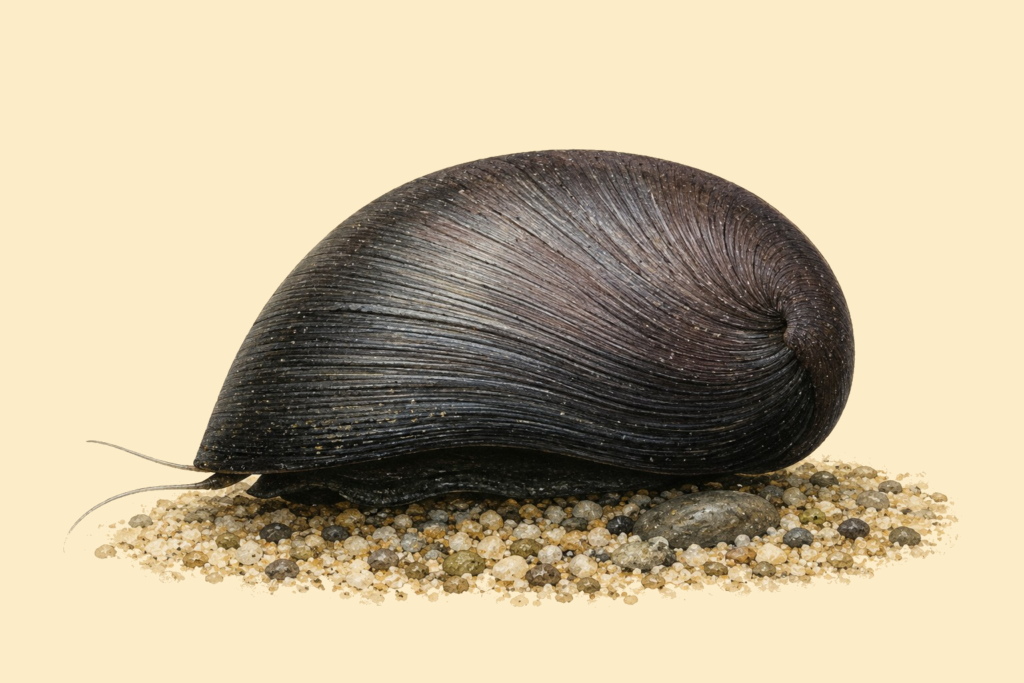
People love this snail for its understated, almost industrial appearance. The rounded, dark shell looks like a miniature helmet, which is exactly where the common name comes from. It is not the flashiest invertebrate you can buy, but there is something satisfying about watching it methodically work its way across glass, rocks, and driftwood, leaving clean surfaces in its wake. For planted tank enthusiasts who battle green film algae or diatoms, a small group of these snails can make a noticeable difference within days.
The Black Military Helmet Snail suits just about any freshwater keeper. It is forgiving of minor water quality fluctuations, peaceful with every tank mate imaginable, and requires almost no specialised care. Beginners will appreciate how easy it is to maintain, while experienced aquascapers will value its algae control without the risk of plant damage. If you keep tropical community tanks, shrimp tanks, or planted setups, this snail deserves a spot on your shortlist.
Quick stats
| Scientific name | Neritina pulligera |
| Family | Neritidae |
| Origin | Southeast Asia, including the Philippines, Indonesia, and Malaysia |
| Adult size | 2.5 to 3 cm |
| Lifespan | 3 to 5 years |
| Difficulty | Beginner |
| Breeding difficulty | Challenging |
| Temperature | 22 to 28 °C |
| pH range | 6.5 to 8.5 |
| Minimum tank size | 20 litres |
Appearance
The Black Military Helmet Snail has a thick, dome-shaped shell that sits low and rounded over its body, giving it the helmet-like profile that inspired its name. The shell is almost uniformly dark, ranging from deep olive-black to pure jet black, and it typically lacks the stripes or patterns you see on many other nerite species. The surface is smooth and slightly glossy when the snail is healthy, though older specimens may develop a slightly worn or pitted look near the apex of the shell. The foot and body beneath the shell are dark grey to charcoal, sometimes with lighter speckling near the head. Two small sensory tentacles protrude from the head, constantly feeling along the surface as the snail moves.
Telling males from females is extremely difficult without close examination. In general, females tend to be slightly larger, but the difference is subtle enough that most hobbyists cannot reliably sex them. There are no obvious colour differences between the sexes. One trait to note is the operculum, the hard trap door that seals the shell opening when the snail retracts. In healthy specimens, this structure is intact and closes tightly. A damaged or eroded operculum is a sign of poor health or calcium deficiency rather than a sex indicator. Colour variation is minimal compared to other nerites, and what you see in the shop is essentially what you get. Occasionally, individuals may appear slightly brownish under strong lighting, but the overall look remains dark and uniform.
Natural habitat
Neritina pulligera is native to tropical streams and rivers throughout Southeast Asia, with populations found across the Philippines, Indonesia, Malaysia, and parts of mainland Indochina. These snails typically inhabit clean, well-oxygenated waterways with moderate to strong current. They are often found clinging to rocks, submerged wood, and other hard surfaces in shallow, fast-moving sections of streams where biofilm and algae grow abundantly. The waters in these habitats tend to be warm year-round, slightly alkaline, and moderately hard due to the limestone geology common in the region.
Understanding this natural habitat helps explain several important care considerations. The preference for current means these snails do best in tanks with decent water flow rather than stagnant setups. The alkaline, mineral-rich water they evolved in means they need some dissolved calcium to maintain shell health, so very soft or acidic water can cause gradual shell erosion over time. The tropical temperatures are easy to replicate in a heated aquarium. Perhaps most importantly, the life cycle of Neritina pulligera involves a larval stage that drifts downstream to brackish estuaries, which is why successful breeding in a home freshwater tank is essentially impossible. This quirk of biology is a blessing for hobbyists who want effective algae control without the snail population explosions that plague keepers of species like Malaysian trumpet snails or bladder snails.
Tank size and setup
A single Black Military Helmet Snail can live comfortably in a tank as small as 20 litres, but since they are most effective and interesting in small groups, a tank of 40 litres or more is preferable. A good rule of thumb is to allow roughly 10 additional litres per extra snail. In a well-planted 60-litre community tank, three to four of these snails can patrol every surface without competing for food.
Substrate choice matters less for these snails than it does for burrowing species, but they will spend time on the bottom, so go with something that will not trap waste. Fine gravel, smooth river pebbles, or inert sand like CaribSea Super Naturals or ADA La Plata Sand all work well. If you are running a planted tank with a nutrient-rich substrate like Tropica Aquarium Soil or Fluval Stratum, that is perfectly fine too, though the snails themselves will spend most of their time on hardscape and glass rather than sifting through soil.
Provide plenty of hard surfaces for grazing. Rocks, driftwood, and the glass panels themselves are the primary feeding grounds. Seiryu stone, lava rock, and spider wood all develop biofilm quickly and give the snails something to work on. Live plants are a wonderful addition and will not be damaged by these snails. Java Fern (Microsorum pteropus), Anubias barteri, Bucephalandra, and Java Moss (Taxiphyllum barbieri) are all excellent companions. These plants also offer additional grazing surfaces as they accumulate biofilm on their leaves.
Lighting should be moderate. Enough light to support plant growth will also encourage the low-level algae and biofilm that these snails feed on. Avoid very dim tanks where nothing grows, as the snails may slowly starve. Moderate water flow is appreciated, mimicking their natural stream habitat. A filter outlet aimed along the length of the tank or a small circulation pump is enough to keep things moving without creating a whirlpool.
One important setup note: make sure the tank has a tight-fitting lid. Nerite snails, including this species, are notorious escape artists. They will climb above the waterline and, if they find a gap, will leave the tank entirely. A simple glass or acrylic cover prevents heartbreak.
Water parameters
| Temperature | 22 to 28 °C |
| pH | 6.5 to 8.5 |
| General hardness (GH) | 6 to 20 dGH |
| Ammonia | 0 ppm |
| Nitrite | 0 ppm |
| Nitrate | Below 20 ppm |
These snails are adaptable across a reasonably wide pH range, but they thrive best in water that leans neutral to slightly alkaline with moderate hardness. The dissolved minerals in harder water provide the calcium they need to maintain their shell. If your tap water is very soft, consider adding a mineral supplement such as Seachem Equilibrium, or place a small piece of cuttlebone in the tank to slowly release calcium. Acidic, mineral-poor water will gradually erode the shell, leaving it thin, pitted, and white at the apex. Ammonia and nitrite must always be at zero, as invertebrates are generally more sensitive to these compounds than fish. Keep nitrates in check with regular water changes, ideally weekly at 20 to 30 per cent of the tank volume.
Filtration and equipment
Any reliable filter that keeps the water clean and gently oxygenated will work for Black Military Helmet Snails. A hang-on-back filter like the Fluval AquaClear series or a small internal filter is perfectly adequate for tanks up to about 80 litres. In larger setups, a canister filter such as the Eheim Classic 250 or Fluval 107 provides excellent mechanical and biological filtration along with adjustable flow. Sponge filters are also a great choice, especially in smaller tanks or shrimp-and-snail setups, because they provide gentle current and harbour beneficial bacteria without any risk of trapping the snails.
A heater is recommended unless your room temperature consistently stays above 22 °C. An adjustable heater like the Eheim Jäger or Fluval E-Series set to around 25 °C will keep conditions stable. Temperature swings stress invertebrates, so a heater with a reliable thermostat is worth the investment.
A liquid water testing kit, such as the API Freshwater Master Test Kit, is essential. Test strips can give you a rough idea of conditions, but liquid kits are more accurate and more cost-effective in the long run. Test weekly during the first few months and at least fortnightly once the tank is well established. Adding a GH test kit to your collection is worthwhile if you keep nerite snails, since monitoring calcium availability helps prevent shell problems before they become visible.
Diet and feeding
In the wild, Neritina pulligera feeds almost exclusively on biofilm and algae that coat rocks, wood, and other hard surfaces in flowing streams. In the aquarium, their diet is much the same. They graze constantly on green film algae, diatoms (the brown algae common in newer tanks), and the microbial biofilm that develops on every surface over time. They are not effective against hair algae, staghorn algae, or black beard algae, so set your expectations accordingly.
In a well-lit, established tank, there is often enough natural growth to sustain a few snails without any supplemental feeding. However, if you notice your snails spending a lot of time clustered on the glass near the waterline or moving sluggishly, it may be a sign that natural food is running low. In that case, offer blanched vegetables such as zucchini (courgette), spinach, or cucumber slices. Weigh the vegetable down with a stainless steel clip or a small rock and remove any uneaten portions after 24 hours to prevent water quality issues.
Algae wafers are another excellent supplemental food. Hikari Algae Wafers and Sera Spirulina Tabs are both well-regarded options. Drop one into the tank in the evening, as the snails are somewhat more active at night. One wafer every two to three days is usually sufficient for a small group. Avoid overfeeding, as uneaten food decays quickly and can spike ammonia. If you also keep shrimp, they will happily share the wafer, so adjust quantities based on the overall stocking.
Behaviour and temperament
Black Military Helmet Snails are peaceful, slow-moving grazers that go about their business without bothering any tank mate. Their daily routine consists of methodical grazing across surfaces, and you will often see them tracing clean paths through the thin layer of algae on the glass. They are not particularly social with each other in the way that schooling fish are, but they do tolerate one another perfectly well and will sometimes cluster in the same area if that is where the best food is.
They tend to be more active during the evening and nighttime hours, though in a dimly lit tank or during overcast days, they may move around throughout the day. One quirk that catches new keepers off guard is their tendency to climb above the waterline. This is normal behaviour rooted in their natural habitat, where tidal and flow changes mean they are sometimes exposed to air. In an aquarium, it can lead to escape attempts, which is why a secure lid is so important. If you find one on the floor, place it back in the water immediately. As long as it has not been out too long and the operculum is still intact, there is a good chance it will recover.
Another behaviour worth mentioning is their habit of staying motionless for extended periods. A snail that has not moved in a day or two is not necessarily dead. Nerites sometimes wedge themselves into a crevice or behind equipment and simply rest. The easiest way to check is a gentle sniff test: a dead snail produces an unmistakable, strong odour. A healthy resting snail has no smell and will retract its foot tightly when touched.
Tank mates
Good tank mates
- Neon Tetra (Paracheirodon innesi), peaceful and occupies mid-water, completely ignoring snails on the bottom and glass
- Cherry Barb (Puntius titteya), gentle community fish that poses no threat to snails
- Corydoras catfish (Corydoras spp.), bottom-dwelling and peaceful, a classic companion in community tanks
- Otocinclus (Otocinclus spp.), fellow algae grazers that share the same food source without aggression
- Cherry Shrimp (Neocaridina davidi), similar care requirements and no interaction with snails
- Amano Shrimp (Caridina multidentata), another excellent algae eater that coexists peacefully
- Harlequin Rasbora (Trigonostigma heteromorpha), calm schooling fish that stays in mid-water
- Bristlenose Pleco (Ancistrus spp.), peaceful algae eater, fine with snails in tanks of 100 litres or more
- Honey Gourami (Trichogaster chuna), gentle and curious, too small-mouthed to bother a nerite
Fish to avoid
- Assassin Snail (Clea helena), a predatory snail that actively hunts other snail species
- Clown Loach (Chromobotia macracanthus), loaches of all kinds are known to eat snails, prying them from their shells
- Yoyo Loach (Botia almorhae), another snail predator that will harass nerites
- Green Spotted Puffer (Dichotomyctere nigroviridis), crushes snail shells as a primary food source
- Oscar (Astronotus ocellatus), large and predatory, will eat or crush snails
- Large cichlids in general, many species view snails as food or will damage them out of curiosity
Breeding
Breeding Black Military Helmet Snails in a home aquarium is, for all practical purposes, not achievable. The snails will mate in freshwater, and females will deposit small, hard, white egg capsules on hard surfaces throughout the tank, particularly on driftwood, rocks, and glass. These eggs are calcified and stubbornly attached, which can be unsightly. However, in freshwater, the eggs will never hatch. The larvae of Neritina pulligera require brackish to saltwater conditions to develop, and even in controlled laboratory settings, rearing the larvae is extremely difficult.
Sexing these snails visually is nearly impossible without removing the snail from its shell, which is obviously not recommended. Most keepers simply accept that they cannot breed them and purchase new individuals as needed. If you want to attempt breeding, you would need a separate brackish water rearing tank with a salinity of around 10 to 15 ppt, phytoplankton cultures for feeding the microscopic larvae, and a great deal of patience. Success rates are very low even among experienced breeders, and most commercially available nerites are wild-caught.
The white egg deposits in the main tank are harmless but can be annoying. They are difficult to scrape off and can take weeks or even months to dissolve on their own. Reducing the number of females in the tank, if you can identify them, or simply accepting the aesthetic trade-off are your main options. A razor blade can remove them from glass, but they are trickier to clear from porous surfaces like wood or stone.
Common diseases and health
Shell erosion
The most common issue with Black Military Helmet Snails is shell erosion, characterised by thinning, pitting, or whitening of the shell, especially near the apex. This is caused by insufficient calcium in the water, overly acidic conditions, or both. The remedy is straightforward: increase water hardness by adding a calcium source such as cuttlebone, crushed coral in the filter, or a remineraliser like Seachem Equilibrium. Maintaining a pH above 7.0 helps slow or prevent further erosion.
Copper poisoning
Invertebrates, including nerite snails, are extremely sensitive to copper. Copper is found in many fish medications, some tap water conditioners, and occasionally in tap water itself, particularly in homes with copper plumbing. Even trace amounts can be lethal. Always check medication labels before treating a tank that contains snails, and use a water conditioner like Seachem Prime that neutralises heavy metals. If you need to medicate fish with copper-based treatments, remove the snails to a separate holding tank first.
Parasites and hitchhikers
While less common, nerite snails can occasionally carry parasitic worms or leeches, especially if wild-caught. Inspect new snails carefully before adding them to your tank. A brief quarantine period of one to two weeks in a separate container with clean, dechlorinated water allows you to observe the snail and catch any issues early. During quarantine, watch for unusual behaviour, foul odours, or visible parasites on the body or foot. This simple step can protect your main tank from unwanted introductions.
As a general rule, always quarantine new snails just as you would quarantine new fish. A small plastic container or a spare nano tank with a cycled sponge filter, stable temperature, and a piece of algae-covered rock is all you need. Two weeks of observation gives you confidence that the new arrival is healthy before it joins the community.
Frequently asked questions
Why is my Black Military Helmet Snail not moving?
Nerite snails sometimes rest for extended periods, occasionally for a day or more. This is normal, especially after being introduced to a new tank. Check for signs of life by gently touching the foot or lifting the snail slightly. A living snail will retract or resist being pulled. If the snail has a foul smell, it has unfortunately died and should be removed immediately to avoid an ammonia spike.
Will Black Military Helmet Snails breed in my freshwater tank?
They will not produce viable offspring in freshwater. Females may lay small, white, hard egg capsules on surfaces throughout the tank, but these will never hatch because the larvae require brackish or saltwater to develop. The eggs are harmless but can be aesthetically annoying. They eventually dissolve or can be scraped off glass with a razor blade.
Do Black Military Helmet Snails eat plants?
No. These snails feed exclusively on algae and biofilm. They will crawl over plant leaves and may graze algae from the surface, but they will not damage healthy plant tissue. This makes them one of the safest algae-control options for planted tanks.
How many Black Military Helmet Snails can I keep in my tank?
A good guideline is one snail per 10 to 15 litres. In a 60-litre tank, three to four snails is a comfortable number. Overstocking with too many snails in a tank that does not produce enough algae or biofilm will lead to starvation. Watch their behaviour and supplement with algae wafers if natural food runs low.
Why is my Black Military Helmet Snail’s shell turning white?
White patches or thinning on the shell are signs of calcium deficiency or exposure to water that is too soft or acidic. Increase the mineral content of your water by adding cuttlebone, crushed coral, or a commercial remineraliser. Aim for a GH of at least 6 dGH and a pH above 7.0 to prevent further erosion. Existing damage will not repair itself, but you can stop it from getting worse.
Related guides
- Black Military Helmet Snail breeding guide
- Black Military Helmet Snail tank setup and equipment guide
- Black Military Helmet Snail diet and feeding guide
- Best tank mates for Black Military Helmet Snail
- Black Military Helmet Snail diseases and health guide
- Why is my Black Military Helmet Snail losing colour?
- Back to the fish species directory
- Beginner’s guide to cycling your tank