Quick Summary
The Black-belt Tetra is a peaceful, lesser-known shoaling species suited to community aquariums with soft, slightly acidic water. If you enjoy quiet, well-planted setups and want something a little different from the usual neon or ember tetra, this understated Hemigrammus species is an excellent – if somewhat hard to find – choice.
🐠 Build a tank around this species
In this guide:
- Introduction
- Quick Stats
- Appearance
- Natural Habitat
- Tank Size and Setup
- Water Parameters
- Diet and Feeding
- Tank Mates
Introduction
The Black-belt Tetra (Hemigrammus kuroobi) is a relatively recently described species hailing from the Rio Purus basin in the western Amazon region of Brazil. Formally described in the early 2010s, it remains far less well known than mainstream aquarium tetras such as the Rummy-nose or the Black Neon. For hobbyists who enjoy seeking out uncommon species with subtle beauty and rewarding shoaling behaviour, the Black-belt Tetra offers a genuinely distinctive addition to the softwater community tank.
Because H. kuroobi has a smaller information base than many of its more popular Hemigrammus relatives, keepers should expect to draw on general best-practice husbandry for the genus while paying close attention to the specific water-chemistry preferences that wild-origin fish typically demand. This guide compiles the best available information – drawn from collection data, genus-level care knowledge, and the experience of specialist keepers – to help you succeed with this charming little characin.
It is worth noting that availability can be sporadic. The Black-belt Tetra appears in specialist importers’ lists rather than high-street pet shops, and specimens may arrive under slightly varying trade names. When you do find them, purchasing a group of at least eight is strongly recommended to bring out natural behaviour and reduce individual stress.
Quick Stats
| Scientific name | Hemigrammus kuroobi |
|---|---|
| Common names | Black-belt Tetra, Hemigrammus kuroobi |
| Family | Characidae |
| Origin | Rio Purus basin, Amazonas, Brazil |
| Adult size | 4 cm |
| Lifespan | 3–5 years |
| Difficulty | Intermediate |
| Breeding difficulty | Advanced |
| Temperature | 24–28 °C |
| pH | 5.5–7 |
| GH | 2–8 dGH |
| KH | 1–4 dKH |
| Minimum tank size | 40 L |
| Conservation status | Not evaluated |
Appearance
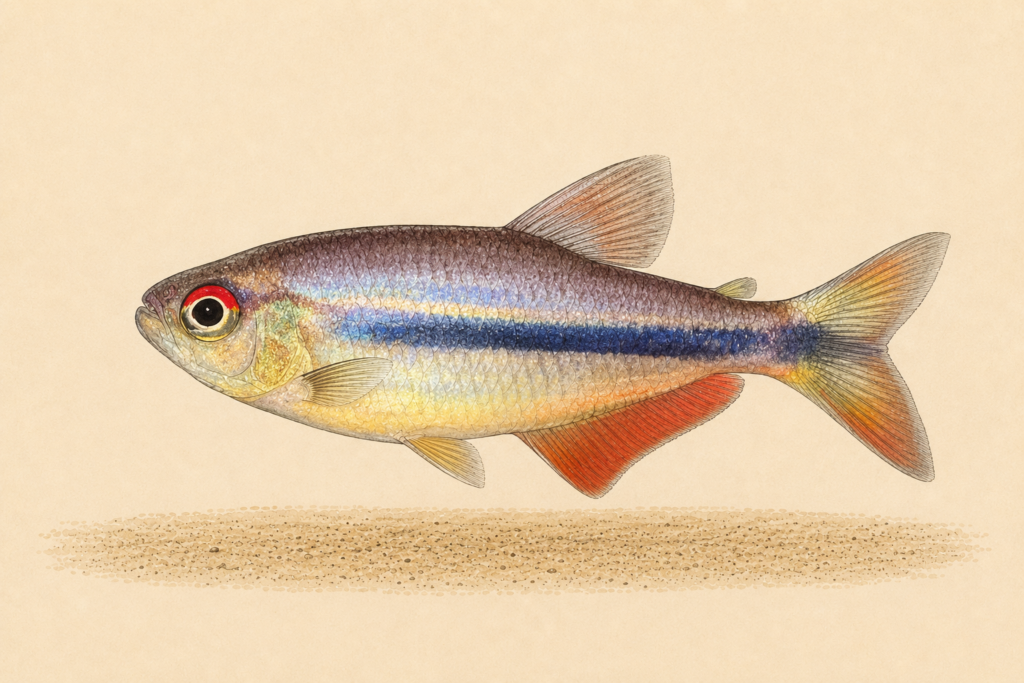
Hemigrammus kuroobi is a modestly sized tetra with a compressed, somewhat deep body typical of its genus. The overall base colour is a translucent silvery-olive, and in good conditions the flanks take on a warm golden-green sheen that catches the light attractively. The species’ common name refers to a distinctive dark lateral band – a bold, roughly belt-like marking – that runs along the mid-body. This band is most pronounced under subdued lighting and against a dark substrate, becoming somewhat washed out under harsh illumination or when the fish is stressed.
The fins are largely hyaline (clear) to very faintly tinted, and there may be subtle reddish or orange tones at the base of the caudal fin in well-conditioned specimens. The eye is large and reflective, with a reddish-gold upper iris that is a hallmark of many Hemigrammus species. Sexual dimorphism is slight: mature females tend to be a little deeper-bodied and marginally larger than males, while males may show slightly more intense colouration, particularly in the lateral band and caudal region, when in breeding condition.
Because this is a relatively obscure species, photographs circulating online can sometimes be misidentified. Confirm identification by looking for the combination of the dark midlateral stripe, the adipose fin (present, as in all Hemigrammus), and the overall body shape. If in doubt, purchasing from a reputable specialist importer who can provide collection locality data is the safest route.
Natural Habitat
The Black-belt Tetra originates from tributaries and flooded-forest habitats within the Rio Purus drainage, a major southern tributary of the Amazon in western Brazil. The Rio Purus system is characterised by a mixture of whitewater and blackwater influences, with many smaller streams running through dense tropical forest where leaf litter, fallen branches, and submerged root tangles dominate the substrate.
Water in these habitats is typically soft and acidic, stained amber-brown by tannins released from decomposing vegetation. Conductivity is low, and the pH often falls between 5.0 and 6.5. Temperatures are warm and stable year-round, generally sitting between 25 and 28 C. Light levels beneath the forest canopy are subdued, filtered through overhanging vegetation – a detail that is well worth replicating in the aquarium.
In the wild, H. kuroobi is likely found in loose shoals among flooded marginal vegetation and leaf-litter banks, feeding on small invertebrates, insect larvae, and organic detritus. The species shares its habitat with a rich community of other small characins, dwarf cichlids, catfish, and various invertebrates, providing useful context for selecting compatible tank mates.
As a lesser-known species, detailed ecological studies specific to H. kuroobi are scarce. However, general knowledge of the Rio Purus system and the ecology of similar-sized Hemigrammus species provides a reliable framework for captive care.
Tank Size and Setup
A minimum tank volume of 80 litres is recommended for a shoal of eight to ten Black-belt Tetras. If you plan to keep them alongside other community species – which is encouraged – a tank of 120 litres or more will give you significantly more flexibility in terms of both stocking and aquascaping.
The ideal setup mirrors the species’ natural environment: a densely planted tank with areas of open swimming space, plenty of driftwood, and a generous layer of dried leaf litter. Indian almond leaves (Terminalia catappa), oak leaves, or similar botanicals serve the dual purpose of releasing beneficial tannins into the water and providing a natural-looking substrate that these fish clearly feel comfortable over. The tannin-stained water also helps bring out the best colouration in the fish.
Use a dark, fine-grained substrate such as sand or a specialist planted-tank soil. Avoid bright white or coarse gravel, which reflects light upwards and can cause the fish to appear pale and washed out. Background planting with species like Vallisneria, Echinodorus, or Cryptocoryne creates welcome cover, while floating plants such as Salvinia or Amazon frogbit diffuse overhead light and reinforce the subdued, shaded atmosphere these tetras prefer.
Lighting should be moderate to low. If you are growing demanding plants, use floating cover to create shaded refuges. The fish will reward you with bolder colouration and more relaxed behaviour when they are not exposed to intense overhead light.
A tight-fitting lid is advisable. Like many small tetras, H. kuroobi can be a surprisingly capable jumper, especially when startled or during the acclimatisation period after introduction to a new tank.
Water Parameters
Maintaining stable, appropriate water chemistry is arguably the single most important aspect of keeping Black-belt Tetras successfully. As a species from soft, acidic Amazonian waters, H. kuroobi will be most comfortable and display its best colouration in conditions that approximate its natural habitat. The table below summarises the target ranges.
| Temperature | 24 – 28 C |
| pH | 5.5 – 7.0 |
| General hardness (GH) | 2 – 10 dGH |
| Carbonate hardness (KH) | 1 – 6 dKH |
| Ammonia | 0 ppm |
| Nitrite | 0 ppm |
| Nitrate | Below 20 ppm |
Where possible, aim for the softer, more acidic end of these ranges – a pH of around 6.0 to 6.5 with a GH of 2 to 6 dGH is ideal for long-term health and any future breeding attempts. If your tap water is moderately hard or alkaline, consider blending it with reverse-osmosis (RO) water or using peat filtration to bring parameters into range.
Consistency matters more than hitting a precise number. Sudden swings in pH or temperature are far more harmful than keeping the fish at, say, pH 6.8 rather than 6.0. Perform regular partial water changes of around 20 to 25 per cent weekly, matching the replacement water to the tank’s temperature and chemistry before adding it.
Filtration and Equipment
A good-quality filter rated for the tank volume is essential, but flow rate should be kept moderate. In the wild, Black-belt Tetras inhabit slow-moving streams and flooded margins rather than fast-flowing rapids. A hang-on-back filter, a small canister filter, or a mature sponge filter will all work well. If using a canister filter with a high turnover rate, consider fitting a spray bar or lily pipe to diffuse the output and avoid creating a strong current that pushes the fish around.
A reliable heater with an adjustable thermostat is necessary unless you live in a consistently warm climate where room temperature remains above 24 C year-round. Set the heater to 26 C as a sensible starting point. A separate thermometer – ideally a digital probe or a stick-on LCD strip – provides an independent check on the heater’s accuracy.
Aeration requirements are modest. Surface agitation from the filter outlet is usually sufficient to maintain adequate dissolved oxygen levels. If you are running a heavily planted, tannin-rich setup with minimal surface movement, a small air stone on a low setting can provide extra gas exchange without disturbing the calm environment.
Lighting should be chosen with plants in mind first, then moderated for the fish. LED units with adjustable intensity and a warm colour temperature (around 6,500 K or lower) work well. A timer set to an eight- to ten-hour photoperiod keeps things consistent and helps discourage excessive algae growth.
Diet and Feeding
Black-belt Tetras are omnivorous and not fussy eaters, which makes feeding them straightforward. A high-quality micro-pellet or crushed flake food designed for small tropical fish provides a solid nutritional foundation. Look for products that list whole fish meal or insect meal as the first ingredient, and avoid those padded out with excessive cereal fillers.
Supplement the staple diet with regular offerings of small live or frozen foods. Daphnia, baby brine shrimp (Artemia nauplii), cyclops, micro-worms, and grindal worms are all eagerly accepted and help promote vibrant colour and overall condition. Live foods in particular encourage natural foraging behaviour and are invaluable for conditioning fish prior to breeding attempts.
Feed small amounts two to three times per day rather than one large meal. These are tiny fish with correspondingly small stomachs, and spreading the feeding across the day reduces waste and helps maintain water quality. Each feeding should be consumed within two to three minutes; remove any uneaten food promptly.
A varied diet is key. Rotating between different dry foods and two or three types of live or frozen food across the week ensures a broad spectrum of nutrients and keeps the fish interested. Occasional offerings of blanched, finely chopped spinach or spirulina-based foods add useful plant matter to the diet.
Behaviour and Temperament
Hemigrammus kuroobi is a peaceful, sociable shoaling species that poses no threat to any tank mate it cannot fit in its mouth – which, given its small adult size, essentially means it is harmless to everything else in a standard community setup. It spends most of its time in the middle water column, moving as a loose group through open swimming lanes and among plant stems.
Shoaling behaviour is most pronounced and visually appealing when the fish are kept in groups of eight or more. In smaller groups, individuals may become timid, spend long periods hiding, and fail to develop their full colouration. A larger shoal also distributes any minor intra-group chasing – which is normal and harmless – across more individuals, preventing any single fish from being harassed.
Males may engage in brief bouts of fin-flaring and parallel swimming displays, particularly around feeding time or when competing for position within the shoal. These interactions are not aggressive and rarely result in any fin damage. They are, in fact, one of the more engaging aspects of keeping a well-sized group.
The Black-belt Tetra can be somewhat shy, especially in the first few weeks after introduction to a new aquarium. Providing ample cover in the form of plants, driftwood, and leaf litter helps the fish settle in more quickly. Once established, they become bolder and will spend more time in the open, particularly at feeding time.
Because this is a lesser-known species with a comparatively small captive population, behavioural observations published by hobbyists remain limited. However, nothing in the available reports suggests any behaviour that deviates significantly from other small, peaceful Hemigrammus species.
Tank Mates
The Black-belt Tetra’s gentle disposition makes it compatible with a wide range of similarly peaceful, small community fish. The key considerations are that tank mates should not be large or aggressive enough to bully or eat the tetras, and they should share a preference for soft, acidic to neutral water. Avoid boisterous species, notorious fin-nippers, or anything large enough to view a 3-4 cm tetra as food.
Good tank mates
- Ember Tetra – A similarly small, peaceful tetra that thrives in the same soft, warm conditions and complements the Black-belt Tetra’s colouration beautifully.
- Cardinal Tetra – Another Amazonian species with overlapping water parameter requirements and a calm temperament that makes cohabitation easy.
- Rummy-nose Tetra – A classic community tetra from soft-water habitats; its tight shoaling behaviour contrasts nicely with the looser grouping of Hemigrammus kuroobi.
- Pygmy Corydoras – A tiny, bottom-dwelling catfish that occupies a different zone of the tank and shares the same preference for soft, warm water.
- Corydoras sterbai – A robust, warm-water-tolerant Corydoras that makes an excellent bottom-dwelling companion in Amazonian biotope setups.
- Apistogramma cacatuoides – A peaceful dwarf cichlid from similar habitats; pairs generally ignore small tetras, adding interest to the lower levels of the tank.
- Otocinclus Catfish – Gentle, algae-grazing catfish that pose no threat to tetras and benefit from the same water chemistry.
- Harlequin Rasbora – A hardy, peaceful shoaler that coexists well with small tetras in planted community aquariums.
- Amano Shrimp – Useful algae-eating invertebrates large enough to avoid predation by these small tetras.
Fish to avoid
- Oscar – A large, predatory cichlid that would view Black-belt Tetras as food.
- Convict Cichlid – Aggressive and territorial, particularly when breeding; far too boisterous for small tetras.
- Tiger Barb – A notorious fin-nipper whose rambunctious behaviour would stress these shy tetras.
- Red-tail Black Shark – Territorial and fast-moving; likely to harass and chase small shoaling fish.
- African Rift Lake Cichlids – Require hard, alkaline water that is the opposite of what Black-belt Tetras need, and many are aggressive.
- Common Pleco – While not aggressive, this species grows far too large for the tank sizes appropriate for Black-belt Tetras and produces excessive waste.
Breeding
Breeding Hemigrammus kuroobi in captivity has been achieved, but it remains challenging and is not well documented owing to the species’ relative obscurity. The general approach follows the pattern established for other egg-scattering Hemigrammus species.
Condition a group of adults on a rich diet of live and frozen foods for two to three weeks before attempting to spawn them. Select the plumpest female (indicating she is carrying eggs) and the most colourful male, and transfer them to a separate breeding tank of around 20 to 30 litres. This tank should be dimly lit, furnished with fine-leaved plants or spawning mops, and filled with very soft, acidic water – a pH of 5.5 to 6.0 and a GH of 1 to 3 dGH is recommended. Temperature should be at the upper end of the species’ range, around 27 to 28 C.
Spawning typically occurs in the early morning. The pair will scatter small, semi-adhesive eggs among the plants or mops. Remove the adults immediately after spawning, as Hemigrammus species are known egg predators and will readily consume their own eggs if given the opportunity.
The eggs are light-sensitive, so keep the breeding tank dark or very dimly lit. Hatching usually occurs within 24 to 36 hours, and the fry become free-swimming roughly three to four days after that. First foods should be infusoria or commercially available liquid fry food, graduating to freshly hatched brine shrimp nauplii once the fry are large enough to accept them.
Growth is slow, and the fry are tiny and delicate. Maintain impeccable water quality with gentle sponge filtration and very small, frequent water changes. Expect some losses, especially with first attempts. As with many uncommon species, patience, meticulous preparation, and a willingness to learn from trial and error are essential.
Common Diseases
The Black-belt Tetra is not known to be unusually susceptible to any species-specific diseases. However, as with all small freshwater fish, it can be affected by the common ailments that plague tropical aquaria, particularly when water quality is poor or the fish are stressed.
White spot disease (Ichthyophthirius multifiliis) is perhaps the most frequently encountered problem. It presents as small white cysts on the fins and body and is highly contagious. Raise the temperature gradually to 28 to 30 C and treat with a proprietary white-spot remedy. Many experienced keepers prefer half-dose treatments with small tetras, as they can be sensitive to some medications.
Fin rot, caused by opportunistic bacterial infections, can occur when water quality deteriorates or a fish sustains fin damage from nipping. Improving water quality through increased water changes is often sufficient to resolve mild cases; more severe infections may require antibiotic or antibacterial treatment.
Columnaris (cotton-wool disease) and fungal infections occasionally appear, usually secondary to physical injury or chronic stress. Quarantining affected individuals and treating with an appropriate broad-spectrum medication is the standard approach.
Neon tetra disease (Pleistophora hyphessobryconis), despite its name, can affect various tetra species. It causes pale patches on the body, loss of colouration, and erratic swimming. There is no reliable cure; affected fish should be humanely euthanised to prevent the spread of the microsporidian parasite through the tank.
Prevention, as always, is far better than cure. Quarantine all new fish for at least two weeks before introducing them to an established community. Maintain stable water parameters, avoid overstocking, and provide a varied, nutritious diet. These simple measures go a long way towards keeping disease at bay.
FAQs
How many Black-belt Tetras should I keep together?
A minimum of eight is recommended, with ten or more being preferable. Larger groups produce more natural, confident behaviour and a more visually appealing display. In groups of fewer than six, individual fish often become reclusive and may show poor colouration due to stress.
Is the Black-belt Tetra suitable for beginners?
It is rated as moderate rather than easy, primarily because it benefits from soft, acidic water that may require the use of RO water or other adjustments if your tap water is hard and alkaline. If you already have experience maintaining stable water parameters in a tropical community tank, you should find it manageable. Complete beginners may find it more straightforward to start with hardier tetras and work up to this species.
Can Black-belt Tetras live in a planted tank?
Absolutely – a well-planted tank is the ideal environment for this species. The fish do not eat or damage live plants. Dense planting provides cover, helps stabilise water chemistry, and creates the subdued, natural aesthetic in which these tetras look and behave their best.
Why is my Black-belt Tetra hiding all the time?
Persistent hiding usually indicates stress. Common causes include an insufficiently large shoal, overly bright lighting, aggressive or boisterous tank mates, or unsuitable water parameters. Check each of these factors in turn. Adding more individuals to the group, dimming the lights with floating plants, and ensuring water chemistry falls within the recommended range will typically resolve the issue within a week or two.
Where can I buy Black-belt Tetras?
Because Hemigrammus kuroobi is a lesser-known species, it rarely appears in general pet shops. Your best sources are specialist online retailers, dedicated tropical fish importers, and hobbyist breeders who may occasionally have stock available. Joining online fishkeeping forums and social media groups focused on South American species is a good way to track down availability.
Related Guides
- Cardinal Tetra Care Guide – A popular Amazonian tetra with similar water requirements and an excellent community companion for the Black-belt Tetra.
- Ember Tetra Care Guide – Another small, peaceful tetra that thrives in soft, warm water and planted tanks.
- Rummy-nose Tetra Care Guide – A classic soft-water shoaler often kept alongside other South American tetras.
- Apistogramma cacatuoides Care Guide – A compatible dwarf cichlid ideal for biotope-style Amazonian community setups.
- Pygmy Corydoras Care Guide – A diminutive bottom-dweller that pairs well with small tetras in softwater tanks.