Quick Summary
The Blue Flash Glass Tetra is an uncommon, transparent-bodied characin best suited to experienced hobbyists who can provide soft, acidic water and a calm, well-planted aquarium. If you enjoy keeping rare South American shoaling species and can source a group of six or more, this delicate beauty will reward you with subtle iridescent flashes and fascinating natural behaviour.
🐠 Build a tank around this species
In this guide:
- Introduction
- Quick Stats
- Appearance
- Natural Habitat
- Tank Size and Setup
- Water Parameters
- Diet and Feeding
- Tank Mates
Introduction
The Blue Flash Glass Tetra (Heterocharax virgulatus) is one of those quietly spectacular fish that appeals to aquarists who look beyond the mainstream. Belonging to the family Characidae, this small, almost entirely transparent characin hails from slow-moving blackwater tributaries in South America’s Amazon basin. Its common name derives from the fleeting blue-green iridescence that catches the light along its flanks – a momentary flash that appears and vanishes as the fish changes angle, making it an endlessly captivating species to observe in a dimly lit aquarium.
Heterocharax virgulatus remains uncommon in the aquarium trade and is seldom bred commercially, meaning most specimens available are wild-caught. This rarity, combined with its need for soft, acidic water and a peaceful environment, places it firmly in the territory of the intermediate to advanced fishkeeper. However, for those willing to meet its requirements, the Blue Flash Glass Tetra offers a genuinely unique display fish that few other hobbyists will have encountered.
As a shoaling species, Heterocharax virgulatus should always be kept in groups. A shoal of these glass-bodied tetras moving through a tannin-stained aquarium, their internal organs and skeletal structure visible through their translucent skin, is one of the more arresting sights the hobby can offer. This guide covers everything you need to know to keep them healthy, well-fed, and thriving in the home aquarium.
Quick Stats
| Scientific name | Heterocharax virgulatus |
|---|---|
| Common names | Glass Tetra |
| Family | Acestrorhynchidae (formerly Characidae) |
| Origin | Amazon basin, South America (Brazil, Peru) |
| Adult size | 4 cm |
| Lifespan | 3–5 years |
| Difficulty | Intermediate |
| Breeding difficulty | Advanced |
| Temperature | 23–27 °C |
| pH | 4.5–6.5 |
| GH | 2–8 dGH |
| KH | 1–4 dKH |
| Minimum tank size | 75 L |
| Conservation status | Least Concern (IUCN, assessed 2020) |
Appearance
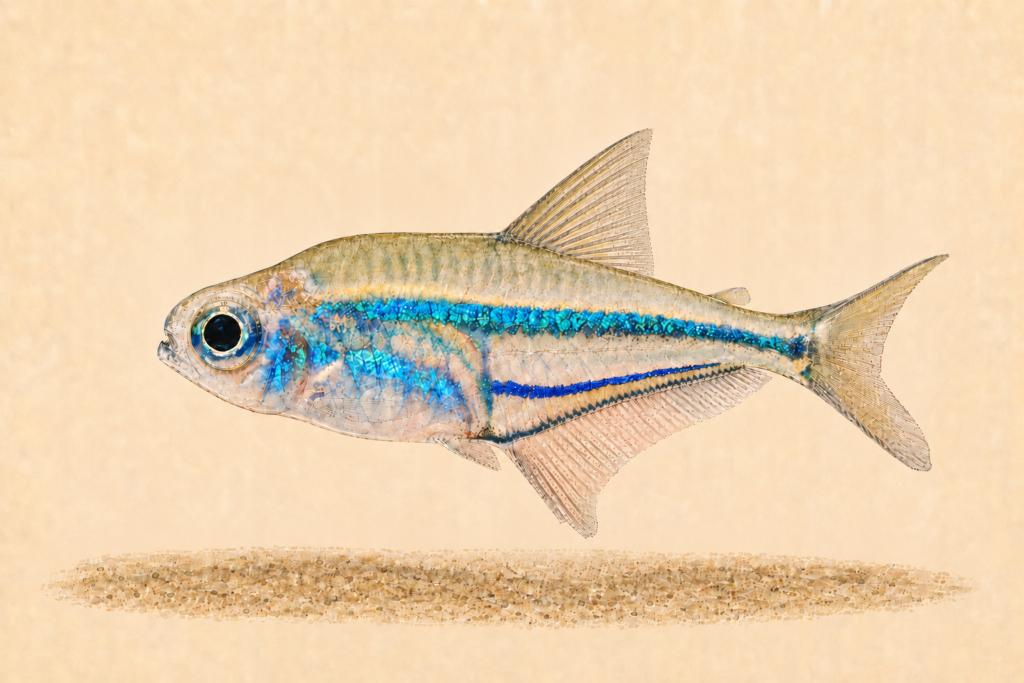
The defining feature of the Blue Flash Glass Tetra is, unsurprisingly, its near-complete transparency. The body is laterally compressed and elongated, typical of many small characins, but the lack of pigmentation in the skin and scales means that the spine, swim bladder, and internal organs are clearly visible to the naked eye. The overall impression is of a living piece of glass moving through the water column.
What elevates this species beyond simple transparency is the iridescent blue-green flash that runs along the lateral line. This structural colouration is produced by guanine crystals in the skin and is angle-dependent, meaning it appears only when light strikes the fish at certain angles. In a well-lit aquarium, members of a shoal will produce brief, almost electric flashes of blue as they turn and change direction – an effect that gives the species its common name. Under subdued, tannin-filtered light, the flashes become subtler but arguably more beautiful, appearing as cool, silvery-blue glints against the amber water.
The fins are generally hyaline (clear) with a very faint yellowish or pinkish tint, depending on the individual and its condition. The eye is relatively large in proportion to the head and has a reflective silver iris. Males tend to be very slightly slimmer than females when viewed from above, and may display a marginally more intense iridescence during breeding condition, though sexual dimorphism is minimal in this species. Adult specimens reach approximately 3 to 4 centimetres in standard length, making them one of the smaller glass-bodied characins available to hobbyists.
One point worth noting is that the transparency of this fish makes it an excellent indicator of overall health. A well-fed Blue Flash Glass Tetra will have a visible, slightly orange-tinged gut from its diet of small invertebrates. Stress, disease, or poor water quality can cause a subtle milky cloudiness in the body tissue, which is immediately apparent given the species’ see-through nature. This makes it easier to spot problems early, provided you observe your fish regularly.
Natural Habitat
Heterocharax virgulatus is native to the Amazon basin in South America, where it inhabits slow-moving blackwater streams, flooded forest margins, and small tributaries shaded by dense canopy cover. These environments are characterised by extremely soft, acidic water stained a deep tea colour by the decomposition of leaf litter, fallen branches, and other organic matter. The pH in these habitats can drop below 5.0, and the general hardness is often negligible – sometimes barely measurable.
The substrate in these biotopes is typically composed of fine sand overlaid with a thick carpet of decomposing leaves, seed pods, and twigs. Aquatic vegetation is often sparse due to the low light levels beneath the forest canopy, though emergent and marginal plants may be present along the banks. Instead of lush plant growth, the underwater landscape is dominated by submerged wood, root tangles, and leaf litter, which provide both shelter and foraging grounds for small fish like Heterocharax virgulatus.
The water in these habitats is warm, typically ranging from 24 to 28 degrees Celsius, and moves slowly or remains almost still. Dissolved oxygen levels can be relatively low in some of these environments, particularly in areas with heavy leaf litter decomposition. The tannins and humic acids released by the decaying plant matter have mild antibacterial and antifungal properties, which may contribute to the overall health of the fish living in these waters. Understanding this natural biotope is key to replicating suitable conditions in the aquarium.
In the wild, the Blue Flash Glass Tetra shares its habitat with a diverse community of small characins, dwarf cichlids, catfish, and various invertebrates. It is a mid-water shoaling species that typically swims in loose groups among submerged roots and branches, darting into cover when threatened by predators. Its transparency is almost certainly an adaptation to reduce visibility to predators in these dimly lit, tannin-stained waters.
Tank Size and Setup
A minimum tank volume of 75 litres is recommended for a group of Blue Flash Glass Tetras. Given that this is an obligate shoaling species, you should plan on keeping at least six individuals, and ideally eight to ten or more. A larger group not only produces a more impressive display but also reduces stress on individual fish by allowing them to engage in natural shoaling behaviour. For a group of ten or more, a tank of 100 litres or above is preferable.
The ideal aquascape for Heterocharax virgulatus draws heavily on its natural blackwater biotope. Use a fine sand substrate in a natural tan or brown colour, and add a generous layer of dried leaf litter – Indian almond leaves (Terminalia catappa), oak leaves, or beech leaves all work well. The leaves will gradually release tannins into the water, softening it and lowering the pH while also providing a natural food source in the form of the biofilm and microfauna that colonise decomposing foliage. Replace leaves as they break down, roughly every few weeks.
Driftwood and branching wood pieces are essential components of the setup. Arrange them to create a complex network of hiding spots and visual barriers. Malaysian driftwood, mopani wood, and spider wood are all suitable choices. The wood will also leach tannins, contributing to the desired water chemistry. Aquatic plants are not strictly necessary and are not a major feature of the natural habitat, but if you wish to include them, choose species tolerant of soft, acidic water and lower light levels, such as Java fern (Microsorum pteropus), Java moss (Taxiphyllum barbieri), Anubias species, or various Cryptocoryne species. Attach epiphytic plants to the driftwood rather than planting them in the substrate.
Lighting should be subdued. Bright overhead lighting will wash out the delicate iridescence of the fish and cause them to appear pale and stressed. Use dim or diffused lighting, or allow floating plants such as Amazon frogbit (Limnobium laevigatum) or water lettuce (Pistia stratiotes) to cover a portion of the surface, filtering the light and creating the dappled, shaded conditions these fish prefer. Under low light with tannin-stained water, the blue flash along the lateral line becomes far more visible and striking.
A tight-fitting lid or cover glass is advisable. Like many small characins, Heterocharax virgulatus is capable of jumping, and startled individuals may leap from an open-top aquarium. Ensure there are no gaps around filter inlets, heater cables, or other equipment where a small fish could escape.
Water Parameters
Getting the water chemistry right is arguably the most important aspect of keeping Heterocharax virgulatus successfully. This is a soft, acidic water species, and it will not thrive – and may not survive long-term – in hard, alkaline tap water. If your local water supply is hard and alkaline, you will need to use reverse osmosis (RO) water, remineralised to the appropriate level with a product designed for soft-water fish, or blend RO water with a small proportion of tap water to reach the desired parameters.
| Temperature | 23-27 C |
| pH | 4.5-6.5 |
| General hardness (GH) | 1-6 dGH |
| Carbonate hardness (KH) | 0-3 dKH |
| Ammonia | 0 ppm |
| Nitrite | 0 ppm |
| Nitrate | Below 20 ppm |
The ideal pH for this species sits between 5.0 and 6.0, though it can tolerate a range of 4.5 to 6.5. Water should be very soft, with a general hardness of 1 to 6 dGH and a carbonate hardness of 0 to 3 dKH. The low KH means the water has very little buffering capacity, so pH can fluctuate if not managed carefully. Adding leaf litter and driftwood helps to stabilise pH in the acidic range, but you should test regularly, particularly after water changes, to ensure conditions remain consistent.
Stability is more important than hitting an exact number. A sudden pH swing from 5.0 to 6.5 during a water change is far more dangerous than keeping the fish at a steady 6.0. When performing water changes, ensure the replacement water is temperature-matched and has been adjusted to match the tank’s pH and hardness before adding it. Small, frequent water changes of 10 to 15 per cent are safer than large infrequent ones in a soft-water setup.
Ammonia and nitrite must always be at zero. In acidic water, ammonia is predominantly present in its less toxic ammonium form, but this does not mean you can be complacent about biological filtration. Nitrate should be kept below 20 ppm, which is easily achievable with regular water changes and a moderate stocking level.
Filtration and Equipment
Filtration for a Blue Flash Glass Tetra tank should prioritise gentle water flow and excellent biological filtration. These fish come from slow-moving or near-still waters and will be stressed by strong currents. A sponge filter is an excellent choice for smaller setups, providing biological and mechanical filtration with minimal flow. For larger tanks, a small hang-on-back filter or canister filter with an adjustable flow rate, turned down to its lowest setting or fitted with a spray bar to diffuse the output, works well.
In very soft, acidic water, the beneficial bacteria that drive the nitrogen cycle can function less efficiently than in neutral or slightly alkaline conditions. This means you should allow the filter to mature thoroughly before adding fish, and avoid overstocking. Supplementing filtration media with additional biological media such as sintered glass or ceramic rings can help ensure adequate bacterial colonisation.
A reliable, adjustable heater is essential to maintain a stable temperature within the 24 to 28 degrees Celsius range. In very small tanks, an undersized heater is preferable to one that could overshoot, as temperature spikes are dangerous for these sensitive fish. Use a separate thermometer – ideally a digital one – to verify the heater’s accuracy, as built-in thermostats can be imprecise.
An air pump and airstone are not strictly necessary if you are using a sponge filter, which provides gentle surface agitation and gas exchange. However, if you notice your fish gasping at the surface, increasing surface agitation slightly can help improve oxygenation. Avoid excessive aeration, as this will drive off the dissolved CO2 that helps maintain the low pH in a soft-water setup.
Consider using peat filtration or adding peat granules to the filter if you are struggling to achieve the desired pH and water colour. Peat releases tannins and humic acids, lowering the pH and softening the water while producing the characteristic amber tint of blackwater conditions. Ensure you use aquarium-grade peat that has not been treated with fertilisers or other chemicals.
Diet and Feeding
In the wild, Heterocharax virgulatus feeds primarily on tiny invertebrates, insect larvae, microcrustaceans, and organic detritus found among the leaf litter on the stream bed. In the aquarium, it is generally not a difficult fish to feed, but it does best on a varied diet that includes live or frozen foods alongside high-quality prepared options.
Live and frozen foods should form the backbone of the diet. Daphnia, baby brine shrimp (Artemia nauplii), cyclops, moina, micro worms, and grindal worms are all excellent choices. These foods closely replicate the natural prey items of the species and help to maintain condition and colouration. Frozen bloodworm can be offered occasionally but should not be a staple, as it is relatively low in nutritional diversity and can cause digestive issues if overfed.
High-quality micro-pellets and crushed flake food can be offered as a supplementary diet. Choose products specifically formulated for small tropical fish, with a high protein content and minimal fillers. Some specimens may be reluctant to accept dry foods initially, particularly if they are wild-caught, but most will learn to take them in time if live and frozen foods are gradually mixed in with prepared options.
Feed small amounts two to three times daily rather than one large feeding. The tiny mouth of this species means it cannot handle large food particles, so ensure all offerings are appropriately sized. Crushed flakes, micro-pellets of 0.5 mm or smaller, and finely chopped frozen foods are ideal. Remove any uneaten food after a few minutes to prevent it from fouling the water, which is particularly important in a soft, acidic setup where decomposition can quickly alter water chemistry.
The biofilm and microfauna that develop on decomposing leaf litter in the aquarium provide a valuable supplementary food source. Fish will often be seen picking at leaf surfaces throughout the day, grazing on the tiny organisms that colonise the decaying material. This natural foraging behaviour is another excellent reason to include a generous leaf litter layer in the tank.
Behaviour and Temperament
The Blue Flash Glass Tetra is a peaceful, retiring species that spends most of its time in the mid-water column, gently drifting among driftwood and plant stems in a loose shoal. It is not an aggressive fish and poses no threat to tank mates of any size, though its small stature makes it vulnerable to predation by larger or more boisterous species.
Shoaling behaviour is a central part of this species’ natural repertoire. When kept in groups of six or more, Blue Flash Glass Tetras will form loose aggregations, swimming in roughly the same direction and maintaining a degree of spacing between individuals. They do not form the tight, synchronised shoals seen in some other tetra species, but they clearly derive comfort and security from the presence of conspecifics. Solitary individuals or those kept in pairs will be visibly stressed, spending most of their time hiding and refusing food.
Within the shoal, there may be occasional minor sparring between males, typically involving brief parallel displays and fin flaring. These interactions are harmless and are a normal part of social behaviour. No physical damage results from these encounters, and they add interest to the display.
This species is somewhat timid and can be easily startled by sudden movements, loud noises, or abrupt changes in lighting. A dimly lit tank with plenty of cover helps to minimise stress and encourages the fish to spend more time in the open. When first introduced to a new aquarium, expect them to be shy and reclusive for the first week or two as they acclimate to their surroundings. Patience is key – once settled, they will gradually become bolder and more visible.
Activity levels are moderate. These are not hyperactive fish, and they spend much of the day gently cruising or hovering in place, interspersed with bouts of more purposeful swimming when feeding. Their transparent bodies and subtle flashes of iridescence make them particularly enjoyable to watch in the calm, contemplative setting of a blackwater biotope aquarium.
Tank Mates
Choosing tank mates for the Blue Flash Glass Tetra requires careful consideration of its small size, peaceful nature, and preference for soft, acidic water. Ideal companions are other small, non-aggressive species from similar blackwater habitats that will not outcompete Heterocharax virgulatus for food or harass it. Avoid anything large enough to eat it, anything territorial or aggressive, and anything that requires significantly different water parameters.
Good tank mates
- Cardinal Tetra – A classic blackwater companion that shares identical water chemistry requirements and is completely peaceful.
- Green Neon Tetra – Another small, soft-water tetra that thrives in the same dimly lit, acidic conditions.
- Ember Tetra – A tiny, gentle tetra that adds a warm colour contrast without posing any threat.
- Pygmy Corydoras – Peaceful bottom-dwelling catfish that occupy a different zone of the tank and enjoy soft water.
- Otocinclus – Gentle algae-eating catfish that coexist peacefully and appreciate similar water conditions.
- Chocolate Gourami – A soft-water labyrinth fish that is calm and slow-moving, making it an excellent mid-water companion.
- Apistogramma cacatuoides – A dwarf cichlid that shares the same biotope and is generally peaceful towards small tetras, provided the tank offers adequate space.
- Pencilfish (Nannostomus spp.) – Slender, peaceful surface-dwellers from similar blackwater habitats that complement the Blue Flash Glass Tetra beautifully.
Fish to avoid
- Oscar – A large, predatory cichlid that would quickly consume any Blue Flash Glass Tetra.
- Tiger Barb – An active, nippy species whose boisterous behaviour would stress and potentially injure these delicate tetras.
- Convict Cichlid – Aggressive and territorial, especially when breeding, and far too rough for this species.
- African Cichlids (Malawi/Tanganyikan) – Require hard, alkaline water that is entirely incompatible with Heterocharax virgulatus.
- Angelfish – Adults are large enough to eat small tetras, and they can be territorial in planted setups.
- Red Tail Shark – Territorial and aggressive towards small, passive fish sharing its lower and mid-water space.
- Common Pleco – Grows far too large for the tank sizes suitable for Blue Flash Glass Tetras and produces excessive waste.
Breeding
Breeding Heterocharax virgulatus in captivity is rarely achieved and poorly documented. This is not a species that has been commercially bred to any significant degree, and most information on its reproduction is extrapolated from closely related characins rather than from direct observation of this particular species. That said, with the right conditions and a healthy, well-conditioned group, spawning is not impossible for the dedicated hobbyist.
Like most small characins, the Blue Flash Glass Tetra is assumed to be an egg scatterer. The female releases eggs among fine-leaved plants, moss, or leaf litter, and the male fertilises them externally. There is no parental care; the adults will readily consume the eggs if given the opportunity, so a separate breeding tank is strongly recommended.
Set up a small breeding tank of approximately 20 to 30 litres with very soft, acidic water – aim for a pH of 5.0 to 5.5 and a GH of 1 to 2 dGH. Temperature should be at the warmer end of the species’ range, around 27 to 28 degrees Celsius. Include a layer of fine-leaved aquatic moss such as Java moss, or a spawning mop, to catch the eggs. Dim the lighting to near darkness, as eggs and fry of blackwater species are often light-sensitive.
Condition a pair or a small group with frequent feedings of live foods for two to three weeks before attempting to induce spawning. Introduce the conditioned fish to the breeding tank in the evening. Spawning, if it occurs, is most likely to take place at dawn. After spawning, remove the adults immediately to prevent egg predation.
Eggs are tiny, semi-transparent, and likely to hatch within 24 to 48 hours depending on temperature. The fry will initially survive on their yolk sac before becoming free-swimming, at which point they will require extremely small live foods such as infusoria, paramecium, or vinegar eels. After a week or so, they can be transitioned to freshly hatched brine shrimp nauplii. Growth is likely to be slow, and fry will be extremely delicate in the first few weeks of life. Maintain impeccable water quality in the rearing tank and avoid sudden parameter swings.
Common Diseases
The Blue Flash Glass Tetra is not unusually susceptible to disease compared to other small characins, but its need for very specific water conditions means that problems often arise from husbandry errors rather than from any inherent fragility in the species itself. Maintaining stable, soft, acidic water and a clean environment is the single best preventive measure.
Ich (white spot disease) is the most common ailment seen in newly imported specimens. It presents as small white cysts on the fins and body – highly visible on a transparent fish. Raise the temperature gradually to 30 degrees Celsius and treat with a half-dose of a malachite green or formalin-based medication, as small, scaleless or thin-scaled fish can be sensitive to standard dosing. Remove any carbon from the filter during treatment.
Bacterial infections, including fin rot and columnaris, can occur if water quality deteriorates or the fish are stressed by poor conditions or aggressive tank mates. Symptoms include fraying or reddening of the fins, white or grey patches on the skin, and lethargy. Improve water quality immediately and treat with an appropriate antibacterial medication if symptoms do not resolve.
Fungal infections may appear as cotton-like growths on the body or fins, often secondary to physical injuries or existing bacterial infections. These are generally treatable with antifungal medications, but addressing the underlying cause – whether poor water quality, injury, or stress – is essential to prevent recurrence.
Internal parasites can be a concern with wild-caught specimens. Signs include weight loss despite eating, stringy white faeces, and a hollow-bellied appearance. An anti-parasitic food or medication containing praziquantel or levamisole may be necessary. Quarantining all new arrivals for at least two weeks before introducing them to the main display tank is strongly advisable, particularly with wild-caught fish.
The transparency of this species is genuinely useful for spotting health issues early. Changes in the colour or opacity of the internal organs, unusual swelling, or visible parasites within the body cavity can all be detected before they become critical, provided you observe your fish closely on a regular basis.
FAQs
How many Blue Flash Glass Tetras should I keep together?
A minimum of six is recommended, but groups of eight to ten or more are ideal. Larger groups produce more natural shoaling behaviour, reduce individual stress levels, and result in a more confident, visible shoal. Solitary or paired individuals will be chronically stressed and are unlikely to thrive.
Can I keep Blue Flash Glass Tetras in hard, alkaline water?
No. This species requires soft, acidic water and will not adapt to hard, alkaline conditions. If your tap water is hard, you will need to use reverse osmosis water, remineralised to the appropriate softness, or blend RO water with a small amount of tap water. Attempting to keep this species in unsuitable water chemistry will result in chronic stress, poor health, and a significantly shortened lifespan.
Are Blue Flash Glass Tetras suitable for a community tank?
They can be kept in a community setting, but only with other small, peaceful species that share similar water chemistry requirements. Boisterous, aggressive, or large tank mates should be avoided. A blackwater-themed community with other soft-water South American species such as cardinal tetras, pencilfish, and dwarf cichlids is the ideal context for this species.
Why are my Blue Flash Glass Tetras hiding all the time?
This is common behaviour in newly introduced specimens and typically resolves within one to two weeks as the fish settle in. Ensure the tank has subdued lighting, plenty of cover in the form of driftwood and leaf litter, and that there are no aggressive tank mates causing stress. Keeping a sufficiently large group also helps, as the fish feel more secure in numbers.
Do Blue Flash Glass Tetras need live food?
While they do not strictly require live food, they strongly benefit from it. Live and frozen foods such as daphnia, baby brine shrimp, and micro worms should form a significant portion of the diet. Most individuals will learn to accept high-quality micro-pellets and crushed flakes over time, but a diet based solely on dry food is unlikely to bring out the best condition and colouration in this species.
Related Guides
- Cardinal Tetra Care Guide – A staple blackwater tetra that shares the same habitat requirements and makes an ideal companion species.
- Green Neon Tetra Care Guide – Another small, soft-water tetra with similar care needs and a complementary appearance.
- Apistogramma cacatuoides Care Guide – A popular dwarf cichlid from overlapping habitats that pairs well in a blackwater community tank.
- Pygmy Corydoras Care Guide – A tiny, peaceful catfish perfect for the bottom layer of a small soft-water community.
- Pencilfish (Nannostomus) Care Guide – Elegant surface-dwelling characins from similar South American blackwater environments.