Quick Summary
The Blue-Striped Rivulus is a small, beautifully marked killifish best suited to experienced hobbyists willing to provide soft, acidic water, dim lighting, and a secure, tight-fitting lid. It rewards patient keepers with subtle colour displays and fascinating natural behaviour, but it is not a good fit for bright, hard-water community tanks.
🐠 Build a tank around this species
In this guide:
- Introduction
- Quick Stats
- Appearance
- Natural Habitat
- Tank Size and Setup
- Water Parameters
- Diet and Feeding
- Behaviour and Temperament
- Tank Mates
- Breeding
Introduction
The Blue-Striped Rivulus, Laimosemion xiphidius, is a small South American killifish that has earned a dedicated following among specialist fishkeepers. Originally classified within the sprawling genus Rivulus, it was moved to Laimosemion following a major taxonomic revision that split the old catch-all genus into several smaller, more manageable groups. Despite the name change in the scientific literature, the species is still widely referred to by hobbyists as a “rivulus” or simply by its scientific epithet, xiphidius.
This killifish hails from shallow, tannin-stained waterways in the Guiana Shield region of northern South America, where it inhabits leaf-litter beds, flooded forest margins, and tiny blackwater creeks. In the aquarium it retains all of the habits that make it so well adapted to those environments: a preference for dim, subdued lighting; a taste for live invertebrate prey; and an almost legendary ability to jump. Any keeper considering this species must treat a tight-fitting aquarium lid as an absolute necessity, not an optional accessory.
Laimosemion xiphidius is not a true annual killifish. It does not require its eggs to be dried or incubated in peat for extended periods in the way that many African and South American annuals do. Instead, it is a semi-annual or non-annual species whose eggs can develop in water, albeit slowly, and whose adults can live for two years or more under good conditions. That said, its lifespan is still shorter than that of many mainstream community fish, and prospective keepers should be prepared for a faster generational turnover than they might be used to with tetras or corydoras.
Overall, this is a fish that repays careful observation. Males are strikingly coloured, territorial displays are dramatic without being destructive, and breeding behaviour is endlessly interesting. It is not, however, a species for beginners. Its water-chemistry requirements are specific, its diet ideally includes live foods, and its small size and retiring nature mean it can easily be overlooked or outcompeted in a busy community aquarium. For the dedicated hobbyist with a small, carefully managed tank, the Blue-Striped Rivulus is a genuinely rewarding species to keep.
Quick Stats
| Scientific name | Laimosemion xiphidius |
|---|---|
| Common names | Blue-Striped Rivulus, Xiphidius Killifish |
| Family | Rivulidae |
| Origin | Guiana Shield: Guyana, Suriname, French Guiana |
| Adult size | 3.5 cm |
| Lifespan | 2–3 years |
| Difficulty | Intermediate |
| Breeding difficulty | Moderate |
| Temperature | 22–26 °C |
| pH | 4.5–6.5 |
| GH | 1–6 dGH |
| KH | 0–3 dKH |
| Minimum tank size | 30 L |
| Conservation status | Least Concern (IUCN) |
Appearance
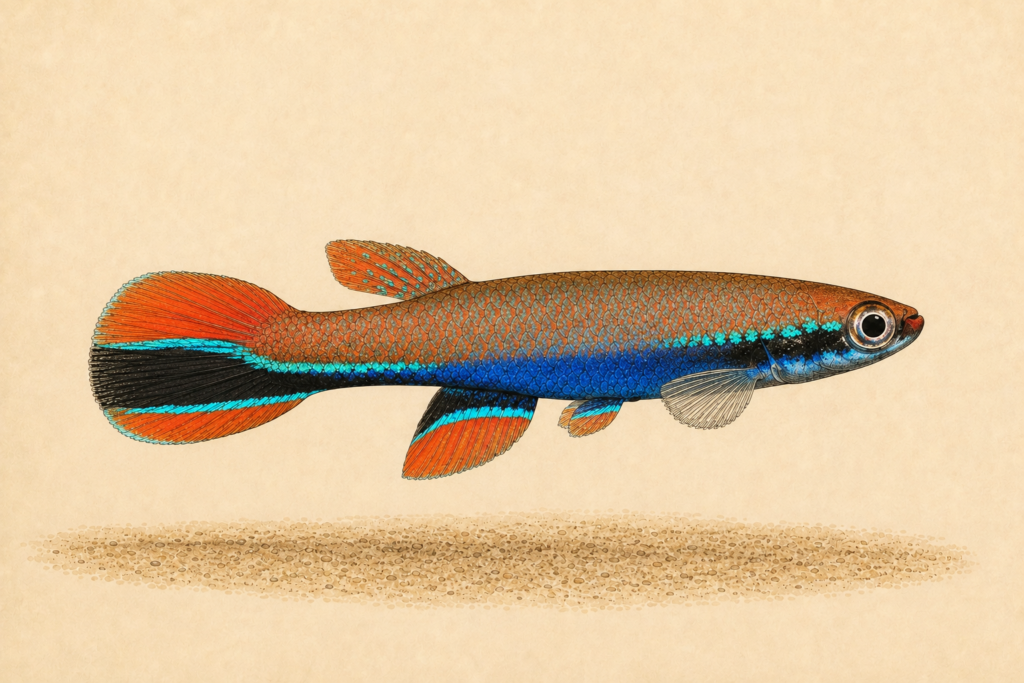
Laimosemion xiphidius is a slender, elongated killifish with a slightly upturned mouth that betrays its surface-feeding habits. Males are the more colourful sex and develop a series of vivid, iridescent blue-green horizontal stripes along the flanks, set against a warm brownish-gold to olive base colour. These stripes can appear almost electric under subdued lighting, particularly when the fish is in breeding condition or displaying to a rival. The unpaired fins – dorsal, anal, and caudal – often carry extensions of these blue markings, along with subtle red or orange edging that adds further visual interest. The caudal fin may show a slight point or lyre-shaped extension in mature males, a feature reflected in the species’ name: “xiphidius” derives from the Greek for “small sword.”
Females are considerably more muted. They display a brownish body with faint lateral striping and usually carry a dark ocellus, or “rivulus spot,” near the upper base of the caudal peduncle. This marking is a characteristic feature shared by many species in the broader rivuline lineage and is thought to serve as a predator-deterrent false eye spot. In some populations the female’s fins are almost entirely clear, while in others a faint wash of yellow or orange may be present.
Juveniles of both sexes resemble females and only begin to differentiate as they approach sexual maturity, typically at around two to three months of age. Because adults reach only 3 to 4 centimetres in total length, this is a fish best appreciated in a small, dedicated aquarium viewed at close range, rather than in a large display tank where it may simply disappear into the background.
Natural Habitat
The Blue-Striped Rivulus is found in the lowland forests of the Guiana Shield region, encompassing parts of Guyana, Suriname, and French Guiana. It is a fish of shallow, slow-moving or still bodies of water: tiny forest streams, swampy depressions, roadside ditches, and the flooded margins of larger creeks. These habitats are typically heavily shaded by overhanging forest canopy, which limits light penetration and keeps the water cool relative to open tropical waterways.
The water itself is classic blackwater: deeply stained by humic acids and tannins leaching from decomposing leaf litter, fallen branches, and other organic material. It is extremely soft, with negligible mineral content, and highly acidic, with pH values routinely falling below 5.0 in many collection localities. The substrate is usually a thick carpet of decomposing leaves, with very little aquatic vegetation growing in the dim, nutrient-poor conditions. Instead, the structure of the habitat comes from root tangles, fallen wood, and the leaf-litter layer itself.
In these environments, Laimosemion xiphidius occupies the upper water column and the surface film, where it hunts for small terrestrial and aquatic invertebrates. Fallen insects, mosquito larvae, tiny crustaceans, and worms make up the bulk of its natural diet. Population densities can be quite high in suitable microhabitats, but males establish small territories around prominent pieces of structure – a particular root, a curled leaf, or a depression in the litter – and defend them vigorously against rivals.
Seasonal fluctuations in water level play an important role in the species’ life cycle. During periods of high water, populations disperse across a wider area of flooded forest floor; as water recedes, fish concentrate in smaller pools and breeding activity intensifies. Eggs are deposited on submerged plant roots, leaf surfaces, or fibrous substrates and can tolerate brief periods of reduced moisture, though they do not require the extended dry incubation typical of true annual killifish species.
Tank Size and Setup
A single pair or trio (one male and two females) of Blue-Striped Rivulus can be housed comfortably in a tank of 30 litres or more. For a small group or a species-community setup with compatible tank mates, 45 to 60 litres is a more practical starting point. Footprint matters more than height: a long, shallow tank provides more surface area for a fish that spends the majority of its time in the upper third of the water column. Standard “nano” cubes of 30 litres work well for a dedicated breeding pair.
A tight-fitting lid with no gaps is essential. Laimosemion xiphidius is an extremely capable jumper, and even a gap of a few millimetres around filter inlet tubes, heater cables, or airline tubing is enough for a determined fish to exploit. Foam strips, cut-to-fit acrylic covers, or cling film over any openings will save lives. This cannot be overstated: carpet-surfing is the single most common cause of death for this species in captivity.
The ideal substrate is a layer of dried leaf litter over a thin base of fine, dark sand or bare-bottom glass. Indian almond leaves (Terminalia catappa), oak leaves, or beech leaves all work well. They serve multiple purposes: they release tannins that acidify and tint the water, they provide cover and foraging surfaces, and they support microfaunal colonies that supplement the fish’s diet. A bed of three to five centimetres of leaves, replaced as they decompose, creates an environment that closely mimics the species’ natural habitat.
Dim lighting is strongly preferred. Floating plants such as Salvinia, Riccia, or Amazon frogbit help to diffuse overhead light and provide additional cover at the surface, which helps the fish feel secure and encourages natural behaviour. Rooted plants are not strictly necessary given the low light levels, but species tolerant of shade – such as Java fern, Anubias, and various mosses – can be attached to small pieces of driftwood or stone to add vertical structure without overwhelming the aquascape.
Bogwood, small branches, and coconut shell halves make excellent hiding spots. The goal is to create a densely structured environment with plenty of shaded refuges, particularly near the water surface. Open, brightly lit tanks will stress the fish and cause it to remain hidden, defeating the purpose of keeping such a visually appealing species.
Water Parameters
| Temperature | 22-26 C |
| pH | 4.5-6.5 |
| General hardness (GH) | 1-5 dGH |
| Carbonate hardness (KH) | 0-3 dKH |
| Ammonia | 0 ppm |
| Nitrite | 0 ppm |
| Nitrate | Below 20 ppm |
Laimosemion xiphidius is a true blackwater species, and getting the water chemistry right is fundamental to its long-term health and breeding success. Soft, acidic water is not merely “preferred” – it is a genuine requirement. Fish kept in hard, alkaline tapwater will often survive for a time but will show muted colour, suppressed breeding behaviour, and increased susceptibility to disease. If your local tapwater is hard or alkaline, you will need to use reverse osmosis (RO) water or a similar demineralisation method and remineralise it lightly with a product designed for soft-water species.
The very low carbonate hardness means that pH can fluctuate rapidly if the biological load is high or if water changes are neglected. Small, frequent water changes – 10 to 15 per cent twice a week rather than a single large change – help maintain stability. When performing water changes, ensure that the replacement water is temperature-matched and has similar chemistry to the tank water. A sudden swing from pH 5.0 to pH 7.0 during a water change can be lethal.
Tannin-staining from leaf litter and driftwood is beneficial and should be embraced rather than filtered out with activated carbon. The humic substances released by decomposing organic matter have mild antibacterial and antifungal properties and contribute to the stable, low-pH environment the fish requires. If the water appears clear rather than tea-coloured, consider adding more leaf litter or a bag of alder cones to the filter.
Temperature should be maintained in the range of 22 to 26 degrees Celsius. This species does not tolerate high temperatures well; sustained periods above 28 C can cause stress and shorten lifespan. In warm climates, an aquarium fan or careful placement away from direct sunlight may be needed to keep temperatures in check during summer months.
Filtration and Equipment
Filtration for a Blue-Striped Rivulus tank should be gentle. A small air-driven sponge filter is the gold standard: it provides adequate biological filtration without creating strong currents that would stress a fish adapted to near-still water. For slightly larger setups, a small internal or hang-on-back filter with the flow turned down to its minimum setting will also work, provided the outflow is baffled or directed against the glass to diffuse the current.
Avoid canister filters or powerheads that create significant water movement. Laimosemion xiphidius is a poor swimmer in fast-flowing water and will expend energy fighting the current rather than feeding and displaying. If you are using a filter with adjustable flow, aim for a turnover rate of no more than three to four times the tank volume per hour, and ideally less.
An aquarium heater rated for the tank size is necessary in most temperate climates. A heater with a reliable thermostat set to 24 C provides a comfortable midpoint. Place the heater near the filter outflow to ensure even heat distribution, and use a separate thermometer to verify the temperature independently of the heater’s built-in dial, which can be inaccurate.
Lighting should be low-intensity. If the tank has floating plants, a basic LED strip light on a timer set for eight to ten hours per day is sufficient. The floating plants will do most of the work of shading the water column. If no floating plants are used, consider using a dimmable light turned down low, or position the tank away from overhead room lighting. The fish will be more active, more colourful, and more likely to breed under subdued illumination.
Activated carbon is generally unnecessary and counterproductive in a blackwater setup, as it will strip the beneficial tannins from the water. Chemical filtration media designed to remove organic discolouration should likewise be avoided. Stick to mechanical and biological media only: a sponge filter or a filter compartment filled with ceramic rings or sintered glass is all that is needed.
Diet and Feeding
In the wild, Laimosemion xiphidius feeds almost exclusively on small invertebrates: mosquito larvae, fruit flies, tiny worms, and micro-crustaceans that fall onto the water surface or inhabit the leaf-litter layer. In captivity, a diet that mirrors this as closely as possible will produce the best colour, health, and breeding response.
Live foods should form the core of the diet wherever practical. Freshly hatched brine shrimp (Artemia nauplii) are readily accepted and are an excellent staple for both adults and growing fry. Micro-worms, grindal worms, and white worms are all taken with enthusiasm. Daphnia and moina provide valuable roughage and are particularly useful for conditioning breeding adults. Wingless or flightless fruit flies (Drosophila) dropped onto the water surface are a superb treat that closely mimics the species’ natural feeding behaviour and are invariably met with an immediate predatory response.
Frozen foods are a good alternative when live cultures are not available. Frozen bloodworm, daphnia, brine shrimp, and cyclops are all accepted, though some individuals may need a brief adjustment period before they recognise non-living food items as edible. Thaw frozen foods in a small amount of tank water before feeding to avoid introducing cold water and to prevent uneaten food from sinking and fouling the substrate.
High-quality dry foods – specifically micro-pellets or crushed flakes formulated for small carnivorous or insectivorous fish – can be used as an occasional supplement but should not form the sole diet. Many Blue-Striped Rivulus will accept dry food once acclimatised, but others remain stubbornly disinterested. A mixed diet with a strong emphasis on live and frozen invertebrate prey is the safest approach.
Feed small amounts two to three times per day rather than a single large meal. This species has a small stomach and a fast metabolism, and frequent small feeds reduce waste while keeping the fish in good condition. Remove any uneaten food promptly to maintain water quality, particularly in the soft, low-pH environment where nitrification bacteria may be less efficient than in harder water.
Behaviour and Temperament
The Blue-Striped Rivulus is a peaceful species overall, well suited to a quiet community of small, non-aggressive fish. That said, males are territorial towards one another and will engage in frequent sparring displays when kept in close quarters. These confrontations typically involve flared fins, intensified colour, and lateral displays rather than outright physical aggression, but in very small tanks or tanks with insufficient cover, a dominant male can harass a subordinate to the point of chronic stress.
The safest approach is to keep either a single male with one or two females, or a group large enough (six or more) that aggression is spread across multiple individuals. A pair in a well-furnished 30-litre tank is the simplest and most commonly recommended setup. If keeping multiple males, provide ample visual barriers – dense plant growth, driftwood tangles, and leaf litter – so that each male can establish and defend a small territory without being in constant visual contact with rivals.
Females are generally tolerant of one another and of other species. They spend much of their time foraging among the leaf litter or hovering just below the water surface, and they rarely initiate aggressive interactions. In mixed-sex groups, females may be pursued persistently by males; keeping two or three females per male helps to distribute this attention and prevents any single female from being over-harassed.
This species is most active during the early morning and late evening, corresponding to the crepuscular conditions of its natural forest-stream habitat. Under bright lighting it tends to remain hidden among plants and leaf litter, emerging only to feed. Under dim lighting, or in a well-shaded tank, it will spend much more time in the open, displaying, foraging, and interacting with tank mates. Keepers who provide the right conditions are rewarded with a far more engaging and visible fish.
Jumping behaviour is not limited to escape attempts. Blue-Striped Rivulus will jump to catch insects above the waterline, to move between pools in the wild, and sometimes apparently for no reason at all. A secure lid must be in place at all times. Even during feeding or maintenance, take care not to leave the tank uncovered for longer than necessary.
Tank Mates
The Blue-Striped Rivulus is best housed either in a species-only setup or with other small, peaceful fish that share its preference for soft, acidic water and calm conditions. Avoid any tank mates that are large enough to view the rivulus as food, boisterous enough to outcompete it at feeding time, or aggressive enough to harass it. Fast-moving, open-water swimmers and fin-nipping species are poor choices. Ideal companions are other small blackwater species that occupy the middle and lower water column, leaving the surface zone primarily to the rivulus.
Good tank mates
- Ember Tetra – A tiny, peaceful tetra that thrives in soft, acidic water and occupies the middle water column, rarely competing with surface-dwelling rivulus.
- Green Neon Tetra – Another small blackwater tetra that appreciates tannin-stained water and low lighting, making it an excellent habitat match.
- Pygmy Corydoras – A gentle bottom-dweller that stays small, tolerates soft water, and poses no threat to killifish fry or adults.
- Chocolate Gourami – A slow-moving, soft-water specialist that shares the rivulus’ preference for dim, tannin-rich environments.
- Beckford’s Pencilfish – A calm, slender characin that does well in acidic water and adds visual interest without causing conflicts.
- Otocinclus – A small, non-aggressive algae grazer that stays on surfaces and leaves killifish entirely alone, though it prefers slightly harder water so suitability depends on your specific parameters.
- Dwarf Pencilfish – Nannostomus marginatus is a tiny, peaceful species ideally suited to the same blackwater conditions.
- Clown Killifish – Another small surface-dwelling killifish; can coexist if the tank is large enough and well planted, though monitor for territorial overlap at the surface.
Fish to avoid
- Angelfish – Far too large and predatory; an adult angelfish will readily consume a Blue-Striped Rivulus.
- Tiger Barb – A notorious fin-nipper that is too boisterous and aggressive for a small, retiring killifish.
- Convict Cichlid – Highly territorial and aggressive, completely incompatible with any small, peaceful species.
- Betta – Males may view the colourful rivulus as a rival and attack; both species also occupy the surface zone, increasing conflict potential.
- Chinese Algae Eater – Becomes aggressive and territorial with age and may harass or injure small tank mates.
- Buenos Aires Tetra – Too large, too active, and prone to nipping; it also prefers harder, more alkaline water.
Breeding
Breeding Laimosemion xiphidius in captivity is a rewarding experience and is well within the capabilities of a moderately experienced killifish keeper. The species is a continuous spawner rather than a seasonal one, meaning that a well-conditioned pair will deposit eggs on an almost daily basis when conditions are right.
To condition adults for breeding, increase the proportion of live foods in the diet – brine shrimp nauplii, daphnia, and grindal worms are all excellent choices – and ensure that water parameters are stable at the softer, more acidic end of the acceptable range. A pH of 5.0 to 5.5, a temperature of 24 to 25 C, and very soft water (GH 1-2 dGH) are ideal spawning conditions. Frequent small water changes with slightly cooler water can help to stimulate breeding activity.
Eggs are deposited individually on fine-leaved plants, java moss, spawning mops, or the fibrous surfaces of submerged roots and leaf litter. The female places each egg carefully, pressing it onto the chosen substrate with her anal fin. Spawning mops made from dark acrylic yarn are the traditional collecting medium for killifish breeders: they are easy to inspect, easy to remove, and readily accepted by the fish.
Eggs are small, round, and semi-transparent. They are not adhesive in the manner of many egg-scattering species, but they do cling lightly to fibrous surfaces. Incubation in water takes approximately 14 to 21 days at 24 C, though this can vary depending on temperature and water chemistry. The eggs can also tolerate short periods of slightly damp storage on peat or damp tissue if the breeder wishes to collect and transport them, but this species does not require a dry incubation phase.
Fry are tiny at hatching and require infusoria, vinegar eels, or paramecium as a first food for the initial few days. They can usually take freshly hatched brine shrimp nauplii within a week of becoming free-swimming. Growth is steady but not rapid; expect juveniles to reach a recognisable size at around four to six weeks and to begin showing sexual dimorphism at two to three months.
Adults will eat their own eggs and fry given the opportunity, so either remove spawning mops to a separate hatching container every few days, or provide extremely dense plant cover and leaf litter in the breeding tank to give fry a chance to survive. A dedicated breeding setup with regular mop collection is far more productive than relying on natural survival in the main tank.
Common Diseases
Laimosemion xiphidius is a relatively hardy species when kept in appropriate water conditions, but it is not immune to the common ailments that affect freshwater aquarium fish. The most frequently encountered health issues are typically linked to poor water quality, inappropriate water chemistry, or stress from unsuitable tank mates or housing.
Velvet disease (Oodinium), caused by the parasitic dinoflagellate Piscinoodinium, is one of the more common afflictions seen in killifish generally. It presents as a fine, gold or rust-coloured dusting on the skin, often most visible on the head and gill covers. Affected fish may clamp their fins, scratch against surfaces, and breathe rapidly. Treatment involves raising the temperature slightly, dimming the lights, and dosing with a copper-based medication, though care must be taken with copper in very soft water as it can become toxic at lower pH values. Salt baths are an alternative where copper sensitivity is a concern.
Ich (white spot disease), caused by Ichthyophthirius multifiliis, can also occur, particularly if new fish are introduced without quarantine. The characteristic white cysts are usually easy to spot, and treatment with heat (raising the temperature to 28-30 C for a few days) combined with aquarium salt or a proprietary ich remedy is generally effective. Be aware that the species’ preference for cooler water means the heat treatment should be kept as brief as possible.
Bacterial infections, including fin rot and mouth fungus (columnaris), are typically secondary to stress or injury. Maintaining pristine water quality, avoiding overcrowding, and providing adequate cover are the best preventive measures. If bacterial infection does develop, a broad-spectrum antibiotic or antibacterial treatment appropriate for small, sensitive species should be used, following the manufacturer’s dosage instructions carefully.
Internal parasites can be present in wild-caught specimens. Symptoms include weight loss despite normal feeding, white or stringy faeces, and a generally emaciated appearance. A course of anti-parasitic medication containing levamisole or praziquantel, administered via the food or dissolved in the water, is usually effective.
The single most effective disease-prevention strategy for this species is to maintain stable, appropriate water parameters. The majority of health problems in captive Blue-Striped Rivulus can be traced back to water that is too hard, too alkaline, or too polluted. A well-maintained blackwater environment with regular water changes and a varied, high-quality diet will go a long way towards keeping these fish healthy throughout their natural lifespan.
FAQs
Is the Blue-Striped Rivulus suitable for a beginner?
It is not the best choice for a complete beginner. While not exceptionally difficult to keep, its requirements for soft, acidic water, live foods, and a secure lid set it apart from more forgiving beginner species. A hobbyist who has successfully maintained a tropical aquarium for six months or more and is comfortable with water chemistry testing and adjustment should find this species manageable.
How long does the Blue-Striped Rivulus live?
Under good conditions, Laimosemion xiphidius typically lives for two to three years, occasionally slightly longer. This is shorter than many mainstream community fish but considerably longer than true annual killifish species, which may live for less than a year. Regular breeding means that a self-sustaining colony can be maintained indefinitely.
Can I keep Blue-Striped Rivulus in a community tank?
Yes, provided the tank mates are small, peaceful, and tolerant of the same soft, acidic water conditions. Ideal companions include ember tetras, pencilfish, pygmy corydoras, and other small blackwater species. Avoid large, aggressive, or fast-moving fish that would outcompete or harass the rivulus.
Do I need to use RO water?
If your tapwater is moderately soft and slightly acidic (GH below 6 dGH, pH below 7.0), you may be able to use it with the addition of tannin-rich botanicals to lower the pH further. If your tapwater is hard or alkaline, as it is in much of the UK and many urban areas worldwide, reverse osmosis water remineralised to the desired parameters is strongly recommended and in many cases essential for long-term success.
What is the best food for Blue-Striped Rivulus?
Live foods are ideal. Freshly hatched brine shrimp, daphnia, grindal worms, and flightless fruit flies are all excellent choices. Frozen alternatives such as bloodworm and cyclops are accepted by most individuals. High-quality micro-pellets can supplement the diet but should not be the sole food source. A varied diet rich in live invertebrate prey produces the best colour, health, and breeding results.
Related Guides
- Clown Killifish – Another small, surface-dwelling killifish suited to nano blackwater setups, making it a natural comparison species.
- Ember Tetra – One of the best community companions for small killifish in a soft-water planted tank.
- Chocolate Gourami – A fellow blackwater specialist with similar water chemistry demands, often kept alongside small killifish.
- Pygmy Corydoras – A gentle bottom-dweller that complements surface-dwelling species like the Blue-Striped Rivulus perfectly.
- Green Neon Tetra – A classic soft-water tetra that thrives in the same tannin-stained conditions preferred by Laimosemion species.