Quick Summary
The Broken-Line Tetra is a very peaceful shoaling fish that is happiest among its own kind.
🐠 Build a tank around this species
In this guide:
- Introduction
- Quick Stats
- Appearance
- Natural Habitat
- Tank Size and Setup
- Water Parameters
- Filtration and Equipment
- Diet and Feeding
- Behaviour and Temperament
- Tank Mates
- Breeding
- Common Diseases
- FAQs
- Related Guides
Introduction
The Broken-Line Tetra is a freshwater fish and was first described in 1895. The species is listed as Least Concern, as assessed in March 2021. The scientific classification of the Broken-Line Tetra is unsettled, and most experts think the group it belongs to needs a thorough overhaul, with many of its members likely to be moved elsewhere. Other fish are often wrongly taken for the Broken-Line Tetra.
Quick Stats
| Scientific name | Hemigrammus ulreyi |
|---|---|
| Common names | Ulrey's Tetra |
| Family | Acestrorhamphidae (formerly Characidae) |
| Origin | South America: Paraguay River basin (Argentina, Bolivia, Paraguay and Brazil) |
| Adult size | 5 cm |
| Difficulty | Easy |
| Breeding difficulty | Moderate |
| Temperature | 23–27 °C |
| pH | 6–7 |
| GH | 5–12 dGH |
| Minimum tank size | 68 L |
| Conservation status | Least Concern (IUCN, assessed 2021) |
Appearance
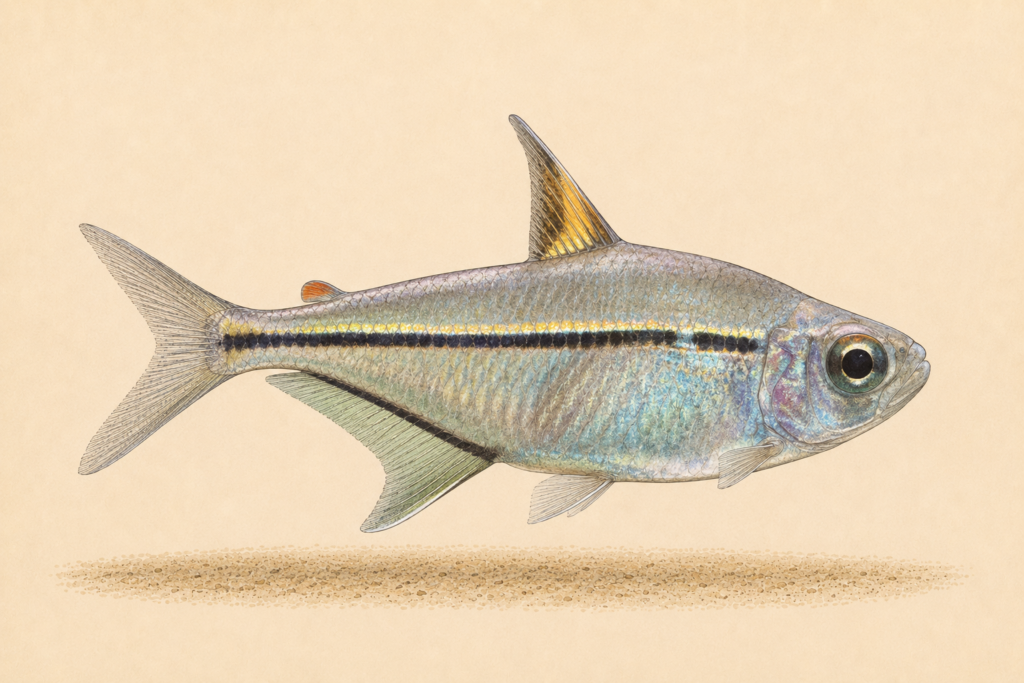
The largest adults measure 50 mm, not counting the tail fin. Once adult, females are bigger than males and have a rounder belly.
Natural Habitat
The Broken-Line Tetra comes from the Paraguay River basin in South America. There it lives in slow-moving rivers and their tributaries. Its home waters have little or no plant life growing in them.
Tank Size and Setup
We recommend a tank of at least 68 litres. A biotope setup is simple to put together for this fish. Twisted roots and a few driftwood branches suit the tank, set over a floor of river sand. Common beech makes a safe stand-in for driftwood, as long as it has been thoroughly dried and the bark stripped off. To round off the natural feel, add a few handfuls of dried leaves, either beech or oak.
The water should end up the colour of weak tea as the wood and leaves stain it. Old leaves should be taken out and replaced every few weeks, since left in they can rot and foul the water. Lighting should be kept fairly dim. In an aquarium, a heavily planted tank that is kept clean suits it too, and so does a tank shared with other peaceful fish.
Water Parameters
Aim for a pH of 6.0 to 7.0 and a hardness of 5 to 12 dGH.
| Temperature | 23-27 C |
| pH | 6.0-7.0 |
| General hardness (GH) | 5-12 dGH |
| Ammonia | 0 ppm |
| Nitrite | 0 ppm |
| Nitrate | Below 20 ppm |
Both the temperature and the pH need to stay steady for this fish. Other published figures give a pH of 5.8 to 7.2 and a hardness of up to 10 dGH.
Filtration and Equipment
To mimic black water conditions, you can put aquarium-safe peat in a small net bag and add it to the filter. We recommend a filter that turns the water over four to five times an hour for a tank of at least 68 litres, and a heater to hold the temperature within 23 to 27 degrees Celsius.
Diet and Feeding
The Broken-Line Tetra is easy to feed and will take almost anything you offer. Feed small live or frozen foods regularly, such as bloodworm, Daphnia and brine shrimp, with flakes or granules alongside, to keep the fish in good condition and bring out its colours. A quality dried food, freeze-dried bloodworm and freeze-dried brine shrimp are also recommended.
Behaviour and Temperament
These are very peaceful fish, and they struggle to hold their own against very boisterous or much larger tank mates. They are naturally shoaling fish and do much better among their own kind. Keep a minimum of 6, and ideally 10 or more. A group also shows the fish off better, as is the case with most tetras.
Tank Mates
Choosing companions for the Broken-Line Tetra is one of the easier tasks in fish keeping. Their gentle temperament and preference for the mid-water column make them compatible with a vast range of similarly peaceful tropical species. The main considerations are to avoid anything large enough to eat them, anything aggressive or territorial enough to bully them, and anything that requires drastically different water conditions.
Good tank mates
- Neon Tetra – A classic companion; similar size, temperament and water requirements make these two an ideal pairing.
- Ember Tetra – Tiny and completely non-aggressive, Ember Tetras add a warm splash of colour without any compatibility concerns.
- Rummy-Nose Tetra – A fellow Hemigrammus species that shares identical care needs and creates a striking multi-species shoaling display.
- Panda Corydoras – Peaceful bottom-dwellers that occupy a different zone of the tank and help clean up uneaten food.
- Otocinclus – Gentle algae grazers that stay small and pose no threat whatsoever to tetras.
- Harlequin Rasbora – Another calm, similarly sized shoaling species that coexists beautifully with small tetras.
- Honey Gourami – A mild-mannered surface dweller that adds variety without introducing aggression.
- Cherry Shrimp – Adult shrimp are safe with Broken-Line Tetras; the fish may eat very young shrimplets but generally coexist well in a planted tank.
- Kuhli Loach – A quirky, nocturnal bottom-dweller that is entirely peaceful and occupies the substrate level the tetras ignore.
Fish to avoid
- Oscar – Far too large and predatory; Broken-Line Tetras would be seen as food.
- Tiger Barb – Notorious fin nippers that can relentlessly harass slower, gentler tetras.
- Convict Cichlid – Highly territorial, especially when breeding, and will bully or kill small tetras.
- Red-Tail Catfish – Grows enormous and is a voracious predator of small fish.
- Jaguar Cichlid – An aggressive, large cichlid that is wholly incompatible with any small tetra.
- Betta – While sometimes kept with tetras, the Betta’s flowing fins and territorial tendencies can lead to stress for both parties; best avoided in smaller tanks.
Breeding
Breeding is possible in much the same way as for related fish, but raising a good number of fry means moving to a separate tank. A tank of about 18 by 10 by 10 inches is big enough. The breeding tank needs very dim lighting, and clumps of java moss or spawning mops will give the fish places to lay eggs. Another option is mesh over the base of the tank, with holes wide enough for eggs to drop through yet too narrow for adults to reach them.
Use soft, acidic water in the breeding tank, at a pH of 5.5 to 6.5 and a gH of 1 to 5. Both RO water and peat filtration of the breeding water are useful. You can spawn them as a group, and about six fish of each sex works well. Given a good run of tiny live meals beforehand, spawning ought not to prove very troublesome.
Spawning in pairs is the alternative. For that, keep males and females in separate tanks until they are ready. Pair up the fattest female with the best-coloured male at a time when females look heavy with eggs and males show off their finest colours, moving the two to the spawning tank in the evening. Expect eggs by the next morning.
Adults will eat the eggs whenever they can, so take them out as soon as eggs appear, whether you spawn in a group or in pairs. The eggs hatch in 24 to 36 hours. The fry swim freely 3 to 4 days after hatching. Darkness is best for the tank if it can be managed, since eggs and fry are sensitive to light at first.
Common Diseases
The Broken-Line Tetra can be affected by Cryptobia infestation, a parasitic problem, and by general bacterial infections.
FAQs
How big does the Broken-Line Tetra get?
The largest adults measure 50 mm, not counting the tail fin.
How many Broken-Line Tetras should I keep together?
Aim for at least 6 fish, and ideally 10 or more.
Is the Broken-Line Tetra easy to feed?
Yes, it is easy to feed and takes almost any food offered.
How can I tell males and females apart?
Look at size and belly shape: adult females are the bigger fish and have a rounder belly than males.
Related Guides
- Rummy-Nose Tetra Care Guide – A closely related Hemigrammus species with similar care needs and excellent community compatibility.
- Head-and-Taillight Tetra Care Guide – Another Hemigrammus tetra that makes a fine companion and shares almost identical requirements.
- Neon Tetra Care Guide – The most popular small tetra in the hobby, often kept alongside Broken-Line Tetras in community set-ups.
- Panda Corydoras Care Guide – A peaceful bottom-dwelling catfish that pairs beautifully with mid-water shoaling tetras.
- Ember Tetra Care Guide – A tiny, undemanding tetra ideal for nano and community tanks alongside other gentle species.