Quick Summary
Burgess Corydoras is a peaceful, bottom-dwelling catfish best suited to aquarists who can provide soft substrate, stable soft-water conditions, and a group of at least six. It is a moderately easy species that rewards careful setup with charming social behaviour and an attractive banded pattern.
🐠 Build a tank around this species
In this guide:
- Introduction
- Quick Stats
- Appearance
- Natural Habitat
- Tank Size and Setup
- Water Parameters
- Diet and Feeding
- Behaviour and Temperament
- Tank Mates
- Breeding
Introduction
Burgess Corydoras, formally described as Corydoras burgessi and recently reassigned to the genus Hoplisoma following the 2024 taxonomic revision by Dias and colleagues, is a small armoured catfish from the upper Rio Negro drainage in Brazil. First described by Axelrod in 1987, it quickly gained a following among dedicated corydoras enthusiasts for its bold dark mask and distinctive dorsal-fin blotch. Though not as commonly available as species such as the Bronze Corydoras or Peppered Corydoras, Burgess Corydoras appears regularly in specialist shops and online retailers, often commanding a slightly higher price than the most ubiquitous corydoras species.
Like all members of the corydoras group – now split across Hoplisoma, Corydoras sensu stricto, and several other genera – this species is an obligate shoaler. Keeping it in groups of six or more is not merely a recommendation but a genuine welfare requirement. Solitary or paired individuals tend to become reclusive, stressed, and prone to health problems. In a properly furnished tank with a soft substrate, dim lighting, and a companionable group, Burgess Corydoras is an active, endearing fish that spends much of the day sifting through the substrate for food morsels.
This guide covers everything you need to know to keep Hoplisoma burgessi healthy and thriving in a home aquarium, from tank dimensions and water chemistry to compatible tank mates and breeding protocols.
Quick Stats
| Scientific name | Corydoras burgessi |
|---|---|
| Common names | Burgess Cory, C087 |
| Family | Callichthyidae |
| Origin | Upper Rio Negro basin, Amazonas, Brazil |
| Adult size | 5.5 cm |
| Lifespan | 5–8 years |
| Difficulty | Intermediate |
| Breeding difficulty | Moderate |
| Temperature | 22–26 °C |
| pH | 5.5–7 |
| GH | 2–8 dGH |
| KH | 1–4 dKH |
| Minimum tank size | 75 L |
| Conservation status | Least Concern (IUCN, assessed 2018) |
Appearance
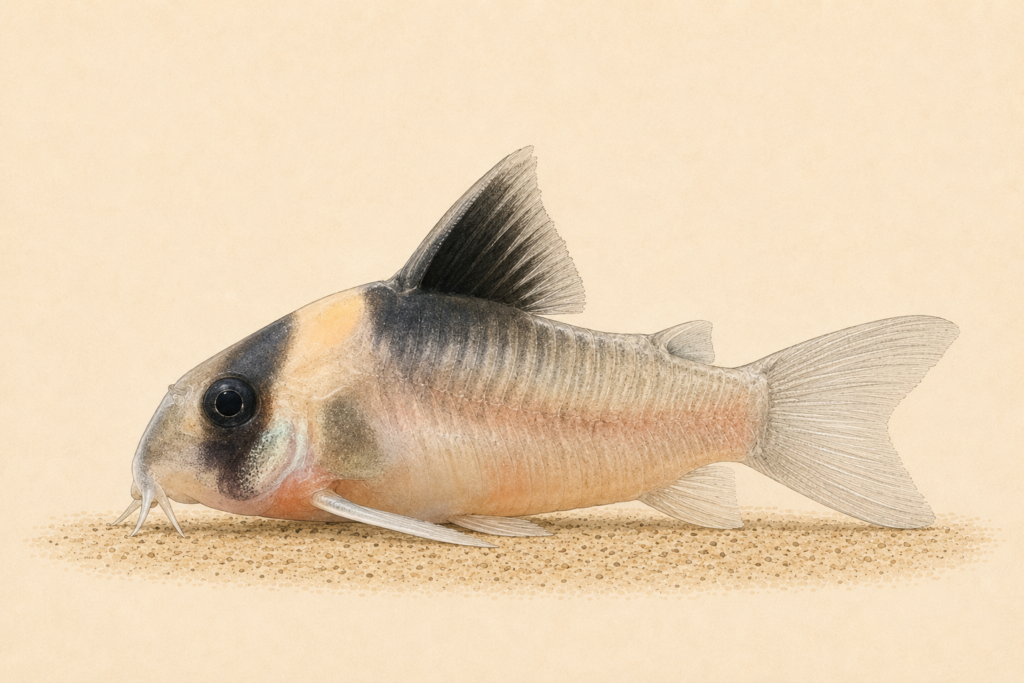
Burgess Corydoras is one of the more immediately recognisable members of the broader corydoras group. The base body colour is a warm cream to pale beige, sometimes with a faint pinkish or silvery sheen depending on lighting and mood. Two prominent dark markings dominate the fish’s appearance. The first is a broad, dark band or mask that runs across the top of the head, through the eye, and down towards the gill cover. This eye band is bold and well-defined, giving the fish a somewhat raccoon-like appearance that many hobbyists find appealing. The second major marking is a large, roughly triangular dark blotch on the dorsal fin and the area immediately behind it along the dorsal ridge, extending partially down the flanks. Between these two dark areas, the body remains largely pale, creating a striking contrast.
The caudal fin is typically translucent with faint dark spotting or barring, while the pectoral and ventral fins are clear to very lightly pigmented. As with all corydoras-type catfish, Hoplisoma burgessi possesses two rows of overlapping bony scutes along each flank rather than traditional scales, giving the body a slightly armoured, angular profile. The mouth is subterminal and flanked by two pairs of short barbels used for locating food in the substrate. These barbels are sensitive structures and are easily damaged by rough or sharp substrates – a key husbandry consideration discussed further in the Tank Size and Setup section.
Sexual dimorphism is subtle. Mature females tend to be slightly larger and noticeably rounder when viewed from above, particularly when gravid. Males are generally a touch more slender and may have slightly more pointed pectoral-fin spines, though this difference is difficult to judge without direct comparison. Both sexes display identical colour patterns.
Natural Habitat
Hoplisoma burgessi is endemic to the upper Rio Negro drainage in Amazonas state, Brazil. The Rio Negro is one of the most chemically distinctive waterways in the Amazon basin, famous for its dark, tea-coloured waters stained by dissolved tannins and humic acids leaching from decomposing vegetation in surrounding forests. These blackwater conditions produce extremely soft, acidic water with very low mineral content. Conductivity readings in typical Burgess Corydoras habitat are often below 20 microsiemens per centimetre, and pH values can fall as low as 4.0-5.0 in the most extreme blackwater tributaries, though the species is usually collected from slightly less extreme environments at pH 5.0-6.5.
In the wild, this species inhabits slow-moving tributaries, flooded forest margins, and shallow sandy stretches where leaf litter accumulates. The substrate is typically fine white or beige sand, sometimes mixed with a layer of decomposing leaves and twigs. Overhead cover is dense, with the forest canopy filtering light and submerged roots, branches, and leaf litter providing abundant shelter. Water temperatures in these habitats generally range from 23 to 27 degrees Celsius, with seasonal fluctuations linked to rainfall patterns.
The Rio Negro’s nutrient-poor waters support relatively low bacterial populations, which means that the fish have evolved in an environment with minimal pathogen pressure. This can make them somewhat sensitive to poor water quality in captivity, particularly elevated nitrate levels or bacterial blooms that would be unusual in their natural habitat. Understanding this ecological background helps explain why Burgess Corydoras thrives in clean, well-maintained aquaria with soft, acidic water and a sandy bottom strewn with leaf litter and driftwood.
Tank Size and Setup
A group of six Burgess Corydoras requires a minimum of 75 litres, though 100 litres or more is preferable, especially if keeping them in a community setting. Tank footprint matters more than height for this bottom-dwelling species; a longer, shallower tank with ample floor space is always a better choice than a tall, narrow design. A tank measuring roughly 80 cm in length and 30 cm in depth (front to back) provides a good starting point for a small group.
Substrate choice is critical for all corydoras-type catfish. Fine, smooth sand is the only truly appropriate option. Sharp gravel, crushed coral, and rough substrates will abrade and erode the delicate barbels over time, leading to infections and reducing the fish’s ability to feed naturally. Play sand, pool filter sand, or purpose-sold aquarium sand in a natural beige or white tone works perfectly and also echoes the pale sandy bottoms of the species’ native habitat. A substrate depth of 2-4 cm is sufficient.
Decor should aim to replicate the sheltered, dimly lit environments this species prefers. Driftwood – particularly pieces of Malaysian driftwood, mopani wood, or spider wood – provides visual barriers and leaches tannins that gently acidify the water. Indian almond leaves (Terminalia catappa) or dried oak leaves scattered across the substrate serve a similar function while also harbouring biofilm and microfauna that the fish will graze on. Live plants are not essential but are certainly compatible; species tolerant of soft, acidic water such as Java Fern (Microsorum pteropus), Anubias varieties, and various Cryptocoryne species are ideal choices. These can be attached to driftwood or rooted in the sand.
Lighting should be subdued. Burgess Corydoras is most active and comfortable under dim conditions, and floating plants such as Amazon Frogbit or Salvinia can help diffuse overhead light. If using LED fixtures, dimming to around 30-50 per cent output or using a timer to provide a natural photoperiod of 8-10 hours is advisable.
Ensure the tank has a secure, tight-fitting lid or cover. While corydoras are not habitual jumpers, they do occasionally dash to the surface to gulp atmospheric air – a normal behaviour linked to their ability to absorb oxygen through the intestinal lining – and a startled fish can breach the surface with enough force to leave an uncovered tank.
Water Parameters
Burgess Corydoras originates from soft, acidic blackwater environments, and while captive-bred specimens may tolerate a somewhat broader range of conditions, providing water chemistry that leans towards these natural parameters will promote the best health, colour, and breeding potential. The table below summarises the recommended ranges for long-term maintenance.
| Temperature | 22-26 C |
| pH | 5.5-7.0 |
| General hardness (GH) | 1-8 dGH |
| Carbonate hardness (KH) | 0-4 dKH |
| Ammonia | 0 ppm |
| Nitrite | 0 ppm |
| Nitrate | Below 20 ppm |
Stability is arguably more important than hitting any single target value. Sudden swings in pH or temperature are far more dangerous to corydoras than a reading that sits slightly outside the ideal range but remains consistent. Use a reliable liquid test kit (not test strips) to monitor ammonia, nitrite, and nitrate at least weekly, and check pH and hardness monthly or whenever you change your water source.
If your tap water is moderately hard or alkaline, you can soften it by blending with RO (reverse osmosis) or deionised water. Adding botanicals such as Indian almond leaves, alder cones, or peat filtration media will also help lower pH and introduce beneficial tannins. Avoid chasing extremely low pH values unless you are experienced with buffering and understand the risks of pH crashes in very low-KH water.
Weekly water changes of 25-30 per cent are recommended. When preparing replacement water, match the temperature closely – corydoras are sensitive to sudden temperature drops, which can trigger stress, disease, or even unwanted spawning activity in the short term.
Filtration and Equipment
Good filtration is essential, but flow rate should be moderate. Burgess Corydoras is not a riverine species accustomed to strong currents; it prefers gentle to moderate water movement that turns the tank volume over approximately four to six times per hour. A quality hang-on-back filter or a small canister filter is ideal for tanks in the 75-150 litre range. Sponge filters also work well, particularly in breeding setups, as they provide excellent biological filtration without generating excessive flow and pose no risk to fry or eggs.
If using a canister or power filter, ensure the intake is fitted with a sponge pre-filter or fine guard to prevent small fish or fry from being drawn in. Position the outflow so that it creates gentle circulation across the tank without blasting a strong current directly at the substrate, which can stress bottom-dwellers.
A heater rated appropriately for the tank volume is necessary to maintain a stable temperature in the 22-26 C range. Heaters with external temperature controllers or those with reliable built-in thermostats are preferable; always verify the actual water temperature with an independent thermometer rather than relying solely on the heater dial. Place the heater near the filter outflow to ensure even heat distribution.
An air pump is optional but can be beneficial, particularly in warmer conditions when dissolved oxygen levels drop. While Burgess Corydoras can supplement its oxygen intake by gulping air at the surface, this behaviour should not be frequent under normal conditions. If you notice your corydoras dashing to the surface repeatedly and persistently, it often indicates low dissolved oxygen, high temperature, or poor water quality rather than normal behaviour.
Diet and Feeding
Burgess Corydoras is an omnivorous, benthic feeder. In the wild, it sifts through sandy substrates and leaf litter to find insect larvae, worms, small crustaceans, detritus, and biofilm. In captivity, it accepts a wide range of prepared and live foods, but a varied diet is important for long-term health and breeding condition.
A high-quality sinking pellet or wafer designed for bottom-feeders should form the dietary staple. Look for products with whole fish meal, shrimp meal, or insect meal as the primary ingredient rather than wheat or soy fillers. Offer these once or twice daily in quantities that the group can consume within a few minutes. Corydoras are enthusiastic eaters but can be outcompeted by faster midwater or surface-feeding tank mates, so feeding after lights-out or using a feeding dish placed directly on the substrate can help ensure they receive their share.
Supplement the staple diet regularly with frozen or live foods. Bloodworm, daphnia, brine shrimp (Artemia), tubifex, and micro worms are all excellent choices. Live foods are particularly valuable for conditioning breeding pairs and promoting natural foraging behaviour. Blanched vegetables such as courgette (zucchini), cucumber, or shelled peas can be offered occasionally as an additional source of fibre and plant matter, though corydoras typically show less interest in vegetable foods than in protein-rich items.
Avoid overfeeding. Uneaten food that sinks into the substrate and decomposes will quickly degrade water quality – a particular concern for a species sensitive to elevated nitrate and organic waste. Remove any uneaten food after a couple of hours. A varied feeding schedule – for example, sinking pellets in the morning, frozen bloodworm in the evening, and a fasting day once a week – promotes good digestion and keeps the fish engaged.
Behaviour and Temperament
Burgess Corydoras is a peaceful, sociable species that poses absolutely no threat to any tank mate. It spends the majority of its time on or very near the substrate, methodically probing the sand with its barbels in search of food. Groups display a loose shoaling behaviour, often resting together in shaded spots during quieter periods and then fanning out across the tank floor when actively foraging. This synchronised activity is one of the great pleasures of keeping corydoras and is only visible when the fish are maintained in groups of six or more.
Like other corydoras-type catfish, Hoplisoma burgessi is capable of intestinal respiration. You will periodically see individuals dart rapidly to the water surface, gulp a bubble of air, and return to the bottom. This is completely normal and not a sign of distress unless it happens with unusual frequency. The swallowed air passes through the gut, where oxygen is absorbed across the highly vascularised intestinal wall.
The species is generally most active during dawn, dusk, and after lights-out, though well-settled individuals in a dimly lit tank can be active throughout the day. Newly introduced fish may be shy and reclusive for the first week or two; providing ample cover in the form of driftwood, leaf litter, and plants helps them acclimatise more quickly. Once settled, they become confident and inquisitive, often approaching the front glass at feeding time.
Aggression is essentially non-existent. The only physical interactions you are likely to observe are mild jostling over a particularly desirable food morsel and the distinctive “T-position” mating clasp during spawning. Burgess Corydoras can be kept with other corydoras species without any issues; mixed-species corydoras communities are a popular approach in Amazonian-themed biotope tanks.
Tank Mates
Burgess Corydoras is an exceptionally peaceful fish and can coexist with a wide range of similarly gentle species. The ideal tank mates are small, non-aggressive fish that occupy the mid-water or surface zones and thrive in similar soft, acidic water conditions. Avoid any species large enough to view the corydoras as prey, any species known for fin-nipping or aggressive territorial behaviour, and any bottom-dwellers that might compete aggressively for the same substrate space.
Good tank mates
- Cardinal Tetra – A classic Rio Negro companion that shares the same soft, acidic water requirements and occupies the midwater zone.
- Rummy-nose Tetra – Another gentle shoaling tetra from similar Amazonian blackwater habitats, making it an ideal biotope companion.
- Ember Tetra – A tiny, peaceful tetra that adds colour to the upper water column without any risk to bottom-dwellers.
- Nannostomus Pencilfish – Calm, slender surface-dwellers that complement corydoras perfectly in soft-water setups.
- Otocinclus – Peaceful algae-eating catfish that occupy different feeding niches and share a preference for gentle conditions.
- Chocolate Gourami – A soft-water labyrinth fish with a calm disposition, well suited to the same dimly lit, tannin-rich environment.
- Pygmy Corydoras – A smaller corydoras relative that can share the same tank without territorial conflict, adding variety to the lower zone.
- Apistogramma agassizii – A dwarf cichlid from soft-water Amazonian habitats that is generally peaceful towards corydoras, though pairs may defend a breeding site.
Fish to avoid
- Oscar – Far too large and predatory; an adult Oscar will easily consume a Burgess Corydoras.
- Convict Cichlid – Highly aggressive, especially when breeding, and will harass and injure small bottom-dwellers.
- Tiger Barb – A notorious fin-nipper that creates constant stress for peaceful species like corydoras.
- Red-tail Catfish – A massive predatory catfish entirely incompatible with any small community fish.
- Chinese Algae Eater – Becomes territorial and aggressive with age, often latching onto the flanks of slow-moving tank mates.
- African Rift Lake Cichlids – Require hard, alkaline water that is the opposite of what Burgess Corydoras needs, and many species are highly aggressive.
Breeding
Breeding Burgess Corydoras in captivity is achievable and follows the general pattern seen across most corydoras species. Success depends on having a well-conditioned group in excellent health, providing appropriate water conditions, and simulating the natural triggers that stimulate spawning.
Start with a group of at least six individuals to ensure a good mix of sexes. Condition the group with frequent feedings of high-protein live and frozen foods – bloodworm, daphnia, and brine shrimp are all effective – for two to three weeks prior to any spawning attempt. During this conditioning period, maintain the water at the warmer end of the species’ range, around 25-26 C.
Spawning is typically triggered by simulating the onset of the rainy season. Perform a large water change (50-70 per cent) using water that is slightly cooler (2-3 C below the tank temperature), softer, and more acidic than the existing tank water. Lowering barometric pressure, which naturally occurs before storms, also seems to play a role, so attempting spawning during unsettled weather may improve results. Increased aeration and a slight drop in temperature often act as additional stimuli.
When ready to spawn, the female will become noticeably plumper and more active. Males will pursue her energetically, and the classic corydoras “T-position” will be observed: the male clasps the female’s barbels between his pectoral fin and body while she receives sperm and simultaneously releases a small clutch of eggs, typically two to five at a time, held between her ventral fins. She then deposits the adhesive eggs on a smooth surface – typically the aquarium glass, broad plant leaves, or the underside of driftwood. This process repeats over several hours, with a total clutch often numbering 30-80 eggs.
The eggs are small, round, and slightly yellowish. Neither parent provides any care after spawning, and adults may eat the eggs if given the opportunity. For the best hatching rates, carefully remove the eggs to a separate rearing container with matching water parameters and gentle aeration. Adding a few drops of methylene blue or a small piece of Indian almond leaf to the rearing water helps inhibit fungal growth on the eggs. Hatching typically occurs within four to five days at 24-25 C. The newly hatched fry are tiny and will absorb their yolk sacs over the first two to three days before becoming free-swimming and needing their first feeds of infusoria, microworms, or commercially available liquid fry food. As they grow, they can be transitioned to freshly hatched brine shrimp nauplii and finely crushed dry food.
Common Diseases
Burgess Corydoras is generally robust when kept in appropriate conditions, but like all aquarium fish it is susceptible to certain health issues, particularly when water quality declines or the environment is poorly suited to its needs.
Barbel erosion is one of the most frequently seen problems in corydoras kept on inappropriate substrates. Sharp gravel or rough substrates gradually wear down the barbels, leaving them shortened, damaged, and vulnerable to secondary bacterial infection. Prevention is simple: always use fine, smooth sand. If you acquire fish with already-shortened barbels, providing an ideal substrate and clean water will usually allow partial regrowth over time.
White spot disease (Ichthyophthirius multifiliis), commonly known as ich, can affect Burgess Corydoras, particularly after sudden temperature drops or during periods of stress. The characteristic white cysts are visible on the body and fins. Treatment should be approached with caution, as corydoras and other scaleless or armoured catfish can be sensitive to certain medications. Use ich treatments at half the standard dose, or opt for the heat method (gradually raising temperature to 30 C for 10-14 days while increasing aeration) if your other tank inhabitants can tolerate it.
Bacterial infections, including fin rot and skin ulcers, can occur in tanks with poor water quality. Elevated ammonia, nitrite, or nitrate levels, infrequent water changes, and overcrowding all increase the risk. Maintaining excellent water quality is the best preventive measure. Mild cases often resolve with improved conditions alone; more severe infections may require treatment with a broad-spectrum antibacterial medication suitable for use with catfish.
Internal parasites can occasionally be a concern, particularly in wild-caught specimens. Symptoms may include weight loss despite a healthy appetite, white or stringy faeces, and a gradual decline in condition. A quarantine period of two to four weeks for all new arrivals, combined with prophylactic treatment with a suitable anti-parasitic if warranted, is good practice.
Fungal infections sometimes appear on eggs during breeding attempts or on wounds. Maintaining clean water, removing dead or infertile eggs promptly, and using antifungal agents such as methylene blue in breeding containers will minimise the risk.
FAQs
How many Burgess Corydoras should I keep together?
A minimum of six is strongly recommended, and larger groups of eight to twelve are even better. Corydoras are obligate shoaling fish that rely on the security of numbers to feel confident enough to exhibit natural behaviours. Keeping fewer than six typically results in timid, stressed fish that hide constantly and may suffer health problems linked to chronic stress.
Can I keep Burgess Corydoras on gravel?
No. Gravel, especially sharp or coarse varieties, will damage the sensitive barbels that the fish rely on for feeding. Fine, smooth sand is the only appropriate substrate. If your tank currently has gravel and you wish to keep corydoras, switching to sand is a straightforward and worthwhile change.
Is Burgess Corydoras the same as Corydoras burgessi?
Yes. Hoplisoma burgessi is the current valid name following the 2024 taxonomic revision that split the traditional genus Corydoras into several genera. Most hobbyists and retailers still use the name Corydoras burgessi, and both names refer to the same species. You may see either name used in shops and online listings.
Why do my Burgess Corydoras keep darting to the surface?
Occasional trips to the surface to gulp air are completely normal. Corydoras possess the ability to absorb oxygen through their intestinal lining, and periodic air-gulping is part of their natural behaviour. However, if the fish are doing this very frequently – every few seconds or in a frantic manner – it may indicate low dissolved oxygen levels, high temperature, or deteriorating water quality. Check your water parameters and ensure adequate aeration.
Can I keep Burgess Corydoras with other corydoras species?
Absolutely. Different corydoras (and Hoplisoma) species coexist peacefully and can share a tank without any issues. Each species will tend to shoal primarily with its own kind, so it is best to maintain each species in groups of at least six rather than keeping, say, three of one species and three of another. A mixed corydoras community in a larger tank can be a wonderfully active and visually interesting display.
Related Guides
- Bronze Corydoras – The most widely kept corydoras species, sharing very similar care requirements and making a useful comparison for beginners.
- Sterbai Corydoras – A popular warm-water corydoras with comparable husbandry needs, often kept alongside Burgess Corydoras in soft-water setups.
- Panda Corydoras – Another attractively patterned corydoras species that thrives in similar conditions, useful for comparison shopping.
- Cardinal Tetra – An ideal midwater companion from the same Rio Negro habitat, covered in detail in its own guide.
- Apistogramma agassizii – A soft-water dwarf cichlid that pairs well with corydoras in Amazonian biotope setups.