Quick Summary
The Empire Gudgeon is a beautifully coloured, hardy native Australian fish that suits community tanks of 100 litres or more, provided you offer plenty of hiding spots and a varied diet including live or frozen foods to bring out the males’ stunning breeding colours.
🐠 Build a tank around this species
In this guide:
- Introduction
- Quick Stats
- Appearance
- Natural Habitat
- Tank Size and Setup
- Water Parameters
- Diet and Feeding
- Behaviour and Temperament
- Tank Mates
- Breeding
Introduction
The Empire Gudgeon (Hypseleotris compressa) is one of Australia’s most attractive native freshwater fish and has earned a loyal following among aquarists worldwide. Despite being relatively undemanding in terms of water chemistry, this species rewards keepers who take the time to replicate elements of its natural environment and provide a high-quality, varied diet. Males in breeding condition develop a spectacular livery of red, orange, and iridescent blue that rivals many tropical imports, making the Empire Gudgeon a compelling alternative for hobbyists seeking something a little different from the usual community tank fare.
Belonging to the family Eleotridae – the sleeper gobies – Empire Gudgeons are not true gobies but share a similar bottom-dwelling lifestyle. Unlike gobies, however, their pelvic fins are separate rather than fused into a sucker disc, which gives them a distinctive resting posture and swimming style. They are found across a wide range of habitats in eastern Australia and southern New Guinea, from clear coastal streams to brackish estuaries, and this adaptability translates well to captive life. They tolerate a broad spectrum of water conditions and can even be kept in lightly brackish setups, although they do perfectly well in pure freshwater.
Empire Gudgeons have been available in the aquarium trade for decades but remain somewhat underappreciated outside of their native range. Their moderate adult size, peaceful (if occasionally territorial) disposition, and manageable care requirements make them suitable for intermediate hobbyists and even well-prepared beginners. This guide covers everything you need to know to keep and breed Empire Gudgeons successfully, from tank setup and water parameters to diet, behaviour, and compatible tank mates.
Quick Stats
| Scientific name | Hypseleotris compressa |
|---|---|
| Common names | Empire Fish, Carp Gudgeon |
| Family | Eleotridae |
| Origin | Eastern Australia and southern New Guinea |
| Adult size | 10 cm |
| Lifespan | 3–5 years |
| Difficulty | Intermediate |
| Breeding difficulty | Moderate |
| Temperature | 20–28 °C |
| pH | 6.5–8 |
| GH | 5–20 dGH |
| KH | 3–15 dKH |
| Minimum tank size | 100 L |
| Conservation status | Least Concern (IUCN) |
Appearance
The Empire Gudgeon is a laterally compressed, moderately elongated fish with a slightly pointed snout and upward-angled mouth. Its body shape is typical of the eleotrid gudgeons – robust but streamlined, with two distinct dorsal fins (the first spiny, the second soft-rayed) set well apart on the back. The caudal fin is rounded to slightly truncate, and the pectoral fins are broad and fan-like, often used to prop the fish up when it rests on the substrate or on a flat surface.
Sexual dimorphism in this species is pronounced and is one of its chief attractions. Females and non-breeding males are a subdued olive-brown to grey, with a dark lateral stripe running from the snout through the eye to the base of the tail. A second, less distinct stripe may run along the belly. The fins are mostly translucent with faint dusky markings. This understated colouration provides effective camouflage against a natural substrate of sand and leaf litter.
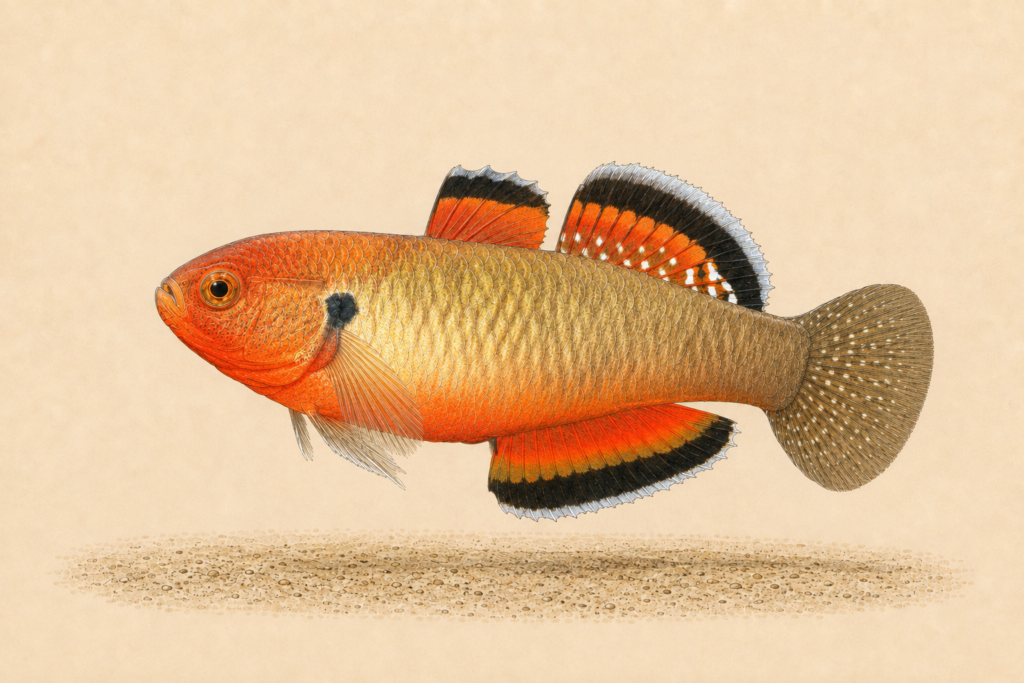
Males in breeding condition, however, undergo a dramatic transformation. The body takes on a rich reddish-orange to deep crimson hue, particularly along the flanks and belly. The head and gill covers develop an iridescent blue-green sheen, and the dorsal, anal, and caudal fins become edged with vivid red, orange, or white margins. The first dorsal fin may display a bold black spot or ocellus. The overall effect is striking and has earned the species its regal common name. The intensity of male colour depends heavily on diet, water quality, and social dynamics – dominant males with access to high-quality live foods and a territory to defend will show the most vibrant colours.
Juveniles of both sexes resemble adult females, with the lateral stripe being the most prominent feature. Males typically begin to show colour from around 4-5 cm in length, with full breeding dress developing as they approach maturity at around 6-8 cm.
Natural Habitat
Empire Gudgeons occupy a remarkably wide range of habitats across their native range in eastern Australia and southern New Guinea. They are found in coastal rivers, creeks, lagoons, billabongs, and estuarine environments from far north Queensland down to northern New South Wales, and across the Top End of the Northern Territory. Populations also occur in the freshwater and brackish waterways of southern Papua New Guinea and possibly parts of Irian Jaya.
In the wild, these fish favour slow-moving or still sections of waterways with abundant cover. Typical microhabitats include undercut banks, submerged tree roots, fallen timber, beds of aquatic macrophytes, and areas of dense riparian vegetation that trail into the water. The substrate in these environments is usually sand, fine gravel, or mud, often covered with a layer of decomposing leaf litter. Water clarity varies enormously – from crystal-clear spring-fed creeks to tannin-stained billabongs and turbid lowland rivers.
Water chemistry across the species’ range is similarly variable. Many populations inhabit soft, slightly acidic freshwater, while others thrive in moderately hard, alkaline conditions or even in brackish estuarine zones where salinity can fluctuate with the tides. Water temperatures in their native range typically sit between 20 and 30 degrees Celsius, with cooler conditions prevailing in the southern parts of the range during winter and warmer temperatures in the tropical north year-round. This broad environmental tolerance is one of the reasons the Empire Gudgeon adapts so well to aquarium life.
Empire Gudgeons are often found alongside other native Australian species such as rainbowfish (Melanotaenia spp.), blue-eyes (Pseudomugil spp.), and other gudgeon species. They share their habitat with freshwater prawns, aquatic insects, and small crustaceans, all of which form part of their natural diet. In estuarine environments, they may coexist with species more commonly associated with brackish or marine conditions.
Tank Size and Setup
A minimum tank volume of 100 litres is recommended for a small group of Empire Gudgeons. While a single specimen could technically be housed in a smaller setup, these fish are best kept in groups of at least four to six individuals, and the additional space is essential for managing the semi-territorial behaviour of breeding males. For larger groups or mixed community setups, a tank of 150-200 litres or more is preferable.
The tank should be set up to provide ample cover and clearly defined territories. Driftwood, smooth rocks, and dense plantings are all valuable for breaking up sightlines and giving subordinate fish places to retreat. Empire Gudgeons are primarily bottom-dwelling, so the lower third of the tank is the most important zone to furnish. Flat rocks, upturned terracotta pots, coconut shell halves, and pieces of PVC pipe all make excellent cave-like shelters that males will use as spawning sites and territorial bases. Arrange hardscape to create multiple distinct hiding spots – this is especially important if you intend to keep more than one male, as it allows each to establish a territory without constant conflict.
A sandy substrate is ideal, as it mimics the natural habitat and allows the fish to rest comfortably on the bottom. Fine gravel is also acceptable. Avoid sharp or rough substrates that could damage the fish’s underside as they rest on the bottom. A scattering of dried leaf litter (such as Indian almond leaves or oak leaves) adds a naturalistic touch, provides additional cover for fry and shy individuals, and releases beneficial tannins that can help condition the water.
Live plants are recommended and serve multiple purposes: they improve water quality, provide cover, and create a more visually appealing display. Hardy species such as Java Fern (Microsorum pteropus), Anubias, Vallisneria, and Java Moss (Taxiphyllum barbieri) are all good choices. Floating plants can be used to diffuse overhead light, which makes the fish feel more secure and can encourage males to display more boldly. Empire Gudgeons are not known to damage plants, so even delicate species are generally safe.
A secure, tight-fitting lid is essential. Empire Gudgeons are capable jumpers, particularly when startled or during territorial disputes. Any gaps around filter inlets, heater cables, or airline tubing should be blocked.
Lighting should be moderate. Overly bright lighting can make these fish nervous and may suppress colour display. If you are growing light-demanding plants, consider using floating plants or positioning hardscape to create shaded areas where the gudgeons can retreat.
Water Parameters
| Temperature | 20-28 C |
| pH | 6.5-8.0 |
| General hardness (GH) | 5-20 dGH |
| Carbonate hardness (KH) | 3-15 dKH |
| Ammonia | 0 ppm |
| Nitrite | 0 ppm |
| Nitrate | Below 20 ppm |
One of the Empire Gudgeon’s greatest assets as an aquarium fish is its tolerance of a wide range of water conditions. It can be kept successfully in soft, acidic water or in moderately hard, alkaline setups, and it will even tolerate mildly brackish conditions (up to around 5 parts per thousand salinity). This flexibility makes it compatible with a variety of community tank setups and means it can usually be kept in unmodified tap water in most parts of the United Kingdom and Australia.
That said, consistency matters more than hitting a specific number. Sudden swings in temperature or pH are far more stressful than a reading slightly outside the ideal range. Aim for stability above all else. Weekly water changes of 20-30% are recommended to keep nitrate levels low and maintain good overall water quality. Empire Gudgeons are not especially sensitive to nitrate compared to some species, but chronically elevated levels (above 40 ppm) will dull their colours and may predispose them to disease.
Temperature is worth considering carefully. At the lower end of their range (20-22 C), Empire Gudgeons are less active and less colourful but can be long-lived. At the higher end (26-28 C), they are more active, show better colour, and are more likely to breed, but their metabolism is higher and their lifespan may be slightly shorter. A temperature of around 24-26 C represents a good balance for most community setups. If you are attempting to breed them, a gradual increase in temperature to 26-28 C, combined with increased feeding of live foods, can help trigger spawning behaviour.
Filtration and Equipment
Empire Gudgeons do not have exceptionally demanding filtration requirements, but good mechanical and biological filtration is important for maintaining the stable, clean water conditions that keep them healthy and colourful. A standard hang-on-back filter or internal canister filter rated for the tank’s volume is usually sufficient. For larger setups or heavily stocked tanks, an external canister filter is preferable, as it provides greater biological filtration capacity and is generally quieter.
Flow rate is a consideration worth noting. While Empire Gudgeons can tolerate moderate current, they naturally inhabit slow-moving or still water and prefer a gentle flow. If your filter produces a strong current, use a spray bar, baffle, or direct the outflow against the glass to diffuse it. The fish should be able to rest comfortably on the substrate without being buffeted by the current. Excessively strong flow will stress them and may discourage breeding behaviour.
A reliable heater is recommended for most setups, particularly if the tank is in an unheated room or in a climate where temperatures drop below 20 C. An adjustable thermostat heater rated for the tank volume is ideal. In tropical or subtropical climates where ambient room temperature stays within the species’ preferred range year-round, a heater may not be necessary, but it is still good practice to have one available as a safeguard.
An air pump and airstone can be beneficial, particularly in warmer setups where dissolved oxygen levels may be lower. Gentle surface agitation from a filter outflow or airstone helps maintain adequate oxygenation. Sponge filters are an excellent choice for breeding tanks, as they provide gentle filtration without creating strong currents or posing a risk to tiny fry.
Diet and Feeding
Empire Gudgeons are primarily carnivorous in the wild, feeding on small aquatic invertebrates, insect larvae, worms, crustaceans, and zooplankton. In captivity, they will accept a range of foods, but a varied diet that includes regular offerings of live or frozen foods is essential for maintaining optimal health, colour, and breeding condition.
High-quality sinking pellets or granules formulated for carnivorous or omnivorous fish make a suitable staple diet. Choose a product with a high protein content and avoid those that are primarily plant-based or contain excessive fillers. Flake food is generally less suitable, as Empire Gudgeons feed primarily at the bottom and mid-water and may not readily take food from the surface.
Live and frozen foods should be offered several times per week, and ideally daily if you are conditioning fish for breeding. Excellent choices include bloodworm (chironomid larvae), brine shrimp (Artemia), daphnia, Moina, blackworm, tubifex, mosquito larvae, and glass worms (Chaoborus larvae). Live foods are particularly effective at bringing out the best colour in males and stimulating natural feeding behaviour. Frozen foods are a convenient and safe alternative when live cultures are not available.
Occasional offerings of finely chopped earthworm, whiteworm, or grindal worm provide excellent nutrition and variety. Some keepers also report success with freeze-dried foods, although these are generally less readily accepted and less nutritious than their live or frozen counterparts.
Feed once or twice daily, offering only as much food as the fish will consume within a few minutes. Empire Gudgeons can be somewhat deliberate feeders, so ensure that food reaches the bottom of the tank before more aggressive mid-water species intercept it. In community tanks, feeding at dusk or using sinking foods can help ensure the gudgeons get their fair share.
Overfeeding should be avoided, as uneaten food will foul the water. Empire Gudgeons that are well-fed on a varied diet will show noticeably better colour, stronger immune function, and greater willingness to breed than those kept on a monotonous staple diet alone.
Behaviour and Temperament
Empire Gudgeons are generally peaceful community fish, but they are not entirely passive. Males, in particular, can be semi-territorial, especially during the breeding season or when defending a chosen spawning site. Territorial disputes between males typically involve flaring of fins, lateral displays, and short chases rather than serious physical combat, but in cramped or sparsely decorated tanks, persistent harassment can stress subordinate individuals.
The key to managing territorial behaviour is to provide sufficient space and cover. In a well-furnished tank with multiple hiding spots and visual barriers, males will establish small territories around their preferred shelters and largely leave each other alone outside of brief display bouts. A ratio of one male to two or three females helps distribute male attention and reduces aggression. Keeping a single male with several females is the simplest approach for smaller tanks.
Empire Gudgeons spend much of their time resting on the substrate, on flat rocks, or on broad-leaved plants, adopting a characteristic propped-up posture supported by their pectoral fins. They are most active during dawn, dusk, and the evening hours, and may be somewhat retiring under bright midday lighting. They are not schooling fish in the strict sense but are sociable and seem more confident and colourful when kept in groups rather than singly.
When settled and comfortable, males will display frequently, fanning their fins and parading in front of females or rival males. This behaviour is one of the species’ most appealing qualities and is best observed in a dimly lit tank with plenty of cover, where the fish feel secure enough to come out and interact. Newly introduced individuals may be shy and hide for several days before becoming accustomed to their surroundings.
Empire Gudgeons are not aggressive towards other species in most circumstances. They may occasionally snap at very small tank mates such as newly born fry or tiny shrimp, but they generally ignore fish that are too large to swallow. They are not fin-nippers and do not harass other bottom-dwellers unless those species encroach on a defended spawning site.
Tank Mates
Empire Gudgeons are compatible with a wide range of peaceful to moderately active community fish. The best tank mates are species that occupy different areas of the water column, are similar in temperament, and share overlapping water parameter requirements. Avoid housing them with large, aggressive, or highly territorial species that might bully or outcompete them for food and territory. Very small fish or invertebrates may be at risk of predation, particularly if they are small enough to fit in an adult gudgeon’s mouth.
Good tank mates
- Boesemani Rainbowfish – a peaceful mid-water swimmer that occupies a different zone and shares similar water parameter preferences.
- Eastern Rainbowfish (Melanotaenia splendida) – a fellow Australian native that thrives in the same conditions and adds colour to the upper levels of the tank.
- Pacific Blue-eye (Pseudomugil signifer) – a small, peaceful Australian native that complements Empire Gudgeons well in a biotope setup.
- Threadfin Rainbowfish – a gentle, top-dwelling species that stays out of the gudgeons’ territory and enjoys similar water conditions.
- Bristlenose Pleco – a peaceful bottom-dweller that helps with algae control and generally ignores gudgeons.
- Kuhli Loach – a docile, nocturnal bottom-dweller that coexists peacefully with Empire Gudgeons.
- Cherry Barb – a calm, small barb that occupies mid-water and does not compete for territory.
- Amano Shrimp – large enough to avoid predation by adult gudgeons and an excellent algae-eating addition to the tank.
Fish to avoid
- Oscar – far too large and aggressive; would view Empire Gudgeons as prey.
- Convict Cichlid – highly territorial and aggressive, especially when breeding, and would dominate the bottom of the tank.
- Red-bellied Piranha – an obvious predator that is completely incompatible with any small peaceful fish.
- Tiger Barb – a nippy, boisterous species that can harass slower-moving bottom-dwellers.
- African Rift Lake Cichlids – too aggressive and territorial for peaceful gudgeons, and prefer very different water chemistry.
- Cherry Shrimp – adults may survive but juveniles and shrimplets are likely to be eaten by Empire Gudgeons.
Breeding
Breeding Empire Gudgeons in captivity is achievable with moderate effort and is a rewarding experience for hobbyists willing to invest the time. The species is an egg-depositor, with males guarding the eggs until hatching. Triggering spawning behaviour usually involves conditioning the fish on a rich diet of live and frozen foods, raising the water temperature slightly (to 26-28 C), and performing larger-than-usual water changes to simulate the onset of the wet season.
Males in breeding condition are unmistakable, displaying their most intense colours and actively courting females. A breeding male will select and defend a spawning site – typically the underside of a flat rock, a piece of driftwood, or the roof of a cave. He will clean the surface meticulously and display vigorously to attract a female. The courtship display involves rapid fin-flaring, lateral shimmying, and leading the female towards the spawning site.
Once a female is receptive, she will follow the male to the spawning site and deposit a clutch of small, adhesive eggs on the prepared surface. The eggs are tiny – approximately 1 mm in diameter – and are laid in a single layer. A typical clutch consists of 50 to 200 eggs, although larger females may produce more. The male fertilises the eggs immediately and then takes sole responsibility for guarding and fanning them. The female plays no further role in parental care and should not be removed, as her presence does not typically cause problems.
The eggs hatch in approximately 5 to 7 days at 26-28 C. The newly hatched larvae are extremely small – only 2 to 3 mm in length – and are essentially planktonic for the first few weeks of life. This is the most challenging stage of rearing. The larvae require very fine foods such as infusoria, liquid fry food, or commercially available rotifers for the first week or two. Once they are large enough, they can be transitioned to freshly hatched brine shrimp nauplii, which should be offered several times daily.
Rearing fry in the main tank is rarely successful, as the tiny larvae are easily consumed by adult fish (including their own parents once the male’s guarding instinct wanes) and are vulnerable to being drawn into filter intakes. For the best survival rates, either remove the spawning surface with the attached eggs to a dedicated rearing tank equipped with a gentle sponge filter, or set up a separate breeding tank from the outset. The rearing tank should be kept scrupulously clean with daily partial water changes, and uneaten food should be removed promptly to prevent water quality deterioration.
Growth is relatively slow. Fry will begin to show adult body shape at around 4 to 6 weeks, but it may take several months before they are large enough to be safely introduced to a community tank. Males begin to develop colour at around 3 to 4 months of age, with full breeding dress appearing from around 6 months onward, depending on diet and conditions.
Common Diseases
Empire Gudgeons are reasonably hardy fish and are not prone to any species-specific diseases. However, like all freshwater fish, they can be affected by common ailments if water quality is poor or if they are stressed by overcrowding, aggression, or inadequate diet.
White spot disease (Ichthyophthirius multifiliis, commonly known as ich) is perhaps the most frequently encountered illness. It presents as small white cysts on the body and fins and is usually triggered by temperature fluctuations or the introduction of infected fish. Treatment involves raising the temperature gradually to 28-30 C and, if necessary, using a proprietary ich medication. Empire Gudgeons generally tolerate standard ich treatments well, but always check that the product is safe for scaleless or sensitive fish, as some formulations containing copper or malachite green can be harsh.
Fin rot is another common problem, typically resulting from poor water quality or physical damage from aggression. Affected fins appear ragged, frayed, or discoloured at the edges. Improving water quality through more frequent water changes is usually sufficient to resolve mild cases. More severe infections may require treatment with an antibacterial medication.
Internal parasites can occasionally be an issue, particularly in wild-caught specimens. Signs include weight loss despite a healthy appetite, stringy white faeces, and a generally emaciated appearance. Commercially available anti-parasitic foods or medications containing praziquantel or levamisole are effective treatments.
Fungal infections may appear as fluffy white or grey growths on the body or fins, often at the site of a wound or abrasion. These are typically secondary infections and respond well to antifungal treatments. Ensuring that the substrate is smooth and free of sharp edges helps prevent the injuries that predispose fish to fungal problems.
The best defence against disease in Empire Gudgeons – as with any aquarium fish – is prevention through good husbandry. Maintaining stable water parameters, performing regular water changes, feeding a varied and nutritious diet, avoiding overcrowding, and quarantining new arrivals before adding them to an established tank will go a long way towards keeping your fish healthy.
FAQs
Can Empire Gudgeons be kept in a coldwater or unheated tank?
Empire Gudgeons can tolerate temperatures as low as 18-20 C for short periods, and some keepers in subtropical climates maintain them successfully without a heater. However, they are most active, colourful, and likely to breed at temperatures of 24-28 C. In the UK, an aquarium heater is strongly recommended to maintain stable temperatures within this range, particularly during the colder months.
Do Empire Gudgeons need brackish water?
No. While Empire Gudgeons are tolerant of brackish conditions and are sometimes found in estuarine habitats in the wild, they do perfectly well in pure freshwater. There is no need to add salt to their aquarium unless you are specifically setting up a brackish biotope. If you do choose to keep them in mildly brackish water (up to around 5 parts per thousand), ensure all tank mates are equally tolerant of salt.
How many Empire Gudgeons can I keep together?
A group of four to six individuals is a good starting point for a 100-litre tank. Keep one male to every two or three females to minimise territorial disputes. If you wish to keep multiple males, increase the tank size to at least 150-200 litres and provide abundant hiding spots and visual barriers so each male can establish a territory. In well-furnished larger tanks, small groups of males can coexist with relatively little aggression.
Will Empire Gudgeons eat shrimp?
Adult Empire Gudgeons may eat very small shrimp and shrimplets. Larger shrimp species such as Amano Shrimp are generally safe, as they are too big to be swallowed. Smaller species such as Cherry Shrimp or Crystal Red Shrimp are at greater risk, particularly juveniles. If you want to keep small shrimp with Empire Gudgeons, provide dense plant cover and plenty of hiding spots, but be aware that some predation is likely.
Why are my Empire Gudgeons not showing colour?
Pale or dull colouration in Empire Gudgeons usually indicates one or more of the following: the fish are female (only males develop vivid colours), the males are not yet mature, the diet lacks variety (particularly live or frozen foods), the fish are stressed by poor water quality, bright lighting, or aggressive tank mates, or there is no social stimulus (males colour up most when competing with rivals or displaying to females). Improving the diet, reducing light levels, adding more cover, and ensuring a mixed-sex group are the most effective steps to bring out the best colour.
Related Guides
- Pacific Blue-eye Care Guide – a small native Australian species that pairs beautifully with Empire Gudgeons in a biotope aquarium.
- Threadfin Rainbowfish Care Guide – another peaceful, visually striking species from Australia and New Guinea that shares compatible water requirements.
- Bristlenose Pleco Care Guide – a popular bottom-dwelling companion for community tanks housing Empire Gudgeons.
- Australian Rainbowfish Care Guide – covers the care of Melanotaenia species that make excellent mid-water tank mates.
- Peacock Gudgeon Care Guide – a related gudgeon species with similar care requirements and equally stunning male colouration.