Quick summary
The Threadfin Rainbowfish is a stunning nano fish best suited to keepers who can provide a densely planted, gently filtered, warm-water tank of at least 60 litres and a small group with more females than males. It’s moderately difficult to keep and breed, requiring low water flow to protect its delicate trailing fins and small, frequent feedings due to its tiny mouth, making it a better fit for hobbyists with some prior experience than complete beginners.
🐠 Build a tank around this species
In this guide:
- Introduction
- Quick Stats
- Appearance
- Natural Habitat
- Tank Size and Setup
- Water Parameters
- Filtration and Equipment
- Diet and Feeding
- Behaviour and Temperament
- Tank Mates
- Breeding
- Common Diseases
- FAQs
Introduction
The Threadfin Rainbowfish (Iriatherina werneri) is one of the most visually striking nano fish available in the freshwater aquarium hobby. Males of this species possess dramatically elongated fin rays that fan out like delicate threads, giving the fish an almost ethereal appearance as it glides through a planted aquarium. Despite its small size – rarely exceeding 5 cm – this fish commands attention in any setup, and it is frequently regarded as one of the most beautiful freshwater species kept in captivity.
First described by Meinken in 1974, Iriatherina werneri belongs to the family Pseudomugilidae (blue-eyes), rather than the true rainbowfish family Melanotaeniidae, though it is closely related and often grouped alongside rainbowfish in the hobby. It is the sole member of its genus, making it a truly unique fish with no close relatives that share its distinctive finnage. Native to both northern Australia and southern New Guinea, the Threadfin Rainbowfish inhabits slow-moving, heavily vegetated waterways where its elaborate fins are not impeded by strong currents.
In the aquarium, Threadfin Rainbowfish are peaceful, social fish that thrive in groups and are best appreciated in a well-planted setup where their natural behaviour – including the spectacular courtship displays of rival males – can be observed. While not particularly difficult to keep, they do have some specific requirements regarding water flow, tank mates, and diet that must be met for them to thrive and display their full finnage. This guide covers everything you need to know to keep and breed Threadfin Rainbowfish successfully.
Quick Stats
| Scientific name | Iriatherina werneri |
|---|---|
| Common names | Featherfin Rainbowfish, Threadfin Rainbow |
| Family | Melanotaeniidae (sometimes placed in Pseudomugilidae) |
| Origin | Northern Australia and southern New Guinea |
| Adult size | 5 cm |
| Lifespan | 3–5 years |
| Difficulty | Intermediate |
| Breeding difficulty | Moderate |
| Temperature | 24–30 °C |
| pH | 5.5–7.5 |
| GH | 5–12 dGH |
| KH | 3–8 dKH |
| Minimum tank size | 60 L |
| Conservation status | Least Concern (IUCN) |
Appearance
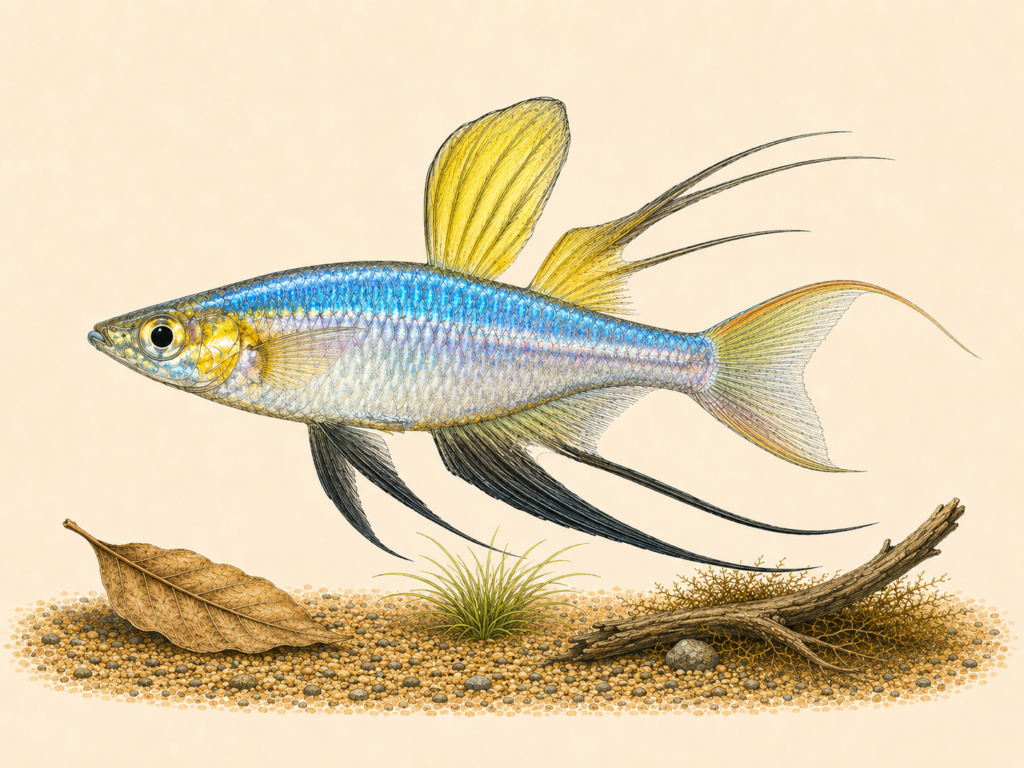
The Threadfin Rainbowfish has a slender, laterally compressed body with a distinctly forked caudal fin and two separate dorsal fins – a trait shared with other members of the Pseudomugilidae and Melanotaeniidae families. The body shape is somewhat elongated and streamlined, tapering to a narrow caudal peduncle. Adults typically reach between 3.5 and 5 cm in total length, with males generally being slightly larger than females.
The base body colour is a shimmering silver with a subtle golden or olive-green iridescence along the flanks. In good conditions and under appropriate lighting, the scales can reflect shades of blue, green, and bronze, creating a constantly shifting palette as the fish moves. A faint dark midlateral stripe may be visible, running from behind the gill cover to the base of the tail, though this is often obscured by the iridescent sheen of the scales.
Sexual dimorphism in this species is pronounced and unmistakable. Males develop extraordinarily elongated fin rays on both the first and second dorsal fins, the anal fin, and the pelvic fins. The first dorsal fin develops into a tall, sail-like structure with extended rays that can reach well beyond the body. The second dorsal fin and anal fin produce thread-like extensions that trail behind the fish as it swims, giving the species its common name. The pelvic fins are also dramatically elongated, sometimes reaching past the anal fin. These fin extensions are typically black or dark grey, often with subtle orange, red, or yellow highlights, particularly on the first dorsal fin and the tips of the pelvic fins. The caudal fin in males often shows red or orange colouration, particularly on the upper and lower lobes.
Females, by contrast, are considerably plainer. They lack the elongated fin rays almost entirely, possessing only short, rounded fins. Their body colouration tends to be a more uniform silver with a slightly yellowish tint. While females are attractive in their own right, it is the males that draw hobbyists to this species. Juvenile fish of both sexes resemble females, and males typically begin developing their extended finnage from around 8 to 12 weeks of age, with full fin development taking several months.
The overall impression of a mature male Threadfin Rainbowfish in full display is remarkable. When flaring at rivals or courting females, the fins are spread to their maximum extent, and the fish appears far larger than its actual body size would suggest. The contrast between the shimmering body and the dark, elaborate finnage makes this one of the most photogenic freshwater fish available.
Natural Habitat
Iriatherina werneri has a relatively broad distribution across two major landmasses. In Australia, it is found in the freshwater systems of northern Queensland (particularly around the Jardine River and other Cape York Peninsula waterways) and across the Top End of the Northern Territory, including tributaries of the Adelaide, Mary, and South Alligator rivers. In New Guinea, it occurs in the southern lowlands of Papua New Guinea and the Indonesian province of Papua (formerly Irian Jaya), particularly in the Fly River system and the Merauke region.
Throughout its range, the Threadfin Rainbowfish inhabits slow-moving or still freshwater environments. It is most commonly found in heavily vegetated swamps, billabongs, lagoons, backwater channels, and the margins of slow-flowing streams. These habitats are characterised by dense aquatic vegetation, including submerged grasses, water lilies, and other floating and emergent plants. The substrate is typically composed of fine silt, mud, or decomposing organic matter, and the water is often stained to various degrees by tannins from decaying plant material.
Water conditions in these habitats are generally warm, soft, and slightly acidic to neutral. Temperatures can be quite high, particularly in the Australian populations, where water temperatures in the dry season can exceed 30 °C. The pH tends to range from mildly acidic to neutral, and the water hardness is generally low to moderate. During the wet season in both Australia and New Guinea, these habitats may expand significantly with floodwaters, providing additional breeding and feeding grounds.
In the wild, Threadfin Rainbowfish are typically found in small to moderately sized shoals, often in the company of other small rainbowfish, blue-eyes (Pseudomugil species), and gudgeons. They tend to occupy the middle and upper water column, feeding on tiny invertebrates, algae, and plant matter at the water’s surface and among vegetation. The still or very gently moving water is critical to their ecology, as the elaborate finnage of the males would be a significant hindrance in fast-flowing conditions.
Tank Size and Setup
A minimum tank size of 60 litres is recommended for a small group of Threadfin Rainbowfish. However, a larger aquarium of 80 to 120 litres or more is preferable, particularly if you wish to keep a larger group or house them alongside other species. The additional space allows males to establish small territories and perform their courtship displays without excessive conflict. A longer, shallower tank is preferable to a tall, narrow one, as these fish primarily occupy the middle and upper water column and benefit from a greater horizontal swimming area.
Dense planting is essential for this species. In their natural habitat, Threadfin Rainbowfish are almost always associated with thick aquatic vegetation, and replicating this in the aquarium is key to their well-being. Fine-leaved plants such as Java Moss (Taxiphyllum barbieri), Cabomba, Hornwort (Ceratophyllum demersum), and Myriophyllum species are excellent choices and also serve as spawning sites. Floating plants such as Amazon Frogbit, Salvinia, or Water Lettuce are highly recommended, as they diffuse lighting and create the dappled, shaded conditions these fish prefer. The inclusion of floating plants also encourages natural surface-feeding behaviour.
The substrate choice is not critical, but a dark, fine-grained substrate such as sand or fine gravel will best showcase the fish’s colouration and iridescence. Dark substrates also help the fish feel more secure, as bright, reflective substrates can cause stress. Driftwood and leaf litter can be added to create a more natural appearance and to release tannins into the water, which these fish appreciate. Indian Almond Leaves (Terminalia catappa) are a popular choice for this purpose.
Provide a mix of open swimming space and densely planted areas. Males need some open water in which to display, but all fish should have access to cover when they feel threatened. Arranging plants more densely around the back and sides of the tank while leaving a clear area towards the front provides both display space and security. Tall plants and midground vegetation help break up sightlines, which reduces aggression between rival males.
Lighting should be moderate. While bright lighting may be necessary for live plant growth, floating plants will help to diffuse the light and prevent the fish from becoming washed out or stressed. If using strong lighting, ensure there is ample shade available through floating plants or overhanging vegetation.
Water Parameters
| Temperature | 24 – 30 °C |
| pH | 5.5 – 7.5 |
| General hardness (GH) | 5 – 12 dGH |
| Carbonate hardness (KH) | 3 – 8 dKH |
| Ammonia | 0 ppm |
| Nitrite | 0 ppm |
| Nitrate | Below 20 ppm |
Threadfin Rainbowfish are tolerant of a reasonable range of water parameters, but they do best in warm, soft to moderately hard, and slightly acidic to neutral water. A temperature of around 26 – 28 °C is ideal for everyday maintenance, and the fish can tolerate temperatures up to 30 °C, which is consistent with the warm tropical waters of their natural habitat. Avoid keeping them at the lower end of their temperature range for prolonged periods, as they are fundamentally a warm-water species.
Stability is more important than hitting an exact number. Sudden fluctuations in temperature, pH, or hardness can cause stress, fin damage, and disease. Regular partial water changes of 20 – 25% per week are recommended to maintain water quality and keep nitrate levels low. Use a good-quality water conditioner when performing water changes, and try to match the temperature and chemistry of the replacement water to the tank water as closely as possible.
If your local tap water is very hard and alkaline, you may need to use reverse osmosis (RO) water or a mix of RO and tap water to achieve suitable parameters. Alternatively, the use of peat filtration or the addition of Indian Almond Leaves, alder cones, or driftwood can help to naturally soften and acidify the water. These additions also release beneficial tannins and humic substances that mimic the blackwater conditions found in many of the species’ natural habitats.
Filtration and Equipment
Low water flow is critically important for Threadfin Rainbowfish. Their elaborate, elongated fins create significant drag, and strong currents will exhaust them, cause fin damage, and prevent males from displaying properly. A gentle sponge filter is the ideal choice for a dedicated Threadfin Rainbowfish tank, as it provides effective biological filtration with minimal water movement. Air-driven sponge filters also have the advantage of not posing a risk to fry if you intend to breed the fish.
If using a hang-on-back (HOB) filter or a small canister filter, ensure the flow rate is adjustable and reduce it to the minimum setting. Directing the outflow against the glass, using a spray bar, or adding a baffle to the filter output can help to disperse the flow and prevent strong currents from developing in the tank. Lily pipe outlets are another effective option for diffusing flow in planted setups.
A reliable heater is essential, as Threadfin Rainbowfish require consistently warm water. Choose a heater rated for your tank size and set it to maintain a temperature of around 26 – 28 °C. A thermometer placed at the opposite end of the tank from the heater will allow you to monitor the actual water temperature and identify any discrepancies.
Lighting should support plant growth while not being excessively bright. A standard LED aquarium light on a timer set for 8 – 10 hours per day is usually sufficient. The presence of floating plants will naturally moderate the light reaching the fish. If you are growing demanding plant species, a higher-output light may be necessary, but always ensure adequate shade is available.
An air pump is optional but can be beneficial if used with a sponge filter or a gentle airstone. Avoid creating excessive surface agitation, as this species prefers calm water. If you are running a sponge filter with an air pump, adjust the air flow to the lowest level that still provides adequate filtration.
Diet and Feeding
Threadfin Rainbowfish are omnivorous micropredators in the wild, feeding primarily on tiny aquatic invertebrates, zooplankton, phytoplankton, and algae. They have very small mouths, and food size is a crucial consideration. Standard-sized flake foods and pellets are often too large for them to consume comfortably, and offering inappropriate food sizes is one of the most common mistakes made by new keepers of this species.
A varied diet is recommended. High-quality micro pellets or finely crushed flake food can form the staple of their diet, but this should be supplemented regularly with live or frozen foods. Baby brine shrimp (Artemia nauplii) are an excellent food source and are eagerly accepted. Microworms, Daphnia, Moina, and cyclops are also outstanding choices. Vinegar eels can be useful for very small or newly imported specimens. Frozen foods should be thawed and, if necessary, chopped finely before offering.
Feed small amounts two to three times daily rather than one large feeding. Threadfin Rainbowfish have small stomachs and fast metabolisms, and they do better with frequent small meals. Only offer what the fish can consume within a few minutes to avoid excess food fouling the water. Observe the fish during feeding to ensure all individuals are getting food – in a community setting, more assertive species may outcompete the Threadfins.
Colour-enhancing foods containing astaxanthin and other carotenoids can help to intensify the orange and red tones in the fins of males. Spirulina-based foods are also beneficial, providing vegetable matter that these fish would naturally consume. A well-fed Threadfin Rainbowfish will show richer colouration, more vigorous displays, and better overall fin condition.
Behaviour and Temperament
Threadfin Rainbowfish are peaceful, social fish that should always be kept in groups. A minimum group of six is recommended, with a ratio of at least two females per male to reduce the intensity of male-to-male competition and prevent individual females from being harassed. In larger tanks, groups of 10 or more create a truly spectacular display, with multiple males vying for the attention of females simultaneously.
Males are mildly territorial and will frequently display to one another, spreading their elaborate fins to their fullest extent and performing a quivering lateral display. These interactions are fascinating to observe and are rarely harmful – the displays are almost entirely ritualistic, and physical contact is uncommon. Rival males may chase each other briefly, but injuries are extremely rare provided the tank is large enough and has sufficient visual barriers in the form of plants and decor.
The courtship display of the male Threadfin Rainbowfish is one of the most beautiful behaviours in the freshwater aquarium hobby. A displaying male will position himself beside or slightly in front of a female, fully erect his dorsal, anal, and pelvic fins, and perform a rapid quivering motion. The extended fin rays create a shimmering, almost hypnotic visual effect. If the female is receptive, she will follow the male to a spawning site among fine-leaved plants.
These fish occupy primarily the middle and upper water column, though they will venture throughout the tank to feed and explore. They are active during the day and tend to be most active in the morning and evening. They are not particularly skittish once settled into a well-planted aquarium, but they may be nervous in sparsely decorated tanks or in the presence of boisterous tank mates. Newly introduced specimens may hide for the first few days but typically settle in within a week.
Threadfin Rainbowfish are not fin nippers despite their interest in each other’s finnage during display. They are entirely safe with long-finned species and will not bother other fish. However, their own elongated fins can make them targets for fin-nipping species, which is an important consideration when choosing tank mates.
Tank Mates
Due to their small size, peaceful temperament, and delicate finnage, Threadfin Rainbowfish require careful consideration when selecting tank mates. Ideal companions are other small, peaceful species that will not outcompete them for food, nip their fins, or cause stress through boisterous behaviour. The best community setups for Threadfin Rainbowfish feature other gentle, similarly sized species from comparable environments. Avoid any fish large enough to eat them, any known fin nippers, and any highly active or aggressive species that would dominate the tank.
Good tank mates
- Celestial Pearl Danio – A similarly small, peaceful species that occupies the lower to middle water column, complementing the Threadfin’s preference for higher zones.
- Pacific Blue-eye (Pseudomugil signifer) – A close relative from the same family that shares similar water requirements and temperament, creating a natural biotope pairing.
- Forktail Blue-eye (Pseudomugil furcatus) – Another peaceful pseudomugilid that coexists beautifully without competition or aggression.
- Pygmy Corydoras – A tiny, peaceful bottom-dweller that occupies a completely different area of the tank and will not compete for food.
- Ember Tetra – A small, gentle tetra with warm colouration that makes an attractive and compatible companion in planted setups.
- Chili Rasbora – One of the smallest rasbora species, peaceful and colourful, ideal for nano community tanks with Threadfins.
- Otocinclus – A small, algae-eating catfish that is entirely peaceful and helps to maintain a clean tank without disturbing the Threadfins.
- Amano Shrimp – Excellent tank janitors that are too large to be eaten by Threadfins and completely non-aggressive.
- Cherry Shrimp – Compatible invertebrates, though adult Threadfins may occasionally eat very small shrimplets.
Fish to avoid
- Tiger Barb – A notorious fin nipper that will relentlessly target the elongated fin rays of male Threadfin Rainbowfish.
- Serpae Tetra – Known for fin-nipping behaviour, especially towards slow-moving species with trailing fins.
- Betta (Siamese Fighting Fish) – May view the elaborate finnage of male Threadfins as a rival and attack, or conversely, Threadfins may stress a Betta with their displays.
- Convict Cichlid – Far too aggressive and territorial for cohabitation with this delicate species.
- Angelfish – Large enough to eat adult Threadfins and will dominate the tank with their size and slow aggression.
- Chinese Algae Eater – Becomes aggressive and territorial with age and may harass or injure smaller fish.
- Buenos Aires Tetra – Too large and boisterous, likely to outcompete Threadfins for food and may nip fins.
- Paradise Fish – Aggressive and territorial, particularly towards small, flashy species with elaborate fins.
Breeding
Threadfin Rainbowfish can be bred in captivity with moderate effort. They are egg scatterers that deposit adhesive eggs among fine-leaved vegetation. Breeding can occur in the main display tank if conditions are favourable, but raising fry to adulthood is far more successful in a dedicated breeding setup where eggs and fry are protected from predation.
To condition breeding pairs or groups, increase the proportion of live and frozen foods in their diet for two to three weeks. Baby brine shrimp, Daphnia, and microworms are excellent conditioning foods. Ensure water quality is pristine, with warm temperatures around 27 – 28 °C and a slightly acidic to neutral pH. These conditions simulate the onset of the wet season, which triggers spawning activity in the wild.
Provide spawning mops or clumps of fine-leaved plants such as Java Moss, Cabomba, or synthetic spawning medium. Males will display vigorously to receptive females, leading them to the spawning site where a small number of eggs are deposited and fertilised. Threadfin Rainbowfish are not prolific spawners – a female may only produce a few eggs per day over an extended period, rather than releasing a large batch all at once. This means that breeding is a gradual process requiring patience.
The eggs are small, clear, and adhesive, attaching to plant material or spawning mop fibres. They are relatively resistant to fungus compared to many other species, but unfertilised eggs should be removed if possible to prevent contamination. Incubation takes approximately 7 to 12 days depending on temperature, with warmer water accelerating development.
The fry are extremely small at hatching and require appropriately tiny first foods. Infusoria, paramecium, or liquid fry food should be offered for the first week or so. As the fry grow, they can be transitioned to newly hatched baby brine shrimp, vinegar eels, and microworms. Growth is relatively slow, and the fry will take several months to reach a size at which they can be safely returned to the main tank. Maintain excellent water quality in the fry tank with gentle sponge filtration and frequent small water changes. Keep the water level relatively low initially and increase it as the fry grow.
Sexing becomes possible at around 6 to 8 weeks of age, when the first signs of fin elongation appear in males. Full fin development may take 4 to 6 months or longer. Patience is required, as the reward of watching young males gradually develop their spectacular finnage is one of the great pleasures of breeding this species.
Common Diseases
Threadfin Rainbowfish are generally hardy fish when kept in appropriate conditions, but they can be susceptible to several common freshwater diseases, particularly when stressed by poor water quality, inappropriate tank mates, or inadequate diet.
Fin rot is perhaps the most relevant concern for this species, given the importance and delicacy of their elongated finnage. Fin rot is typically caused by bacterial infections (Aeromonas, Pseudomonas, or Flavobacterium species) and manifests as fraying, discolouration, or progressive erosion of the fin edges. Poor water quality is the primary underlying cause. Treatment involves improving water quality through more frequent water changes, and in more advanced cases, the use of antibacterial medications. Catching fin rot early is important, as severely damaged fins may not fully regenerate.
Ich (white spot disease) caused by the protozoan Ichthyophthirius multifiliis can affect Threadfin Rainbowfish, particularly after temperature fluctuations or the introduction of new, unquarantined fish. Symptoms include small white spots on the body and fins, flashing (rubbing against objects), and lethargy. Treatment with raised temperature (to around 30 °C, which is within this species’ tolerance range) combined with aquarium salt or proprietary ich medication is usually effective. Note that these fish can be sensitive to some medications, particularly those containing copper or malachite green at full strength – always use half doses initially and observe the fish’s response.
Velvet disease (Oodinium) is another parasitic condition that can affect small rainbowfish species. It presents as a fine, gold or rust-coloured dusting on the skin, often accompanied by rapid breathing and clamped fins. Velvet is more difficult to spot than ich in its early stages but can be fatal if left untreated. Dimming the lights can make the characteristic golden sheen more visible. Treatment involves darkening the tank and using copper-based or proprietary anti-parasitic medications at appropriate doses.
Internal parasites can occasionally affect wild-caught or newly imported specimens. Symptoms may include weight loss despite a good appetite, white or stringy faeces, and a general lack of condition. Anti-parasitic foods or appropriate medications can be used to treat internal parasites, but prevention through quarantine of new additions is always preferable.
Maintaining stable, clean water conditions, providing a nutritious and varied diet, and avoiding stressful tank mates are the most effective ways to prevent disease in Threadfin Rainbowfish. Quarantine all new fish for a minimum of two weeks before adding them to an established tank.
FAQs
How many Threadfin Rainbowfish should I keep together?
A minimum group of six is recommended, with a higher ratio of females to males (at least 2:1). Larger groups of 10 to 15 or more are ideal, as the fish will be more confident, display more natural behaviours, and the males will produce more spectacular displays when they have rivals to compete with. In a group with multiple males, the constant interaction between them is one of the most rewarding aspects of keeping this species.
Can Threadfin Rainbowfish be kept in a nano tank?
While they are small fish, a nano tank below 60 litres is not recommended for Threadfin Rainbowfish. They are active swimmers that need space for displaying, and their social dynamics require enough room for males to establish small territories. A 60-litre tank is the absolute minimum for a small species-only group, but 80 litres or more is preferable for a community setup or a larger group. Tanks that are too small can lead to stress, increased aggression between males, and poor fin development.
Why are my Threadfin Rainbowfish not showing their full fins?
Several factors can prevent males from developing or displaying their full finnage. Stress from aggressive tank mates, strong water flow, poor water quality, or an inadequate diet can all contribute. Ensure the tank has gentle filtration, dense planting for security, and that the fish are receiving a varied diet including live and frozen foods. Fin damage from nipping species will also reduce the appearance of the fins. Additionally, young males may take several months to develop their full fin extensions, so patience is important with newly purchased fish.
Are Threadfin Rainbowfish safe with shrimp?
Adult Threadfin Rainbowfish are generally safe with adult shrimp species such as Amano Shrimp and Cherry Shrimp. However, they may eat very small shrimplets, as their diet in the wild includes tiny invertebrates. If you are breeding shrimp in the same tank, providing dense plant cover (particularly Java Moss) will give shrimplets places to hide and improve their survival rate. The Threadfins’ small mouth size means they are less of a threat to shrimp fry than many other fish species of a similar size.
Do Threadfin Rainbowfish need a heater?
Yes, a heater is essential unless you live in a tropical climate where room temperatures consistently remain above 24 °C. Threadfin Rainbowfish are a warm-water species that thrive at temperatures between 26 and 28 °C. Temperatures below 24 °C can cause stress, lethargy, reduced immune function, and a loss of colour. A reliable, adjustable heater is a necessary piece of equipment for keeping this species successfully in most climates.
Related Guides
- Forktail Blue-eye (Pseudomugil furcatus) Care Guide – A closely related pseudomugilid species with similar care requirements and an excellent companion for Threadfin Rainbowfish.
- Pacific Blue-eye (Pseudomugil signifer) Care Guide – Another member of the Pseudomugilidae family native to Australia, sharing habitat preferences and tank requirements.
- Celestial Pearl Danio Care Guide – A popular nano fish that makes an excellent tank mate for Threadfin Rainbowfish in planted community setups.
- Dwarf Neon Rainbowfish (Melanotaenia praecox) Care Guide – A small, colourful rainbowfish from the closely related family Melanotaeniidae, suitable for similar setups.
- Ember Tetra Care Guide – A peaceful nano tetra that pairs beautifully with Threadfin Rainbowfish in warm, soft-water planted aquariums.