Quick summary
The Flagtail Porthole Catfish is a peaceful, hardy shoaling catfish that suits community tanks of 120 litres or more, provided you can keep a group of at least four to six and offer soft, slightly acidic, dimly lit blackwater-style conditions. It’s a good match for moderate-level aquarists, though breeding it successfully is considered difficult.
🐠 Build a tank around this species
In this guide:
- Introduction
- Quick Stats
- Appearance
- Natural Habitat
- Tank Size and Setup
- Water Parameters
- Filtration and Equipment
- Diet and Feeding
- Behaviour and Temperament
- Tank Mates
- Breeding
- Common Diseases
- FAQs
Introduction
The Flagtail Porthole Catfish (Dianema urostriatum) is a distinctive and endearing member of the Callichthyidae family, closely related to the ever-popular Corydoras catfishes. Originally described by Ribeiro in 1912, this South American armoured catfish has earned a loyal following among aquarists who appreciate its striking tail markings, peaceful disposition, and fascinating social behaviour. Unlike its more commonly kept cousins, the Flagtail Porthole Catfish remains something of a hidden gem in the hobby, occasionally appearing in specialist shops and online retailers but never quite achieving mainstream popularity.
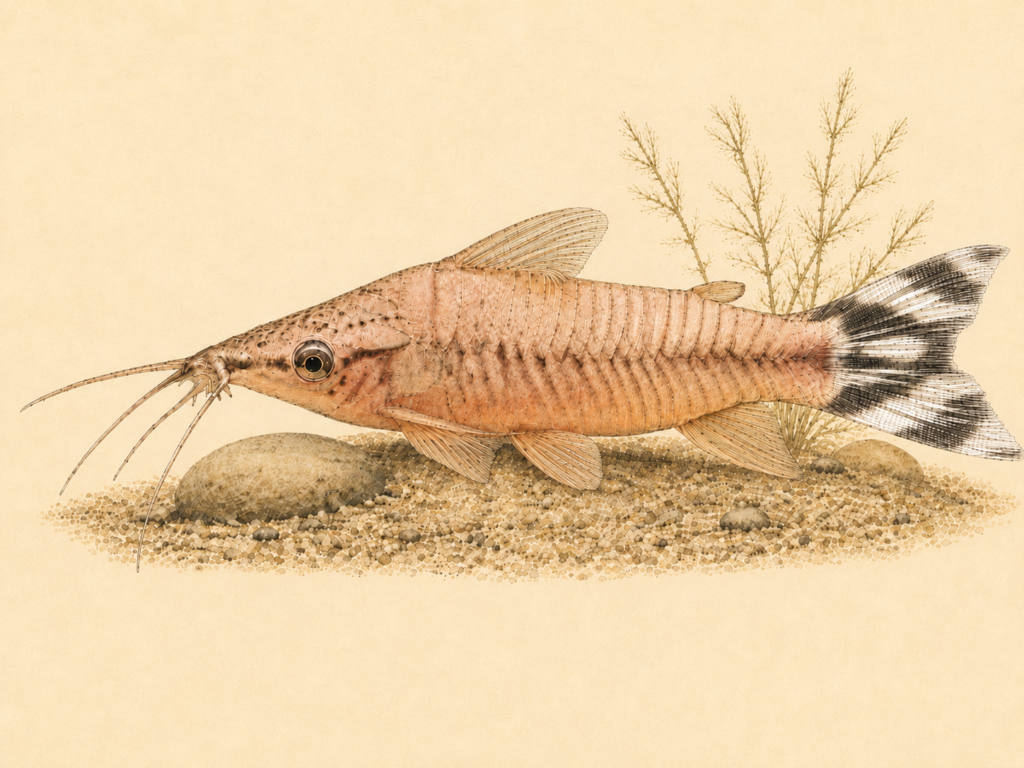
The common name “Porthole Catfish” refers to the row of dark spots running along the lateral line of the body, reminiscent of portholes on a ship’s hull. The “Flagtail” designation distinguishes this species from its close relative, Dianema longibarbis, thanks to the bold black-and-white striped pattern adorning its caudal fin. This tail pattern is arguably the fish’s most eye-catching feature and makes identification straightforward even for beginners.
Native to the slow-moving tributaries and floodplain lakes of the Amazon basin, the Flagtail Porthole Catfish is adapted to warm, soft, slightly acidic waters rich in organic matter. In the aquarium, it proves to be a hardy and adaptable species, tolerating a reasonable range of water conditions once properly acclimatised. Its peaceful nature, manageable adult size, and willingness to accept a variety of foods make it an excellent choice for community tanks, particularly those themed around South American biotopes. This guide covers everything you need to know to keep and breed Dianema urostriatum successfully in the home aquarium.
Quick Stats
| Scientific name | Dianema urostriatum |
|---|---|
| Common names | Stripe-tailed Catfish, Flagtail Catfish |
| Family | Callichthyidae |
| Origin | South America, Amazon basin (Rio Negro, Brazil) |
| Adult size | 12 cm |
| Lifespan | 8–10 years |
| Difficulty | Intermediate |
| Breeding difficulty | Advanced |
| Temperature | 24–28 °C |
| pH | 5.5–7.5 |
| GH | 2–15 dGH |
| KH | 1–8 dKH |
| Minimum tank size | 120 L |
| Conservation status | Least Concern (IUCN, assessed 2018) |
Appearance
The Flagtail Porthole Catfish is an elongated, somewhat cylindrical species with a profile that sits between the compact, rounded shape of Corydoras and the more elongated form of its other callichthyid relatives such as Hoplosternum. The body is covered in two rows of overlapping bony scutes, a hallmark of the Callichthyidae family, that provide a degree of armour-like protection. These scutes give the flanks a subtly textured appearance that catches the light attractively when viewed at certain angles.
The base body colour is a warm grey-brown to olive, overlaid with a series of dark spots arranged in a lateral row along the midline of the body. These “porthole” spots are the feature that gives the genus its common name, and they vary somewhat in size and intensity between individuals. Some specimens display additional smaller spots scattered above and below the main row, creating a lightly speckled effect across the flanks.
The most diagnostic feature of D. urostriatum is its caudal fin, which bears bold, alternating black-and-white horizontal stripes. This “flag” pattern is immediately recognisable and distinguishes it from the closely related Dianema longibarbis, which has a plain, unmarked tail. The dorsal, pectoral, and anal fins are largely translucent to lightly pigmented, sometimes showing faint spots or a dusting of melanophores.
The head is somewhat flattened dorsoventrally, with a slightly underslung mouth flanked by two pairs of barbels. These barbels are reasonably long and used to probe the substrate for food particles. The eyes are relatively small and positioned laterally, giving the fish a wide field of vision, an adaptation to its benthic, dimly lit natural environment. Males and females are difficult to distinguish outside of breeding condition, though mature females tend to be slightly fuller-bodied when viewed from above, and males may develop slightly thickened pectoral fin spines.
Juveniles display the same general patterning as adults but often show more contrast in their colouration, with the porthole spots appearing bolder against a lighter background. As the fish matures, the overall colouration tends to darken slightly, though the flagtail pattern remains vivid throughout life. Healthy, well-maintained specimens develop a pleasing sheen to their scutes, particularly under subdued lighting.
Natural Habitat
The Flagtail Porthole Catfish is native to the Amazon basin in Brazil, with its primary range centred on the Rio Negro and its numerous tributaries. The Rio Negro is famous for its blackwater conditions, water stained a deep tea-brown colour by tannins and humic acids leached from decomposing leaf litter and submerged vegetation. These waters are characteristically soft, acidic, and mineral-poor, with pH values often dropping below 5.0 in some areas, though the fish also inhabits tributaries where conditions are somewhat less extreme.
Dianema urostriatum typically inhabits slow-moving or still waters, including floodplain lakes (known locally as igapó when forested), backwaters, and quiet stretches of streams and rivers. The substrate in these habitats is usually composed of fine sand overlaid with a thick layer of decomposing leaves, fallen branches, and other organic debris. Submerged root tangles, driftwood, and marginal vegetation provide abundant cover and foraging opportunities.
Light levels in these habitats are generally low, filtered through the dense canopy of the surrounding rainforest and further attenuated by the dark, tannin-stained water. This preference for dim conditions should be considered when setting up the aquarium, as bright overhead lighting can cause the fish to remain hidden and stressed. In nature, D. urostriatum is typically found in small groups, foraging together across the substrate and occasionally rising to the surface to gulp atmospheric air, a supplementary breathing strategy common among callichthyid catfishes.
Water temperatures in the species’ natural range typically fall between 24 and 28 °C, with seasonal fluctuations linked to the annual flood cycle. During the wet season, rising water levels inundate vast areas of forest, dramatically expanding the available habitat and triggering breeding activity in many fish species, including Dianema. Understanding these seasonal rhythms can be valuable for aquarists attempting to breed this species in captivity.
Tank Size and Setup
A minimum tank size of 120 litres is recommended for a small group of Flagtail Porthole Catfish. As a sociable species that is best kept in groups of at least four to six individuals, a tank measuring approximately 80 cm in length provides adequate swimming space and allows the fish to exhibit their natural shoaling behaviour. Larger tanks of 180 litres or more are preferable, particularly if the fish are to be housed in a community setting with other species.
The aquascape should aim to replicate the species’ natural blackwater habitat as closely as practical. A substrate of fine, smooth sand is ideal, as it allows the fish to forage naturally using their barbels without risk of abrasion or damage. Coarse gravel or sharp-edged substrates should be avoided, as they can wear down the barbels over time, impairing the fish’s ability to find food. A layer of dried leaf litter, Indian almond leaves (Terminalia catappa), oak leaves, or beech leaves, scattered across the substrate creates an authentic environment and releases beneficial tannins into the water.
Driftwood and bogwood should feature prominently in the tank layout, providing shelter, visual barriers, and additional surfaces for biofilm growth. Pieces that create overhangs, caves, and tunnels are particularly valued, as the fish will use these as daytime resting spots. Dense plantings of low-light species such as Java fern (Microsorum pteropus), Anubias species, and Amazon swords (Echinodorus species) complement the setup well and provide additional cover. Floating plants such as Amazon frogbit (Limnobium laevigatum) or water lettuce (Pistia stratiotes) are highly recommended, as they diffuse overhead light and create the shaded conditions that encourage the fish to be more active and visible during the day.
Ensure the tank has a tightly fitting lid or cover slides, as Flagtail Porthole Catfish are known to leap, particularly when startled or during changes in atmospheric pressure. The species regularly rises to the surface to take gulps of atmospheric air as a supplement to gill respiration, so there should always be a small gap between the water surface and the lid to allow access to air.
Water Parameters
| Temperature | 24–28 °C |
| pH | 5.5–7.5 |
| General hardness (GH) | 2–15 dGH |
| Carbonate hardness (KH) | 1–8 dKH |
| Ammonia | 0 ppm |
| Nitrite | 0 ppm |
| Nitrate | Below 20 ppm |
The Flagtail Porthole Catfish is adaptable to a range of water conditions, but it thrives best in soft to moderately hard, slightly acidic to neutral water. Wild-caught specimens may initially require softer, more acidic water to settle, while tank-raised fish are generally more tolerant of harder, more alkaline conditions. Regardless of the specific parameters, consistency is more important than hitting exact numbers, sudden swings in pH, temperature, or hardness can cause significant stress.
Regular partial water changes of 20–30% weekly are essential to maintain water quality and keep nitrate levels low. The use of a good-quality water conditioner is recommended with each change. Adding tannin sources such as Indian almond leaves, alder cones, or commercially available blackwater extracts can help replicate the natural water chemistry and may have mild antifungal and antibacterial properties. If the tap water in your area is very hard or alkaline, consider blending it with RO (reverse osmosis) water to achieve more suitable parameters.
Temperature should ideally be maintained in the mid-range of the species’ tolerance, around 25–27 °C, with a reliable heater and thermometer used to prevent fluctuations. Avoid temperatures consistently above 28 °C, as elevated warmth reduces dissolved oxygen levels, something particularly relevant for a species that supplements its oxygen intake with atmospheric air gulping.
Filtration and Equipment
Filtration for a Flagtail Porthole Catfish tank should prioritise biological efficiency and gentle water flow. In nature, this species inhabits slow-moving or still waters, and it does not appreciate strong currents. An external canister filter is an excellent choice for tanks of 120 litres and above, offering ample biological and mechanical filtration capacity while allowing the flow rate to be adjusted or diffused using a spray bar or lily pipe. For smaller setups, a quality internal filter or a large sponge filter can also work well.
The filter should be mature and well-established before the fish are introduced, with stable populations of beneficial bacteria capable of processing ammonia and nitrite effectively. As bottom-dwelling fish, Flagtail Porthole Catfish are particularly sensitive to poor substrate hygiene, so regular gravel vacuuming (or sand-siphoning) during water changes is important to remove accumulated detritus and uneaten food.
Lighting should be subdued, reflecting the fish’s natural preference for dimly lit environments. LED units with adjustable intensity or a dimming function are ideal, and the use of floating plants to break up direct light is strongly recommended. If brighter lighting is required for live plants, ensure there are shaded retreat areas within the tank where the fish can escape the light.
A reliable, thermostatically controlled heater sized appropriately for the tank volume is essential. For a 120-litre tank, a 100–150 watt heater is typically sufficient. An accurate digital thermometer, placed at the opposite end of the tank from the heater, provides a useful check on temperature consistency. An air pump is not strictly necessary, the fish can supplement their oxygen via atmospheric air gulping, but gentle aeration can help maintain good oxygen levels throughout the water column, particularly in warmer setups.
Diet and Feeding
The Flagtail Porthole Catfish is an omnivorous, benthic feeder that accepts a wide variety of foods in the aquarium. In the wild, its diet consists primarily of small invertebrates, insect larvae, worms, and organic detritus gleaned from the substrate and leaf litter. Replicating this varied diet in captivity is straightforward and contributes significantly to the fish’s health, colouration, and longevity.
A high-quality sinking pellet or wafer designed for bottom-dwelling catfish should form the staple of the diet. These foods are formulated to sink quickly, reaching the fish before midwater tankmates can intercept them. Supplement this base diet regularly with frozen or live foods such as bloodworm, daphnia, brine shrimp, tubifex, and mosquito larvae. These protein-rich offerings are enthusiastically consumed and help condition the fish for breeding. Blanched vegetables, courgette (zucchini) slices, cucumber, shelled peas, and spinach, can also be offered occasionally and provide useful dietary fibre and micronutrients.
Feed once or twice daily, offering only as much food as the group can consume within a few minutes. Overfeeding is a common mistake with bottom-dwelling catfish, as uneaten food quickly fouls the substrate and degrades water quality. Because D. urostriatum is somewhat crepuscular to nocturnal in its activity patterns, consider offering at least one feeding in the evening, shortly after the lights have been dimmed, when the fish are most actively foraging.
Watch for signs that the fish are receiving adequate nutrition: a gently rounded belly (neither sunken nor bloated), active foraging behaviour, and good colouration all indicate a well-fed individual. If housing the fish with more boisterous or competitive feeders, ensure food reaches the substrate before it is consumed, and observe feeding sessions regularly to confirm the Porthole Catfish are getting their fair share.
Behaviour and Temperament
The Flagtail Porthole Catfish is a peaceful, social species that thrives in the company of its own kind. It should be kept in groups of at least four, with six or more being preferable. In smaller numbers, individuals tend to be shy and reclusive, spending most of their time hiding behind décor or under driftwood. In a well-sized group, the fish become noticeably more confident and active, often foraging together across the substrate in a loose shoal that is highly engaging to watch.
This species is primarily crepuscular, meaning it is most active during dawn and dusk. In tanks with subdued lighting and abundant cover, however, the fish can be surprisingly active throughout the day, emerging regularly to forage and interact with one another. The provision of floating plants and dim lighting significantly increases daytime activity levels.
One of the most charming behaviours exhibited by Dianema urostriatum is its habit of resting in mid-water, hovering motionlessly amongst plant stems or driftwood branches. This behaviour can alarm new keepers who mistake it for illness, but it is entirely normal and characteristic of the genus. The fish also frequently rises to the surface to gulp air, swallowing a bubble that is then processed in the intestine for supplementary oxygen absorption. This behaviour is more frequent in warm water, during periods of low atmospheric pressure, or when dissolved oxygen levels are suboptimal.
Within the group, interactions are generally amicable. Males may engage in mild sparring or chasing during breeding season, but serious aggression is extremely rare. The fish is entirely harmless towards other species and will not predate on small fish or shrimp, though very tiny shrimp fry might occasionally be consumed opportunistically. Overall, this is one of the most peaceable catfish species available in the hobby, making it an ideal community resident.
Tank Mates
The Flagtail Porthole Catfish’s gentle temperament and undemanding nature make it compatible with a wide range of peaceful to moderately active community fish. The ideal tank mates are species that share similar water parameter preferences, soft to moderately hard, slightly acidic to neutral water at tropical temperatures, and that will not outcompete the Porthole Catfish for food or harass it. Avoid housing with large, aggressive, or highly territorial species, as well as anything likely to nip at the catfish’s barbels or fins.
Good tank mates
- Cardinal Tetra, a classic Rio Negro companion that shares the same water parameter preferences and creates a stunning visual contrast in a blackwater biotope.
- Rummy-nose Tetra, a tight-shoaling, peaceful tetra that occupies midwater levels, leaving the bottom free for the catfish to forage undisturbed.
- Bronze Corydoras, a fellow callichthyid that coexists peacefully and adds activity to the lower levels of the tank without competition.
- Kuhli Loach, another bottom-dwelling species with a peaceful disposition that complements the Porthole Catfish without territorial conflict.
- Pearl Gourami, a calm, elegant gourami that occupies the upper to middle regions of the tank and tolerates soft, acidic water well.
- German Blue Ram, a small, peaceful dwarf cichlid that thrives in warm, soft water and generally ignores bottom-dwelling catfish.
- Bristlenose Pleco, a hardy algae-eating pleco that occupies a different ecological niche and coexists without issue.
- Harlequin Rasbora, a peaceful, easy-going shoaling fish that adds colour and movement to the midwater zone.
- Otocinclus Catfish, a tiny, non-competitive algae grazer that shares similar water preferences and is entirely harmless to other fish.
Fish to avoid
- Oscar, a large, predatory cichlid that will readily consume or injure a Porthole Catfish.
- Tiger Barb, a notorious fin nipper that may harass the catfish and damage its barbels and fins.
- Red-tail Catfish, a massive predatory catfish entirely unsuitable for community tanks and capable of swallowing tankmates whole.
- Jack Dempsey, an aggressive, territorial cichlid that will bully and potentially injure peaceful bottom-dwellers.
- Green Terror, a highly territorial and aggressive cichlid that poses a serious threat to any peaceful tankmate.
- Red-bellied Piranha, an obligate predator that will attack and consume smaller, defenceless fish.
- African Cichlids (Mbuna), Require hard, alkaline water incompatible with the Porthole Catfish’s needs, and are frequently aggressive.
- Flowerhorn, an extremely aggressive hybrid cichlid that should be housed alone or with equally robust species.
Breeding
Breeding the Flagtail Porthole Catfish in captivity is achievable but considered difficult, requiring specific conditions, patience, and a degree of experience. The species is a bubble-nest builder, a relatively unusual reproductive strategy among catfish, with the male constructing a floating nest of bubbles and plant matter at the water’s surface, into which the eggs are deposited.
To condition a breeding group, begin by feeding heavily with high-quality live and frozen foods such as bloodworm, daphnia, and brine shrimp for several weeks. Simultaneously, gradually lower the water temperature by 2–3 °C over the course of a week, then perform a large (50–60%) water change with slightly cooler, softer water to simulate the onset of the rainy season. This combination of increased nutrition and environmental triggers is often the key to initiating spawning behaviour.
The male begins by constructing a bubble nest, usually beneath a broad leaf, a piece of floating plant, or against the tank glass near the surface. The nest may incorporate fragments of plant material and can be quite substantial. Once the nest is ready, the male courts the female with persistent chasing and gentle nudging. If receptive, the female deposits a batch of eggs into the nest, which the male then fertilises and guards attentively.
The male guards the nest aggressively throughout the incubation period, fanning the eggs with his pectoral fins and repairing the bubble nest as needed. Incubation typically takes 3–4 days at around 26 °C. The fry are tiny and initially feed on their yolk sacs before becoming free-swimming. First foods should consist of infusoria, liquid fry food, or freshly hatched brine shrimp nauplii. Growth is steady but slow, and the fry require consistently clean water with frequent small water changes to thrive.
Separating the breeding pair or group into a dedicated spawning tank of at least 60 litres is advisable, as it reduces the risk of egg predation by tankmates and allows the aquarist to manage water quality more effectively for the delicate fry. The spawning tank should be furnished with floating plants or a broad-leaved plant near the surface to provide a suitable site for nest construction.
Common Diseases
The Flagtail Porthole Catfish is a reasonably hardy species but, like all aquarium fish, is susceptible to a number of common diseases, particularly when water quality is allowed to deteriorate or when the fish is stressed by poor husbandry or incompatible tankmates.
White spot disease (Ichthyophthirius multifiliis), commonly known as ich, is one of the most frequently encountered illnesses. It presents as small white cysts on the body, fins, and gills, and is typically triggered by sudden temperature drops or the introduction of infected fish. Note that Dianema species, like other scaleless or lightly scaled catfish, can be sensitive to some ich medications, particularly those containing copper or malachite green. Half-dose treatments or heat-based methods (gradually raising the temperature to 30 °C for several days) are often safer alternatives. Always read medication labels carefully and research catfish-safe options.
Bacterial infections, including fin rot and body ulcers, can occur when water quality is poor or the fish has suffered physical injury. Symptoms include ragged or eroded fins, reddened areas on the body, and lethargy. Prompt improvement of water conditions, combined with appropriate antibacterial treatment, usually resolves these issues if caught early.
Fungal infections may appear as white, cottony growths on the body or fins, often secondary to an existing wound or bacterial infection. Antifungal medications are effective, but again, care should be taken to select products safe for use with catfish.
Barbel erosion is a common but preventable condition in bottom-dwelling catfish. It results from keeping the fish on sharp or coarse substrates, or in tanks with chronically poor substrate hygiene. The barbels gradually wear down and may become infected. Prevention is straightforward: use fine, smooth sand as a substrate and maintain good tank cleanliness through regular water changes and substrate siphoning.
Internal parasites, while less common in captive-bred specimens, can affect wild-caught fish. Symptoms include weight loss despite a good appetite, white or stringy faeces, and a generally emaciated appearance. Specialist anti-parasitic medications are available and effective when used as directed.
FAQs
How many Flagtail Porthole Catfish should I keep together?
A minimum group of four is recommended, with six or more being ideal. Flagtail Porthole Catfish are social animals that exhibit natural shoaling behaviour, and solitary individuals or pairs tend to be excessively shy and stressed. In a larger group, the fish are more confident, more active, and significantly more engaging to observe. Ensure your tank is large enough to accommodate the group comfortably, at least 120 litres for four fish, with additional volume for larger groups.
Why does my Flagtail Porthole Catfish keep gulping air at the surface?
This is entirely normal behaviour and not a cause for concern in most cases. Like other callichthyid catfish, Dianema urostriatum possesses a modified intestine capable of absorbing oxygen from swallowed air. This supplementary breathing mechanism is used regularly, even in well-oxygenated water. However, if the fish is gulping air excessively or constantly, it may indicate low dissolved oxygen levels, poor water quality, or elevated temperatures. Check your water parameters and ensure adequate surface agitation or aeration.
Is the Flagtail Porthole Catfish suitable for a planted tank?
Yes, this species is an excellent resident for planted aquariums. It does not dig up or damage live plants, and its preference for subdued lighting aligns well with low-light plant species such as Java fern, Anubias, and various mosses. The leaf litter often used in its setup can also complement a natural planted aesthetic. Floating plants are particularly beneficial, as they reduce light intensity and encourage the catfish to be more active during daylight hours.
Can I keep Flagtail Porthole Catfish with shrimp?
Adult ornamental shrimp, such as Amano shrimp and larger cherry shrimp, are generally safe with Flagtail Porthole Catfish. The catfish is not an active predator and largely ignores shrimp as tankmates. However, very small shrimp fry may occasionally be eaten opportunistically, so if you are breeding shrimp in the same tank, some fry losses are possible. Providing dense plant cover and hiding spots for the shrimp will help mitigate this.
What is the difference between Dianema urostriatum and Dianema longibarbis?
The two species are closely related and share a similar body shape, size, and general behaviour. The most obvious difference is the caudal fin: D. urostriatum has bold black-and-white horizontal stripes on its tail (hence “Flagtail”), while D. longibarbis has a plain, unmarked caudal fin and is commonly known simply as the Porthole Catfish. D. longibarbis also tends to have slightly longer barbels, as its name suggests. Care requirements for both species are virtually identical, and they can be housed together without issue.
Related Guides
- Porthole Catfish (Dianema longibarbis), the Flagtail’s closest relative, sharing nearly identical care requirements and often available alongside it in the trade.
- Bronze Corydoras, a fellow callichthyid and one of the most popular beginner catfish, offering useful comparisons in care and behaviour.
- Cardinal Tetra, an ideal midwater companion for a Rio Negro biotope tank featuring Flagtail Porthole Catfish.
- Bristlenose Pleco, another peaceful bottom-dwelling catfish commonly kept alongside Dianema species in community setups.
- German Blue Ram, a dwarf cichlid that pairs beautifully with Porthole Catfish in warm, soft-water community tanks.