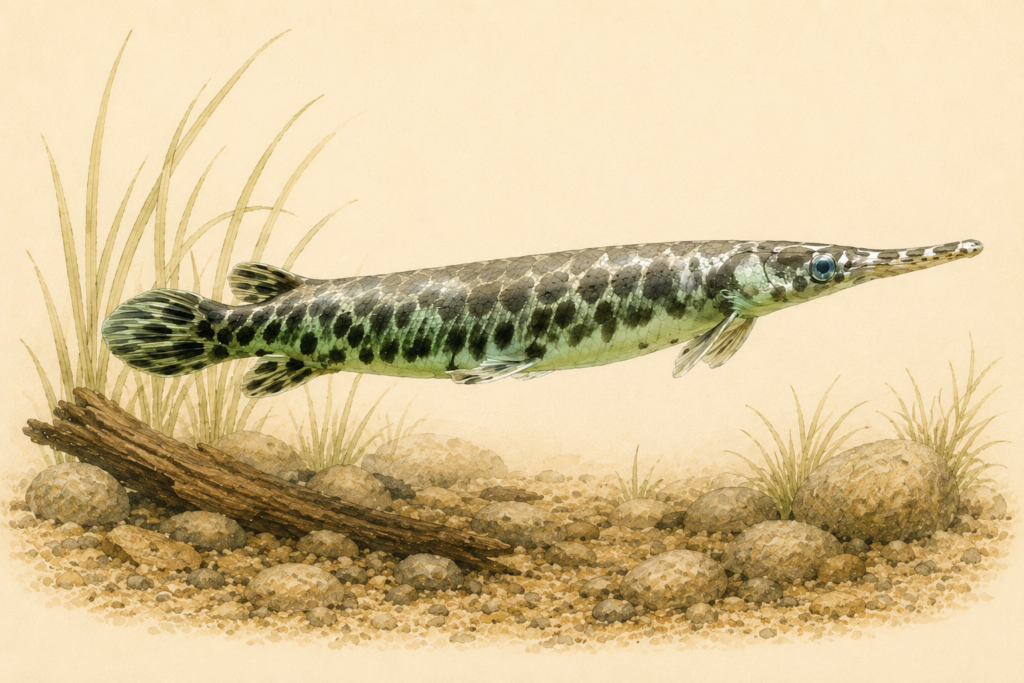
Quick summary
The Florida Gar is an advanced-level predatory fish that grows to 50-70 cm and needs a minimum 1,100 litre tank, so it’s only suitable for experienced keepers who can commit to a large, well-filtered setup and a lifespan of 15-20 years. It’s not right for beginners, small tanks, or anyone unwilling to feed a protein-rich diet and keep only tank mates too large to be eaten.
🐠 Build a tank around this species
Grows large. Read this before buying. The Florida Gar is usually sold as a small juvenile and is easy to keep at that size, but a healthy adult reaches around 60 cm. A juvenile will be happy in a standard tank for its first year or so. An adult needs something in the region of 1,100 litres, which in practice means a purpose-built plywood-and-glass tank rather than anything off the shelf. Decide now whether you will build for the adult, or have a realistic rehoming plan, because public aquaria and specialist keepers are often full. It is a superb fish for the keeper who plans for it and a sad one for everyone else.
In this guide:
- Introduction
- Quick Stats
- Appearance
- Natural Habitat
- Tank Size and Setup
- Water Parameters
- Filtration and Equipment
- Diet and Feeding
- Behaviour and Temperament
- Tank Mates
- Breeding
- Common Diseases
- FAQs
Introduction
The Florida Gar (Lepisosteus platyrhincus) is a striking, prehistoric-looking freshwater fish endemic to the state of Florida and parts of Georgia in the United States. As one of the smaller members of the gar family, it has earned a devoted following among keepers of predatory and oddball fish. Its elongated, torpedo-shaped body, hard ganoid scales, and long snout evoke an ancient lineage that stretches back over 100 million years, making it a genuine living fossil in the home aquarium.
Despite its fearsome appearance, the Florida Gar is a relatively manageable species compared to its larger cousins such as the Alligator Gar. Nevertheless, it is emphatically not a beginner’s fish. Adults routinely reach 50 to 70 centimetres in captivity, and their predatory habits, air-breathing behaviour, and long lifespan demand significant commitment in terms of tank size, filtration, and long-term planning. For the experienced aquarist willing to provide adequate space and proper care, however, the Florida Gar rewards its keeper with fascinating behaviour, an impressive presence, and a genuine connection to the deep evolutionary history of bony fishes.
This guide covers everything you need to know to keep a Florida Gar successfully in a home aquarium, from water parameters and diet to tank mates and breeding. Whether you are considering your first gar or looking to refine your existing setup, the information below will help you provide the best possible environment for this remarkable species.
Quick Stats
| Scientific name | Lepisosteus platyrhincus |
|---|---|
| Common names | Florida Spotted Gar |
| Family | Lepisosteidae |
| Origin | Florida and southern Georgia, USA |
| Adult size | 60 cm |
| Lifespan | 15–20 years |
| Difficulty | Advanced |
| Breeding difficulty | Advanced |
| Temperature | 18–28 °C |
| pH | 6–8 |
| GH | 5–20 dGH |
| KH | 4–15 dKH |
| Minimum tank size | 1100 L |
| Conservation status | Least Concern (IUCN) |
Appearance
The Florida Gar possesses the classic gar body plan: a long, cylindrical torso clad in interlocking diamond-shaped ganoid scales that function almost like armour. These scales are composed of ganoine, a hard, enamel-like substance that gives the fish an almost lacquered sheen when viewed under aquarium lighting. The body colour is typically olive-green to brown on the dorsal surface, fading to a creamy yellow or white on the belly. Irregular dark spots and blotches are scattered liberally across the body, fins, and snout, and it is this extensive spotting that helps distinguish the Florida Gar from the closely related Spotted Gar (Lepisosteus oculatus).
The snout of the Florida Gar is notably broad and relatively short compared to the Longnose Gar, giving the species its Latin epithet platyrhincus, meaning “flat snout.” The jaws are lined with numerous sharp, needle-like teeth designed for seizing prey sideways before manoeuvring it head-first for swallowing. The dorsal and anal fins are set far back on the body near the heterocercal tail, providing explosive acceleration when the fish lunges at prey. The pectoral and pelvic fins are rounded and used primarily for precise hovering and slow manoeuvring.
A key distinguishing feature from the Spotted Gar is the absence of bony plates on the underside of the isthmus (the region between the gill covers). In the Florida Gar, this area lacks ossified plates, whereas the Spotted Gar possesses them. The distance from the front of the eye to the back edge of the gill cover is also comparatively shorter in the Florida Gar. Juveniles display a distinctive dark mid-lateral stripe running from snout to tail, which gradually breaks up into the adult spotted pattern as the fish matures.
Like all gars, the Florida Gar has a highly vascularised swim bladder that functions as a primitive lung, enabling it to gulp atmospheric air at the surface. This adaptation allows the species to survive in oxygen-poor habitats that would be lethal to many other fish. Aquarists will regularly observe their gar rising to the surface to take a breath, which is entirely normal and not a sign of poor water quality.
Natural Habitat
The Florida Gar is found throughout peninsular Florida and into the Ochlockonee River drainage in the Florida panhandle and extreme southern Georgia. It inhabits a wide range of freshwater environments, including slow-moving rivers, canals, lakes, and heavily vegetated marshes and swamps. Its preferred habitats tend to be calm, warm, and richly planted, often with tannic, slightly acidic water stained by decaying vegetation. However, the species also thrives in alkaline, hard-water habitats such as Florida’s many spring-fed systems and limestone-bedded canals, demonstrating impressive adaptability.
In the wild, Florida Gars are typically found lurking among dense stands of submerged and emergent aquatic vegetation, fallen branches, and root tangles. They are ambush predators that rely on camouflage and patience, hovering motionless near cover before striking at passing fish, crayfish, and large invertebrates with a rapid lateral snap of the jaws. The warm subtropical climate of Florida means that these fish experience relatively stable temperatures year-round, though they can tolerate surprisingly cool conditions during winter cold fronts, with water temperatures occasionally dipping below 15 °C in the northern parts of their range.
The waters they inhabit are typically shallow to moderate in depth, often with soft, muddy substrates and abundant organic debris. Understanding this natural habitat is crucial for replicating appropriate conditions in the aquarium. While the Florida Gar is adaptable, providing a setup that mirrors its natural environment in terms of cover, flow rate, and water chemistry will result in a healthier, less stressed, and more behaviourally interesting fish.
Tank Size and Setup
Housing a Florida Gar demands serious commitment to space. A single adult requires a minimum tank volume of around 1,100 litres, though larger is always better. The footprint of the tank is arguably more important than the total volume; a long, wide tank is vastly preferable to a tall, narrow one. An aquarium measuring at least 240 cm in length and 75 cm in width should be considered the practical minimum for an adult specimen. Juveniles can be started in smaller tanks of around 400 to 500 litres, but keepers must plan ahead and upgrade well before the fish outgrows its quarters, as cramped conditions lead to spinal deformities, stress, and stunted growth.
The substrate should ideally be sand or fine gravel, which is closest to the silty and sandy bottoms found in the gar’s natural habitat. A dark-coloured substrate will show off the fish’s markings more attractively and also tends to reduce stress in many species. Decorations should focus on providing cover without creating hazards. Large pieces of driftwood, smooth river rocks, and robust aquatic plants such as Vallisneria, Java Fern, and Anubias can all be used, though be aware that gars are powerful fish and will dislodge poorly anchored décor. Fragile ornaments and sharp edges should be avoided entirely, as the gar’s habit of rapid lunging during feeding can result in injuries against unsuitable tank furnishings.
It is absolutely essential that the tank has a secure, tightly fitting lid with no gaps. Florida Gars are accomplished jumpers, and an uncovered or poorly secured aquarium will eventually result in the fish ending up on the floor. The lid should also leave a gap of several centimetres between the water surface and the cover to allow the gar to breathe atmospheric air comfortably. Sealing this gap or filling the tank to the very brim will compromise the fish’s ability to use its air-breathing adaptation and can lead to respiratory stress.
Lighting should be moderate. Gars do not require intense illumination and tend to be more active and confident under subdued lighting or with floating plants that diffuse the light. Dim lighting also better replicates the shadowy, vegetation-choked waterways they call home.
Water Parameters
The Florida Gar is a remarkably tolerant species when it comes to water chemistry, reflecting the broad range of habitats it occupies in the wild. It thrives in anything from soft, slightly acidic, tannin-stained water to moderately hard, alkaline conditions. The key to success is stability rather than hitting a precise number; avoid sudden swings in pH or temperature, and the gar will generally do well.
| Temperature | 18–28 °C |
| pH | 6.0–8.0 |
| General hardness (GH) | 5–20 dGH |
| Carbonate hardness (KH) | 4–15 dKH |
| Ammonia | 0 ppm |
| Nitrite | 0 ppm |
| Nitrate | Below 40 ppm |
A comfortable temperature range for everyday keeping is between 22 and 26 °C. The species can handle brief dips below 18 °C and short excursions above 28 °C, but prolonged exposure to extreme temperatures should be avoided. While the gar’s air-breathing ability provides a buffer against low dissolved oxygen levels, this should never be treated as an excuse for poor aeration or water quality. Ammonia and nitrite must always be maintained at zero, and nitrate should ideally be kept below 40 ppm through regular water changes. Large, messy predators like gars produce significant waste, and weekly water changes of 25 to 30 per cent are the minimum recommended frequency.
Filtration and Equipment
Effective filtration is non-negotiable when keeping a large predatory fish like the Florida Gar. The biological load produced by a fish of this size, fed predominantly on protein-rich foods, is substantial. A canister filtration system rated for well above the actual tank volume is recommended; aim for a turnover rate of at least four to six times the tank volume per hour. Many experienced gar keepers use multiple large canisters or combine a canister with a sump system to ensure adequate mechanical, biological, and chemical filtration.
Mechanical filtration should be robust enough to handle the debris generated by messy feeding sessions. Coarse and fine filter media layers will help trap uneaten food particles and waste. Biological filtration is equally critical; generous quantities of high-surface-area media such as sintered glass, ceramic rings, or bio-balls will support the nitrifying bacteria colony needed to process the ammonia and nitrite output of a large predator. Some keepers also incorporate activated carbon or Purigen to maintain water clarity and reduce dissolved organics, though these are supplementary rather than essential.
Flow rate in the tank should be moderate. Florida Gars are not riverine fish adapted to strong currents; they prefer calm to gently moving water. Position filter outlets and any supplementary powerheads so that there are areas of low flow where the gar can rest comfortably, as well as gentle circulation throughout the tank to prevent dead spots and debris accumulation.
A reliable heater rated appropriately for the tank volume is necessary unless the aquarium is kept in a room that naturally maintains tropical temperatures year-round. An external or in-line heater is often preferable to a standard submersible unit, as gars can damage internal equipment during sudden movements. If a submersible heater must be used, protect it with a heater guard. A thermometer should be placed where it is easily visible for daily monitoring.
Diet and Feeding
In the wild, the Florida Gar is an opportunistic ambush predator that feeds primarily on smaller fish, crayfish, shrimp, and large aquatic insects. In captivity, replicating this varied, protein-rich diet is essential for long-term health. Newly acquired specimens, especially wild-caught individuals, may initially only accept live foods, but with patience most can be weaned onto dead or prepared alternatives.
A staple diet of whole fish such as silversides, lance fish, smelt, or whitebait is ideal. These can be offered fresh, frozen, or thawed from frozen. Prawns, shrimp, and crayfish tails provide excellent variety and are generally accepted eagerly. Earthworms and nightcrawlers are another outstanding food source, rich in nutrition and readily taken by most gars. Some keepers successfully train their Florida Gars to accept high-quality carnivore pellets or sticks, such as those designed for large predatory cichlids or other predatory species. This is worth pursuing, as pellets offer a more balanced nutritional profile than a diet of fish alone and are far more convenient to store and use.
Feeder fish should be avoided or used only as a last resort. The practice of offering live feeder goldfish or minnows carries significant risks of disease and parasite transmission, and feeder fish are often nutritionally poor. If live food is necessary to stimulate feeding in a reluctant specimen, use home-bred or quarantined fish rather than shop-bought feeders. Thiaminase-containing fish such as goldfish and certain minnow species should be avoided entirely, as regular consumption destroys vitamin B1 and leads to serious deficiency over time.
Juvenile Florida Gars should be fed daily, as their rapid growth demands consistent nutrition. Adults can be fed every two to three days; overfeeding is a common mistake with gars and can lead to obesity and fatty liver disease. A good rule of thumb is to offer a portion roughly equivalent to the size of the gar’s head at each feeding. Monitor body condition carefully. A healthy gar should have a gently rounded belly without appearing bloated; a pronounced concavity behind the skull or along the flanks indicates underfeeding or illness.
Behaviour and Temperament
The Florida Gar is a quintessential ambush predator. For much of the day, it will hover motionless near the surface or among cover, conserving energy and waiting for prey to drift within striking range. This sedentary behaviour is perfectly normal and should not be mistaken for lethargy or illness. When prey is detected, the gar attacks with startling speed, snapping its jaws sideways to seize the target before manipulating it head-first for swallowing. This hunting method is mesmerising to watch and is one of the primary appeals of keeping gars in captivity.
Despite their predatory nature, Florida Gars are not aggressive towards fish that are too large to swallow. They are surprisingly placid and will coexist peacefully with appropriately sized tank mates. They rarely display territorial behaviour and can even be kept in groups with other gars, provided the tank is large enough. In fact, multiple gars often rest alongside each other in close proximity, seemingly quite sociable by predator standards.
Florida Gars are primarily crepuscular, meaning they tend to be most active during dawn and dusk. Under aquarium conditions, they often adjust their activity patterns to the feeding schedule and may become more active in anticipation of meals. They are not particularly shy once settled into a tank, and many keepers report that their gars learn to recognise them and will approach the glass when the keeper enters the room.
The air-breathing behaviour of gars is a constant feature of their activity. Expect your Florida Gar to rise to the surface every few minutes to gulp air, regardless of the dissolved oxygen levels in the water. This is a normal physiological behaviour and a legacy of their ancient lineage. It also means that gars must have unobstructed access to the water surface at all times.
Tank Mates
Selecting tank mates for a Florida Gar requires careful consideration of one overriding principle: any fish that can fit into the gar’s mouth will eventually be eaten. The gar’s long jaws can accommodate surprisingly large prey relative to its body diameter, so err heavily on the side of caution. Ideal tank mates are robust, peaceful to semi-aggressive species that are too large and deep-bodied to be swallowed, and that will not harass or nip at the gar’s fins. Extremely aggressive or territorial species should be avoided, as should anything small enough to be considered food. The tank must be large enough to accommodate the full adult size of all inhabitants comfortably.
Good tank mates
- Oscar (Astronotus ocellatus), a large, robust cichlid that is too deep-bodied for a gar to swallow and generally coexists well in a spacious predator community.
- Silver Dollar (Metynnis argenteus), a peaceful, schooling species that reaches a good size and is too disc-shaped and tall-bodied to be easily consumed by an adult gar.
- Common Pleco (Hypostomus plecostomus), a heavily armoured catfish that occupies a different niche in the tank and is generally ignored by gars.
- Bichir (Polypterus spp.), another ancient, air-breathing species that makes an excellent companion in a large prehistoric-themed setup, provided both fish are of comparable size.
- Severum (Heros efasciatus), a peaceful, sizeable cichlid that is typically too large and calm-tempered to cause issues with gars.
- Blue Acara (Andinoacara pulcher), a moderately sized, generally peaceful cichlid that can coexist with gars in sufficiently large tanks once it reaches a safe size.
- Spotted Gar (Lepisosteus oculatus), a closely related species that can be housed alongside Florida Gars in very large setups, as the two tend to coexist without conflict.
- Channel Catfish (Ictalurus punctatus), a robust, bottom-dwelling North American native that occupies a different level of the water column and is generally compatible in very large aquaria.
Fish to avoid
- Neon Tetra (Paracheirodon innesi), far too small and will be immediately consumed as prey.
- Guppy (Poecilia reticulata), Much too small to be kept with any gar species and will be eaten within moments.
- Tiger Barb (Puntigrus tetrazona), too small to survive and also a notorious fin nipper that may harass the gar before being eaten.
- Red-bellied Piranha (Pygocentrus nattereri), a shoaling predator that may attack and injure the gar, especially in groups, making cohabitation risky.
- Convict Cichlid (Amatitlania nigrofasciata), an overly aggressive, territorial cichlid that will harass slower-moving tank mates and is also small enough to be consumed.
- Goldfish (Carassius auratus), Besides being an easy prey item, goldfish are rich in thiaminase, making them nutritionally harmful if consumed regularly.
- Corydoras Catfish (Corydoras spp.), far too small to coexist safely with a Florida Gar and will be quickly predated upon.
- Flowerhorn Cichlid, an extremely aggressive and territorial hybrid cichlid that is likely to attack and injure the gar in a shared tank.
Breeding
Breeding the Florida Gar in captivity is exceptionally challenging and is rarely accomplished in home aquaria. The primary obstacle is the sheer space required; spawning behaviour in the wild involves males chasing and flanking a gravid female over large areas of shallow, densely vegetated water, and replicating this in a tank is extremely difficult. Successful captive breeding has been achieved in very large ponds and public aquarium facilities, but it remains out of reach for most private keepers.
In their natural habitat, Florida Gars typically spawn in spring when water temperatures rise to between 22 and 26 °C. Males court females by swimming alongside them and nudging their flanks. The female deposits adhesive, toxic green eggs among aquatic vegetation, and one or more males fertilise them externally. The eggs are mildly toxic to deter predation by other animals, which is an unusual and noteworthy reproductive strategy among freshwater fish. A single female can produce several thousand eggs per spawning event.
The eggs hatch in approximately six to eight days at typical spring temperatures. The fry possess an adhesive disc on the top of their heads that they use to attach to vegetation, where they remain largely stationary until the yolk sac is absorbed. Once free-swimming, the fry are voracious predators and will feed on tiny invertebrates such as daphnia, newly hatched brine shrimp, and mosquito larvae. Growth is rapid under good conditions, and the young quickly develop the characteristic elongated snout and spotted patterning of the species.
Sexing Florida Gars is difficult outside of the breeding season. Females tend to be slightly larger and fuller-bodied than males of the same age, but there are no reliable external differences in colour or finnage. If breeding is a serious goal, maintaining a group of several individuals in a very large, well-planted pond or indoor enclosure and providing a seasonal temperature cycle that simulates the transition from winter to spring offers the best prospect of success.
Common Diseases
Florida Gars are generally hardy fish with strong immune systems, particularly when kept in clean, well-maintained water. Their tough ganoid scales provide a significant physical barrier against many of the external parasites and infections that plague softer-skinned species. However, they are not immune to health problems, and several conditions merit attention.
Bacterial infections can occur, particularly in fish kept in suboptimal water quality or that have sustained physical injuries from sharp tank décor, aggressive tank mates, or failed escape attempts. Symptoms include reddening of the skin, ulcers, cloudy eyes, or frayed fins. Treatment typically involves improving water quality, adding aquarium salt at a rate of one to two tablespoons per 40 litres, and in serious cases, antibiotic treatment under the guidance of a veterinarian experienced with fish.
Ich (white spot disease) can affect gars, though it is less common than in many tropical species. The telltale white spots may be harder to see against the gar’s patterned body, so watch for behavioural signs such as flashing (rubbing against surfaces) and increased lethargy. Raise the temperature gradually to 28–30 °C and treat with a suitable ich medication, being mindful that gars can be sensitive to certain chemicals, particularly copper-based treatments and formalin at high doses. Always use medications at half the recommended dose initially and monitor the fish closely for adverse reactions.
Internal parasites are a risk, particularly for wild-caught specimens or gars that have been fed live feeder fish. Symptoms include weight loss despite a good appetite, white or stringy faeces, and a gradual decline in body condition. A veterinarian can prescribe appropriate anti-parasitic medication; praziquantel and levamisole are commonly used treatments for internal helminths in gars.
One of the most preventable but commonly seen problems in captive gars is spinal deformity caused by inadequate tank size. Gars kept in tanks that are too short for them to swim and turn comfortably will develop permanent curvature of the spine, which cannot be reversed. This underscores the importance of providing appropriately spacious accommodation from the outset.
FAQs
How big does a Florida Gar get in captivity?
In a suitably large aquarium, a Florida Gar will typically reach between 50 and 70 centimetres in total length. Growth can be somewhat restricted in smaller tanks, but this results in health problems rather than a conveniently small fish. In the wild, exceptional specimens have been recorded at up to 130 centimetres, though sizes above 90 centimetres are uncommon. Providing a spacious tank and a proper diet will allow the fish to reach a healthy adult size.
Can I keep a Florida Gar in a 300-litre tank?
A 300-litre tank is only appropriate for a small juvenile Florida Gar as a temporary arrangement. Gars grow steadily and will quickly outgrow a tank of this size. Keeping an adult in a 300-litre aquarium would be detrimental to its health, leading to stress, spinal deformities, and a significantly shortened lifespan. Plan for a minimum of 1,100 litres for a single adult, with a tank length of at least 240 centimetres.
Do Florida Gars need to breathe air?
Yes, Florida Gars are obligate air breathers and must have access to the water surface to gulp atmospheric air. Their swim bladder is highly vascularised and functions as an accessory respiratory organ. Even in well-oxygenated water, they will regularly rise to the surface to breathe. If denied access to the surface, a gar will eventually suffocate regardless of dissolved oxygen levels. Always ensure there is a gap between the waterline and the tank lid.
Will a Florida Gar eat my other fish?
A Florida Gar will eat any fish that fits into its mouth. Its long, narrow jaws can accommodate surprisingly large prey items, so tank mates must be chosen with care. As a general rule, companions should be at least two-thirds the length of the gar and ideally deep-bodied to further reduce the risk of predation. Slow-moving, elongated fish of moderate size are at the greatest risk.
Is it legal to keep a Florida Gar in the UK?
At the time of writing, there are no specific legal restrictions on keeping Florida Gars in the United Kingdom. They are not listed under CITES, and the IUCN classifies them as Least Concern. However, keepers should always check current local and national regulations, as laws regarding the keeping of non-native predatory fish can change. It is illegal to release any non-native species into UK waterways, and responsible ownership means committing to the fish for its full lifespan of 15 to 20 years or more.
Related Guides
- Spotted Gar (Lepisosteus oculatus) Care Guide, a closely related and similarly sized gar species with overlapping care requirements, ideal for keepers comparing the two.
- Longnose Gar (Lepisosteus osseus) Care Guide, a larger gar species with a distinctively elongated snout, requiring similar but more spacious accommodations.
- Bichir (Polypterus spp.) Care Guide, another ancient, air-breathing predator that makes an excellent companion species in large prehistoric-themed setups.
- Oscar (Astronotus ocellatus) Care Guide, a popular large cichlid frequently kept alongside gars in predator community aquaria.
- Alligator Gar (Atractosteus spatula) Care Guide, the largest member of the gar family, included here for comparison and to highlight the size differences keepers should be aware of.