Quick summary
The Severum is a great choice if you have a large tank (280 litres or more) and want a big, colourful cichlid with a calm, tolerant personality, similar in appeal to an Oscar but far less aggressive. It’s fairly hardy and adaptable to a range of water conditions, making it a solid option for beginners ready to commit to the space and moderate care it needs.
🐠 Build a tank around this species
In this guide:
- Introduction
- Quick Stats
- Appearance
- Varieties and Morphs
- Natural Habitat
- Tank Size and Setup
- Water Parameters
- Filtration and Equipment
- Diet and Feeding
- Behaviour and Temperament
- Tank Mates
- Breeding
- Common Diseases
- FAQs
Introduction
The Severum is one of the most enduringly popular South American cichlids in the freshwater hobby, and for good reason. Often described as a gentler alternative to the Oscar, this sizeable yet relatively peaceful cichlid combines striking looks with a personality that endears it to keepers of all experience levels. Its calm disposition, willingness to accept a broad range of foods, and compatibility with a variety of tank mates make it a superb centrepiece fish for medium to large community aquariums.
“Severum” is a trade name applied to several distinct Heros species and ornamental forms. This profile covers fish sold and bred as Heros efasciatus specifically. Heros severus is a separate, validly accepted species with its own distribution and reproductive biology, and its information must not be merged into this profile. Wild-caught or locality-labelled fish should be identified separately before assuming they are H. efasciatus. Regardless of the taxonomic debate, the fish sold under the name “Severum” in aquarium shops worldwide is a robust, rewarding cichlid; anecdotal keeper reports suggest a lifespan of a decade or more in good conditions, though this isn’t documented in the primary ichthyological sources checked for this profile. This guide covers everything you need to know to keep Severums healthy, well-fed, and thriving in your home aquarium.
Quick Stats
| Scientific name | Heros efasciatus |
|---|---|
| Common names | Severum, Gold Severum, Green Severum |
| Family | Cichlidae |
| Origin | Amazon basin: tributaries of the Ucayali and Amazon rivers in Peru, and the Solimoes-Amazon system in Brazil |
| Adult size | 30 cm |
| Difficulty | Intermediate |
| Breeding difficulty | Moderate |
| Temperature | 24–28 °C |
| pH | 5.5–7.5 |
| GH | 1–8 dGH |
| Minimum tank size | 280 L |
| Conservation status | Least Concern (IUCN, assessed 19 November 2020) |
Appearance
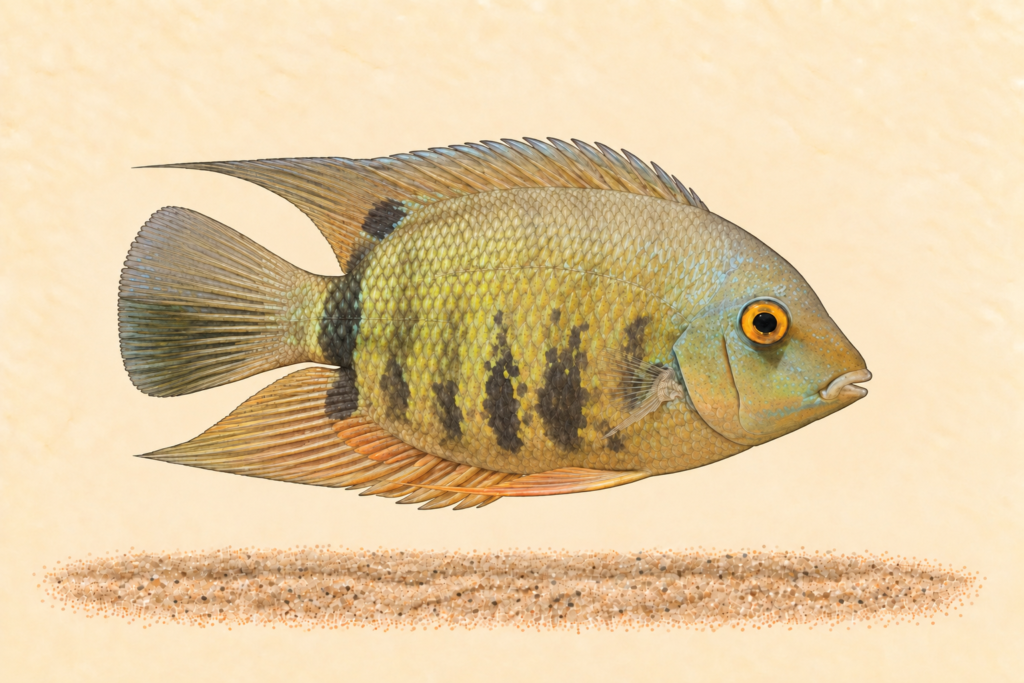
The Severum has a deep, laterally compressed body that gives it a disc-like profile reminiscent of its distant relatives the Discus and the Angelfish. Adults typically reach into the mid-20s of centimetres in length, with well-cared-for specimens capable of reaching up to 30 centimetres (12 inches) in spacious aquaria. The body shape is powerful and somewhat oval, with a prominent forehead that becomes more pronounced in mature males.
In its wild form, the Severum displays an olive-green to brownish-green base colour overlaid with a series of dark vertical bars that become more prominent towards the rear of the body. The flanks may show iridescent green, gold, or reddish-brown spangles, and the gill covers are frequently decorated with reddish-orange markings and worm-like patterning. A dark blotch at the base of the caudal peduncle is a common feature. The fins are expansive, with the dorsal and anal fins extending towards the tail in mature fish, sometimes developing elongated trailing edges in males.
Sexual dimorphism is present but not always immediately obvious. Males tend to develop more pointed dorsal and anal fin extensions and often display stronger facial markings, including bolder vermiculations (worm-shaped patterns) on the gill covers and lower head. Females are generally rounder-bodied and may show slightly less intense colouration, though this can be variable depending on the colour morph. During spawning, both sexes intensify in colour, and females may develop a darkened ventral region.
Varieties and Morphs
Selective breeding over many decades has produced a number of attractive Severum colour morphs that are now widely available in the aquarium trade. The Green Severum is the form closest to the wild type, displaying the characteristic olive-green body with dark banding and iridescent spangles across the flanks. It remains one of the most popular forms due to its natural beauty and robust constitution.
The Gold Severum is arguably the most commonly sold variety and has been a staple in the hobby for years. This morph lacks much of the dark pigmentation seen in the wild type, resulting in a warm golden-yellow body that may retain faint remnants of the vertical barring. Some specimens develop a soft orange blush across the face and ventral area, making them particularly eye-catching under aquarium lighting.
The Red-Spotted Gold Severum, sometimes sold simply as the Red Spotted Severum, takes the gold base and adds prominent red or orange spotting across the body and fins. This is a highly sought-after variant that commands a premium price. The Super Red Severum is an intensified form where selective breeding has pushed the red colouration to cover much of the body, creating a truly stunning fish that rivals many marine species for visual impact.
The Turquoise Severum features enhanced blue-green iridescence over a darker base, giving the fish a shimmering, almost metallic appearance. This variety highlights the natural iridescent qualities of the species and looks particularly striking under subdued lighting. The Red Shoulder Severum, sometimes called the Rotkeil Severum, is an unresolved or separately identified Heros aquarium form rather than a simple colour morph of H. efasciatus, and is distinguished by a vivid red-orange patch on the shoulder and gill cover area. It is one of the more expensive forms available.
Other varieties occasionally encountered include the Blue Severum, which emphasises blue tones through selective breeding, and various regional wild-caught forms that differ in the intensity and pattern of their markings. Albino Severums appear from time to time, displaying a pale body with red eyes. Most of the captive-bred morphs are hardy and straightforward to keep, sharing the same care requirements as the wild-type form.
Natural Habitat
Heros efasciatus is native to the warm, slow-moving rivers, tributaries, lakes, and floodplain pools of the Amazon basin, specifically tributaries of the Ucayali and Amazon rivers in Peru and the Solimoes-Amazon system in Brazil. This distribution should not be conflated with that of other Heros species, which occupy different river systems. They are typically found in areas with soft, slightly acidic water, though they inhabit a variety of habitats across their extensive range and demonstrate considerable adaptability to differing water conditions.
In the wild, Severums favour calm or gently flowing waters where submerged tree roots, fallen branches, and overhanging riparian vegetation provide shelter and foraging opportunities. During the wet season, they move into flooded forest areas where they feed on fruits, seeds, insects, and plant matter that falls from the canopy. This seasonal flooding creates a diverse and food-rich environment that has shaped the Severum’s omnivorous dietary habits. The substrate in their native waters is typically composed of sand, leaf litter, and decomposing organic material, which stains the water a characteristic tea-brown colour through the release of tannins and humic acids.
Understanding this natural habitat helps inform the ideal aquarium setup. While Severums are adaptable and do not demand blackwater conditions in captivity, they appreciate a tank environment that offers ample hiding places, subdued lighting, and a soft or sandy substrate reminiscent of their Amazonian home.
Tank Size and Setup
Given their adult size and active swimming habits, Severums require a reasonably spacious aquarium. A single Severum should be housed in a tank of no less than 280 litres, and a pair or small group will benefit from 400 litres or more. These are not fish that thrive in cramped quarters; insufficient space leads to stress, aggression, and stunted growth. The tank should ideally be at least 120 centimetres in length to provide adequate swimming room.
When designing the aquascape, aim for a balance between open swimming areas and sheltered retreats. Severums appreciate driftwood, large pieces of bogwood, and rock formations that create caves, overhangs, and visual barriers. These structures allow subordinate fish to escape the line of sight of dominant individuals, which is particularly important if you are keeping more than one Severum or housing them with other cichlids. A sandy substrate is ideal, as it mimics their natural environment and is gentle on the fish if they choose to sift through it while foraging.
Live plants can be included, but it is worth noting that Severums are notorious plant nibblers. Tough-leaved species such as Anubias, Java Fern, and Bolbitis are the best choices, as they are less palatable and more resistant to damage. Attaching plants to driftwood or rocks rather than planting them in the substrate makes them harder for the Severums to uproot. Delicate stem plants and soft-leaved species are unlikely to survive long in a Severum tank. Floating plants can work well, providing diffused lighting and a sense of overhead cover that helps the fish feel secure.
A secure, well-fitting lid is recommended. While Severums are not habitual jumpers, they can leap when startled or during aggressive encounters, and a covered tank also reduces evaporation and maintains stable humidity above the water surface.
Water Parameters
Severums are relatively adaptable when it comes to water chemistry, which is one reason they have remained so popular in the hobby. They do best in warm, slightly acidic to neutral water, but captive-bred specimens in particular can tolerate a fairly broad range of conditions. The key to success lies in maintaining stable, clean water rather than chasing a specific number on your test kit.
| Temperature | 24–28 °C |
| pH | 5.5–7.5 |
| General hardness (GH) | 1–8 dGH |
| Ammonia | 0 ppm |
| Nitrite | 0 ppm |
| Nitrate | Below 30 ppm |
As with all cichlids, ammonia and nitrite must be maintained at zero at all times. Severums are messy eaters and produce a considerable bioload for their size, so regular water testing is essential, particularly in the weeks following tank setup or any significant changes to the stocking level. Nitrate should be kept below 30 ppm through a combination of adequate filtration, sensible stocking, and consistent water changes. Aim for weekly water changes of 25 to 40 per cent, adjusting the volume based on your specific bioload and nitrate readings.
If you are keeping wild-caught specimens or attempting to breed your Severums, softer and more acidic water in the range of pH 5.5 to 6.5 and GH of 4 to 8 dGH will more closely replicate their natural conditions and may improve breeding success. The addition of Indian almond leaves, peat filtration, or driftwood can help naturally lower pH and tint the water with beneficial tannins.
Filtration and Equipment
Robust filtration is essential for keeping Severums in good health. These are large, messy fish that produce a significant amount of waste, and their aquarium water quality can deteriorate quickly without adequate mechanical and biological filtration. A canister filter rated for a tank larger than your actual aquarium volume is the best choice. For a 280-litre setup, consider a filter rated for 400 litres or more. If budget and space allow, running two filters provides redundancy and improved water circulation.
The filter should provide gentle to moderate flow. Severums come from relatively calm waters and do not appreciate a strong current, particularly when resting or feeding. If your filter creates an overly vigorous flow, direct the outlet towards the glass or use a spray bar to diffuse the current. Good surface agitation is important for gas exchange, but the overall movement in the tank should not force the fish to fight a constant current.
A reliable heater is necessary to maintain the tropical temperatures Severums require. An inline heater or a heater guard is advisable, as large cichlids can sometimes dislodge or damage standard submersible heaters. Maintaining a stable temperature is far more important than hitting an exact figure; sudden fluctuations can cause stress and increase susceptibility to disease.
Lighting should be moderate. Severums do not have specific lighting requirements, but they tend to display their best colours and most natural behaviour under subdued to moderate illumination. If you are growing live plants, choose a light that meets the needs of the plant species you have selected, and use floating plants or driftwood overhangs to create shaded areas where the Severums can retreat.
Diet and Feeding
One of the great advantages of keeping Severums is their willingness to eat virtually anything offered. They are true omnivores with a natural diet that includes insects, small invertebrates, algae, plant matter, fruits, and seeds. In the aquarium, this translates to a fish that accepts a wide variety of prepared, frozen, and live foods with enthusiasm.
A high-quality cichlid pellet should form the staple of their diet. Choose a pellet formulated for medium to large New World cichlids, with a balanced ratio of protein and vegetable matter. Supplement this with regular offerings of frozen or live foods such as bloodworm, brine shrimp, krill, and chopped earthworms. These protein-rich foods promote growth, enhance colouration, and provide variety that keeps the fish engaged and active at feeding time.
The vegetable component of the Severum’s diet should not be overlooked. Blanched spinach, peas (with shells removed), courgette slices, cucumber, and spirulina-based flakes or wafers are all eagerly consumed. Providing regular vegetable matter helps maintain digestive health and reduces the likelihood of the fish turning to your aquarium plants as a salad bar. Some keepers find that offering plant-based foods several times a week significantly decreases plant damage in the tank.
Feed adult Severums once or twice daily, offering only as much as they can consume within a few minutes. Overfeeding is a common pitfall with these enthusiastic eaters and leads to poor water quality, obesity, and related health problems. Juvenile fish benefit from two to three smaller meals per day to support their rapid growth. One fasting day per week can be beneficial for adult fish, allowing the digestive system to rest and helping to prevent bloat.
Behaviour and Temperament
Severums are often described as one of the more peaceful large cichlids, and this reputation is well earned. While they are certainly not pushovers and can hold their own against similarly sized tank mates, they lack the relentless aggression that characterises many other cichlids of comparable size. Their temperament is best described as assertive but generally tolerant, making them suitable for carefully planned community setups.
In a well-designed tank with sufficient space and hiding places, Severums tend to establish a loose territory around their preferred shelter without constantly harassing other inhabitants. Many keepers report that their Severums become accustomed to routine feeding times and develop distinct individual personalities, though this is anecdotal rather than documented behaviour.
Aggression levels increase notably during breeding. A pair that has bonded and is preparing to spawn will become highly territorial and may vigorously chase away any fish that ventures too close to their chosen spawning site. This is normal cichlid behaviour, but it means you need to ensure that the tank is large enough and contains enough visual barriers for other inhabitants to escape the pair’s attention. Some individual Severums become more aggressive towards tank mates when kept entirely alone, a tendency that can almost always be prevented by keeping the Severum in the company of its own kind. If you do keep several Severums together, ensure the tank is large enough to diffuse any territorial disputes that arise, particularly during breeding.
Severums are primarily diurnal and most active during the day. They spend their time cruising the mid-water and lower regions of the tank, investigating décor, foraging along the substrate, and interacting with their tank mates. Their deliberate, almost stately swimming style is part of their appeal, and watching a group of Severums navigate a well-aquascaped tank is genuinely absorbing.
Tank Mates
Choosing appropriate tank mates for Severums requires consideration of size, temperament, and environmental needs. The ideal companions are robust fish that are too large to be considered prey, not so aggressive as to bully the Severums, and comfortable in similar water conditions. Avoid very small fish that a full-grown Severum could fit in its mouth, as even the most peaceful cichlid may opportunistically consume a tiny tank mate. Similarly, avoid highly aggressive species that would keep the Severum in a constant state of stress.
Good tank mates
- Geophagus species, Eartheaters share similar water requirements and their peaceful, substrate-sifting habits make them excellent companions for Severums.
- Bristlenose Pleco (Ancistrus sp.), a hardy, bottom-dwelling algae eater that occupies a different niche and is largely ignored by Severums.
- Clown Loach (Chromobotia macracanthus), a sociable, active bottom-dweller whose size and temperament make it a compatible and visually appealing companion.
- Silver Dollar (Metynnis sp.), a peaceful schooling fish of appropriate size that occupies the mid-water column and rarely conflicts with Severums.
- Blue Acara (Andinoacara pulcher), a similarly tempered cichlid that coexists well with Severums provided the tank offers ample space and cover.
- Keyhole Cichlid (Cleithracara maronii), one of the most peaceful cichlids available, the Keyhole shares a preference for soft, warm water and is unlikely to provoke aggression.
- Rainbowfish (Melanotaenia sp.), Active, colourful schooling fish that are large enough to avoid predation and fast enough to evade any occasional chasing.
- Corydoras Catfish, Peaceful bottom-dwellers that are generally left alone, though only larger Corydoras species should be chosen to avoid any risk of predation.
Fish to avoid
- Neon Tetra (Paracheirodon innesi), far too small for a Severum tank and will almost certainly be eaten once the cichlid reaches adult size.
- Oscar (Astronotus ocellatus), while sometimes kept together, Oscars grow larger and can be significantly more aggressive, often dominating or injuring Severums.
- Jaguar Cichlid (Parachromis managuensis), a highly predatory and aggressive Central American cichlid that is likely to bully or attack a Severum.
- Jack Dempsey (Rocio octofasciata), Can be overly aggressive and territorial, particularly during breeding, frequently causing stress and injury to Severums.
- Guppy (Poecilia reticulata), Much too small and slow-moving to survive alongside a full-grown Severum, which will view them as food.
- Flowerhorn Cichlid, Extremely territorial and aggressive hybrids that should not be housed with Severums under any circumstances.
- Red Devil Cichlid (Amphilophus labiatus), a large, belligerent Central American cichlid whose aggression levels are incompatible with the relatively peaceful Severum.
- Cherry Shrimp (Neocaridina davidi), Any ornamental shrimp will be quickly consumed by a Severum and should not be considered as tank mates.
Breeding
Breeding Severums in captivity is a rewarding experience, though it requires patience and some preparation. They are biparental substrate spawners, meaning both parents participate actively in guarding and caring for the eggs and fry. Obtaining a compatible pair is the first and often the most challenging step. The most reliable method is to raise a group of six to eight juveniles together and allow them to pair off naturally as they mature. Forced pairings of two random adults frequently result in aggression rather than romance.
Once a pair has formed, they will begin to display courtship behaviours including lip-locking, gill flaring, and intensified body colouration. These interactions may seem aggressive to the uninitiated, but they are a normal part of the bonding process. The pair will select and meticulously clean a flat surface, a piece of slate, a smooth rock, a broad leaf, or even the aquarium glass, as their spawning site.
To encourage breeding, provide the pair with slightly warmer water (around 27–28 °C), ensure excellent water quality, and offer a protein-rich diet of live and frozen foods. Soft, slightly acidic water with a pH of 6.0 to 6.5 can act as a trigger, particularly if you simulate a rainy season water change by replacing a significant portion of the tank water with slightly cooler, softer water.
The female will deposit up to around 1,000 eggs in neat rows on the prepared surface, and the male will follow behind to fertilise them. Both parents take turns guarding and fanning the eggs to maintain water flow and prevent fungal growth. Unfertilised or fungused eggs are typically removed and eaten by the parents. Once hatched, both parents will mouthbrood the fry for a period, taking them into their mouths for protection, before releasing them as free-swimming young, a distinctive behaviour among substrate-spawning cichlids.
Once the fry become free-swimming, they can be fed freshly hatched brine shrimp, microworms, or finely crushed high-quality flake food. The parents will continue to guard the fry for several weeks, herding them into a tight school and aggressively defending them against perceived threats. First-time parents sometimes eat their eggs or fry; this is not unusual and they typically improve with subsequent spawns. If you wish to maximise fry survival in a community tank, you may consider moving the breeding pair to a dedicated spawning tank before they lay their eggs.
Common Diseases
White spots, wasting, stringy faeces, skin lesions and head erosion can have several causes and cannot be diagnosed reliably from appearance alone. Isolate the affected fish where practical and check ammonia, nitrite, nitrate, temperature and oxygenation. Seek diagnosis from an aquatic veterinarian or experienced fish health professional when illness persists or is severe. Treat only after identifying the likely cause, using a product licensed for ornamental fish and following its label exactly. Do not automatically raise the temperature, add salt, combine medicines, reduce a labelled dose or deworm fish prophylactically. Maintain strong aeration and complete the full labelled course.
FAQs
How big do Severums get?
Adult Severums typically reach 20 to 25 centimetres, with well-kept specimens capable of reaching up to 30 centimetres (12 inches). Their ultimate size depends on genetics, diet, water quality, and the size of the tank in which they are housed.
Can Severums be kept with live plants?
Severums can be kept in planted tanks, but they are well-known plant nibblers. Tough, unpalatable species such as Anubias, Java Fern, and Bolbitis attached to hardscape are your best options. Delicate or soft-leaved plants are unlikely to survive. Supplementing the diet with blanched vegetables can help reduce the fish’s interest in nibbling on aquarium plants.
Are Severums aggressive?
Severums are considered one of the more peaceful large cichlids. They are assertive and will defend a territory, particularly during breeding, but they are generally tolerant of appropriately sized tank mates. Aggression can increase in overcrowded conditions or if the tank lacks sufficient hiding places and visual barriers.
Can I keep a single Severum on its own?
Yes, a single Severum can be kept in a community tank. However, some individuals become more aggressive towards tank mates when kept entirely alone, a tendency that can almost always be prevented by keeping the Severum with others of its own kind. If you wish to keep a pair or group instead, ensure the tank is large enough to accommodate any territorial behaviour.
How can I tell the difference between male and female Severums?
Sexing Severums can be challenging, especially in juveniles. Mature males tend to have more pointed dorsal and anal fin extensions, bolder worm-like patterning (vermiculations) on the gill covers and lower jaw, and a slightly more angular head profile. Females are generally rounder-bodied and may show less intense facial markings. Venting (examining the genital papilla) is the most reliable method and is best performed by an experienced aquarist.
Related Guides
- Oscar Care Guide, a comparison of another popular large South American cichlid, useful for keepers deciding between the two species.
- Blue Acara Care Guide, a similarly tempered New World cichlid that makes an excellent tank mate for Severums.
- Geophagus Care Guide, Eartheater cichlids share habitat preferences and are among the best companions for Severums in large community setups.
- Angelfish Care Guide, another laterally compressed South American cichlid with overlapping care requirements and compatible temperament.
- South American Cichlid Tank Setup Guide, a broader guide to creating an ideal biotope-style aquarium for Amazonian cichlids including Severums.