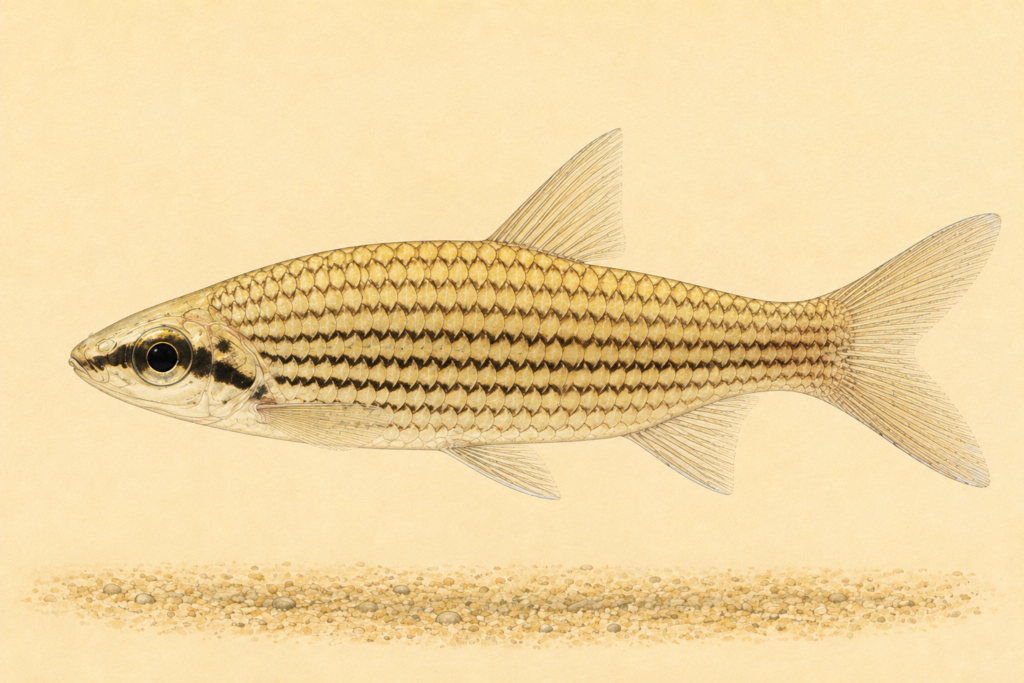
Quick summary
The so-called Golden Mascara Tetra (Cyphocharax multilineatus) is a peaceful, unusual addition to a soft-water community aquarium, best suited to experienced fishkeepers who appreciate rare and under-documented species. Despite its common name, this fish is not a true tetra at all; it belongs to the family Curimatidae, making it a relative of headstanders and toothless characins rather than conventional tetras. It is a gentle aufwuchs and algae grazer that does well in groups, but prospective keepers should be aware that very little aquarium literature exists for this species, and no breeding reports have been published.
🐠 Build a tank around this species
Last researched and fact-checked: June 2025.
- Introduction
- Quick Stats
- Appearance
- Natural habitat
- Tank size and setup
- Water parameters
- Filtration and equipment
- Diet and feeding
- Behaviour and temperament
- Tank mates
- Breeding
- Common diseases and health
- Frequently asked questions
- Related guides
Introduction
Cyphocharax multilineatus is a small, silvery-gold curimatid from the upper reaches of the Rio Negro and upper Orinoco basins, straddling the border region between Brazil and Venezuela. It turns up only occasionally in the UK hobby, usually as a wild-caught import, and the common name “Golden Mascara Tetra” is not a long-established or widely recognised trade name. The name appears to trace to a single retailer or exporter suggestion rather than any established convention, so keepers searching for information under that label may find very little. In scientific literature and on databases such as FishBase the species is listed simply as Cyphocharax multilineatus, sometimes with no common name at all.
This is an important point to emphasise from the outset: this is one of the more obscure fish you are likely to encounter in a UK shop. The genus Cyphocharax contains over 40 described species, most of which are virtually unknown in the aquarium trade. C. multilineatus was described by Steindachner in 1911, but detailed aquarium husbandry literature is sparse. Much of the practical guidance in this profile is based on what is documented about the species’ wild habitat, the general biology of the family Curimatidae, and the limited firsthand hobbyist accounts that exist. Where information is not specifically documented for this species, we say so plainly.
That said, what makes C. multilineatus appealing is precisely its novelty. It is a gentle, unassuming fish with a subtle beauty: a warm golden sheen over silver scales, fine horizontal lines along the flanks, and a distinctive dark stripe running through the eye (the “mascara” of its unofficial name). It swims in a normal, level posture, which distinguishes it at a glance from the superficially similar spotted headstander (Chilodus punctatus), a fish from the same broad order that habitually tilts head-down. For keepers running a blackwater or soft-water biotope aquarium modelled on Rio Negro or Orinoco habitats, C. multilineatus is a characterful and authentic choice.
Quick Stats
| Scientific name | Cyphocharax multilineatus |
|---|---|
| Common names | Golden Mascara Tetra, Cyphocharax multilineatus |
| Family | Curimatidae |
| Origin | Upper Rio Negro and upper Orinoco basins, South America |
| Adult size | 9 cm |
| Lifespan | 5–8 years |
| Difficulty | Intermediate |
| Breeding difficulty | Advanced |
| Temperature | 24–28 °C |
| pH | 4.5–7 |
| GH | 1–6 dGH |
| KH | 0–3 dKH |
| Minimum tank size | 100 L |
| Conservation status | Least Concern (IUCN, assessed 2020) |
Appearance
Cyphocharax multilineatus is a modestly sized, laterally compressed fish with a shape broadly typical of the Curimatidae: a somewhat deep body relative to its length, a small subterminal mouth, and a gently curved dorsal profile. The overall body colour is silver with a warm golden or brassy overlay, particularly noticeable under subdued lighting or when the fish is settled and unstressed. The specific epithet multilineatus refers to the multiple fine, dark horizontal lines running along the flanks, following the scale rows. These lines can appear more or less prominent depending on the fish’s condition and the lighting used.
The most immediately striking feature is the bold dark stripe that passes through the eye, extending from the snout tip across the iris and fading toward the operculum. This is the feature responsible for the “mascara” part of its unofficial common name, and it is also the key visual character separating C. multilineatus at a glance from Chilodus punctatus (spotted headstander), which it superficially resembles in body shape and size. The headstander, however, has a pattern of spotted or dotted horizontal lines rather than continuous stripes, and of course it adopts its characteristic head-down swimming posture, whereas C. multilineatus swims in a perfectly level orientation.
The fins are largely transparent to pale yellow, sometimes with a faint dusky edging on the dorsal and caudal fins. Sexual dimorphism has not been well documented for this species. In other Cyphocharax species, mature females tend to be slightly deeper-bodied than males, and it is reasonable to suspect something similar here, but this has not been confirmed in published sources for C. multilineatus specifically.
Natural habitat
Cyphocharax multilineatus is found in the upper Rio Negro drainage and the upper Orinoco basin, in the border region between southern Venezuela and north-western Brazil. This is classic blackwater territory: rivers and tributaries stained dark brown by dissolved tannins and humic acids leaching from decaying leaf litter and flooded forest. The water in these habitats is typically extremely soft and acidic, often with a pH below 5.0 and negligible mineral hardness. Conductivity values can be astonishingly low, sometimes below 10 µS/cm in the most pristine tributaries.
The substrates in these habitats are typically fine sand overlain with leaf litter and submerged wood. Aquatic vegetation may be sparse in the heavily shaded forest streams, though marginal and emergent plants are present along banks. The water is warm year-round, generally in the range of 25 – 28 °C (77 – 82 °F), with relatively little seasonal temperature fluctuation compared to more temperate or highland areas.
As a member of the Curimatidae, C. multilineatus is an aufwuchs grazer. Curimatids are characterised by their lack of teeth in the adult stage; they feed by scraping or sucking biofilm, periphyton, fine algae, detritus, and associated microorganisms from submerged surfaces such as wood, rocks, and leaf litter. This feeding niche makes them ecologically important in their native systems, and it is a critical consideration for aquarium husbandry.
The species has not been assessed by the IUCN Red List. Its wild population status is not well documented, and the specimens entering the aquarium trade are believed to be wild-caught from the Rio Negro/Orinoco region.
Tank size and setup
A minimum tank size of 120 litres (approximately 26 UK gallons) is recommended for a small group of C. multilineatus. As a social species best kept in groups of six or more, a larger tank of 180 – 240 litres (40 – 53 UK gallons) is preferable and will allow the fish to exhibit more natural behaviour. A longer tank footprint (at least 90 cm / 3 feet) is better than a tall, narrow one, as these fish spend much of their time grazing along the bottom and lower midwater.
The ideal setup mirrors the species’ natural blackwater biotope. Use a fine sand substrate, which allows the fish to engage in natural foraging behaviour without risking damage to their subterminal mouths. Add plenty of driftwood and bogwood, both for its aesthetic contribution and because submerged wood will develop a biofilm layer that the fish will graze on. Dried leaf litter (Indian almond leaves, oak leaves, or beech leaves) is another valuable addition; the leaves release tannins that tint the water, lower the pH, and provide additional grazing surfaces as they decompose.
Lighting should be subdued. In the wild, these fish inhabit shaded, tea-coloured waters where very little light penetrates. Bright lighting is likely to make the fish skittish and may wash out their subtle colouration. Floating plants such as Amazon frogbit or water lettuce are an excellent way to diffuse overhead light naturally. Rooted plants are not essential and may struggle in very soft, acidic conditions, but species tolerant of such parameters (certain Cryptocoryne species, for example) can work well and provide additional cover.
Provide some open swimming space in the midwater and lower regions, balanced with areas of cover formed by wood and plants. The fish are not aggressive or territorial, so elaborate hiding spots are not critical, but a well-structured tank with visual barriers will help them feel secure.
Water parameters
Maintaining suitable water chemistry is arguably the most important aspect of keeping C. multilineatus. This is a soft-water, acidic-water species from one of the most mineral-poor aquatic environments on Earth. While it may tolerate slightly harder or more neutral conditions in captivity, it is unlikely to thrive long-term in hard, alkaline water.
| Temperature | 24 – 28 °C (75 – 82 °F) |
| pH | 4.5 – 7.0 (ideally 5.0 – 6.5) |
| General hardness (GH) | 1 – 8 dGH (softer is better; aim for 1 – 4 dGH where possible) |
| Ammonia | 0 ppm |
| Nitrite | 0 ppm |
| Nitrate | Below 10 ppm (this is a sensitive wild-caught species from pristine, mineral-poor waters) |
In many parts of the UK, tap water is moderately to very hard and alkaline, which is unsuitable for this species. Keepers will typically need to use reverse osmosis (RO) water, remineralised very lightly with a product designed for soft-water fish, or blended with a small proportion of tap water to achieve the desired low hardness and acidic pH. Peat filtration or the addition of botanical materials (leaves, alder cones, driftwood) can help buffer the water toward acidic conditions and add beneficial tannins.
Regular water changes are important to keep nitrate levels low, but large sudden changes should be avoided if the replacement water differs significantly in temperature or chemistry. Smaller, more frequent water changes (15 – 20% once or twice a week) are preferable to infrequent large ones.
Filtration and equipment
Filtration should be efficient but should not produce an excessively strong current. In the wild, C. multilineatus is not typically found in fast-flowing rapids; it inhabits slower-moving tributaries and flooded margins. A canister filter or a well-sized internal filter is suitable. If using a filter with an adjustable flow rate, keep the output moderate. A spray bar or lily pipe can help to distribute flow evenly and reduce localised turbulence.
Biological filtration is the priority. In very soft, acidic water, the nitrogen cycle can be less efficient because the bacteria responsible for converting ammonia to nitrite and nitrite to nitrate function less effectively at low pH values, particularly below 6.0. Keepers running very acidic setups should be aware of this and ensure generous biological media capacity. Monitoring ammonia and nitrite levels regularly is advisable, especially when the tank is newly established or when significant changes to the bioload are made.
A heater is necessary to maintain tropical temperatures. A reliable, thermostatically controlled heater set to 25 – 27 °C (77 – 81 °F) is ideal. Use a separate thermometer to verify the temperature independently of the heater’s built-in thermostat.
As noted above, lighting should be kept low to moderate. LED units with adjustable brightness or a dimming function work well. If the tank includes live plants, choose low-light-tolerant species and adjust the intensity accordingly. A timer providing a consistent photoperiod of 8 – 10 hours per day is recommended.
Diet and feeding
Understanding the feeding biology of C. multilineatus is essential to keeping it successfully. This is an aufwuchs grazer, a fish that in the wild feeds almost exclusively by scraping biofilm, periphyton (microscopic algae, diatoms, bacteria, and detritus) from submerged surfaces. Adult curimatids lack jaw teeth entirely, and the mouth is adapted for this scraping/sucking mode of feeding rather than biting or chewing conventional fish foods.
In the aquarium, this means the keeper must ensure that suitable grazing surfaces are available. Driftwood, smooth stones, and decomposing leaves will all develop a natural biofilm layer over time, and the fish will spend hours methodically working over these surfaces. Encouraging biofilm growth (by not keeping the tank too sterile) is actually beneficial for this species.
Supplementary feeding should focus on foods that approximate the natural diet. Good choices include:
- Spirulina-based flake or wafer foods, which provide the algal component of the diet.
- Blanched vegetables such as courgette (zucchini), cucumber, or spinach, weighted down so they sink.
- Algae wafers designed for bottom-dwelling herbivores.
- Frozen or live foods high in plant matter or detritus, such as daphnia (which feed on algae and bacteria themselves).
Avoid relying heavily on high-protein foods designed for carnivorous or omnivorous fish. While C. multilineatus may pick at the occasional small invertebrate or protein-rich morsel, its digestive system is adapted for a largely herbivorous and detritivorous diet. Overfeeding protein-rich foods could cause digestive issues over time.
Feed small amounts once or twice daily, and remove any uneaten supplementary food after a few hours to prevent water quality deterioration. In a well-established tank with plenty of biofilm-covered surfaces, the fish will obtain a significant proportion of their nutrition through natural grazing, so supplementary feeding can be kept moderate.
Behaviour and temperament
Cyphocharax multilineatus is a peaceful, inoffensive fish. It poses no threat to tankmates and is not territorial. It spends the majority of its time in the lower half of the water column, methodically grazing over surfaces in a characteristically slow, deliberate manner. The swimming posture is level and steady, quite different from the head-down tilt of the related headstanders.
This is a social species and should be kept in a group of at least six individuals, though larger groups are preferable. In smaller numbers, the fish may be shy and reluctant to emerge from cover. In a suitably sized group, they tend to be more confident and will graze openly, sometimes loosely shoaling as they move around the tank. They are not a tight-schooling species in the manner of many true tetras; rather, they form loose aggregations with individuals spread across the available grazing surfaces.
Overall activity level is moderate. These are not boisterous or fast-moving fish. They are calm and unhurried, which is part of their charm but may disappoint keepers looking for dynamic, active swimmers. They are most likely to display their natural behaviour in a dimly lit, well-decorated tank with soft, acidic water and minimal disturbance from aggressive or hyperactive tankmates.
Tank mates
Cyphocharax multilineatus is an ideal community fish for a soft-water, blackwater-style setup. It is entirely non-aggressive and will not bother other fish, invertebrates, or plants. The main consideration when choosing tankmates is to select species that share its requirement for soft, acidic water and that will not bully, outcompete, or stress it. Avoid large, boisterous, or aggressive species, and avoid hard-water fish that would be incompatible with the required water chemistry.
Good tank mates
- Cardinal tetra, a classic Rio Negro species perfectly suited to the same soft, acidic conditions
- Rummy-nose tetra, another peaceful blackwater tetra that thrives in similar parameters
- Green neon tetra, a small, gentle schooler from the same upper Rio Negro region
- Chocolate gourami, a soft-water labyrinth fish with similarly quiet temperament
- Pencilfish, peaceful and slender surface-to-midwater dwellers ideal for blackwater tanks
- Corydoras habrosus, a tiny, peaceful bottom dweller comfortable in soft water
- Otocinclus, a fellow algae grazer that shares the same gentle disposition and water preferences
- Apistogramma, small dwarf cichlids from similar soft-water habitats (choose less aggressive species)
- Hatchetfish, surface-dwelling fish from blackwater environments, a good complement occupying a different water level
- Spotted headstander, a related curimatid-order species from overlapping habitats, offering an interesting comparison in swimming posture
Fish to avoid
- Oscar, far too large and aggressive; would view C. multilineatus as food
- Convict cichlid, aggressive and territorial, requiring harder water
- Tiger barb, a boisterous fin nipper that would harass this slow-moving grazer
- African cichlids, require hard, alkaline water completely incompatible with this species’ needs
- Red-tail shark, territorial and aggressive toward bottom-dwelling fish
- Flowerhorn, a large, highly aggressive hybrid cichlid utterly unsuitable as a companion
- Buenos Aires tetra, a robust, often nippy species that prefers cooler, harder water
- Green terror, a large and aggressive cichlid that would dominate and stress this species
- Rainbow shark, territorial toward bottom-dwelling and slow-moving fish
- Jaguar cichlid, a large predatory cichlid entirely incompatible in size, temperament, and water requirements
Breeding
No aquarium breeding reports for Cyphocharax multilineatus have been published in the hobbyist or scientific literature as of the time of writing. This is not uncommon for members of the Curimatidae; the family as a whole is very rarely bred in captivity, and many species in the genus Cyphocharax have never been spawned under aquarium conditions.
In the wild, curimatids generally undertake seasonal spawning migrations linked to the flood cycle, scattering eggs in flooded marginal habitats during the wet season. It is possible that C. multilineatus follows a similar reproductive strategy, but this has not been specifically confirmed for this species, and we do not wish to present assumptions drawn from related species as established fact.
Sexual dimorphism has not been clearly described for C. multilineatus. In some other Cyphocharax species, gravid females become noticeably deeper-bodied, but whether this is a reliable sexing method for C. multilineatus is unknown.
If any keeper does succeed in breeding this species, it would represent a genuinely noteworthy achievement, and sharing detailed records with the wider hobby community would be extremely valuable. Until such reports emerge, prospective keepers should assume that captive breeding is not a realistic expectation with current knowledge.
Common diseases and health
There are no species-specific diseases documented for Cyphocharax multilineatus. As a wild-caught freshwater fish from South American blackwater habitats, it is susceptible to the same range of common aquarium ailments as other tropical species. White spot disease (ich), caused by the parasite Ichthyophthirius multifiliis, is always a risk, particularly during transport stress or when fish are introduced to a new tank without adequate quarantine. Velvet disease (caused by Piscinoodinium) and bacterial infections can also occur, especially if water quality is poor or the fish is stressed.
Because this species originates from extremely soft, acidic, mineral-poor water, it may be more sensitive than many common aquarium fish to elevated nitrate levels, dissolved minerals, or pH values outside its preferred range. Maintaining pristine water quality through regular water changes, efficient filtration, and careful stocking is the single most important step in disease prevention. New specimens should always be quarantined for at least two to three weeks before being added to an established community tank, particularly given that wild-caught fish may harbour internal parasites that are not immediately obvious.
The aufwuchs-grazing feeding mode of curimatids means that nutritional deficiency is a potential concern if the tank does not provide sufficient biofilm or suitable supplementary food. A fish that is not feeding adequately will lose condition gradually, becoming thin and pale. Ensuring a varied, plant-based diet and providing ample grazing surfaces are key to maintaining good nutritional health. If a fish appears to be losing weight despite food being available, consider whether the diet is appropriate and whether more dominant tankmates may be preventing it from feeding.
Frequently asked questions
Is the Golden Mascara Tetra actually a tetra?
No. Despite the common name, Cyphocharax multilineatus is not a true tetra. It belongs to the family Curimatidae (toothless characins), which is in the same order (Characiformes) as true tetras but is a distinct family. It is more closely related to headstanders and other curimatids than to familiar tetras like neons or cardinals. The name “Golden Mascara Tetra” is an unofficial trade name that appears to originate from a single retailer or exporter, and it is not a widely recognised or established common name.
How many should I keep together?
A minimum group of six is recommended, with larger groups of eight to ten being preferable if tank size allows. Keeping fewer than six may result in shy, reclusive behaviour.
Can I keep this species in hard, alkaline tap water?
This is not advisable. C. multilineatus originates from some of the softest, most acidic freshwater environments on the planet. While it may survive for a time in moderately hard water, it is unlikely to thrive long-term. Keepers in hard-water areas will need to use RO water to achieve suitable conditions.
What is the difference between this fish and the spotted headstander?
Cyphocharax multilineatus and Chilodus punctatus (spotted headstander) are superficially similar in body shape and size, but they are easily distinguished. The spotted headstander swims in a characteristic head-down posture, whereas C. multilineatus swims level. Additionally, C. multilineatus has a bold dark stripe through the eye, while the spotted headstander has rows of dark spots along the body. Both belong to the order Characiformes but are in different families.
Will this fish eat algae in my tank?
Yes, to an extent. As a natural aufwuchs grazer, C. multilineatus will feed on biofilm, periphyton, and fine algae growing on surfaces in the tank. However, it should not be purchased primarily as an “algae cleaner.” Its grazing is methodical and focused on biofilm rather than on thick growths of nuisance algae, and it requires a suitable supplementary diet to stay healthy.
Can I breed this species?
As of June 2025, there are no published aquarium breeding reports for Cyphocharax multilineatus. Captive breeding of curimatids in general is extremely rare. Prospective keepers should not purchase this fish with the expectation of breeding it.
Is this species endangered?
The species has not been assessed by the IUCN Red List, so its conservation status is formally unknown. It is found across a reasonably broad range in the upper Rio Negro and upper Orinoco systems, but detailed population data are not available.