Apistogramma Care Guide — Tank Setup, Feeding and Breeding
Introduction
The Cockatoo Dwarf Cichlid, known properly as Apistogramma cacatuoides, is one of the most popular and recognizable dwarf cichlids in the freshwater hobby. Named for the male’s tall, spiky dorsal fin rays that call to mind a cockatoo’s crest, this little South American cichlid packs an astonishing amount of personality and colour into a body that rarely exceeds 8 centimetres. It is the fish that has launched countless aquarists into the wider world of Apistogramma keeping, and for good reason.
What draws people to the Cockatoo Apisto is the combination of visual impact and genuine character. Males display vivid reds, oranges, and yellows across their fins and flanks, and they patrol their territories with the confidence of a fish three times their size. Females, while more subdued in colour most of the time, transform into striking lemon-yellow guardians when they are tending eggs or fry. Watching a pair interact, spar gently, and eventually raise young together is one of the most rewarding experiences the hobby offers.
In terms of difficulty, A. cacatuoides sits at the more forgiving end of the Apistogramma spectrum. It tolerates a broader range of water parameters than many of its relatives and adapts well to community aquariums when housed with the right tank mates. If you have some experience keeping tropical fish and you are ready to step into the world of dwarf cichlids, this is an excellent species to start with. Absolute beginners can succeed too, provided they do the homework on water quality and tank setup before bringing a pair home.
Quick stats
| Scientific name | Apistogramma cacatuoides |
| Family | Cichlidae |
| Origin | Peru, Colombia, and western Brazil (Amazon basin tributaries) |
| Adult size | Males up to 8 cm; females up to 5 cm |
| Lifespan | 3 to 5 years |
| Difficulty | Intermediate |
| Breeding difficulty | Easy |
| Temperature | 24 – 28 °C |
| pH range | 5.5 – 7.5 |
| Minimum tank size | 75 litres (for a pair) |
Appearance
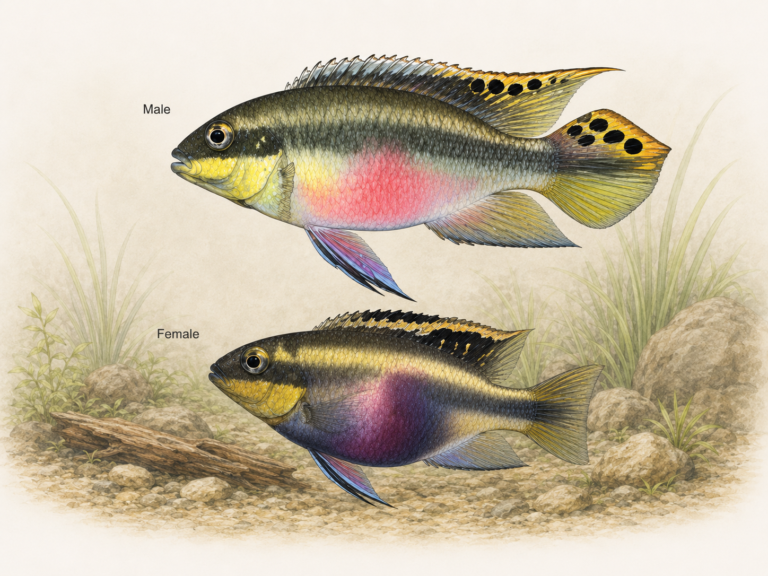
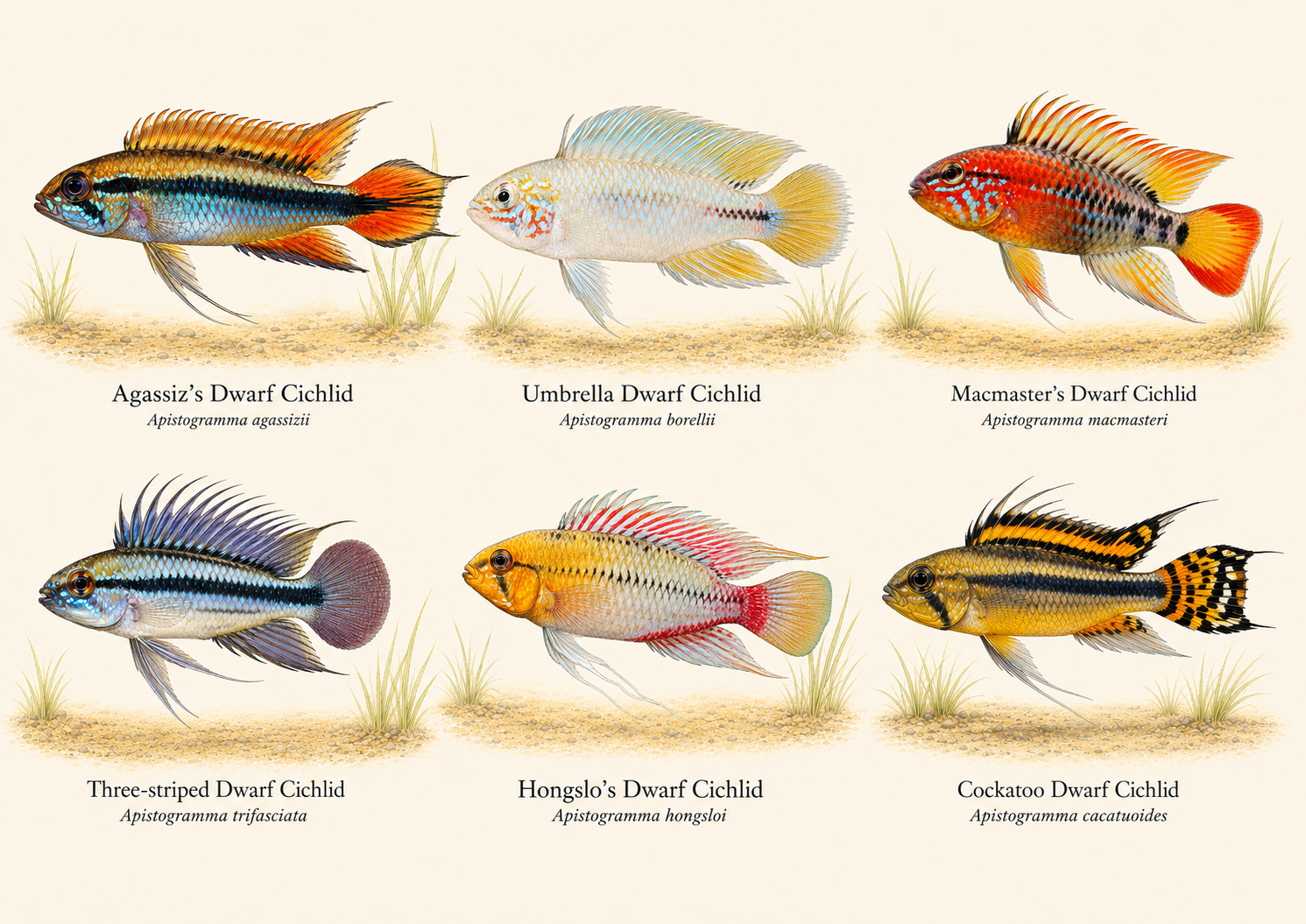
Male Cockatoo Apistos are the showstoppers. Their dorsal fins feature elongated, separated anterior rays that stand up like a crest, giving the species its common name. Wild-type males have a base colour of silvery grey to olive, overlaid with a bold black lateral stripe that runs from the snout through the eye to the caudal peduncle. Their caudal fins are lyrate (spade-shaped) and marked with red or orange spots and streaks. Through decades of selective breeding, commercial strains now come in “Double Red,” “Triple Red,” “Orange Flash,” “Super Red,” and even “Sunburst” varieties, pushing the red and orange pigmentation across the entire finnage and sometimes onto the body.
Females are considerably smaller and less flamboyant in their resting coloration, typically displaying a muted yellowish-grey body with faint barring and a less pronounced lateral stripe. However, when a female enters breeding mode, she turns a vivid bright yellow with contrasting jet-black markings on her ventral fins and face. This transformation is unmistakable and one of the clearest visual signals in the dwarf cichlid world. Beyond colour, sexing is straightforward once fish reach maturity: males are larger, have the extended dorsal rays, and develop more elaborate fin extensions overall. Females remain compact and rounded, particularly when carrying eggs.
Natural habitat
Apistogramma cacatuoides is found across a wide range in the western Amazon basin, primarily in Peru’s Ucayali and Amazon River drainages, with populations extending into parts of Colombia and western Brazil. These fish inhabit slow-moving tributaries, flooded forest pools, and small streams where the water is often stained brown by tannins leaching from decomposing leaf litter on the substrate. The bottom in these habitats is typically a mix of sand, fine mud, and dense layers of fallen leaves, with submerged roots, branches, and overhanging vegetation providing structure and shelter.
What makes A. cacatuoides notable among Apistogramma species is that it is found in a relatively diverse set of water conditions in the wild. While many of its relatives are restricted to extremely soft, acidic blackwater, this species also turns up in clearwater and mildly harder streams. This ecological flexibility is the reason it is more adaptable in captivity than, say, A. iniridae or A. elizabethae. That said, understanding its origins still matters: providing leaf litter, dim lighting, and gentle flow in the aquarium mimics the conditions that allow this fish to feel secure, display its best colours, and behave naturally.
Tank size and setup
A single pair of A. cacatuoides can be kept comfortably in a 75-litre aquarium, but if you plan to keep a small harem (one male with two or three females, which is the more natural social structure) or a community setup, aim for 110 to 150 litres as a minimum. Floor space is more important than water depth for these bottom-oriented fish, so longer tanks are preferable to tall ones. A standard 80 × 35 cm footprint works well for a pair, while a 100 × 40 cm footprint suits a harem setup.
For substrate, a fine sand such as pool filter sand, ADA La Plata Sand, or CaribSea Super Naturals is ideal. Apistos frequently sift through substrate, picking up and spitting out mouthfuls of sand as they forage, so sharp or coarse gravel should be avoided. On top of the sand, scatter a generous layer of dried Indian almond leaves (Terminalia catappa) or oak leaves. These release tannins that slightly soften and acidify the water, create a natural look, and serve as grazing surfaces for microfauna that fry will feed on.
Caves are essential. Coconut shell halves, small terracotta pots laid on their sides, ceramic breeding caves, or stacked flat stones all work. Provide at least one cave per female; these serve as spawning sites and territorial centres. Driftwood and branching root structures like Malaysian driftwood or spider wood add both visual complexity and hiding spots. For plants, choose species that thrive in moderate to low light: Cryptocoryne wendtii, Cryptocoryne parva, Java fern (Microsorum pteropus), Anubias nana, and floating plants like Amazon frogbit (Limnobium laevigatum) or red root floaters (Phyllanthus fluitans). Floating plants are particularly useful because they diffuse overhead light and give the fish a sense of security. Lighting should be moderate; if you are using a brighter LED fixture, the floating plant cover will take care of the dimming naturally. Water flow should be gentle, these fish come from sluggish waters and do not appreciate strong currents.
Water parameters
| Temperature | 24 – 28 °C |
| pH | 5.5 – 7.5 |
| General hardness (GH) | 2 – 15 dGH |
| Carbonate hardness (KH) | 1 – 10 dKH |
| Ammonia | 0 ppm |
| Nitrite | 0 ppm |
| Nitrate | Below 20 ppm |
While A. cacatuoides is more parameter-flexible than many Apistogramma species, it still performs best in soft to moderately hard, slightly acidic to neutral water. A pH around 6.5 and a temperature of 26 °C is a comfortable middle ground for general keeping. If you intend to breed, nudging the pH down towards 6.0 and keeping hardness on the lower side can improve fertilisation rates and fry survival. Stability matters more than hitting a specific number, so avoid chasing parameters with constant chemical adjustments. Weekly water changes of 20 to 30 percent, matched to the tank temperature, will keep nitrates in check and maintain water quality.
Filtration and equipment
A sponge filter is the classic choice for an Apistogramma tank, and for good reason. It provides gentle, even flow and biological filtration without creating suction that can trap fry. A Hikari Bacto-Surge sponge filter or a Matten filter powered by a small air pump works beautifully. If you prefer a hang-on-back or small canister filter, options like the Oase Filtosmart 100 or Aquael Versamax Mini are fine, just baffle the outflow with a sponge or spray bar to reduce current, and cover the intake with a pre-filter sponge to protect fry.
A reliable heater is important. An adjustable 50-watt heater suits tanks up to around 80 litres, while a 100-watt unit is appropriate for 100 to 150 litres. Brands like Eheim Jäger and Fluval E-Series offer accurate and durable options. Set it to 26 °C and verify with a separate glass or digital thermometer.
For water testing, the API Freshwater Master Test Kit remains the best value liquid test kit for monitoring ammonia, nitrite, nitrate, and pH. A GH/KH test kit is also worth having, particularly if you plan to breed. Test weekly during regular maintenance and more frequently during cycling or any time fish behaviour seems off.
Diet and feeding
In the wild, A. cacatuoides is a micro-predator, feeding on insect larvae, tiny crustaceans, worms, and other invertebrates found among leaf litter and substrate detritus. In captivity, a varied diet that reflects this preference will keep the fish healthy, colourful, and in breeding condition.
A high-quality micro pellet or granule should form the staple. Hikari Micro Pellets, Northfin Community, and Sera Cichlid Green XS are all well-suited. Supplement this regularly with frozen foods: baby brine shrimp, daphnia, cyclops, and bloodworms (the latter sparingly, as a treat rather than a staple). Live foods like freshly hatched brine shrimp nauplii, grindal worms, and microworms are excellent for conditioning breeders and are essential for raising fry. Freeze-dried tubifex cubes can also be offered occasionally.
Feed small amounts once or twice a day, only as much as the fish consume within two to three minutes. Apistos have small stomachs and fare better with modest, frequent meals than large, infrequent ones. Overfeeding fouls the water quickly and can lead to health issues. A fasting day once per week is perfectly fine and mimics natural feeding patterns.
Behaviour and temperament
Apistogramma cacatuoides is an intelligent, inquisitive fish with a rich behavioural repertoire. Males spend their time patrolling territory boundaries, displaying to females, and investigating every corner of the tank. They are bold for their size and will often come to the front glass to watch you as much as you watch them. In a well-set-up tank, you will see a full range of natural behaviours: fin flaring, lateral displays, sand sifting, and the characteristic slow “hover and inspect” movement as they pick through leaf litter.
Within their own species, social dynamics are fascinating. A dominant male will oversee a territory that encompasses the smaller sub-territories of one or more females. Each female defends the area around her chosen cave, and her relationship with the male shifts between tolerance and active courtship. After spawning, females become aggressively protective of their eggs and fry, and will chase the male and any other fish away from the cave entrance. In undersized tanks, this aggression can become problematic, which is why adequate space and line-of-sight breaks are so important. Males may occasionally spar with each other using lateral displays and brief lip-locking, but serious injury is rare if the tank provides enough room and structure for a subordinate male to retreat.
Tank mates
Good tank mates
- Cardinal tetra (Paracheirodon axelsi), peaceful, stays in midwater, and thrives in similar soft, acidic conditions
- Rummy-nose tetra (Hemigrammus rhodostomus), calm schooling fish that occupies the middle and upper water column
- Ember tetra (Hyphessobrycon amandae), tiny and non-competitive, a great match in smaller setups
- Corydoras catfish (Corydoras spp.), gentle bottom dwellers, though keep an eye during breeding as females may chase them from cave areas
- Otocinclus catfish, unobtrusive algae grazers that stay out of the Apisto’s way
- Harlequin rasbora (Trigonostigma heteromorpha), easygoing and prefers the same water parameters
- Pencilfish (Nannostomus spp.), slender, peaceful, and occupy the upper water layers
Fish to avoid
- Oscars and other large cichlids, will eat or terrorise Apistogramma
- Angelfish (Pterophyllum scalare), can be too large and assertive, and may prey on Apisto fry
- German blue rams (Mikrogeophagus ramirezi), occupy the same niche and territory conflicts are common in all but the largest tanks
- Tiger barbs, nippy and boisterous, will harass the Apisto’s trailing fins
- Convict cichlids, far too aggressive and territorial for cohabitation
- Large or aggressive plecos, species like the common pleco grow too large and may disturb caves at night
- Male guppies, their bright, flowing tails can trigger aggression from male Apistogramma, and they often prefer harder water
Breeding
Apistogramma cacatuoides is one of the easiest Apistogramma species to breed in captivity, making it a fantastic introduction to dwarf cichlid breeding. Sexing adults is straightforward: males are larger, more colourful, and have the elongated dorsal crest and lyrate caudal fin. Females are smaller, rounder in the belly, and develop a yellow breeding dress with black markings on the ventral area and cheeks when they are ready to spawn.
To condition a pair or harem for breeding, increase the proportion of live and frozen foods over a period of one to two weeks. Keep the water clean, with a temperature around 26 to 27 °C and a pH near 6.0 to 6.5. The female will select a cave, often the most secluded option available, and begin cleaning the interior surfaces. When she is ready, she displays to the male by arching her body, vibrating, and presenting her bright yellow flanks. Spawning takes place inside the cave, where the female deposits 40 to 80 adhesive eggs on the ceiling or walls. The male briefly enters to fertilise them and is then typically chased away.
From this point, the female takes charge. She fans the eggs to keep them oxygenated and removes any that fungus. Eggs hatch in approximately two to three days at 26 °C, and the wrigglers remain attached to the cave surfaces for another three to four days while they absorb their yolk sacs. Once the fry become free-swimming, the female herds them around her territory in a tight school, aggressively defending them from all other fish. The male may patrol the outer perimeter but is not directly involved in fry care.
Free-swimming fry are tiny but can immediately accept freshly hatched baby brine shrimp (Artemia nauplii), vinegar eels, and commercial powdered fry foods such as Sera Micron. Feed small amounts several times a day. If you want to maximise survival, consider moving the female and fry to a dedicated grow-out tank, though many hobbyists successfully raise broods in the main tank with enough cover and the right tank mates. Fry grow steadily and begin showing sex-related differences at around three to four months of age.
Common diseases and health
Hole-in-the-head disease (HITH)
This condition presents as small pits or erosions on the head and lateral line area. It is strongly associated with poor water quality, high nitrate levels, and nutritional deficiencies. Treatment involves improving water quality through more frequent water changes, diversifying the diet to include more live and frozen foods, and in more advanced cases, treating with metronidazole. Maintaining nitrate levels below 20 ppm is the best preventive measure.
Ich (white spot disease)
Ich is recognisable by small white spots resembling grains of salt on the body and fins, along with flashing (scratching against objects) and clamped fins. Raise the temperature gradually to 30 °C over 24 hours and treat with a half-dose of a malachite green and formalin-based medication, as Apistogramma can be sensitive to full-strength treatments. Maintain the elevated temperature for at least 10 days to break the parasite’s life cycle.
Bacterial infections
Fin rot, body slime, and other bacterial infections can occur when fish are stressed by poor water quality, aggression, or sudden parameter swings. Symptoms include frayed fins, reddened areas on the body, lethargy, and loss of appetite. Mild cases often resolve with pristine water conditions alone. For more serious infections, treatments containing kanamycin or a combination of kanaplex and furan-2 are effective. Always remove activated carbon from the filter during medication.
Quarantining new fish before adding them to your main tank is strongly recommended. A simple bare-bottom quarantine tank of 20 to 40 litres with a sponge filter, heater, and a hiding spot is all you need. Observe new arrivals for two to three weeks, watching for signs of disease, parasites, or stress. This small investment of time can prevent introducing pathogens that are far more difficult to deal with once they are established in a community system.
Frequently asked questions
Can I keep Apistogramma cacatuoides in a community tank?
Yes, and they do very well in community setups as long as their tank mates are peaceful, not too large, and do not compete for the same bottom territory. Small tetras, rasboras, Corydoras, and Otocinclus are all solid choices. Just be aware that breeding females will become territorial around their caves and may chase other bottom-dwelling fish during that period.
How many Apistogramma cacatuoides can I keep together?
In a 75-litre tank, a single pair is the safest option. For a harem of one male and two to three females, you will want at least 110 to 150 litres with plenty of caves and visual barriers so each female can establish her own territory. Keeping two males together requires a significantly larger tank, 200 litres or more, with dense structure to break sight lines and reduce aggression.
Do Apistogramma cacatuoides need soft water?
They are more flexible than many Apistogramma species and will live happily in water with a GH up to around 12 to 15 dGH and a pH up to 7.5. However, for breeding success and the best colouration, softer and slightly acidic water in the range of pH 6.0 to 6.5 and GH 2 to 8 is preferable. If your tap water is moderately hard, the fish will likely still thrive, but breeding may be less productive.
Why is my Apistogramma hiding all the time?
New Apistogramma often hide for the first few days to a week as they settle into their environment. If hiding persists, check that the tank has enough cover (plants, driftwood, leaf litter) and that the lighting is not too bright. Floating plants can make a dramatic difference. Also rule out bullying from tank mates, and test your water parameters to make sure nothing is off. A confident Apisto in a well-set-up tank will be out and about regularly.
How long do Apistogramma cacatuoides live?
With good care, they typically live three to five years in captivity. Factors that support a longer lifespan include stable water quality, a varied diet, low stress, and appropriate water temperature. Keeping them at the lower end of their temperature range (around 24 to 25 °C) can slow their metabolism slightly and may contribute to a longer life, though this is a marginal effect compared to overall husbandry quality.