Quick Summary
The Guapore Corydoras is a peaceful, small armoured catfish that bucks the typical bottom-dwelling trend of its relatives by actively shoaling in midwater – making it a fascinating and unusual choice for community aquariums with soft, acidic water. It is best suited to intermediate keepers who can maintain stable, warm conditions and provide a group of six or more.
🐠 Build a tank around this species
In this guide:
- Introduction
- Quick Stats
- Appearance
- Natural Habitat
- Tank Size and Setup
- Water Parameters
- Diet and Feeding
- Behaviour and Temperament
- Tank Mates
- Breeding
Introduction
The Guapore Corydoras, now formally classified as Gastrodermus guapore following the major 2024 taxonomic revision that split the historically enormous Corydoras genus into several smaller genera, is a delightful small catfish from the Rio Guapore basin in South America. You will still find this species widely sold under the older name Corydoras guapore, and it may be some time before the hobby fully adopts the updated nomenclature. Regardless of the name on the label, this is a charming, sociable fish that deserves far more attention than it currently receives.
What makes the Guapore Corydoras truly stand out among its relatives is its unusual swimming behaviour. Unlike the vast majority of Corydoras-type catfish, which are strictly bottom-dwelling substrate sifters, Gastrodermus guapore is a genuine midwater swimmer. It is frequently observed hovering and shoaling in the water column, sometimes well above the substrate, behaving more like a tetra than a typical cory. This midwater habit is not a sign of stress or poor water quality – it is the species’ natural behaviour, and once you understand this, watching a group cruise through open water becomes one of the most appealing aspects of keeping them.
First described by Knaack in 1961, this species has remained somewhat uncommon in the hobby, partly because it originates from a relatively remote drainage and partly because it lacks the dramatic patterning of some of its more commercially popular cousins. Nevertheless, for aquarists who appreciate subtle beauty and unusual behaviour, the Guapore Corydoras is a genuinely rewarding fish to keep and observe.
Quick Stats
| Scientific name | Gastrodermus guapore (Knaack, 1961) |
|---|---|
| Common names | Guapore Cory, Corydoras guapore |
| Family | Callichthyidae |
| Origin | Rio Guapore basin, Brazil/Bolivia, South America |
| Adult size | 4.5 cm |
| Lifespan | 5–8 years |
| Difficulty | Intermediate |
| Breeding difficulty | Moderate |
| Temperature | 24–28 °C |
| pH | 5.5–7 |
| GH | 1–10 dGH |
| KH | 1–5 dKH |
| Minimum tank size | 80 L |
| Conservation status | Least Concern (IUCN, assessed 2020) |
Appearance
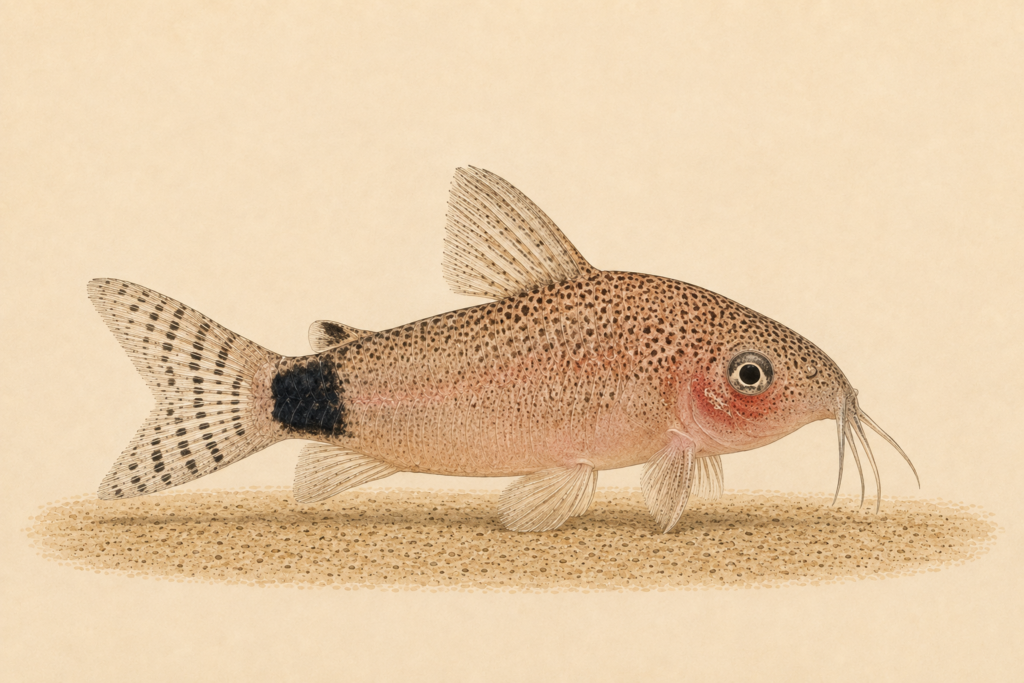
The Guapore Corydoras is a modestly sized armoured catfish, typically reaching around 4 to 5 centimetres in total length when fully grown. Its body shape follows the classic corydoradine form – a deep, laterally compressed body protected by two rows of overlapping bony scutes (dermal plates) running along each flank. The head is slightly rounded with a short, blunt snout bearing two pairs of small barbels on the upper and lower jaw, which the fish uses to explore its surroundings.
The base colouration is a warm, translucent beige to light tan, overlaid with a subtle iridescent sheen that can appear greenish or bronze under aquarium lighting. A dark lateral stripe runs from behind the gill cover to the base of the caudal fin, and this stripe can vary in intensity depending on the fish’s mood, the lighting, and the substrate colour. Above and below this lateral stripe, the body often shows a scattering of fine dark speckles or spots, giving the fish a pleasantly dappled look when viewed up close.
The fins are largely transparent to lightly tinted, with the dorsal fin sometimes showing a faint dark blotch near its leading edge. The caudal fin is forked and clear, well-suited to the species’ midwater swimming habits. Males tend to be slightly slimmer than females when viewed from above, while gravid females develop a noticeably rounder belly. Overall, this is not a fish that jumps out at you with bold colours, but its gentle, understated appearance combined with its lively swimming behaviour makes it quietly captivating in a well-designed aquarium.
Like all callichthyid catfish, the Guapore Corydoras possesses the ability to gulp atmospheric air at the water’s surface, supplementing gill respiration via a modified section of intestine. Occasional dashes to the surface are entirely normal and should not cause alarm unless they become very frequent, which could indicate poor dissolved oxygen levels.
Natural Habitat
The Guapore Corydoras is native to the Rio Guapore (also known as the Rio Itenez on the Bolivian side), a major tributary of the Rio Mamore in the upper Amazon basin. The Rio Guapore forms part of the border between the Brazilian state of Rondonia and the Beni Department of Bolivia. This is a region of lowland tropical rainforest, where rivers and streams wind through dense vegetation, flooded forests, and seasonally inundated grasslands.
In its natural environment, Gastrodermus guapore inhabits slow-moving tributaries, backwaters, and flooded forest margins where the water is typically warm, soft, and acidic. The substrate in these habitats is usually fine sand or mud, covered with a layer of decomposing leaf litter. Submerged tree roots, fallen branches, and aquatic vegetation provide structure and shelter, while the tannin-stained water often reduces visibility and creates the characteristic tea-brown colour associated with blackwater environments.
Water parameters in these habitats tend to be quite specific: temperatures range from 24 to 28 degrees Celsius, pH values are often between 5.5 and 6.5, and the water is extremely soft with very low mineral content. The low conductivity and acidity of these waters are maintained by the continuous input of humic acids from decomposing organic matter. During the wet season, water levels rise substantially, flooding the surrounding forest and creating vast areas of shallow, tannin-rich water through which these catfish can forage and breed.
Understanding this natural habitat is key to replicating suitable conditions in the aquarium. The warm, soft, acidic water and fine sandy substrate of the Rio Guapore should be the baseline for any keeper aiming to provide the best possible environment for this species.
Tank Size and Setup
A minimum tank size of 80 litres is recommended for a group of Guapore Corydoras. Because this species is an active midwater swimmer rather than a sedentary bottom-dweller, it benefits from a tank with a decent footprint and some vertical space. A standard 80-litre aquarium measuring roughly 60 by 30 by 35 centimetres will work for a group of six, but a longer tank of 90 to 100 litres or more is preferable if you plan to keep a larger group or house them in a community setting.
Substrate choice is critical for all Corydoras-type catfish, and the Guapore Corydoras is no exception. Use fine, smooth sand – never sharp gravel or coarse substrates that can damage the delicate barbels. Damaged barbels are a common and entirely preventable problem in cory keeping, and eroded barbels can lead to secondary infections. Play sand, pool filter sand, or purpose-made aquarium sands are all suitable choices. A layer of around 2 to 3 centimetres is sufficient.
Although Gastrodermus guapore spends more time in midwater than most of its relatives, it will still visit the substrate regularly to forage, so the sand requirement remains non-negotiable. Beyond the substrate, aim to provide a mix of open swimming space and shelter. Driftwood pieces, particularly those that release tannins into the water, are ideal as they help acidify the water gently and mimic the species’ natural environment. Arrange wood and smooth rocks to create visual barriers and retreats without cluttering the midwater zone where the fish prefer to swim.
Dried Indian almond leaves (Terminalia catappa) or oak leaves scattered across the substrate serve a dual purpose: they release beneficial tannins and provide a natural foraging surface for the catfish. As the leaves decompose, they also support microfauna that juvenile fish can feed on. Replace leaves as they break down, roughly every two to four weeks.
Live plants are a welcome addition, though not strictly essential. Species that tolerate soft, acidic water work best – consider Java fern (Microsorum pteropus), Anubias species, Cryptocoryne species, or floating plants such as Amazon frogbit (Limnobium laevigatum). Floating plants help diffuse light and create the slightly dim conditions that these fish seem to prefer, and they also provide a sense of overhead cover that can encourage more natural behaviour.
Lighting should be moderate to subdued. Bright, unshaded lighting can make these fish skittish and less inclined to venture into open water. If your lighting is on the stronger side, floating plants or tinted water from tannins can help soften the intensity.
Water Parameters
| Temperature | 24-28 C |
| pH | 5.5-7.0 |
| General hardness (GH) | 1-10 dGH |
| Carbonate hardness (KH) | 1-5 dKH |
| Ammonia | 0 ppm |
| Nitrite | 0 ppm |
| Nitrate | Below 20 ppm |
The Guapore Corydoras comes from warm, soft, acidic waters, and replicating these conditions as closely as possible will result in the healthiest and most naturally behaving fish. A temperature in the range of 24 to 28 degrees Celsius is appropriate, with 25 to 27 degrees being a comfortable sweet spot for long-term keeping. This is slightly warmer than some of the more commonly kept Corydoras species (such as C. paleatus or C. aeneus), so bear this in mind when selecting tank mates.
A pH between 5.5 and 7.0 is tolerable, but the species will be most comfortable and show its best colouration in slightly acidic water around pH 6.0 to 6.5. General hardness should ideally be kept low, between 1 and 10 dGH, with softer water preferred. Carbonate hardness of 1 to 5 dKH is acceptable. If your tap water is moderately hard, blending it with reverse osmosis (RO) or demineralised water can help achieve the desired softness.
As with all fish, ammonia and nitrite must be maintained at zero at all times. Nitrate should be kept below 20 ppm through regular partial water changes. A weekly water change of 25 to 30 per cent is a good baseline, though the exact schedule will depend on your stocking levels, filtration capacity, and feeding regime. When performing water changes, ensure the replacement water is temperature-matched and treated to remove chlorine and chloramine.
Stability is arguably more important than hitting an exact number. Sudden swings in pH or temperature are far more harmful than a pH that sits at 6.8 rather than 6.2. Invest in a reliable liquid test kit and monitor parameters regularly, particularly in the first few months after setting up a new tank.
Filtration and Equipment
Filtration for the Guapore Corydoras should be efficient but gentle. These fish do not appreciate strong currents, particularly given their preference for midwater swimming where flow tends to be most pronounced. A hang-on-back filter or a small canister filter rated for the tank’s volume is usually sufficient. Sponge filters are another excellent option, especially for breeding setups, as they provide gentle biological filtration without any risk of trapping small fry.
If using a canister or hang-on-back filter, consider fitting a spray bar or adjusting the outlet to diffuse the flow across the water’s surface rather than creating a single strong jet. This ensures adequate surface agitation for gas exchange while preventing the fish from being buffeted by current. Internal flow rates of around four to six times the tank volume per hour are a reasonable target.
A reliable heater is essential given this species’ preference for warm water. Choose a heater with a thermostat and, if possible, a visible temperature display. In larger tanks, two smaller heaters positioned at opposite ends can provide more even heat distribution. Always use an external thermometer as a backup to verify the heater is maintaining the correct temperature.
An air pump is not strictly necessary if surface agitation from the filter is adequate, but a gentle airstone can be beneficial for supplemental oxygenation, particularly during warm summer months when dissolved oxygen levels naturally drop. Since Gastrodermus guapore can supplement its oxygen intake with atmospheric air, it is somewhat more tolerant of low-oxygen conditions than many fish, but this should never be used as an excuse for poor aeration.
A tight-fitting lid or coverslips are recommended. While corydoradine catfish are not known as prolific jumpers, their periodic dashes to the surface to gulp air can occasionally result in a fish breaching the water’s surface, and a lid also reduces evaporation and helps maintain stable temperatures.
Diet and Feeding
The Guapore Corydoras is an omnivore with a slight preference for small invertebrates and other protein-rich foods. In the wild, it feeds on insect larvae, small worms, crustaceans, and organic detritus found in the substrate and water column. In the aquarium, it readily accepts a wide variety of prepared and live foods.
A high-quality sinking pellet or wafer designed for bottom-feeding catfish should form the staple diet. However, because this species spends a significant amount of time in midwater, it will also readily take foods that drift through the water column – crushed flake food, micro-pellets, and freeze-dried items are all accepted with enthusiasm. This midwater feeding behaviour is unusual for a corydoradine and is one of the charming quirks of the species.
Supplement the staple diet with regular offerings of frozen or live foods. Bloodworm, daphnia, brine shrimp (both adult and baby), tubifex, and micro-worms are all excellent choices. Live foods in particular seem to stimulate natural foraging behaviour and can help condition fish for breeding. Aim to offer protein-rich foods two to three times per week.
Feed once or twice daily, offering only as much as the fish can consume within a few minutes. Overfeeding is a common cause of water quality problems, especially in smaller tanks. Remove any uneaten food promptly to prevent it from fouling the water. If you keep your Guapore Corydoras in a community tank, ensure that food reaches them and is not monopolised by faster or more aggressive feeders higher in the water column – though this species’ willingness to feed in midwater does help in this regard.
Occasional vegetable matter can be offered in the form of blanched courgette, cucumber, or a high-quality spirulina wafer, though plant matter will typically make up a minor portion of the diet compared to protein-based foods.
Behaviour and Temperament
The most distinctive behavioural trait of Gastrodermus guapore is its tendency to shoal in midwater rather than remaining on or near the substrate. This is genuinely unusual among Corydoras-type catfish. Most species in the broader corydoradine group are quintessential bottom-dwellers, spending the vast majority of their time sifting through sand, resting on the substrate, or sheltering among decor. The Guapore Corydoras, by contrast, frequently hovers in the water column, swimming in loose shoals with its conspecifics. It will still visit the substrate to forage, particularly at feeding time, but you should expect to see these fish spending significant portions of the day suspended in open water.
This midwater behaviour can initially confuse keepers who are accustomed to other Corydoras species. It is easy to mistake this natural activity for stress, illness, or poor water quality. However, provided the water parameters are appropriate and the fish are feeding well, midwater swimming in this species is entirely normal and healthy. A stressed Guapore Corydoras is more likely to hide persistently or rest motionless on the bottom than to swim freely in open water.
Like all corydoradine catfish, this species is highly social and must be kept in groups of at least six individuals. Larger groups of eight to twelve or more will result in more confident, active fish that display a wider repertoire of natural behaviours. Kept singly or in pairs, these fish become withdrawn, stressed, and prone to health problems. There is no substitute for conspecific company.
The Guapore Corydoras is entirely peaceful. It poses no threat to any tank mate and has no territorial instincts. It may occasionally engage in playful chasing with conspecifics, but this is social interaction rather than aggression. The species is active during the day and tends to be most lively during the morning and evening, with quieter periods around midday and overnight.
As mentioned earlier, periodic dashes to the water’s surface to gulp atmospheric air are normal. This is a physiological adaptation shared by all callichthyid catfish and does not indicate a problem unless it occurs with very high frequency, in which case dissolved oxygen levels or water quality should be checked.
Tank Mates
The Guapore Corydoras is an excellent community fish that gets along with virtually any peaceful species sharing similar water parameter requirements. When selecting tank mates, prioritise species that thrive in warm, soft, acidic water and that will not harass or outcompete the corydoras for food. Avoid large, aggressive, or boisterous fish that could stress or injure these gentle catfish. Because the Guapore Corydoras is an active midwater swimmer, also consider the spatial dynamics of your tank – it will occupy a different zone than a strictly bottom-dwelling cory would, so choose tank mates that complement this pattern rather than creating congestion in the mid-level.
Good tank mates
- Cardinal Tetra – Shares a preference for warm, soft, acidic water and occupies a similar midwater zone without competing aggressively for food.
- Rummy-nose Tetra – Another soft-water tetra that makes an excellent companion, with tight shoaling behaviour that complements the corydoras’ own group dynamics.
- Ember Tetra – A tiny, peaceful tetra that thrives in warm, tannin-stained water and poses no threat whatsoever.
- Nannostomus Pencilfish – Gentle, slender fish from similar habitats that add visual interest to the upper and mid-levels of the tank.
- Chocolate Gourami – A soft-water species that occupies the upper levels and is too placid to cause any conflict.
- Otocinclus – Peaceful algae-eating catfish that stay small and share the same gentle temperament.
- Kuhli Loach – A nocturnal, bottom-dwelling loach that occupies a different time niche and coexists peacefully.
- Pygmy Corydoras – Another small corydoradine that also exhibits some midwater tendencies, making a fascinating companion species.
Fish to avoid
- Oscar – Far too large and predatory; would view the Guapore Corydoras as food.
- Convict Cichlid – Aggressive and territorial, especially when breeding, and prefers harder, more alkaline water.
- Tiger Barb – Boisterous fin-nipper that can harass slower tank mates and thrives in different water conditions.
- Common Plecostomus – Grows far too large for the tanks suited to this species and can become territorial over substrate space.
- African Cichlids (Rift Lake) – Require hard, alkaline water that is completely incompatible with the Guapore Corydoras’ needs.
- Red-tail Catfish – A massive predatory catfish entirely unsuitable for community life with small species.
Breeding
Breeding the Guapore Corydoras in captivity is achievable but requires some deliberate effort and attention to water conditions. It follows the general corydoradine breeding pattern, though reports from hobbyists are less abundant than for more commonly bred species like the Bronze or Peppered Cory, owing to its relative rarity in the hobby.
To condition a breeding group, increase the frequency and variety of protein-rich live and frozen foods – bloodworm, daphnia, and baby brine shrimp are particularly effective. A well-conditioned female will become noticeably plumper when viewed from above. Maintain a ratio of at least two males per female to encourage courtship competition.
Spawning can often be triggered by simulating the onset of the rainy season. Perform a large water change of 40 to 50 per cent using water that is slightly cooler (by 2 to 3 degrees Celsius) and softer than the tank water. A drop in barometric pressure can also help trigger spawning, so water changes timed around weather fronts may be more successful. Some breeders also lower the water level slightly and then refill gradually over a day or two to simulate rising water conditions.
Courtship follows the typical corydoradine “T-position” – the male positions himself perpendicular to the female’s head, and the female clasps his ventral fins with her pelvic fins while eggs are fertilised. She then deposits small clusters of adhesive eggs onto hard surfaces – aquarium glass, broad plant leaves, driftwood, and even the filter inlet are all commonly chosen sites. A single spawning event may produce 30 to 80 eggs, depending on the female’s size and condition.
The eggs are small, round, and pale. They typically hatch within four to five days at temperatures around 25 to 26 degrees Celsius. The adults do not exhibit parental care and may eat their own eggs if given the opportunity, so it is advisable to either remove the eggs to a separate hatching container or remove the adults from the breeding tank once spawning is complete. Treating the eggs with a few drops of methylene blue can help prevent fungal growth.
Newly hatched fry are tiny and will initially feed on their yolk sacs. Once free-swimming, they can be fed infusoria, liquid fry food, or commercially prepared powdered fry foods. Within a few days, they will accept freshly hatched baby brine shrimp (Artemia nauplii), which is the gold-standard first food for corydoradine fry. Maintain excellent water quality in the fry tank with gentle sponge filtration and frequent small water changes.
Common Diseases
The Guapore Corydoras is generally a hardy species when kept in appropriate conditions, but it is susceptible to the same diseases that affect other Corydoras-type catfish. Prevention through good water quality, proper diet, and low stress is always more effective than treatment.
Barbel erosion is one of the most frequently encountered problems in corydoradine catfish. It is caused almost exclusively by abrasive or sharp substrates and can be entirely prevented by using fine, smooth sand. Eroded barbels are not merely cosmetic – they can become infected and impair the fish’s ability to forage. If barbel damage is observed, check the substrate immediately and replace it if necessary.
White spot disease (Ichthyophthirius multifiliis, commonly known as ich) can affect this species, particularly after sudden temperature drops or the introduction of new, unquarantined fish. Corydoras-type catfish are sensitive to many common ich medications, particularly those containing copper or malachite green at full strength. Always use medications at half dose or choose formulations specifically labelled as safe for scaleless and armoured catfish. Raising the temperature gradually to 28-30 degrees Celsius can also help speed the parasite’s lifecycle and improve treatment outcomes.
Bacterial infections, including fin rot and skin ulcers, can occur in fish kept in poor water quality or those that have suffered physical injuries. Maintaining pristine water conditions and avoiding sharp decor are the best preventative measures. If infection does occur, broad-spectrum antibacterial treatments safe for catfish should be used, ideally in a hospital tank.
Internal parasites can occasionally be a concern, particularly in wild-caught specimens. Symptoms may include weight loss despite a good appetite, stringy or white faeces, and general lethargy. A course of anti-parasitic food or medication may be necessary, guided by the specific parasite involved.
Stress-related issues are worth mentioning because they underpin many of the health problems listed above. Keeping this species in groups that are too small, in overly bright tanks, with aggressive tank mates, or in water that is too hard or alkaline will chronically stress the fish and weaken their immune systems, making them far more vulnerable to opportunistic infections.
FAQs
Why does my Guapore Corydoras swim in midwater instead of staying on the bottom?
This is completely normal behaviour for this species and one of its most distinctive characteristics. Unlike most Corydoras-type catfish, Gastrodermus guapore is a natural midwater swimmer and will frequently shoal in open water well above the substrate. As long as the fish is eating well and water parameters are within the appropriate range, midwater swimming is a sign of a healthy, well-adjusted fish rather than a cause for concern.
Is Gastrodermus guapore the same as Corydoras guapore?
Yes. Following a comprehensive taxonomic revision published in 2024, the historically large genus Corydoras was split into several smaller genera. The species formerly known as Corydoras guapore is now placed in the genus Gastrodermus. The fish itself has not changed – only the scientific name. You will still find this species sold under the older name in many shops and online retailers, and both names refer to the same animal.
How many Guapore Corydoras should I keep together?
A minimum group of six is essential, but eight to twelve or more is strongly recommended. Like all corydoradine catfish, this is a highly social species that relies on the presence of conspecifics for security and natural behaviour. Keeping fewer than six individuals will result in stressed, withdrawn fish that are far more susceptible to health problems. Larger groups produce more confident, active shoals and allow you to observe a wider range of social interactions.
Can I keep Guapore Corydoras in hard, alkaline water?
This species is best suited to soft, slightly acidic water that mirrors its natural habitat in the Rio Guapore basin. While it may survive in moderately hard water for a time, it is unlikely to thrive or breed, and long-term health may be compromised. If your tap water is hard and alkaline, consider blending it with reverse osmosis water to bring the hardness and pH into a more suitable range before adding it to the aquarium.
Will Guapore Corydoras eat my shrimp?
Adult Guapore Corydoras are unlikely to actively hunt adult shrimp such as Cherry Shrimp or Amano Shrimp. However, they may opportunistically consume very small shrimplets if they encounter them while foraging. If maintaining a breeding shrimp colony is a priority, providing dense plant cover and mosses will give juvenile shrimp places to hide. In general, the risk to adult shrimp is minimal, but coexistence with a thriving shrimp breeding colony may require some additional planning.
Related Guides
- Pygmy Corydoras Care Guide – Another small corydoradine species with midwater tendencies, making for an interesting comparison.
- Bronze Corydoras Care Guide – The most commonly kept cory species, useful for understanding baseline corydoradine care before tackling less common species.
- Cardinal Tetra Care Guide – An ideal tank mate for the Guapore Corydoras, sharing its preference for warm, soft, acidic conditions.
- Otocinclus Care Guide – A peaceful catfish companion that complements the Guapore Corydoras well in a soft-water community setup.
- Panda Corydoras Care Guide – A popular and attractive corydoradine species with somewhat similar care requirements, useful for comparison.