Quick summary
The Guaramiranga Corydoras is a tiny, peaceful bottom-dwelling catfish from coastal Brazil, well suited to soft, clean water and a soft sandy substrate. If you enjoy shoaling corydoras-type fish and can offer a stable, well-established tank, this small and relatively uncommon species is a rewarding, low-difficulty choice for a peaceful nano or community setup.
🐠 Build a tank around this species
Last researched and fact-checked: September 2026.
- Introduction
- Quick Stats
- Appearance
- Natural habitat
- Tank size and setup
- Water parameters
- Filtration and equipment
- Diet and feeding
- Behaviour and temperament
- Tank mates
- Breeding
- Common diseases and health
- Frequently asked questions
- Related guides
Introduction
The Guaramiranga Corydoras (Aspidoras rochai) is a small armoured catfish first formally described in 1907 by the Brazilian biologist Rodolpho von Ihering, with its type locality given as Guaramiranga in Ceará state, Brazil. The species name honours Francisco Dias da Rocha, who supplied the original holotype specimen to Ihering. It belongs to Aspidoras, a genus of cory-relatives restricted almost entirely to coastal river systems in north-eastern Brazil rather than the Amazon basin that most well-known Corydoras species call home.
Like its better-known relatives, it is a calm, social bottom-dweller that spends its day foraging over soft substrate in a loose group. Its tiny adult size, easy-going temperament, and modest care requirements make it a good fit for peaceful nano and community tanks. It remains, however, a much less commonly traded species than mainstream Corydoras, and it is worth setting expectations accordingly: this is a fish for hobbyists who enjoy tracking down something a little different, not one you’ll typically find at a general pet shop.
Because Aspidoras as a genus receives far less research and hobbyist attention than Corydoras proper, a fair amount of what follows draws on the well-documented care requirements of closely related Aspidoras species and on general Callichthyidae husbandry principles, alongside the more limited direct data available for A. rochai itself. Anywhere the two diverge, or where direct evidence is thin, that is flagged rather than presented as settled fact.
Quick Stats
| Scientific name | Aspidoras rochai |
|---|---|
| Common names | Guaramiranga Cory |
| Family | Callichthyidae |
| Origin | Coastal rivers of Ceará, Brazil |
| Adult size | 4.5 cm |
| Lifespan | 5–8 years |
| Difficulty | Easy |
| Breeding difficulty | Moderate |
| Temperature | 21–25 °C |
| pH | 6–7.5 |
| GH | 2–15 dGH |
| KH | 2–12 dKH |
| Minimum tank size | 60 L |
| Conservation status | Data Deficient (IUCN) |
Appearance
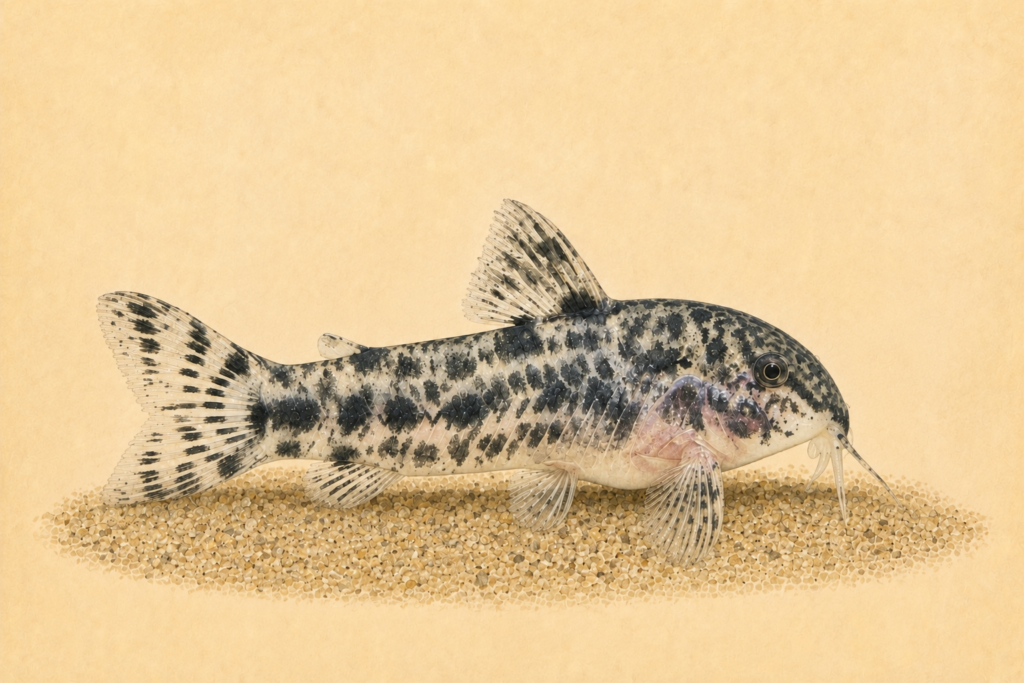
Guaramiranga Corydoras share the classic cory silhouette: a short, deep body, a downturned mouth ringed with barbels for sifting substrate, and bony armoured plates running along the flanks in place of true scales. They stay noticeably smaller than mainstream Corydoras species, rarely exceeding 4.5cm even as fully grown adults, and most individuals in the trade top out closer to 4cm.
Base colouration is a pale sandy-cream to light tan body with darker mottled patterning along the back and a dark stripe running through the eye, giving good camouflage against light substrate in the wild. As with most Aspidoras species, colouration is understated and cryptic rather than showy, which is part of why the species has stayed a niche rather than mainstream aquarium fish. It simply doesn’t photograph as dramatically as more boldly patterned Corydoras.
Sexing is difficult and largely follows the pattern seen across small Corydoras relatives: females tend to grow slightly larger and noticeably rounder-bodied when viewed from above, particularly when in breeding condition and carrying eggs, while males stay slimmer and marginally smaller overall. There are no reliable colour-based sexing cues in this species.
Natural habitat
Aspidoras rochai is found in small coastal rivers and streams in Ceará state, north-eastern Brazil, well outside the Amazon basin most popular Corydoras hail from. These habitats are typically shallow and slow-flowing, running over sand or fine sediment, with leaf litter accumulating along the banks and root tangles from overhanging vegetation providing shelter and cover from predators.
Coastal Ceará has a pronounced wet and dry season, and stream conditions likely shift noticeably between the two: higher flow and cooler, more dilute water during the rainy season, versus lower flow, warmer temperatures, and more concentrated minerals during the dry months. This seasonal cycle is thought to be an important breeding trigger, echoing what’s documented in better-studied Aspidoras and Corydoras species from similar habitats.
This species is not as widely studied or heavily traded as mainstream Corydoras, so some of what’s understood about its wild ecology is inferred from closely related Aspidoras species living in similar coastal habitats, rather than from dedicated field studies of A. rochai itself. Its IUCN status is listed as Data Deficient, which reflects this general lack of targeted research rather than any specific evidence of population decline.
Tank size and setup
A tank of 60 litres upwards comfortably houses a proper shoal of six or more. As with all cory-type fish, they should always be kept in groups rather than singly or in pairs, since shoaling behaviour is central to how this species feels secure and behaves naturally. A longer, low footprint is more valuable to them than tank height, since virtually all of their activity happens at substrate level.
Use a soft, sand or fine-gravel substrate rather than coarse gravel, which can damage their sensitive barbels over time and lead to painful erosion that in turn increases susceptibility to secondary infection. Play sand or a fine-grade aquarium sand sold specifically for bottom-dwelling species is ideal, and should be at least a couple of centimetres deep to allow natural sifting behaviour.
Furnish the tank with driftwood, smooth rocks, and some leaf litter or dried botanicals such as almond leaves to mimic their natural habitat, along with planted or shaded areas the group can retreat to when resting. Floating plants or a well-planted midground can help diffuse light, since these fish come from streams with fairly subdued lighting conditions under forest canopy.
A tight-fitting cover glass is not optional with this species. Hobbyist breeding accounts specifically flag Aspidoras rochai as a determined escape artist, capable of squeezing through surprisingly small gaps around filter inlets, cables, or an ill-fitting lid. It’s worth physically checking every entry point, including wedging small offcuts of filter foam into gaps where airline tubing or cabling passes into the tank, since a fish this motivated to escape will usually find any opening left unblocked.
Because they are so small, it can be tempting to house them in a genuinely tiny tank. Resist that temptation: water quality and parameter stability degrade far faster in very small volumes, and this is a species that specifically does not tolerate fluctuating conditions well, so the 60-litre minimum is about stability as much as physical space.
Water parameters
| Temperature | 21 – 25 °C (70 – 77 °F) |
| pH | 6.0 – 7.5 |
| General hardness (GH) | 2 – 15 dGH |
| Ammonia | 0 ppm |
| Nitrite | 0 ppm |
| Nitrate | Below 20 ppm |
This species is sensitive to poor water quality and should never be added to a new, uncycled aquarium. Wait until the tank has been fully established for several weeks, with a stable nitrogen cycle confirmed by test kit readings, before introducing a group.
Consistency matters more than hitting an exact number on any single parameter. Sudden swings in temperature or pH, even within the tolerated range, are more likely to cause stress than a stable reading slightly outside the ideal band. Aim for weekly partial water changes of around 20-25% to keep nitrate low and dissolved organics from building up between changes.
Given their sensitivity, it’s worth investing in a reliable liquid test kit rather than paper strips, which are notoriously imprecise for ammonia and nitrite. Testing regularly during the first few months after introducing this species, and after any major water change or filter maintenance, is the best way to catch a developing problem before it affects the group.
Filtration and equipment
A gentle to moderate filter is ideal. Strong, turbulent flow isn’t necessary and can stress a fish that naturally lives in calmer coastal waters rather than fast-flowing rapids. Sponge filters, or standard hang-on-back or canister filters fitted with a spray bar to diffuse the outflow, both work well, especially in smaller nano setups where an unmodified filter outlet could easily overpower the tank.
A heater is recommended in most homes to keep temperatures stable at the lower end of the species’ preferred tropical range, since the coastal Brazilian streams it comes from don’t reach the higher temperatures often used for Amazonian species. A heater with an external controller or built-in thermostat that holds within a degree or two is preferable to a cheap unregulated unit, given how much this species dislikes fluctuation.
Standard aquarium lighting is fine, though given their preference for more subdued conditions in the wild, providing some shaded areas via floating plants, driftwood, or broad-leaved plants lets the group retreat from direct light if they choose to, rather than being lit uniformly bright across the whole footprint.
Diet and feeding
In the wild, FishBase records Aspidoras rochai’s natural diet as worms, benthic crustaceans, insects, and plant matter, sifted from the substrate as it forages. This is a directly documented data point for this species rather than an inference from relatives, though it’s a broad dietary category typical of small benthic catfish generally rather than a detailed breakdown of specific prey items.
In the aquarium, feeding is straightforward. A high-quality sinking pellet or wafer designed for bottom feeders makes a good staple. Look for products specifically marketed for Corydoras or bottom-dwelling catfish, since these are formulated to soften quickly and stay put on the substrate rather than dissolving into the water column. Supplement this staple with frozen or live foods two to three times a week: bloodworm, daphnia, and brine shrimp are all readily accepted.
Because they’re bottom feeders, food needs to actually reach the substrate rather than being intercepted by faster mid-water tankmates. If housed with more active schooling fish, it’s worth feeding sinking food after the main feeding has settled, or using a feeding dish or targeted feeding tube to make sure the group gets its share.
Given their small size, portions should be correspondingly small and frequent rather than large and infrequent. Feeding a modest amount once or twice daily, only what can be cleared within a couple of minutes, avoids the water quality problems that come with uneaten food decomposing in the substrate.
Behaviour and temperament
This is a thoroughly peaceful species that poses no threat to tankmates and won’t compete aggressively for food. They spend most of their active time foraging along the substrate in a loose group, occasionally resting together in a sheltered spot during quieter periods of the day, particularly right after lights-out or first thing in the morning.
They are not fin-nippers and are safe to keep with slow-moving or long-finned tankmates. Keeping a group of six or more brings out their natural social behaviour and noticeably reduces stress compared to keeping smaller numbers. A common observation across small Corydoras-type fish is that undersized groups spend far more time hiding and far less time engaging in the confident, synchronised foraging that makes them interesting to watch.
Activity level does pick up around feeding time and can increase after water changes, which seems to mimic the environmental cues (fresh, cooler water entering the system) they’d experience after rainfall in the wild. This is a normal and healthy response rather than a sign of stress.
Tank mates
Good tank mates
- Neon Tetra, a classic soft-water schooling fish that occupies the mid to upper water column
- Cardinal Tetra, peaceful and similarly sized, thriving in the same soft, gently acidic water
- Ember Tetra, a tiny, calm schooler well suited to nano tanks of this size
- Rummy-nose Tetra, a tightly schooling species that shares identical water requirements
- Harlequin Rasbora, a hardy, peaceful shoaler for the upper water column
- Elegant Corydoras, another small, peaceful bottom-dweller with similar needs
- Panda Corydoras, a similarly small, sociable cory that shoals well alongside other Corydoras-type species
- Tailspot Pygmy Cory, a similarly tiny, peaceful shoaler suited to nano community tanks
- Amano Shrimp, a peaceful algae-eating invertebrate that won’t compete for sinking food
- Otocinclus Catfish, another small, peaceful algae grazer suited to the same soft-water setup
Fish to avoid
- Oscar, a large, predatory cichlid that will happily eat a fish this small
- Flowerhorn Cichlid, far too large and aggressive for a delicate nano species
- Angelfish, which can grow large enough to see a 4cm cory as a snack
- Tiger Barb, a boisterous fin-nipper that will stress smaller, slower tankmates
- Jaguar Cichlid, a large, aggressive predator entirely unsuitable for a peaceful nano setup
- Redtail Catfish, a giant predatory species that will outgrow and eat small tankmates
- Green Terror Cichlid, too large and territorial for a small, peaceful shoaler
- Convict Cichlid, a feisty, territorial species likely to bully or injure smaller fish
- Silver Arowana, a large surface predator that views small fish as food
- Mbuna Cichlids, aggressive African cichlids that need very different, harder water anyway
Breeding
Unlike many obscure Aspidoras species, there is a genuine, published hobbyist breeding account for this exact species, and it’s worth following closely rather than falling back on general Corydoras theory. Aquarist Adrian Taylor documented a successful spawning of Aspidoras cf. rochai in a small aquarium measuring roughly 40 x 16 x 16 cm, filtered by an air-powered sponge (Hamburg mattenfilter) at one end, over a sand substrate topped with Java moss, with a nylon spawning mop hung near the surface at the opposite end from the filter.
Two males (around 30mm SL) and two females (around 35mm SL) were conditioned for roughly seven months on a mixed diet of commercial, tablet, and granular foods, supplemented with grindal worms every five days, before a deliberate spawning attempt began. Conditioning was then intensified: a commercial catfish tablet each morning plus cyclops or grindal worms each evening, alongside a step-up in water-change rate, first to 30% every other day, then to 50% after two weeks produced no results.
Roughly ten days after that increase, males were observed vigorously pursuing the noticeably more rotund females and offering their flanks to the females’ snouts, classic Corydoras-type courtship behaviour. Spawning itself happened overnight and went unobserved, but the following morning small, slightly opaque eggs were found laid singly or in pairs among the Java moss just above the substrate, with a handful laid in the spawning mop as well. The eggs were removed to a small separate container with an air line and hatched within about 12 hours.
Fry were reared on finely powdered flake food mixed with green water for the first three days with daily 50% water changes, then moved to a fry-rearing setup and fed crushed flake in the morning and micro-worm in the evening for a week, after which newly hatched brine shrimp was added to the diet. After roughly ten days the fry were robust enough to compete for food alongside other young Corydoras-type fry, and after about six weeks were large enough to move into a general community grow-on tank.
This is one documented account rather than an exhaustive study, so treat the specific numbers (tank size, conditioning period, exact water-change percentages) as a proven starting recipe rather than the only way to succeed. Unlike many under-documented Aspidoras, this is a real, traceable spawning report for this exact species, not an inference from relatives.
Common diseases and health
Like most Corydoras relatives, they’re susceptible to standard freshwater ailments such as ich (white spot) and fin or barbel damage from rough substrate or declining water quality, rather than anything species-specific. Barbel erosion from coarse gravel is a particular risk worth watching for in this genus, presenting as shortened, reddened, or ragged-looking barbels rather than the neat whiskers a healthy fish should have.
This species is also considered notably sensitive to medications compared with many other freshwater fish, a trait shared across scaleless and armoured catfish more broadly, since their skin lacks the protective scale layer that helps many other fish tolerate treatments. Copper-based medications in particular should be avoided or used at reduced dosage, and any treatment should ideally be researched specifically for catfish safety before use.
Maintaining stable water quality and a soft substrate is the most effective prevention, since this species is more sensitive to declining water conditions than many hardier community fish. Quarantining new arrivals for a couple of weeks before adding them to an established tank is a sensible precaution given how easily this species can be stressed by sudden environmental change.
Frequently asked questions
How many Guaramiranga Corydoras should I keep together?
A minimum of six is recommended. Corydoras and their relatives are social fish that rely on the safety of numbers, and keeping fewer than six often results in shy, stressed individuals that hide constantly. In a larger tank, groups of eight to twelve produce more natural, confident behaviour.
Can I keep Guaramiranga Corydoras on gravel?
Coarse gravel isn’t recommended, as it can damage their sensitive barbels over time. Sand or fine, smooth gravel is a much safer choice for the substrate.
Are Guaramiranga Corydoras suitable for a planted tank?
Yes. They are fully plant-safe and won’t damage live plants, making them a good fit for a softly planted community tank.
Is this species the same as a regular Corydoras?
No. Aspidoras is a closely related but separate genus to Corydoras, found in coastal Brazilian rivers rather than the Amazon basin, though day-to-day care requirements are very similar.
Why is there less information available on this species?
Aspidoras rochai is much less widely kept and studied than mainstream Corydoras species, so general husbandry detail here draws partly on closely related Aspidoras species where dedicated information on A. rochai itself is limited. Breeding is an exception: a specific, documented hobbyist spawning report for this exact species does exist and is used directly above, rather than inferred from relatives. Wherever information is inferred rather than directly confirmed for this species, that’s stated explicitly.
Is this species sensitive to medications?
Yes. Like other scaleless, armoured catfish, it lacks the protective scale layer many fish rely on to tolerate treatments, so copper-based medications in particular should be used cautiously or avoided.