Quick Summary
The L168 Butterfly Pleco is a peaceful, modestly sized loricariid that thrives in well-oxygenated tanks with plenty of driftwood. It suits intermediate fishkeepers who can provide stable water quality, strong filtration, and a varied diet beyond simple algae grazing.
🐠 Build a tank around this species
In this guide:
- Introduction
- Quick Stats
- Appearance
- Natural Habitat
- Tank Size and Setup
- Water Parameters
- Diet and Feeding
- Tank Mates
Introduction
Dekeyseria brachyura, widely known in the hobby by its L-number designation L168 or the common name Butterfly Pleco, is a striking freshwater catfish from the rivers of South America. It belongs to the family Loricariidae, the largest catfish family, and sits within the genus Dekeyseria – a small group of beautifully patterned plecos that have earned a loyal following among catfish enthusiasts. Although not as commonly stocked as bristlenose or clown plecos, L168 regularly appears in specialist aquarium shops and online retailers, particularly those with a focus on rare or unusual loricariids.
This species appeals to aquarists who want a pleco that combines visual interest with manageable size. Unlike some of the larger Loricariidae members that can exceed 30 cm, the Butterfly Pleco remains relatively compact, making it a practical choice for medium-sized community aquariums. Its care requirements, while not extreme, do go beyond the basics. It needs excellent water quality, robust filtration, and – crucially – driftwood in the tank, which it rasps on as part of its digestive process. Keepers who understand these needs and commit to providing them will be rewarded with a hardy, long-lived fish that quietly goes about its business on the bottom of the tank.
The L-number system, developed by the German aquarium magazine DATZ in the 1980s, provides a practical way of identifying plecos that have not yet been formally described or whose taxonomy is still being resolved. L168 is one of the more established codes and is universally recognised in the trade. You may also encounter the fish labelled as the Butterfly Pleco, Flounder Pleco, or occasionally the Short-tailed Butterfly Pleco – all referring to the same species.
Quick Stats
| Scientific name | Dekeyseria brachyura |
|---|---|
| Common names | Butterfly Pleco, Flounder Pleco, Short-tailed Butterfly Pleco, L168 |
| Family | Loricariidae |
| Origin | South America (Rio Negro and Orinoco basins) |
| Adult size | 13.5 cm |
| Lifespan | 8–10 years |
| Difficulty | Intermediate |
| Breeding difficulty | Advanced |
| Temperature | 25–30 °C |
| pH | 5.5–7 |
| GH | 2–10 dGH |
| KH | 1–5 dKH |
| Minimum tank size | 150 L |
| Conservation status | Least Concern (IUCN, assessed 2020) |
Appearance
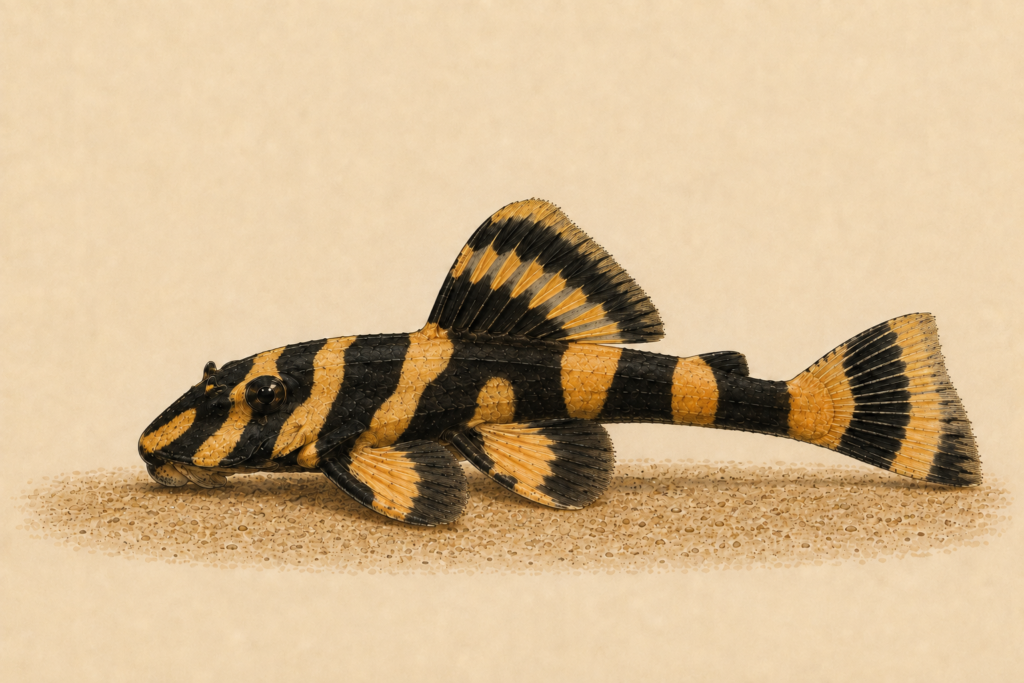
The Butterfly Pleco is named for the broad, flattened profile it presents when viewed from above – with its wide pectoral and pelvic fins spread out, it loosely resembles the wings of a butterfly at rest. The body is dorsoventrally compressed, as is typical of many Loricariidae, giving the fish an almost pancake-like shape. This flattened body plan is an adaptation to life in fast-flowing water, allowing the fish to cling to rocks and submerged wood with minimal resistance from the current.
The base colouration ranges from dark brown to near-black, overlaid with a pattern of lighter bands or stripes that run laterally across the body and extend onto the fins. These bands can vary from pale tan to golden-yellow depending on the individual and the conditions in which it is kept. In well-maintained tanks with subdued lighting and dark substrates, the contrast between the dark base and lighter banding tends to be most pronounced, making for a particularly attractive fish. Under harsh or bright lighting, the colours can appear somewhat washed out.
The head is broad and equipped with a well-developed suckermouth, a hallmark of the loricariid family. The eyes are relatively large and positioned high on the head, providing good upward visibility – useful for a species that spends most of its time pressed against surfaces. The caudal fin is relatively short compared to the body length, which is reflected in the specific epithet “brachyura” (from the Greek for “short tail”). The dorsal fin is sizeable and often held erect, displaying the same banded patterning seen across the rest of the body.
Sexual dimorphism is subtle in this species. Mature males tend to develop slightly broader heads and may show more pronounced odontodal growth (small tooth-like projections) along the leading edges of the pectoral fins and on the cheeks, particularly during breeding condition. Females are generally a touch rounder in the belly when viewed from above, especially when carrying eggs. Outside of breeding condition, however, reliably sexing juveniles or sub-adults is extremely difficult.
Juveniles display the same basic colour pattern as adults but are often more boldly marked, with crisper, more defined bands. As the fish matures, the patterning can become slightly more diffuse, though well-kept specimens retain strong contrast throughout their lives.
Natural Habitat
Dekeyseria brachyura is native to the blackwater and clearwater river systems of northern South America, with its range centring on the Rio Negro drainage in Brazil and parts of the Orinoco basin in Venezuela and Colombia. These are warm, soft, acidic waters – the Rio Negro, in particular, is famously tea-stained with dissolved tannins from decomposing leaf litter and fallen wood, resulting in a pH that can drop below 5.0 in some areas.
In the wild, the Butterfly Pleco inhabits moderate to fast-flowing stretches of river where submerged logs, branches, and rocky outcrops provide abundant surfaces for grazing and shelter. It is typically found clinging to waterlogged wood or wedged into crevices during the day, becoming more active at dusk and into the night when it ventures out to feed. The substrate in its native habitat is usually composed of sand, fine gravel, and accumulated leaf litter, and the water is highly oxygenated due to the flow rate.
The importance of driftwood in this species’ natural environment cannot be overstated. Like many loricariids, D. brachyura rasps on wood as part of its feeding behaviour. The ingested wood fibres are thought to play a role in digestion, acting as roughage and possibly supporting gut microflora. Aquarists who attempt to keep this species without driftwood in the tank often observe declining health over time, even if other aspects of care are adequate.
Seasonal flooding in Amazonian and Orinocan river systems can dramatically alter water conditions, and the species is adapted to cope with some degree of fluctuation. However, in the aquarium, stability is always preferable to attempting to replicate these seasonal extremes. The key takeaway from the wild habitat is the need for warm, soft, slightly acidic water with excellent oxygenation and plenty of natural wood surfaces.
Tank Size and Setup
A minimum tank size of 150 litres is recommended for a single L168 Butterfly Pleco. While the fish itself is not especially large, it is territorial in a low-key way and appreciates space to establish its own patch of wood or rockwork. If you plan to keep more than one, or to house one alongside other bottom-dwelling species, a larger tank of 200 litres or more is advisable to reduce the likelihood of territorial friction.
The tank should be set up with the species’ natural habitat in mind. A sandy or fine-gravel substrate is ideal, as coarse or sharp substrates can damage the fish’s underside. Above all else, driftwood is essential – not merely decorative but functionally important for the fish’s digestive health. Provide several pieces of well-waterlogged bogwood, Malaysian driftwood, or mopani wood, arranged to create caves, overhangs, and crevices where the pleco can hide during the day. The fish will spend considerable time rasping the surfaces of this wood, gradually wearing it down over months and years.
Rocks and smooth stones can supplement the hardscape, providing additional hiding spots and surfaces for biofilm and algae growth. Slate caves or ceramic pleco caves are also appreciated and can be useful if you have breeding aspirations, as they mimic the tight crevices the species naturally favours for egg deposition.
Live plants are not strictly necessary but are compatible with this species, provided they are robust enough to withstand the occasional inadvertent disturbance from a foraging pleco. Hardy species such as Anubias and Java Fern, which can be attached directly to driftwood, are excellent choices and will complement the natural aesthetic. Floating plants can also be useful for diffusing light, which helps the Butterfly Pleco feel more secure and brings out its best colouration.
Lighting should be moderate to subdued. As a primarily nocturnal or crepuscular species, L168 is most active in low light and may remain hidden for extended periods under bright illumination. A planted tank with a canopy of floating plants, or a setup with a dimmer or timed lighting cycle, will encourage the fish to emerge earlier in the evening and behave more naturally.
Water Parameters
Maintaining stable, clean water is the single most important aspect of keeping the L168 Butterfly Pleco healthy. This species originates from warm, soft, acidic waters, and while it shows reasonable adaptability to a range of conditions in captivity, it performs best when parameters lean toward the softer, more acidic end of the spectrum. Avoid keeping it in hard, alkaline water, as this can cause chronic stress and increase susceptibility to disease.
| Temperature | 25-30 C |
| pH | 5.5-7.0 |
| General hardness (GH) | 2-12 dGH |
| Carbonate hardness (KH) | 1-6 dKH |
| Ammonia | 0 ppm |
| Nitrite | 0 ppm |
| Nitrate | Below 20 ppm |
The temperature preference of 25-30 C places this species firmly in the tropical range. A heater is necessary in most climates, and a reliable, adjustable heater-thermostat is recommended so you can fine-tune the temperature. For general community keeping, 26-28 C is an ideal target. If attempting to breed the species, slightly warmer temperatures of 28-30 C may help stimulate spawning behaviour.
Ammonia and nitrite must always read zero. This species is sensitive to dissolved waste products, and any detectable ammonia or nitrite indicates a filtration or maintenance problem that must be addressed immediately. Nitrate should be kept below 20 ppm through regular partial water changes – weekly changes of 25-30% are a sensible baseline, with more frequent changes beneficial in heavily stocked tanks.
If your tap water is hard and alkaline, consider using a blend of reverse osmosis (RO) water and tap water to achieve softer, more acidic conditions. Adding Indian almond leaves, alder cones, or driftwood to the tank will naturally release tannins that gently lower pH and soften the water, while also providing a more authentic environment for the fish.
Filtration and Equipment
Strong, efficient filtration is non-negotiable for the Butterfly Pleco. In its natural habitat, this fish lives in well-oxygenated, flowing water, and it does not cope well with sluggish or stagnant conditions. A canister filter rated for at least the full volume of the tank – ideally somewhat higher – is the best choice. Canister filters provide excellent mechanical and biological filtration and allow you to create a meaningful flow pattern within the tank without relying on additional equipment.
If a canister filter is not available or practical, a high-quality internal power filter or a large sponge filter driven by a powerful air pump can serve as alternatives, though you may need to supplement with an additional powerhead or wavemaker to ensure adequate water movement. The goal is to create a gentle but consistent current across the bottom of the tank, mimicking the flowing conditions the pleco encounters in the wild. Avoid dead spots where detritus can accumulate, as these can become sources of poor water quality.
Oxygenation is particularly important. Surface agitation from the filter outlet is usually sufficient, but an airstone or air-driven sponge filter can provide additional aeration, especially in warmer tanks where dissolved oxygen levels are naturally lower. If you keep the temperature at the higher end of the range (28-30 C), extra aeration becomes increasingly important.
A reliable heater with an accurate thermostat is essential. Choose a heater rated appropriately for the tank volume and consider using two smaller heaters rather than one large one – this provides redundancy in case of failure and distributes heat more evenly. A digital thermometer, placed away from the heater, allows you to verify the actual water temperature at a glance.
Lighting, as mentioned in the tank setup section, should be moderate. LED units with adjustable brightness and a programmable timer are ideal, allowing you to create a gradual dawn-and-dusk effect that suits the pleco’s crepuscular habits. A moonlight mode, if available, lets you observe the fish during its most active period without disturbing it.
Diet and Feeding
The L168 Butterfly Pleco is primarily a grazer, feeding on algae, biofilm, and the surface layers of submerged wood in the wild. In the aquarium, while it will certainly graze on any natural algae growth and biofilm that develops on driftwood, glass, and decor, this alone is rarely sufficient to meet its nutritional needs. Supplemental feeding is essential for long-term health.
High-quality algae wafers should form the backbone of the diet. These are widely available from major aquarium food brands and provide a balanced blend of plant-based nutrients. Offer one or two wafers per pleco in the evening, around lights-out, when the fish is most active and likely to feed. Remove any uneaten food the following morning to prevent water quality issues.
Blanched vegetables are an excellent and inexpensive supplement. Courgette (zucchini), cucumber, spinach, kale, and shelled peas are all readily accepted. To prepare, briefly blanch the vegetable in boiling water for 30-60 seconds to soften it, then allow it to cool before placing it in the tank. A vegetable clip or a fork pushed into the substrate can hold the food in place and prevent it from floating. Most plecos prefer slightly softened vegetables, and you may find that the fish ignores raw offerings that are too firm.
Sinking pellets designed for herbivorous or omnivorous catfish can add variety and ensure a broad nutritional profile. Occasional protein-rich foods such as frozen or freeze-dried bloodworm, daphnia, or brine shrimp can be offered once or twice a week, but the diet should remain predominantly plant-based. Over-reliance on high-protein foods can lead to digestive issues in a species adapted to a largely herbivorous diet.
The role of driftwood in the diet deserves emphasis. Rasping on wood is not merely a behavioural curiosity – the ingested wood fibres appear to be important for gut health and digestion. A tank without driftwood is an incomplete environment for this species, regardless of how well the supplemental diet is managed. Ensure that several pieces of wood are always available and replace or supplement them if they become heavily worn over time.
Feeding frequency should be daily, with the main meal offered in the evening. Observing the fish’s body condition is the best guide to whether you are feeding enough – a healthy Butterfly Pleco should have a gently rounded belly without appearing bloated. A concave or sunken belly is a warning sign of underfeeding or internal parasites and should prompt a review of the feeding regime and water quality.
Behaviour and Temperament
The Butterfly Pleco is a peaceful, unobtrusive species that spends the majority of its time clinging to driftwood, hiding in caves, or resting against the glass in dimly lit areas. It is primarily nocturnal or crepuscular, becoming most active around dusk and during the night. During the day, it may be almost invisible, wedged into a favourite crevice or tucked behind a piece of decor. This behaviour is entirely normal and should not be mistaken for illness or stress.
Toward its own kind, L168 can be mildly territorial, particularly if space and hiding spots are limited. Two males in a small tank may engage in low-level disputes over preferred resting sites, which can escalate to fin damage if the subordinate fish has nowhere to retreat to. Providing ample hiding spots – at least one per pleco, plus extras – generally prevents any serious aggression. In larger tanks with abundant cover, multiple specimens can coexist without difficulty.
Toward other species, the Butterfly Pleco is almost invariably peaceful. It ignores midwater and surface-dwelling fish entirely and poses no threat to small tetras, rasboras, or other community species. The only potential source of conflict is competition for bottom-dwelling territory with other pleco species or loaches, and even this is usually resolved without incident if the tank is adequately sized and furnished.
One behaviour worth noting is the pleco’s tendency to remain motionless for extended periods. New keepers sometimes worry that their fish is unwell when it sits in the same spot for hours at a time. This is completely normal for the species. If you want to see more activity, try dimming the lights or observing the tank with a red or moonlight torch in the evening – you may be surprised at how active the fish becomes when it feels the cover of darkness.
Tank Mates
The L168 Butterfly Pleco is an accommodating community fish that coexists well with a wide range of peaceful to moderately boisterous species. The key considerations when choosing tank mates are compatibility with the pleco’s water parameter preferences (warm, soft, slightly acidic), a peaceful enough temperament to leave a bottom-dwelling catfish alone, and avoidance of direct competition for the same resting and feeding spaces. Aggressive or very large cichlids, fin-nipping species, and anything likely to monopolise the bottom of the tank should be avoided.
Good tank mates
- Cardinal Tetra – Shares the same soft, acidic water preferences and occupies the mid-water column, posing no competition.
- Rummy-nose Tetra – A peaceful shoaling tetra from similar South American blackwater habitats, an excellent match.
- Ember Tetra – Tiny, gentle, and undemanding, these tetras stay well out of the pleco’s way.
- Harlequin Rasbora – A calm, mid-water species that thrives in similar temperatures and soft water.
- Corydoras sterbai – A warm-water Corydoras that tolerates the higher temperatures L168 prefers, and occupies a slightly different niche on the substrate.
- German Blue Ram – A small, peaceful dwarf cichlid that shares the Butterfly Pleco’s preference for warm, soft water.
- Kuhli Loach – Nocturnal and peaceful, these slender loaches cohabit well provided hiding spots are plentiful.
- Otocinclus – Tiny algae grazers that pose no territorial threat and appreciate similar water conditions.
Fish to avoid
- Oscar – Far too large and aggressive; likely to bully or injure a Butterfly Pleco.
- Jaguar Cichlid – A large, predatory cichlid that would view L168 as a target or food item.
- Tiger Barb – Notorious fin-nippers that may harass the pleco when it is resting.
- Common Pleco – Grows far too large and can become territorially dominant, monopolising hiding spots and food.
- Red-tail Catfish – A massive predatory catfish entirely incompatible with a community setup.
- African Cichlids (Mbuna) – Require hard, alkaline water that is fundamentally unsuitable for this species, and many are aggressively territorial.
Breeding
Breeding Dekeyseria brachyura in captivity is achievable but challenging, and documented home aquarium spawnings are relatively uncommon. The species is a cave spawner, with the male selecting and defending a suitable cavity – typically a tight crevice in driftwood or a ceramic cave – and enticing a ripe female to deposit her eggs inside.
To maximise your chances of breeding, start with a group of at least four to six juveniles and allow them to mature and pair naturally. Attempting to sex young fish is unreliable, and a group approach ensures you are likely to have at least one pair. House the group in a spacious tank (200 litres minimum for a breeding project) with multiple caves and hiding spots, each sized so that a single adult can just fit inside. The caves should be slightly snug, as loricariids generally prefer tight enclosures for spawning.
Condition the fish with a high-quality, varied diet for several weeks before attempting to trigger spawning. Increase the proportion of protein-rich foods – bloodworm, brine shrimp, and high-protein sinking pellets – alongside the usual vegetable and algae-based staples. Good body condition in both sexes is a prerequisite for successful reproduction.
Spawning triggers in the wild are thought to be linked to seasonal changes in water level, temperature, and flow. In the aquarium, simulating these changes can encourage breeding behaviour. A large water change of 40-50% with slightly cooler, soft water, combined with a slight increase in flow and a subsequent gradual temperature rise, can mimic the onset of the rainy season. Some breeders report success by dropping the temperature by two or three degrees during the water change and then allowing it to rise back to 28-30 C over the following day or two.
Once spawning occurs, the male takes sole charge of egg care, fanning the clutch to ensure adequate oxygenation and defending the cave entrance against intruders. The eggs are relatively large and adhesive, typically numbering between 20 and 60 per clutch depending on the size and condition of the female. Incubation lasts approximately five to seven days at 28-30 C, after which the fry emerge with a substantial yolk sac that sustains them for the first few days.
Newly free-swimming fry can be fed finely crushed algae wafers, powdered spirulina, and biofilm that naturally develops on surfaces within the tank. Maintaining impeccable water quality during this period is critical – the fry are more sensitive to dissolved waste than adults. Small, frequent water changes of 10-15% every two to three days are advisable. Growth is steady but not rapid, and the juveniles will begin to show adult colouration within a few weeks.
Common Diseases
The L168 Butterfly Pleco is a reasonably hardy species when kept in suitable conditions, but it is not immune to the diseases that affect freshwater aquarium fish. Prevention through excellent water quality, proper diet, and low stress is always preferable to treatment.
Ich (white spot disease), caused by the protozoan parasite Ichthyophthirius multifiliis, is one of the most common ailments encountered in tropical fish. It presents as small white cysts on the body and fins. The Butterfly Pleco’s dark colouration can make early detection more challenging than with lighter-skinned species, so inspect the fish carefully during feeding time. Treatment involves raising the temperature to 30 C (within this species’ tolerance) and administering a proprietary ich medication. Avoid copper-based treatments, as loricariids and other scaleless or armoured catfish can be sensitive to copper. Always check the medication label for catfish safety before dosing.
Bacterial infections can occur following physical injury, stress, or prolonged exposure to poor water quality. Symptoms include reddened patches on the skin, frayed fins, lethargy, and loss of appetite. Improving water quality through water changes and ensuring the tank is not overcrowded will often resolve mild cases. More severe infections may require treatment with a broad-spectrum antibacterial medication safe for catfish.
Fungal infections, appearing as white or grey cotton-like growths on the body or fins, are typically secondary to an existing wound or immunosuppression from stress. Antifungal treatments are available and generally well tolerated by this species, though copper-free formulations should always be chosen.
Internal parasites can be a concern, particularly in wild-caught specimens. Signs include persistent weight loss despite normal feeding, a sunken belly, and pale or stringy faeces. A course of anti-parasitic medication designed for internal worms and flagellates, administered via medicated food, is the standard approach. Quarantining new arrivals for two to four weeks before introducing them to the main tank is an excellent practice that helps intercept parasite issues before they spread.
A less dramatic but important health concern is malnutrition, which can occur gradually if the fish is not receiving enough food or if the diet lacks variety. A pleco that is slowly starving may appear increasingly thin, with a concave belly and reduced activity levels. This is particularly common in community tanks where more assertive species consume all the supplemental food before the pleco has a chance to feed. Ensuring food reaches the bottom of the tank and feeding after lights-out can help address this.
FAQs
Is the L168 Butterfly Pleco a good algae eater?
It will graze on algae and biofilm, and it can help manage light algae growth on driftwood, glass, and decor. However, it should not be relied upon as a sole algae-control solution. Its grazing contributes to tank maintenance but does not replace regular cleaning, and the fish itself needs supplemental feeding to remain healthy regardless of how much algae is available.
Why does my Butterfly Pleco hide all day?
This is entirely normal behaviour. Dekeyseria brachyura is a nocturnal to crepuscular species that naturally rests in concealed positions during daylight hours. It typically becomes active around dusk and feeds primarily at night. Providing subdued lighting, plenty of hiding spots, and feeding after lights-out will allow you to observe more natural and active behaviour during the evening.
Do I really need driftwood in the tank?
Yes, driftwood is essential rather than optional for this species. Like many loricariids, the Butterfly Pleco rasps on wood as part of its natural feeding and digestive process. The ingested wood fibres are thought to support gut function and overall digestive health. A tank without driftwood is an incomplete and potentially harmful environment for this fish.
Can I keep more than one L168 Butterfly Pleco together?
Yes, provided the tank is large enough and has sufficient hiding spots for each individual. A tank of 200 litres or more with multiple caves and pieces of driftwood can comfortably house a small group. Territorial disputes may occur if space is limited, particularly between males, but these are generally mild and resolve quickly when adequate cover is available.
Is the Butterfly Pleco safe with live plants?
Generally, yes. This species is not a significant plant eater and tends to focus its grazing on algae, biofilm, and driftwood surfaces rather than on live plant tissue. Robust, hard-leaved plants such as Anubias and Java Fern are the safest choices. Delicate, soft-leaved plants may occasionally suffer minor damage from incidental rasping, but deliberate plant destruction is uncommon with this species.
Related Guides
- Bristlenose Pleco – A widely available and beginner-friendly pleco that shares many care requirements with L168, useful for comparison.
- Clown Pleco – Another small, wood-rasping loricariid with similar dietary and habitat needs.
- Corydoras sterbai – A warm-water bottom-dweller that makes an excellent companion in the same setup as the Butterfly Pleco.
- Cardinal Tetra – An ideal mid-water companion species that thrives in the same soft, acidic conditions.
- German Blue Ram – A dwarf cichlid suited to the warm, soft water parameters that the Butterfly Pleco prefers.