Quick summary
The LDA008 Gold Marble Bristlenose is a hardy, peaceful catfish well suited to intermediate aquarists with at least an 80 litre tank, stable warm soft-to-moderate water, and plenty of caves and driftwood. It is not much harder to keep than a common bristlenose pleco, making it a good step up for hobbyists wanting a more ornamental, collector-grade species.
🐠 Build a tank around this species
In this guide:
- Introduction
- Quick Stats
- Appearance
- Natural Habitat
- Tank Size and Setup
- Water Parameters
- Filtration and Equipment
- Diet and Feeding
- Behaviour and Temperament
- Tank Mates
- Breeding
- Common Diseases
- FAQs
Introduction
The LDA008 Gold Marble Bristlenose Catfish is one of the most visually striking members of the Ancistrus genus, prized by collectors and aquarists alike for its distinctive golden-yellow base colouration overlaid with irregular dark marbling. Scientifically described as Ancistrus claro, this species hails from the clear, fast-flowing tributaries of the Rio Claro system in the Mato Grosso state of Brazil. While it shares many of the practical, hardy qualities that have made bristlenose plecos a staple of the freshwater hobby, the LDA008 stands apart through its ornamental appeal and relative rarity in the trade compared to the ubiquitous common bristlenose (Ancistrus cf. cirrhosus).
First assigned its L-number designation by the German aquarium magazine DATZ, the LDA008 has since become a sought-after species among pleco enthusiasts who appreciate its manageable adult size, peaceful disposition, and the fascinating breeding behaviour characteristic of Ancistrus catfish. Males develop the trademark fleshy tentacles – or bristles – on the snout that give the genus its common name, and these are particularly eye-catching against the gold marble patterning. Despite its collector status, Ancistrus claro is not significantly more difficult to keep than other bristlenose species, making it an excellent choice for intermediate aquarists looking to move beyond the standard offerings and into the world of L-number and LDA-number catfish.
In this comprehensive care guide, we cover everything you need to know to keep LDA008 Gold Marble Bristlenose Catfish thriving in your aquarium, from water parameters and tank setup to diet, breeding, and compatible tank mates.
Quick Stats
| Scientific name | Ancistrus claro |
|---|---|
| Common names | LDA008, Gold Marble Bristlenose Pleco, Claro Bristlenose |
| Family | Loricariidae |
| Origin | Rio Claro basin, Mato Grosso, Brazil |
| Adult size | 7 cm |
| Lifespan | 8–12 years |
| Difficulty | Intermediate |
| Breeding difficulty | Moderate |
| Temperature | 24–28 °C |
| pH | 6–7.5 |
| GH | 2–15 dGH |
| KH | 2–10 dKH |
| Minimum tank size | 80 L |
| Conservation status | Least Concern (IUCN, assessed 2018) |
Appearance
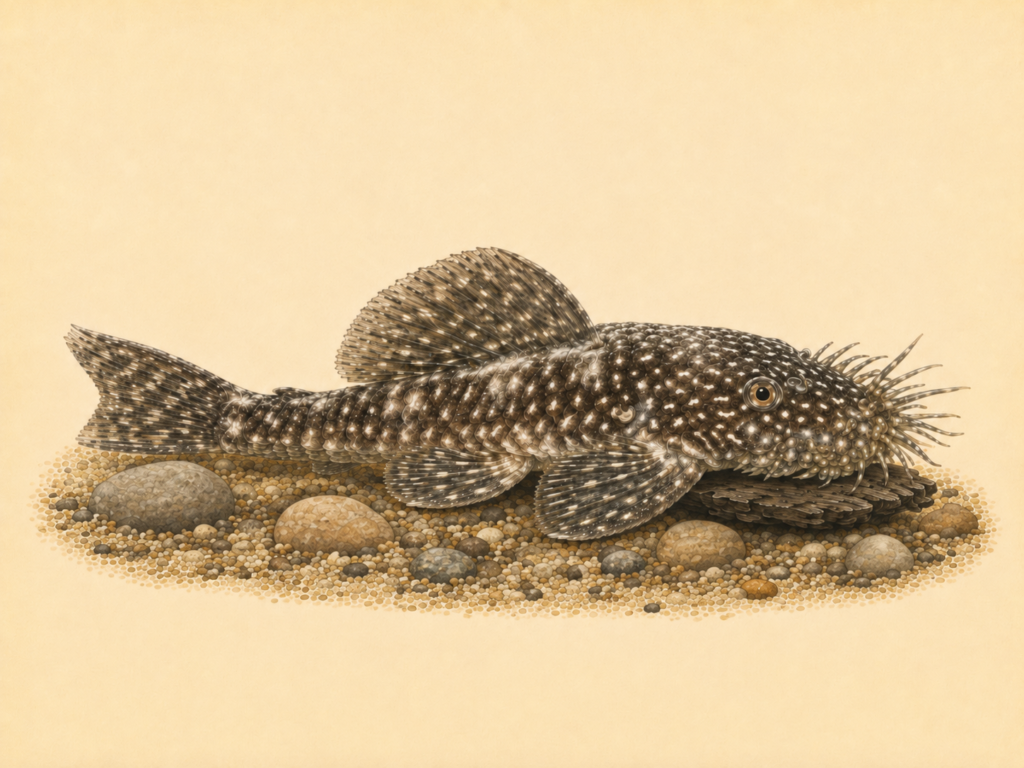
Ancistrus claro is a moderately sized loricariid catfish with a dorsoventrally flattened body plan typical of bristlenose plecos. The body is broad at the head, tapering gradually toward the caudal peduncle, and is covered in bony plates (scutes) that provide armour-like protection. The mouth is positioned ventrally and forms a powerful sucker disc lined with small, rasping teeth, perfectly adapted for scraping biofilm and algae from hard surfaces.
The defining feature of the LDA008 is its colouration. The base colour ranges from bright gold to warm amber-yellow, over which a network of irregular dark brown to black marbling extends across the body, head, and fins. This marbling pattern is highly variable between individuals, with some specimens displaying bold, contrasting patches and others showing finer, more intricate reticulations. The dorsal, pectoral, caudal, and anal fins typically carry the same marbled patterning, often with alternating bands of gold and dark pigment that create a particularly attractive display when the fins are spread. The ventral surface is generally paler, ranging from cream to light gold.
Sexual dimorphism becomes apparent as the fish mature, typically from around 12-18 months of age. Males develop prominent fleshy growths known as tentacles or bristles along the upper margin of the snout and sometimes extending onto the head. These bristles can become quite elaborate in dominant males and are used in both territorial displays and mate attraction. Females may develop very small bristles along the lip margin but never to the extent seen in males. Males also tend to be slightly larger and broader in the head region, while females are often slightly plumper in the body when viewed from above, particularly when gravid.
Juvenile LDA008 specimens can appear somewhat duller than adults, with the gold colouration intensifying and the marbling becoming more defined as the fish grows. Under optimal water conditions and appropriate lighting, the gold tones can be remarkably vivid, making this one of the most photogenic Ancistrus species available.
Natural Habitat
Ancistrus claro is endemic to the Rio Claro and its associated tributaries in the state of Mato Grosso in central-western Brazil. The Rio Claro is part of the greater Paraguay River basin, flowing through areas of cerrado (tropical savanna) and transitional forest. The waterways in this region are characterised by clear to slightly tinted water with moderate to strong current, flowing over substrates composed of sand, gravel, and rocky outcrops.
In the wild, LDA008 inhabits sections of river and stream where rocky structures, submerged logs, and root tangles provide abundant hiding places and surfaces for grazing. The clear waters of the Rio Claro system allow good light penetration, which supports growth of periphyton – the complex community of algae, bacteria, and microorganisms that forms a biofilm on submerged surfaces and constitutes a major part of the species’ natural diet.
Water conditions in the native habitat are typically warm, with temperatures ranging from 24 to 28 degrees Celsius depending on the season. The pH tends toward neutral to slightly acidic, and the water is generally soft to moderately hard. Seasonal variations do occur, with the rainy season (October to March) bringing higher water levels, increased flow, and a slight drop in temperature, which may serve as natural spawning triggers. During the dry season, water levels recede, concentrating fish populations around remaining pools and deeper channels.
The riparian vegetation along the Rio Claro provides fallen leaves, branches, and woody debris that contribute to the aquatic environment. Decaying wood is particularly significant for Ancistrus species, as they are known to rasp and ingest wood fibre as part of their digestive process, supplementing their diet and potentially aiding in the cultivation of beneficial gut microbiota.
Tank Size and Setup
A single LDA008 Gold Marble Bristlenose Catfish can be housed in a tank of at least 80 litres, though a larger aquarium of 120 litres or more is recommended if you plan to keep a pair or a small group. If you intend to maintain a breeding colony or house the species alongside other bottom-dwelling fish, aim for 150 litres or above to ensure sufficient territory and grazing surfaces for all occupants.
The aquascape should prioritise structure and hiding places. Incorporate a generous number of caves, which can be created using purpose-made ceramic or slate breeding caves, stacked rocks, or sections of PVC pipe. Each male will claim and defend a cave as his territory, so providing at least one cave per male – ideally two – is essential to reduce aggression. Natural driftwood is another critical element of the setup, serving dual purposes as both shelter and a dietary supplement. Pieces of bogwood, Malaysian driftwood, or mopani wood should be included, as Ancistrus species benefit from rasping wood fibre. Ensure the wood is well-waterlogged before placing it in the tank to prevent it from floating and to minimise excessive tannin leaching, though a light amber tint to the water is perfectly acceptable and may even be beneficial.
The substrate should be smooth sand or fine rounded gravel to protect the fish’s delicate ventral surface and barbels. Avoid sharp-edged substrates such as crushed coral or jagged gravel, which can cause abrasions. A sandy substrate also mimics the natural riverbed conditions more closely.
Live plants can be included, though Ancistrus species may occasionally rasp on broad-leaved plants if they are not receiving sufficient vegetable matter in their diet. Hardy species such as Anubias, Java fern (Microsorum pteropus), and Vallisneria are good choices, as they are typically tough enough to withstand minor attention from bristlenose catfish. Attaching plants to driftwood or rocks rather than planting them in the substrate can also help protect root systems.
Good water movement is important for this species. The LDA008 originates from flowing waterways and appreciates moderate to strong current in the aquarium. A powerhead or spray bar positioned to create directional flow across the length of the tank will help simulate natural conditions and promote oxygenation. Ensure there are also areas of calmer water behind decor where the fish can rest.
Lighting can be moderate. While the LDA008 is primarily nocturnal and crepuscular, a standard planted-tank lighting regime with a consistent photoperiod of 8-10 hours per day works well. The fish will be most active during dawn, dusk, and after lights-out, though well-settled specimens often become bolder and emerge during the day, particularly at feeding time.
Water Parameters
Maintaining stable water conditions is key to the long-term health of Ancistrus claro. While this species is reasonably adaptable, it does best in clean, well-oxygenated water that approximates its natural habitat conditions. The following table summarises the ideal water parameters for the LDA008 Gold Marble Bristlenose Catfish.
| Temperature | 24-28 °C |
| pH | 6.0-7.5 |
| General hardness (GH) | 2-15 dGH |
| Carbonate hardness (KH) | 2-10 dKH |
| Ammonia | 0 ppm |
| Nitrite | 0 ppm |
| Nitrate | Below 20 ppm |
Consistency is more important than hitting an exact number within these ranges. Sudden fluctuations in temperature or pH can stress the fish and predispose it to disease. Aim for a target temperature of around 26 degrees Celsius and a pH near neutral for optimal results. Weekly water changes of 25-30 per cent are recommended to keep nitrate levels low and replenish trace minerals. If you are keeping the species in a heavily stocked community tank, more frequent or larger water changes may be necessary.
Ancistrus claro is sensitive to elevated nitrate levels and poor water quality. Ensure the tank is fully cycled before introducing this species, and monitor parameters regularly using a reliable liquid test kit. Elevated ammonia or nitrite levels, even briefly, can cause gill damage and increase susceptibility to bacterial infections.
Filtration and Equipment
Given the LDA008’s preference for clean, well-oxygenated water with moderate current, filtration should be robust and efficient. An external canister filter is the ideal choice for tanks of 80 litres and above, as these units provide excellent mechanical, biological, and chemical filtration while allowing you to direct the outflow via a spray bar to create the gentle to moderate current this species prefers. For smaller setups, a quality hang-on-back filter or large sponge filter can suffice, though supplementary aeration via an airstone or powerhead is advisable.
The filter turnover rate should be at least 6-8 times the tank volume per hour. For example, in a 120-litre tank, aim for a filter rated at 720-960 litres per hour. This high turnover ensures effective waste processing and maintains the dissolved oxygen levels that Ancistrus species require. Bristlenose catfish produce a significant amount of waste relative to their size, particularly when fed a varied diet rich in vegetable matter, so do not underestimate filtration needs.
A reliable heater with a thermostat is essential to maintain the tropical temperatures required. Choose a heater appropriate for your tank volume and consider using a heater guard to prevent the fish from resting against the heating element and sustaining burns – a common issue with bottom-dwelling species. A separate thermometer placed at the opposite end of the tank from the heater provides an independent check on temperature stability.
An additional powerhead can be beneficial in longer tanks to eliminate dead spots and ensure even circulation. Position it to create a current along the bottom of the tank where the catfish spend most of their time. Some keepers also add an airstone or air-driven sponge filter to maximise surface agitation and gas exchange, which is particularly helpful in warmer water where dissolved oxygen levels are naturally lower.
Lighting does not need to be specialised for the fish itself, but if you are maintaining live plants, a quality LED unit on a timer set for 8-10 hours will serve both purposes. The LDA008 will appreciate shaded areas beneath driftwood and rock overhangs where it can retreat from direct light during the day.
Diet and Feeding
The LDA008 Gold Marble Bristlenose Catfish is primarily herbivorous and detritivorous, though it is best described as an omnivore that leans heavily toward plant matter. In the wild, Ancistrus claro feeds on periphyton (the biofilm of algae, bacteria, and microorganisms coating submerged surfaces), decaying plant material, wood fibre, and small invertebrates encountered while grazing. In captivity, a varied diet that mirrors this natural intake will produce the best health, colouration, and breeding results.
The foundation of the diet should be high-quality sinking algae wafers or vegetable-based catfish pellets. Look for products with spirulina, kelp, or other plant-based ingredients listed as the primary components rather than fish meal. Supplement these with fresh or blanched vegetables offered several times per week. Courgette (zucchini) slices, cucumber rounds, shelled peas, blanched spinach, kale, sweet potato, and butternut squash are all readily accepted. Blanching tougher vegetables briefly in boiling water softens them and helps them sink. Remove any uneaten fresh food after 12-24 hours to prevent water quality deterioration.
Driftwood should be present in the tank at all times, as Ancistrus species rasp wood fibre as part of their natural feeding behaviour. This is believed to aid digestion and may contribute essential lignin and cellulose to the diet. If you notice your fish spending extended periods rasping on wood, this is entirely normal and healthy behaviour.
While the LDA008 is predominantly herbivorous, occasional protein-rich foods are beneficial, particularly for conditioning breeding adults. Frozen or freeze-dried bloodworms, daphnia, brine shrimp, and tubifex can be offered once or twice per week. Avoid over-reliance on high-protein foods, as this can lead to digestive issues and excessive waste production.
Feed once or twice daily, offering only as much food as the fish can consume within a few hours. Because bristlenose catfish are primarily nocturnal feeders, it is often best to offer the main meal just before or shortly after lights-out. You can verify consumption by checking for leftovers the following morning and adjusting portion sizes accordingly. Despite their reputation as algae eaters, do not rely on naturally occurring algae in the tank as the sole food source – these fish require supplemental feeding to thrive.
Behaviour and Temperament
Ancistrus claro is a generally peaceful and retiring species, spending much of the daylight hours hidden within caves, beneath driftwood, or wedged into crevices. Activity increases significantly during the evening and nighttime hours, when the fish emerges to graze methodically across surfaces throughout the tank. Well-established specimens in tanks with plenty of cover often become bolder over time and may be seen feeding or exploring during the day, particularly once they associate the aquarist with food.
Males are territorial, especially toward other males of the same or closely related species. Territorial disputes typically involve flaring of the gill covers and pectoral fin spines, head-to-head confrontations, and occasionally physical locking of interopercular spines (the cheek spines that Ancistrus males can extend). While these encounters rarely result in serious injury in a well-decorated tank with ample hiding spots, they can become problematic in cramped quarters with insufficient caves. Providing more caves than there are males is the simplest way to mitigate aggression.
Females are less territorial and can generally coexist peacefully with one another and with males, though they may squabble mildly over favoured resting spots. In a community setting, the LDA008 is an excellent citizen, showing no interest in other fish species and largely ignoring mid-water and surface-dwelling tank mates. Its armoured body and defensive spines make it virtually invulnerable to harassment from all but the most aggressive cichlids.
One behaviour worth noting is the tendency for bristlenose catfish to become somewhat possessive over food. A dominant fish may attempt to guard a vegetable slice or algae wafer, chasing away other bottom feeders. Distributing food across multiple locations in the tank can help ensure all fish get their share.
Tank Mates
The LDA008 Gold Marble Bristlenose Catfish is an adaptable community fish that coexists well with a wide range of peaceful to moderately active species. Its armoured body and bottom-dwelling habits mean it is rarely bothered by mid-water fish, and it poses no threat to other species in return. The main considerations when choosing tank mates are avoiding highly aggressive or predatory fish that might cause chronic stress, and being mindful of competition for bottom territory and food with other benthic species. In well-planned community setups with adequate space and structure, the LDA008 integrates beautifully.
Good tank mates
- Cardinal Tetra – A peaceful, mid-water schooling fish that occupies a completely different zone of the tank and shares similar water parameter preferences.
- Rummy Nose Tetra – Another excellent schooling tetra that thrives in the same warm, slightly acidic conditions favoured by the LDA008.
- Ember Tetra – A small, peaceful nano tetra whose warm orange colouration complements the gold marble bristlenose beautifully in planted setups.
- Corydoras sterbai – A sociable bottom-dwelling catfish that appreciates similar temperatures and generally avoids direct competition with Ancistrus for caves.
- Kuhli Loach – A peaceful, eel-like bottom dweller that is too slender and non-confrontational to pose any territorial conflict.
- Dwarf Gourami – A calm surface-to-mid-water species that adds colour to the upper tank levels without interfering with the bristlenose below.
- Harlequin Rasbora – A gentle, hardy schooling fish well suited to the soft, warm water conditions the LDA008 prefers.
- Cherry Barb – A peaceful barb species that stays small, schools attractively, and does not compete for bottom territory.
- Bolivian Ram – A mild-mannered dwarf cichlid that coexists well with bristlenose plecos provided both have adequate hiding spots.
Fish to avoid
- Oscar – A large, aggressive cichlid that may harass or attempt to swallow smaller bristlenose catfish and will monopolise territory.
- Jaguar Cichlid – A highly predatory and territorial species far too aggressive to house with a peaceful bristlenose pleco.
- Green Terror – A boisterous and territorial cichlid that would cause chronic stress and potential physical harm to the LDA008.
- Common Pleco – Grows far too large and will outcompete and potentially bully the much smaller bristlenose for territory and food.
- Red Tail Catfish – A massive predatory catfish entirely unsuitable for cohabitation with any small to medium species.
- Tiger Barb – A notorious fin nipper that may harass the bristlenose when it is exposed and resting on surfaces.
- Chinese Algae Eater – Becomes increasingly aggressive and territorial with age and may latch onto the bristlenose’s body, causing injury.
- Flowerhorn – An extremely aggressive hybrid cichlid that will not tolerate other bottom dwellers in its territory.
Breeding
Breeding the LDA008 Gold Marble Bristlenose Catfish is a rewarding endeavour that is within the reach of dedicated hobbyists, though it requires more deliberate setup and conditioning than some of the more commonly bred Ancistrus species. The fundamental breeding biology follows the typical Ancistrus pattern: the male selects and prepares a cave, courts a gravid female, and then assumes sole responsibility for egg guarding, fanning, and fry care.
To encourage spawning, begin by ensuring you have a confirmed pair or a small group of one male to two or three females. Sexing is straightforward in mature fish, as males display the characteristic bristle tentacles on the snout. Set up the breeding tank (or a dedicated section of the main tank) with several appropriately sized caves. Ceramic bristlenose caves with a single entrance, sized to be a snug fit for the male, are ideal. The male should be able to just fit inside and use his pectoral fin spines to brace himself across the entrance, blocking access to the eggs.
Condition the breeding group with a high-quality diet emphasising both vegetable matter and protein-rich foods such as frozen bloodworms and brine shrimp for two to three weeks prior to a spawning attempt. Increase the proportion of fresh vegetables and ensure water quality is impeccable.
Spawning is often triggered by a large, cool water change that simulates the onset of the rainy season in the wild. Perform a 40-50 per cent water change using water that is 2-3 degrees Celsius cooler than the tank temperature. Repeat this over several days if necessary. A simultaneous slight drop in pH and an increase in current can also serve as triggers.
When ready to spawn, the male will clean the interior of his chosen cave meticulously and may display to passing females by emerging partially from the entrance and vibrating his body. A receptive female will enter the cave, and spawning typically occurs overnight. The female deposits a cluster of 30-80 large, adhesive, orange-yellow eggs on the cave ceiling or walls before departing. The male then fertilises the eggs and assumes full parental duties.
The male will guard the eggs diligently, fanning them with his fins to ensure oxygenation and removing any infertile or fungused eggs. He will rarely leave the cave during this period and may refuse food. Incubation takes approximately 5-7 days at 26 degrees Celsius, after which the fry emerge with large yolk sacs attached. The fry remain in or near the cave for a further 3-5 days while they absorb the yolk sac, after which they begin to disperse and graze on biofilm.
First foods for free-swimming fry include the biofilm naturally present on tank surfaces, crushed algae wafers, blanched courgette, and commercially available fry foods formulated for herbivorous catfish. Growth is steady, with the distinctive gold marble patterning beginning to develop within the first few weeks. Maintain excellent water quality with frequent small water changes during the fry-rearing period, as young Ancistrus are sensitive to deteriorating conditions.
Common Diseases
The LDA008 Gold Marble Bristlenose Catfish is a hardy species when maintained in appropriate conditions, but like all aquarium fish it can be susceptible to certain health issues, particularly when water quality is compromised or the fish is stressed.
Ich (white spot disease), caused by the protozoan parasite Ichthyophthirius multifiliis, is one of the most common ailments affecting aquarium fish, including Ancistrus species. It presents as small white cysts on the body, fins, and gills. Treatment involves raising the temperature gradually to 30 degrees Celsius and adding aquarium salt at a concentration of 1-2 grams per litre, or using a proprietary ich medication. Note that Ancistrus and other scaleless or armoured catfish can be sensitive to certain medications, particularly those containing copper or malachite green. Always use medications at half the standard dose for catfish unless the product specifically states it is safe for scaleless fish, and monitor the fish closely during treatment.
Bacterial infections can manifest as fin rot, body sores, or cloudy patches on the skin and are usually secondary to poor water quality, physical injury, or stress. Maintaining pristine water conditions is both the best prevention and the first line of treatment. Mild cases often resolve with improved water quality alone; more severe infections may require treatment with antibacterial medications safe for catfish.
Fungal infections, appearing as cottony white growths on the body or fins, can occur following physical damage or in tanks with poor water circulation. Anti-fungal treatments are available, but again, caution with dosing for loricariid catfish is advised.
Internal parasites can sometimes affect wild-caught or newly imported specimens, presenting as weight loss, lethargy, stringy white faeces, or a hollow belly despite adequate feeding. Anti-parasitic foods or medications containing praziquantel or levamisole can be effective treatments.
Nutritional deficiencies may arise if the diet is overly monotonous or lacking in vegetable content. Symptoms can include faded colouration, lethargy, and poor growth. A varied diet rich in plant matter, supplemented with occasional protein, prevents these issues effectively.
Stress-related issues, including loss of appetite, colour fading, and increased hiding, are often the result of inadequate cover, aggressive tank mates, or unstable water parameters. Addressing the underlying cause is always the most effective remedy.
FAQs
Is the LDA008 Gold Marble Bristlenose Catfish a good algae eater?
Yes, like other Ancistrus species, the LDA008 will graze on algae growing on glass, rocks, driftwood, and other surfaces. It is particularly effective at consuming soft green and brown algae as well as biofilm. However, it should not be relied upon as the sole means of algae control in a tank, and it must be provided with supplemental feeding to remain healthy. It is not effective against certain types of algae, such as black beard algae or blue-green algae (cyanobacteria).
How can I tell males from females?
The most reliable method of sexing Ancistrus claro is by the presence of bristles (tentacles) on the snout. Mature males develop prominent, branching bristle growths on the upper snout and sometimes onto the forehead. Females may have very small bristles along the lip margin but never develop the elaborate tentacles seen in males. Males also tend to have a broader, flatter head when viewed from above, while females often appear slightly rounder in the body when carrying eggs. Sexing is typically reliable from around 12-18 months of age.
Can I keep more than one LDA008 in the same tank?
Yes, you can keep a group of LDA008 bristlenose catfish together, but you should provide ample space and an abundance of caves and hiding spots, particularly if you have more than one male. Males are territorial and will compete for caves, which can lead to stress and aggression in cramped conditions. A good rule of thumb is to provide at least two caves per male and ensure the tank is large enough (120 litres or more for a pair, 150 litres or more for a group) to allow each fish to establish its own territory.
Does the LDA008 need driftwood in its tank?
Driftwood is considered essential for keeping Ancistrus species, including the LDA008. These fish actively rasp wood fibre, which is believed to play an important role in their digestive process. The wood also provides shelter, grazing surfaces for biofilm, and contributes to the natural aesthetic of the aquarium. Without access to driftwood, bristlenose catfish may suffer from digestive issues or attempt to rasp other surfaces, including silicone seals and plant leaves.
Will the LDA008 eat my aquarium plants?
The LDA008 is generally considered plant-safe, though hungry or underfed specimens may occasionally rasp on soft or broad-leaved plants. To minimise the risk, ensure the fish receives adequate vegetable matter in its diet through regular offerings of blanched vegetables and quality algae wafers. Hardy plant species such as Anubias, Java fern, and Bucephalandra are rarely bothered even by the most determined bristlenose, making them the safest choices for a planted tank housing this species.
Related Guides
- Common Bristlenose Pleco – The most widely kept Ancistrus species, sharing many care requirements with the LDA008 and providing a useful baseline for comparison.
- L144 Blue Eye Lemon Bristlenose – Another popular colour form of Ancistrus, offering similar care challenges and a complementary golden appearance.
- Corydoras sterbai – A compatible bottom-dwelling tank mate that thrives in similar warm, soft water conditions.
- L046 Zebra Pleco – A highly sought-after L-number pleco for advanced keepers interested in expanding their collection of rare loricariids.
- Clown Pleco – A small, wood-eating pleco species that shares the LDA008’s requirement for driftwood and makes an interesting comparison species.