Quick summary
The Mimicry Otocinclus is a small, peaceful algae grazer that does best in mature, well-planted tanks with stable water quality, making it a rewarding choice for intermediate keepers who already have some experience maintaining a healthy aquarium.
🐠 Build a tank around this species
- Introduction
- Quick stats
- Appearance
- Natural habitat
- Tank size and setup
- Water parameters
- Filtration and equipment
- Diet and feeding
- Behaviour and temperament
- Tank mates
- Breeding
- Common diseases and health
- Frequently asked questions
- Related guides
Introduction
Otocinclus mimulus, commonly known as the Mimicry Otocinclus, is one of the lesser-known members of the Otocinclus genus, a group of tiny South American catfish beloved by planted-tank enthusiasts around the world. The “mimicry” in its name comes from its resemblance to certain Corydoras species, a form of Batesian mimicry that likely offers it some protection in the wild by fooling predators into thinking it is a more heavily armoured fish. It is a subtle, clever survival strategy, and it gives this species an interesting story that goes beyond its role as an algae cleaner.
People love Otocinclus species because they are some of the most effective natural algae grazers you can keep in a freshwater aquarium. Unlike many plecos, otos stay small, stay gentle, and never outgrow a modest tank. The Mimicry Otocinclus follows this pattern perfectly. It spends its day methodically working across leaves, glass, and hardscape, rasping away soft algae with minimal fuss. For anyone who wants a living cleanup crew that also happens to be genuinely interesting to watch, these fish are hard to beat.
That said, Otocinclus in general are not the most forgiving fish for total beginners. They are sensitive to poor water quality, can struggle in immature tanks, and may starve if algae supplies run low and supplemental feeding is not offered. If you have a cycled, stable, planted aquarium and you are willing to pay attention to their dietary needs, Otocinclus mimulus will reward you with years of quiet, endearing companionship. They are ideal for keepers who have moved past the absolute basics and are ready for a fish that asks for a little more care in return.
Quick stats
| Scientific name | Otocinclus mimulus |
| Family | Loricariidae |
| Origin | Rio Paraguay basin, South America (Paraguay, Brazil) |
| Adult size | 3.5 – 4 cm |
| Lifespan | 3 – 5 years |
| Difficulty | Intermediate |
| Breeding difficulty | Challenging |
| Temperature | 22 – 27 °C |
| pH range | 6.0 – 7.5 |
| Minimum tank size | 60 litres |
| Conservation status | Near Threatened (IUCN, assessed 2021) |
Appearance
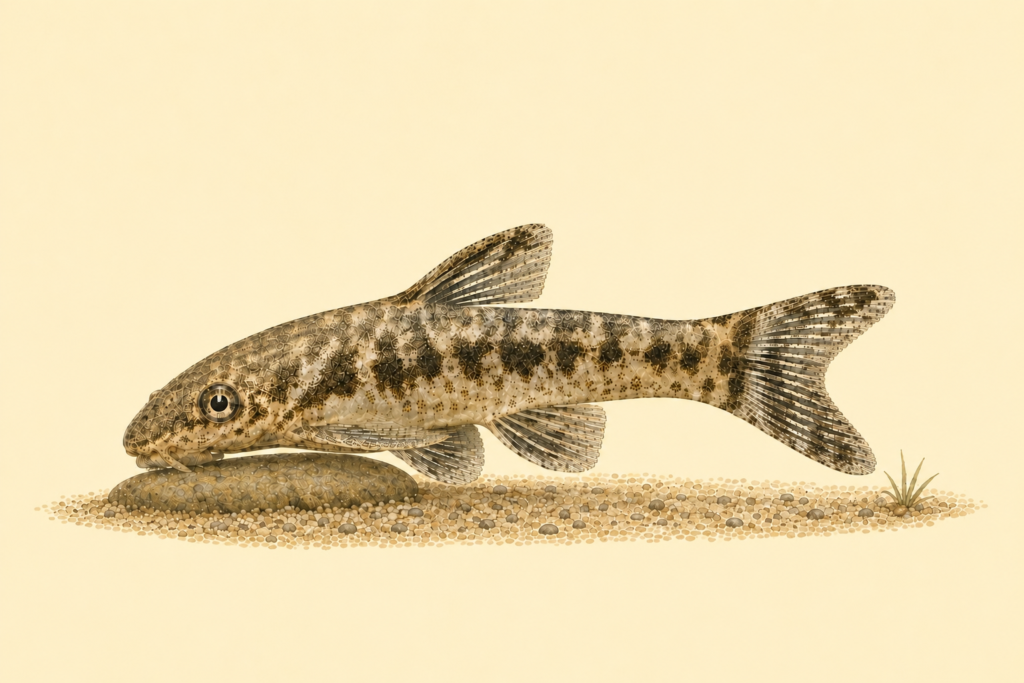
Otocinclus mimulus is a small, streamlined catfish that typically reaches around 3.5 to 4 cm in total length. Its body is elongated and slightly flattened ventrally, as is typical of the Otocinclus genus, with a prominent sucker mouth designed for clinging to surfaces and rasping algae. The base colour is a pale greyish-tan to olive, overlaid with a bold, dark lateral stripe running from the snout through the eye and along the flank to the caudal peduncle. This stripe is the most distinctive marking and is part of what gives the fish its mimicry resemblance to certain Corydoras species that share its habitat. The belly is typically pale white or cream. The fins are mostly transparent, sometimes with a faint yellowish or greenish tint.
Telling males from females can be tricky, especially in younger fish. Mature females tend to be slightly plumper and broader when viewed from above, particularly when carrying eggs. Males are generally a touch slimmer and may have a slightly more defined genital papilla, though this requires close observation. Colour differences between the sexes are negligible. Overall, Otocinclus mimulus is not a flashy fish, but its clean patterning and endearing behaviour give it a quiet charm that grows on you the longer you keep them.
Natural habitat
Otocinclus mimulus is native to the Rio Paraguay drainage in South America, with populations found in parts of Paraguay and the Mato Grosso do Sul region of Brazil. These habitats are typically slow to moderately flowing streams and tributaries with clear or slightly tannin-stained water. The substrate in these environments is often sandy or composed of fine gravel, with abundant submerged vegetation, fallen branches, and leaf litter providing both grazing surfaces and shelter.
Understanding this habitat is useful because it tells you exactly what this fish expects in captivity. The water in these streams is generally soft to moderately hard, slightly acidic to neutral, and well-oxygenated. Dense plant growth is a constant feature, and biofilm-coated surfaces provide the fish with a near-continuous food source. When you replicate these conditions in your aquarium, from the gentle flow to the planted layout to the stable, clean water, you give Otocinclus mimulus the best chance of thriving rather than merely surviving.
Tank size and setup
A group of six Otocinclus mimulus can be comfortably housed in a tank of 60 litres or more. Since these fish are social and should always be kept in groups, plan on roughly 8 to 10 additional litres per extra fish beyond the initial group. Longer tanks are preferable to tall ones, as otos spend most of their time on surfaces near the bottom and midwater rather than swimming in open columns.
For substrate, a fine sand such as pool filter sand or a planted-tank substrate like Tropica Aquarium Soil or ADA Amazonia works well. Avoid sharp or coarse gravel that could irritate the fish’s soft belly. Planting is essential. Provide a good variety of broad-leaved and fine-leaved species, as these give the otos ample surface area for grazing. Anubias barteri, Echinodorus species (Amazon swords), Java fern (Microsorum pteropus), and Vallisneria are all excellent choices. Floating plants like Amazon frogbit (Limnobium laevigatum) help diffuse lighting and create a more natural, comfortable environment.
Include pieces of driftwood and smooth river stones as additional grazing surfaces. Driftwood is especially valuable because it grows biofilm that otos love to feed on. Lighting should be moderate, enough to support healthy plant growth and encourage a thin film of algae on surfaces, but not so intense that it promotes problem algae like blue-green algae or hair algae. Water flow should be gentle to moderate. A slight current is appreciated and mimics their natural stream habitat, but avoid strong powerheads that would exhaust these small fish.
Water parameters
| Temperature | 22 – 27 °C |
| pH | 6.0 – 7.5 |
| Hardness (GH) | 3 – 15 dGH |
| Ammonia | 0 ppm |
| Nitrite | 0 ppm |
| Nitrate | Below 20 ppm |
Otocinclus mimulus is quite sensitive to dissolved waste, particularly ammonia and nitrite. This is one of the key reasons they are not recommended for uncycled or newly set-up tanks. Your aquarium should be fully cycled and mature, ideally running for at least two to three months, before introducing any otos. Regular water changes of 20 to 30 percent weekly will help keep nitrate levels low. Consistency is more important than perfection here. Sudden swings in temperature or pH are far more dangerous than a reading that is slightly outside the ideal range. Use a reliable liquid test kit to monitor parameters regularly.
Filtration and equipment
A good quality hang-on-back filter or a small canister filter is ideal for an Otocinclus mimulus tank. Sponge filters also work well, especially in smaller setups, and they have the added benefit of providing a biofilm-coated surface that the otos will graze on. If you use a hang-on-back or canister filter, make sure the intake is covered with a pre-filter sponge to prevent these tiny fish from being sucked against it. Brands like Eheim, Fluval, and Aquael all offer reliable filters in the right size range for a 60 to 120 litre planted tank.
A heater is necessary unless your room temperature consistently stays within the 22 to 27 °C range. An adjustable heater rated for your tank volume, such as the Eheim Jäger or Fluval M series, gives you precise control. Place it near the filter outflow to ensure even heat distribution. For water testing, invest in a liquid-based kit like the API Freshwater Master Test Kit. It is far more accurate than test strips and will be essential for keeping on top of ammonia, nitrite, nitrate, and pH as your tank matures.
Diet and feeding
In the wild, Otocinclus mimulus feeds almost exclusively on biofilm, aufwuchs (the thin layer of algae, microorganisms, and organic matter that grows on submerged surfaces), and soft green algae. They are not fish that eat hair algae, black beard algae, or any of the tougher algae varieties. Their diet is fundamentally herbivorous and microbial.
In the aquarium, you should not rely solely on the algae growing in your tank. Most tanks, especially well-maintained ones, do not produce enough algae to sustain a group of otos long-term. Supplement their diet with blanched vegetables like courgette (zucchini), cucumber, and spinach. Leave a small piece in the tank for 12 to 24 hours, then remove any uneaten portion. High-quality sinking algae wafers are another important staple. Hikari Algae Wafers and Repashy Soilent Green are both excellent options. Repashy gel foods are particularly good because they coat surfaces and mimic the biofilm the fish naturally graze on. Feed small amounts daily, or at least every other day, and watch to make sure all the fish in the group are eating. A thin oto with a sunken belly is a warning sign that the fish is not getting enough food.
Behaviour and temperament
Otocinclus mimulus is a thoroughly peaceful, non-aggressive fish. It poses no threat to any tank mate, including the tiniest shrimp fry. Day to day, you will see these fish resting on leaves, driftwood, or the aquarium glass, occasionally scooting to a new surface to graze. They are not particularly active swimmers in the way that tetras or rasboras are. Instead, their movement is purposeful and methodical, a short dart followed by a long pause as they rasp at a surface with their sucker mouth.
They are social fish that are noticeably more confident and active when kept in groups of six or more. A solitary oto, or one kept in a pair, tends to hide constantly and may stop eating due to stress. In a proper group, they will often cluster together on the same piece of driftwood or leaf, which is one of their more endearing behaviours. They are primarily diurnal but may also graze during the evening hours if the tank is dimly lit. One quirk worth mentioning is their occasional dash to the surface to gulp air, which is normal. Otocinclus species can perform intestinal breathing, using a modified section of their gut to extract oxygen from swallowed air. This is not a sign of distress unless it is happening constantly, in which case you should check your dissolved oxygen levels and water quality.
Tank mates
Good tank mates
- Ember Tetra (Hyphessobrycon amandae), a tiny, peaceful fish that shares similar water preferences and will not compete for food.
- Cardinal Tetra (Paracheirodon axeleri), calm and colourful, occupies the middle of the water column while otos stay on surfaces.
- Harlequin Rasbora (Trigonostigma heteromorpha), gentle schooling fish that adds movement to the midwater without causing stress.
- Pygmy Corydoras (Corydoras pygmaeus), another small, peaceful bottom-dweller that tolerates the same conditions.
- Cherry Shrimp (Neocaridina davidi), totally peaceful invertebrates that coexist perfectly and help with additional cleanup.
- Kuhli Loach (Pangio kuhlii), a shy, nocturnal bottom-dweller that rarely interacts with otos and shares their preference for soft substrate.
- Honey Gourami (Trichogaster chuna), a gentle, slow-moving fish that stays in the upper to mid level and poses no threat.
Fish to avoid
- Oscars (Astronotus ocellatus), large, predatory cichlids that would see otos as food.
- Tiger Barbs (Puntigrus tetrazona), known fin nippers that can harass and stress small, slow-moving fish.
- Convict Cichlids (Amatitlania nigrofasciata), territorial and aggressive, especially when breeding.
- Chinese Algae Eater (Gyrinocheilus aymonieri), becomes aggressive as it matures and may latch onto the otos’ flanks.
- Common Pleco (Pterygoplichthys pardalis), grows far too large and can outcompete otos for food and resting spots in smaller tanks.
Breeding
Breeding Otocinclus mimulus in captivity is challenging and rarely achieved deliberately. Most successful spawning events happen almost by accident in well-established, heavily planted tanks with pristine water quality and a well-fed group. Sexing the fish is the first hurdle. As noted, females are slightly broader when viewed from above, but the differences are subtle and often only apparent in mature, well-conditioned individuals.
Conditioning involves feeding the group a varied, high-quality diet rich in fresh vegetables and Repashy gel food for several weeks. Some breeders report that a slight drop in temperature followed by a gradual return to normal (simulating a seasonal change), combined with a large water change using slightly cooler, softer water, can trigger spawning behaviour. When ready, the female will become visibly plumper, and the male will pursue her around the tank in a pattern similar to other Otocinclus species. The pair will adopt a “T position,” with the male clasping the female near her head, at which point she releases a small clutch of eggs, typically one to three at a time, and deposits them on plant leaves or smooth surfaces like the aquarium glass.
Eggs are small, adhesive, and translucent. A single spawning may yield anywhere from 20 to 50 eggs. The adults do not guard the eggs and generally do not eat them either, but it is safest to separate the eggs if possible. Eggs hatch in roughly two to three days at 25 °C. The fry are tiny and initially feed on their yolk sac before transitioning to microscopic biofilm and infusoria. Providing surfaces coated in green biofilm is critical for fry survival. Powdered spirulina and very finely crushed algae wafers can supplement once the fry are a few days old. Growth is slow, and raising the fry successfully requires patience, excellent water quality, and a constant food supply.
Common diseases and health
One of the most common problems with Otocinclus mimulus, and indeed all Otocinclus species, is starvation. These fish have high metabolic rates relative to their size and can decline quickly if food is insufficient. Symptoms include a sunken belly, lethargy, and a loss of colour. Prevention is straightforward: make sure you are supplementing their diet with blanched vegetables and algae wafers regularly, and do not add otos to a brand new tank that has not had time to develop biofilm.
Ich (white spot disease) is another concern, particularly after the stress of transport and acclimation. You will see small white spots on the body and fins, and the fish may flash against surfaces. Treat with a quality ich medication such as eSHa Exit or raise the temperature gradually to 28 to 30 °C over a few days if your other tank inhabitants tolerate it. Be cautious with copper-based medications if you keep shrimp.
Bacterial infections can also occur, often secondary to poor water quality or physical injury. Symptoms include redness, frayed fins, and loss of appetite. Maintaining excellent water quality is the best prevention. Treat with a broad-spectrum antibacterial like eSHa 2000 or API Melafix if you catch it early. Always quarantine new Otocinclus for at least two weeks before adding them to your main tank. These fish are often wild-caught and can carry parasites or be stressed from shipping. A quiet quarantine tank with established biofilm, gentle flow, and stable parameters gives them the best start.
Frequently asked questions
How many Otocinclus mimulus should I keep together?
You should keep a minimum of six. Otocinclus are social fish that rely on group dynamics for confidence and security. In smaller numbers they tend to hide, eat poorly, and show signs of chronic stress. A group of six to ten in an appropriately sized tank is ideal and allows you to see their natural behaviour.
Can Otocinclus mimulus live with bettas?
In many cases, yes. Otocinclus mimulus is so peaceful and unobtrusive that most bettas will ignore them entirely. However, this depends on the individual betta’s temperament. Make sure the tank is at least 40 litres (though 60 or more is better for a group of otos), well-planted, and offers plenty of cover. Monitor interactions closely for the first week.
Why is my Otocinclus mimulus not eating algae wafers?
Newly introduced otos are often stressed and may take several days to start accepting prepared foods. Try offering blanched courgette or Repashy Soilent Green, which can be more appealing than hard wafers. Make sure the tank has surfaces with natural biofilm for them to graze on in the meantime. If the fish still will not eat after a week, check your water parameters and consider whether the fish might be ill.
Do Otocinclus mimulus eat all types of algae?
No. Otocinclus species are specialists on soft green algae, diatoms, and biofilm. They will not eat hair algae, black beard algae (BBA), staghorn algae, or blue-green algae (cyanobacteria). If you have a problem with these tougher algae types, you will need other solutions such as improving your lighting balance, adding CO2, or manually removing the algae.
How can I tell if my Otocinclus mimulus is healthy?
A healthy oto has a gently rounded belly, clear eyes, intact fins, and is actively grazing throughout the day. It should move purposefully from surface to surface rather than sitting motionless in one spot for hours. A sunken belly, faded colour, clamped fins, or excessive hiding are all warning signs that something is wrong, whether it is water quality, diet, or disease.
Related guides
- Mimicry Otocinclus breeding guide
- Mimicry Otocinclus tank setup and equipment guide
- Mimicry Otocinclus diet and feeding guide
- Best tank mates for Mimicry Otocinclus
- Mimicry Otocinclus diseases and health guide
- Why is my Mimicry Otocinclus losing colour?
- Back to the fish species directory
- Beginner’s guide to cycling your tank