Quick Summary
The Red Spotted Splash Tetra is a peaceful, surface-dwelling characin best suited to experienced hobbyists who can provide soft, acidic water and a well-planted tank with a secure lid. It rewards patient keepers with subtle beauty and one of the most extraordinary breeding behaviours in the freshwater hobby – pairs leap from the water to deposit eggs on overhanging surfaces above the waterline.
🐠 Build a tank around this species
In this guide:
- Introduction
- Quick Stats
- Appearance
- Natural Habitat
- Tank Size and Setup
- Water Parameters
- Diet and Feeding
- Behaviour and Temperament
- Tank Mates
- Breeding
- Common Diseases
- FAQs
Introduction
Copella meinkeni, commonly known as the Red Spotted Splash Tetra, is a small, elegant characin found in the slow-moving, heavily shaded waterways of South America. It belongs to the family Lebiasinidae, a group of pencilfish and splash tetras that occupies a slightly different ecological niche from the mainstream tetras of the family Characidae. Within the aquarium hobby, it remains relatively uncommon compared to its more famous relative Copella arnoldi, yet it is equally fascinating and arguably even more attractive, bearing a scattering of vivid red spots along its flanks that shimmer under subdued lighting.
What truly sets the splash tetras apart – and what draws many dedicated aquarists to seek them out – is their remarkable reproductive strategy. Rather than scattering eggs among plants or over substrate like most characins, breeding pairs of Copella leap clear of the water together to deposit eggs on the underside of overhanging leaves, tank lids, or other surfaces above the waterline. The male then returns repeatedly to splash water onto the exposed egg mass, keeping it moist until the fry hatch and drop into the water below. This behaviour is unique among freshwater fish and represents one of the most captivating spectacles the hobby has to offer.
In day-to-day care, C. meinkeni is a peaceful, undemanding species once its core requirements for soft, acidic water and a calm environment are met. It spends most of its time near the surface, often hovering just below floating plants, and coexists readily with other small, non-aggressive species. It is not a beginner fish in the strictest sense – its water chemistry preferences and sensitivity to poor conditions put it a step above hardier community species – but any aquarist with a solid understanding of tropical freshwater husbandry should find it manageable and deeply rewarding.
Quick Stats
| Scientific name | Copella meinkeni |
|---|---|
| Common names | Meinken's Splash Tetra |
| Family | Lebiasinidae |
| Origin | South America, Rio Negro and Orinoco basins |
| Adult size | 4.5 cm |
| Difficulty | Intermediate |
| Breeding difficulty | Advanced |
| Temperature | 20–28 °C |
| pH | 4–7 |
| GH | 1–8 dGH |
| Minimum tank size | 45 L |
| Conservation status | Least Concern (IUCN, assessed 2020) |
Appearance
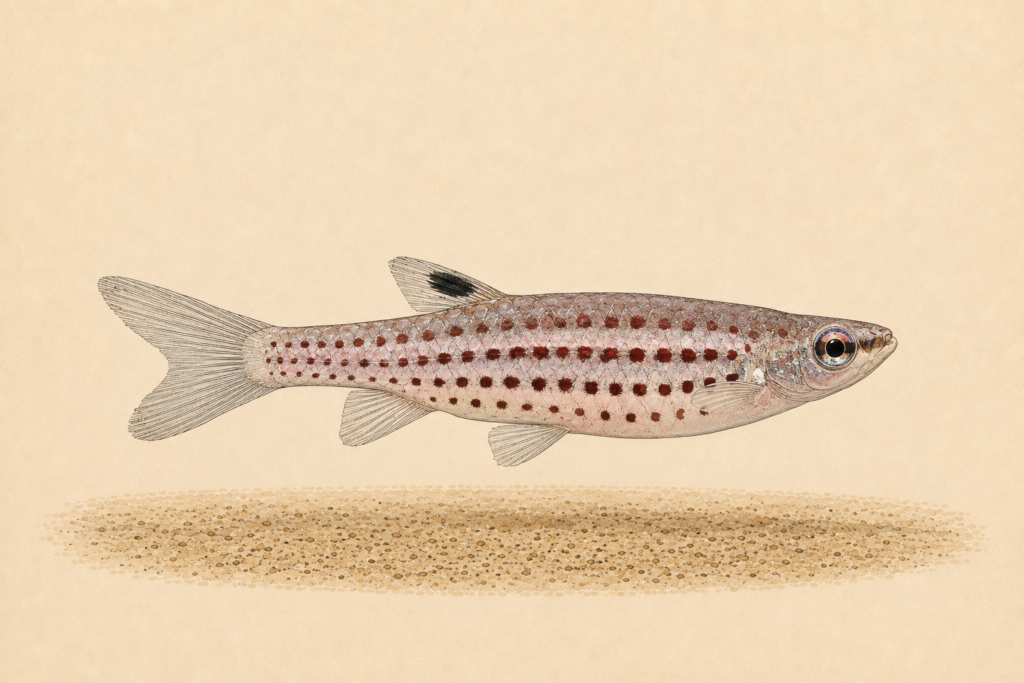
The Red Spotted Splash Tetra is a slender, laterally compressed fish with a body shape typical of the Lebiasinidae – elongated and somewhat torpedo-like, built for quick darts to the surface and the remarkable aerial leaps that define its breeding behaviour. Adults typically reach between 4 and 5 centimetres in total length, with males tending towards the upper end of that range and displaying noticeably more vivid colouration than females.
The base body colour is a warm, translucent golden-brown to olive, often with a faint iridescent sheen that catches the light when viewed from certain angles. The species’ most distinctive feature is the series of bright red to crimson spots that dot the flanks, arranged in loose rows that follow the lateral line and extend towards the caudal peduncle. The intensity of these spots varies with the fish’s condition, diet, and mood – a well-kept specimen in breeding condition can display spots of startling vibrancy, while a stressed or newly imported individual may appear comparatively washed out.
The fins are largely transparent to pale yellow, with the dorsal and anal fins sometimes showing faint red or orange accents, particularly in males. Males also tend to develop slightly more extended finnage as they mature, with the upper lobe of the caudal fin sometimes growing marginally longer than in females. The eye is relatively large and prominent, typical of surface-dwelling species that rely on good vision to detect food items falling onto the water’s surface and to coordinate their leaping behaviour during spawning.
Sexual dimorphism is present but subtle outside of breeding condition. Males are generally a touch larger and more colourful, with bolder spotting and slightly more elaborate fins. Females tend to be slightly rounder in the belly, especially when gravid, and their colouration, while attractive, is more muted. Distinguishing the sexes with confidence typically requires observing a group of mature specimens side by side.
Natural Habitat
Copella meinkeni inhabits the slow-moving tributaries, forest streams, and flooded margins of the Rio Negro and Orinoco river basins in northern South America, spanning parts of Brazil, Venezuela, and Colombia. These are classic blackwater environments – the water is stained dark amber to tea-brown by dissolved tannins leaching from decomposing leaf litter and submerged wood on the forest floor. The chemistry of these waters is extreme by aquarium standards: pH values often sit between 4.5 and 6.0, general hardness is negligible, and conductivity is extraordinarily low.
The streams and pools where this species is found are typically shaded by dense tropical forest canopy, resulting in subdued, dappled lighting conditions at the water’s surface. The substrate is usually a thick layer of decomposing leaves, fallen branches, and fine sand. Aquatic plants may be sparse in the deepest shade, but marginal and overhanging vegetation is abundant – this is critically important for splash tetras, as the overhanging leaves serve as the spawning substrate onto which eggs are deposited above the waterline.
Water flow in these habitats is gentle to negligible, particularly in the flooded forest margins and backwater pools that C. meinkeni prefers. The fish tends to occupy the upper water column, hovering near the surface beneath overhanging branches and leaf litter, where it feeds on small insects, insect larvae, and other invertebrates that fall onto or drift across the water’s surface. This surface-oriented lifestyle is reflected in the species’ upturned mouth and large eyes, both adaptations for spotting and capturing food items from above.
The temperature in these habitats is relatively stable, typically ranging from 24 to 28 degrees Celsius, with only minor seasonal fluctuations. The rainy season brings rising water levels and an influx of fresh organic matter, which may serve as a trigger for breeding activity. Understanding these natural conditions is essential for replicating the species’ requirements in captivity, particularly the soft, acidic water chemistry and the presence of overhanging surfaces for spawning.
Tank Size and Setup
A minimum tank size of 75 litres is recommended for a small group of Red Spotted Splash Tetras. While the fish themselves are not large, they are active near the surface and benefit from a tank with a generous footprint rather than excessive depth. A standard 80 by 35 centimetre footprint or larger is ideal, providing ample horizontal swimming space in the upper water column where the species spends most of its time. If you plan to keep a larger group or a community alongside them, scale up accordingly – a 120 to 150 litre tank will give you considerably more flexibility in stocking and aquascaping.
A tight-fitting lid is essential. Splash tetras are accomplished jumpers by nature – their entire reproductive strategy depends on leaping from the water – and they will readily escape through any gap in the tank cover, often with fatal results. Ensure that the lid sits securely with no openings large enough for a small fish to pass through. At the same time, there should be an air gap of at least 5 to 10 centimetres between the water surface and the lid or any overhanging surfaces. This gap is important for breeding (see the Breeding section below), but it also provides the humid, enclosed atmosphere above the water that helps prevent the fish from injuring themselves during their characteristic surface leaps.
The substrate should be fine sand or a similarly smooth material in a dark tone. Dark substrates help the fish feel secure and bring out the best in their colouration. A generous layer of dried leaf litter – Indian almond leaves, oak leaves, or similar – scattered over the substrate is highly beneficial. The leaves release tannins that soften the water and lower the pH naturally, closely replicating the blackwater conditions of the species’ native habitat. They also provide a source of microfauna for the fish to graze on and contribute to the overall biological complexity of the aquarium.
Driftwood and bogwood are excellent hardscape choices, again for their tannin-releasing properties and for the shelter they provide. Arrange wood pieces to create shaded areas and overhangs near the surface. Live plants are welcome and appreciated, particularly floating species such as Amazon frogbit, Salvinia, or red root floaters, which diffuse the light and give the fish the sense of cover they prefer. Stem plants and low-growing species such as Cryptocoryne can be used to fill the mid and lower levels of the tank without encroaching on the open surface swimming space.
Lighting should be moderate to subdued. Splash tetras are naturally found in heavily shaded environments and will appear stressed and pale under bright, unfiltered light. Floating plants help enormously in diffusing overhead lighting, but you can also reduce the intensity at the fixture level or use a dimmer if your light supports one. The goal is a tank that feels calm and sheltered from above, mimicking the dappled forest canopy of the species’ home waters.
Water Parameters
The Red Spotted Splash Tetra is a soft, acidic water species that does best when its native conditions are approximated as closely as practical. While it can tolerate a modest range of conditions once acclimated, long-term health, vibrant colouration, and any prospect of breeding depend on maintaining water chemistry within the ranges below.
| Temperature | 20-28 C |
| pH | 4.0-7.0 |
| General hardness (GH) | 1-8 dGH |
| Ammonia | 0 ppm |
| Nitrite | 0 ppm |
| Nitrate | Below 20 ppm |
Achieving and maintaining these parameters may require the use of reverse osmosis (RO) water or a combination of RO and remineralised water, depending on your local tap water chemistry. In many areas, tap water is far too hard and alkaline for this species. Peat filtration, Indian almond leaves, and driftwood all contribute to softening and acidifying the water naturally, but they are best used as supplements to an already appropriate base water rather than relied upon to transform fundamentally unsuitable tap water.
Stability is at least as important as hitting a specific number. Sudden swings in pH or temperature are more dangerous than a pH that sits at 6.5 rather than 5.5. Perform regular partial water changes of 15 to 25 per cent weekly, using water that has been temperature-matched and, if necessary, pre-treated to match the tank’s chemistry. Keep a close eye on nitrate levels – splash tetras are sensitive to accumulated waste products, and elevated nitrates will suppress colouration and compromise immune function over time.
Filtration and Equipment
Filtration should be efficient but gentle. The Red Spotted Splash Tetra is a still to slow-water species and does not appreciate strong currents, particularly at the surface where it spends most of its time. A sponge filter is an excellent choice for a dedicated species tank, providing reliable biological filtration with minimal flow disturbance. For community setups or larger tanks, a small hang-on-back filter or canister filter with an adjustable flow rate works well, provided the outflow is diffused with a spray bar or directed against the glass to break up the current.
A reliable heater is essential for maintaining the stable tropical temperatures this species requires. Choose a heater rated appropriately for your tank volume and consider using a separate thermometer to verify the temperature independently – built-in heater thermostats can drift over time. Position the heater near the filter outflow to ensure even heat distribution throughout the tank.
As noted in the Tank Size and Setup section, a secure, tight-fitting lid is non-negotiable. For breeding purposes, the underside of the lid itself can serve as an egg-deposition surface, but many breeders prefer to position broad leaves (real or artificial) or sheets of frosted glass at an angle just above the waterline, giving the fish a textured surface to attach eggs to. Whatever arrangement you choose, ensure that the air space above the water is enclosed and humid – eggs deposited above the waterline will desiccate and die if the air above the tank is dry or subject to draughts.
An air pump is not strictly necessary if your filtration provides adequate gas exchange, but a gentle airstone can be useful in heavily planted or tannin-stained tanks where oxygen levels may dip slightly overnight. Keep the airflow gentle – a roiling surface will unsettle these fish.
Diet and Feeding
In the wild, Copella meinkeni is primarily an insectivore and surface feeder, taking small insects, insect larvae, and other invertebrates that land on or drift across the water’s surface. In captivity, it accepts a range of foods but consistently shows its best colour and condition when offered a diet rich in small live and frozen invertebrates.
High-quality micro-pellets or slow-sinking granules formulated for small tropical fish can form the staple of the diet, but these should be supplemented regularly – ideally daily – with live or frozen foods. Daphnia, baby brine shrimp (Artemia nauplii), cyclops, micro-worms, and fruit flies (wingless or flightless varieties) are all eagerly accepted and provide the protein and variety needed to maintain vibrant colouration and support breeding condition. Fruit flies and other surface-dwelling live foods are particularly appropriate, as they encourage the natural surface-feeding behaviour of the species.
Feed small amounts two to three times per day rather than one large meal. Splash tetras have small stomachs and benefit from frequent, modest feedings. Remove any uneaten food promptly to prevent it from fouling the water – this is especially important in the soft, acidic conditions this species requires, where the biological filtration capacity may be lower than in harder, more alkaline setups.
Avoid feeding large or hard food items that the fish cannot easily consume. Flake food is accepted by some individuals but is not ideal as a staple, as it tends to disperse quickly and can be difficult for surface feeders to consume efficiently before it sinks and breaks apart.
Behaviour and Temperament
The Red Spotted Splash Tetra is a peaceful, somewhat reserved species that occupies the upper water column almost exclusively. It spends the majority of its time hovering just below the surface, often beneath floating plants or overhanging objects, occasionally darting forward to intercept a food item or engage in brief, harmless displays with conspecifics. It is not a hyperactive swimmer and tends to move in short, deliberate bursts rather than the constant schooling motion seen in many mainstream tetras.
While not a strict shoaling species in the manner of cardinal or neon tetras, C. meinkeni is decidedly social and should be kept in a group of at least six individuals. In smaller numbers, the fish tend to be shy and reclusive, spending most of their time hidden and rarely displaying their full colouration. A group of six or more allows natural social interactions to develop, including the gentle sparring between males that brings out the best in their colour and finnage. Males may display to one another with flared fins and intensified spotting, but these encounters are brief and never result in injury.
This species is not aggressive towards other fish and makes an excellent community resident alongside similarly peaceful, small species. It largely ignores fish that occupy the mid and lower levels of the tank, and its surface-oriented habits mean it rarely competes directly for food or territory with bottom-dwellers or mid-water swimmers. However, it can be easily intimidated by boisterous or aggressive tank mates, so care should be taken to avoid pairing it with species that are significantly larger, faster, or more assertive.
One behaviour worth noting is the species’ tendency to leap. Even outside of breeding, splash tetras may jump at the surface, particularly when startled, during feeding, or when males are displaying. This is entirely normal and not a sign of distress, but it underscores the absolute necessity of a secure, tight-fitting lid. A startled fish that clears the rim of an open tank is unlikely to survive.
Tank Mates
The Red Spotted Splash Tetra is a gentle, surface-dwelling species that coexists well with a wide range of small, peaceful community fish. The ideal tank mates are species that share its preference for soft, acidic water, occupy different levels of the water column, and are unlikely to outcompete it for food at the surface. Avoid anything large enough to view the splash tetra as prey, anything aggressive or territorial, and fast, boisterous species that will stress it into hiding.
Good tank mates
- Cardinal Tetra – A classic soft-water companion that occupies the mid-water column and shares identical water chemistry requirements.
- Ember Tetra – Tiny, calm, and beautifully coloured; stays in the middle and lower levels without competing at the surface.
- Pygmy Corydoras – A diminutive bottom-dweller that adds activity to the lower levels without disturbing surface-dwelling species.
- Otocinclus – Peaceful algae grazers that keep to glass and plant surfaces, posing no threat or competition.
- Chocolate Gourami – Another soft, acidic water specialist that is quiet and unobtrusive, though it may occasionally visit the surface.
- Green Neon Tetra – A small, subdued schooling tetra ideally suited to blackwater conditions alongside splash tetras.
- Kuhli Loach – A shy, nocturnal bottom-dweller that stays well out of the splash tetra’s way and thrives in similar conditions.
- Nannostomus Pencilfish – Close ecological relatives from the same habitats; pencilfish are peaceful and occupy a similar niche without conflict.
Fish to avoid
- Tiger Barb – Boisterous and nippy; will harass splash tetras and outcompete them at feeding time.
- Oscar – Far too large and predatory; would view splash tetras as food.
- African Cichlids – Require hard, alkaline water and are typically too aggressive for soft-water community tanks.
- Convict Cichlid – Territorial and aggressive, especially when breeding; completely incompatible temperamentally.
- Chinese Algae Eater – Becomes aggressive and territorial with age and may harass smaller tank mates.
- Red Tail Shark – Territorial bottom-dweller that can dominate an aquarium and stress timid species.
- Giant Gourami – Grows far too large and will treat small tetras as prey items.
Breeding
Copella meinkeni exhibits one of the most extraordinary breeding behaviours of any freshwater fish. Unlike the vast majority of characins, which scatter eggs among plants or over substrate, splash tetras are aerial spawners. A conditioned pair will leap together out of the water, belly-to-belly, to deposit a clutch of eggs on the underside of an overhanging surface above the waterline – in nature this is typically a broad leaf; in captivity it may be the underside of the tank lid, a piece of glass, a plastic sheet, or an artificial leaf positioned above the water. The pair may make dozens of these leaps during a single spawning session, depositing a few eggs with each jump until a clutch of 50 to 200 or more eggs has accumulated.
After spawning is complete, the male assumes sole responsibility for egg care. He positions himself below the egg mass and periodically flicks water upward onto it with powerful beats of his caudal fin. This splashing behaviour – which gives the group its common name – keeps the eggs moist and prevents them from desiccating in the open air. The male will continue this vigil for approximately 36 to 72 hours until the eggs hatch and the tiny fry drop into the water below.
To breed this species successfully in captivity, you must provide a tight-fitting lid with an air gap of at least 5 to 10 centimetres between the water surface and the lid or spawning surface. The air space above the water must remain humid and still – if the air is dry or there is a draught, the eggs will desiccate and fail to develop regardless of the male’s splashing efforts. Some breeders seal the tank almost completely during spawning, leaving only minimal ventilation. Position a broad, smooth surface – a large leaf, a piece of frosted acrylic, or the underside of the lid itself – at a slight angle just above the waterline to give the fish a target. Darker or textured surfaces often seem to be preferred over smooth, reflective ones.
Condition the breeding pair or group with a diet rich in live foods for several weeks prior to attempting to spawn them. Increase the proportion of fruit flies, daphnia, and baby brine shrimp in the diet. A slight drop in water level, a modest temperature increase of one to two degrees, and a large water change with slightly cooler water can all serve as spawning triggers, simulating the onset of the rainy season in the wild.
Once the fry drop into the water, they are extremely small and will initially require infusoria or commercially prepared liquid fry food. After a few days they can graduate to freshly hatched brine shrimp nauplii and microworms. Growth is steady but not rapid, and the fry will need very clean water with frequent, small water changes to thrive. Keep the breeding tank covered at all times and maintain the soft, acidic water conditions that the adults require.
Breeding Copella meinkeni is rated as difficult, not because the fish are reluctant to spawn under the right conditions, but because replicating the precise environmental requirements – the water chemistry, the humidity above the waterline, the spawning surfaces, and the rearing conditions for the tiny fry – demands careful preparation and attentive husbandry. For dedicated aquarists, however, witnessing the aerial spawning display is one of the most unforgettable experiences the freshwater hobby can offer.
Common Diseases
The Red Spotted Splash Tetra is not unusually susceptible to disease, but like all small tropical fish it is vulnerable to the common ailments that affect freshwater species, particularly when water quality is suboptimal or the fish is stressed by poor conditions, aggressive tank mates, or sudden changes in parameters.
Ichthyophthirius multifiliis, commonly known as white spot or ich, is probably the most frequently encountered disease in community aquaria. It presents as small white cysts on the fins and body and is typically triggered by temperature fluctuations or the introduction of infected fish. Treatment involves raising the temperature gradually to 28-30 degrees Celsius (if the fish can tolerate it) and administering a proprietary white spot remedy according to the manufacturer’s instructions. Note that splash tetras, like many soft-water species, may be sensitive to some medications, particularly those containing copper – always use half-dose treatments initially and observe the fish closely for signs of distress.
Fungal infections can occur on damaged skin or fins, appearing as white or grey cotton-like growths. These are usually secondary to an injury or to chronically poor water quality. Improving water conditions and treating with an appropriate antifungal remedy will normally resolve the issue. Fin rot, caused by bacterial infection, presents as ragged, eroding fin edges and is almost always a consequence of poor water quality. Correcting the underlying conditions and, if necessary, treating with a broad-spectrum antibacterial medication will usually effect a cure.
Velvet disease (Oodinium) is another parasitic condition that can affect small tropicals, presenting as a fine, gold-dusted appearance on the skin. It is less common than ich but can be equally dangerous if untreated. Darkening the tank and treating with a copper-free anti-parasitic remedy is the standard approach for sensitive species.
Prevention is always preferable to treatment. Maintaining stable, clean water within the species’ preferred parameters, quarantining all new additions before introducing them to the main tank, feeding a varied and nutritious diet, and avoiding overstocking will collectively minimise the risk of disease. Observe your fish daily – changes in behaviour, appetite, or colouration are often the earliest indicators that something is amiss.
FAQs
Do Red Spotted Splash Tetras really jump out of the water to breed?
Yes, this is genuinely how they reproduce. Breeding pairs leap from the water together and deposit eggs on the underside of overhanging surfaces above the waterline. The male then splashes water onto the eggs periodically to keep them moist until they hatch. It is one of the most remarkable reproductive behaviours in the freshwater fish world and is not an exaggeration or myth – it is well documented in both wild populations and captive breeding programmes.
Can I keep Red Spotted Splash Tetras in hard, alkaline water?
This is not recommended. Copella meinkeni is a soft, acidic water specialist, and prolonged exposure to hard, alkaline conditions will stress the fish, suppress its colouration, compromise its immune system, and almost certainly prevent breeding. If your tap water is hard, you will need to use reverse osmosis water or a similar method to achieve the soft, acidic conditions this species requires.
How many Red Spotted Splash Tetras should I keep together?
A minimum of six is recommended. Splash tetras are social fish that behave more naturally and display better colouration in groups. In smaller numbers they tend to be shy and reclusive. A group of eight to ten is even better if your tank size allows it, as this provides a richer social dynamic and increases the likelihood of having at least one compatible breeding pair.
Will Red Spotted Splash Tetras eat my shrimp?
Adult splash tetras may prey on very small shrimp fry, but they generally ignore adult dwarf shrimp such as Neocaridina or Caridina species. If you are keeping a breeding shrimp colony, the presence of splash tetras may reduce the survival rate of the smallest shrimplets, but established adult shrimp should be safe. Dense planting and hiding spots will improve shrimp survival in a mixed setup.
Why are my splash tetras hiding and not showing colour?
This is almost always a sign of stress. Common causes include water parameters outside the species’ preferred range, excessive lighting, a lack of surface cover (floating plants or overhanging decor), aggressive or overly boisterous tank mates, or simply a group that is too small. Review your setup against the recommendations in this guide, address any shortcomings, and give the fish time to settle. With appropriate conditions, splash tetras are confident, visible, and beautifully coloured.
Related Guides
- Splash Tetra (Copella arnoldi) – The most well-known splash tetra species and a close relative with the same extraordinary aerial breeding behaviour.
- Cardinal Tetra – A quintessential soft-water community fish and one of the best mid-water companions for splash tetras.
- Golden Pencilfish (Nannostomus beckfordi) – A peaceful lebiasinid relative that thrives in identical blackwater conditions.
- Chocolate Gourami – Another soft, acidic water specialist that pairs well with splash tetras in a carefully managed community.
- Pygmy Corydoras – An ideal bottom-dwelling companion for a small blackwater community tank.