Royal Whiptail Catfish Care Guide – Tank Setup, Feeding and Breeding
Quick summary
The Royal Whiptail Catfish is a moderately difficult, peaceful algae grazer best suited to intermediate keepers who can provide a 200+ litre tank with strong water flow and consistently pristine water quality. It cannot survive on algae alone, so be prepared to offer a varied diet of vegetables, wafers, and protein-rich foods to keep it healthy.
🐠 Build a tank around this fish
In this guide:
- Introduction
- Quick Stats
- Appearance
- Natural Habitat
- Tank Size and Setup
- Water Parameters
- Filtration and Equipment
- Diet and Feeding
- Behaviour and Temperament
- Tank Mates
- Breeding
- Common Diseases
- FAQs
Introduction
The Royal Whiptail Catfish (Sturisoma panamense) is one of the most elegant and distinctive members of the Loricariidae family. Native to Central America, this armoured catfish stands out from many of its South American relatives with its elongated, slender body, dramatically extended caudal filaments, and a regal bearing that has earned it the “royal” moniker. Unlike the more commonly encountered Rineloricaria whiptails, S. panamense grows considerably larger and possesses a more striking profile, making it a centrepiece species for planted aquaria and community setups alike.
First described scientifically in the late 19th century, Sturisoma panamense has gradually gained popularity among dedicated aquarists, although it remains less widely available than many other loricariid catfish. Its relatively peaceful temperament, fascinating algae-grazing behaviour, and unusual appearance make it an appealing choice for hobbyists looking to move beyond the more commonly kept plecostomus species. However, this species does demand good water quality, a varied diet, and a well-structured environment to truly thrive, placing it firmly in the intermediate bracket of fishkeeping difficulty.
In the wild, Royal Whiptail Catfish inhabit flowing rivers and streams with moderate to strong current, where they cling to submerged wood and rocks using their specialised mouthparts. Replicating these conditions in captivity is essential for long-term health and successful breeding. This guide covers every aspect of Royal Whiptail Catfish care, from tank setup and water chemistry to diet, breeding, and disease prevention, providing everything needed to keep this remarkable catfish in excellent condition.
Quick Stats
| Scientific name | Sturisoma panamense |
| Common names | Royal Whiptail Catfish, Panama Sturisoma, Royal Farlowella, Royal Twig Catfish |
| Family | Loricariidae |
| Origin | Central America (Panama, Colombia – Pacific slope drainages) |
| Adult size | 20-26 cm (including caudal filaments) |
| Lifespan | 8-12 years |
| Difficulty | Moderate |
| Breeding difficulty | Moderate |
| Temperature | 22-28 °C |
| pH range | 6.0-7.5 |
| General hardness (GH) | 3-15 dGH |
| Carbonate hardness (KH) | 2-10 dKH |
| Minimum tank size | 200 litres |
| Conservation status | Not Evaluated |
Appearance
Sturisoma panamense is immediately recognisable by its extremely elongated, flattened body shape – a design perfectly adapted for life in flowing water. The body is covered in bony armour plates typical of the Loricariidae family, giving it a rough, textured appearance. The overall colouration is a warm golden-brown to olive-brown on the dorsal surface, often with darker mottled patterning or subtle banding along the flanks. The ventral surface is considerably paler, ranging from cream to light tan. A dark lateral stripe frequently runs from the snout through the eye and along the body, adding visual definition.
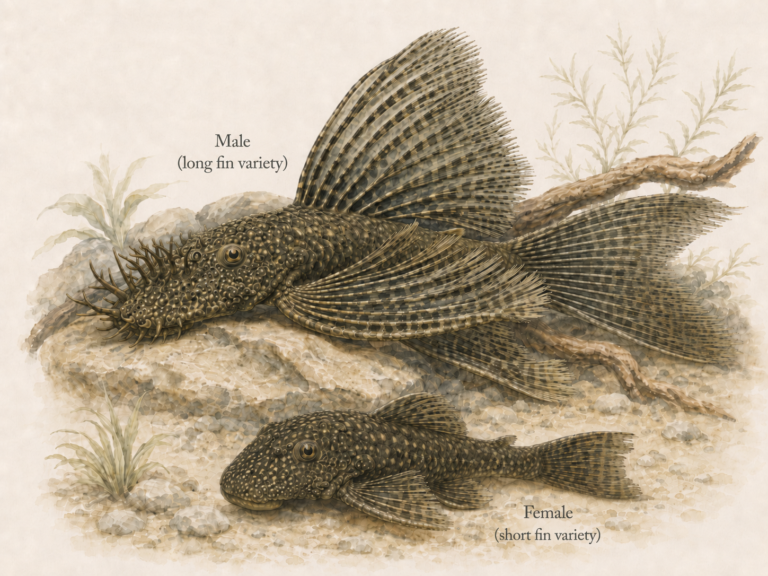
The head is distinctly flattened and somewhat elongated, tapering to a pointed snout. The mouth is positioned ventrally and modified into a suckermouth disc, which the fish uses to rasp biofilm, algae, and organic matter from hard surfaces. Males and females can be distinguished with practice: mature males develop prominent bristle-like odontodes (small tooth-like projections) on the sides of the head and along the pectoral fin spines, particularly noticeable during breeding condition. Females tend to have a broader, more rounded body profile when viewed from above, especially when gravid.
One of the most striking features of the Royal Whiptail is its dramatically extended caudal fin filaments. Both the upper and lower lobes of the tail fin extend into long, trailing threads that can add several centimetres to the fish’s total length. These filaments are delicate and can be damaged by aggressive tank mates or poor water conditions, so their condition serves as a useful indicator of overall health. The dorsal fin is tall and triangular, held erect when the fish is alert, and the pectoral fins are broad and paddle-like, helping the fish maintain its position in current.
Compared to the closely related Farlowella species, Sturisoma panamense has a somewhat broader and more robust build, though it remains slender by most catfish standards. Compared to Rineloricaria whiptails, the Royal Whiptail is noticeably larger and possesses a more elongated snout and more prominent caudal extensions. The overall impression is of a streamlined, almost prehistoric creature – an aquatic twig come to life.
Natural Habitat
Sturisoma panamense is found in Central America, primarily in Pacific slope river drainages of Panama and extending into northwestern Colombia. This makes it one of the relatively few loricariid catfish native to Central America, as the vast majority of the family’s diversity is concentrated in South America. The species inhabits rivers and streams at low to moderate elevations, typically in areas with moderate to strong water flow.
In its natural environment, S. panamense is found clinging to submerged wood, rocks, and root tangles in well-oxygenated waterways. The substrate in these habitats tends to be a mix of sand, gravel, and rounded stones, with a covering of biofilm and algae on most hard surfaces. The water is generally clear to slightly tannin-stained, with temperatures remaining relatively stable throughout the year due to the tropical climate. Surrounding riparian vegetation provides dappled shade, and fallen branches and leaf litter contribute to the complex underwater structure that these catfish rely upon for shelter and feeding opportunities.
The water chemistry in these habitats is typically soft to moderately hard, with a slightly acidic to neutral pH. Dissolved oxygen levels are high owing to the flowing nature of the water, and nitrate concentrations remain low due to the volume and turnover of water. These conditions are important to replicate in the aquarium, as Royal Whiptail Catfish are less tolerant of stagnant, poorly oxygenated water than many other loricariid species. Understanding this natural context helps explain many of the species’ requirements in captivity, from the need for good current flow to the importance of maintaining pristine water quality.
The diet in the wild consists primarily of aufwuchs – the complex community of algae, biofilm, microorganisms, and detritus that grows on submerged surfaces. The fish spend much of their time rasping at wood and stones, ingesting this material along with small invertebrates and organic particles. This dietary pattern is crucial to understand when planning feeding strategies in captivity.
Tank Size and Setup
Given their adult size of up to 26 cm and their active grazing behaviour, Royal Whiptail Catfish require a reasonably spacious aquarium. A minimum tank size of 200 litres is recommended for a single specimen or a pair, with larger tanks of 300 litres or more preferred for groups or community setups. The tank should ideally have a generous footprint rather than being excessively tall, as these fish spend the majority of their time on or near the bottom and on surfaces throughout the aquarium.
The aquascape should aim to replicate the natural habitat as closely as possible. Driftwood is an essential component – not only does it provide grazing surfaces covered in biofilm, but the cellulose in the wood is believed to aid in digestion for many loricariid species. Include several pieces of bogwood, mopani wood, or Malaysian driftwood of varying sizes, arranged to create sheltered spots and open grazing areas. Smooth river stones and flat rocks also make excellent additions, providing additional surfaces for algae growth and resting places for the fish.
A sandy or fine gravel substrate is ideal, as coarse substrates can damage the delicate ventral surface and barbels of these catfish. Avoid sharp-edged substrates entirely. Live plants are highly compatible with Royal Whiptail Catfish and are encouraged, as the fish rarely damage healthy plant tissue, preferring instead to graze on the algae and biofilm that accumulates on plant leaves. Hardy species such as Anubias, Java Fern, Vallisneria, and various Cryptocoryne species work particularly well. Floating plants can help diffuse lighting and provide a more natural feel.
Moderate to strong water flow is important and should be provided via the filtration system or supplementary powerheads. The fish will readily position themselves in areas of current, and the increased oxygenation benefits their health considerably. Lighting should be moderate – bright enough to support plant growth and some algae development on hardscape, but not so intense as to cause excessive algae blooms that could compromise water quality. A regular day-night cycle of 8-10 hours of light is appropriate.
Provide open areas along the bottom of the tank as well as vertical and angled surfaces for the fish to rest on. Royal Whiptails will frequently be found perched on driftwood at various angles, on the glass walls of the aquarium, or resting along plant stems. A well-structured tank with plenty of surface area for grazing and resting will result in a more active, visible, and healthy fish.
Water Parameters
Maintaining stable, high-quality water is arguably the single most important aspect of Royal Whiptail Catfish care. These fish are less tolerant of poor water conditions than many commonly kept loricariids, and deteriorating water quality is one of the leading causes of health problems in captive specimens. The following parameters should be maintained consistently:
| Temperature | 22-28 °C |
| pH | 6.0-7.5 |
| General hardness (GH) | 3-15 dGH |
| Carbonate hardness (KH) | 2-10 dKH |
| Ammonia | 0 ppm |
| Nitrite | 0 ppm |
| Nitrate | Below 20 ppm |
Ammonia and nitrite must always read zero – these compounds are toxic even at low levels and will rapidly compromise the health of this species. Nitrates should be kept as low as possible, ideally below 20 ppm, through regular water changes and efficient biological filtration. An ideal temperature for long-term keeping is around 24-26 °C, which sits comfortably in the middle of the acceptable range and supports good metabolic function without excessive oxygen depletion.
Weekly water changes of 25-30% are recommended as a baseline, with more frequent or larger changes advisable in heavily stocked tanks or those without extensive plant cover. When performing water changes, ensure that replacement water is temperature-matched and dechlorinated before adding it to the tank. Sudden shifts in temperature or pH can stress these fish and potentially trigger disease outbreaks.
High dissolved oxygen levels are important for this species and can be maintained through good surface agitation, moderate current flow, and avoiding overstocking. If necessary, a supplementary air pump with an airstone can provide additional oxygenation, particularly in warmer weather when water holds less dissolved oxygen.
Filtration and Equipment
Effective filtration is non-negotiable for Royal Whiptail Catfish. Given their sensitivity to water quality, a filter rated for at least 1.5 times the actual tank volume is advisable. External canister filters are generally the best choice for tanks of 200 litres and above, as they provide substantial biological filtration capacity, excellent mechanical filtration, and can be configured to create appropriate water flow within the aquarium.
The filter should provide good biological filtration media – ceramic rings, sintered glass, or similar high-surface-area media – to support the nitrifying bacteria that process ammonia and nitrite. Mechanical filtration using filter floss or foam pads will help remove particulate matter and keep the water clear. Chemical filtration with activated carbon is optional but can be useful for maintaining water clarity and removing dissolved organics.
Water flow is an important consideration. As mentioned earlier, Royal Whiptail Catfish naturally inhabit flowing water and benefit from moderate to strong current in the aquarium. Position the filter outlet to create a directional flow across the length of the tank, and consider adding a powerhead or wavemaker if the filter alone does not provide sufficient water movement. However, ensure that there are also quieter zones in the tank where the fish can rest without constantly fighting against the current.
A reliable heater with a thermostat is essential for maintaining stable temperatures. Choose a heater appropriately sized for the tank volume and consider using two smaller heaters rather than one large unit for added safety and more even heat distribution. An accurate thermometer – ideally a digital model – should be used to monitor temperature regularly.
Lighting should support plant growth if live plants are used, but should not be excessively intense. LED lighting systems with adjustable intensity and colour temperature work well, allowing the keeper to fine-tune the light levels to encourage beneficial algae growth on hardscape while supporting healthy plant development. A timer ensures a consistent photoperiod, which benefits both the fish and the plants.
Diet and Feeding
Feeding Royal Whiptail Catfish properly is one of the keys to long-term success with this species, and it is an area where many keepers fall short. While these fish are often purchased for their algae-eating abilities, they cannot survive on algae alone. In the wild, their diet consists of aufwuchs – a complex mixture of algae, biofilm, microorganisms, and organic detritus – supplemented with small invertebrates. A varied diet that reflects this natural feeding ecology is essential.
High-quality sinking wafers and tablets designed for herbivorous and omnivorous catfish should form the staple of the diet. Products rich in spirulina, kelp, and other plant-based ingredients are particularly suitable. Supplement these with blanched vegetables such as courgette (zucchini), cucumber, spinach, peas, and sweet potato. These should be weighted down or attached to a clip to prevent them floating and should be removed after 12-24 hours to prevent them fouling the water.
Protein supplementation is also important, particularly for growing juveniles and breeding adults. Frozen or live foods such as bloodworms, daphnia, brine shrimp, and tubifex worms are all readily accepted and provide valuable animal protein. However, these should be offered as supplements rather than the primary diet – a ratio of roughly 70% plant-based to 30% animal-based food is a reasonable guideline.
Driftwood should always be available in the tank. Many loricariid species, including Sturisoma, are believed to rasp on wood to obtain cellulose fibre and the associated microorganisms that aid digestion. Even if the fish do not appear to be actively consuming the wood, its presence is considered beneficial for digestive health.
Feed once or twice daily, offering only as much food as the fish can consume within a few hours. Overfeeding leads to water quality problems, which are particularly detrimental to this species. Observe the fish’s body condition regularly – a healthy Royal Whiptail should have a slightly rounded belly and a well-fleshed appearance along the body. Sunken bellies or a visibly emaciated profile indicate inadequate nutrition and should be addressed immediately with increased feeding frequency and variety.
Behaviour and Temperament
Royal Whiptail Catfish are generally peaceful, somewhat retiring fish that spend much of their time resting on surfaces or slowly grazing across driftwood, rocks, and glass. They are primarily crepuscular and nocturnal, being most active during the twilight hours and after lights-out, although well-established specimens in a calm aquarium will become increasingly active during daylight hours as they settle in.
These fish are not territorial in the aggressive sense, but males may engage in mild posturing and positioning disputes, particularly around favoured resting spots or during breeding periods. Such interactions rarely result in physical damage and typically consist of one fish displacing another from a preferred location. In sufficiently large tanks with adequate hiding spots and surface area, multiple specimens can be kept together without significant conflict.
S. panamense is a relatively sedentary species compared to many other aquarium fish. It will often remain motionless for extended periods, clinging to a surface with its suckermouth, and can easily be overlooked in a well-planted tank. This is normal behaviour and not a cause for concern. When the fish does move, it tends to do so in a deliberate, unhurried manner, gliding across surfaces with its characteristic undulating body motion.
Despite their calm demeanour, Royal Whiptails can be surprisingly skittish when first introduced to a new tank or when startled by sudden movements or loud noises near the aquarium. Provide plenty of cover and avoid placing the tank in high-traffic areas to help the fish feel secure. Over time, most specimens become more confident and will readily feed in the open, even with activity around the tank.
One particularly interesting behaviour exhibited by this species is its habit of resting at unusual angles – often perched vertically on the glass or at steep angles on driftwood. This is entirely normal and is facilitated by the powerful suction of the specialised mouthparts. Observing the fish in these positions is one of the small pleasures of keeping this species.
Tank Mates
Royal Whiptail Catfish are excellent community fish, provided their tank mates are chosen with care. Their peaceful nature and preference for surfaces and bottom areas mean they rarely come into conflict with mid-water and upper-water species. The main considerations when selecting tank mates are to avoid aggressive or overly boisterous species that might outcompete the whiptails for food, damage their delicate fins and filaments, or cause chronic stress through harassment. Similarly, very small shrimp may be at slight risk around larger specimens, though Royal Whiptails are not active predators.
Good tank mates
- Cardinal Tetra – A peaceful, small-bodied tetra that occupies the mid-water column and poses no threat to Royal Whiptails.
- Rummy Nose Tetra – Another excellent schooling tetra that thrives in similar water conditions and adds visual interest to the upper tank levels.
- Corydoras sterbai – A bottom-dwelling catfish that coexists peacefully and enjoys the same warm temperatures preferred by Royal Whiptails.
- Harlequin Rasbora – A gentle, schooling rasbora that stays in the mid-water zone and shares similar water chemistry requirements.
- Amano Shrimp – Excellent algae-eating invertebrates that are large enough to avoid predation and complement the whiptail’s cleanup efforts.
- Kuhli Loach – A peaceful, bottom-dwelling loach that occupies different microhabitats and rarely competes for the same food sources.
- Pearl Gourami – A calm, elegant gourami that occupies the upper and mid-water levels and is compatible in temperament and water parameter requirements.
- Bristlenose Pleco – While both are loricariids, they generally coexist well in larger tanks with sufficient territory and grazing surfaces.
- Ember Tetra – A tiny, peaceful tetra perfectly suited to planted tanks and completely non-threatening to whiptail catfish.
Fish to avoid
- Oscar – A large, predatory cichlid that would readily consume or injure a Royal Whiptail Catfish.
- Tiger Barb – A notorious fin-nipper that would harass the whiptail and damage its delicate caudal filaments.
- Green Terror – An aggressive cichlid that would bully and potentially kill a peaceful whiptail catfish.
- Red Tail Catfish – A massive predatory catfish completely unsuitable for housing with any smaller species.
- Jaguar Cichlid – A highly aggressive and predatory cichlid that poses a serious threat to any peaceful tank mate.
- Common Pleco – Grows very large and can become territorial, potentially outcompeting or bullying the more delicate Royal Whiptail.
- Jack Dempsey – An aggressive cichlid known for territorial behaviour that would stress and potentially injure whiptails.
- Chinese Algae Eater – Becomes increasingly aggressive with age and is known to attach to and damage the flanks of flat-bodied fish.
Breeding
Breeding Royal Whiptail Catfish in captivity is achievable and rewarding, though it requires some preparation and attention to detail. Unlike many loricariid species that breed exclusively in caves, Sturisoma panamense typically deposits its eggs on flat, exposed surfaces – making the breeding process visible and fascinating to observe.
To encourage breeding, maintain a group of at least one male and one or two females in a well-established tank with excellent water quality. Condition the fish with a protein-rich diet including frozen bloodworms, brine shrimp, and high-quality sinking wafers for several weeks prior to anticipated spawning. A slight drop in temperature of 1-2 °C during a water change, followed by a gradual return to normal temperature, can sometimes stimulate spawning behaviour, mimicking the effect of seasonal rainfall in the wild.
When ready to spawn, the female will deposit a clutch of adhesive eggs on a flat surface – commonly the aquarium glass, a flat rock, a broad plant leaf, or a smooth piece of driftwood. Clutch sizes typically range from 30 to 100 eggs, depending on the size and condition of the female. The eggs are relatively large for a loricariid, oval in shape, and pale yellowish-green in colour.
The male assumes sole responsibility for egg care. He will position himself over the clutch and fan the eggs continuously with his pectoral fins, providing oxygenation and preventing fungal growth. This dedicated parental behaviour is one of the most captivating aspects of breeding this species. The male may barely feed during this period, which can last 7-10 days depending on temperature. It is important not to disturb the male during incubation, as stress can cause him to abandon the eggs.
The eggs hatch after approximately 7-10 days at 25-26 °C. The newly hatched fry are relatively large and carry a significant yolk sac, which sustains them for the first 2-3 days. Once the yolk sac is absorbed, the fry should be offered finely powdered spirulina-based foods, blanched and mashed courgette, infusoria, and newly hatched brine shrimp. Growth is steady but not rapid, and the fry can take 12-18 months to reach mature size.
If breeding in a community tank, be aware that eggs and fry may be consumed by other tank inhabitants. For maximum survival rates, consider carefully removing the eggs (along with the surface they are attached to, if possible) to a separate rearing tank with matching water parameters and gentle aeration. Alternatively, a breeding net within the main tank can offer some protection, though it may restrict the male’s access to the eggs if he is separated from them.
Common Diseases
Royal Whiptail Catfish are generally hardy when maintained in appropriate conditions, but they are susceptible to several health issues, particularly when water quality is compromised or nutrition is inadequate.
Ich (white spot disease) is one of the most common ailments encountered, presenting as small white cysts on the body and fins. It is typically triggered by temperature fluctuations or stress. Treatment involves gradually raising the temperature to 28-30 °C and adding aquarium salt at a low concentration (2-3 grams per litre), though caution is advised with salt as loricariids can be sensitive to high concentrations. Proprietary ich medications containing malachite green or formalin can also be used, but always at half the recommended dose for scaleless or armoured catfish, and monitor the fish closely for adverse reactions.
Bacterial infections can manifest as reddened areas on the body, frayed fins, or cloudy patches on the skin. These are almost always secondary to poor water quality or physical injury. Improving water conditions through increased water changes and ensuring pristine filtration is the first line of defence. In severe cases, antibacterial treatments may be necessary, but the underlying cause must be addressed to prevent recurrence.
Fungal infections appear as cotton-like white or grey growths on the body, fins, or mouth. They frequently develop on wounds or in areas damaged by physical abrasion. Antifungal treatments containing methylene blue or similar active ingredients are effective, and maintaining clean water will promote healing.
Malnutrition and emaciation are perhaps the most common problems seen in captive Royal Whiptails, particularly in newly acquired specimens. These fish have high metabolic demands relative to their body mass and can deteriorate rapidly if not fed adequately. A sunken belly, visible skeletal structure, and lethargy are all warning signs. Increasing feeding frequency, providing a wider variety of foods, and ensuring the fish is not being outcompeted for food by tank mates are all essential steps in recovery.
Internal parasites can occasionally affect wild-caught specimens, presenting as weight loss despite adequate feeding, pale or stringy faeces, or general lethargy. Treatment with antiparasitic medications designed for internal parasites, administered through medicated food, may be necessary. Quarantining new acquisitions for 2-4 weeks before introducing them to an established community tank is strongly recommended to prevent the introduction of parasites and other pathogens.
FAQs
How can I tell the difference between male and female Royal Whiptail Catfish?
Mature males develop small bristle-like odontodes (cheek bristles) on the sides of the head and along the leading edge of the pectoral fin spines. These become more prominent during breeding condition. Females lack these bristles or have very reduced versions. Additionally, females tend to have a broader, more rounded body profile when viewed from above, particularly when carrying eggs. Sexing juveniles is extremely difficult and generally unreliable.
Do Royal Whiptail Catfish eat plants?
No, Royal Whiptail Catfish are not plant eaters in the traditional sense. They graze on the biofilm and algae that grow on plant leaves, but they do not consume healthy plant tissue. They are considered safe for planted aquaria and are often kept alongside delicate aquatic plants without any damage. Occasionally, very soft or decaying plant matter may be consumed, but this is uncommon and not a concern for healthy plants.
Can Royal Whiptail Catfish be kept alone, or do they need company?
Royal Whiptail Catfish can be kept as solitary individuals without any apparent ill effects, as they are not a strongly social species in the same way as schooling fish. However, they do seem to tolerate conspecifics well and keeping a small group of 3-5 individuals in a suitably sized tank can result in more natural behaviour and better feeding confidence. For breeding purposes, at least one male and one female are obviously required.
Why is my Royal Whiptail Catfish losing weight despite being fed regularly?
Weight loss in a regularly fed Royal Whiptail is most commonly caused by one of three factors: internal parasites (especially in wild-caught specimens), competition from faster or more aggressive tank mates that consume the food before the whiptail can access it, or an insufficiently varied diet. Ensure the fish has access to food by feeding after lights-out when the whiptails are most active, diversify the diet to include blanched vegetables and protein-rich frozen foods, and consider treating for internal parasites if the problem persists.
How long do the caudal filaments take to regrow if damaged?
If the caudal filaments are nipped or broken, they will typically regrow over a period of several weeks to a few months, provided the fish is in good health and water quality is maintained at a high standard. A nutritious diet rich in vitamins and protein supports faster regrowth. However, severely damaged filaments may never fully regenerate to their original length. Preventing damage in the first place by avoiding fin-nipping tank mates and maintaining excellent water quality is always preferable.
Related Guides
- Bristlenose Pleco – A widely available loricariid catfish that shares many care requirements and makes a good companion species in larger tanks.
- Rineloricaria lanceolata – A smaller whiptail catfish species with similar body shape and behaviour, offering a useful point of comparison for keepers interested in whiptail catfish.
- Farlowella acus – Another slender, twig-like loricariid that occupies a similar ecological niche and presents comparable care challenges.
- Corydoras sterbai – A popular bottom-dwelling catfish that thrives alongside Royal Whiptails and shares preferences for warm, clean water.
- Otocinclus – A small algae-eating loricariid that complements the Royal Whiptail’s role in a planted aquarium cleanup crew.