Quick Summary
The Silver Hatchetfish is a peaceful, surface-dwelling shoaling species that makes a fascinating addition to a community aquarium – provided you keep a group of at least six and, most importantly, fit a tightly sealed lid, as this species is one of the most determined jumpers in the hobby. It is moderately easy to keep but does best with soft, slightly acidic water and gentle current.
🐠 Build a tank around this species
In this guide:
- Introduction
- Quick Stats
- Appearance
- Natural Habitat
- Tank Size and Setup
- Water Parameters
- Diet and Feeding
- Behaviour and Temperament
- Tank Mates
- Breeding
Introduction
Few freshwater fish are as instantly recognisable as the Silver Hatchetfish (Thoracocharax stellatus). Named for its dramatically deep, laterally compressed body that resembles the head of a hatchet, this South American characin occupies a niche that very few other aquarium species fill: the upper third of the water column, ranging closer to the surface than most community fish. While many community fish are marketed as “top dwellers,” the Silver Hatchetfish leans into that description more than most, spending much of its time near the surface film, scanning for fallen insects and tiny invertebrates.
This species belongs to the family Gasteropelecidae, a small group of characins that have evolved powerful pectoral muscles anchored to a pronounced sternal keel. In the wild, these muscles allow the fish to launch itself clear of the water and glide short distances – a remarkable adaptation for evading predators and, arguably, for snatching insects from just above the waterline. For the aquarist, this means one thing above all else: a tightly fitted, gap-free lid is absolutely non-negotiable. Silver Hatchetfish are among the most persistent jumpers kept in home aquaria, and even a small gap around filter pipes or heater cables can be enough for a fish to find its way onto the floor.
Once their basic requirements are met – a secure lid, a decent-sized group, soft water, and a gentle flow – Silver Hatchetfish are not especially demanding. They are peaceful to a fault, rarely interact with mid-water or bottom-dwelling tank mates, and add a layer of activity to the aquarium that most other species simply cannot provide. Their silvery, reflective flanks catch the light beautifully under good aquarium lighting, and watching a shoal hover together at the surface, occasionally darting forward to snatch a floating morsel, is genuinely captivating.
This guide covers everything you need to know to keep Silver Hatchetfish healthy and thriving, from tank dimensions and water chemistry to diet, compatible tank mates, and the challenges of breeding them in captivity.
Quick Stats
| Scientific name | Thoracocharax stellatus |
|---|---|
| Common names | Spotfin Hatchetfish, Platinum Hatchetfish |
| Family | Gasteropelecidae |
| Origin | South America (Amazon, Orinoco, Paraguay-Parana basins) |
| Adult size | 7 cm |
| Difficulty | Intermediate |
| Breeding difficulty | Advanced |
| Temperature | 20–28 °C |
| pH | 5–7.5 |
| GH | 1–12 dGH |
| Minimum tank size | 243 L |
| Conservation status | Least Concern (IUCN, assessed 2020) |
Appearance
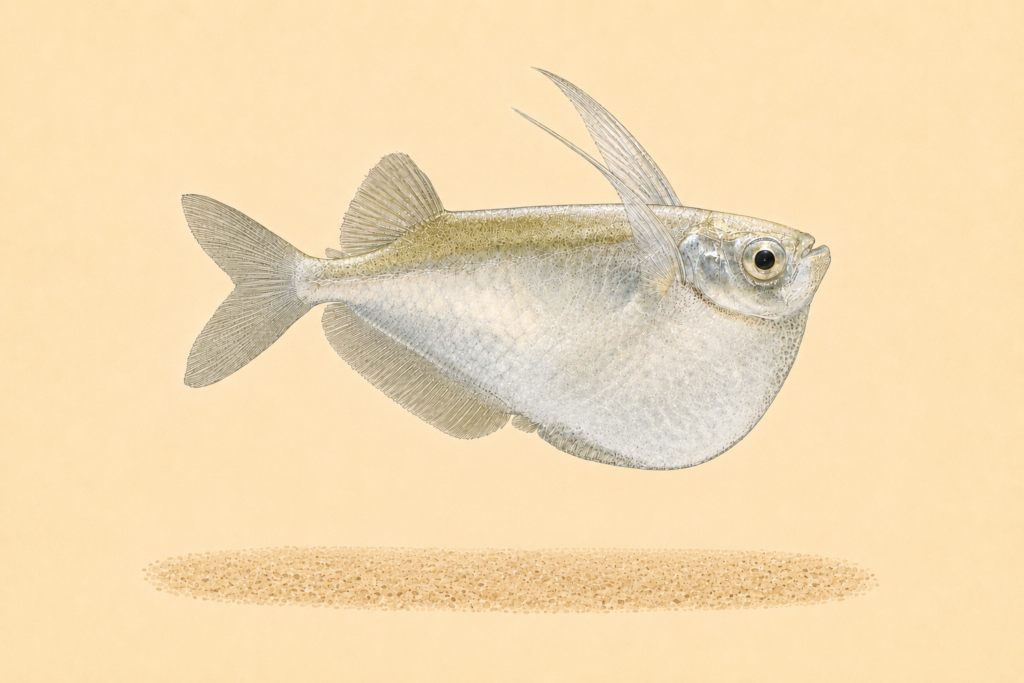
The most striking feature of Thoracocharax stellatus is its extraordinary body shape. The ventral profile is deeply convex, forming a pronounced keel that extends from the throat to the base of the anal fin. This keel houses the enlarged pectoral musculature that powers the species’ characteristic leaping and short gliding flights. From the side, the body outline genuinely resembles a hatchet blade – broad and deep at the front, tapering sharply towards the caudal peduncle.
The body is strongly laterally compressed, giving the fish a surprisingly narrow profile when viewed head-on. The scales are large, highly reflective, and uniformly silver across the flanks, often with a faint golden or pale blue iridescence under certain lighting conditions. The dorsal surface is darker, typically olive-grey to brownish, creating a natural countershading effect that helps break up the fish’s outline when viewed from above in the wild.
The pectoral fins are notably large and wing-like, set high on the body just behind the gill covers. These fins are usually transparent to pale grey and are held outward at rest, giving the fish an almost aerodynamic appearance. The dorsal fin is relatively small and set far back on the body, positioned almost directly above the anal fin. The caudal fin is forked and transparent, sometimes with a faint dark edging. The anal fin is moderately long and runs along the lower rear portion of the body.
The eyes are large and positioned high on the head – an adaptation for scanning the water surface and the air above for insects. The mouth is upturned (superior), another clear adaptation for surface feeding. There is little obvious sexual dimorphism in this species, though mature females tend to be slightly deeper-bodied when viewed from above, and gravid females may appear noticeably rounder through the keel area.
Silver Hatchetfish are sometimes confused with the smaller Common Hatchetfish (Gasteropelecus sternicla) or the Marbled Hatchetfish (Carnegiella strigata). Thoracocharax stellatus is the largest of the commonly available hatchetfish species and can be distinguished by its more uniformly silver colouration, larger adult size, and the dark spot or blotch that is sometimes visible at the base of the pectoral fin.
Natural Habitat
Silver Hatchetfish have one of the broadest natural ranges of any hatchetfish species, occurring across much of tropical South America. They are found throughout the Amazon basin in Brazil, Peru, and Colombia, in the Orinoco drainage of Venezuela and Colombia, and in the Paraguay-Parana river system extending into Paraguay and Argentina. This wide distribution encompasses a considerable range of habitat types, which partly explains why the species is somewhat more adaptable in captivity than some of its relatives.
In the wild, Thoracocharax stellatus inhabits slow-moving rivers, tributaries, backwaters, flooded forests, and oxbow lakes. They favour calm or gently flowing stretches with overhanging vegetation, where insects regularly fall onto the water surface. The water in many of their habitats is soft and acidic, often stained a tea-brown colour by tannins leaching from decaying leaf litter and submerged wood. However, populations in the Paraguay-Parana system may encounter somewhat harder and more neutral water, reflecting the geological diversity across their range.
These fish are almost exclusively surface dwellers in the wild, forming loose shoals that patrol the uppermost few centimetres of the water column. They position themselves beneath overhanging branches and vegetation, ready to intercept any insect that lands on the surface. When threatened by predatory fish from below, they use their powerful pectoral muscles to leap clear of the water and glide several metres through the air – a behaviour that has been well documented in field observations and represents a genuinely remarkable adaptation among freshwater fish.
The substrates in their native habitats vary from fine sand to thick layers of decomposing leaves. Submerged roots, fallen branches, and tangles of aquatic vegetation provide cover and help break up current flow. Floating plants and emergent vegetation at the margins create dappled light conditions at the surface, though Silver Hatchetfish tend to prefer open patches of surface rather than areas completely covered by floating plants, as they need clear water surface to feed effectively and to launch themselves into the air if necessary.
Tank Size and Setup
Because Silver Hatchetfish are dedicated surface dwellers, tank dimensions matter more than raw volume. A tank with a large surface area is far more important than a deep one. A standard rectangular aquarium of at least 100 litres is the minimum for a group of six, but a longer, shallower design – such as a 120 cm by 30 cm footprint – would be ideal. Tanks that are unusually tall and narrow should be avoided, as the fish will only use the top few centimetres regardless of depth.
A tightly fitted lid with no gaps is the single most important piece of equipment for this species. Silver Hatchetfish will jump through the smallest of openings – around filter inlet pipes, airline tubing holes, feeding hatches left ajar, or gaps between glass lids. Many experienced keepers recommend sealing any openings with foam, mesh, or cut pieces of acrylic. Rimless, open-top aquaria are wholly unsuitable for this species unless fitted with a secure mesh cover. It is not a question of whether they will jump, but when.
The aquascape should provide a balance between open surface swimming space and some visual security. Tall plants that reach the surface – such as Vallisneria, Amazon swords, or stem plants like Hygrophila – offer useful cover along the back and sides of the tank without obstructing the open surface area that hatchetfish need. A few pieces of driftwood or bogwood arranged vertically or at angles can mimic the fallen branches of their natural habitat and provide additional shelter.
Floating plants can be used sparingly to create patches of shade, which the fish will appreciate, but avoid covering the entire surface. Silver Hatchetfish need clear, open stretches of water surface to feed and to behave naturally. A good rule of thumb is to leave at least half to two-thirds of the surface area free of floating vegetation.
Substrate choice is not critical for a species that never ventures to the bottom, but a dark sand or fine gravel substrate will help show off the fish’s reflective silver colouration. Leaf litter – Indian almond leaves or dried oak leaves – can be scattered on the substrate to release tannins and create a more natural environment, though this is optional.
Lighting should be moderate. Very intense lighting directly at the surface can make the fish feel exposed and stressed. If using bright LED units, consider dimming slightly or using floating plants or tall stem plants to create areas of shade at the surface.
Water Parameters
Silver Hatchetfish are somewhat adaptable thanks to their broad natural range, but they do best in soft to moderately soft, slightly acidic to neutral water. They can tolerate a wider range than some other hatchetfish species, but extremes of hardness or alkalinity should be avoided. Stability is important – sudden swings in pH or temperature are more harmful than slightly suboptimal but consistent values.
| Temperature | 20-28 C |
| pH | 5.0-7.5 |
| General hardness (GH) | 1-12 dGH |
| Ammonia | 0 ppm |
| Nitrite | 0 ppm |
| Nitrate | Below 20 ppm |
Weekly water changes of 20-30% are recommended to keep nitrate levels low and maintain stable water chemistry. When performing water changes, ensure the replacement water is temperature-matched and treated with a suitable dechlorinator. If your tap water is particularly hard or alkaline, consider blending it with reverse osmosis (RO) water to bring values into the preferred range.
Adding tannins to the water through Indian almond leaves, alder cones, or peat filtration can help lower pH naturally and create the slightly tea-stained water that many populations encounter in the wild. This is beneficial but not essential if your water parameters are already within the acceptable range.
Filtration and Equipment
Filtration should be efficient but gentle. Silver Hatchetfish are surface dwellers and will be directly affected by any strong surface current created by filter outlets. Powerful hang-on-back filters, canister filter spray bars pointed at the surface, or wavemakers can create uncomfortable conditions for these fish, pushing them to the edges of the tank or causing stress.
A canister filter or internal filter with an adjustable flow rate is ideal. If using a canister filter, position the spray bar below the surface and angle it slightly downward, or fit a lily pipe or similar diffuser that disperses the flow gently. Sponge filters are another excellent option, particularly in smaller tanks – they provide good biological filtration with minimal surface disturbance and the added benefit of harbouring microorganisms that the fish may occasionally pick at.
An air pump with an airstone can aid oxygenation, but position it towards one end of the tank so that the fish have calm areas to rest at the surface. Silver Hatchetfish prefer still or very gently moving water at the surface, and excessive agitation will stress them.
A reliable heater with a thermostat is essential to maintain stable tropical temperatures. Position it where there is some water circulation to distribute heat evenly but, again, avoid creating strong currents at the surface. A thermometer placed near the surface can help you monitor conditions in the zone where these fish actually live.
Good oxygenation is important despite the preference for calm water. The surface film should be gently broken or turned over by mild water movement. If you notice a persistent oily biofilm on the surface, a surface skimmer attachment or slight increase in surface agitation will help keep the water clean for a species that lives right at the air-water interface.
Diet and Feeding
In the wild, Silver Hatchetfish are primarily insectivores, feeding on insects that fall onto the water surface – flies, ants, beetles, and other small invertebrates. They also take mosquito larvae and other small aquatic organisms found at or near the surface. Their upturned mouths are perfectly adapted for scooping food from the surface film, and they will rarely, if ever, pursue food that has sunk below the top few centimetres of the water column.
This surface-feeding behaviour has important implications for how you feed them in captivity. Sinking pellets, wafers, and foods that quickly descend through the water column are essentially useless for this species. You need to offer foods that float or remain at the surface long enough for the fish to eat them.
A good staple diet consists of high-quality floating flakes or micro-granules designed for small tropical fish. Crush flakes slightly if needed to create pieces appropriate for the fish’s small mouth. Supplement this regularly – ideally several times per week – with live or frozen insects and invertebrates. Fruit flies (Drosophila), both wingless and flightless varieties, are an outstanding food source and closely mimic their natural diet. Small crickets, mosquito larvae (live or frozen), bloodworms, daphnia, and brine shrimp are all accepted enthusiastically.
Freeze-dried foods such as tubifex or bloodworm can also be offered, as these tend to float for a reasonable period. However, live and frozen foods should form a significant part of the diet rather than being an occasional treat. A varied diet rich in insect-based protein will promote the best colouration, health, and longevity.
Feed small amounts two to three times daily rather than one large feeding. Silver Hatchetfish have relatively small stomachs and benefit from frequent, modest meals. Watch carefully during feeding to ensure all individuals in the shoal are eating – shy or subordinate fish can sometimes miss out if more assertive tank mates are dominating the surface.
Behaviour and Temperament
Silver Hatchetfish are peaceful, non-aggressive shoaling fish. They show no territorial behaviour and will not bother any other species in the aquarium. Their entire world is the top centimetre or two of the water column, and they largely ignore anything happening below them. This makes them exceptionally compatible with a wide range of community fish, provided those fish do not harass or intimidate the hatchetfish at the surface.
In a group, Silver Hatchetfish form a loose, rather informal shoal. They do not swim in the tight, synchronised formations seen in some tetra species. Instead, they tend to spread out across the available surface area, hovering just below the waterline with their pectoral fins extended, occasionally drifting forward or making short, rapid dashes to intercept a food item. They are most active during feeding and tend to be relatively still at other times, which is normal behaviour and not a sign of illness.
A group of at least six is essential, and eight to ten is preferable. Kept singly or in very small numbers, Silver Hatchetfish become visibly nervous and are far more likely to jump. A well-socialised group in a suitably set-up tank will be noticeably calmer and more confident, spending more time in the open rather than hiding at the edges.
Jumping is the behaviour that defines this species in captivity. They will jump when startled – by sudden movements outside the tank, by aggressive tank mates, by loud noises, or sometimes seemingly without obvious cause. New fish are particularly prone to jumping in the first few days after introduction, as they adjust to unfamiliar surroundings. During acclimatisation, keep the lights dim and minimise disturbance around the tank.
Silver Hatchetfish are generally diurnal, most active during the day and relatively quiescent at night. They appreciate a consistent light-dark cycle and will settle into a predictable routine fairly quickly once established in a stable environment.
Tank Mates
Silver Hatchetfish are among the most peaceful community fish available, and their exclusive occupation of the surface layer means they have minimal interaction with mid-water and bottom-dwelling species. The key considerations when choosing tank mates are to avoid anything large enough to eat them, anything aggressive or nippy enough to harass them, and anything that creates excessive surface turbulence or competes aggressively for surface food. Ideal companions are calm, similarly sized South American species that occupy different levels of the water column.
Good tank mates
- Cardinal Tetra – a peaceful mid-water shoaling species that shares similar soft-water preferences and will not compete at the surface.
- Rummy Nose Tetra – another gentle mid-water characin that thrives in the same water conditions and occupies a different zone in the tank.
- Ember Tetra – a tiny, non-competitive tetra that stays in the middle to lower areas of the tank and shares a preference for soft, acidic water.
- Corydoras sterbai – a bottom-dwelling catfish that complements hatchetfish perfectly by occupying the opposite end of the water column.
- Bronze Corydoras – another peaceful bottom dweller that helps clean up any food that sinks past the hatchetfish.
- Otocinclus – a small, gentle algae-eating catfish that poses no threat and stays on surfaces and lower levels.
- Kuhli Loach – a peaceful, nocturnal bottom dweller that will never interact with surface-dwelling hatchetfish.
- Apistogramma cacatuoides – a small dwarf cichlid that stays near the bottom and shares soft-water preferences without bothering surface fish.
- Marbled Hatchetfish – a related hatchetfish species that can coexist peacefully at the surface, though ensure enough surface area for both groups.
Fish to avoid
- Oscar – a large, predatory cichlid that would readily eat Silver Hatchetfish.
- Tiger Barb – a notorious fin nipper whose boisterous behaviour would stress and harass surface-dwelling hatchetfish.
- Red Tail Catfish – a massive predatory catfish wholly unsuitable for community tanks and capable of consuming hatchetfish easily.
- Convict Cichlid – an aggressive, territorial cichlid that would intimidate and potentially attack hatchetfish.
- Green Terror – a large and aggressive cichlid that would view hatchetfish as prey or harass them relentlessly.
- Betta – a surface-dwelling species that may display aggression at the surface and compete for the same zone, causing stress to both species.
- African Butterfly Fish – another dedicated surface predator that could prey on or aggressively compete with hatchetfish at the surface.
Breeding
Breeding Silver Hatchetfish in captivity is challenging and rarely achieved intentionally in home aquaria. The species is an egg scatterer, and most specimens available in the trade are wild-caught rather than captive-bred. However, spawning has been recorded under specific conditions, and dedicated breeders have had occasional success.
Sexing Silver Hatchetfish is difficult. Females are generally slightly fuller-bodied, particularly when gravid, but the differences are subtle. The most reliable method is to observe a group of mature fish from above – gravid females will appear noticeably wider through the keel than males.
To encourage spawning, set up a dedicated breeding tank of at least 60 litres with very soft, acidic water – a pH of 5.5-6.0 and a GH below 4 dGH. The temperature should be raised slightly to around 27-28 C. Dim lighting and the addition of tannin-rich botanicals such as Indian almond leaves can help replicate the blackwater conditions that may trigger breeding behaviour. Fine-leaved floating plants or spawning mops at the surface can provide a medium for egg deposition.
Condition potential breeders with a rich diet of live insects, particularly fruit flies, for several weeks before attempting to spawn them. Some breeders report that simulating the onset of the rainy season – through large, cool water changes using very soft water – can act as a spawning trigger.
When spawning occurs, eggs are typically scattered among fine-leaved plants or fall to the substrate. The eggs are small, semi-transparent, and adhesive. Parents show no parental care and will eat the eggs if given the opportunity, so adult fish should be removed from the breeding tank promptly after spawning is observed.
Eggs typically hatch within 24-36 hours at tropical temperatures. The fry are extremely small and will need infusoria or commercially available liquid fry food for the first week or so before graduating to newly hatched brine shrimp (Artemia nauplii). Growth is slow, and fry mortality can be high. Maintaining pristine water quality, stable temperatures, and a constant supply of appropriately sized food are all critical during the early weeks.
Given the difficulty involved, most hobbyists are content to enjoy Silver Hatchetfish as a display species without attempting to breed them. The species reproduces readily in the wild, and its IUCN status of Least Concern means that sustainable wild collection currently poses no conservation risk.
Common Diseases
Silver Hatchetfish are reasonably hardy once established but can be susceptible to a few conditions, particularly during and shortly after the stress of capture, transport, and acclimatisation to a new aquarium.
Ich (white spot disease) is one of the most common ailments seen in newly imported Silver Hatchetfish. The parasite Ichthyophthirius multifiliis manifests as small white spots on the body and fins, and affected fish may flash against surfaces or clamp their fins. Treatment involves raising the temperature to 28-30 C and using a commercially available ich medication, following the manufacturer’s dosage instructions carefully. Silver Hatchetfish can be sensitive to some medications, particularly those containing copper, so choose treatments labelled as safe for scaleless or sensitive fish as a precaution.
Bacterial infections can occur when fish are stressed, injured – often from jumping and hitting the lid – or kept in water with elevated ammonia or nitrite levels. Symptoms include reddened areas on the body, fin erosion, or ulceration. Improving water quality is the first step, followed by treatment with a broad-spectrum antibacterial medication if symptoms persist.
Internal parasites are occasionally a concern with wild-caught specimens. Fish that eat well but remain thin or show white, stringy faeces may be affected. Antiparasitic foods or medications containing praziquantel or levamisole can be effective.
Velvet disease (Piscinoodinium) is another ectoparasite that can affect hatchetfish, presenting as a fine, gold-dust-like coating on the skin. It is often harder to spot than ich but equally dangerous. Treatment involves dimming lights (the parasite is partly photosynthetic), raising temperature, and using a suitable anti-parasitic medication.
Prevention is always preferable to treatment. Quarantining new arrivals for two to four weeks before adding them to the main display tank is strongly recommended. Maintaining stable water parameters, avoiding overcrowding, providing a varied and nutritious diet, and minimising stress from aggressive tank mates or excessive disturbance will keep Silver Hatchetfish in the best possible health.
FAQs
How many Silver Hatchetfish should I keep together?
A minimum of six is recommended, but eight to ten or more is preferable. Silver Hatchetfish are shoaling fish that feel more secure in larger groups. Individuals kept alone or in pairs will be chronically stressed, more prone to jumping, and unlikely to display natural behaviour. In a sufficiently large tank, a group of twelve or more makes a truly impressive display at the surface.
Why do my Silver Hatchetfish keep jumping?
Jumping is a natural, instinctive behaviour for this species – it is their primary method of escaping predators in the wild. In captivity, they are most likely to jump when startled by sudden movements, loud noises, aggressive tank mates, or during the initial acclimatisation period. Poor water quality can also increase jumping. A tightly sealed lid with no gaps is essential at all times, and reducing external disturbances around the tank will help minimise the frequency of jumps.
Can Silver Hatchetfish be kept in an open-top aquarium?
No. Open-top or rimless aquaria without a secure cover are completely unsuitable for Silver Hatchetfish. These fish will find their way out of uncovered tanks with near certainty. If you strongly prefer an open-top aesthetic, consider fitting a clear mesh or perforated acrylic cover that sits flush with the rim. However, even with such measures, there is more risk than with a solid, well-fitted glass or plastic lid.
Will Silver Hatchetfish eat food that sinks below the surface?
Generally, no. Silver Hatchetfish feed almost exclusively at the water surface and will very rarely pursue food that has sunk even a few centimetres below. This means you need to provide floating foods – flakes, floating micro-granules, or live insects placed on the surface. Any uneaten food that sinks will need to be consumed by mid-water or bottom-dwelling tank mates, or removed during maintenance to prevent water quality issues.
What is the difference between Silver Hatchetfish and Common Hatchetfish?
The Silver Hatchetfish (Thoracocharax stellatus) is notably larger than the Common Hatchetfish (Gasteropelecus sternicla), reaching 6-8 cm compared to the Common Hatchetfish’s 3-4 cm. The Silver Hatchetfish also has a more uniformly silvery body without the dark lateral stripe that characterises the Common Hatchetfish. Both species share similar care requirements, though the Silver Hatchetfish needs a somewhat larger tank due to its greater size. The two species can be kept together in a sufficiently spacious aquarium.
Related Guides
- Marbled Hatchetfish – a smaller, patterned relative from the same family with similar surface-dwelling habits and care requirements.
- Common Hatchetfish – another popular Gasteropelecidae species often kept alongside or as an alternative to the Silver Hatchetfish.
- Cardinal Tetra – one of the best mid-water companions for Silver Hatchetfish, sharing a preference for soft, acidic water.
- Corydoras sterbai – an ideal bottom-dwelling tank mate that completes a South American community setup with hatchetfish at the top.
- Apistogramma cacatuoides – a popular dwarf cichlid for soft-water community tanks that pairs well with surface-dwelling hatchetfish.