Quick Summary
The Marbled Hatchetfish is a fascinating surface-dwelling characin that can genuinely glide through the air, but it demands stable water quality, a tight-fitting lid, and a mature aquarium – making it a rewarding choice for intermediate to experienced fishkeepers rather than an easy beginner species.
🐠 Build a tank around this species
In this guide:
- Introduction
- Quick Stats
- Appearance
- Natural Habitat
- Tank Size and Setup
- Water Parameters
- Diet and Feeding
- Tank Mates
Introduction
Few freshwater aquarium fish can claim the ability to fly, but the Marbled Hatchetfish (Carnegiella strigata) is one of the genuine exceptions. This diminutive characin, with its deeply keeled, hatchet-shaped body and oversized pectoral muscles, can launch itself from the water’s surface and achieve genuine powered flight for short distances by rapidly beating its pectoral fins – a remarkable adaptation evolved to escape predators in its native Amazonian waterways. In the home aquarium, this behaviour makes a secure, gap-free lid not merely advisable but absolutely essential.
First described in 1864, the Marbled Hatchetfish belongs to the family Gasteropelecidae, a small group of South American characins that have all, to varying degrees, evolved for aerial escape. Carnegiella strigata is arguably the most commonly kept member of this family in the aquarium hobby, prized for its intricate marbled patterning and its unusual habit of hovering just beneath the water’s surface. It occupies a niche that most other community fish ignore entirely, which makes it a superb complement to a well-planned biotope or community setup.
Despite its small adult size – typically around 3.5 centimetres – the Marbled Hatchetfish is not a fish to be underestimated in terms of its care requirements. It is sensitive to poor water quality, intolerant of sudden parameter swings, and can be shy and stressed if kept in insufficient numbers or in tanks with too much surface disturbance. This guide covers everything you need to know to keep these captivating little fish healthy and thriving.
Quick Stats
| Scientific name | Carnegiella strigata |
|---|---|
| Common names | Marble Hatchetfish |
| Family | Gasteropelecidae |
| Origin | Amazon and Orinoco basins, South America |
| Adult size | 3.5 cm |
| Difficulty | Intermediate |
| Breeding difficulty | Advanced |
| Temperature | 20–28 °C |
| pH | 4–7 |
| GH | 1–10 dGH |
| Minimum tank size | 70 L |
| Conservation status | Least Concern (IUCN) |
Appearance
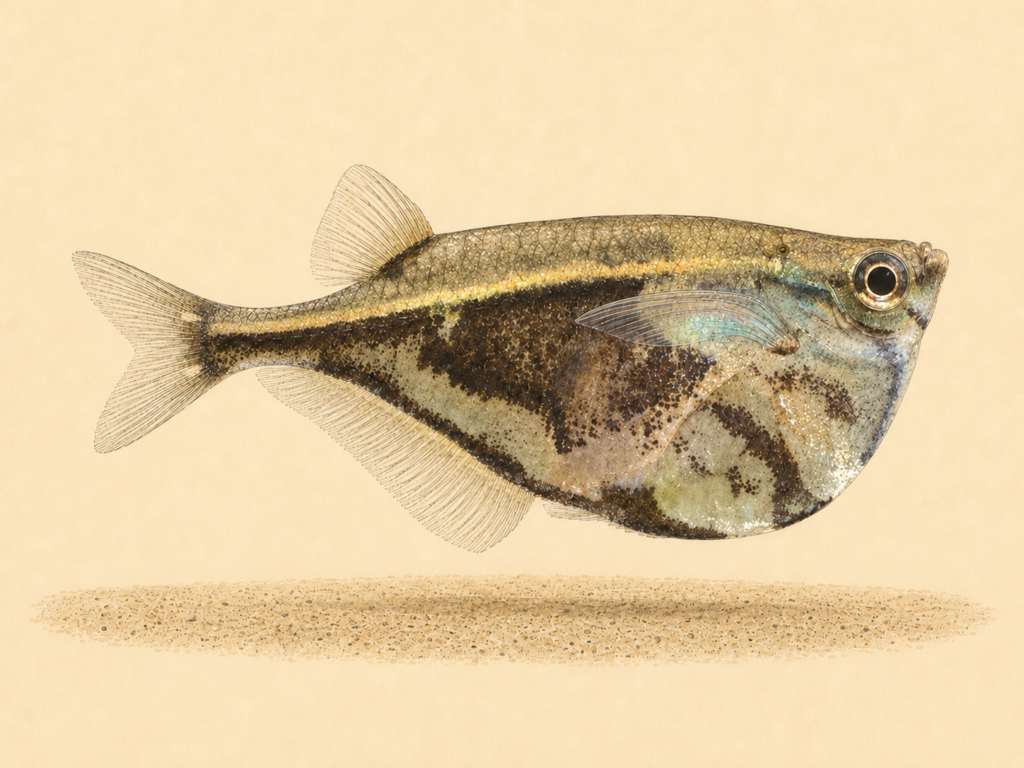
The Marbled Hatchetfish earns its common name from two key visual features: the deeply compressed, hatchet-shaped body that forms a pronounced ventral keel, and the intricate dark marbling that adorns its flanks. Viewed from the side, the body profile is unmistakable – the chest region is massively expanded downwards to accommodate the powerful pectoral muscles that power its aerial glides, giving it a shape reminiscent of a small axe head.
The base body colour is a pale silvery-gold, overlaid with irregular dark brown to black streaks and patches that run roughly diagonally from back to belly. These markings are highly variable between individuals, almost like a fingerprint, and they provide effective camouflage when the fish is viewed from below against a dappled, light-filtered water surface. A thin, dark lateral line runs along the midline of the body. The fins are largely transparent to very slightly tinted, and the pectoral fins are noticeably larger than those of most comparably sized fish – these are the ‘wings’ that enable its remarkable gliding ability.
Sexual dimorphism is subtle and often difficult to discern. Mature females tend to be slightly rounder in the belly when viewed from above, particularly when gravid. Males are generally a touch more slender. Beyond this, there are no reliable external differences in colouration or fin shape, which is one of the reasons breeding this species in captivity remains challenging.
Healthy Marbled Hatchetfish display crisp, well-defined marbling and a bright, silvery sheen. Faded or washed-out colouration, clamped fins, or an uncharacteristically sunken belly are early warning signs of stress or illness and should prompt an immediate check of water quality and tank conditions.
Natural Habitat
The Marbled Hatchetfish is native to the Amazon and Orinoco river basins, with its range spanning parts of Peru, Brazil, Colombia, Guyana, and Suriname. It inhabits slow-moving creeks, tributaries, flooded forest areas, and blackwater streams where the water is typically soft, acidic, and stained dark by tannins leached from decomposing leaf litter and fallen wood.
In the wild, these fish live almost exclusively at the water’s surface, sheltering beneath overhanging vegetation, floating plants, and fallen branches. The dense canopy of the tropical rainforest filters the light, creating a dim, dappled environment at the water’s surface. The water flow in their preferred habitats is gentle – they are not fish of rapids or strong currents. The substrate below is usually composed of sand, mud, and layers of decaying leaves, though the hatchetfish themselves have little direct interaction with the bottom of the water column.
This surface-dwelling lifestyle is central to every aspect of their biology. They feed on insects that land on or fall onto the water’s surface, and their upturned mouths are perfectly adapted for snatching prey from the film. When threatened by a predatory fish approaching from below, they can burst from the water, rapidly vibrating their pectoral fins to achieve a short powered glide – a behaviour that has been documented at distances of over a metre in the wild. This is not merely jumping; research has confirmed that the pectoral muscles produce genuine thrust during the aerial phase, making these fish among the very few that can be said to truly fly, however briefly.
Understanding this habitat is critical for replicating suitable conditions in captivity. Soft, acidic water, subdued lighting, floating plant cover, minimal surface agitation, and a secure lid are all direct translations of the Marbled Hatchetfish’s natural environment into aquarium design.
Tank Size and Setup
A minimum tank size of 60 litres is recommended for a group of six Marbled Hatchetfish. Because these fish occupy the surface almost exclusively, the footprint of the aquarium matters more than its height. A longer, shallower tank provides more surface area for the shoal to spread out comfortably, whereas a tall, narrow tank wastes vertical space that the hatchetfish will simply never use. An aquarium measuring at least 60 cm in length is a sensible starting point.
A tight-fitting lid with no gaps is absolutely essential. This cannot be overstated. Marbled Hatchetfish are powerful jumpers and gliders, and they will exploit even small openings around filter inlets, heater cables, or airline tubing. Every gap must be sealed or blocked. Many experienced keepers use condensation covers or custom-cut acrylic lids to ensure complete coverage. Rimless tanks without lids are entirely unsuitable for this species. Even a brief startle – a sudden light turning on, a loud noise, or a boisterous tank mate – can trigger a jump that ends fatally on the floor.
The tank should include a generous layer of floating plants. Species such as Amazon frogbit, water lettuce, or red root floaters are ideal choices. These plants serve multiple purposes: they diffuse overhead light, provide a sense of security, and create the shaded surface environment the fish instinctively seek out. Aim to cover roughly 50 to 70 per cent of the surface area, leaving some open sections for feeding and gas exchange.
Below the surface, the aquascape can be designed to suit whatever mid-level and bottom-dwelling species share the tank. Driftwood, leaf litter, and live plants such as Java fern, Anubias, or Cryptocoryne species all contribute to a natural Amazonian aesthetic and help to buffer the water with tannins, which the hatchetfish appreciate. The substrate type is not critical from the hatchetfish’s perspective, though a dark sand or fine gravel will show off their marbling to best effect and contribute to the subdued atmosphere they prefer.
Lighting should be moderate to low. If stronger lighting is required for planted tank growth, the floating plants will naturally filter it before it reaches the surface zone where the hatchetfish reside. Avoid bright, unshaded overhead lights that leave the water surface fully exposed – this will stress the fish and make them more prone to jumping.
Water Parameters
Maintaining stable, appropriate water chemistry is one of the most important aspects of Marbled Hatchetfish care. These fish originate from soft, acidic blackwater environments and are noticeably less tolerant of hard, alkaline water or fluctuating conditions than many commonly kept community species. A mature, well-cycled aquarium is a prerequisite – never introduce Marbled Hatchetfish to a newly set up tank.
| Temperature | 20 – 28 C |
| pH | 4.0 – 7.0 |
| General hardness (GH) | 1 – 10 dGH |
| Ammonia | 0 ppm |
| Nitrite | 0 ppm |
| Nitrate | Below 20 ppm |
Consistency is paramount. Sudden shifts in temperature or pH – even within the acceptable range – can cause severe stress, suppressed immunity, and disease outbreaks. When performing water changes, ensure the replacement water is matched closely in temperature and chemistry before adding it to the tank. Smaller, more frequent water changes (15 to 20 per cent once or twice a week) are preferable to large, infrequent ones that risk destabilising the environment.
The addition of Indian almond leaves, alder cones, or peat filtration can help to naturally lower the pH and release beneficial tannins, replicating the blackwater conditions of the fish’s native habitat. Many keepers find that their Marbled Hatchetfish display richer colouration and more confident behaviour in tannin-stained water. If your tap water is particularly hard or alkaline, you may need to use reverse osmosis (RO) water remineralised with an appropriate product to achieve suitable softness.
Filtration and Equipment
Filtration for a Marbled Hatchetfish tank should prioritise biological capacity and gentle flow. These fish inhabit calm surface waters in the wild and are visibly uncomfortable in tanks with strong currents, especially at the surface. A hang-on-back filter with an adjustable flow rate, a small internal filter, or a sponge filter are all suitable choices. If using a canister filter, direct the outflow below the surface or use a spray bar angled to minimise surface disruption.
Excessive surface agitation is doubly problematic for hatchetfish. Beyond the stress of battling currents, heavy agitation disrupts the calm water film where these fish feed and rest. They are naturally adapted to hover just beneath a still or gently moving surface, and a churning, rippling water surface will leave them unable to feed comfortably and prone to hiding.
A reliable, adjustable heater is important to maintain the warm, stable temperatures these tropical fish require. Position the heater where flow will distribute warmth evenly throughout the tank. A good quality thermometer – ideally a digital one with an external probe – allows for accurate monitoring and early detection of heater malfunctions.
Lighting, as discussed in the setup section, should be moderate. If using LED fixtures with adjustable intensity, dimming the output or programming a gradual sunrise and sunset ramp will reduce the likelihood of startling the fish when lights switch on or off. Timer-controlled lighting on a consistent photoperiod of 8 to 10 hours helps to establish a natural day-night rhythm.
An air pump is not strictly necessary and, if used, should be kept gentle. A fine airstone producing a soft stream of bubbles in one corner of the tank is acceptable, but vigorous aeration that creates significant surface movement should be avoided.
Diet and Feeding
In the wild, Marbled Hatchetfish are primarily insectivores, feeding on small insects, insect larvae, and invertebrates that land on or fall onto the water’s surface. Their upward-facing mouths are specifically evolved for this feeding strategy, and they are reluctant – sometimes entirely unwilling – to feed on food that sinks below the top centimetre or two of the water column.
All food offered must float or remain at the surface long enough for the fish to eat it. Sinking pellets and wafers are useless for this species. High-quality micro floating pellets or fine crushed flake food that stays on the surface film forms a reasonable staple diet. However, a varied diet that includes live or frozen foods is strongly recommended for optimal health and colouration.
Excellent supplementary foods include frozen or live fruit flies (Drosophila – both flightless and wingless varieties are widely available as feeder cultures), frozen bloodworms, frozen or live daphnia, and frozen or live brine shrimp. Fruit flies are a particularly natural and relished food item, closely replicating the insects the fish would catch at the surface in the wild. Mosquito larvae, where legally and safely obtainable, are another superb choice.
Feed small amounts two to three times daily rather than one large meal. Marbled Hatchetfish have small stomachs relative to their body size and benefit from frequent, modest portions. Observe the fish carefully during feeding to ensure all individuals in the group are eating. Newly imported specimens can be reluctant to accept prepared foods and may need to be enticed with live foods initially before gradually transitioning to a broader diet.
Remove any uneaten food promptly to prevent it from sinking and decomposing, which would compromise the water quality these sensitive fish depend upon.
Behaviour and Temperament
The Marbled Hatchetfish is a peaceful, shy, and strictly shoaling species. It should always be kept in groups of at least six, though eight or more is preferable. In smaller numbers, these fish become visibly stressed and skittish, spending their time hiding and refusing food. In a properly sized group, they are noticeably more confident, hovering together in a loose shoal just beneath the water’s surface and displaying their natural feeding and social behaviours.
Their activity pattern is fascinating to observe. For much of the day, hatchetfish hover almost motionless at the surface, their pectoral fins making subtle, rapid adjustments to maintain position. They are alert and watchful, with eyes oriented upwards and outwards – scanning for both food and danger. When food appears on the surface, they dart forward with surprising speed to snatch it. Their movements are precise and economical, quite unlike the constant cruising of many other small characins.
The jumping and gliding behaviour that makes them famous is, in an aquarium context, almost always a stress response. Healthy, unstressed hatchetfish in a well-set-up tank rarely jump. Frequent jumping attempts are a sign that something is wrong – usually insufficient cover, excessive light, aggressive tank mates, poor water quality, or too much surface current. If you notice repeated jumping, investigate the cause immediately rather than simply relying on the lid to keep them contained.
These fish are entirely non-aggressive towards other species. They have no interest in the mid-water or bottom zones of the aquarium and will not compete with, chase, or nip other fish. Their peaceful nature, combined with their exclusive occupation of the surface layer, makes them excellent community fish – provided their tank mates are equally gentle.
Tank Mates
Choosing tank mates for Marbled Hatchetfish requires careful consideration of temperament, size, and preferred water parameters. Ideal companions are peaceful, small to medium-sized species that occupy the mid-water or bottom levels of the aquarium, leaving the surface zone to the hatchetfish. Tank mates should also be comfortable in the soft, acidic, warm water conditions that hatchetfish require. Avoid any species that is boisterous, territorial at the surface, or large enough to view a 3.5 cm fish as a potential meal.
Good tank mates
- Cardinal Tetra – A classic Amazonian companion that shares identical water parameter preferences and occupies the mid-water zone.
- Rummy-nose Tetra – Another soft-water tetra that shoals in the middle of the tank and poses no threat to surface dwellers.
- Ember Tetra – A tiny, peaceful species that stays in the lower to mid-water levels and thrives in similar warm, soft conditions.
- Pygmy Corydoras – A diminutive bottom-dwelling catfish that complements hatchetfish perfectly by occupying a completely different zone.
- Sterbai Corydoras – A robust Corydoras species that tolerates the warmer temperatures hatchetfish prefer, staying firmly on the substrate.
- Otocinclus – A gentle algae-eating catfish that minds its own business on plant leaves and glass, well-suited to soft water.
- Chocolate Gourami – A calm, soft-water labyrinth fish that, while it visits the surface to breathe, is not aggressive or competitive.
- Beckford’s Pencilfish – A slender, placid characin that occupies the mid-water level and shares Amazonian water preferences.
Fish to avoid
- Tiger Barb – A notorious fin nipper with boisterous behaviour that will stress and harass surface-dwelling hatchetfish.
- Angelfish – Adults grow large enough to prey on Marbled Hatchetfish and can be territorial, creating dangerous surface encounters.
- Betta – Surface-dwelling and potentially territorial, a male betta may harass hatchetfish competing for the same water layer.
- African Cichlids – Require hard, alkaline water completely incompatible with hatchetfish needs, and most species are far too aggressive.
- Oscar – A large, predatory cichlid that would quickly eat Marbled Hatchetfish and requires entirely different water conditions.
- Chinese Algae Eater – Becomes increasingly aggressive and territorial with age, and may harass smaller tank mates.
- Red-tail Shark – A territorial bottom-dweller that can create enough commotion and stress to panic surface-dwelling species into jumping.
Breeding
Breeding Marbled Hatchetfish in captivity is considered difficult and is rarely achieved outside of dedicated breeding programmes. The combination of subtle sexual dimorphism, specific water chemistry requirements for spawning, and the challenges of raising tiny fry make this a project for experienced aquarists.
Sexing adult fish is the first challenge. As noted in the appearance section, females are typically slightly plumper when viewed from above, especially when carrying eggs, but this difference is modest and unreliable in non-gravid individuals. Keeping a larger group increases the likelihood of having both sexes present.
To encourage spawning, a separate breeding tank is advisable. This should be dimly lit, with very soft, acidic water – a pH of around 5.5 to 6.0 and a GH below 4 dGH. The temperature should be at the warmer end of the range, around 27 to 28 C. Fine-leaved floating plants or spawning mops placed at the surface provide sites for egg deposition. Some breeders report that simulating the onset of the rainy season – by performing a series of slightly cooler water changes with very soft water over several days – can trigger spawning behaviour.
When spawning occurs, the pair will typically scatter eggs among floating plant roots or fine-leaved plants near the surface. The eggs are small, semi-transparent, and adhesive. The adults should be removed after spawning, as they will readily consume the eggs if given the opportunity.
The eggs hatch in approximately 24 to 36 hours, and the fry are extremely small. They will initially survive on their yolk sacs before requiring infusoria or commercially available liquid fry food as a first food. As they grow, they can be transitioned to freshly hatched brine shrimp nauplii. The fry are delicate and sensitive to water quality fluctuations, requiring meticulous attention to cleanliness and parameter stability. Growth is slow, and it may take several months before the young fish begin to resemble miniature adults.
Common Diseases
Marbled Hatchetfish are not especially prone to unique diseases, but they are more susceptible than many hardy community species to common freshwater ailments, particularly when stressed or kept in suboptimal conditions. Prevention through excellent husbandry is always preferable to treatment.
Ichthyophthirius multifiliis, commonly known as white spot or ich, is perhaps the most frequently encountered disease. It presents as small white spots on the body and fins, accompanied by flashing (rubbing against objects) and laboured breathing. Newly imported hatchetfish are especially vulnerable, as the stress of capture, transport, and acclimatisation suppresses their immune systems. Treatment involves raising the temperature gradually to around 30 C (if tank mates tolerate it) combined with a suitable white spot medication. Note that hatchetfish can be sensitive to certain medications, particularly those containing copper or formalin, so always check the product’s suitability for scaleless or sensitive species and use half-dose protocols if in doubt.
Velvet disease (Oodinium) can also affect hatchetfish, producing a fine, gold-dusted appearance on the body, lethargy, and clamped fins. It is often more difficult to spot in its early stages than ich. Treatment typically involves dimming the lights (as the parasite is partly photosynthetic) and using an appropriate medication.
Bacterial infections, including fin rot and columnaris, may develop secondary to stress or injury. Maintaining pristine water quality and stable parameters is the best defence. If an infection does develop, prompt treatment with a broad-spectrum antibacterial medication is advisable.
Internal parasites can be an issue, particularly in wild-caught specimens. Signs include weight loss despite a normal appetite, white stringy faeces, and a hollow or pinched belly. Quarantining new arrivals for two to four weeks in a separate tank before adding them to the main display is strongly recommended. During quarantine, prophylactic treatment with an anti-parasitic medication can help to address any hitchhiking parasites before they spread to established fish.
Stress itself is arguably the single biggest health risk for this species. Inadequate group size, excessive surface agitation, bright unshaded lighting, aggressive tank mates, and unstable water quality all contribute to chronic stress, which suppresses the immune system and opens the door to opportunistic infections. Address the root causes of stress, and many health problems will resolve or, better yet, never arise in the first place.
FAQs
Can Marbled Hatchetfish really fly?
Yes, they genuinely can. Unlike most jumping fish that simply leap out of the water using tail thrust alone, Marbled Hatchetfish use their enlarged pectoral muscles to rapidly vibrate their pectoral fins during the aerial phase, generating lift and thrust. This makes them one of the very few fish species capable of true powered flight, albeit over very short distances of up to about a metre. In an aquarium, this behaviour is almost always a fright response, so a completely secure, gap-free lid is non-negotiable.
How many Marbled Hatchetfish should I keep together?
A minimum of six is the widely accepted baseline, but groups of eight to ten or more are preferable. As a shoaling species, they rely on the security of numbers to feel confident. In groups smaller than six, they become noticeably more nervous, are more likely to jump, and may refuse food. The larger the group, the more natural and relaxed their behaviour will be.
Why are my hatchetfish hiding and not eating?
This is almost always a sign of stress. Common causes include insufficient group size, too much light at the surface without floating plant cover, excessive water flow or surface agitation, aggressive or overly boisterous tank mates, and poor or unstable water quality. Newly added fish may also take several days to a week to settle in and begin feeding confidently. Offering live foods such as fruit flies or daphnia can sometimes tempt shy newcomers to start eating.
Do Marbled Hatchetfish need a heater?
Yes. They are tropical fish that require a stable temperature between 24 and 28 C. In most temperate climates, this means a reliable aquarium heater is essential. Temperature fluctuations stress these fish considerably, so a good quality, thermostatically controlled heater paired with an accurate thermometer is an important part of their setup.
Are Marbled Hatchetfish suitable for a planted tank?
Absolutely, and in fact a planted tank is one of the best environments for them. Live plants help to stabilise water chemistry, and floating plants in particular are highly beneficial for providing the shaded, sheltered surface conditions that hatchetfish prefer. Rooted plants below the surface contribute to biological filtration and create a natural, calming environment. Just ensure the lighting intensity is managed so that the surface zone remains subdued, using floating plants as a natural filter.
Related Guides
- Silver Hatchetfish – A larger relative in the family Gasteropelecidae with similar care requirements but a plainer silver colouration.
- Cardinal Tetra – One of the best mid-water companions for a Marbled Hatchetfish biotope aquarium.
- Pygmy Corydoras – An ideal bottom-dwelling tank mate that shares the same soft, acidic water preferences.
- Chocolate Gourami – Another soft-water specialist that pairs well with hatchetfish in a carefully maintained blackwater setup.
- Blackwater Aquarium Setup – A comprehensive guide to creating the tannin-rich, soft-water environment that Marbled Hatchetfish thrive in.