Quick summary
The Sixbar Distichodus is a stunning juvenile fish that grows into a 40-50 cm adult requiring a minimum 1,500 litre tank, making it unsuitable for standard home aquaria. Only consider this species if you have access to a very large, purpose-built tank or indoor pond and are prepared for a 15-20+ year commitment with no realistic rehoming options later on.
🐠 Build a tank around this species
Grows large. Read this before buying. The Sixbar Distichodus is usually sold as a small juvenile and is easy to keep at that size, but a healthy adult reaches around 75 cm. A juvenile will be happy in a standard tank for its first year or so. An adult needs something in the region of 1,500 litres, which in practice means a purpose built plywood and glass tank rather than anything off the shelf. Decide now whether you will build for the adult, or have a realistic rehoming plan, because public aquaria and specialist keepers are often full. It is a superb fish for the keeper who plans for it and a sad one for everyone else.
In this guide:
- Introduction
- Quick Stats
- Appearance
- Natural Habitat
- Tank Size and Setup
- Water Parameters
- Filtration and Equipment
- Diet and Feeding
- Behaviour and Temperament
- Tank Mates
- Breeding
- Common Diseases
- FAQs
Introduction
The Sixbar Distichodus (Distichodus sexfasciatus) is one of the most visually striking large characins found in the freshwater rivers and lakes of Central Africa. Juveniles are especially eye-catching, displaying a warm reddish-brown to reddish-yellow body boldly marked with six prominent dark vertical bands – a colour pattern that has made this species a tempting purchase for many aquarists browsing the large-fish section of their local shop. Unfortunately, the appeal of those vibrant young fish belies the enormous commitment this species demands.
This is a genuinely large fish. In the wild, Distichodus sexfasciatus can reach 76 cm (approximately 30 inches) in total length, and even in captivity specimens regularly exceed 40 cm. It is not suitable for standard home aquaria. Only fishkeepers with access to very large, purpose-built tanks or indoor ponds should consider keeping this species. The vast majority of hobbyists who purchase juveniles – often sold at just 5-8 cm – are unable to house them long-term, and rehoming a large, boisterous Distichodus is not straightforward. This care guide exists to provide an honest, thorough overview of the species’ needs so that prospective keepers can make a fully informed decision before committing.
Despite these caveats, for those with the space, budget, and dedication, the Sixbar Distichodus can be a magnificent centrepiece fish. It is hardy, long-lived, and full of personality. Kept in an appropriately sized setup with suitable companions, it rewards its keeper with years of robust, active behaviour that few other freshwater species can match.
Quick Stats
| Scientific name | Distichodus sexfasciatus |
|---|---|
| Common names | Sixbar Distichodus, Six-Banded Distichodus, Six-Barred Distichodus |
| Family | Distichodontidae |
| Origin | Congo River basin, Central Africa |
| Adult size | 75 cm |
| Difficulty | Advanced |
| Breeding difficulty | Advanced |
| Temperature | 22–26 °C |
| pH | 6–7.5 |
| GH | 10–20 dGH |
| Minimum tank size | 1500 L |
| Conservation status | Least Concern (IUCN) |
Appearance
The Sixbar Distichodus is a deep-bodied, laterally compressed characin with a high dorsal profile that gives it a robust, powerful silhouette. The body shape is somewhat reminiscent of a large, elongated disc, tapering towards a moderately forked caudal fin. The dorsal fin is tall and prominent, while the anal fin is relatively long-based. The mouth is subterminal and adapted for grazing on plant matter and algae, equipped with spatula-shaped, multi-cusped teeth – a characteristic of the Distichodontidae family.
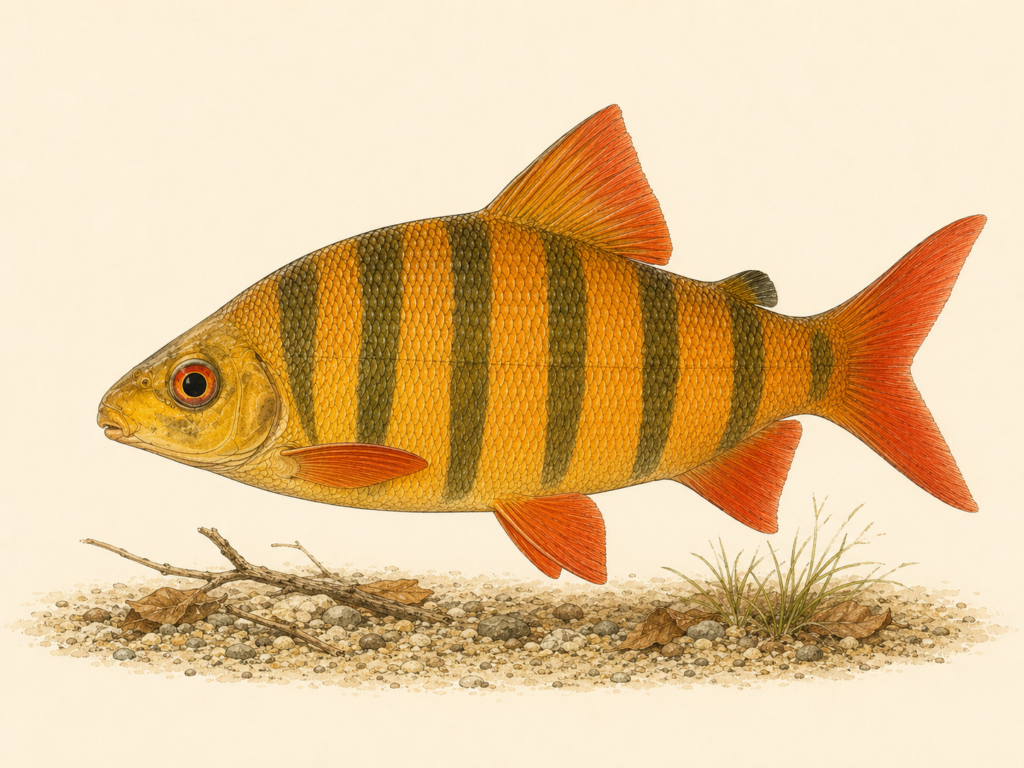
Juvenile and sub-adult specimens are the most attractive stage of this fish’s life. The base body colour ranges from a rich reddish-brown to a striking reddish-yellow or orange, overlaid with six bold, dark brown to black vertical bands that extend from the dorsal region down towards the belly. The fins are typically tinged with red or orange, particularly the caudal and anal fins, adding further to the fish’s visual impact at this stage. The overall effect is vivid and unmistakable – there are few freshwater fish of this size that display such clear, graphic markings.
However, prospective keepers should be aware that this striking colouration fades significantly as the fish matures and grows larger. Adult specimens progressively lose the intense reds and oranges, and the body colour shifts towards a duller greyish-brown or olive-grey. The six vertical bands may become less distinct, blending into the overall darker body tone, although they rarely disappear entirely. The fins also lose much of their red pigmentation. This is an entirely natural process and not a sign of poor health, but it does mean that the spectacular fish seen in the shop as a juvenile will look quite different as a 40-50 cm adult. Prospective keepers should be prepared for and accepting of this change.
There is no reliable external sexual dimorphism in this species. Males and females are essentially indistinguishable by appearance alone, though mature females may appear slightly deeper-bodied when carrying eggs.
Natural Habitat
Distichodus sexfasciatus is native to the vast Congo River basin, one of the largest and most biodiverse freshwater systems on Earth. Its range spans several countries in Central Africa, including the Democratic Republic of the Congo, the Republic of the Congo, Angola, Zambia, and parts of Tanzania where Congo basin tributaries reach. It has also been recorded from Lake Tanganyika, though it is primarily a riverine species.
In the wild, this species inhabits a variety of freshwater habitats including the main channels of large rivers, tributaries, floodplain lakes, and marshy areas. It tends to favour areas with moderate to strong current, though it is also found in calmer backwaters, particularly during seasonal flooding when it moves into inundated forest and grassland to feed. The substrates in its native range vary from sandy and muddy bottoms to rocky stretches, and the water is often slightly acidic to neutral, moderately soft, and warm year-round.
As a primarily herbivorous species, the Sixbar Distichodus plays an ecological role in its native habitat as a grazer of aquatic plants, algae, and fallen plant matter. It feeds extensively on submerged vegetation, fruits, seeds, and detritus, contributing to the cycling of nutrients within these tropical freshwater ecosystems. The species is found alongside a huge diversity of other large African fish, including various cichlids, catfishes, mormyrids, and other characins.
Understanding its natural habitat is essential for replicating appropriate conditions in captivity. The key takeaways are that this is a fish accustomed to large, open water volumes with good water flow, warm and relatively soft water, and abundant plant-based food sources.
Tank Size and Setup
A minimum tank volume of 1,500 litres is recommended for a single adult Sixbar Distichodus, and groups or communities of large fish will require substantially more – 2,000 litres and above. This is not a species where “minimum” should be interpreted loosely. These are powerful, active swimmers that can reach 40-50 cm in captivity, and they need a proportionally large amount of open swimming space. Tank dimensions are as important as volume; aim for a tank that is at least 250 cm long and 75 cm wide (front to back) as an absolute minimum for an adult specimen. Depth (height) is less critical than length and width, though adequate depth helps accommodate the fish’s high-backed body shape.
The aquascape for a Sixbar Distichodus should be relatively simple and robust. Live plants are not recommended, as this species will enthusiastically consume and destroy virtually all aquatic vegetation. Even tough, supposedly “fish-proof” plants like Anubias and Java Fern will eventually be damaged or eaten. If any greenery is desired for aesthetic purposes, artificial plants made of durable materials can be used, though even these may be dislodged by a large, active fish.
The substrate can be sand or smooth gravel. Sand is often preferred as it more closely mimics the natural environment and is less likely to cause injury if the fish roots around in it. Large, smooth rocks and pieces of driftwood can be used to create structure and visual barriers, which is particularly useful if keeping a group or community. Ensure all hardscape is extremely well-secured, as a large Distichodus is more than capable of dislodging heavy decor. Rocks should be placed directly on the glass base (before adding substrate) or siliconed into position to prevent collapse.
A tight-fitting, heavy lid or cover is essential. While not renowned as a jumping species in the way some other large characins are, the Sixbar Distichodus is powerful enough to launch itself from the water if startled, and the consequences of a 40 cm fish landing on the floor are not something any keeper wants to experience. The lid also helps reduce evaporation from such a large volume of warm water.
Lighting can be moderate. This species has no particular lighting requirements, and subdued lighting may help reduce stress and bring out what remains of the fish’s colouration. If the tank has no live plants, lighting is purely for the keeper’s viewing pleasure and can be adjusted accordingly.
Water Parameters
| Temperature | 22-26 °C |
| pH | 6.0-7.5 |
| General hardness (GH) | 10-20 dGH |
| Ammonia | 0 ppm |
| Nitrite | 0 ppm |
| Nitrate | Below 30 ppm |
The Sixbar Distichodus is a reasonably adaptable species when it comes to water chemistry, tolerating a fairly broad range of pH and hardness values. It does best in slightly acidic to neutral water, but it will thrive in moderately hard, slightly alkaline conditions as well. This adaptability is one of the species’ strengths from a husbandry perspective, as it means the fish can be kept successfully in many different tap water chemistries without the need for extensive modification.
Water temperature should be maintained within the 22-26 °C range. The lower end of this range is acceptable, but a stable temperature of around 24-25 °C is ideal for long-term health and activity. Consistency is more important than hitting a specific number – avoid rapid temperature fluctuations, which can stress the fish and compromise its immune system.
Water quality is paramount. As a large, messy eater that produces a significant amount of waste, the Sixbar Distichodus demands excellent filtration and regular, substantial water changes. Ammonia and nitrite must always read zero in a properly cycled system. Nitrate should be kept below 30 ppm, and ideally below 20 ppm. In a tank of the required size, maintaining these parameters requires a serious commitment to water change routines – expect to change 30-50% of the water volume weekly, which in a 1,500-litre system means moving several hundred litres of water each week. Automated water change systems or dedicated plumbing to a drain can make this task considerably more manageable.
Filtration and Equipment
Filtration for a tank housing Distichodus sexfasciatus must be powerful, reliable, and capable of handling a substantial biological load. A single adult fish of this size produces a significant amount of waste, and any tank mates will add to this burden. The filtration system should ideally turn over the total tank volume at least four to six times per hour.
For tanks of 1,500 litres and above, most hobbyists will turn to large external canister filters, sump systems, or a combination of both. A sump is often the most practical solution for tanks of this size, as it provides a large additional water volume (improving overall stability), ample space for biological media, and easy access for maintenance. Sumps can also house heaters and other equipment, keeping the main display tank uncluttered and reducing the risk of the fish damaging equipment.
If using canister filters, multiple large units will typically be needed to provide adequate flow and biological filtration capacity. Brands that produce filters rated for 1,000+ litres are worth investigating, and running two or more in parallel provides redundancy – if one unit fails, the other continues to process waste while the problem is resolved.
Mechanical filtration (foam pads, filter floss) should be cleaned or replaced regularly, as the large volume of plant matter and waste this species produces can clog pre-filters quickly. Biological media (ceramic rings, sintered glass, plastic bio-balls) should be given ample space within the filtration system and disturbed as little as possible during maintenance to preserve beneficial bacterial colonies.
Water movement and surface agitation should be moderate to strong. The Sixbar Distichodus comes from riverine environments and appreciates a degree of current, though it does not require the extreme flow of a river-tank setup. Additional powerheads or wavemakers can supplement the filter return to create a gentle directional flow across the tank length.
Heating a tank of this size requires one or more high-wattage aquarium heaters. Titanium heaters with external controllers are recommended for their durability and the reduced risk of the fish breaking a glass heater. Alternatively, inline heaters fitted to the filter return plumbing keep heating elements entirely out of the display tank. For very large systems, purpose-built aquarium heating units or even heat exchangers may be more practical and cost-effective than multiple consumer-grade heaters.
An air pump and air stone are not strictly necessary if surface agitation from the filter is adequate, but additional aeration is never harmful in a heavily stocked large-fish system. Dissolved oxygen levels should be kept high, particularly during warmer months or if the ambient room temperature rises.
Diet and Feeding
In the wild, Distichodus sexfasciatus is primarily herbivorous, feeding on aquatic plants, algae, fruits, seeds, and detritus. In captivity, this dietary preference should be respected, and the bulk of the diet should consist of plant-based foods. A well-fed Sixbar Distichodus on a predominantly vegetable diet will be healthier, more colourful (insofar as its maturity allows), and less prone to digestive issues than one fed a protein-heavy diet.
Suitable staple foods include high-quality spirulina-based pellets or wafers, blanched vegetables (courgette/zucchini, cucumber, peas, spinach, lettuce, kale), and algae wafers designed for large herbivorous fish. Pellets should be of an appropriate size for the fish’s mouth – as the fish grows, it will need correspondingly larger pellets or a greater quantity of smaller ones. Sinking pellets are generally preferred, as this species tends to feed in the mid-water to lower portions of the tank.
Variety is important to ensure balanced nutrition. Supplement the staple diet with occasional offerings of fruits (melon, grapes cut in half, banana), blanched sweet potato, nori (seaweed sheets), and duckweed or other floating plants offered as a live food source. These supplementary items provide different vitamins and minerals and keep the fish interested in feeding.
While the Sixbar Distichodus is primarily herbivorous, it is not exclusively so. In the wild, it will opportunistically consume small invertebrates, insect larvae, and worms. In captivity, occasional protein-rich treats such as earthworms, prawns, mussels, or bloodworm can be offered, but these should make up no more than 10-15% of the overall diet. Overfeeding protein-rich foods can lead to digestive problems and excessive waste production.
Feed adult fish once or twice daily, offering only as much food as they can consume within a few minutes. Uneaten food, particularly fresh vegetables, should be removed promptly to prevent it from decomposing and fouling the water. Juveniles and sub-adults can be fed more frequently – two to three times daily – to support their rapid growth.
Be aware that this species’ voracious appetite for plant matter is the primary reason live plants cannot be kept in the same tank. Any aquatic plants introduced, whether as food or decoration, will be consumed rapidly and thoroughly.
Behaviour and Temperament
The Sixbar Distichodus is an active, robust, and sometimes boisterous fish. It is not typically aggressive in the predatory sense – it will not hunt or consume fish of a reasonable size – but it can be assertive, territorial, and physically imposing. Its size and strength alone mean that it can inadvertently bully or stress smaller or more timid tank mates simply through its presence and activity level.
When kept singly, a Sixbar Distichodus can become somewhat territorial over the entire tank, chasing or harassing other fish that enter its perceived space. This behaviour tends to be more pronounced in tanks that are too small, where the fish feels cramped and all other inhabitants are constantly within its territory. In adequately sized tanks, a single specimen is usually manageable, though it will still be the dominant presence.
Keeping a group of Distichodus sexfasciatus can help diffuse aggression, as hierarchical dynamics within the group spread the attention more evenly. However, this approach requires a significantly larger tank – housing three to five of these fish demands a system of 3,000 litres or more. Within a group, there will be a clear pecking order, and some chasing and fin-nipping between conspecifics is normal. Serious injury is uncommon in a sufficiently spacious environment, but in cramped conditions, subordinate individuals may be relentlessly bullied.
This species is diurnal and spends most of the daylight hours actively swimming, foraging, and exploring its environment. It is a strong swimmer and will make use of the full length of the tank. At night, it tends to rest near the bottom or among any available shelter, becoming considerably less active.
The Sixbar Distichodus can become somewhat tame over time and may learn to recognise its keeper, approaching the front glass at feeding time. This interactive behaviour is one of the species’ most endearing qualities and contributes to the “pet-like” bond that keepers of large fish often develop with their charges.
One behavioural trait worth noting is that this species can be a fin-nipper, particularly towards slow-moving or long-finned tank mates. This is not universal – some individuals are more inclined to nip than others – but it is common enough that potential tank mates should be chosen with this tendency in mind.
Tank Mates
Selecting appropriate tank mates for the Sixbar Distichodus requires careful consideration of several factors: the sheer size of the fish, its semi-aggressive and occasionally nippy temperament, its herbivorous diet (which means any plants in the tank will be destroyed), and the very large tank volumes involved. Suitable companions are generally other large, robust species that can hold their own without being aggressive enough to cause serious conflict. Small or delicate fish will be stressed, outcompeted for food, or potentially injured, even if the Distichodus does not actively prey on them. Very aggressive or territorial species can also be problematic, as the Distichodus, while robust, is not built for combat in the way some large cichlids are.
Good tank mates
- Bichirs (Polypterus species) – Large, armoured, bottom-dwelling fish that occupy a different niche and are generally ignored by Distichodus.
- African Knifefish (Xenomystus nigri) – A robust, nocturnal species that avoids direct competition by being active at different times.
- Synodontis eupterus – A large, hardy African catfish that coexists well with big characins in spacious tanks.
- Sailfin Pleco (Pterygoplichthys gibbiceps) – A large, heavily armoured pleco that is tough enough to share space with boisterous tank mates.
- Tinfoil Barb (Barbonymus schwananfeldii) – A large, fast-swimming shoaling fish that can match the Distichodus for activity and robustness.
- Silver Dollar (Metynnis species) – Another large herbivorous characin that shares similar dietary and environmental needs, though a sizable group is required.
- Clown Loach (Chromobotia macracanthus) – A large, sociable loach species that, when kept in a group, is active and robust enough to cohabit successfully.
- Flagtail Prochilodus (Semaprochilodus insignis) – A large, active South American characin with a similar temperament and dietary profile.
Fish to avoid
- Neon Tetra (Paracheirodon innesi) – Far too small; would be stressed, outcompeted for food, and potentially harmed.
- Angelfish (Pterophyllum scalare) – Slow-moving with long trailing fins, making them prime targets for fin-nipping.
- Discus (Symphysodon species) – Too sensitive, slow, and delicate to cope with the boisterous behaviour of a large Distichodus.
- Guppy (Poecilia reticulata) – Tiny and long-finned; entirely unsuitable for a tank with large, active fish.
- Oscar (Astronotus ocellatus) – While large enough, Oscars are highly territorial and aggressive, leading to potential conflict.
- Flowerhorn Cichlid – Extremely aggressive and territorial; likely to attack and injure the Distichodus.
- Red-Tail Catfish (Phractocephalus hemioliopterus) – A massive predatory catfish that will eventually attempt to consume any tank mate that fits in its mouth.
Breeding
Breeding Distichodus sexfasciatus in captivity is exceptionally rare and has not been reliably documented in home aquaria. The vast majority of specimens available in the trade are wild-caught, and the species is not commercially bred in captivity to any significant degree. This is due to a combination of factors that make captive reproduction extremely challenging.
Firstly, the sheer size of the adult fish means that a breeding pair or group would require an enormous tank or pond – far larger than even the minimum recommended for general keeping. Secondly, there is no reliable method for sexing this species externally, making it difficult to ensure that a group contains both males and females. Thirdly, the natural breeding triggers – which likely involve seasonal flooding, changes in water chemistry, and migratory behaviour in the wild – are extremely difficult to replicate in captivity.
In their natural habitat, Distichodus species are believed to be egg scatterers that breed during the rainy season when rivers flood and spread into surrounding forests and grasslands. The increase in water volume, the drop in water hardness from rainwater, and the availability of abundant food in newly flooded areas likely all play a role in triggering spawning. Eggs are scattered over submerged vegetation and substrates in the floodplain, and there is no parental care.
Any serious attempt at captive breeding would likely require a very large, dedicated facility with the ability to simulate seasonal changes in water temperature, hardness, pH, and water level. It would also require a group of mature adults (which take several years to reach sexual maturity) and considerable patience and resources. For the foreseeable future, this remains a species best appreciated for its presence in the aquarium rather than bred in captivity.
Common Diseases
The Sixbar Distichodus is a hardy species that, when kept in appropriate conditions, is not particularly susceptible to disease. However, like all freshwater fish, it can be affected by common aquarium ailments, particularly when water quality is allowed to deteriorate or when the fish is stressed by inadequate tank size, poor diet, or incompatible tank mates.
White spot disease (Ichthyophthirius multifiliis, commonly known as ich) is perhaps the most frequently encountered illness. It presents as small white spots covering the body and fins, and the fish may flash (rub against surfaces) in an attempt to relieve irritation. Treatment involves raising the water temperature slightly (to around 28-30 °C if the species and tank mates tolerate it) and administering a suitable ich medication. In a large tank, accurate dosing is critical – calculate the treatment volume carefully, accounting for the actual water volume after subtracting the space occupied by decor and substrate.
Bacterial infections can occur, often secondary to physical injury (from collisions with tank decor or aggression from tank mates) or as a result of poor water quality. Symptoms include reddened areas on the body, frayed or eroded fins, ulcers, or a general loss of appetite and lethargy. Treatment typically involves improving water quality (which may resolve mild infections on its own), combined with antibacterial medications if necessary.
Hole-in-the-head disease (Hexamita or head and lateral line erosion, HLLE) has been reported in large characins kept in suboptimal conditions. It manifests as pitting and erosion around the head and lateral line. The exact cause is debated but is associated with poor water quality, nutritional deficiencies (particularly a lack of dietary variety and vitamins), and the presence of the Hexamita parasite. Prevention through excellent husbandry and a varied diet is far more effective than treatment.
Internal parasites are a particular concern with wild-caught specimens, which make up the majority of fish available in the trade. Newly acquired Distichodus should ideally be quarantined for several weeks and observed for signs of parasitic infection such as weight loss despite eating, white or stringy faeces, or bloating. Prophylactic treatment with a broad-spectrum anti-parasitic medication during quarantine is advisable, guided by veterinary advice where possible.
Maintaining excellent water quality, providing a varied and nutritionally complete diet, and ensuring the fish has adequate space are the most effective measures for preventing disease in this species. Regular observation is also key – because of the fish’s large size, changes in behaviour, appetite, or appearance are usually quite noticeable and can be acted upon promptly.
FAQs
How big does the Sixbar Distichodus actually get in an aquarium?
While the species can reach up to 76 cm in the wild, captive specimens typically grow to between 40 and 50 cm, occasionally larger in very spacious setups. Even at the lower end of this range, this is a substantial fish that requires a very large tank. Growth rate is relatively fast during the first few years, so keepers should have an appropriately sized tank ready well in advance rather than planning to “upgrade later.”
Can I keep live plants with a Sixbar Distichodus?
No. This species is an enthusiastic herbivore that will consume or destroy virtually all live aquatic plants, including species often considered tough or unpalatable to fish, such as Anubias and Java Fern. If greenery is desired for aesthetic purposes, high-quality artificial plants are the only practical option, though even these may be dislodged by the fish’s activity.
Is the Sixbar Distichodus aggressive?
It is best described as semi-aggressive or assertive rather than outright aggressive. It is not a predator and will not typically hunt other fish, but it can be territorial, boisterous, and prone to fin-nipping. Its sheer size also means it can inadvertently bully smaller or more timid species. Choosing large, robust tank mates and providing ample space are the best strategies for minimising conflict.
Why has my Sixbar Distichodus lost its colour?
If the fish is a maturing sub-adult or adult, the most likely explanation is the natural colour change that occurs as this species grows. The vivid reddish-brown body and bold dark bands of juvenile fish gradually fade towards a greyer, less contrasting appearance in adulthood. This is entirely normal and not a sign of illness. However, if the colour change is sudden or accompanied by other symptoms such as lethargy, loss of appetite, or visible lesions, water quality and health should be investigated.
Can I keep a Sixbar Distichodus in a 500-litre tank?
No. A 500-litre tank is far too small for this species, even as a temporary or “grow-out” arrangement. A juvenile may appear comfortable in such a tank for a short time, but the fish will grow rapidly and will soon be severely cramped, leading to stress, poor health, and behavioural problems. The minimum recommended tank size for a single adult is 1,500 litres, and larger is always better. If you cannot provide a tank of this size, this species is not a suitable choice.
Related Guides
- Distichodus lusosso (Long-Nosed Distichodus) – A closely related large Distichodus species with similar care requirements and temperament.
- Bichir Care Guide (Polypterus species) – A popular tank mate choice for large African community tanks that includes species commonly kept alongside Distichodus.
- Synodontis eupterus Care Guide – A hardy African catfish often housed with large characins in spacious setups.
- Tinfoil Barb Care Guide – Another large, active fish suited to very big tanks, with useful overlap in husbandry practices.
- Silver Dollar Care Guide (Metynnis species) – A herbivorous characin that shares dietary requirements and is sometimes kept alongside Distichodus in large systems.