Quick summary
Discus are stunning but demanding cichlids best suited to advanced aquarists who can maintain warm, soft, pristine water with frequent water changes, ideally in a group of six or more in a tank of at least 250 litres. If you’re new to the hobby or not ready for meticulous water quality management, this is not a good first fish.
🐠 Build a tank around this species
In this guide:
- Introduction
- Quick Stats
- Appearance
- Varieties and Morphs
- Natural Habitat
- Tank Size and Setup
- Water Parameters
- Filtration and Equipment
- Diet and Feeding
- Behaviour and Temperament
- Tank Mates
- Breeding
- Common Diseases
- FAQs
Introduction
The Discus is widely regarded as the king of the freshwater aquarium, and it is not difficult to see why. With its striking disc-shaped body, regal bearing, and extraordinary palette of colours, Symphysodon aequifasciatus has captivated aquarists for decades. Native to the slow-moving tributaries and floodplain lakes of the Amazon Basin, this cichlid demands a level of care and dedication that places it firmly in the advanced category of fishkeeping. Yet for those willing to invest the time and effort, keeping a healthy shoal of Discus is one of the most rewarding experiences the hobby has to offer.
First described by Pellegrin in 1904, the taxonomy of Discus fish has been a matter of ongoing debate among ichthyologists. The genus Symphysodon currently comprises at least two widely accepted species, S. aequifasciatus (the green or brown Discus) and S. discus (the Heckel Discus), with S. tarzoo sometimes treated as a distinct species. The vast majority of Discus available in the aquarium trade today are captive-bred colour morphs derived primarily from S. aequifasciatus, though many represent hybridised lineages. Regardless of their precise taxonomic heritage, all Discus share the same fundamental care requirements: warm, clean, soft water, a high-quality diet, and a calm, well-maintained environment.
This guide covers everything you need to know to keep Discus successfully, from tank setup and water parameters to diet, breeding, and disease prevention. Whether you are considering your first Discus tank or looking to refine your existing husbandry, the information below will help you provide the best possible care for these magnificent fish.
Quick Stats
| Scientific name | Symphysodon spp. (trade hybrids, primarily derived from S. aequifasciatus) |
|---|---|
| Common names | Green Discus, Brown Discus, Blue Discus, King of the Aquarium |
| Family | Cichlidae |
| Origin | Amazon Basin, South America (Brazil, Peru, Colombia) |
| Adult size | 14 cm |
| Difficulty | Advanced |
| Breeding difficulty | Advanced |
| Temperature | 28–30 °C |
| pH | 6–7.6 |
| GH | 1–8 dGH |
| Minimum tank size | 250 L |
| Conservation status | Least Concern (IUCN, 2018) |
Appearance
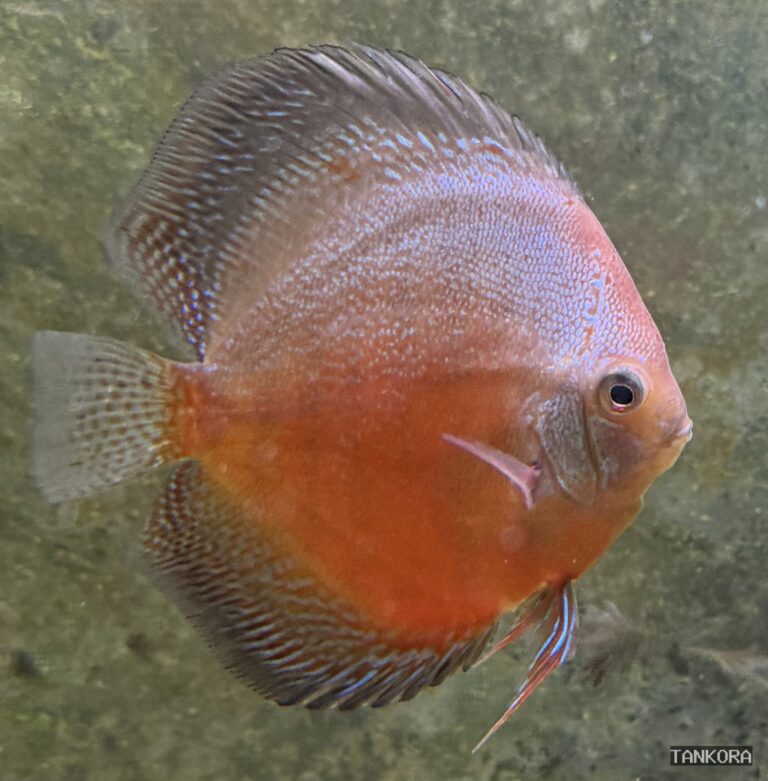
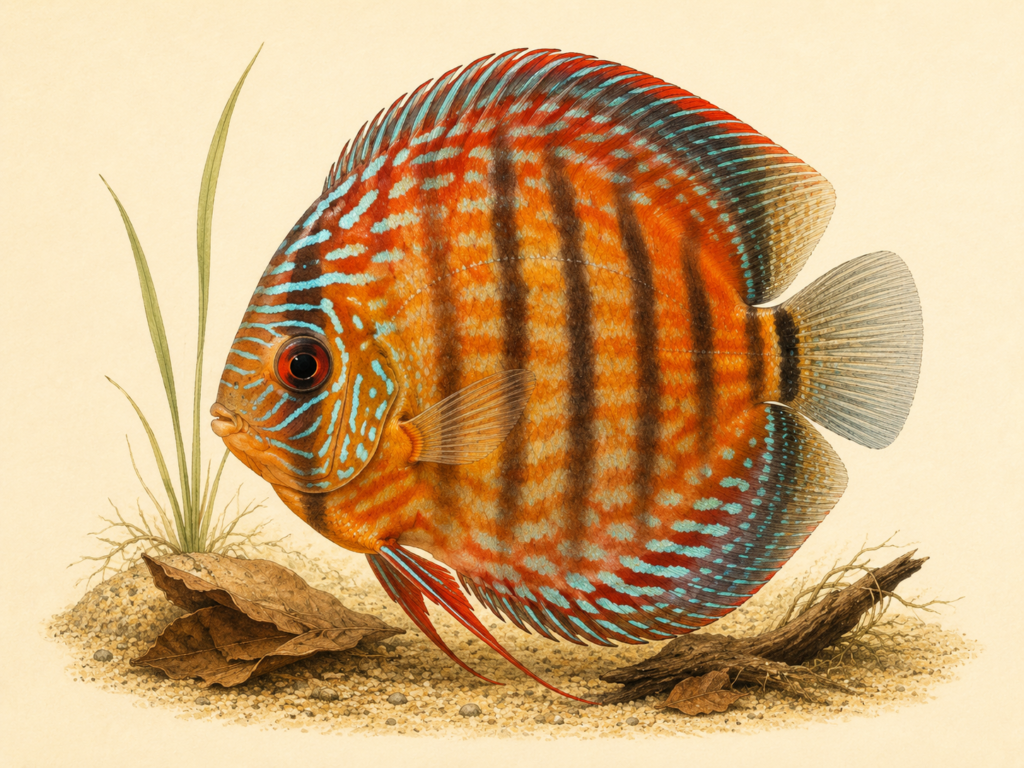
The most immediately striking feature of the Discus is its laterally compressed, almost perfectly circular body, the characteristic that gives the fish its common name. When viewed from the side, a healthy adult Discus presents a near-perfect disc, with smoothly rounded dorsal and anal fins that extend almost the full length of the body and blend seamlessly into its outline. The pelvic fins are elongated and trail elegantly beneath, while the caudal fin is relatively small and fan-shaped.
Wild S. aequifasciatus typically displays a base colouration ranging from olive-green to brown, overlaid with nine vertical dark bars that can intensify or fade depending on the fish’s mood, health, and social status. Iridescent blue or turquoise striations often adorn the face, gill covers, and flanks, lending a shimmering quality that is particularly pronounced in the blue and green wild variants. The eye is usually reddish-orange and remarkably expressive, adding to the fish’s alert, intelligent appearance.
Captive-bred Discus have been selectively bred for generations, resulting in an extraordinary range of colours and patterns that extend far beyond anything found in the wild. Adults typically reach up to 14 centimetres in diameter under ideal conditions. Sexual dimorphism is minimal and notoriously difficult to discern outside of breeding condition. Males may develop a slightly thicker forehead and more pointed genital papilla, but reliable sexing generally requires observing spawning behaviour.
Varieties and Morphs
Decades of selective breeding have produced a remarkable diversity of Discus colour morphs, many of which have become established varieties with strong followings among hobbyists. The Pigeon Blood Discus is perhaps the most commercially successful morph, characterised by a creamy yellow to orange base colour with red speckles and peppering across the body. This variety was developed in Asia during the 1990s and remains hugely popular, though it is worth noting that Pigeon Blood fish are more susceptible to black peppering, dark melanin spots that can increase with stress.
The Turquoise Discus is one of the older cultivated forms, featuring an intense turquoise blue body with red or orange striations. Closely related is the Cobalt Blue Discus, which displays a deep, solid blue colouration across the entire body with minimal patterning, creating a particularly clean and striking appearance. The Red Melon Discus is another widely admired variety, offering a vivid orange-red body colour that is remarkably uniform and eye-catching.
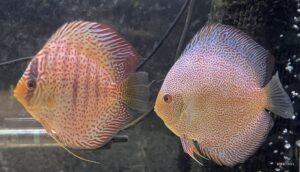
Snow White Discus represent one of the more extreme selective breeding achievements, featuring an entirely white body devoid of any patterning or striations. These fish lack the typical dark pigmentation and can be stunning centrepieces, though they may be slightly more delicate than more robustly pigmented varieties. The Leopard Discus, sometimes called the Snakeskin Discus, showcases a fine spotted or reticulated pattern across the body that creates a distinctly exotic appearance.
The Eruption Discus is a relatively modern variety, distinguished by vivid red spots against a blue or turquoise background, while the Golden Discus presents a warm, rich yellow to golden body colour. The Checkerboard Discus displays a regular grid-like pattern of red and blue markings that is quite unlike any other variety. Finally, the Red Map Discus features bold, irregular red markings over a blue base, creating a striking contrast that makes each individual essentially unique. Wild-caught and wild-type Discus, including the Green Discus and Brown Discus forms, continue to be valued by purists who appreciate the subtle, natural beauty and fascinating behavioural authenticity of unmanipulated fish.
Natural Habitat
In the wild, Discus inhabit the warm, slow-moving waters of the Amazon River basin, including tributaries, floodplain lakes, and flooded forest areas in Brazil, Peru, and Colombia. These environments are characterised by soft, acidic water with very low mineral content, stained a deep amber-brown by tannins leaching from decomposing leaf litter and submerged wood. Visibility is often limited, and the water chemistry typically features a pH of 4.5 to 6.5 with negligible hardness.
The typical Discus habitat features a substrate of fine sand or mud, littered with fallen branches, tree roots, and decaying leaves. Aquatic vegetation is often sparse in the deeply shaded blackwater environments these fish favour, though in some clearer-water habitats, stands of aquatic plants can be found. Water temperatures in Discus habitats are consistently warm, typically ranging from 28 to 32 °C, with relatively little seasonal variation compared to temperate freshwater environments.
Discus are generally found in groups among submerged roots and fallen trees, where the complex structure provides shelter from predators and breaks up water current. They feed on a varied diet of small invertebrates, insect larvae, algae, and organic detritus. Understanding these natural conditions is essential for replicating them in captivity, as Discus are notably less tolerant of suboptimal water conditions than many other commonly kept tropical fish.
Tank Size and Setup
Discus are large, social cichlids that require spacious aquaria. The absolute minimum tank size for a small group is 250 litres, but a tank of 350 to 500 litres or larger is strongly recommended, particularly if you intend to keep a group of six or more, which is the ideal minimum number. Discus are tall-bodied fish, so tank height is important, aim for an aquarium that is at least 45 centimetres tall, and ideally 50 centimetres or more. Standard rectangular tanks with dimensions of approximately 120 × 50 × 50 centimetres work very well for a group of six adult Discus.
When it comes to aquascaping, there are two broad philosophies. Some experienced Discus keepers favour bare-bottom tanks, which make cleaning easier and allow for more precise control of water quality. This approach is particularly popular among breeders and those raising juveniles, where rapid growth depends on frequent water changes and immaculate hygiene. The alternative is a planted or decorated tank, which is more aesthetically pleasing and can provide the fish with a more naturalistic environment. If you choose to use a substrate, fine sand is preferable, as it is easy to keep clean and mimics the natural riverbed.
Décor should include driftwood and tall plants to provide visual barriers and resting spots. Tall-growing species such as Amazon swords, Vallisneria, and Echinodorus are excellent choices, as they complement the Discus’s Amazonian origins and tolerate the warm water temperatures required. Avoid sharp or rough decorations that could injure the fish’s delicate flanks. Lighting should be moderate, Discus do not appreciate intense illumination and will show better colour and more confident behaviour under subdued lighting. Floating plants can help diffuse light and create the dappled conditions these fish experience in the wild.
It is important to ensure that the tank is placed in a calm area of the home, away from heavy foot traffic, loud noises, or vibrations. Discus are sensitive, somewhat skittish fish, particularly when newly introduced, and a peaceful environment goes a long way towards reducing stress and encouraging natural behaviour.
Water Parameters
Maintaining stable, pristine water quality is the single most important aspect of Discus care. These fish have evolved in some of the softest, warmest, and cleanest freshwater environments on Earth, and they are far less forgiving of poor water conditions than many other tropical species. The following parameters represent the ideal range for captive Discus.
| Temperature | 28–30 °C |
| pH | 6.0–7.6 |
| General hardness (GH) | 1–8 dGH |
| Ammonia | 0 ppm |
| Nitrite | 0 ppm |
| Nitrate | Below 20 ppm |
Temperature is a critical parameter for Discus. These fish require water at the upper end of the tropical range, and temperatures below 27 °C can lead to immune suppression, reduced appetite, and increased susceptibility to disease. Many experienced keepers maintain their Discus tanks at a steady 30 °C. Consistency is as important as the absolute value, temperature fluctuations of more than one or two degrees in a short period can cause significant stress.
Captive-bred Discus are generally more adaptable to moderate pH and hardness levels than their wild-caught counterparts, but they still perform best in soft, slightly acidic water. If your tap water is hard or alkaline, you may need to use reverse osmosis (RO) water, remineralised to the appropriate hardness, to achieve suitable conditions. Regular water changes are non-negotiable, most successful Discus keepers perform changes of 25 to 50 per cent at least twice per week, with some performing daily changes, particularly when raising juveniles. Always match the temperature and chemistry of replacement water carefully to avoid shocking the fish.
Filtration and Equipment
Given the Discus’s sensitivity to water quality, robust and efficient filtration is essential. A high-quality canister filter is the most popular choice among Discus keepers, as these units provide excellent mechanical, biological, and chemical filtration while allowing for flexible media configurations. The filter should ideally turn over the tank volume four to six times per hour. For a 350-litre tank, this means a filter rated for at least 1,400 litres per hour, though the actual flow rate delivered to the tank will be lower once head height and media resistance are accounted for.
Sponge filters can be used as supplementary filtration and are particularly valuable in breeding and grow-out tanks, where they provide gentle biological filtration without creating excessive current. Discus prefer calm water, so it is important to diffuse the filter outlet or position it to avoid creating a strong flow. Spray bars, lily pipes, or directing the outflow against the glass are all effective strategies for reducing current.
A reliable, high-quality heater is arguably the most critical piece of equipment in a Discus tank. Given the elevated temperatures required, an undersized or unreliable heater can be catastrophic. Use a heater rated appropriately for your tank volume and consider using two smaller heaters rather than one large unit, this provides redundancy if one fails and distributes heat more evenly. An external or inline heater connected to the canister filter outlet is an excellent option if you wish to keep equipment out of the display tank. A separate thermometer, ideally a digital model, should be used to monitor temperature independently of the heater’s built-in thermostat.
An air pump is not strictly necessary if surface agitation from the filter provides adequate gas exchange, but supplementary aeration can be beneficial, particularly at the higher end of the temperature range, where dissolved oxygen levels naturally decrease. UV sterilisers are used by some Discus keepers as an additional measure to control free-floating pathogens and algae, and can be a worthwhile investment, particularly in established community tanks.
Diet and Feeding
Discus are omnivores with a preference for protein-rich foods, and providing a varied, high-quality diet is essential for maintaining their health, colour, and vitality. In the wild, their diet consists primarily of small invertebrates, insect larvae, and algae scraped from submerged surfaces. In captivity, this should be replicated with a combination of high-quality prepared foods and fresh or frozen offerings.
A good-quality Discus-specific pellet or granule food should form the staple of the diet. These formulations are designed to meet the nutritional requirements of Discus and typically contain a balanced blend of proteins, fats, vitamins, and colour-enhancing ingredients. Supplement the staple diet with frozen foods such as bloodworm, brine shrimp, white mosquito larvae, and daphnia. These provide variety and are eagerly accepted by most Discus. Avoid feeding live tubifex worms from unreliable sources, as they can introduce parasites and pathogens.
Many dedicated Discus keepers prepare homemade food, often referred to as beefheart mix, which combines lean beefheart with shrimp, vegetables, vitamins, and a binding agent such as gelatin. While beefheart-based recipes are nutritious and highly palatable to Discus, they can foul the water quickly if overfed, so portions should be kept small and uneaten food removed promptly. Some keepers have moved away from beefheart in favour of fish-based and insect-based recipes, which are considered more natural and less polluting.
Feed adult Discus two to three times daily, offering only as much food as they will consume within a few minutes. Juvenile Discus, which are growing rapidly, benefit from more frequent feeding, four to six small meals per day is ideal for fish under six months of age. Overfeeding must be avoided, not because Discus are particularly prone to obesity, but because excess food rapidly degrades water quality. A varied diet, combined with excellent water conditions, will be reflected in vibrant colouration, strong growth, and active, confident behaviour.
Behaviour and Temperament
Discus are social, shoaling cichlids that thrive when kept in groups. A minimum group size of six is strongly recommended, as smaller numbers tend to result in excessive aggression directed at subordinate individuals. Within a group, Discus establish a clear social hierarchy, with dominant fish claiming preferred positions and feeding first. This hierarchical behaviour is normal and generally manageable in a sufficiently large group and tank, where aggression is distributed and no single individual bears the brunt of bullying.
Despite being cichlids, Discus are relatively peaceful and lack the overt territorial aggression seen in many of their relatives. They are, however, surprisingly sensitive and intelligent fish that recognise their keepers, learn feeding routines, and can become remarkably tame over time. A well-settled group of Discus will often approach the front of the tank when their owner enters the room, associating the presence with food and positive interaction.
Stress is the great enemy of Discus keeping. When stressed, Discus will darken in colour, display prominent stress bars (the vertical dark bars become very pronounced), clamp their fins, and refuse food. Common causes of stress include poor water quality, inadequate group size, aggressive tank mates, sudden changes in lighting or environment, and illness. A stressed Discus is an immunocompromised Discus, and chronic stress is the precursor to most disease problems. Creating a calm, stable environment and maintaining consistent routines are therefore central to successful Discus husbandry.
Discus tend to occupy the mid-water column, though they will explore all levels of the tank. They are not particularly fast swimmers and move through the water with a distinctive, deliberate grace that adds enormously to their appeal as display fish. During the day, they may rest among plants or near driftwood, becoming more active during feeding times. It is worth noting that newly introduced Discus can be extremely shy and may hide for several days before gaining confidence, patience during the acclimatisation period is essential.
Tank Mates
Choosing tank mates for Discus requires careful consideration of temperament, water parameter requirements, and feeding competition. The warm, soft, acidic water that Discus require immediately eliminates many commonly kept tropical fish from contention. Any potential tank mate must be peaceful, non-competitive at feeding time, and comfortable at temperatures of 28 to 31 °C. Discus are slow, methodical feeders, and boisterous or aggressive species will outcompete them for food and cause chronic stress. Many experienced keepers choose to maintain species-only Discus tanks, which simplifies management considerably, but a carefully planned community is certainly possible.
Good tank mates
- Cardinal Tetra, a classic Discus companion that shares the same Amazonian soft-water requirements and adds a beautiful contrast of colour.
- Rummy-nose Tetra, a peaceful, tight-schooling species that thrives in warm, soft water and complements Discus beautifully.
- Sterbai Corydoras, one of the few Corydoras species comfortable at the elevated temperatures Discus require, providing useful bottom-level activity.
- Bristlenose Pleco, a generally peaceful algae eater that tolerates warm water, though individuals should be monitored for any tendency to attach to Discus flanks.
- German Blue Ram, a small, peaceful cichlid that thrives in warm, soft water and occupies the lower portion of the tank without competing with Discus.
- Ember Tetra, a tiny, peaceful species that tolerates warm water well and adds subtle colour without causing any disturbance.
- Harlequin Rasbora, a calm, schooling fish that does well in soft, slightly acidic water at the lower end of the Discus temperature range.
- Clown Loach, suitable only in very large tanks, this peaceful bottom-dweller enjoys warm water but grows very large and requires ample space.
- Amano Shrimp, useful algae consumers that are generally too large to be eaten by adult Discus and tolerate warm conditions reasonably well.
Fish to avoid
- Tiger Barb, a notorious fin-nipper that will harass Discus relentlessly and cause severe stress.
- Angelfish, although often suggested, Angelfish can bully Discus, carry diseases transmissible between cichlids, and compete aggressively for food.
- Oscar, a large, aggressive predatory cichlid completely incompatible with Discus in terms of temperament and adult size.
- Chinese Algae Eater, becomes aggressive and territorial with age and has a well-documented tendency to attach to the flanks of flat-bodied fish like Discus.
- Common Pleco, grows far too large, produces excessive waste, and may rasp the mucus coat of Discus during the night.
- Buenos Aires Tetra, too boisterous and nippy for the calm environment Discus require, and prefers cooler water.
- Convict Cichlid, highly territorial and aggressive, particularly during breeding, and entirely unsuitable as a Discus companion.
- Zebra Danio, an extremely active fish that prefers cooler water and will outcompete Discus at feeding time while creating a frenetic atmosphere.
Breeding
Breeding Discus is one of the most fascinating and rewarding challenges in the freshwater aquarium hobby. While not impossible for dedicated hobbyists, it requires patience, excellent water quality, and a good understanding of the species’ unique reproductive biology. Discus are biparental substrate spawners with one of the most remarkable forms of parental care in the fish world, the fry feed on a mucus secretion produced by the parents’ skin during their first days of life.
The first step in breeding Discus is obtaining a compatible pair. The most reliable method is to raise a group of six or more juveniles together and allow pairs to form naturally. Attempting to force-pair two random adults is often unsuccessful, as Discus are selective in their choice of mate. Once a pair has bonded, they will typically separate from the group, begin cleaning a vertical spawning surface (such as a broad leaf, a piece of slate, or the side of a clay cone), and become noticeably more territorial.
To encourage spawning, maintain water temperature at approximately 30 to 31 °C, with a pH of 5.5 to 6.5 and very low hardness. Frequent water changes with slightly cooler, soft water can help trigger spawning behaviour. The female deposits rows of eggs on the chosen surface, and the male follows behind to fertilise them. A typical clutch contains 100 to 400 eggs, depending on the size and experience of the pair.
Both parents fan the eggs continuously to ensure adequate oxygenation, and infertile or fungused eggs are removed. The eggs hatch after approximately 48 to 60 hours, and the wriggling fry remain attached to the spawning surface for a further two to three days while they absorb their yolk sacs. Once free-swimming, the fry instinctively swim to the parents’ flanks and begin feeding on the protein-rich mucus coat that both parents produce. This mucus feeding phase typically lasts up to a month, with a gradual weaning period beginning around three weeks in, during which the fry grow rapidly.
After the mucus feeding stage, the fry can be weaned onto newly hatched brine shrimp (Artemia nauplii) and finely powdered fry food. Growth during the first three months is critical, frequent small feedings and impeccable water quality are essential for producing healthy, well-proportioned juvenile Discus. Many breeders separate the fry from the parents after the mucus feeding phase and raise them in dedicated grow-out tanks with bare bottoms and sponge filtration, performing daily water changes of 50 per cent or more to maximise growth rates.
Common Diseases
White spots, wasting, stringy faeces, skin lesions and head erosion can have several causes and cannot be diagnosed reliably from appearance alone. Isolate the affected fish where practical, check ammonia, nitrite, nitrate, temperature and oxygenation, and seek diagnosis from an aquatic veterinarian or experienced fish-health professional. Treat only after identifying the likely cause, using a product licensed for ornamental fish and following its label exactly. Do not automatically raise the temperature, combine medicines, or reduce a labelled dose: heat changes the parasite life cycle and dissolved oxygen, while under-dosing can fail to clear an infection. Remove carbon only when the medicine’s instructions require it, maintain strong aeration and treat for the full labelled course.
FAQs
How many Discus should I keep together?
A minimum group of six is recommended. Discus are social fish that establish a pecking order, and in groups smaller than six, dominant individuals tend to bully subordinates excessively. Larger groups of eight or more distribute aggression even more effectively and produce more natural, confident behaviour. A single Discus or a pair kept without conspecifics will often become withdrawn, stressed, and more prone to illness.
Can Discus be kept in a planted tank?
Yes, Discus can be kept very successfully in planted aquaria, and a well-designed planted tank can create a stunning display. The main challenge is finding plant species that thrive at the elevated temperatures Discus require. Amazon swords, Vallisneria, Anubias, Java fern, and many stem plants tolerate temperatures of 28 to 30 °C without difficulty. High-light, CO2-injected planted tanks are entirely compatible with Discus keeping, provided that the lighting does not cause the fish undue stress, floating plants can help diffuse intensity.
Why are my Discus turning dark and hiding?
Darkened colouration and hiding behaviour are classic signs of stress in Discus. Common causes include poor water quality (check ammonia, nitrite, and nitrate levels immediately), incorrect temperature, bullying by tank mates or dominant conspecifics, recent environmental changes, and illness. Test your water parameters, observe for signs of aggression within the group, and ensure the tank is positioned in a calm area. If the behaviour persists and water parameters are correct, consider the possibility of disease and examine the fish closely for any physical symptoms.
Do Discus need daily water changes?
Daily water changes are not strictly necessary for adult Discus in a well-filtered, appropriately stocked tank, but they are beneficial and many experienced keepers do perform them. As a minimum, aim for water changes of 25 to 50 per cent at least twice per week. Juvenile Discus in grow-out tanks benefit enormously from daily water changes of 50 per cent or more, as this maintains the pristine water conditions necessary for rapid, healthy development.
Is RO water necessary for keeping Discus?
Whether you need reverse osmosis water depends entirely on your local tap water chemistry. If your tap water is soft and slightly acidic to neutral (GH below 8 dGH, pH below 7.5), you may be able to keep captive-bred Discus successfully without RO water. However, if your tap water is moderately hard or hard, as is the case in many areas of the United Kingdom, using RO water remineralised to the appropriate hardness and buffered to the correct pH is strongly recommended. For breeding, soft, acidic water is almost always essential, regardless of your tap water source.
Related Guides
- Cardinal Tetra Care Guide, the quintessential Discus tank mate, sharing identical water requirements and creating a classic Amazonian biotope display.
- German Blue Ram Care Guide, another warm-water cichlid that pairs beautifully with Discus and benefits from similar husbandry practices.
- Sterbai Corydoras Care Guide, one of the few bottom-dwelling species suitable for the elevated temperatures of a Discus tank.
- Angelfish Care Guide, a related Amazonian cichlid often compared to Discus, useful for understanding the differences in care requirements and compatibility considerations.
- Rummy-nose Tetra Care Guide, a superb schooling companion for Discus that also serves as an excellent indicator of water quality.