Quick summary
The Golden Ornate Julie suits moderately experienced aquarists who can maintain stable, hard, alkaline Tanganyikan water and provide a rock-filled tank of at least 75 litres. It’s a good pick if you want a compact, characterful cichlid that forms long-term pair bonds and can be bred at home, but it’s not ideal for beginners still mastering water chemistry or for mixed African cichlid communities with more aggressive species.
🐠 Build a tank around this fish
In this guide:
- Introduction
- Quick Stats
- Appearance
- Natural Habitat
- Tank Size and Setup
- Water Parameters
- Filtration and Equipment
- Diet and Feeding
- Behaviour and Temperament
- Tank Mates
- Breeding
- Common Diseases
- FAQs
Introduction
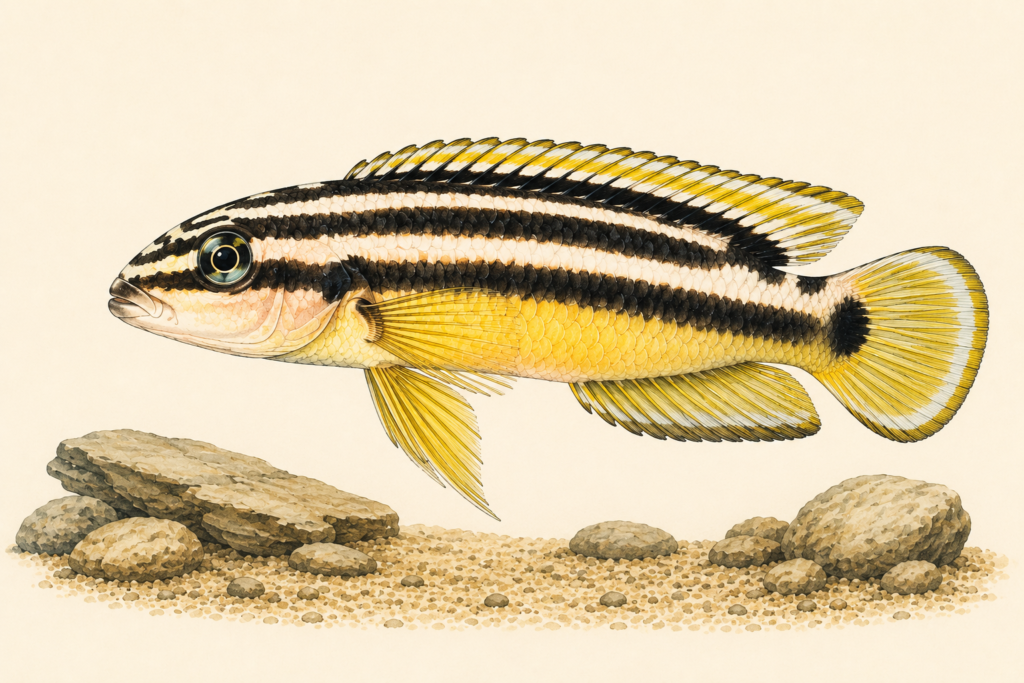
The Golden Ornate Julie (Julidochromis ornatus) is one of Lake Tanganyika’s most endearing cichlids and a perennial favourite among keepers of African rift-lake aquariums. Compact, intelligent and strikingly marked, this rock-dwelling species belongs to the genus Julidochromis – a small group of elongated cichlids that have evolved to exploit the narrow crevices and boulder fields of Tanganyika’s rocky littoral zone. The golden colour form, which gives the fish its common name, exhibits a warm, buttery-yellow base colour overlaid with bold dark horizontal stripes, making it one of the more visually appealing members of the genus.
What truly sets the Golden Ornate Julie apart from many other cichlids, however, is its behaviour. These fish form strong, monogamous pair bonds that can last for the lifetime of the individuals involved. Watching a bonded pair patrol their territory, tending eggs and guarding fry together, is one of the genuine pleasures of keeping Tanganyikan cichlids. Their relatively small adult size, manageable temperament and fascinating social dynamics make them an excellent choice for aquarists who want to experience the complexity of cichlid behaviour without needing an enormous aquarium.
Julidochromis ornatus was first described by Boulenger in 1898 and has been a staple of the aquarium hobby since the mid-twentieth century. Although the species as a whole displays some geographical colour variation across its range in the northern part of Lake Tanganyika, the golden form is the most commonly encountered variant in the trade and the one most hobbyists picture when they hear the name “Ornate Julie.” This care guide covers everything you need to know to keep and breed Golden Ornate Julies successfully, from tank setup and water chemistry to diet, compatible tank mates and breeding strategies.
Quick Stats
| Scientific name | Julidochromis ornatus |
|---|---|
| Common names | Golden Julie, Ornatus Cichlid, Yellow Ornate Julie |
| Family | Cichlidae |
| Origin | Lake Tanganyika, East Africa |
| Adult size | 8 cm |
| Lifespan | 5–8 years |
| Difficulty | Intermediate |
| Breeding difficulty | Moderate |
| Temperature | 23–27 °C |
| pH | 7.5–9 |
| GH | 8–20 dGH |
| KH | 10–18 dKH |
| Minimum tank size | 75 L |
| Conservation status | Least Concern (IUCN) |
Appearance
Julidochromis ornatus possesses the characteristically elongated, torpedo-shaped body typical of the genus. The body profile is laterally compressed, tapering to a pointed snout and a rounded caudal fin. The dorsal fin runs almost the entire length of the back and is edged with a fine pale-blue to white margin – a subtle but attractive detail that catches the light when the fish is in motion. The anal fin is similarly elongated and often tipped with a pale edge. Pectoral fins are transparent and fan-shaped, while the pelvic fins are relatively small. This fin arrangement, along with the slender body, allows the fish to navigate narrow rock crevices with remarkable agility, often hovering upside down beneath overhangs or moving along vertical surfaces as though gravity were irrelevant.
The golden colour form that gives the fish its trade name displays a warm, rich yellow to golden-ochre base colouration across the flanks and belly. Two to three bold, dark brown to near-black horizontal stripes run from the snout through the eye and along the body to the caudal peduncle. The uppermost stripe typically follows the dorsal contour, while the most prominent stripe passes directly through the eye – a common feature among Julidochromis species that likely helps to break up the fish’s outline when viewed against a backdrop of rock. Depending on the individual’s mood, locality and condition, additional finer lines or chequered patterning may be visible between the primary stripes.
The eye itself is relatively large and expressive, befitting an intelligent, visually oriented predator of small invertebrates. Sexual dimorphism in this species is subtle. Females tend to be slightly larger than males when fully mature, and some breeders report that females may display a marginally deeper body and a more rounded genital papilla when in breeding condition, but these differences are not reliable for sexing juveniles. Most keepers find it best to purchase a group of young fish and allow pairs to form naturally.
Juvenile Golden Ornate Julies display essentially the same patterning as adults, though the golden base colour tends to intensify with maturity and good husbandry. Fish that are kept in appropriate conditions with a varied diet will typically develop the richest colouration. Stress, poor water quality or an unsuitable diet can cause the gold to fade to a washed-out cream or pale yellow.
Natural Habitat
Lake Tanganyika, the world’s second-oldest and second-deepest freshwater lake, occupies a section of the Western Rift Valley in East Africa. Julidochromis ornatus is found along the rocky shorelines of the lake’s northern and central reaches, occurring in the Democratic Republic of the Congo, Burundi and the northern tip of Zambia. The species is closely associated with the upper rocky littoral zone, typically at depths of one to ten metres, where boulders, cobbles and bedrock create a labyrinth of crevices, tunnels and overhangs.
The water of Lake Tanganyika is famously hard and alkaline, with a pH that hovers between 8.6 and 9.2 in most areas, general hardness of around 10-15 dGH and very high carbonate hardness. Surface temperatures range from approximately 24 to 28 degrees Celsius depending on the season and location. The lake’s waters are remarkably clear and well-oxygenated, particularly in the shallow zones where Julidochromis species live. Nutrient levels are very low, and the lake’s chemistry has been stable for millions of years – a fact that helps explain why Tanganyikan cichlids tend to be less tolerant of water-quality fluctuations than many other freshwater fish.
In the wild, Golden Ornate Julies occupy small territories within the rock matrix, usually centred on a particular crevice or cavity that serves as both a refuge and a potential spawning site. Bonded pairs defend their territory against conspecifics and other small rock-dwelling cichlids, but they are not open-water swimmers by nature. Their movement patterns are typically short and precise – darting between rocks, hovering along vertical surfaces, and picking at the biofilm (Aufwuchs) and tiny invertebrates that colonise the rock surfaces. Understanding this highly rock-dependent lifestyle is essential for providing appropriate captive conditions.
Tank Size and Setup
A single bonded pair of Golden Ornate Julies can be housed in a tank of approximately 75 litres, though 100 litres or more is preferable, especially if you intend to allow fry to grow on or to house additional tank mates. If you wish to keep a small community of Tanganyikan cichlids that includes a pair of J. ornatus, a tank of 150 to 200 litres is a more sensible starting point, as it provides the space needed to establish separate territories and reduce aggression.
The aquascape should be built around rock. This cannot be overstated – Julidochromis ornatus is a rock-dwelling species that will be stressed and unhappy without ample rockwork. Use a combination of larger stones, flat slabs and rounded cobbles to create a complex structure with numerous caves, crevices, overhangs and tunnels. Ensure that the rocks are stable and cannot topple; resting them directly on the tank base (rather than on substrate) is a wise precaution, and some keepers use aquarium-safe silicone or reef cement to bond structures together. Suitable rock types include limestone, ocean rock, Texas holey rock, slate and lava rock. Avoid any rock that might acidify the water.
The substrate should be fine to medium-grade sand, ideally in a light colour such as aragonite sand or pale river sand. This not only looks natural but helps to buffer pH and hardness in the correct direction. Avoid dark substrates if you want the golden colouration of the fish to be displayed at its best, as many cichlids will darken their base colour over dark substrates.
Live plants are not a significant feature of the rocky Tanganyikan littoral zone, but a few hardy species can be used if desired. Anubias species tied to rocks, Java fern and Vallisneria are all capable of tolerating Tanganyikan water chemistry. Dense planting is neither necessary nor natural for this species.
Lighting should be moderate. Bright illumination can encourage desirable algal biofilm growth on rocks – the same Aufwuchs that forms part of the fish’s natural diet – but excessively intense lighting may cause stress if there are insufficient shaded retreats. A standard LED fixture on a timer providing eight to ten hours of light per day is appropriate.
Water Parameters
Maintaining stable, alkaline water conditions is one of the most important aspects of keeping Golden Ornate Julies. Lake Tanganyika’s chemistry is remarkably consistent, and the fish have evolved over millions of years in this stable environment. They are correspondingly intolerant of wide swings in pH, hardness or temperature. Consistency matters more than hitting an exact number – a stable pH of 7.8 is far preferable to one that swings between 8.0 and 9.0.
| Temperature | 23-27 °C |
| pH | 7.5-9.0 |
| General hardness (GH) | 8-20 dGH |
| Carbonate hardness (KH) | 10-18 dKH |
| Ammonia | 0 ppm |
| Nitrite | 0 ppm |
| Nitrate | Below 20 ppm |
If your tap water is naturally soft and acidic, you will need to use a Tanganyika buffer or cichlid salt mix to raise hardness and pH to appropriate levels. Aragonite sand or crushed coral in the substrate or filter media can also help to maintain alkalinity. Regular water testing is essential, particularly when the tank is newly established or when any changes are made to the setup. Weekly water changes of 20-30 per cent are recommended, using water that has been pre-treated to match the tank’s existing parameters.
Ammonia and nitrite must always be at zero. Even low, transient spikes can cause gill damage and stress in Tanganyikan cichlids. Nitrate should be kept below 20 ppm; ideally below 10 ppm. The naturally low nutrient levels of Lake Tanganyika mean that these fish are less adapted to cope with elevated nitrogenous waste than many other freshwater species.
Filtration and Equipment
Good filtration is non-negotiable for a Tanganyikan cichlid setup. An external canister filter is the ideal choice for tanks of 75 litres and above, as it provides excellent mechanical, biological and chemical filtration without cluttering the interior of the aquarium. Choose a filter rated for at least one and a half to two times the tank volume in turnover per hour. For a 100-litre tank, for example, a filter with a flow rate of 150 to 200 litres per hour would be appropriate. If using a smaller internal filter, supplement it with additional biological media such as ceramic rings or sintered glass.
Julidochromis ornatus prefers moderate water movement rather than strong currents. In the wild, the rocky littoral zone is subject to gentle wave action rather than powerful flows. Position the filter outlet to create some surface agitation for gas exchange, but avoid directing a strong jet of water at the fish’s primary territory. A spray bar can help to diffuse flow evenly across the tank.
A reliable heater is essential, as temperature stability is critical for Tanganyikan cichlids. Choose a heater with a thermostat rated for the tank size and, in larger setups, consider using two smaller heaters rather than one large unit for redundancy. Place the heater near the filter outlet to ensure even heat distribution. An accurate, separate thermometer should be used to verify the heater’s thermostat.
An air pump and airstone are optional but can be beneficial, particularly in warmer climates or during summer months when dissolved oxygen levels may drop. Good oxygenation supports the fish’s health and the efficiency of the biological filter. If the filter provides adequate surface agitation, an airstone may not be necessary.
Diet and Feeding
In the wild, Golden Ornate Julies feed primarily on small invertebrates, insect larvae, crustaceans and the biofilm (Aufwuchs) that coats the rock surfaces in their habitat. This biofilm is a complex community of algae, bacteria, diatoms and tiny organisms. In captivity, the species is not difficult to feed, but a varied diet that reflects this natural omnivorous tendency will produce the best health, colouration and breeding results.
A high-quality cichlid pellet or flake designed for small African cichlids should form the staple of the diet. Look for formulations that are relatively high in protein but also contain spirulina or other algal ingredients. Avoid foods that are excessively high in fat or that contain large amounts of mammalian protein (such as beef heart), as these can cause digestive problems in Tanganyikan cichlids.
Supplement the staple food with regular offerings of frozen or live foods such as brine shrimp, daphnia, cyclops, mosquito larvae and Mysis shrimp. These not only provide nutritional variety but also stimulate natural foraging behaviour. Blanched vegetables such as courgette, spinach or shelled peas can be offered occasionally, particularly if you want to encourage the growth of beneficial gut flora.
Feed small amounts two to three times per day rather than one large feed. Golden Ornate Julies have small stomachs and are designed to graze frequently throughout the day. Overfeeding is a common mistake and can quickly degrade water quality in the hard, alkaline conditions these fish require. Remove any uneaten food after a few minutes to prevent fouling.
Behaviour and Temperament
The behavioural complexity of Julidochromis ornatus is one of its greatest attractions. These are intelligent, observant fish that quickly learn to recognise their keeper and will often approach the front glass at feeding time. They are also highly territorial, particularly once a pair bond has been established, and their defence of their chosen spawning site can be vigorous and persistent.
Golden Ornate Julies form strong, monogamous pair bonds. In many cases, a bonded pair will remain together for life – a genuinely unusual trait among freshwater aquarium fish. The pair will select a cave or crevice as their territory and defend it against all comers, including much larger fish. Both the male and female participate in territorial defence and brood care, with the male typically guarding the outer perimeter while the female tends the eggs and early fry.
It is important to understand that pair formation in Julidochromis can be a tense process. If two incompatible individuals are forced together in a small space, aggression can escalate to the point of serious injury or death. The safest approach is to purchase a group of five or six juveniles and allow pairs to form naturally as the fish mature. Once a pair has bonded, the remaining individuals should ideally be removed, as the dominant pair will increasingly harass them in a confined tank.
A characteristic behaviour of Julidochromis species is their ability to swim and hover upside down beneath rock overhangs. This is perfectly normal and is an adaptation to their crevice-dwelling lifestyle. You will also observe the fish moving along vertical rock faces, picking at the surface for food, and engaging in subtle body-language displays such as fin flaring, lateral presentations and gentle jaw-locking during disputes.
Despite their territorial nature, Golden Ornate Julies are not open-water aggressors. Their aggression is highly localised – concentrated on the area immediately around their cave – and they are generally indifferent to fish that occupy different zones of the tank. This makes them good candidates for a carefully planned Tanganyikan community, provided tank mates are chosen with care.
Tank Mates
Choosing tank mates for Golden Ornate Julies requires an understanding of both their territorial behaviour and the specific water chemistry they need. Ideal companions are other Tanganyikan species that occupy different ecological niches within the tank – shell dwellers on the sand, open-water swimmers in the middle and upper column, and other rock dwellers that are sufficiently different in appearance and habits to avoid direct competition. Avoid mixing different Julidochromis species or geographical variants, as they may hybridise, and avoid any species large or aggressive enough to bully or eat the Julies.
Good tank mates
- Multifasciatus Shell Dweller – A diminutive shell dweller that occupies a completely different zone of the tank and poses no territorial conflict with rock-dwelling Julies.
- Neolamprologus brevis – Another small shell-dwelling species that stays close to the substrate and is unlikely to encroach on Julie territory.
- Cyprichromis leptosoma – A peaceful, open-water schooling cichlid that stays in the mid to upper water column, well away from the rocks where Julies live.
- Neolamprologus leleupi – A similarly sized rock dweller that can coexist with Julies in a sufficiently large, well-structured tank with plenty of separate caves.
- Altolamprologus calvus – A slow-moving, laterally compressed predator that generally ignores small, established tank mates and occupies its own cave system.
- Synodontis petricola – A small, attractively marked catfish endemic to Lake Tanganyika that is an excellent bottom-dwelling companion for cichlid communities.
- Neolamprologus brichardi – The Fairy Cichlid can work in larger tanks where both species have ample rockwork, though care should be taken if both are breeding simultaneously.
- Lamprologus ocellatus – A feisty but tiny shell dweller whose territory is centred on a single shell, keeping it well clear of the Julie’s rock-based domain.
Fish to avoid
- Cyphotilapia frontosa – Far too large and predatory; an adult Frontosa could easily swallow a Golden Ornate Julie.
- White Spotted Cichlid – Highly aggressive and territorial rock dwellers that would dominate and stress Julies in most tank setups.
- Tropheus moorii – Similar aggression issues as Tropheus duboisi, with boisterous feeding behaviour that can intimidate smaller species.
- Julidochromis marlieri – Congeneric species that may hybridise with J. ornatus, producing undesirable hybrid offspring.
- Julidochromis regani – Another Julidochromis species with a high risk of hybridisation and direct territorial competition.
- Astronotus ocellatus (Oscar) – A large, predatory New World cichlid completely incompatible in terms of size, temperament and water chemistry requirements.
- Amatitlania nigrofasciata (Convict Cichlid) – A Central American species requiring different water chemistry; highly aggressive and likely to outcompete Julies for territory.
- Puntigrus tetrazona (Tiger Barb) – Requires softer, more acidic water and its boisterous, fin-nipping behaviour makes it an unsuitable companion.
Breeding
Breeding Golden Ornate Julies is one of the most rewarding aspects of keeping this species, and it is well within the reach of aquarists with moderate experience. The key prerequisites are a well-bonded pair, stable water conditions, appropriate rockwork and a varied diet.
As noted earlier, the best way to obtain a compatible pair is to raise a group of five to six juveniles together and allow natural pair formation. Once a pair has bonded – signalled by the two fish spending most of their time together in or near a particular cave and driving away other tank mates – the unpaired individuals should be rehomed to prevent ongoing harassment.
The spawning site is typically a cave, crevice or the underside of a flat rock. The female deposits a relatively small clutch of eggs – usually between 20 and 50 – on the ceiling or walls of the chosen cavity. The eggs are adhesive and are tended primarily by the female, who fans them to ensure adequate oxygenation and removes any that become fungused. The male guards the perimeter of the territory and assists with defence.
Incubation takes approximately three to four days at typical aquarium temperatures (25-26 degrees Celsius), after which the fry hatch and remain attached to the substrate by their yolk sacs for a further three to five days. Once free-swimming, the fry are tiny but immediately capable of taking very fine foods. Newly hatched brine shrimp (Artemia nauplii) are the ideal first food, supplemented with finely powdered fry food or crushed flake.
One of the most fascinating aspects of Julidochromis breeding behaviour is that established pairs will often allow successive broods of fry to remain in the territory. It is not uncommon to see fry of several different ages coexisting within the parental cave system. Older juveniles may even assist with territorial defence. However, once the young reach a size where they begin to compete with the adults for food and space, they will be driven away. In a closed aquarium, this is the point at which overcrowding and aggression can become problematic, so regular removal and rehoming of young fish is advisable.
Do not separate a bonded pair and attempt to re-pair either individual with a new partner. Julidochromis pairs have been known to kill a newly introduced “replacement” mate. If one member of a pair dies, introduce several juveniles rather than a single adult, and allow the surviving fish to choose its own new partner.
Common Diseases
Golden Ornate Julies are generally robust fish when maintained in appropriate conditions, but they are susceptible to the same diseases that affect other freshwater cichlids, particularly when water quality deteriorates or when new fish are introduced without quarantine.
Ich (white spot disease), caused by the protozoan Ichthyophthirius multifiliis, is one of the most common ailments. It presents as small white cysts on the fins and body and is usually triggered by temperature drops or stress. Treatment involves gradually raising the temperature to 28-30 degrees Celsius and, if necessary, using a proprietary white spot treatment. Be cautious with copper-based medications in hard, alkaline water, as their toxicity can be altered by pH.
Bloat, sometimes referred to as Malawi bloat despite also affecting Tanganyikan cichlids, is a serious and often fatal condition characterised by abdominal swelling, loss of appetite and lethargy. Its exact causes are debated, but it is often linked to poor diet (particularly excessive protein or inappropriate food types), stress and poor water quality. Prevention through proper husbandry is far more effective than treatment, but metronidazole-based medications are sometimes used in early cases.
Bacterial infections, including fin rot and body ulcers, can occur in response to injury, poor water quality or stress. These are best treated with broad-spectrum antibacterial medications and, crucially, by identifying and correcting the underlying cause. Maintaining pristine water quality and avoiding overcrowding are the most effective preventive measures.
Internal parasites such as intestinal worms and hexamita can occasionally affect wild-caught specimens or fish that have been kept in poorly maintained conditions. Symptoms may include weight loss despite a good appetite, white or stringy faeces and lethargy. Treatment typically involves anti-parasitic medications added to the food.
Fungal infections, recognisable by cotton-like white growths on the body or fins, usually occur as secondary infections following physical damage. They respond well to antifungal treatments, but again, addressing the root cause – such as sharp decor or aggression from tank mates – is essential.
FAQs
How can I tell the difference between male and female Golden Ornate Julies?
Sexing Julidochromis ornatus is notoriously difficult, particularly in young fish. Females tend to be slightly larger than males when fully grown and may show a marginally more rounded body shape, but these differences are subtle and unreliable. The most practical approach is to buy a group of juveniles and let them pair off naturally. Once a pair bond is evident through shared territory defence and spawning behaviour, you can be confident you have a male and female.
Can I keep Golden Ornate Julies in a community with Malawi cichlids?
This is generally not recommended. While the water chemistry requirements of Tanganyikan and Malawian cichlids overlap to some degree, Malawi cichlids – particularly mbuna – tend to be significantly more aggressive and boisterous than Julidochromis ornatus. The Julies are likely to be bullied, outcompeted for food and chronically stressed. It is far better to keep them in a dedicated Tanganyikan community with species that share their temperament and ecological requirements.
Why is my Golden Ornate Julie swimming upside down?
If the fish is hovering upside down beneath a rock overhang or along the ceiling of a cave, this is completely normal behaviour for all Julidochromis species. It is an adaptation to their crevice-dwelling lifestyle and nothing to worry about. However, if the fish is floating upside down at the surface, struggling to right itself or showing other signs of distress, this may indicate a swim bladder disorder or another health issue requiring attention.
How many Golden Ornate Julies can I keep in a 100-litre tank?
A 100-litre tank is suitable for a single bonded pair and their current brood of fry. Keeping multiple adults in a tank of this size is likely to lead to aggression, particularly once a dominant pair has established itself. If you wish to keep a group during the pairing process, start with five or six juveniles in a well-decorated tank and remove the unpaired fish once a pair has formed. For a larger group or a mixed-species Tanganyikan community, a tank of 150 litres or more is advisable.
Do Golden Ornate Julies eat plants?
Julidochromis ornatus is not a dedicated herbivore and will not systematically destroy aquarium plants. They may occasionally nibble at soft-leaved plants or graze on algae growing on plant surfaces, but they are unlikely to cause significant damage. Hardy species such as Anubias, Java fern and Vallisneria are the best choices for a Tanganyikan setup, as they tolerate hard, alkaline water and are generally unpalatable to cichlids.
Related Guides
- Julidochromis marlieri Care Guide – A closely related Julidochromis species with similar care requirements but a distinct chequered pattern, useful for comparison.
- Julidochromis transcriptus Care Guide – The smallest member of the genus, ideal for aquarists interested in Julies but working with smaller tanks.
- Multifasciatus Shell Dweller – An excellent shell-dwelling companion species for a Tanganyikan community featuring Golden Ornate Julies.
- Cyprichromis leptosoma Care Guide – A popular open-water Tanganyikan cichlid that complements rock dwellers like J. ornatus in a mixed community.
- Neolamprologus leleupi Care Guide – Another small, colourful Tanganyikan rock dweller with overlapping habitat preferences and compatible temperament in suitably sized tanks.