Quick summary
Glass Catfish are a striking but moderately challenging fish best suited to hobbyists willing to keep a shoal of six or more in a well-planted, dimly lit tank with stable, clean water. They are not ideal for beginners seeking a low-maintenance or solitary fish, as insufficient group size or poor water quality quickly leads to stress, feeding refusal, and decline.
🐠 Build a tank around this fish
In this guide:
- Introduction
- Quick Stats
- Appearance
- Natural Habitat
- Tank Size and Setup
- Water Parameters
- Filtration and Equipment
- Diet and Feeding
- Behaviour and Temperament
- Tank Mates
- Breeding
- Common Diseases
- FAQs
Introduction
The Glass Catfish, scientifically known as Kryptopterus vitreolus, is one of the most visually striking freshwater fish available to aquarists. Its almost entirely transparent body reveals the skeleton, internal organs, and swim bladder in remarkable detail, making it a living anatomy lesson and an endlessly fascinating centrepiece for a community aquarium. Few fish can match its otherworldly appearance, and it has captivated hobbyists for decades.
For many years, the Glass Catfish sold in the aquarium trade was misidentified as Kryptopterus bicirrhis, a larger and quite different species rarely seen in captivity. It was not until 2013 that ichthyologist Heok Hee Ng formally described Kryptopterus vitreolus as the true species behind the familiar transparent catfish of the hobby. This taxonomic clarification is worth noting when researching older care guides, which may reference the outdated name.
Despite its delicate, almost ethereal appearance, the Glass Catfish is a surprisingly hardy fish once settled into a well-maintained aquarium. It does, however, have specific social and environmental needs that set it apart from many other beginner-friendly species. It is a shoaling fish that can become stressed, refuse food, and decline rapidly if kept alone or in insufficient numbers. Understanding and meeting these requirements is the key to long-term success with this remarkable species.
This guide covers everything you need to know about keeping Glass Catfish healthy and thriving, from tank setup and water parameters to diet, compatible tank mates, and the considerable challenges of breeding them in captivity.
Quick Stats
| Scientific name | Kryptopterus vitreolus |
|---|---|
| Common names | Ghost Catfish, Phantom Catfish, Ghost Glass Cat |
| Family | Siluridae |
| Origin | Thailand (Mekong and Chao Phraya basins) |
| Adult size | 7 cm |
| Lifespan | 5–8 years |
| Difficulty | Intermediate |
| Breeding difficulty | Advanced |
| Temperature | 22–28 °C |
| pH | 6–7.5 |
| GH | 3–10 dGH |
| KH | 2–8 dKH |
| Minimum tank size | 115 L |
| Conservation status | Least Concern (IUCN) |
Appearance
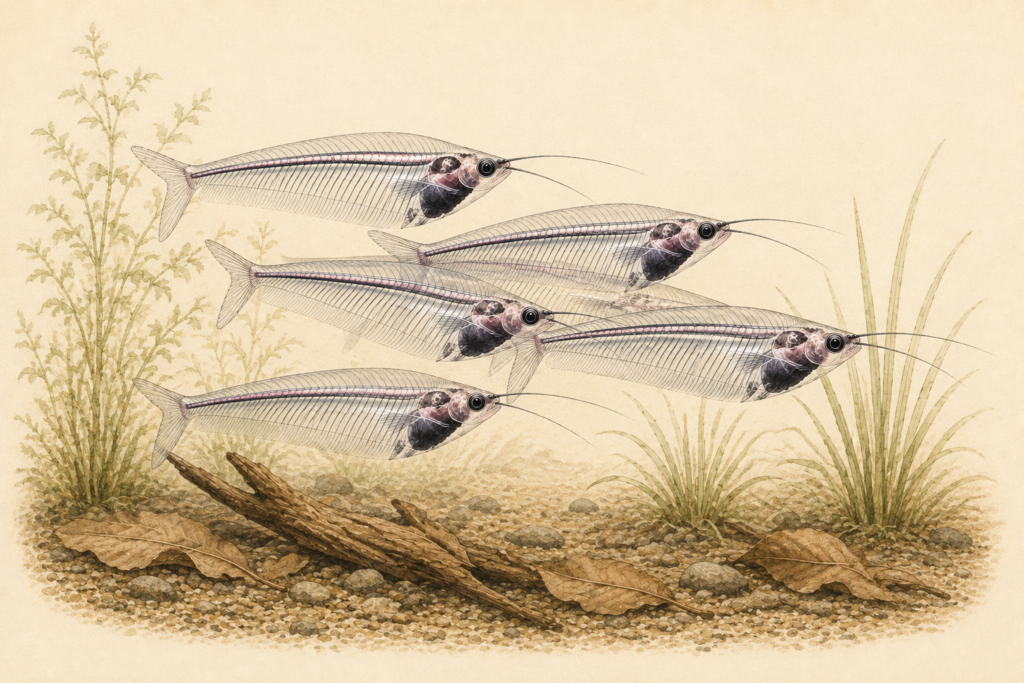
The Glass Catfish’s defining characteristic is its near-total transparency. The body is laterally compressed and elongated, with skin and muscle tissue so thin that light passes through almost unimpeded. When viewed from the side, the vertebral column is clearly visible as a silvery line running from head to tail, and the internal organs are compacted into a small, reflective mass just behind the head. The swim bladder is also plainly visible. In certain lighting conditions, the body refracts light in a subtle iridescent rainbow shimmer, adding a prismatic quality to an already extraordinary appearance.
The head is relatively small and bears a pair of long, delicate barbels that extend forward from the upper jaw. These barbels are highly sensitive and are used to detect food and navigate in low-light environments. The dorsal fin is reduced to a tiny, almost imperceptible filament, which is a characteristic of the genus Kryptopterus. The anal fin, by contrast, is exceptionally long, running along most of the underside of the body and providing the primary means of propulsion. The caudal fin is small and forked.
Healthy Glass Catfish display a clear, glassy body with no cloudiness or whitish opaqueness. A loss of transparency is often one of the first signs of stress or illness. When the fish is severely unwell or after death, the body turns a milky white colour. Sexual dimorphism is minimal and extremely difficult to discern in this species. Mature females may appear very slightly fuller in the abdominal region when carrying eggs, but this difference is subtle and unreliable as a sexing method for most hobbyists.
Adults typically reach between six and eight centimetres in total length, making them a modest-sized addition to the community tank. Their small stature, combined with their transparency, means they can sometimes be surprisingly difficult to spot in a densely planted aquarium, despite being kept in groups.
Natural Habitat
Kryptopterus vitreolus is native to Thailand, where it inhabits the river systems of the Mekong and Chao Phraya basins. In the wild, these fish are found in slow-moving streams, tributaries, and floodplain areas rather than in the main channels of large rivers. They tend to favour sections with moderate to dense vegetation, submerged roots, and overhanging bankside plants that provide shade and shelter from predators.
The waters they inhabit are typically soft to moderately hard with a slightly acidic to neutral pH. These environments are often stained with tannins from decaying leaf litter, giving them a characteristic tea-brown tint. The substrate tends to be composed of sand, fine gravel, and accumulated organic detritus. Light levels in their natural habitat are generally subdued, filtered through overhead vegetation and the tannin-rich water column.
Glass Catfish are found in shoals in the wild, often congregating in areas of gentle current where they hover in the midwater column, facing into the flow. This behaviour is readily observed in the aquarium when water movement is provided. They are not bottom-dwellers in the traditional catfish sense; instead, they occupy the middle levels of the water column, holding their position with subtle undulations of their long anal fin. Understanding this midwater, shoaling lifestyle is essential for replicating appropriate conditions in captivity.
Tank Size and Setup
A minimum tank size of 115 litres is recommended for a group of Glass Catfish. Since these fish must be kept in groups of at least six to feel secure, and ideally eight or more, the aquarium needs to offer sufficient swimming space along its length. A tank measuring at least 80 cm in length is preferable, as horizontal swimming space is more important to this species than overall volume alone. Larger tanks of 150 litres or more allow for bigger shoals and provide a more stable environment, which benefits these somewhat sensitive fish considerably.
The aquascape should aim to replicate the shaded, vegetated habitats these catfish occupy in the wild. Planting is of particular importance. Dense stands of tall background plants such as Vallisneria, Hygrophila, or Cryptocoryne species offer shelter and help reduce ambient light levels in the tank. Floating plants are highly recommended as well, as they dim the lighting naturally and provide a canopy that makes Glass Catfish feel significantly more at ease. Under bright, unshaded lighting, these fish will often hide constantly and display signs of chronic stress.
Driftwood and smooth rocks can be used to create additional structure and shaded retreats, but the tank should not be so heavily decorated that swimming space in the midwater zone is compromised. Glass Catfish spend the vast majority of their time hovering together in a loose shoal in open water areas, typically near cover but not hidden within it. The ideal layout offers a balance of planted zones and open swimming corridors.
A dark substrate is generally preferred, as it reduces light reflection from below and more closely mimics natural conditions. Fine sand or smooth gravel in dark tones works well. Some keepers add dried Indian almond leaves or other botanicals to introduce tannins into the water, which further replicates their native environment and can have mild antibacterial and antifungal benefits. While not strictly necessary, tannin-stained water often coincides with Glass Catfish displaying their most relaxed and natural behaviour.
Water Parameters
Glass Catfish are not especially demanding with regard to water chemistry, but they are sensitive to poor water quality. Ammonia and nitrite must be maintained at zero at all times, as is the case with any properly cycled aquarium, but these fish show less tolerance for elevated nitrate levels than many other community species. Regular water changes are essential to keep nitrate concentrations low and the water consistently fresh.
| Temperature | 22–28 °C |
| pH | 6.0–7.5 |
| General hardness (GH) | 3–10 dGH |
| Carbonate hardness (KH) | 2–8 dKH |
| Ammonia | 0 ppm |
| Nitrite | 0 ppm |
| Nitrate | Below 20 ppm |
Stability is arguably more important than hitting a specific number within these ranges. Sudden fluctuations in temperature, pH, or hardness can trigger stress and illness in Glass Catfish. When performing water changes, it is advisable to match the temperature and chemistry of the new water as closely as possible to the tank water. A weekly water change of 20–30% is a good baseline for most setups, though more frequent changes may be warranted in smaller or more heavily stocked aquaria.
These fish do best in soft to moderately hard water with a slightly acidic to neutral pH. Very hard, alkaline water is not ideal and may lead to long-term health issues. If your tap water is particularly hard, blending it with reverse osmosis water can help achieve a more suitable range.
Filtration and Equipment
Good filtration is essential for Glass Catfish, but the choice of filter should take into account their preference for gentle to moderate water flow. A high-quality hang-on-back filter or a canister filter with an adjustable flow outlet is ideal. Sponge filters also work well in smaller setups and have the added advantage of providing biological filtration without creating excessive current. Powerheads or wavemakers are generally unnecessary and may produce currents that are too strong for these relatively small, lightweight fish.
While Glass Catfish do appreciate a gentle current to hover in, they will naturally orient themselves facing into the flow, they should not be buffeted by powerful water movement. Positioning the filter outlet to create a mild, laminar flow across one section of the tank allows them to choose their preferred current strength by moving closer to or further from the source.
Lighting should be subdued. This is one of the most commonly overlooked aspects of Glass Catfish husbandry. Under intense lighting, these fish will retreat to the darkest corners of the tank, refuse food, and become chronically stressed. If your tank uses high-output LEDs for plant growth, the addition of a thick layer of floating plants is strongly advised to provide shaded zones. Alternatively, a dimmer or a timed ramp-up and ramp-down schedule can help create a more comfortable environment.
A reliable heater with an accurate thermostat is necessary to maintain stable tropical temperatures. In regions with significant ambient temperature fluctuations, a heater guard may be worthwhile to prevent the fish from resting against the heater and sustaining burns, though Glass Catfish are midwater swimmers and this risk is lower than it would be with bottom-dwelling species. An air pump is not required if adequate surface agitation is provided by the filter, but it can be useful in warmer months to ensure sufficient oxygenation.
Diet and Feeding
Glass Catfish are omnivores with a strong preference for small, protein-rich foods. In the wild, their diet consists largely of tiny invertebrates, zooplankton, insect larvae, and other small organisms drifting in the water column. Replicating this varied diet in captivity is important for maintaining good health, vibrant transparency, and strong immune function.
High-quality micro-pellets or slow-sinking granules designed for small tropical fish make a suitable staple food. However, Glass Catfish can be reluctant feeders, particularly when newly introduced to an aquarium, and they may initially refuse dried foods entirely. Offering live or frozen foods such as daphnia, baby brine shrimp, cyclops, bloodworms, and mosquito larvae is often necessary to encourage feeding during the acclimatisation period and remains beneficial as a regular dietary supplement thereafter.
These fish feed in the midwater column rather than at the surface or on the substrate, so food that sinks slowly through their preferred zone is ideal. Flake food can work but tends to either float for too long or sink too quickly past the fish before they have a chance to eat. Slow-sinking micro-granules or foods dispensed in small pinches that drift naturally through the water column will yield much better results.
Feed small amounts two to three times per day rather than one large meal. Glass Catfish have small stomachs and benefit from frequent, modest feedings. Overfeeding should be avoided, as uneaten food will quickly degrade water quality, to which these fish are particularly sensitive. Observing the group during feeding to confirm that all individuals are eating is good practice, as subordinate or stressed fish may miss out, especially in community tanks with more assertive feeders.
Behaviour and Temperament
Glass Catfish are peaceful, shy, and inherently social fish. They are obligate shoalers, meaning they require the company of their own kind to feel secure and exhibit normal behaviour. A solitary Glass Catfish, or one kept in a group of fewer than six, will almost invariably become reclusive, refuse food, lose its transparency, and ultimately decline. A minimum group of six is essential, but groups of eight to twelve or more produce the most natural and rewarding behaviour.
In a properly maintained shoal, Glass Catfish will spend most of the day hovering together in a characteristic formation in the midwater column. They face into whatever gentle current is present, maintaining their position with small, rhythmic movements of the anal fin. The group tends to remain quite tightly clustered, often with individuals hovering just centimetres apart. This coordinated behaviour is one of the most appealing aspects of keeping the species and gives the impression of a group of miniature glass sculptures suspended in the water.
They are most active during dawn and dusk, which reflects their crepuscular tendencies in the wild. During the brightest part of the day, they may retreat to shaded areas, particularly if lighting is intense. Under subdued or floating-plant-filtered light, however, they remain visible and active throughout the day. At night, they may become slightly more dispersed and exploratory.
Glass Catfish are not aggressive in any context. They pose no threat to other fish, to plants, or to invertebrates. Their barbels are sensory organs, not weapons, and they have no territorial instincts. They can, however, be easily intimidated by boisterous or aggressive tank mates, which is an important consideration when selecting companions. A stressed Glass Catfish shoal that is constantly hiding or huddled in a corner is a sure sign that something in the tank environment, whether it be lighting, water quality, group size, or incompatible tank mates, needs to be addressed.
Tank Mates
Selecting appropriate tank mates for Glass Catfish is largely a matter of choosing species that share their peaceful disposition and preference for calm, well-planted environments. Boisterous, aggressive, or large predatory fish should be avoided entirely. Ideal companions are small to medium-sized community species that occupy different areas of the tank or coexist peacefully in the midwater zone. Fast-moving surface feeders that might outcompete Glass Catfish for food during mealtimes should also be considered with caution, and extra care taken to ensure the catfish are receiving their share of food.
Good tank mates
- Harlequin Rasbora, a similarly peaceful, shoaling species from Southeast Asia that thrives in the same soft, slightly acidic water conditions.
- Neon Tetra, a small, non-aggressive tetra that occupies similar midwater zones without posing any competitive or territorial threat.
- Ember Tetra, a tiny, calm tetra that adds subtle colour without the boisterous behaviour that would stress Glass Catfish.
- Kuhli Loach, a peaceful bottom-dweller that stays out of the Glass Catfish’s midwater territory and shares a preference for dimly lit environments.
- Corydoras Catfish, another gentle, shoaling species that occupies the lower levels of the tank and poses absolutely no threat.
- Celestial Pearl Danio, a small, shy species that pairs well with Glass Catfish in well-planted, low-flow setups.
- Otocinclus Catfish, a diminutive algae eater that is entirely non-confrontational and compatible in both temperament and water parameter preferences.
- Cherry Shrimp, Peaceful dwarf shrimp that are generally too large for Glass Catfish to predate and add colour and interest to the lower levels of the tank.
- Honey Gourami, one of the most placid gourami species, sharing a preference for calm, planted environments with subdued lighting.
- Cardinal Tetra, a beautiful, peaceful shoaling tetra that thrives in the soft, acidic water conditions Glass Catfish prefer.
Fish to avoid
- Oscar, a large, predatory cichlid that would readily consume Glass Catfish and requires entirely different water conditions and tank size.
- Tiger Barb, a notorious fin nipper with boisterous, semi-aggressive behaviour that would severely stress Glass Catfish.
- African Cichlids, Territorial, aggressive species requiring hard, alkaline water that is wholly incompatible with Glass Catfish needs.
- Red-Tail Catfish, an enormous predatory catfish that would eat Glass Catfish and requires a tank far larger than any community setup.
- Convict Cichlid, an aggressive, territorial cichlid, especially during breeding, that would dominate and terrify Glass Catfish.
- Chinese Algae Eater, Becomes increasingly aggressive and territorial with age and has been known to harass and attach to slow-moving tank mates.
- Flowerhorn Cichlid, a highly aggressive, large cichlid entirely unsuitable for any community tank containing small, peaceful species.
- Green Spotted Puffer, an aggressive fin nipper that also requires brackish water, making it doubly incompatible with Glass Catfish.
Breeding
Breeding Glass Catfish in captivity is extremely difficult and only rarely achieved, even by experienced aquarists. There are very few confirmed reports of successful captive breeding, and the species is almost exclusively supplied to the aquarium trade through wild collection. The challenges are multifaceted, beginning with the near-impossibility of visually sexing the fish and extending to the apparent need for very specific environmental triggers that are poorly understood.
In the wild, Glass Catfish are believed to breed during the rainy season, when water levels rise, temperatures drop slightly, and the water becomes softer and more acidic due to the influx of fresh rainwater. Attempts to replicate these conditions in captivity have met with occasional success. The general approach involves conditioning a healthy, well-established group on a rich diet of live foods for several weeks, then simulating the onset of a rainy season by performing a series of large water changes with slightly cooler, softer water over the course of several days. Lowering the water level in the tank and then gradually refilling it can sometimes serve as an additional trigger.
When spawning does occur, the eggs are typically scattered among fine-leaved plants or java moss. The eggs are small and somewhat adhesive. Parental care is absent, and the adults may consume the eggs if given the opportunity, so removing the spawning medium or the adults after a suspected spawning event is advisable. Incubation is reported to take approximately three to four days at tropical temperatures, and the resulting fry are extremely small and delicate.
Raising the fry presents its own challenges. They require infusoria or commercially prepared liquid fry food for the first week or so, graduating to freshly hatched brine shrimp nauplii as they grow. Water quality must be kept pristine throughout, and the fry are sensitive to sudden changes in conditions. Given the difficulty involved, breeding Glass Catfish is best regarded as a project for advanced hobbyists with dedicated breeding setups rather than something to attempt in a standard community tank.
Common Diseases
Glass Catfish are susceptible to the same diseases that affect other freshwater tropical fish, but their sensitivity to water quality means they are often among the first inhabitants of a tank to show symptoms when conditions deteriorate. Their transparent bodies can actually be an advantage in this regard, as internal infections and parasites that might go unnoticed in opaque fish are sometimes visible through the clear skin of a Glass Catfish.
White spot disease, also known as ich (caused by the protozoan Ichthyophthirius multifiliis), is one of the most common ailments. It presents as small, white, grain-of-salt-like spots on the body and fins. Glass Catfish are considered somewhat more susceptible to ich than many other species, particularly when stressed by poor water quality, temperature fluctuations, or inadequate group size. Treatment involves raising the temperature gradually to around 28–30 °C and administering a suitable ich medication. It is important to note that Glass Catfish, like many scaleless and thin-skinned fish, can be sensitive to certain medications, particularly those containing copper or malachite green at full concentration. Half-dosing is often recommended, and any medication should be used cautiously and in accordance with the manufacturer’s guidance for sensitive species.
Bacterial infections can manifest as cloudiness or a milky appearance to the body, red streaks on the fins, or ulceration. These are typically secondary to poor water quality or physical injury. Maintaining pristine water conditions is the single most effective preventive measure. If a bacterial infection does develop, treatment with a broad-spectrum antibacterial medication designed for freshwater aquarium use is usually appropriate.
Fungal infections, visible as white, cotton-wool-like growths on the body or fins, may also occur, particularly on fish that have sustained physical damage or are immunocompromised. Antifungal treatments are available, but again, care should be taken with dosing for this sensitive species.
A loss of transparency is not a disease in itself but is an important early warning sign that should not be ignored. A Glass Catfish that turns opaque or milky is under significant stress, and the underlying cause, whether it be water quality, social stress from insufficient group size, incompatible tank mates, or illness, must be identified and addressed promptly. In many cases, correcting the environmental issue will restore the fish’s normal transparency within a few days.
Preventive care is always preferable to treatment with Glass Catfish. Quarantining new fish before introducing them to an established tank, maintaining stable water parameters, performing regular water changes, and providing an appropriate diet and social environment will go a long way towards keeping these fish healthy throughout their lifespan.
FAQs
How many Glass Catfish should I keep together?
A minimum of six is essential, but groups of eight to twelve or more are strongly recommended. Glass Catfish are obligate shoalers, and individuals kept alone or in very small groups almost always become stressed, refuse food, lose their transparency, and eventually die prematurely. The larger the group, the more confident and natural their behaviour will be, and the more impressive the shoaling display.
Why has my Glass Catfish turned white or milky?
A loss of transparency in a Glass Catfish is a clear sign of stress or illness. Common causes include poor water quality (elevated ammonia, nitrite, or nitrate), sudden changes in temperature or pH, insufficient group size, overly bright lighting, or the presence of aggressive tank mates. Test your water parameters immediately and review the tank conditions. If the cause is identified and corrected quickly, the fish will often regain its normal transparency within a few days. A permanently milky appearance, however, may indicate a serious infection requiring treatment.
Are Glass Catfish difficult to feed?
They can be somewhat fussy, particularly when newly introduced to a tank. Newly acquired Glass Catfish may refuse dried foods entirely for the first week or two and will often only accept live or frozen foods such as daphnia, baby brine shrimp, or bloodworms. Once settled, most individuals will learn to accept high-quality micro-pellets or slow-sinking granules, especially if these are offered alongside their preferred live or frozen fare. Patience during the acclimatisation period is important.
Can Glass Catfish be kept with shrimp?
Yes, Glass Catfish are generally safe to keep with adult dwarf shrimp such as Cherry Shrimp or Amano Shrimp. Their mouths are relatively small, and they do not actively hunt shrimp. However, very small shrimplets may occasionally be consumed, as they fall within the size range of the tiny invertebrates Glass Catfish naturally feed upon. If you are breeding shrimp and wish to maximise shrimplet survival, dense plantings of moss and other fine-leaved plants will provide essential refuge.
Do Glass Catfish need a planted tank?
While it is technically possible to keep Glass Catfish in an unplanted aquarium, it is strongly inadvisable. Plants, particularly floating species, play a critical role in providing shade and reducing light levels, which is essential for the comfort and wellbeing of this species. Dense plantings also offer visual barriers and retreats that help the fish feel secure. A well-planted tank with areas of subdued lighting will produce far healthier, more confident, and more active Glass Catfish than a bare or sparsely decorated setup.
Related Guides
- Kuhli Loach Care Guide, another peaceful, shy species from Southeast Asia that makes an excellent companion for Glass Catfish in a community setup.
- Harlequin Rasbora Care Guide, a classic community fish from overlapping habitats that shares similar water parameter requirements and temperament.
- Corydoras Catfish Care Guide, a popular shoaling catfish for the lower levels of the tank, complementing the midwater niche occupied by Glass Catfish.
- Honey Gourami Care Guide, a gentle, small gourami species well suited to the calm, planted environments that Glass Catfish thrive in.
- Neon Tetra Care Guide, one of the hobby’s most popular community fish and a natural pairing with Glass Catfish in soft-water setups.