Quick summary
The Watermelon Distichodus is a stunning but demanding fish suited only to experienced keepers, growing up to 40 cm and requiring an 800+ litre tank as it becomes territorial and aggressive with age. It also destroys live plants and is essentially unbreedable in home aquariums, so it’s not a good fit for beginners or standard community setups.
🐠 Build a tank around this species
Grows large. Read this before buying. The Watermelon Distichodus is usually sold as a small juvenile and is easy to keep at that size, but a healthy adult is reported to reach around 40 cm, although the exact identity of the fish sold under this name is unresolved, so treat that as a planning figure rather than a measured adult size. A juvenile will be happy in a standard tank for its first year or so. An adult needs a very large tank, six feet long or more, and the water changes to match. Decide now whether you will build for the adult, or have a realistic rehoming plan, because public aquaria and specialist keepers are often full. It is a superb fish for the keeper who plans for it and a sad one for everyone else.
In this guide:
- Introduction
- Quick Stats
- Appearance
- Natural Habitat
- Tank Size and Setup
- Water Parameters
- Filtration and Equipment
- Diet and Feeding
- Behaviour and Temperament
- Tank Mates
- Breeding
- Common Diseases
- FAQs
Introduction
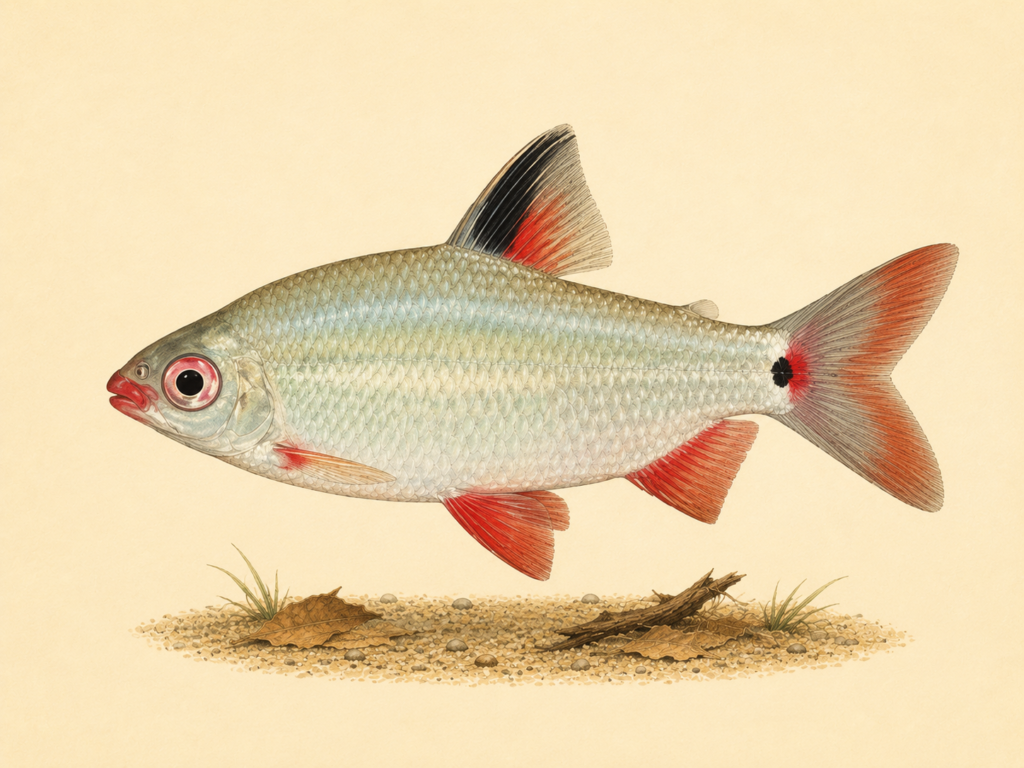
The Watermelon Distichodus is one of the most visually striking yet taxonomically puzzling large characins available in the freshwater aquarium trade. Sold most commonly under the designation Distichodus sp. “Red & Black”, this fish hails from the Lefini River, a tributary of the Congo River system in the Republic of Congo. Its common name derives from its remarkable colouration – a shimmering golden body paired with vivid red lips, eyes, and fins, all offset by a bold black stripe running through the dorsal fin. The effect is reminiscent of a watermelon rind, and it makes this species instantly recognisable among its congeners.
The exact taxonomic placement of this fish is genuinely unresolved, and hobbyists should be aware that multiple theories circulate without definitive confirmation. Most specialist importers and aquarist databases treat it as an undescribed or undetermined species within the genus Distichodus, hence the provisional trade label Distichodus sp. “Red & Black”. Seriously Fish notes that some specimens of Distichodus affinis display variable red-fin and pink-sheen colouration that “may indicate different species” closely resembling D. affinis, which is relevant context here, though it has not been confirmed that the Watermelon Distichodus is necessarily one of these forms. Separately, at least one retailer has marketed this fish as “Distichodus noboli lefini”, suggesting a possible relationship to Distichodus noboli as a locality form from the Lefini drainage. Neither identification has been formally verified through published taxonomic revision, and it is entirely possible that this fish represents a genuinely undescribed species. Until a proper scientific description is published, all identifications should be treated with appropriate caution.
Regardless of its unresolved taxonomy, the Watermelon Distichodus is a fish of considerable size and personality. Juveniles are peaceable and attractive shoaling fish, which unfortunately leads many aquarists to purchase them without appreciating just how large and assertive they become. Adults can reach up to 40 cm (approximately 16 inches) in captivity, and their temperament shifts significantly as they mature, becoming increasingly territorial and aggressive towards conspecifics and other tank inhabitants. This is emphatically not a long-term community fish for a standard aquarium. It demands a very large tank, robust filtration, and carefully selected tank mates that can hold their own against a large, sometimes belligerent characin. For experienced keepers with the space and resources to accommodate it, however, the Watermelon Distichodus is a genuinely rewarding species – bold, active, and stunningly beautiful throughout its life.
Quick Stats
| Scientific name | Distichodus sp. “Red & Black” (undescribed/undetermined) |
|---|---|
| Common names | Watermelon Distichodus, Red and Black Distichodus, Distichodus sp. Red & Black, Lefini |
| Family | Distichodontidae |
| Origin | Lefini River, Congo River basin, Republic of Congo |
| Adult size | 40 cm |
| Difficulty | Advanced |
| Breeding difficulty | Advanced |
| Temperature | 24–28 °C |
| pH | 6–7.5 |
| GH | 3–15 dGH |
| Minimum tank size | 800 L |
| Conservation status | Not evaluated |
Appearance
The Watermelon Distichodus is a genuinely handsome fish at every stage of its development, though its appearance does evolve somewhat as it matures. The body is deep and laterally compressed, typical of the Distichodus genus, with a robust, muscular build that becomes more pronounced with age. The overall body colour is a lustrous golden to brassy hue, with individual scales catching the light to produce a shimmering, almost metallic effect. This golden base colour is the canvas upon which the fish’s more dramatic features are displayed.
The most immediately eye-catching features are the vivid red accents. The lips are a conspicuous bright red, as are the eyes, giving the fish an intense, alert expression. All of the fins – pectoral, pelvic, anal, and caudal – are suffused with rich red to orange-red colouration, which can intensify or pale somewhat depending on mood, water conditions, and diet. The dorsal fin is where the fish earns its “watermelon” nickname: it carries a striking dark black stripe or band that contrasts sharply against the red colouration of the fin’s base and tip. This combination of red and black on the dorsal fin, set against the golden body, creates the distinctive appearance that gives the fish both its common and trade names.
Juveniles tend to display these colours more subtly, with the golden body sometimes appearing more silvery and the red accents developing their full intensity over the first year or two of growth. As the fish matures, the body deepens in colour and the contrast between the golden flanks, red fins, and black dorsal stripe becomes increasingly dramatic. Adults in peak condition, kept in appropriate water quality and fed a varied diet, can be truly spectacular.
In terms of size, this is a fish that grows considerably beyond what many aquarists anticipate. Juveniles are typically sold at around 5-8 cm, at which size they appear perfectly suited to a moderately sized aquarium. However, growth is steady and relentless, and adults routinely reach 30-40 cm in captivity. The body becomes noticeably deeper and heavier as the fish approaches its full size, and a mature Watermelon Distichodus is a substantial, powerful animal that commands immediate attention in any aquarium.
Sexual dimorphism is not well documented for this species, which is unsurprising given its unresolved taxonomic status and the relative rarity of captive breeding. There are no reliably established external differences between males and females, though it is possible that mature females may be slightly deeper-bodied when in spawning condition.
Natural Habitat
The Watermelon Distichodus originates from the Lefini River, a significant left-bank tributary of the Congo River in the Republic of Congo (Congo-Brazzaville). The Lefini drains a substantial area of the Teke Plateau and the surrounding lowland forests before joining the Congo River. This region of Central Africa is characterised by tropical forest, seasonal flooding, and a complex network of rivers, streams, and associated floodplain habitats.
The Congo River basin as a whole is one of the most biodiverse freshwater systems on the planet, and the Lefini contributes to this richness as a distinct sub-catchment with its own ecological character. The waters of the Lefini and its associated habitats are generally warm, soft to moderately hard, and slightly acidic to neutral in pH. Substrates in the main river channel tend to be a mixture of sand, gravel, and mud, with submerged wood, fallen branches, and leaf litter providing structural complexity.
Like many Distichodus species, the Watermelon Distichodus is likely associated with areas of moderate to strong current, particularly rocky or structured stretches of the river where food is abundant and territories can be established. Distichodus species are generally herbivorous or omnivorous in the wild, feeding on algae, aquatic plants, fallen fruits, seeds, and various invertebrates. The dense riparian vegetation along the Lefini would provide ample organic input into the aquatic system, supporting a rich food web.
Seasonal variations in water level and flow are a significant feature of the Congo basin’s ecology. During the wet season, rivers like the Lefini swell and inundate adjacent floodplains, creating temporary feeding and possibly spawning habitats. During the dry season, water levels drop and fish populations become concentrated in the main channels and deeper pools. These natural fluctuations likely play a role in the species’ reproductive cycle, though specific details for this undescribed form remain unknown.
The relatively limited geographic range of this fish – apparently confined to or at least centred on the Lefini River system – makes it potentially vulnerable to habitat disturbance, though its conservation status has not been formally assessed. The Republic of Congo’s river systems face pressures from deforestation, agricultural runoff, and artisanal mining, all of which can degrade water quality and alter habitat structure.
Tank Size and Setup
A minimum tank size of 800 litres is recommended for a single adult Watermelon Distichodus, with considerably larger volumes required if keeping a group or housing it alongside other large species. This is not a recommendation that should be taken lightly. Juveniles may thrive temporarily in smaller aquaria, but growth is steady and the behavioural changes that accompany maturity mean that undersized housing will inevitably lead to stress, aggression, and health problems. For a small group of juveniles being grown on, a tank of 400-500 litres may suffice for a time, but long-term planning must account for their eventual adult size and temperament.
The aquarium should be as long as possible, ideally at least 200 cm in length for an adult specimen. Depth and width are also important, as these are active, powerful swimmers that need room to manoeuvre. A tank measuring 200 x 60 x 60 cm or larger would be appropriate for a single adult or a pair, while groups or mixed communities of large fish will require proportionally more space.
Aquascaping for the Watermelon Distichodus presents a particular challenge because Distichodus species are notorious plant destroyers. Live plants are almost certain to be consumed, uprooted, or otherwise demolished, so planted aquascapes are not practical. Instead, focus on providing robust structural elements: large pieces of driftwood, smooth boulders, and rocky formations that create visual barriers and territorial boundaries. These line-of-sight breaks are important for reducing aggression, as they allow subordinate fish to escape the direct attention of a dominant individual.
The substrate should be sand or fine gravel, which is both naturalistic and practical for a fish of this size. Avoid sharp-edged substrates that could injure the fish during its occasional bouts of vigorous activity. A sand substrate also makes maintenance easier, as detritus sits on the surface rather than becoming trapped between larger particles.
Ensure the tank has a secure, heavy-duty lid or cover. Large Distichodus can be surprisingly athletic, and startled fish may leap powerfully enough to displace a lightweight cover. A well-fitted lid also reduces evaporation and helps maintain stable humidity above the water surface.
Lighting can be moderate; this species does not have specific lighting requirements beyond what is comfortable for the keeper to view the fish. Subdued lighting may help reduce skittishness, particularly with newly introduced specimens, and can be achieved with floating plants (if they are not immediately eaten) or by using adjustable LED fixtures.
Water Parameters
| Temperature | 24-28 °C |
| pH | 6.0-7.5 |
| General hardness (GH) | 3-15 dGH |
| Ammonia | 0 ppm |
| Nitrite | 0 ppm |
| Nitrate | Below 30 ppm |
The Watermelon Distichodus is reasonably adaptable in terms of water chemistry, which is consistent with the broader Distichodus genus. It thrives in soft to moderately hard water with a slightly acidic to neutral pH, reflecting conditions in its native Lefini River habitat. Temperature should be maintained within the tropical range of 24-28 degrees Celsius, with 26 degrees Celsius being a good target for most setups.
Water quality is arguably more important than hitting exact parameter targets. As a large, actively feeding fish, the Watermelon Distichodus produces a significant bioload, and elevated levels of ammonia, nitrite, or nitrate will quickly compromise its health. Ammonia and nitrite must be maintained at zero at all times. Nitrate should be kept below 30 ppm through regular water changes and adequate filtration. Weekly water changes of 30-50% are advisable for tanks housing adult specimens, and even more frequent changes may be necessary in heavily stocked systems.
Stability is key. Sudden swings in temperature, pH, or hardness are far more damaging than parameters that sit slightly outside the ideal range but remain consistent. Use a reliable heater with a thermostat, and avoid making large adjustments to water chemistry in a single change. If your tap water differs significantly from the recommended parameters, make adjustments gradually over several days when setting up a new tank or introducing the fish for the first time.
Filtration and Equipment
Robust, high-capacity filtration is non-negotiable for a fish of this size and metabolic output. A large external canister filter, or preferably two operated in tandem, should be the backbone of the filtration system. The combined turnover rate should be at least six to eight times the total tank volume per hour. For an 800-litre tank, this means filters rated to move a combined 4,800-6,400 litres per hour. This may seem excessive, but large characins produce substantial waste, and the biological filtration capacity must be sufficient to process ammonia and nitrite without lag.
Mechanical filtration should include coarse and fine media to capture particulate waste effectively. Biological filtration media – ceramic rings, sintered glass, or similar high-surface-area materials – should fill the majority of the filter chambers. Chemical filtration with activated carbon can be useful for maintaining water clarity but is optional and should be replaced regularly if used.
A sump-based filtration system is an excellent alternative for very large setups, offering greater media capacity, easier maintenance access, and the ability to house additional equipment such as heaters and UV sterilisers away from the main display tank. Sumps also increase the total system water volume, which improves parameter stability.
Heating should be provided by a high-quality, appropriately rated heater or multiple heaters. For large volumes, using two heaters – each rated to approximately two-thirds of the total heating requirement – provides redundancy in case one fails and reduces the risk of a single unit overheating the tank if its thermostat malfunctions. Heater guards are strongly recommended, as a large, active fish can easily crack an unprotected glass heater tube during vigorous swimming or territorial disputes.
An appropriately sized air pump with air stones can supplement oxygenation, particularly in warmer water where dissolved oxygen levels are naturally lower. Surface agitation from filter returns also helps with gas exchange and should be ensured.
Powerheads can be used to create additional water movement, mimicking the moderate to strong currents the species would encounter in its native riverine habitat. Position them to create a directional flow across the length of the tank, giving the fish opportunities to swim against the current as well as to rest in calmer areas behind decor.
Diet and Feeding
The Watermelon Distichodus is primarily herbivorous in its dietary requirements, though like most Distichodus species it is functionally omnivorous and will accept a broad range of foods. In the wild, its diet likely consists of algae, aquatic plants, fallen fruits, seeds, and assorted invertebrates. In captivity, replicating this dietary breadth is important for maintaining health, colour intensity, and overall vigour.
The staple diet should be based on high-quality vegetable matter. Spirulina-based pellets or wafers designed for large herbivorous fish are an excellent foundation. These should be supplemented regularly with fresh vegetables: blanched spinach, lettuce, courgette (zucchini) slices, shelled peas, cucumber, and sweet potato are all readily accepted. Fresh greens should be offered daily or every other day, secured to a vegetable clip or weighted down so they sink.
Occasional protein-rich foods can be offered to provide dietary variety and support growth, but these should not form the bulk of the diet. Earthworms, prawns, mussels, and high-quality sinking pellets formulated for large omnivorous fish are all suitable. Bloodworm and similar small invertebrate foods are appropriate for juveniles but become impractical as the primary protein source for adults simply due to the quantities involved.
Feed adult specimens once or twice daily, offering only as much food as can be consumed within a few minutes. Overfeeding is a significant risk with large, enthusiastic feeders like the Watermelon Distichodus, leading to water quality deterioration and potential obesity. Juveniles can be fed more frequently – two to three times daily – to support their rapid growth.
It is worth noting that this species will almost certainly consume any live plants in the aquarium. This behaviour is not a sign of inadequate feeding but rather a reflection of the fish’s natural dietary preferences. Keepers who wish to maintain a planted display should house this species in a separate, unplanted tank and provide plant matter as food rather than decor.
Behaviour and Temperament
The behavioural profile of the Watermelon Distichodus changes markedly as the fish matures, and this is perhaps the most important aspect of its husbandry for prospective keepers to understand. Juveniles are generally peaceable, somewhat gregarious, and can be kept in groups without significant aggression. At this stage, they shoal loosely, display confidently, and make attractive additions to large community setups. This juvenile temperament, combined with their striking appearance, is what draws many aquarists to purchase them.
However, as the fish grows and matures, its temperament undergoes a significant shift. Adults become increasingly territorial, assertive, and at times outright aggressive, particularly towards conspecifics and similarly shaped or coloured fish. This is a common pattern within the Distichodus genus, and the Watermelon Distichodus is no exception. A dominant adult will actively patrol and defend a territory, chasing away intruders with determination and occasionally inflicting damage through ramming or biting.
In sufficiently large aquaria with adequate line-of-sight breaks, it may be possible to maintain a small group of adults, but this requires careful monitoring and a willingness to separate individuals if aggression becomes excessive. Keeping a single specimen with appropriate tank mates is often the more practical approach for most hobbyists.
The Watermelon Distichodus is an active swimmer that utilises all levels of the aquarium, though it tends to spend much of its time in the mid-water to lower regions. It is a bold fish that typically becomes comfortable with its keeper relatively quickly, often approaching the front of the tank during feeding times. Despite this boldness, it can be startled by sudden movements or loud noises, and a startled large Distichodus can cause significant disruption in the aquarium – including dislodging decor and potentially injuring itself against the glass or lid. Positioning the tank away from high-traffic areas and providing adequate cover can help minimise stress-related behaviours.
This species is also a confirmed plant destroyer. Any live vegetation within reach will be sampled and most likely consumed or uprooted. This is not aggression but simply the fish’s natural feeding behaviour, and it should be planned for rather than resisted.
Tank Mates
Selecting appropriate tank mates for the Watermelon Distichodus requires careful consideration of the species’ size, temperament, and habitat requirements. Juvenile specimens are relatively easy to house with a range of community fish, but long-term planning must account for the adult fish’s territorial nature and substantial size. Ideal tank mates are large, robust species that can hold their own without being either aggressive enough to bully the Distichodus or timid enough to be stressed by its presence. Small, slow-moving, or delicate fish are wholly unsuitable and will be harassed or potentially injured. Bottom-dwelling species and those occupying different spatial niches tend to fare best, as they are less likely to trigger territorial responses.
Good tank mates
- Synodontis eupterus – A large, hardy catfish that occupies a different niche and is robust enough to coexist with a territorial Distichodus.
- Polypterus senegalus – A bottom-dwelling bichir that is tough, well-armoured, and unlikely to provoke or be targeted by the Distichodus.
- Polypterus endlicheri – A larger bichir species that makes an excellent companion in very large tanks, coexisting peacefully due to differing activity patterns.
- Pantodon buchholzi – Occupies the surface exclusively and is generally ignored by mid-water and bottom-dwelling tank mates, though only suitable in very large setups.
- Phenacogrammus interruptus – A sturdy African tetra that can work as a dither fish in large groups, though only in very spacious tanks where the Distichodus is not overtly aggressive.
- Synodontis decorus – Another large Synodontis species that is well-suited to cohabiting with robust African characins.
- Distichodus sexfasciatus – A similarly sized congener that can be housed together in suitably enormous aquaria, though territorial disputes may occur and ample space is essential.
- Ctenopoma acutirostre – A robust African climbing perch that tends to keep to itself and is sturdy enough to avoid being bullied.
Fish to avoid
- Paracheirodon innesi – Far too small and delicate; would be stressed, outcompeted for food, and potentially injured.
- Symphysodon spp. – Sensitive, slow-moving, and unable to cope with the boisterous activity and potential aggression of a large Distichodus.
- Pterophyllum scalare – Too slow and laterally compressed; likely to be harassed and unable to escape attention in a shared tank.
- Poecilia reticulata – Entirely unsuitable due to tiny size; would be viewed as food or harassed relentlessly.
- Astronotus ocellatus – While large enough, Oscars can be aggressive and territorial in ways that conflict directly with a dominant Distichodus, risking serious confrontations.
- Flowerhorn cichlid – Highly aggressive and territorial; housing with a large Distichodus is a recipe for constant conflict and potential injury to both fish.
Breeding
Breeding the Watermelon Distichodus in captivity has not been reliably documented, and this species must be considered essentially unbreedable under typical home aquarium conditions. This is consistent with the broader genus, as very few Distichodus species have been bred in captivity, and those that have generally required extremely large facilities, hormonal induction, or conditions that are difficult to replicate outside of commercial or institutional settings.
The lack of reliable sexual dimorphism makes even the identification of breeding pairs problematic. Without clear external differences between males and females, assembling a compatible pair requires either a large group from which natural pairing can occur – demanding an enormous tank – or hormonal sexing, which is rarely practical for hobbyists.
In the wild, it is likely that spawning is triggered by seasonal environmental cues, particularly changes in water level, temperature, and current associated with the wet season in the Congo basin. Replicating these cues in a captive setting would require significant manipulation of water conditions, including large-scale water changes with cooler, softer water, increased flow, and possibly altered photoperiod.
If spawning were to occur, Distichodus species are generally egg scatterers, releasing eggs over substrates or into the water column with little to no parental care. Eggs and fry would be highly vulnerable to predation by the adults and by any tank mates, and would need to be removed and reared separately in a dedicated grow-out tank.
Given the current state of knowledge, hobbyists should not purchase this species with any expectation of breeding success. The overwhelming majority of specimens in the trade are wild-caught imports from the Republic of Congo. Any future captive breeding efforts would most likely require the resources of a public aquarium, a dedicated breeding programme, or an exceptionally well-equipped and experienced private keeper.
Common Diseases
The Watermelon Distichodus is a generally hardy species that, when kept in appropriate conditions, shows good resistance to common aquarium diseases. However, like all large tropical fish, it is not immune to health problems, particularly when water quality is suboptimal or when the fish is stressed by inadequate housing, poor diet, or inappropriate tank mates.
White spot disease (ichthyophthirius, or “ich”) is perhaps the most commonly encountered ailment, recognisable by the characteristic white cysts that appear on the skin, fins, and gills. Ich is almost always associated with stress or sudden temperature drops, and treatment involves raising the temperature gradually to 30 degrees Celsius over 24-48 hours and, if necessary, using a proprietary ich medication at the recommended dose. Large water changes and improved water quality are essential alongside any chemical treatment.
Bacterial infections, including fin rot and ulcerative conditions, can occur when water quality deteriorates or when the fish sustains injuries during territorial disputes. Symptoms include frayed or disintegrating fins, reddened areas on the body, and open sores. Treatment involves correcting the underlying water quality issues and, in severe cases, administering antibacterial medication. Isolating affected fish in a hospital tank may be necessary for targeted treatment.
Intestinal parasites, particularly flagellates and worms, are a concern with wild-caught specimens. Newly imported fish should be quarantined for a minimum of four to six weeks and observed closely for signs of parasitic infection, including weight loss despite a good appetite, white or stringy faeces, and listlessness. Prophylactic deworming with an appropriate anthelmintic can be considered under veterinary guidance.
Hole-in-the-head disease (HITH or HLLE – head and lateral line erosion) has been reported in large characins kept in suboptimal conditions, particularly those with poor diet, elevated nitrate levels, or insufficient dietary variety. The condition presents as pitting or erosion of the skin around the head and along the lateral line. Prevention through excellent water quality and a varied, vitamin-rich diet is far more effective than treatment of established cases.
Obesity is an underappreciated health concern in large, enthusiastic feeders like the Watermelon Distichodus. An overfed fish will develop a visibly distended abdomen, reduced activity levels, and may suffer from fatty liver disease over time. Controlled feeding with an emphasis on vegetable-based foods helps prevent this condition.
FAQs
How large does the Watermelon Distichodus actually get?
Adults can reach approximately 40 cm (16 inches) in captivity, and occasionally somewhat larger in very spacious setups. This is substantially bigger than many aquarists expect when they purchase a 5-8 cm juvenile, so it is essential to plan for the fish’s eventual adult size from the outset. Growth is steady and, given proper nutrition and water quality, the fish will reach a significant size within two to three years.
Can I keep the Watermelon Distichodus in a planted tank?
No. Like most members of the Distichodus genus, this species is a voracious plant eater and will consume, uproot, or otherwise destroy virtually all live aquarium plants. Aquascaping should rely on driftwood, rocks, and other inert materials. If you wish to provide plant matter, offer it as food rather than attempting to maintain a planted display.
Is it true that this species becomes aggressive as it matures?
Yes. Juveniles are generally peaceable and can be kept in groups, but as the fish matures it becomes increasingly territorial and assertive. Adults may chase, ram, or bite tank mates and conspecifics, particularly in undersized aquaria or those lacking sufficient visual barriers. This behavioural shift is a normal part of the species’ development and should be anticipated and planned for, not treated as a surprise.
What is the correct scientific name for this fish?
The scientific identity of this fish is genuinely unresolved. It is most commonly sold as Distichodus sp. “Red & Black” and treated as an undescribed or undetermined species. Some sources have suggested possible links to Distichodus affinis or Distichodus noboli, but neither identification has been formally confirmed through published taxonomic revision. Until a scientific description is completed, the trade designation Distichodus sp. “Red & Black” remains the most accurate and honest label.
Can I keep more than one Watermelon Distichodus together?
It is possible in a sufficiently large aquarium, but it requires careful management. A group of juveniles can be housed together without significant issues, but as the fish mature, territorial disputes will become more frequent and intense. An aquarium of at least 1,500-2,000 litres with extensive line-of-sight breaks would be needed for a group of adults, and even then, the keeper should be prepared to separate individuals if aggression becomes unmanageable. Keeping a single specimen with other large, robust species is often the more practical long-term solution.
Related Guides
- Distichodus sexfasciatus Care Guide – A closely related and similarly sized Distichodus species with comparable care requirements and temperament.
- Distichodus lusosso Care Guide – Another large Distichodus species frequently encountered in the aquarium trade, useful for comparative husbandry information.
- Polypterus endlicheri Care Guide – A commonly recommended tank mate for large African characins, with complementary care requirements.
- Synodontis eupterus Care Guide – A robust African catfish that makes an excellent companion species in large setups housing Distichodus.
- Congo Tetra Care Guide – A popular African tetra that shares habitat origins and can coexist with Distichodus in appropriately sized aquaria.