Quick summary
The Spotted Raphael Catfish is a hardy, peaceful, nocturnal armoured catfish suited to intermediate keepers who can provide a 200+ litre tank with plenty of hiding spots and are happy to feed after lights-out. It’s a long-term commitment, living 10-15+ years, and while easy to feed and generally disease-resistant, breeding it at home is essentially not realistic for most hobbyists.
🐠 Build a tank around this species
In this guide:
- Introduction
- Quick Stats
- Appearance
- Natural Habitat
- Tank Size and Setup
- Water Parameters
- Filtration and Equipment
- Diet and Feeding
- Behaviour and Temperament
- Tank Mates
- Breeding
- Common Diseases
- FAQs
Introduction
The Spotted Raphael Catfish (Agamyxis pectinifrons) is a fascinating and robust armoured catfish native to the slow-moving waterways of South America. A close relative of the more commonly encountered Striped Raphael Catfish (Platydoras armatulus), this species shares many of the same endearing qualities – a peaceful disposition, impressive hardiness, and a tendency to produce audible croaking or clicking sounds when handled or stressed. These vocalisations are produced by the fish locking its pectoral fin spines and by vibrating its swim bladder, earning members of the family Doradidae the collective nickname “talking catfish.”
Despite its charm, the Spotted Raphael Catfish remains somewhat underappreciated in the freshwater hobby compared to its striped cousin. It is, however, an excellent choice for intermediate and even dedicated beginner aquarists who can provide it with a suitably sized aquarium and appropriate hiding places. This species is almost entirely nocturnal, spending its daylight hours tucked away in caves, driftwood hollows, or dense vegetation, only emerging at dusk to forage along the substrate. Patient keepers who observe their tank during the evening hours will be rewarded with the sight of this attractively marked catfish methodically searching every nook and cranny for food.
In the aquarium trade, the Spotted Raphael Catfish is sometimes sold under the names Spotted Talking Catfish, Whitespotted Doradid, or simply Spotted Doradid. It is typically wild-caught, as captive breeding in home aquaria is exceptionally rare. With proper care, this long-lived species can be a companion for well over a decade, making it a rewarding long-term addition to a community or species-specific setup.
Quick Stats
| Scientific name | Agamyxis pectinifrons |
|---|---|
| Common names | Spotted Talking Catfish, Whitespotted Doradid, Spotted Doradid |
| Family | Doradidae |
| Origin | South America, Amazon and Orinoco basins |
| Adult size | 15 cm |
| Lifespan | 10–15 years |
| Difficulty | Intermediate |
| Breeding difficulty | Advanced |
| Temperature | 22–28 °C |
| pH | 5.8–7.5 |
| GH | 2–20 dGH |
| KH | 2–12 dKH |
| Minimum tank size | 200 L |
| Conservation status | Least Concern (IUCN, assessed 2020) |
Appearance
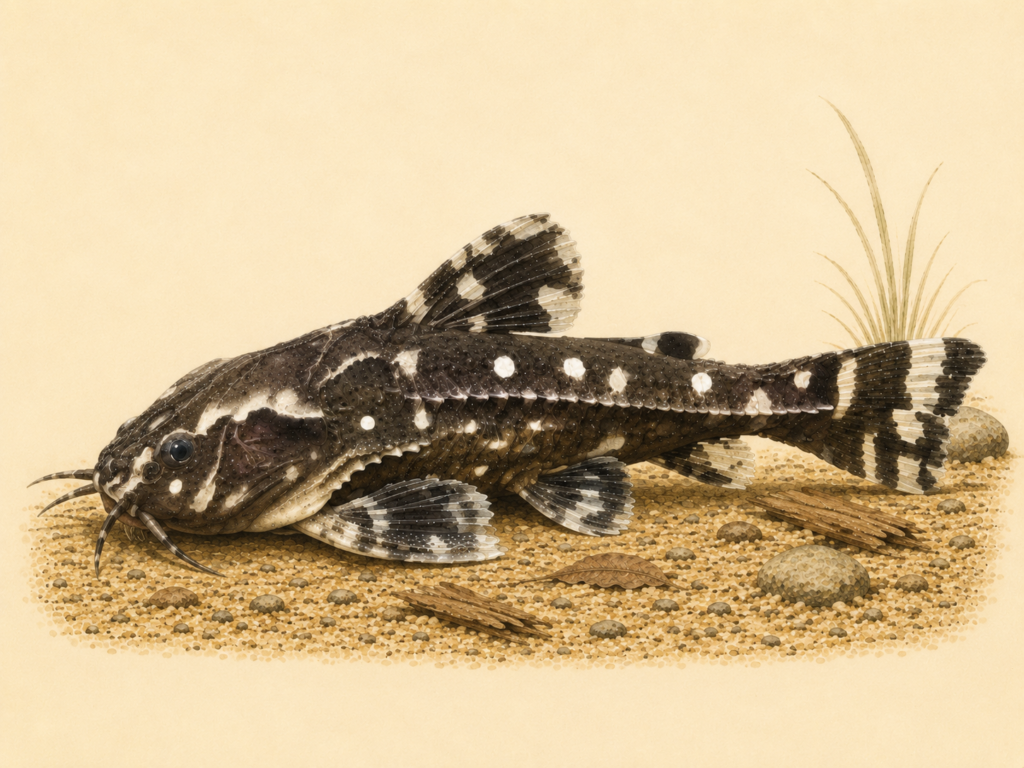
The Spotted Raphael Catfish is a stout, heavily built catfish with a somewhat flattened ventral profile and a broad, rounded head. Its body is covered in bony scutes – overlapping plates of armour that are characteristic of the Doradidae family. Along the lateral line, a row of pronounced thorny scutes runs from behind the gill covers to the base of the caudal fin, giving the fish a distinctly armoured appearance and providing effective protection against predators. These scutes have small, backward-pointing hooks that can easily become entangled in nets, so care should be taken when handling or catching this species. It is strongly recommended to use a solid container rather than a mesh net to move the fish.
The base body colour is a deep chocolate brown to almost black, overlaid with a generous scattering of white to cream-coloured spots. These spots vary in size and density between individuals, with some specimens displaying fine, pinpoint dots while others show larger, more irregularly shaped markings. The spots extend across the head, body, and fins, creating a striking contrast against the dark background. The dorsal, pectoral, and caudal fins typically feature bands or rows of spots, while the adipose fin is small and usually darkly pigmented.
The pectoral fins are notably robust, equipped with strong, serrated spines that the fish can lock in an extended position. These spines are sharp enough to puncture skin and can cause painful wounds, so bare-handed handling should be avoided. The mouth is wide and slightly subterminal, surrounded by three pairs of barbels – one pair of maxillary barbels (the longest, extending roughly to the pectoral fin base) and two pairs of mandibular barbels. These barbels are constantly in motion when the fish is foraging, helping it detect food items in low-light conditions.
Sexual dimorphism in this species is subtle. Mature females are generally broader and more rounded when viewed from above, particularly when gravid with eggs. Males tend to be slightly more slender with marginally longer pectoral fin spines, though these differences are difficult to discern in most aquarium settings. Juvenile specimens display the same spotted patterning as adults, though the contrast between spots and base colour may be somewhat sharper in younger fish.
Natural Habitat
Agamyxis pectinifrons is found across a wide swathe of the Amazon and Orinoco river basins, with records from Peru, Bolivia, Ecuador, Colombia, and Brazil. Its range overlaps with numerous other doradid species, though it tends to favour slightly different microhabitats compared to some of its relatives. The Spotted Raphael Catfish inhabits slow-moving rivers, tributaries, oxbow lakes, flooded forests, and swampy backwaters where the current is gentle and there is an abundance of submerged structure.
In its native waters, this species is typically found in areas with soft, slightly acidic to neutral water. The substrate is often composed of fine sand, mud, and a thick layer of decomposing leaf litter. Fallen trees, submerged root tangles, and dense aquatic or semi-aquatic vegetation provide the sheltered daytime retreats that this nocturnal catfish requires. During the annual flood season, these fish venture into the seasonally inundated forest (igapo and varzea habitats), where they feed on a rich bounty of invertebrates, fruits, and seeds washed into the water.
Water conditions in these habitats are characterised by warm temperatures, typically between 24 and 28 degrees Celsius, with low mineral content and stained, tannin-rich water. Light penetration is often limited due to the dense canopy overhead and the dark, humic-acid-laden water. Understanding these natural conditions is key to providing the Spotted Raphael Catfish with an environment in which it will thrive and display its most natural behaviours.
Tank Size and Setup
A minimum aquarium volume of 200 litres is recommended for a single Spotted Raphael Catfish, with larger tanks preferred if keeping more than one individual or housing them in a community setting. While this species is not an active open-water swimmer, it does grow to a reasonable size and produces a considerable bioload for a catfish of its dimensions, owing to its hearty appetite. A tank with a footprint of at least 100 cm by 40 cm provides adequate floor space for foraging.
The aquascape should prioritise shelter and hiding places above all else. Driftwood with hollows, PVC pipes, clay pots, rock caves, and densely planted areas all serve as suitable daytime retreats. It is essential to provide at least one snug hiding spot per individual, as the Spotted Raphael Catfish will become stressed and refuse food if it cannot find a secure place to rest during the day. Many keepers note that their fish will wedge itself into surprisingly tight spaces, so ensure that any caves or gaps are either large enough for the fish to enter and exit freely, or too small to attempt entry.
A soft, fine-grained substrate such as smooth sand is ideal. The Spotted Raphael Catfish actively forages along the bottom, sifting through the substrate with its sensitive barbels. Coarse or sharp gravel can damage these delicate sensory organs, potentially leading to infection. A layer of dried Indian almond leaves or oak leaves scattered over the substrate can add a naturalistic touch while also releasing beneficial tannins into the water, replicating the conditions of the fish’s native habitat.
Lighting should be subdued. This species is strictly nocturnal and will not emerge during bright daylight hours. Floating plants such as Amazon frogbit, water lettuce, or Salvinia can help diffuse overhead lighting and create a more comfortable environment. If you wish to observe your Spotted Raphael Catfish during its active period, consider installing a dim moonlight or red-spectrum LED, as these wavelengths are less disturbing to nocturnal species.
A secure lid or tight-fitting cover glass is advisable. While the Spotted Raphael Catfish is not a habitual jumper, it can occasionally attempt to climb or wedge itself into filter intakes and overflows, particularly during the first few nights in a new tank.
Water Parameters
| Temperature | 22-28 °C |
| pH | 5.8-7.5 |
| General hardness (GH) | 2-20 dGH |
| Carbonate hardness (KH) | 2-12 dKH |
| Ammonia | 0 ppm |
| Nitrite | 0 ppm |
| Nitrate | Below 30 ppm |
The Spotted Raphael Catfish is remarkably adaptable with regard to water chemistry, which is one of the reasons it has earned a reputation as a hardy aquarium resident. It will tolerate a broad range of pH and hardness values, though it shows a clear preference for softer, slightly acidic to neutral water that mirrors its Amazonian origins. An ideal target would be a pH of around 6.5 to 7.0 and a general hardness of 4-12 dGH.
Temperature stability is more important than hitting a precise figure. Aim for a consistent 24-26 degrees Celsius for everyday maintenance. The species can tolerate short-term temperature dips to around 22 degrees Celsius and increases up to 28 degrees Celsius without issue, but prolonged exposure to temperatures outside this range may suppress the immune system and increase susceptibility to disease.
Ammonia and nitrite must always be maintained at zero. Like most catfish, the Spotted Raphael is sensitive to poor water quality, particularly elevated nitrogenous waste levels. Regular partial water changes of 25-30% weekly are recommended, along with diligent maintenance of the filtration system. Nitrate should ideally be kept below 20 ppm, and certainly no higher than 30 ppm.
Filtration and Equipment
Given the Spotted Raphael Catfish’s substantial appetite and corresponding waste output, efficient biological and mechanical filtration is a necessity. A canister filter rated for the tank volume – or slightly above – is an excellent choice, offering reliable multi-stage filtration without creating excessive current in the aquarium. External canister filters also have the advantage of housing large volumes of biological media, which is beneficial for managing the bioload of a well-stocked community tank.
Internal power filters and hang-on-back filters can also be used, particularly in smaller setups, though they may struggle to keep pace with waste production in a heavily stocked aquarium. Supplementing the primary filter with a sponge filter can provide additional biological filtration and gentle aeration without creating strong water movement. The Spotted Raphael Catfish prefers calm to gently flowing water, so direct the filter outlet against the tank glass or use a spray bar to diffuse the current.
Filter intakes should be fitted with pre-filter sponges or intake guards. The Spotted Raphael Catfish is a curious and sometimes clumsy explorer, and its barbels or spines can become caught in unprotected intakes. Pre-filter sponges also serve the dual purpose of additional mechanical filtration and protecting fry (on the rare occasion that breeding occurs).
A reliable aquarium heater with a built-in thermostat is essential to maintain stable tropical temperatures. Submersible heaters are generally preferred over hang-on models for accuracy and safety. A heater guard is a worthwhile investment, as the Spotted Raphael Catfish may rest against the heater during the day, risking burns if the unit is unshielded.
An air pump with a simple air stone can enhance oxygen levels and provide gentle surface agitation, which is particularly useful in warmer weather when dissolved oxygen levels may drop. However, strong aeration that creates significant turbulence at the surface is unnecessary and may disturb this species.
Diet and Feeding
The Spotted Raphael Catfish is an omnivore with a strong carnivorous leaning. In the wild, its diet consists primarily of aquatic invertebrates, insect larvae, small crustaceans, worms, and fallen fruit or seeds. In the aquarium, this translates to a willingness to accept virtually any food offered, making it one of the easier catfish species to feed – provided the keeper accounts for its nocturnal habits.
A staple diet of high-quality sinking pellets or wafers designed for bottom-dwelling catfish forms an excellent base. Supplement this with regular offerings of frozen or live foods such as bloodworms, tubifex, brine shrimp, daphnia, and blackworms. Occasional treats of blanched vegetables – courgette (zucchini), cucumber, shelled peas, or spinach – add dietary variety and fibre. The fish will also graze on algae wafers, though it should not be relied upon as an algae-control measure.
Feed this species after lights-out, as it is overwhelmingly nocturnal and may not emerge to compete for food during the day. Dropping sinking pellets or frozen food into the tank just after the aquarium lights switch off ensures the Spotted Raphael Catfish can feed without competition from diurnal tank mates. If housed with other nocturnal species, ensure that sufficient food reaches all individuals.
Overfeeding should be avoided. While the Spotted Raphael Catfish is a voracious eater that will consume far more than it needs if given the opportunity, excess food leads to obesity, fatty liver disease, and degraded water quality. Feed an amount the fish can consume within a few minutes, once daily or every other day for adults. Juvenile specimens benefit from more frequent, smaller meals to support their growth.
Behaviour and Temperament
The Spotted Raphael Catfish is a peaceful, reclusive, and predominantly nocturnal species. During daylight hours, it will be almost invisible in a well-decorated aquarium, tucked deep inside a cave, lodged beneath driftwood, or buried partially in the substrate. New keepers sometimes worry that their fish has escaped or died, only to discover it wedged into a hiding spot they did not even know existed. This is entirely normal behaviour and should not be a cause for concern.
As twilight falls, the Spotted Raphael Catfish becomes active, methodically patrolling the substrate and probing every surface with its barbels in search of food. It moves with a deliberate, unhurried gait, occasionally pausing to investigate a particular area more thoroughly. This foraging behaviour is a delight to observe and is one of the species’ most appealing characteristics for those who enjoy evening aquarium viewing.
This species is generally tolerant of conspecifics, though it is not truly social in the way that some shoaling catfish are. Multiple individuals can be kept together provided there are enough hiding places for each fish to claim its own territory. Squabbles are rare and typically limited to mild jostling at feeding time or brief disputes over a favoured hiding spot. They do not inflict harm on one another during these interactions.
One of the most distinctive behaviours of the Spotted Raphael Catfish – and indeed the entire Doradidae family – is its ability to produce sounds. When disturbed, handled, or sometimes when feeding, the fish generates audible clicking, croaking, or grunting sounds. These vocalisations are produced by two mechanisms: stridulation of the pectoral fin spines against the pectoral girdle, and rapid contraction of muscles attached to the swim bladder. While this is an interesting feature, it is also a reminder that the fish is stressed, so unnecessary handling should be minimised.
The Spotted Raphael Catfish is extremely long-lived for an aquarium fish. Specimens kept in good conditions routinely reach 10-15 years of age, and there are credible reports of individuals surviving for 20 years or more. This longevity means that acquiring one is a significant commitment, and prospective keepers should be prepared for a long-term relationship with their fish.
Tank Mates
The Spotted Raphael Catfish is an excellent community fish owing to its peaceful nature and nocturnal habits, which mean it rarely interacts with diurnal species during their most active period. It can be housed with a wide variety of similarly sized, non-aggressive freshwater fish. The main considerations when selecting tank mates are to avoid species small enough to be swallowed (the Spotted Raphael has a surprisingly large mouth for its body size and will consume very small fish overnight), and to avoid overly aggressive or territorial species that might harass a slow-moving, armoured catfish.
Good tank mates
- Striped Raphael Catfish – A close relative with almost identical care requirements and a similarly peaceful disposition, making for a natural pairing.
- Angelfish – Their mid-water swimming zone and calm temperament complement the bottom-dwelling, nocturnal habits of the Spotted Raphael well.
- Bristlenose Pleco – Another peaceful bottom-dweller that occupies a different feeding niche, reducing competition.
- Severum – A large, generally peaceful cichlid that coexists well with robust catfish in spacious tanks.
- Congo Tetra – A mid-sized schooling tetra too large to be eaten and active during the day when the catfish is resting.
- Pearl Gourami – A gentle, slow-moving gourami that occupies the upper water column and poses no threat to a nocturnal catfish.
- Kuhli Loach – A peaceful, nocturnal bottom-dweller that can share the substrate without conflict, provided the tank is large enough.
- Corydoras Catfish – Sociable and peaceful bottom-dwellers that cohabit well with Raphael catfish in community setups.
Fish to avoid
- Oscar – Large, aggressive, and territorial cichlids that may harass or injure the Spotted Raphael, particularly during feeding.
- Neon Tetra – Far too small and will likely be eaten overnight by the opportunistic Spotted Raphael Catfish.
- Red Tail Catfish – Grows to an enormous size and will eventually view the Spotted Raphael as prey.
- Flowerhorn – Highly aggressive and territorial, posing a serious risk of injury to slower, peaceful species.
- Jaguar Cichlid – A large, predatory cichlid with a temperament incompatible with peaceful community fish.
- Endler’s Livebearer – Extremely small and will be consumed by the Spotted Raphael during its nocturnal foraging.
- Green Terror – An aggressive cichlid that may bully and stress a peaceful, slow-moving catfish.
- Celestial Pearl Danio – Too diminutive to be safely housed with a catfish capable of swallowing small fish whole.
Breeding
Breeding the Spotted Raphael Catfish in captivity is exceptionally difficult and is very rarely achieved in home aquaria. The vast majority of specimens available in the trade are wild-caught, and there is limited documented success with captive spawning outside of commercial breeding operations that use hormonal induction. For this reason, breeding difficulty is rated as expert level.
In the wild, spawning is thought to be triggered by the onset of the rainy season, which brings a combination of environmental cues: rising water levels, a drop in water hardness and conductivity, a slight decrease in temperature followed by gradual warming, and an increase in available food. Replicating these conditions in an aquarium setting is challenging but not impossible in theory.
To attempt breeding, begin with a group of at least four to six individuals to increase the likelihood of having both sexes represented. Condition the group heavily with high-protein live and frozen foods for several weeks. Gradually lower the water level in the tank by approximately 30-40%, then perform a series of large water changes with soft, slightly cooler water over the course of several days, simulating the influx of rainwater. Increasing aeration and slightly raising the temperature after this “rain” period may also help stimulate spawning behaviour.
Agamyxis pectinifrons is reported to be a bubble-nest builder, with the male constructing a nest of bubbles among floating vegetation or surface debris. The female deposits eggs into the nest, which the male then guards. However, detailed accounts of successful aquarium spawnings are scarce, and much of the available information is extrapolated from related doradid species or anecdotal reports.
If spawning does occur, the eggs are small and adhesive, typically hatching within 48-72 hours depending on temperature. The fry are tiny and require infusoria or commercially available liquid fry food for the first few days, transitioning to newly hatched brine shrimp (Artemia nauplii) as they grow. Given the rarity of successful spawning, any keeper who manages to breed this species is encouraged to document the process thoroughly for the benefit of the wider hobby.
Common Diseases
The Spotted Raphael Catfish is a hardy species with good disease resistance when maintained in clean, stable water conditions. However, like all aquarium fish, it is not immune to illness, and its armoured body and nocturnal habits can make early detection of disease more challenging than with more visible species.
Ich (white spot disease) is one of the more common ailments that can affect this catfish. The characteristic white cysts are sometimes difficult to spot on the dark, textured skin, so keepers should look for behavioural cues such as flashing (rubbing against objects), clamped fins, and loss of appetite. Treatment should be approached with caution, as scaleless and armoured catfish can be sensitive to certain medications. Avoid copper-based treatments and use medications at half the recommended dose unless the product is specifically labelled as safe for scaleless fish. Raising the temperature to 28-30 degrees Celsius and adding aquarium salt at a low concentration (1-2 grams per litre) can be an effective first-line treatment.
Bacterial infections, including fin rot and skin ulcers, can occur in fish kept in poor water conditions or those that have sustained physical injuries. The Spotted Raphael’s bony armour offers some protection against abrasion, but the barbels and soft tissue around the mouth are vulnerable. Maintaining pristine water quality is the best preventative measure, and mild infections often resolve with improved husbandry alone. More severe cases may require treatment with antibacterial medications safe for catfish.
Fungal infections, recognisable as cotton-like white growths on the skin or fins, are typically secondary to an existing injury or bacterial infection. Treat with antifungal medications appropriate for scaleless fish and address the underlying cause to prevent recurrence.
Internal parasites can be a concern with wild-caught specimens. Signs include weight loss despite a healthy appetite, bloating, or stringy white faeces. A prophylactic deworming treatment upon acquisition, using a praziquantel-based medication, is a sensible precaution for any newly imported wild-caught catfish.
Obesity and fatty liver disease are less dramatic but very real risks for this species in captivity. The Spotted Raphael Catfish has a voracious appetite and will readily overeat. A varied diet with appropriate portion control and regular fasting days (one to two per week) helps maintain a healthy body condition.
FAQs
Why does my Spotted Raphael Catfish make croaking or clicking sounds?
This is a natural behaviour common to all members of the Doradidae family. The sounds are produced by the fish locking and rubbing its pectoral fin spines against the pectoral girdle (stridulation) and by vibrating muscles attached to the swim bladder. It typically occurs when the fish is handled, startled, or occasionally when it is actively feeding. While the sounds are fascinating to hear, they usually indicate that the fish is stressed or alarmed, so try to minimise disturbances that trigger the behaviour.
I never see my Spotted Raphael Catfish – is something wrong?
Almost certainly not. The Spotted Raphael Catfish is one of the most strictly nocturnal species commonly kept in home aquaria. It will spend the entire daylight period hidden away in the darkest, most secluded spot it can find. This is completely normal and healthy behaviour. To observe your fish, try viewing the tank with a dim red or blue light after the main aquarium lights have been off for at least 30 minutes. You will likely find it actively foraging along the substrate.
Can I keep more than one Spotted Raphael Catfish together?
Yes, this species is tolerant of conspecifics and can be kept in groups. While it is not a shoaling species and does not require the company of its own kind, multiple individuals will coexist peacefully provided each fish has access to its own hiding spot. In larger tanks of 300 litres or more, a group of three to five individuals can make for a rewarding display, particularly during their evening active period when they may forage in loose proximity to one another.
Is the Spotted Raphael Catfish safe for a planted aquarium?
Generally, yes. The Spotted Raphael Catfish does not deliberately uproot or consume aquatic plants. However, its nocturnal foraging can involve some substrate disturbance, which may occasionally dislodge newly planted or poorly rooted specimens. Established, well-rooted plants are typically left alone. Hardy species such as Anubias, Java Fern, and Vallisneria are excellent choices that can withstand the occasional bump from a large catfish. Floating plants are particularly useful for providing shade and reducing light levels.
How do I safely catch or move a Spotted Raphael Catfish?
Never use a standard mesh net to catch a Spotted Raphael Catfish. Its serrated pectoral fin spines will become hopelessly entangled in the netting, potentially injuring the fish and damaging the net. Instead, guide the fish into a solid plastic container or jug submerged in the water. If you must handle the fish directly, use thick, wet gloves, and be aware that the spines can puncture skin. Allow the fish to relax its spines before attempting to move it, and never force a spine that is locked in position.
Related Guides
- Striped Raphael Catfish – The most closely related and commonly kept doradid catfish, sharing nearly identical care requirements and temperament.
- Bristlenose Pleco – Another popular armoured catfish that pairs well with the Spotted Raphael in community setups.
- Corydoras Catfish – A widely kept group of peaceful bottom-dwelling catfish with overlapping habitat preferences.
- Angelfish – A classic South American cichlid that makes an excellent mid-water companion for large, peaceful catfish.
- Kuhli Loach – Another nocturnal bottom-dweller that shares many behavioural traits and housing requirements with Raphael catfish.