Quick Summary
The African Banded Barb is a peaceful, hardy shoaling fish that thrives in groups of six or more in a well-planted community tank with soft, slightly acidic water – an excellent choice for beginners and experienced keepers alike who want a colourful, active species without the aggression sometimes associated with other barbs.
🐠 Build a tank around this species
In this guide:
- Introduction
- Quick Stats
- Appearance
- Natural Habitat
- Tank Size and Setup
- Water Parameters
- Diet and Feeding
- Behaviour and Temperament
- Tank Mates
- Breeding
Introduction
The African Banded Barb (Barbus fasciolatus) is one of those understated gems that never seems to receive the attention it deserves in the freshwater hobby. While Asian barbs such as Tiger Barbs and Cherry Barbs dominate the popular imagination, this small African species offers vibrant colour, gentle temperament, and fascinating shoaling behaviour in a manageable package. Native to slow-moving, densely vegetated waterways across parts of East and Central Africa, it brings a taste of the continent’s rich aquatic biodiversity to the home aquarium.
Reaching a modest adult size of around 5-6 cm, the African Banded Barb is well suited to community tanks of moderate size. Its peaceful disposition means it rarely bothers tank mates, and its preference for swimming in tight, coordinated groups makes a shoal of these fish a genuinely captivating centrepiece. Males, especially when in breeding condition, develop a striking orange-red colouration along their flanks and fins that contrasts beautifully against a backdrop of lush aquatic plants.
It is worth noting that some recent taxonomic literature places this species under the genus Enteromius rather than Barbus. However, Barbus fasciolatus remains the standard name used across the aquarium trade and the vast majority of hobbyist references, so that is the convention followed throughout this guide. If you encounter the name Enteromius fasciolatus in scientific papers or newer databases, rest assured it refers to the same fish.
For aquarists looking for a community-friendly, relatively undemanding species that rewards good husbandry with stunning colour and engaging behaviour, the African Banded Barb is an outstanding choice. This guide covers everything you need to know to keep and breed them successfully.
Quick Stats
| Scientific name | Barbus fasciolatus |
|---|---|
| Common names | African Banded Barb, Banded Barb, Angola Barb |
| Family | Cyprinidae |
| Origin | East and Central Africa (Angola, Zambia, DR Congo, Zimbabwe, Mozambique) |
| Adult size | 5.5 cm |
| Lifespan | 4–6 years |
| Difficulty | Easy |
| Breeding difficulty | Moderate |
| Temperature | 22–26 °C |
| pH | 6–7 |
| GH | 2–10 dGH |
| KH | 1–6 dKH |
| Minimum tank size | 80 L |
| Conservation status | Least Concern (IUCN) |
Appearance
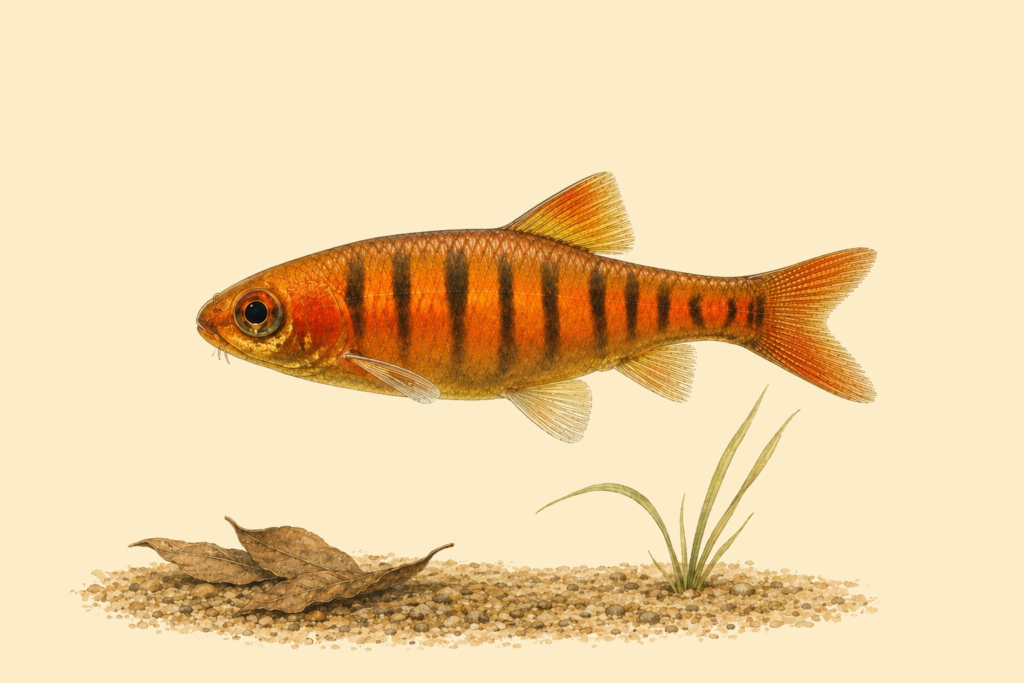
The African Banded Barb is a slender, laterally compressed fish with a body shape typical of the smaller cyprinids. Its most distinctive feature is a series of dark vertical bars – usually between 10 and 14 – that run along the length of the body from just behind the gill cover to the base of the caudal fin. These bands sit against a base colour that ranges from golden-olive to a warm yellowish-bronze, giving the fish a subtle but attractive patterning even when not in peak condition.
Males are the more colourful sex, particularly during the breeding season or when kept in optimal conditions. Their base colour intensifies to a rich orange or orange-red, and the fins take on a warm reddish hue. The vertical bands remain dark and prominent, creating a vivid contrast against the brighter body colour. Females are typically a little plumper and display a more subdued golden or olive tone with less red suffusion, though they retain the characteristic banding.
The fins are relatively short and rounded, with the dorsal fin set roughly at the midpoint of the body. The caudal fin is forked but not deeply so. Both sexes have a small pair of barbels at the corners of the mouth, though these can be difficult to spot without close observation. The eyes are proportionately large, lending the fish an alert, lively appearance.
Overall, the African Banded Barb is not a fish that screams for attention from across the room, but its beauty reveals itself in a well-lit, planted tank where the warm tones of a healthy shoal catch the light. A group of males in breeding dress is genuinely striking and well worth the modest effort required to bring them into peak condition.
Natural Habitat
Barbus fasciolatus is found across a broad swathe of East and Central Africa, with records from Angola, Zambia, the Democratic Republic of the Congo, Zimbabwe, and Mozambique. Its range encompasses several major river systems, including tributaries of the Zambezi, the Okavango, and the Congo basin. This wide distribution accounts for its Least Concern conservation status, though localised populations may face pressures from habitat degradation.
In the wild, the African Banded Barb inhabits slow-moving streams, marshy floodplains, and the shallow, vegetated margins of rivers and pools. These environments are typically characterised by dense stands of aquatic and semi-aquatic vegetation, providing shelter, spawning sites, and rich feeding grounds. The substrate is often composed of fine sand, mud, or a layer of decomposing leaf litter, which contributes tannins and humic acids to the water. This creates the slightly acidic, soft, tea-coloured conditions often described as blackwater or brownwater habitats.
Water in these habitats tends to be warm, soft, and slightly acidic, with minimal current. Overhead canopy from surrounding vegetation often filters sunlight, meaning ambient light levels can be relatively low. Understanding this natural environment is key to replicating conditions that bring out the best in this species in captivity. Dense planting, soft and slightly acidic water, gentle flow, and subdued lighting will all help the African Banded Barb feel secure and display its finest colours.
Tank Size and Setup
A minimum tank size of 80 litres is recommended for a group of six African Banded Barbs. This provides enough horizontal swimming space for the shoal to move naturally and reduces the likelihood of stress-related issues. If you plan to keep a larger group – which is always encouraged with shoaling species – or wish to house them in a community setting with other species, a tank of 120-150 litres or more is preferable.
The African Banded Barb is best displayed in a well-planted aquarium that mimics its natural habitat. Use a dark, fine-grained substrate such as sand or smooth gravel, ideally in a natural brown or dark colour to replicate the muddy or leaf-littered bottoms of its native streams. A layer of dried Indian almond leaves or oak leaves scattered across the substrate will release tannins that soften and slightly acidify the water, closely replicating the blackwater conditions this species prefers. The tannin-stained water also tends to bring out richer colouration in the fish.
Planting should be dense, particularly around the sides and rear of the tank, with open swimming space preserved in the centre and front. Species such as Vallisneria, Cryptocoryne, Java Fern, and Anubias all work well and tolerate the softer water conditions. Floating plants like Amazon Frogbit or Water Lettuce are highly recommended, as they diffuse overhead light and create the dappled, shaded conditions the African Banded Barb encounters in the wild. Under subdued lighting, these fish are noticeably more confident, spending more time in the open and displaying brighter colours.
Include some pieces of bogwood or driftwood to provide additional structure and visual barriers. These also leach tannins into the water, complementing the leaf litter. Avoid sharp or abrasive decor, as the fish may occasionally dart into cover when startled.
A tight-fitting lid is advisable. While the African Banded Barb is not a habitual jumper, most small barbs can and do leap when startled or during energetic chasing behaviour, particularly at feeding time or during breeding activity.
Water Parameters
The African Banded Barb is adapted to soft, slightly acidic water in the wild, and replicating these conditions in captivity will yield the best results in terms of health, colouration, and breeding potential. That said, captive-bred specimens tend to be reasonably adaptable and will tolerate a modest range of water chemistry provided extremes are avoided and conditions remain stable.
| Temperature | 22-26 °C |
| pH | 6.0-7.0 |
| General hardness (GH) | 2-10 dGH |
| Carbonate hardness (KH) | 1-6 dKH |
| Ammonia | 0 ppm |
| Nitrite | 0 ppm |
| Nitrate | Below 20 ppm |
Ammonia and nitrite must always be maintained at 0 ppm. These compounds are toxic to all freshwater fish, and the African Banded Barb is no exception. Nitrate, while less immediately toxic, should be kept as low as practicable – ideally below 20 ppm – through regular partial water changes and good filtration.
Stability is more important than hitting an exact number. Sudden swings in pH or temperature are far more stressful and dangerous to fish than parameters that sit slightly outside the textbook ideal but remain consistent. Aim for a temperature around 24 °C and a pH of 6.5 as a good target, adjusting gradually if needed. If your tap water is moderately hard or neutral, the addition of peat filtration, Indian almond leaves, or a suitable water conditioner can help soften and acidify it gently.
Perform weekly water changes of 20-30% to maintain water quality. Use dechlorinated water matched as closely as possible to the tank’s temperature and chemistry. In heavily planted tanks with low stocking levels, nitrate accumulation tends to be slower, but regular changes remain essential for removing dissolved organic compounds and replenishing trace minerals.
Filtration and Equipment
The African Banded Barb comes from slow-moving or near-still waters, so filtration should be effective without creating excessive current. A quality hang-on-back filter, sponge filter, or small canister filter rated for the tank’s volume will all work well. If using a filter that produces a strong outflow, baffle the output with a spray bar, sponge, or by directing it against the glass to diffuse the flow. The fish should be able to swim comfortably without being pushed around by the current.
Sponge filters are an especially good choice for tanks housing these barbs, particularly if breeding is a goal. They provide gentle, reliable biological filtration without the risk of fry being sucked into an intake. An air-driven sponge filter also adds gentle aeration to the water without disturbing the surface excessively.
A reliable heater with a thermostat is essential to maintain stable temperatures within the 22-26 °C range. Choose a heater appropriately sized for the tank volume and check it regularly with an independent thermometer. Sudden temperature drops, particularly overnight, can stress the fish and make them more susceptible to disease.
Lighting should be moderate to subdued. Bright overhead lighting tends to make the African Banded Barb skittish and washes out its colouration. If you are growing live plants that require higher light levels, use floating plants to shade the water column beneath. LED units with adjustable intensity or a timer that provides a gradual sunrise and sunset effect are ideal.
Diet and Feeding
The African Banded Barb is an omnivore with a natural diet that includes small invertebrates, insect larvae, algae, plant matter, and organic detritus. In the aquarium, it is a thoroughly undemanding feeder that will accept a wide range of commercially prepared and live or frozen foods.
A high-quality micro-pellet or crushed flake food designed for small tropical fish should form the staple diet. Look for products with a good balance of protein and plant-based ingredients, and avoid those heavily padded with fillers or artificial colours. Feed once or twice daily in small amounts that the fish can consume within two to three minutes. Overfeeding is a common cause of water quality problems and should be avoided.
Supplement the staple diet regularly with live or frozen foods such as daphnia, baby brine shrimp (Artemia nauplii), bloodworm, mosquito larvae, and micro worms. These protein-rich foods are excellent for conditioning fish for breeding and for maintaining vibrant colouration. The African Banded Barb is small-mouthed, so ensure that all food items are appropriately sized – crush larger pellets or flakes if necessary, and choose small-grade frozen foods.
Blanched vegetable matter such as tiny pieces of courgette, spinach, or shelled pea can be offered occasionally to provide dietary fibre and plant nutrients. In a well-planted tank, the fish will also graze on biofilm and soft algae that develop naturally on surfaces, supplementing their diet without any intervention from the keeper.
Variety is key. A diverse diet ensures the fish receive a full spectrum of vitamins, minerals, and amino acids, supporting immune function, growth, and reproductive health. Rotating between two or three different staple foods and offering live or frozen treats two to three times per week is a good routine.
Behaviour and Temperament
The African Banded Barb is a genuinely peaceful species that ranks among the most community-friendly barbs available in the hobby. Unlike some of its more boisterous Asian relatives – the Tiger Barb being the most notorious example – it shows virtually no tendency toward fin-nipping or aggression towards tank mates. This makes it a safe companion for long-finned or slow-moving species that would be vulnerable to harassment by more assertive barbs.
This is a strongly shoaling species, and keeping it in a group of at least six is essential. In smaller numbers, individual fish become stressed, withdrawn, and prone to hiding. They may also display faded colours and reduced activity. In a group of six or more – ideally ten or more if space permits – the fish form a cohesive, active shoal that moves through the tank together. Males within the group will engage in gentle sparring and display behaviour, flaring their fins and intensifying their colour to establish a loose hierarchy. These interactions are harmless and entertaining to watch.
The African Banded Barb occupies primarily the middle and lower levels of the water column, though it will venture to the surface at feeding time and occasionally explore all levels of a well-planted tank. It is a moderately active swimmer – not as frenetic as some barbs, but far from sedentary. A tank with adequate horizontal swimming room is important to allow the shoal to behave naturally.
When first introduced to a new tank, the African Banded Barb can be somewhat shy, spending time hidden amongst plants or behind decor. This is normal and usually resolves within a few days as the fish acclimatise. Subdued lighting, dense planting, and the presence of a good-sized group all accelerate this settling-in process. Once established, the fish become confident, bold, and interactive, often approaching the front of the tank when their keeper is nearby – particularly around feeding time.
Tank Mates
The African Banded Barb’s peaceful nature and modest size make it compatible with a wide range of community fish. The ideal tank mates are species of similar size and temperament that share a preference for soft, slightly acidic water. Avoid housing it with large, aggressive, or predatory species, or with very boisterous fish that might out-compete it for food or cause stress through relentless chasing. Likewise, avoid very large or territorial cichlids that might view the barb as prey or a territorial intruder.
Good tank mates
- Congo Tetra – A fellow African species with similar water preferences; its peaceful nature and mid-water swimming complement the barb well.
- Cardinal Tetra – Shares the preference for soft, acidic water and occupies the mid to lower water column without competing for space.
- Rummy-Nose Tetra – Another tight-shoaling species that thrives in similar conditions and adds visual contrast.
- Kribensis Cichlid – A small, relatively peaceful African dwarf cichlid that coexists well with barbs outside of breeding periods.
- Bristlenose Pleco – A gentle bottom-dweller that occupies a different niche and helps with algae management.
- Corydoras sterbai – A peaceful, bottom-dwelling catfish that tolerates the warmer end of the barb’s temperature range.
- Harlequin Rasbora – A similarly sized, gentle shoaling fish that enjoys soft water and planted environments.
- African Dwarf Frog – A calm, small amphibian that cohabits peacefully and adds interest to the lower levels of the tank.
Fish to avoid
- Tiger Barb – Despite being a barb, its notorious fin-nipping and boisterous behaviour can stress the more gentle African Banded Barb.
- Oscar – Far too large and predatory; the African Banded Barb would be viewed as food.
- Jack Dempsey – Highly territorial and aggressive, completely unsuitable for housing with small, peaceful species.
- Jewel Cichlid – An aggressive African cichlid, especially when breeding, that will harass and potentially kill small barbs.
- Red-Tail Shark – Territorial and prone to chasing similarly sized tank mates, particularly in smaller tanks.
- Flowerhorn – An extremely aggressive, large cichlid wholly incompatible with any small, peaceful community fish.
Breeding
Breeding the African Banded Barb in captivity is achievable and represents a rewarding challenge for the hobbyist willing to set up appropriate conditions. Like most small barbs, it is an egg-scattering species with no parental care – adults will readily consume their own eggs if given the opportunity, so a degree of planning is necessary to protect the spawn.
Begin by conditioning a group of adults with frequent feedings of high-quality live and frozen foods such as daphnia, baby brine shrimp, and bloodworm. Over the course of one to two weeks, males will develop intensified orange-red colouration and become noticeably more active in displaying to females. Females will fill out visibly as they develop eggs, appearing rounder when viewed from above.
Set up a dedicated breeding tank of around 30-40 litres with a thin layer of fine-leaved plants or spawning mops on the bottom. Java moss is ideal, as it provides a dense matrix that traps eggs and makes it harder for adults to find and eat them. Alternatively, a mesh or grid placed just above the substrate can allow eggs to fall through to safety. The water in the breeding tank should be soft (2-4 dGH), slightly acidic (pH 6.0-6.5), and warmed to around 25-26 °C. Gentle filtration via a small air-driven sponge filter is sufficient.
Introduce a well-conditioned pair or a small group (two males and three females works well) into the breeding tank in the evening. Spawning typically occurs at first light the following morning. The males will chase and display to the females, and eggs are scattered amongst the plants or over the substrate during brief embraces. A single spawning event can produce 50-200 small, adhesive eggs.
Remove the adults immediately after spawning to prevent egg predation. The eggs are small and translucent, and they typically hatch within 24-48 hours depending on temperature. The fry are tiny and will initially feed on their yolk sacs for a further day or two before becoming free-swimming. First foods should be infusoria, liquid fry food, or very finely powdered dry food, graduating to newly hatched brine shrimp nauplii after a week or so as the fry grow large enough to take them.
Maintain excellent water quality in the rearing tank with small, frequent water changes using water matched to the tank’s parameters. Growth is relatively steady, and the fry will begin to show the characteristic vertical banding within a few weeks. They can typically be introduced to the main community tank once they are large enough not to be eaten by adult fish – usually at around 1.5-2 cm in length.
Common Diseases
The African Banded Barb is a robust species that is not especially prone to disease when kept in clean, stable conditions. However, like all aquarium fish, it can fall victim to a range of common ailments if water quality deteriorates, the fish is stressed, or new arrivals introduce pathogens.
Ichthyophthirius multifiliis, commonly known as white spot or ich, is perhaps the most frequently encountered disease in freshwater aquariums. It presents as small white cysts on the fins and body, and affected fish may flash (rub against surfaces) or become lethargic. Treatment involves raising the water temperature gradually to 28-30 °C over 24-48 hours (to speed up the parasite’s life cycle) in combination with a proprietary white spot medication or a carefully dosed salt treatment. The African Banded Barb tolerates the elevated temperatures well for short treatment periods.
Fin rot, characterised by fraying, discolouration, or erosion of the fin edges, is almost always a secondary symptom of poor water quality or bacterial infection. Address the underlying cause – typically elevated ammonia, nitrite, or nitrate – and treat with an antibacterial medication if the condition does not resolve with improved water conditions alone.
Velvet disease (Oodinium) can occasionally affect small cyprinids. It presents as a fine, gold or rust-coloured dusting on the skin and fins, often accompanied by rapid gill movement and clamped fins. It is treated with copper-based medications, but take care to follow dosing instructions precisely, as copper can be harmful to invertebrates and sensitive fish at higher concentrations.
Internal parasites may occasionally be a concern, particularly with wild-caught specimens. Symptoms include weight loss despite normal feeding, white or stringy faeces, and a generally emaciated appearance. Treat with an appropriate anti-parasitic medication designed for internal worms or flagellates.
Prevention is always preferable to treatment. Quarantine all new fish for at least two weeks before adding them to an established community tank. Maintain stable, clean water conditions through regular partial water changes and good filtration. Feed a varied, nutritious diet to support a strong immune system. Avoid overstocking, which increases the bioload and the risk of disease transmission.
FAQs
How many African Banded Barbs should I keep together?
A minimum of six is recommended, with larger groups of ten or more being even better. As a shoaling species, the African Banded Barb needs the company of its own kind to feel secure and to exhibit natural behaviour. Keeping fewer than six typically results in stressed, pale, and inactive fish that spend most of their time hiding.
Can I keep African Banded Barbs in hard, alkaline water?
While captive-bred specimens can tolerate moderately hard water, they genuinely do best in soft, slightly acidic conditions. Very hard or alkaline water (above 12 dGH or pH 7.5+) is likely to dull their colouration, reduce their lifespan, and make breeding extremely unlikely. If your tap water is hard, consider using a blend of RO (reverse osmosis) water and tap water to bring the hardness and pH down to more suitable levels.
Are African Banded Barbs fin-nippers?
No. Unlike some of the more boisterous barb species, the African Banded Barb is notably gentle and shows virtually no tendency toward fin-nipping. It is safe to keep with long-finned species such as guppies, bettas (with caution regarding the betta’s temperament rather than the barb’s), and angelfish, provided other compatibility factors are met.
Do African Banded Barbs need a planted tank?
While they can survive in a sparsely decorated tank, they will not thrive in one. Dense planting provides the security, shade, and environmental complexity this species relies on to feel confident and display its best colours. A planted tank also supports better water quality through nutrient uptake and provides natural grazing surfaces. For the best results, a well-planted setup is strongly recommended rather than optional.
Is Barbus fasciolatus the same as Enteromius fasciolatus?
Yes. Some recent taxonomic revisions have placed many small African barbs, including this species, into the genus Enteromius. However, Barbus fasciolatus remains the name most widely used in the aquarium trade, in hobbyist literature, and across most online databases. Both names refer to the same fish, and you may encounter either when researching or purchasing this species.
Related Guides
- Cherry Barb – Another small, peaceful barb species with similarly easy care requirements, offering a useful comparison for keepers choosing between community barbs.
- Congo Tetra – A popular African tetra that shares water parameter preferences and makes an excellent tank mate for the African Banded Barb.
- Kribensis Cichlid – A small African cichlid well suited to the same soft, acidic water conditions, and a compatible community companion.
- Cardinal Tetra – A classic soft-water community fish whose care requirements closely overlap with those of the African Banded Barb.
- Harlequin Rasbora – A gentle, similarly sized shoaling species that thrives in planted, soft-water setups alongside small barbs.