Quick Summary
The Blue Panchax is a hardy, colourful surface-dwelling killifish that thrives in a wide range of water conditions, making it an excellent choice for beginners – but it will eat very small tankmates and is a determined jumper, so a tight-fitting lid and sensibly sized companions are essential.
🐠 Build a tank around this species
In this guide:
- Introduction
- Quick Stats
- Appearance
- Natural Habitat
- Tank Size and Setup
- Water Parameters
- Diet and Feeding
- Behaviour and Temperament
- Tank Mates
- Breeding
Introduction
The Blue Panchax (Aplocheilus panchax) is one of the most widespread and adaptable killifish relatives in the freshwater hobby. Found across a vast swathe of South and Southeast Asia – from India and Sri Lanka through to Myanmar, Thailand, Malaysia and Indonesia – it has been a staple of the aquarium trade for well over a century. Unlike many killifish, it is not an annual species and does not require specialised drying periods or peat-based substrates to breed, which removes one of the biggest barriers that put newcomers off keeping killies.
What makes the Blue Panchax particularly appealing is its combination of visual charm and genuine toughness. It tolerates a remarkably broad range of pH, hardness and temperature values, thrives on a simple diet, and rarely succumbs to disease in a well-maintained tank. It occupies the top layer of the water column almost exclusively, which means it fills a niche that many community fish leave empty. Its upturned mouth is perfectly adapted for snatching insects and other small prey from the surface film, giving it a distinctive hunting posture that is endlessly entertaining to watch.
There is, however, an important caveat. The Blue Panchax is an opportunistic predator. While it is peaceful towards fish of a similar size, it will readily consume anything small enough to fit in its mouth – including the fry of other species and very small adult fish such as Microrasbora or newborn livebearers. It is also a remarkably capable jumper. Any aquarium housing this species must have a secure, well-fitting lid with no gaps, or losses are virtually guaranteed. With these two caveats understood and managed, the Blue Panchax is a superb beginner species and a rewarding fish to keep for aquarists of any experience level.
Quick Stats
| Scientific name | Aplocheilus panchax |
|---|---|
| Common names | Common Panchax, Blue-eye Panchax, Indian Blue Panchax |
| Family | Aplocheilidae |
| Origin | South and Southeast Asia (India, Sri Lanka, Nepal, Bangladesh, Myanmar, Thailand, Malaysia, Indonesia) |
| Adult size | 7.5 cm |
| Lifespan | 3–5 years |
| Difficulty | Easy |
| Breeding difficulty | Easy |
| Temperature | 20–28 °C |
| pH | 6–8 |
| GH | 5–20 dGH |
| KH | 3–15 dKH |
| Minimum tank size | 60 L |
| Conservation status | Least Concern (IUCN) |
Appearance
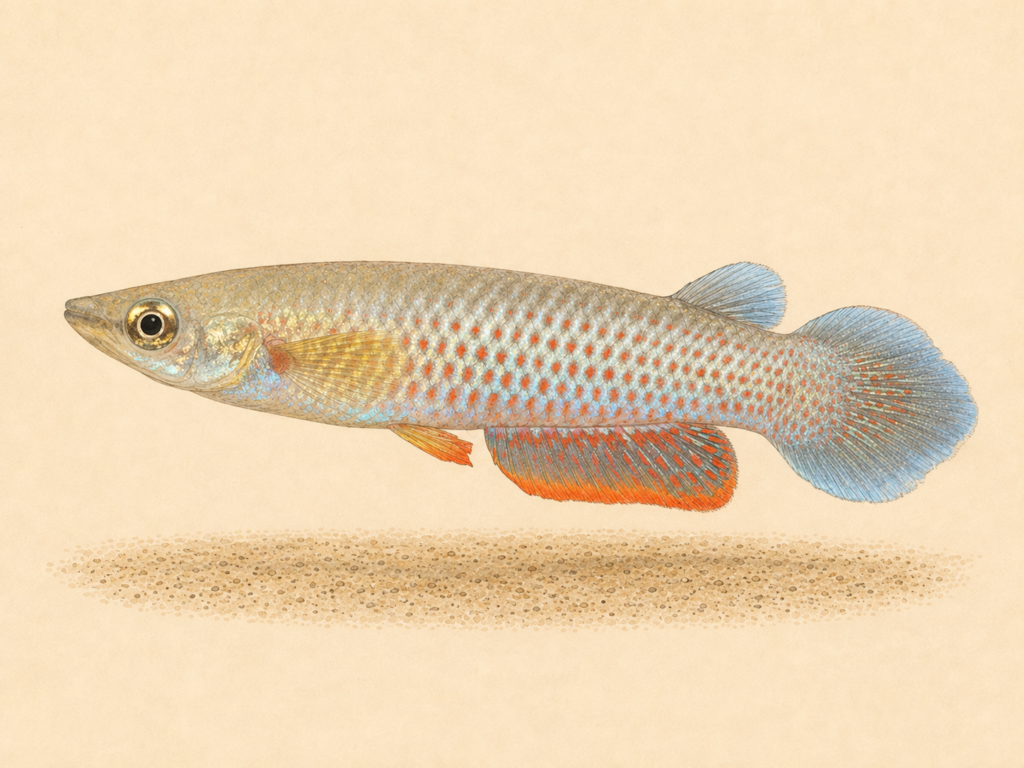
The Blue Panchax has a streamlined, torpedo-shaped body that is slightly flattened on top – a classic adaptation for life at the water’s surface. The head is broad and flat, with a distinctly upward-facing mouth designed for taking food from the surface film. The eyes are large and prominently positioned, and in many specimens they display a striking iridescent blue-green sheen that gives the species one of its common names.
The base body colour is typically a pale silvery-green to yellowish-green, overlaid with a subtle blue iridescence that is most visible under good lighting and against a dark background. The scales have a slightly metallic quality, catching and reflecting light as the fish moves. A faint dark horizontal stripe may run along the flanks in some populations, though this is often barely visible in well-fed, healthy specimens.
The dorsal fin is set well back on the body, positioned close to the caudal peduncle – a characteristic feature of the Aplocheilidae family. The caudal fin is rounded to slightly pointed and may display yellow, orange or reddish edging depending on the population and the individual’s condition. The anal fin is relatively long-based and often carries similar warm tones. Males tend to be more colourful than females, with bolder fin colouration and a more intense body sheen. Females are generally slightly plumper when in breeding condition and have more muted colouration overall.
One of the most distinctive features of the Blue Panchax is a small but conspicuous dark spot at the base of the dorsal fin. This ocellus is present in most specimens and helps distinguish the species from some of its close relatives. Some populations also display a faint orange or reddish margin to the dorsal fin, adding to the overall attractiveness of this understated but genuinely handsome fish.
Natural Habitat
The Blue Panchax has one of the most extensive natural ranges of any freshwater killifish relative. It is found from the Indian subcontinent – including India, Sri Lanka, Nepal and Bangladesh – eastward through Myanmar, Thailand, peninsular Malaysia and into the Indonesian archipelago. This enormous range encompasses a staggering variety of habitat types, which goes a long way towards explaining the species’ remarkable adaptability in captivity.
In the wild, the Blue Panchax inhabits slow-moving or still freshwater environments. It is commonly found in paddy fields, irrigation ditches, marshes, ponds, slow streams, canal margins and the vegetated edges of larger rivers. It shows a strong preference for shallow water with abundant floating or emergent vegetation, which provides both cover from aerial predators and a platform on which to hunt surface-dwelling insects. It is frequently encountered in areas with a dense canopy of water hyacinth, duckweed or similar floating plants.
Water conditions across its range vary enormously. Some populations inhabit soft, acidic blackwater habitats in peat swamp forests, while others thrive in moderately hard, alkaline waters associated with limestone geology. The species has also been recorded in slightly brackish conditions in coastal areas and mangrove margins, demonstrating a truly exceptional tolerance for varying salinity. Water temperatures across its range typically fall between 20 and 30 degrees Celsius, with some seasonal variation.
The Blue Panchax plays an important ecological role in its native habitats as a surface predator of mosquito larvae and other aquatic insect life. In several Asian countries, it has historically been introduced to irrigation systems and rice paddies specifically to help control mosquito populations – a testament to its effectiveness as a natural biocontrol agent. Its adaptability has also led to it becoming established in some areas outside its natural range, though its conservation status remains secure.
Tank Size and Setup
A group of Blue Panchax can be comfortably housed in a tank of 60 litres or more. Because this species occupies primarily the top third of the water column, the surface area of the tank is more important than its depth. A longer, shallower aquarium is preferable to a tall, narrow one. For a small group of four to six individuals, a standard 60-80 litre tank with dimensions of approximately 60 cm in length provides ample room.
A tightly fitting lid is absolutely essential. The Blue Panchax is an accomplished and persistent jumper. Even small gaps around filter inlets, heater cables or airline tubing can provide an escape route. Many experienced keepers recommend using a sheet of perspex or glass cut precisely to fit, with only the minimum necessary openings for equipment. Losses to jumping are the single most common cause of Blue Panchax deaths in captivity, and this point cannot be overstated.
Floating plants are strongly recommended and arguably the single most important element of the aquarium decor for this species. Water lettuce, Amazon frogbit, salvinia or even simple duckweed will provide the shaded surface cover that the Blue Panchax naturally seeks. Floating plants also help diffuse overhead lighting, which can make skittish surface-dwellers more confident and encourage them to display their best colouration. Aim for roughly 40-60 per cent surface coverage, leaving some open areas for feeding and viewing.
Below the surface, the aquascape can be arranged to suit your personal preferences and the needs of any mid-water or bottom-dwelling tankmates. Rooted plants such as Vallisneria, Cryptocoryne or Java fern are all suitable. Driftwood and smooth stones provide additional visual interest and create territories for other species. The substrate choice is not critical for the Blue Panchax itself, as it rarely ventures to the bottom of the tank; fine gravel or sand both work well.
Lighting should be moderate. Very intense lighting without adequate floating plant cover can stress surface-dwelling fish and encourage them to hide. If you are using high-output LED fixtures for planted tank purposes, the floating plant layer will naturally attenuate the light reaching the surface zone where the Panchax spend most of their time.
Water Parameters
One of the Blue Panchax’s greatest strengths as an aquarium fish is its tolerance of a very wide range of water chemistry. It thrives in soft, acidic water and equally in moderately hard, alkaline conditions. This makes it suitable for almost any tapwater in the United Kingdom without the need for remineralisation or RO water – a significant advantage for beginners.
| Temperature | 20-28 C |
| pH | 6.0-8.0 |
| General hardness (GH) | 5-20 dGH |
| Carbonate hardness (KH) | 3-15 dKH |
| Ammonia | 0 ppm |
| Nitrite | 0 ppm |
| Nitrate | Below 30 ppm |
While the Blue Panchax is tolerant of a broad parameter range, it is important to maintain stability rather than chasing a specific number. Sudden swings in pH or temperature are far more stressful than a stable reading that sits slightly outside the textbook ideal. Aim to keep temperature consistent and perform regular partial water changes – around 20-25 per cent weekly – to keep nitrate levels low and water quality high.
The species does tolerate slightly brackish conditions in the wild, and some keepers have successfully maintained it at very low salinities (specific gravity up to 1.005). However, this is neither necessary nor recommended for general community keeping. Freshwater suits the Blue Panchax perfectly well, and adding salt complicates compatibility with many potential tankmates and live plants.
Filtration and Equipment
The Blue Panchax does not require powerful filtration or specialised equipment. As a surface dweller from slow-moving or still waters, it actually prefers gentle water flow. A standard hang-on-back filter or a small internal filter is perfectly adequate for a 60-80 litre tank. Sponge filters are also an excellent choice, particularly in breeding setups, as they provide gentle biological filtration without creating strong currents or posing a risk to fry.
If you are using a more powerful canister filter – perhaps because the tank also houses species that appreciate cleaner water or because you prefer the greater filtration capacity – consider directing the outlet towards the glass or fitting a spray bar to diffuse the flow. Strong surface currents will stress the Blue Panchax and make it difficult for the fish to feed comfortably from the surface film.
A heater is recommended to maintain stable temperatures, particularly in unheated rooms during the cooler months. A standard submersible heater rated for your tank size will suffice. Set it to around 24-25 C for general keeping, which provides a comfortable middle ground within the species’ tolerance range. In consistently warm rooms during summer, a heater may not be strictly necessary, but having one in place as insurance against overnight temperature drops is good practice.
Lighting, as noted above, should be moderate. The floating plant layer will help manage light intensity at the surface. A basic timer set to provide 8-10 hours of light per day will support plant growth without encouraging excessive algae. No specialist UV lighting or CO2 injection is needed for the species itself, though you may choose to add these for the benefit of a planted aquascape.
Diet and Feeding
The Blue Panchax is an omnivore with a strong carnivorous leaning. In the wild, its diet consists primarily of insects, insect larvae, small crustaceans and other invertebrates taken from the water surface or just below it. It is also known to consume mosquito larvae with great enthusiasm – a trait that has made it valued as a biological mosquito control agent in its native range.
In captivity, the Blue Panchax readily accepts a variety of foods. A good quality floating pellet or flake food should form the staple of its diet. Because it feeds almost exclusively at the surface, sinking foods are largely ignored. Choose a high-protein micro pellet or flake designed for small tropical fish, and ensure it floats long enough for the fish to consume it before it becomes waterlogged and sinks.
To maintain optimal health and colouration, supplement the staple diet with regular offerings of live or frozen foods. Daphnia, bloodworm, brine shrimp, mosquito larvae and small wingless fruit flies are all eagerly accepted. Live foods are particularly valuable for conditioning breeding pairs and for encouraging natural hunting behaviour, which is both enriching for the fish and highly entertaining to observe. Freeze-dried foods can be offered as an occasional alternative but should not replace frozen or live options entirely, as they are less nutritious and can cause digestive issues if fed in excess.
Feed the Blue Panchax once or twice daily, offering only as much food as the fish can consume within two to three minutes. Overfeeding is a common mistake with surface feeders, as uneaten food quickly fouls the water. If you notice food sinking uneaten, reduce the portion size at the next feeding. A varied diet will keep the fish healthy, vibrant and in good breeding condition.
Behaviour and Temperament
The Blue Panchax is generally a peaceful fish that coexists well with a wide range of similarly sized tankmates. It spends the vast majority of its time in the top third of the water column, hovering just below the surface with its upturned mouth poised to intercept anything edible that lands on or drifts across the water film. This surface-oriented lifestyle means it rarely interacts with mid-water or bottom-dwelling species, which makes it an excellent complement to fish that occupy different zones of the aquarium.
Males can be mildly territorial towards one another, particularly in smaller tanks with limited surface area. This behaviour rarely escalates beyond brief chases and fin-flaring displays, and serious injuries are extremely uncommon. Keeping the species in a small group of one male with two or three females, or in a larger group where aggression is dispersed, will minimise any territorial squabbles. Providing ample floating plant cover also helps break sightlines and reduce tension.
The Blue Panchax is an opportunistic predator of very small fish. While it is not aggressive in the conventional sense, it will readily consume any fish small enough to fit in its mouth. This includes the fry of virtually all species, as well as very small adult fish such as Boraras species, young endlers or freshly born livebearer fry. This predatory instinct is not a sign of aggression but simply a reflection of the species’ natural feeding ecology. It must be taken into account when selecting tankmates.
The species is a confident and active swimmer once settled, but newly introduced individuals may be skittish for the first few days. Subdued lighting, ample floating plant cover and the presence of calm, established tankmates will help new arrivals settle more quickly. Avoid sudden movements near the tank and give the fish time to acclimatise to their new surroundings.
As mentioned repeatedly, the Blue Panchax is a persistent jumper. This behaviour is most common when the fish are startled, during feeding frenzies, or when males are chasing one another. A secure lid is non-negotiable. Even fish that have been kept for months without incident can suddenly jump if spooked by a loud noise, a sudden light change or the introduction of new tankmates.
Tank Mates
The Blue Panchax is compatible with a wide range of peaceful community fish, provided those tankmates are not small enough to be considered prey. Ideal companions are mid-water and bottom-dwelling species of a similar size or slightly larger, which will not compete for surface territory. Avoid anything too small, anything overly aggressive, and any species with long, trailing fins that might attract nipping – though the Blue Panchax is not a habitual fin-nipper, very tempting finnage can occasionally provoke interest.
Good tank mates
- Harlequin Rasbora – A peaceful, similarly sized shoaling fish that occupies the mid-water zone and does not compete for surface space.
- Cherry Barb – A calm, undemanding barb that stays in the lower and middle levels of the tank.
- Panda Corydoras – A gentle bottom-dweller that will never compete with the Panchax for food or territory.
- Bronze Corydoras – A robust, peaceful bottom-feeder that thrives in a wide range of conditions similar to the Panchax.
- Kuhli Loach – A shy, nocturnal bottom-dweller that occupies a completely different niche in the aquarium.
- Honey Gourami – A gentle labyrinth fish that, while also a surface visitor, is typically peaceful enough to coexist with the Panchax.
- Bristlenose Pleco – A peaceful algae-eating catfish that stays near the bottom and will not interact with surface dwellers.
- Amano Shrimp – Large enough to avoid predation by adult Panchax and an excellent algae-cleaning addition to the tank.
Fish to avoid
- Neon Tetra – Small enough that juveniles and smaller individuals may be at risk of predation by adult Panchax.
- Chili Rasbora – Far too small to keep with the Blue Panchax; almost certain to be eaten.
- Celestial Pearl Danio – Another micro-species that would be at serious risk from the Panchax’s predatory instincts.
- Endler’s Livebearer – Males in particular are small enough to be swallowed, and fry will be consumed immediately.
- Betta (Siamese Fighting Fish) – Both species occupy the surface zone, creating territorial conflict, and the Betta’s flowing fins may provoke attention.
- Convict Cichlid – Far too aggressive and territorial, especially when breeding; will harass and stress the Panchax.
- Tiger Barb – A notorious fin-nipper that can stress surface dwellers and cause injuries through persistent harassment.
Breeding
Breeding the Blue Panchax in captivity is straightforward and well within the abilities of a beginner. Unlike many killifish species, it is not an annual fish and does not require dried substrates or complex seasonal simulations. Given good water quality, a varied diet and a suitable setup, a healthy pair will often spawn with minimal intervention from the keeper.
The Blue Panchax is a plant spawner. The female deposits adhesive eggs among fine-leaved plants or floating plant roots over a period of several days, typically laying a few eggs each day rather than producing a single large batch. Spawning mops – bundles of fine synthetic yarn attached to a cork float – are the traditional and most practical medium for collecting eggs. Java moss, floating plant roots and fine-leaved stem plants also work well.
To condition a breeding pair, provide a rich and varied diet with an emphasis on live and frozen foods such as daphnia, bloodworm and brine shrimp for two to three weeks before attempting to breed. A slight increase in temperature to around 26-27 C can help stimulate spawning activity. The male will display to the female with intensified colouration and a characteristic quivering motion, and the pair will align side by side among the plants or mop to deposit and fertilise the eggs.
The eggs are relatively large, clear to slightly amber in colour, and are deposited individually or in small clusters. They are adhesive and will cling to plant surfaces or mop strands. The adults will eat their own eggs and fry if given the opportunity, so it is important to either remove the spawning mop or plants bearing eggs to a separate hatching container, or to remove the adults from the breeding tank once a sufficient number of eggs have been collected.
Eggs typically hatch in 12 to 16 days at around 25 C, though the incubation period varies with temperature. The fry are relatively large by killifish standards and can usually take newly hatched brine shrimp (Artemia nauplii) as a first food from day one. Microworms and finely crushed flake food can also be offered. Growth is steady, and young fish will begin to show adult colouration at around six to eight weeks of age. Keep the water in the rearing tank clean with small, frequent water changes, and provide gentle filtration – a small air-driven sponge filter is ideal.
Common Diseases
The Blue Panchax is a robust species that is not particularly prone to disease when kept in clean, well-maintained water. However, like all freshwater fish, it can be affected by a number of common ailments if water quality is allowed to deteriorate or if new fish are introduced without proper quarantine.
White spot disease (ichthyophthirius, commonly known as ich) is perhaps the most frequently encountered illness. It presents as small white granules scattered across the body and fins, and affected fish may clamp their fins and rub against hard surfaces. Ich is readily treated by raising the temperature to around 28-30 C and administering a proprietary white spot treatment following the manufacturer’s instructions. Caught early, the prognosis is excellent.
Velvet disease (caused by the dinoflagellate Piscinoodinium) can also affect the Blue Panchax. It appears as a fine, gold or rust-coloured dusting on the body, often most visible under torchlight. Affected fish may become lethargic, lose appetite and breathe rapidly. Treatment involves dimming the lights (the parasite is partly photosynthetic), raising the temperature slightly and dosing with a copper-based medication. Velvet can progress quickly if left untreated, so early intervention is important.
Bacterial fin rot may occur if water quality is poor or if the fish sustains fin damage through aggression or rough handling. Frayed, whitish or reddish fin edges are the typical signs. Improving water quality through increased water changes is often sufficient to resolve mild cases. More severe infections may require treatment with an antibacterial medication.
Fungal infections, typically appearing as white, cotton-wool-like growths on the body or fins, can develop on wounds or areas of damaged tissue. These are secondary infections and usually indicate an underlying issue such as poor water quality, physical injury or stress. Treat with a suitable antifungal product and address the root cause to prevent recurrence.
Prevention is always preferable to treatment. Maintain a consistent water change schedule, avoid overstocking, quarantine new arrivals for at least two weeks before adding them to an established community, and feed a varied, high-quality diet. These simple steps will go a long way towards keeping your Blue Panchax healthy and disease-free.
FAQs
Do Blue Panchax need a heater?
In most UK homes, yes. While the Blue Panchax can tolerate temperatures as low as 20 C, overnight drops during cooler months can stress the fish and increase susceptibility to disease. A basic submersible heater set to around 24-25 C provides stable conditions and is well worth the modest investment.
Can I keep Blue Panchax with shrimp?
It depends on the size of the shrimp. Adult Amano shrimp are generally too large to be bothered, but smaller species such as Cherry Shrimp may be at risk, particularly juveniles and shrimplets. If you want to keep a breeding colony of small shrimp, it is best to house them separately or provide extremely dense plant cover where shrimplets can hide.
How many Blue Panchax should I keep together?
A small group of four to six works well in a 60-80 litre tank. Aim for a ratio of one male to two or three females to reduce any territorial tension between males. A single specimen can also be kept successfully, though the fish tends to be more confident and active when it has conspecific company.
Will Blue Panchax eat their own fry?
Yes. Adult Blue Panchax will readily consume their own eggs and fry. If you wish to raise young, you will need to remove either the eggs (on a spawning mop or plant) or the adults from the breeding tank. Leaving eggs and fry in a community tank with the parents will almost certainly result in total predation.
Why does my Blue Panchax keep jumping?
Jumping is a natural and deeply ingrained behaviour in this species. In the wild, it helps the fish escape predators, move between shallow water bodies and catch insects above the surface. In captivity, jumping is most often triggered by sudden disturbances such as loud noises, rapid lighting changes, being chased by tankmates or simply excitement during feeding. A secure, gap-free lid is the only reliable prevention.
Related Guides
- Golden Wonder Killifish – A popular colour morph of Aplocheilus lineatus, a closely related and similarly kept surface-dwelling species.
- Honey Gourami – Another peaceful, beginner-friendly surface visitor that pairs well with the Blue Panchax in community setups.
- Harlequin Rasbora – An ideal mid-water companion species for tanks featuring surface-dwelling killifish.
- Kuhli Loach – A peaceful bottom-dwelling species that completes the top-middle-bottom stocking approach alongside the Panchax.
- Cherry Barb – A hardy, easy-care barb that thrives in similar water conditions and makes an excellent community tankmate.