Quick summary
Chili Rasboras are tiny, vividly colored shoaling fish best suited to attentive beginners or experienced keepers who can maintain soft, acidic, stable water conditions, and they need a group of at least six (ideally ten or more) in a well-established, softly lit tank to feel secure and show their best color. They are not a low-maintenance choice for hard tap water or casual upkeep, but reward careful husbandry with striking color and engaging social behavior.
🐠 Build a tank around this species
In this guide:
- Introduction
- Quick Stats
- Appearance
- Natural Habitat
- Tank Size and Setup
- Water Parameters
- Filtration and Equipment
- Diet and Feeding
- Behaviour and Temperament
- Tank Mates
- Breeding
- Common Diseases
- FAQs
Introduction
The Chili Rasbora, known scientifically as Boraras brigittae, is one of the smallest and most visually striking freshwater fish available in the aquarium hobby. Despite its diminutive size, rarely exceeding two centimetres in length, this tiny cyprinid commands attention with its vivid red-orange colouration and delicate dark lateral stripe. Originally described by Dieter Vogt in 1978, the species was named in honour of his wife, Brigitte, lending it a touch of romantic provenance that matches its undeniable charm.
Native to the blackwater peat swamps of south-western Borneo, the Chili Rasbora has become enormously popular among nano aquarium enthusiasts, planted tank hobbyists, and aquascapers looking for a shoaling fish that adds a splash of intense colour without overwhelming a small layout. Its peaceful disposition, modest space requirements, and fascinating social behaviour make it an excellent choice for experienced fishkeepers and attentive beginners alike. However, its preference for soft, acidic water and its sensitivity to poor water quality mean it rewards careful husbandry rather than casual neglect.
In this comprehensive guide, we cover everything you need to know to keep Chili Rasboras thriving in a home aquarium, from replicating their natural habitat and selecting compatible tank mates to encouraging spawning behaviour and preventing common diseases.
Quick Stats
| Scientific name | Boraras brigittae |
|---|---|
| Common names | Mosquito Rasbora, Chilli Rasbora, Brigittae Rasbora |
| Family | Cyprinidae |
| Origin | South-western Borneo, Indonesia |
| Adult size | 2 cm |
| Lifespan | 4–8 years |
| Difficulty | Intermediate |
| Breeding difficulty | Moderate |
| Temperature | 20–28 °C |
| pH | 4–7 |
| GH | 1–5 dGH |
| KH | 0–4 dKH |
| Minimum tank size | 45 L |
| Conservation status | Data Deficient (IUCN, assessed 2019) |
Appearance
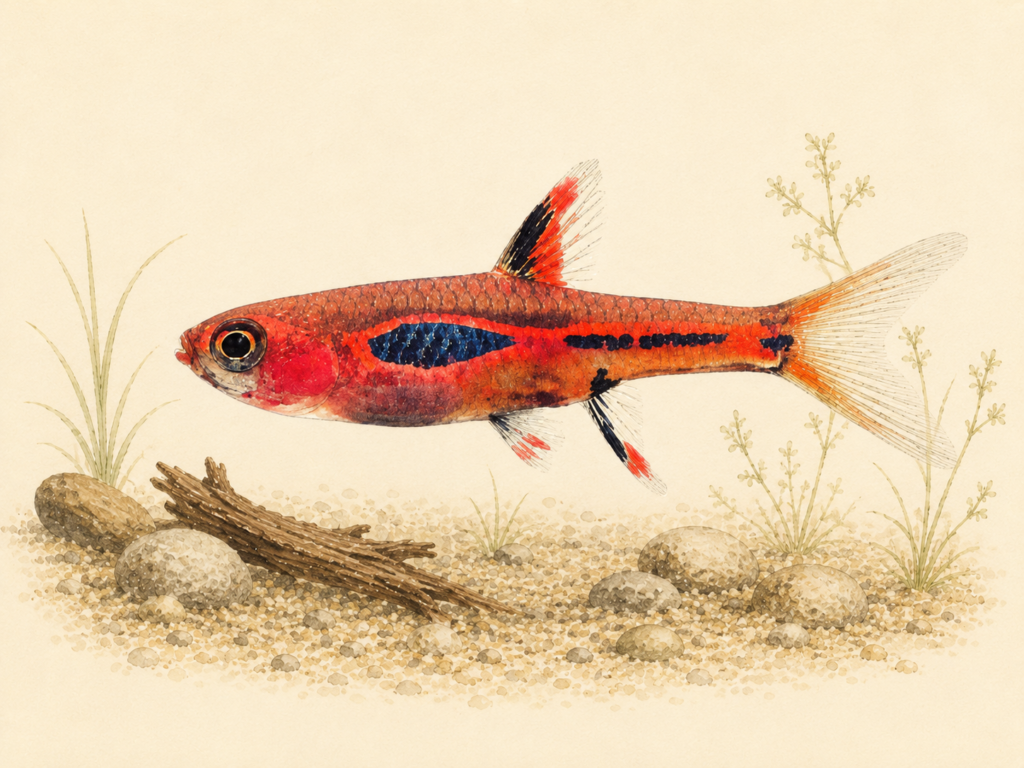
The Chili Rasbora is a genuinely tiny fish, with adults typically reaching between 1.5 and 2 centimetres in total length. Its body is slender and somewhat laterally compressed, with a subtly rounded belly and a small, slightly upturned mouth suited to picking minute food items from the water column and leaf surfaces.
The base colouration is a deep, rich red to reddish-orange that suffuses the entire body when the fish is in good health and kept in appropriate conditions. Running along the midline from behind the eye to the base of the caudal fin is a prominent dark stripe, usually appearing blackish-brown to deep burgundy, which is bordered above and below by a narrow band of brighter red or crimson. This contrast between the dark lateral stripe and the luminous red body is what gives the species its “chili pepper” common name.
The fins are mostly translucent with faint red or orange tinting, and dominant males often display intensified colouration with deeper reds and more saturated pigmentation overall. Females tend to be slightly plumper, particularly when gravid, and their colour, while still attractive, is generally somewhat paler or more orange-toned than that of displaying males. Both sexes possess a small, dark spot at the base of the caudal and anal fins, though this can vary in intensity between individuals.
It is worth noting that Chili Rasboras often appear washed out and pale when stressed, recently imported, or kept in unsuitable conditions. New arrivals to a tank may look disappointingly dull compared to photographs, but given a few weeks to settle into a well-maintained aquarium with appropriate water chemistry and a dark substrate, their true colour emerges spectacularly. The difference between a stressed Chili Rasbora and a settled, confident one is remarkable and serves as a useful visual indicator of the fish’s overall wellbeing.
Natural Habitat
Boraras brigittae is endemic to the peat swamp forests of south-western Borneo in the Indonesian province of Kalimantan. These habitats are ancient, slow-moving or stagnant blackwater environments where dense tropical forest canopy restricts light penetration to the water below. The water itself is stained a deep amber or tea-brown by the continuous release of tannins and humic acids from decaying leaf litter, fallen branches, and the thick layers of peat that form the substrate.
In these swamps, the water is extremely soft, often with negligible mineral content, and profoundly acidic, with pH values frequently dropping below 4.0. Dissolved oxygen levels can be relatively low, and the substrate is a deep accumulation of organic detritus rather than gravel or sand. Aquatic plants are generally sparse, with some species of Cryptocoryne and various mosses being among the few that thrive in such acidic, low-light conditions. The environment is instead characterised by tangled root systems, submerged branches, and thick carpets of decomposing leaves.
Chili Rasboras occupy the shallower, marginal zones of these swamps, often found in very slow-moving or still water amongst leaf litter and root tangles. They shoal in loose groups, foraging for microscopic invertebrates, insect larvae, and other tiny organisms. Understanding this natural habitat is crucial for providing appropriate conditions in the aquarium. While it is not necessary (or practical for most hobbyists) to replicate the extreme acidity of wild blackwater conditions, mimicking the soft water, low lighting, and abundance of botanical cover will bring out the best in this species.
Regrettably, the peat swamp forests of Borneo are under severe and ongoing threat from deforestation, drainage for agriculture (particularly palm oil plantations), and peat fires. While Boraras brigittae is currently classified as Least Concern by the IUCN, the rate of habitat destruction in the region is alarming, and the long-term outlook for many blackwater species remains uncertain. Captive populations in the aquarium hobby may play an increasingly important role in the conservation of this and related species.
Tank Size and Setup
A group of Chili Rasboras can be comfortably housed in a tank as small as 20 litres, making them ideal candidates for nano aquaria. However, a larger volume of 30 to 45 litres or more is preferable, particularly for beginners, as smaller tanks are inherently less stable in terms of water chemistry and temperature. A longer, shallower tank is generally better than a tall one, as these fish predominantly occupy the middle water column and appreciate horizontal swimming space.
The aquascape should aim to replicate the feel of a blackwater forest floor. A dark substrate, such as fine-grained dark sand or aquatic soil, will help the fish feel secure and will dramatically enhance their colour. Pale or reflective substrates tend to wash out the colouration of most small tropical fish, and Chili Rasboras are no exception. Driftwood, preferably pieces with complex branching structures, should be arranged to provide visual barriers and shaded areas. Spider wood and Malaysian driftwood are excellent choices as they also release tannins into the water, which replicates natural blackwater chemistry.
The addition of dried leaf litter is one of the most effective ways to create a naturalistic environment for this species. Indian almond leaves (Terminalia catappa), oak leaves, or beech leaves can be scattered across the substrate where they will slowly decompose, tinting the water amber and providing surfaces for biofilm growth that the fish will graze upon. Alder cones and other botanical additions further contribute to the tannin-rich environment these fish prefer.
Live plants are not essential but are highly recommended. Low-light species such as Java Fern, Java Moss, Bucephalandra, Cryptocoryne, and various floating plants work exceptionally well in a Chili Rasbora setup. Floating plants in particular serve the dual purpose of diffusing overhead light, which helps the fish feel comfortable, and providing cover for any fry that may result from spontaneous spawning. Dense plantings also create visual complexity that encourages natural behaviour and reduces stress.
Lighting should be subdued. These are not fish that thrive under intense illumination; they come from deeply shaded environments and will spend most of their time hiding if the light is too bright. If you are growing plants that need moderate light, ensure that floating plants or tall stem plants create shaded areas where the fish can retreat. The tannin-stained water itself will also help to reduce light intensity naturally.
Water Parameters
Maintaining appropriate water chemistry is arguably the single most important aspect of Chili Rasbora care. These fish originate from some of the softest, most acidic freshwater environments on Earth, and while they are more adaptable in captivity than their wild habitat might suggest, they do best in water that leans towards the softer, more acidic end of the spectrum.
| Temperature | 20–28 °C |
| pH | 4.0–7.0 |
| General hardness (GH) | 1–5 dGH |
| Carbonate hardness (KH) | 0–4 dKH |
| Ammonia | 0 ppm |
| Nitrite | 0 ppm |
| Nitrate | Below 20 ppm |
A temperature range of 22–26 °C represents the sweet spot for most aquarium situations. The ideal pH for long-term health and colour development sits between 5.0 and 6.5, though many hobbyists keep them successfully at a neutral pH of around 7.0, particularly if other conditions are good. Water should be soft, with a general hardness no higher than 5 dGH. Hobbyists in hard water areas will likely need to use RO (reverse osmosis) or demineralised water, remineralised to an appropriate level with a suitable product designed for soft-water species.
Given their small body mass, Chili Rasboras are particularly vulnerable to ammonia and nitrite toxicity. The aquarium must be fully cycled before any fish are introduced, and ongoing water quality should be monitored regularly with a reliable liquid test kit. Weekly water changes of 15–25 per cent are advisable, using water matched to the tank’s temperature and chemistry. Consistency is more important than perfection, sudden swings in pH, temperature, or hardness are more dangerous than slightly suboptimal but stable values.
Filtration and Equipment
Filtration for a Chili Rasbora tank needs to balance effective biological filtration with minimal flow output. These are extremely small, weak-swimming fish that do not appreciate strong currents. In the wild, they inhabit virtually still water, and replicating gentle flow conditions in the aquarium is essential for their comfort and long-term health.
A small sponge filter powered by an air pump is often the best choice for a dedicated Chili Rasbora tank. Sponge filters provide excellent biological filtration, produce a very gentle current, and, critically, are safe for both adult fish and any fry that may be present. They also serve as a supplementary grazing surface, as biofilm and micro-organisms colonise the sponge and provide an additional food source for tiny mouths.
Hang-on-back filters and small internal filters can also work, provided the flow is adjustable and can be turned down to a gentle trickle or diffused with a spray bar. Some hobbyists use a piece of pre-filter sponge over the intake to prevent any risk of fish being drawn against the inlet. Canister filters are generally overkill for nano setups but are perfectly usable in larger community tanks if the outlet is baffled or spread across a spray bar to reduce current strength.
A reliable heater is necessary unless the room in which the aquarium is kept maintains a consistently appropriate temperature year-round. For nano tanks, a small preset or adjustable heater rated for the tank volume is sufficient. Using a separate thermometer to verify the temperature is always good practice, as heater thermostats are not infallible. A tight-fitting lid or cover is recommended, as these small fish can occasionally jump, particularly if startled.
Diet and Feeding
In the wild, Chili Rasboras are micro-predators, feeding on tiny invertebrates, zooplankton, worms, insect larvae, and other organisms small enough to fit in their minuscule mouths. Their mouths are genuinely tiny, even by nano fish standards, and this is the primary consideration when selecting foods for them in captivity. Even standard-sized tropical flake food may need to be crushed into a fine powder to be manageable.
A high-quality micro-pellet or crushed flake food can form the dietary staple, but live and frozen foods should be offered regularly to promote optimal health, colour, and breeding condition. Baby brine shrimp (Artemia nauplii) are arguably the single best food for Chili Rasboras, eagerly consumed and nutritionally excellent. Micro worms, vinegar eels, Walter worms, and Grindal worms are all suitable live food cultures that are relatively easy for hobbyists to maintain at home. Frozen foods such as cyclops, daphnia, and baby brine shrimp are also excellent and far more convenient than live cultures for many keepers.
Feeding should be done in small amounts once or twice daily. It is far better to feed a tiny pinch that is consumed within a minute or two than to overfeed and allow excess food to decompose in the tank. Overfeeding is a common cause of water quality problems in nano aquariums, and with fish this small, the margin for error is slim. Observe your fish during feeding to ensure all individuals are getting food; in a community setting, more assertive species may outcompete the Chili Rasboras at feeding time.
The biofilm that develops on leaf litter, driftwood, and other surfaces in a mature aquarium also provides a continuous supplementary food source. This grazing behaviour is natural and beneficial, and it is another reason why a well-established tank with plenty of botanical material is so well suited to this species.
Behaviour and Temperament
Chili Rasboras are peaceful, social fish that should always be kept in groups. A minimum of six individuals is often cited, but a group of ten or more is strongly recommended. In larger groups, these fish display far more natural behaviour, including confident swimming in the open, micro-territorial sparring between males, and the subtle social hierarchy that makes watching them so endlessly engaging. A pair or trio kept in isolation will typically be shy, stressed, and prone to hiding.
Males establish small, loosely defined territories and will frequently engage in ritualised displays towards one another. These displays involve flared fins, intensified colour, and brief parallel swimming or circling. The interactions are entirely harmless and represent normal social behaviour rather than aggression. Indeed, these displays are one of the most charming aspects of keeping Chili Rasboras, as competing males will show their most vivid colouration during these encounters.
Despite being classified as a shoaling species, Chili Rasboras do not swim in the tight, synchronised formations associated with classic schooling fish. Instead, they tend to occupy a general area of the tank in a loose aggregation, with individuals occasionally drifting away to explore or claim a temporary perching spot near a leaf or twig before returning to the group. They primarily occupy the mid-water level but will venture throughout the water column, particularly to forage near the substrate or amongst floating plant roots.
They are not aggressive in any meaningful sense and pose no threat to any tank mate. Their principal vulnerability is their size, they are small enough to be considered food by a wide range of fish that might otherwise seem harmless. This makes careful tank mate selection essential, as discussed in the following section.
Tank Mates
When selecting tank mates for Chili Rasboras, the guiding principle is simple: choose species that are small, peaceful, and share a preference for soft, acidic water. Due to their tiny size, Chili Rasboras can be eaten or harassed by fish that most hobbyists would consider peaceful community species. Even a moderately sized tetra can view a Chili Rasbora as a potential snack. The safest approach is a species-only tank, which allows you to fully appreciate their natural behaviour, but a carefully chosen community of fellow nano species can also work beautifully.
Good tank mates
- Ember Tetra (Hyphessobrycon amandae), a similarly sized, peaceful micro fish that shares the Chili Rasbora’s preference for soft, acidic water and subdued lighting.
- Pygmy Corydoras (Corydoras pygmaeus), a diminutive bottom-dweller that occupies different tank levels and is far too small and gentle to pose any threat.
- Celestial Pearl Danio (Danio margaritatus), another peaceful nano species that coexists well provided the tank offers enough space and cover for both species.
- Sparkling Gourami (Trichopsis pumila), a tiny, quiet labyrinth fish that thrives in similar blackwater-style setups and generally ignores Chili Rasboras entirely.
- Least Rasbora (Boraras urophthalmoides), a close relative with near-identical care requirements, making it a natural and harmonious companion.
- Otocinclus (Otocinclus spp.), a gentle algae-grazing catfish that stays small and is entirely peaceful, though it prefers slightly higher oxygen levels.
- Amano Shrimp (Caridina multidentata), a hardy, algae-eating shrimp that is too large for Chili Rasboras to bother and far too peaceful to threaten them.
- Cherry Shrimp (Neocaridina davidi), an excellent invertebrate companion, though very small shrimplets may occasionally be picked off by curious fish.
- Dwarf Pencilfish (Nannostomus marginatus), a calm, slow-moving species of comparable size that appreciates the same soft, acidic water conditions.
- Asian Stone Catfish (Hara jerdoni), a tiny, sedentary catfish that rests on the substrate and has no interest in mid-water fish.
Fish to avoid
- Betta (Betta splendens), while sometimes suggested as compatible, bettas can be unpredictable and may harass or prey upon fish as small as Chili Rasboras.
- Angelfish (Pterophyllum scalare), far too large and predatory; Chili Rasboras would be viewed as food by any adult angelfish.
- Guppy (Poecilia reticulata), although peaceful, guppies prefer hard, alkaline water, making them fundamentally incompatible in terms of water chemistry.
- Dwarf Gourami (Trichogaster lalius), Large enough to intimidate or consume Chili Rasboras, and can be territorial during breeding.
- Tiger Barb (Puntigrus tetrazona), an active, nippy species that would stress and outcompete Chili Rasboras at every opportunity.
- African Dwarf Frog (Hymenochirus boettgeri), while generally peaceful, these frogs may attempt to eat any fish small enough to fit in their mouths.
- Rainbow Shark (Epalzeorhynchos frenatum), a territorial, boisterous fish that would terrify and likely harm such tiny tank mates.
- Convict Cichlid (Amatitlania nigrofasciata), an aggressive cichlid that requires entirely different water conditions and would predate on Chili Rasboras without hesitation.
Breeding
Breeding Chili Rasboras in captivity is achievable and represents a rewarding challenge for the dedicated hobbyist. They are egg scatterers that show no parental care, and in a well-maintained, mature aquarium with a good ratio of males to females, spontaneous spawning is not uncommon. However, raising the fry to a viable size requires deliberate effort and appropriate conditions.
To condition fish for breeding, provide a varied diet rich in live and frozen foods, particularly baby brine shrimp and micro worms. Males in breeding condition display their most intense colouration and become more active in their displays towards rivals and potential mates. Females carrying eggs appear noticeably rounder when viewed from above. Keeping the water soft and slightly acidic, with a pH of around 5.0–6.0 and a temperature of 24–26 °C, helps to encourage reproductive behaviour.
Spawning typically occurs in the early morning. The male courts the female with vibrant displays, and if receptive, she will scatter a small number of eggs, often just one or two at a time, amongst fine-leaved plants, moss, or leaf litter. The eggs are tiny, semi-adhesive, and very difficult to see. A female may produce only a handful of eggs per spawning event, but spawning can occur repeatedly over many days or weeks.
The greatest challenge in breeding Chili Rasboras is ensuring fry survival. The adults, while not systematic egg predators, will consume eggs and newly hatched fry if they encounter them. For this reason, serious breeders often use a separate breeding tank with dense clumps of Java Moss or spawning mops, removing the adults after spawning has been observed. Alternatively, in a heavily planted display tank with abundant moss and leaf litter, some fry may survive without intervention, particularly if the adults are well fed and the tank offers ample hiding places.
Eggs typically hatch within 24 to 48 hours, and the resulting larvae are absolutely minuscule. They will subsist on their yolk sac for a day or two before becoming free-swimming. At this stage, they require the smallest possible food: infusoria, paramecium cultures, or commercially available liquid fry food. After one to two weeks, they can graduate to freshly hatched baby brine shrimp and vinegar eels. Growth is slow, and the fry will take several months to reach a size at which they begin to display adult colouration.
Common Diseases
Chili Rasboras are not especially disease-prone, but their small size means that illness can progress rapidly and become fatal before symptoms are clearly visible. Prevention through excellent water quality, a balanced diet, and minimal stress is always the best approach.
Ich, or white spot disease, caused by the parasite Ichthyophthirius multifiliis, is one of the most common ailments in freshwater aquaria and can affect Chili Rasboras, particularly following temperature fluctuations or the introduction of new, unquarantined fish. The characteristic white cysts on the body and fins are visible even on tiny fish. Treatment involves gradually raising the temperature to 28–30 °C over 24 hours and adding aquarium salt or a proprietary ich treatment at half the recommended dose, as small fish can be sensitive to medication.
Bacterial infections, including fin rot and columnaris, can occur in tanks with poor water quality or when fish are stressed. Symptoms may include frayed or eroded fins, patches of discolouration, lethargy, and loss of appetite. Maintaining pristine water conditions is both the best prevention and the first line of treatment. In severe cases, antibiotic treatments may be necessary, but these should be used with caution and ideally administered in a hospital tank.
Internal parasites can occasionally be an issue, particularly with wild-caught specimens. Symptoms are often subtle, gradual weight loss despite normal feeding, or a hollow-bellied appearance. Anti-parasitic foods containing ingredients such as praziquantel or levamisole can be effective, though dosing for such small fish requires care. Velvet disease, caused by the parasite Piscinoodinium, presents as a fine, dusty golden coating on the body and can be particularly dangerous in soft, acidic water. Copper-based treatments are commonly used but must be dosed precisely, as copper is toxic to invertebrates and can stress small fish at higher concentrations.
Quarantining all new arrivals, whether fish, plants, or invertebrates, for a minimum of two weeks before adding them to an established Chili Rasbora tank is a sensible precaution that can prevent the introduction of pathogens and parasites.
FAQs
How many Chili Rasboras should I keep together?
A minimum group of six is often recommended, but ten or more is strongly advised. In larger shoals, Chili Rasboras are noticeably more confident, display brighter colouration, and exhibit a wider range of natural social behaviours, including the charming sparring displays between males. In groups of fewer than six, they tend to be perpetually shy and may spend most of their time hiding, which deprives you of the experience of keeping them and is stressful for the fish.
Can Chili Rasboras live in hard water?
While Chili Rasboras can sometimes survive in moderately hard water for a time, they will not thrive in it. Prolonged exposure to hard, alkaline conditions can shorten their lifespan, suppress their colour, and make them more susceptible to disease. If your tap water is hard, using RO or demineralised water remineralised to appropriate soft-water parameters is the best approach. This investment in water preparation pays dividends in the health and vibrancy of the fish.
Why are my Chili Rasboras pale and not showing colour?
Pale colouration in Chili Rasboras is almost always a sign of stress or suboptimal conditions. Common causes include water that is too hard or alkaline, excessively bright lighting, a pale substrate, insufficient group size, aggressive or boisterous tank mates, and poor diet. Newly purchased fish will also appear washed out for a few days to weeks as they acclimatise. Address each of these potential factors systematically, and you should see colour improve significantly within a few weeks.
What is the difference between a Chili Rasbora and a Mosquito Rasbora?
The names “Chili Rasbora” and “Mosquito Rasbora” are both commonly applied to Boraras brigittae, though “Mosquito Rasbora” is also sometimes used for its close relative Boraras urophthalmoides. This overlap causes frequent confusion in the trade. The most reliable way to distinguish the two species is by examining the lateral marking: Boraras brigittae has a solid, broad dark stripe running along the body, whereas Boraras urophthalmoides displays a more wedge-shaped or exclamation-mark-like spot towards the caudal peduncle.
Do Chili Rasboras need a heater?
In most home environments, yes. Chili Rasboras are tropical fish that require consistently warm water, ideally between 22 and 26 °C. Unless the room in which the aquarium is kept maintains a stable temperature within this range at all times, including overnight and during cooler seasons, a small, thermostatically controlled heater is essential. Temperature fluctuations are a common trigger for stress and disease in these small fish.
Related Guides
- Ember Tetra Care Guide, another jewel-toned nano species with similar water requirements, making it a natural pairing with Chili Rasboras.
- Celestial Pearl Danio Care Guide, a popular nano fish with comparable care needs and striking appearance, ideal for shared planted setups.
- Pygmy Corydoras Care Guide, an excellent bottom-dwelling companion for Chili Rasboras in soft-water nano community tanks.
- Least Rasbora (Boraras urophthalmoides) Care Guide, a closely related Boraras species with near-identical care requirements and frequently confused identity.
- Cherry Shrimp Care Guide, one of the most popular invertebrate tank mates for nano fish, adding colour and clean-up crew functionality.
- Blackwater Aquarium Setup Guide, a detailed guide to creating the tannin-rich, soft-water environment in which Chili Rasboras truly flourish.