Quick Summary
The Amazon Zebra Shrimp is a rare, strikingly patterned freshwater shrimp suited only to experienced keepers willing to maintain soft, acidic blackwater conditions – it is not a beginner species and should not be treated like a common Neocaridina or Caridina dwarf shrimp.
🐠 Build a tank around this species
In this guide:
- Introduction
- Quick Stats
- Appearance
- Natural Habitat
- Tank Size and Setup
- Water Parameters
- Diet and Feeding
- Behaviour and Temperament
- Tank Mates
Introduction
The Amazon Zebra Shrimp (Euryrhynchus amazoniensis) is one of the hobby’s most elusive and fascinating freshwater invertebrates. Belonging to the family Euryrhynchidae – a small, poorly studied group of South American shrimp – it is phylogenetically and ecologically quite distinct from the popular dwarf shrimp genera Neocaridina and Caridina that dominate the ornamental shrimp trade. If you are accustomed to keeping Cherry Shrimp or Crystal Red Shrimp, be aware that the Amazon Zebra Shrimp demands a fundamentally different approach to water chemistry, tank design, and community planning.
What draws hobbyists to this species is its bold, contrasting banding pattern – reminiscent of a zebra’s stripes – set against its small, translucent body. In a well-maintained blackwater aquarium, the visual effect is striking. However, its beauty comes with significant husbandry challenges. The species requires very soft, acidic water rich in tannins, a mature and biologically stable environment, and a diet that reflects its natural foraging habits among leaf litter and submerged wood. It is rarely captive-bred in meaningful numbers, meaning most specimens available are wild-caught, which can introduce additional acclimatisation difficulties.
This guide provides a comprehensive overview of everything you need to know to keep Euryrhynchus amazoniensis successfully. If you are prepared to invest the time, equipment, and patience that blackwater shrimp keeping demands, the Amazon Zebra Shrimp rewards you with a genuinely unique and captivating inhabitant for your aquarium.
Quick Stats
| Common names | Amazon Zebra Shrimp, Amazonian Zebra Shrimp |
|---|---|
| Origin | Amazon basin, South America (Brazil, Peru, Colombia) |
| Adult size | 2.5 cm |
| Difficulty | Advanced |
| Breeding difficulty | Advanced |
| Temperature | 24–28 °C |
| pH | 4–6.5 |
| Minimum tank size | 30 L |
| Conservation status | Not Evaluated |
Appearance
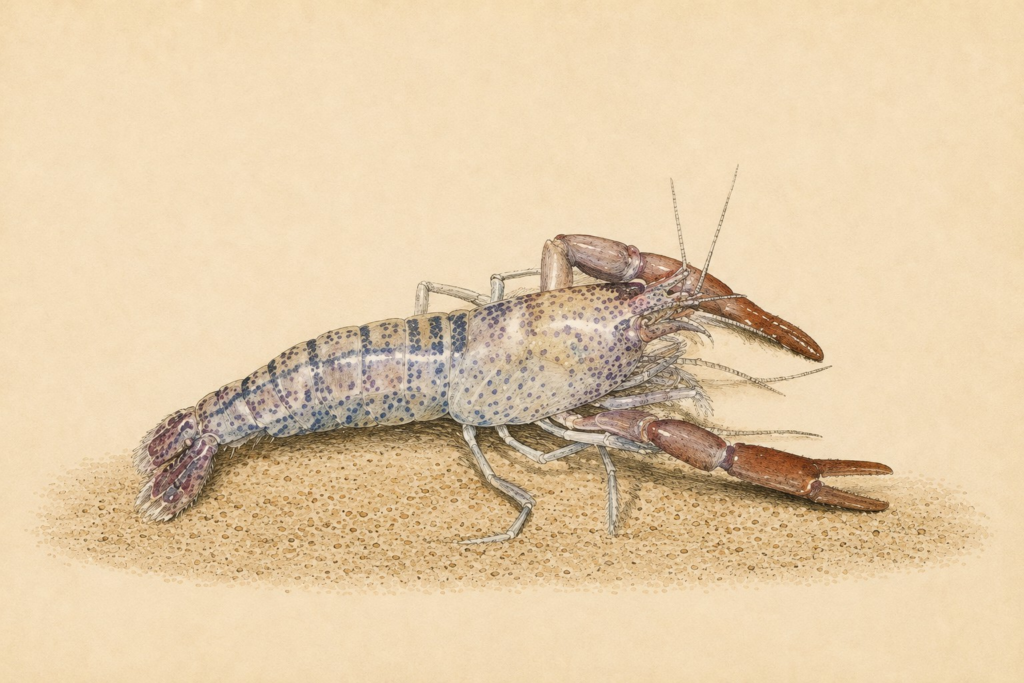
The Amazon Zebra Shrimp is a small, delicately built freshwater shrimp that typically reaches an adult length of 2 to 3 centimetres. Its most defining feature is its pattern of bold, dark bands that encircle the body and appendages in a zebra-like arrangement. These bands are usually deep brown to near-black, set against a pale, semi-translucent to whitish base colour. In healthy specimens under appropriate lighting, the contrast between the dark stripes and the lighter interspaces can be remarkably vivid.
The body shape differs noticeably from the more commonly kept Neocaridina and Caridina species. Euryrhynchus shrimp have a relatively elongated carapace and a more slender overall build. The rostrum (the forward-projecting spine between the eyes) is short and somewhat flattened, a characteristic of the genus. The chelipeds (clawed front legs) are proportionally more developed than those seen in typical dwarf shrimp, reflecting the species’ slightly different feeding ecology – it is more of an active micro-predator and scavenger than a pure biofilm grazer.
The walking legs and antennae also display the characteristic banding to varying degrees, lending the whole animal a strikingly ornamental appearance. Females may appear slightly more robust in the abdomen when carrying eggs, but sexual dimorphism is subtle and can be difficult to discern without experience. Juveniles display a fainter version of the adult banding pattern, which intensifies as they grow.
Colour intensity can vary considerably with water conditions. In tannin-rich blackwater, the shrimp’s bands tend to appear bolder and the base colour more cleanly white or cream. In clearer, harder water – conditions that the species should not be subjected to in any case – colours may wash out, and the animal’s general health will likely decline. Good colour is therefore as much an indicator of correct husbandry as it is of genetics.
Natural Habitat
Euryrhynchus amazoniensis is native to the Amazon basin, where it inhabits blackwater streams, tributaries, and flooded forest environments across Brazil, Peru, and Colombia. These are the classic igapo and igarape habitats – slow-moving or still waters stained deep amber to tea-brown by dissolved humic acids and tannins released from decaying leaves, bark, and submerged wood.
The water in these environments is characteristically extremely soft and acidic, often with a pH as low as 4.0 and negligible mineral content. General hardness and carbonate hardness are frequently at or near zero. The substrate is typically composed of fine sand overlaid with thick deposits of leaf litter, fallen branches, and other organic debris. Light levels beneath the forest canopy are low, and the tannin-stained water further reduces light penetration, creating a dimly lit, richly organic environment.
In these habitats, the Amazon Zebra Shrimp forages among the leaf litter and biofilm-covered wood surfaces, feeding on micro-organisms, detritus, and tiny invertebrates. It shares its environment with a wide array of small characins, dwarf cichlids, and other specialist blackwater fauna. The dense leaf litter provides both food and shelter, offering hiding places from predators and creating a complex micro-habitat teeming with the infusoria and microbial life that supports the shrimp’s diet.
Understanding this natural habitat is essential to keeping the species successfully. Unlike many popular aquarium shrimp that tolerate or even thrive in a broad range of water chemistries, the Amazon Zebra Shrimp is genuinely adapted to extreme softwater conditions. Attempting to keep it in typical tap water – even moderately soft tap water – is likely to result in stress, failed moults, and premature death. Replicating the blackwater environment is not optional; it is a fundamental requirement of the species’ care.
Tank Size and Setup
A minimum tank size of 30 litres is recommended for a small colony of Amazon Zebra Shrimp. While the shrimp themselves are tiny and produce minimal bioload, the challenge lies in maintaining the extremely specific and stable water chemistry they require. Smaller volumes are inherently less stable, and with a species this sensitive to parameter swings, erring on the side of a slightly larger tank is wise. A 40 to 60 litre aquarium provides a more comfortable margin of stability and allows for a more naturalistic aquascape.
The substrate should be fine, dark sand or an inert aquasoil. Active buffering substrates designed for soft, acidic water (such as those marketed for Caridina shrimp or planted tanks) can be useful for maintaining a low pH, but be aware that their buffering capacity depletes over time and they will need replacing. Avoid any substrates that contain calcium carbonate or other mineral content that would raise hardness or pH.
Leaf litter is not merely decorative – it is a critical component of the setup. A generous layer of dried Indian almond leaves (Catappa), oak leaves, or other aquarium-safe botanical materials should cover a significant portion of the substrate. As these leaves decompose, they release tannins that acidify and stain the water, they support biofilm growth that the shrimp feed on, and they provide essential hiding places and foraging surfaces. Replenish leaves as they break down, maintaining a continuous supply of fresh botanicals.
Driftwood is equally important. Malaysian driftwood, mopani wood, or spider wood all leach tannins and provide additional surfaces for biofilm colonisation. Arrange pieces to create sheltered areas and tunnels. The combination of wood, leaves, and dim lighting will closely approximate the shrimp’s natural igapo habitat.
Live plants can be included, but choose species that tolerate very soft, acidic water and low light. Java Moss, various Bucephalandra species, and certain Cryptocoryne species from blackwater habitats are good choices. Avoid plants that require high light, CO2 injection, or mineral-rich fertilisation, as these regimes are incompatible with the shrimp’s water chemistry requirements.
Lighting should be kept subdued. The Amazon Zebra Shrimp is naturally a denizen of shaded, dimly lit environments, and bright lighting will stress the animals and encourage them to hide. A low-intensity LED or a light diffused by floating plants is ideal. If you are keeping live plants that need moderate light, balance this with plenty of shaded areas created by driftwood and overhanging botanicals.
A tight-fitting lid or cover is recommended. While shrimp are less prone to jumping than fish, the small gaps in open-topped aquariums can allow shrimp to climb out, especially along equipment cables or filter intakes. A cover also helps reduce evaporation, which is particularly important in a softwater setup where evaporation concentrates dissolved minerals and can alter water chemistry.
Water Parameters
| Temperature | 24 – 28 C |
| pH | 4.0 – 6.5 |
| General hardness (GH) | 0 – 4 dGH |
| Carbonate hardness (KH) | 0 – 2 dKH |
| Ammonia | 0 ppm |
| Nitrite | 0 ppm |
| Nitrate | Below 10 ppm |
The Amazon Zebra Shrimp has one of the most demanding water chemistry profiles of any commonly discussed ornamental shrimp. It is not sufficient to aim for “soft water” in a general sense – this species genuinely requires near-zero hardness and a strongly acidic pH. Many hobbyists find that a target pH of 4.5 to 5.5 and a GH of 0 to 2 dGH provides the best results, closely replicating the blackwater conditions of the species’ native range.
Achieving and maintaining these parameters almost certainly requires the use of reverse osmosis (RO) water or demineralised water as the base. Tap water in most areas, even relatively soft tap water, will contain too many dissolved minerals and will be buffered to a pH far higher than this species tolerates. RO water should be remineralised only very lightly – if at all – using a specialist shrimp mineral product designed for softwater species. The goal is to add just enough minerals to support moulting (a trace of GH) without raising the water above the acceptable range.
Tannins from leaf litter, driftwood, and botanical extracts naturally lower pH and provide a degree of buffering in the acidic range. Some keepers supplement with commercially available blackwater extract or alder cones to maintain the desired tannin concentration. The distinctive amber tint of the water is a useful visual indicator; if the water is running clear, it is likely time to add more botanicals.
Temperature should remain stable within the 24 to 28 C range. Avoid sudden temperature swings during water changes. When performing water changes, pre-heat the replacement water to match the tank temperature and ensure it has the same pH and hardness as the tank water. Large, abrupt water changes in a softwater system can cause dangerous parameter swings. Smaller, more frequent changes of 10 to 15 per cent are preferable to infrequent large changes.
Nitrate should be kept as low as possible – ideally below 10 ppm. In a well-planted, lightly stocked blackwater tank with a healthy layer of leaf litter, nitrate levels should naturally remain very low, but regular testing is essential. Ammonia and nitrite must always read zero; any detectable level of either indicates a filtration or cycling problem that must be addressed immediately.
Filtration and Equipment
Filtration for the Amazon Zebra Shrimp should prioritise biological efficiency, gentle flow, and safety for small invertebrates. A mature sponge filter is the most commonly recommended option. Sponge filters provide excellent biological filtration, produce a very gentle current, and pose no risk of trapping or injuring shrimp. They also serve as an additional grazing surface where biofilm accumulates, supplementing the shrimp’s diet.
If you prefer a hang-on-back or canister filter for aesthetic reasons or because you are running a larger tank, ensure that the intake is covered with a fine sponge pre-filter to prevent shrimp – especially juveniles – from being sucked in. Adjust the flow rate to the lowest effective setting. The Amazon Zebra Shrimp is adapted to still or very slow-moving water, and strong currents will stress the animals.
An aquarium heater is necessary to maintain the temperature within the recommended range. Use a reliable, adjustable heater with a guard to prevent shrimp from resting directly on the heating element and being burned. In-line heaters used with canister filters are another option that removes the heater entirely from the tank interior.
A thermometer – preferably a digital one for accuracy – should be used to monitor temperature continuously. In a softwater setup with minimal buffering capacity, even small environmental fluctuations can have outsized effects on water chemistry, so consistent monitoring is important.
A TDS (total dissolved solids) meter is an invaluable tool for managing the extremely soft water this species requires. Target TDS readings will typically be in the range of 20 to 80 ppm, depending on how much remineralisation you apply. Regular TDS checks help you detect creeping mineral accumulation from evaporation or substrate exhaustion before it becomes a problem.
Aeration is generally adequate from the sponge filter’s air-driven operation. If you are using a different filter type, ensure there is sufficient surface agitation to maintain oxygen levels without creating excessive turbulence.
Diet and Feeding
In the wild, the Amazon Zebra Shrimp forages among leaf litter, biofilm, and organic detritus, feeding on a mixture of micro-organisms, algae, bacterial colonies, and tiny invertebrates. Its slightly more developed chelipeds compared to typical dwarf shrimp suggest a more omnivorous and opportunistic feeding strategy, including some degree of micro-predation on infusoria and other microscopic prey.
In the aquarium, the foundation of the diet should be the biofilm and microbial life that develops naturally on leaf litter, driftwood, and other surfaces. A well-established blackwater tank with plenty of botanicals will produce a continuous supply of this natural food. This is one reason why a mature tank is so important – a newly set up aquarium simply will not have the microbial ecosystem to support these shrimp.
Supplemental feeding should be provided sparingly. Suitable foods include high-quality shrimp pellets or wafers designed for dwarf shrimp, blanched vegetables such as courgette or spinach (offered in small quantities), and occasional protein-rich foods such as frozen or freeze-dried daphnia, cyclops, or baby brine shrimp. Powdered or liquid fry foods that disperse into the water column and settle on surfaces can also be useful, particularly for supporting juveniles.
Avoid overfeeding. In a tank with abundant leaf litter and biofilm, the shrimp will obtain a significant portion of their nutrition from grazing, and supplemental food should be treated as just that – a supplement. Uneaten food decays rapidly in warm, acidic water and can cause dangerous spikes in ammonia. Feed small amounts every two to three days and remove any uneaten food within a few hours.
Calcium supplementation deserves special mention. In very soft water with near-zero GH, the shrimp may not have access to sufficient calcium and other minerals for successful moulting. Some keepers address this by providing a small piece of cuttlebone or a mineral stone, though in extremely acidic water these will dissolve quickly and may raise hardness beyond the desired range. A more controlled approach is to use a specialist shrimp mineral additive at a very low dose when preparing replacement water. Monitor GH carefully and adjust accordingly.
Behaviour and Temperament
The Amazon Zebra Shrimp is a peaceful, somewhat secretive species. In a well-designed blackwater tank with plenty of leaf litter and hiding places, you will observe the shrimp foraging actively among the botanicals, picking at biofilm on wood surfaces, and exploring the substrate. They are most active during dusk and dawn and in low-light conditions, and may retreat into cover when the lights are bright or when they feel exposed.
This species is best kept in a group. Like most shrimp, they are not truly social in the way that schooling fish are, but they are more confident and display more natural behaviour when kept with conspecifics. A colony of at least six to ten individuals is recommended as a starting point, though larger groups are preferable if the tank size allows.
Moulting behaviour follows the typical pattern for freshwater shrimp: the animal sheds its exoskeleton periodically as it grows. After moulting, the shrimp is temporarily soft-bodied and vulnerable, and it will typically hide for a day or two until the new exoskeleton hardens. Failed moults – where the shrimp cannot fully shed its old shell – are a common cause of death in this species and are almost always linked to incorrect water chemistry, particularly insufficient mineral content for shell formation or excessively hard water that makes the old shell too rigid to shed.
Aggression is not a concern with this species. Amazon Zebra Shrimp are entirely non-aggressive towards one another and towards other tank inhabitants. However, their small size, specific water requirements, and retiring nature mean that they can easily be outcompeted for food or stressed by boisterous tank mates, which is why a species-only setup or a very carefully curated community is strongly recommended.
Tank Mates
Selecting tank mates for the Amazon Zebra Shrimp is a challenge primarily because of its extreme water chemistry requirements rather than any behavioural incompatibility. Very few commonly kept aquarium species thrive in the same ultra-soft, strongly acidic blackwater conditions that this shrimp needs. Any potential tank mate must be a genuine blackwater specialist that tolerates pH values of 4.0 to 6.0 and near-zero hardness. Additionally, tank mates must be small enough and peaceful enough not to prey on or harass the shrimp. For these reasons, a species-only tank is the safest and most commonly recommended approach.
If you do wish to create a community, limit yourself to small, peaceful blackwater fish species that have been successfully kept in comparable conditions. Even with compatible species, the addition of fish increases bioload, introduces competition for food, and raises the risk of predation on juvenile shrimp. Consider carefully whether the aesthetic benefit of a mixed community is worth the added risk.
Good tank mates
- Green Neon Tetra – A tiny, peaceful blackwater characin that thrives in very soft, acidic conditions and is too small to threaten adult shrimp.
- Ember Tetra – Another small, gentle tetra comfortable in soft, acidic water, though it may occasionally take very small juvenile shrimp.
- Nannostomus marginatus (Dwarf Pencilfish) – A slender, peaceful micro-predator adapted to blackwater habitats that generally ignores shrimp.
- Chocolate Gourami – A dedicated blackwater specialist that requires similar ultra-soft, acidic conditions and is typically peaceful towards invertebrates.
- Apistogramma elizabethae – A blackwater-adapted dwarf cichlid, though any Apistogramma may eat juvenile shrimp; best in larger setups with ample cover.
- Otocinclus – Peaceful algae grazers that coexist well with shrimp, though they prefer slightly less extreme water conditions; choose species from softer water habitats.
- Pygmy Corydoras – Tiny, bottom-dwelling catfish that are peaceful towards shrimp, though they prefer slightly higher pH than the Amazon Zebra Shrimp’s ideal range.
Fish to avoid
- Angelfish – Far too large and predatory; will readily eat shrimp of this size and prefer different water conditions.
- Betta – Predatory towards small shrimp and generally kept in warmer, less acidic conditions than the Amazon Zebra Shrimp requires.
- Guppy – Requires hard, alkaline water completely incompatible with this shrimp’s needs; would suffer in blackwater conditions.
- African Cichlids – Require hard, alkaline water and are far too aggressive; entirely incompatible on every measure.
- Tiger Barb – Boisterous, nippy fish that would harass shrimp and prefer harder water conditions.
- Convict Cichlid – Aggressive, territorial, and a predator of small invertebrates; completely unsuitable.
- Goldfish – Coldwater species with entirely different water chemistry requirements; would eat shrimp and produce excessive waste.
Breeding
Breeding the Amazon Zebra Shrimp in captivity is considered advanced and has been achieved only rarely in the hobby. The species is not well documented in aquaculture literature, and much of what is known comes from the experiences of a small number of dedicated specialist keepers. Successfully breeding this shrimp requires an established, stable blackwater environment with impeccable water quality and a healthy, well-conditioned colony.
Females carry relatively few eggs compared to more prolific dwarf shrimp species. The eggs are carried beneath the female’s abdomen (pleopods) and are typically visible as a small cluster of dark-coloured spheres. The incubation period in the warm, acidic conditions this species requires is estimated at approximately three to four weeks, though precise data is limited.
Based on available information, Euryrhynchus amazoniensis appears to follow a direct development pathway rather than requiring a larval brackish-water stage, which is a significant advantage for the aquarist compared to species like Amano Shrimp that need saltwater for larval development. The young hatch as miniature versions of the adults and begin foraging on biofilm and micro-organisms immediately.
Providing conditions for successful breeding means maintaining the water chemistry within the narrowest part of the acceptable range – a pH of 4.5 to 5.5, GH of 0 to 2 dGH, and temperatures around 26 to 27 C. A thick layer of leaf litter is essential, as it provides both food and shelter for the tiny juveniles. Powdered foods and infusoria cultures can supplement the natural biofilm for juvenile nutrition.
Avoid keeping any fish in a breeding tank. Even the smallest, most peaceful fish may consume newly hatched shrimp, which are extremely tiny and vulnerable. A dedicated species-only breeding tank gives the juveniles the best chance of survival.
If you are fortunate enough to observe berried (egg-carrying) females, disturb the tank as little as possible. Minimise water changes, avoid rearranging decor, and keep lighting subdued. Stress is a common cause of females dropping their eggs prematurely.
Common Diseases
The Amazon Zebra Shrimp is susceptible to many of the same health issues that affect other freshwater shrimp, though its sensitivity to water chemistry makes it more vulnerable to problems caused by environmental stress.
Failed moults are perhaps the single most common cause of death in captive Amazon Zebra Shrimp. When the water’s mineral content is incorrect – either too low in calcium and magnesium for the new exoskeleton to form properly, or too high in overall hardness making the old exoskeleton too rigid to shed – the shrimp may become trapped in its old shell and die. Maintaining a stable, very low GH with just enough mineral supplementation to support moulting is the key to prevention.
Bacterial infections can occur, particularly in tanks with poor water quality or where organic waste has been allowed to accumulate. Symptoms include milky or opaque patches on the body, lethargy, and loss of colour. These infections are best prevented through good husbandry – regular removal of uneaten food, consistent water changes with parameter-matched water, and maintaining a biologically active filtration system.
Vorticella and other external parasites occasionally appear as white, fuzzy growths on the shrimp’s exoskeleton or appendages. These are typically protozoan parasites that can be treated by improving water quality and, in severe cases, with salt baths – though salt treatments must be used with extreme caution in a softwater species. A very brief dip in lightly salted water (separate from the main tank) may help, but never add salt directly to the main aquarium.
Copper toxicity is a serious risk for all freshwater shrimp, and the Amazon Zebra Shrimp is no exception. Never use medications, plant fertilisers, or water conditioners that contain copper in any tank housing shrimp. Even trace amounts of copper can be lethal. Always check product labels carefully and err on the side of caution.
Stress-related issues stemming from incorrect pH, hardness, temperature, or exposure to ammonia and nitrite are ultimately the root cause of most health problems in this species. A well-maintained blackwater environment with stable parameters is the single best preventive measure against disease.
FAQs
Can I keep Amazon Zebra Shrimp in the same water as Cherry Shrimp or Crystal Red Shrimp?
No. Cherry Shrimp (Neocaridina davidi) thrive in harder, more neutral to slightly alkaline water that would be harmful to Amazon Zebra Shrimp. Crystal Red Shrimp (Caridina cantonensis) prefer soft, slightly acidic water, which is closer to the Amazon Zebra Shrimp’s requirements, but CRS typically do best at a pH of 5.5 to 6.5 and a GH of 4 to 6 dGH – still higher than the ideal range for Euryrhynchus amazoniensis. The Amazon Zebra Shrimp’s needs are more extreme, and mixing species with different optimal parameters means compromising the conditions for at least one of them.
Do Amazon Zebra Shrimp need a brackish water stage for breeding?
Based on available evidence, no. Unlike Amano Shrimp (Caridina multidentata), which require a brackish or saltwater larval stage, the Amazon Zebra Shrimp appears to undergo direct development. The young hatch as fully formed miniature shrimp and can be raised entirely in freshwater. However, breeding data for this species in captivity is limited, and keepers should be prepared for a learning curve.
How many Amazon Zebra Shrimp should I keep together?
A minimum group of six to ten is recommended to encourage natural behaviour and reduce individual stress. Larger colonies of 15 to 20 or more are preferable if your tank size supports them, as these shrimp are more active and visible in larger groups. They are entirely non-aggressive towards one another, so overstocking from a social standpoint is not a concern – bioload management is the limiting factor.
Can I use tap water if I add a water conditioner?
In almost all cases, no. Standard tap water, even after treatment with a dechlorinator, will have far too high a mineral content and pH for the Amazon Zebra Shrimp. This species requires water with a GH of 0 to 4 dGH and a pH of 4.0 to 6.5. Reverse osmosis (RO) or demineralised water is effectively a requirement. Some keepers with exceptionally soft tap water may be able to use it as a base, but this should be verified with accurate testing before introducing any shrimp.
Are Amazon Zebra Shrimp easy to find for sale?
No. This species is genuinely uncommon in the ornamental trade. It is not bred commercially on any significant scale, and most specimens offered for sale are wild-caught. Availability is sporadic and typically limited to specialist invertebrate dealers or dedicated online sellers. Expect to pay a premium compared to mainstream dwarf shrimp species, and be prepared to join waiting lists or monitor specialist forums for availability alerts.
Related Guides
- Amano Shrimp – A widely available freshwater shrimp species useful for comparison, though it has very different water chemistry requirements and a brackish larval stage.
- Crystal Red Shrimp – A softwater Caridina species whose care overlaps partially with the Amazon Zebra Shrimp’s requirements, offering useful insight into low-pH shrimp keeping.
- Chocolate Gourami – A blackwater fish species with similarly