Horsefaced Loach Care Guide — Tank Setup, Feeding and Breeding
Introduction
The Horsefaced Loach, known scientifically as Acantopsis choirorhynchos, is one of the most distinctive and endearing bottom-dwelling fish available to freshwater aquarists. Named for its elongated, downward-pointing snout that bears a passing resemblance to a horse’s face, this loach has been a staple of the aquarium hobby since the mid-twentieth century. It belongs to the family Cobitidae, the true loaches, and hails from the river systems of Southeast Asia, where it inhabits sandy substrates in flowing waters.
What makes this species particularly fascinating is its remarkable ability to bury itself almost entirely in sand, leaving only its eyes and the tip of its snout visible. This behaviour is not merely entertaining to watch — it is a fundamental part of the fish’s biology, serving as both a feeding strategy and a means of avoiding predators. For this reason, the Horsefaced Loach demands a very specific type of aquarium setup, and keepers who provide the right conditions will be rewarded with a captivating and long-lived companion.
Despite its somewhat specialist requirements, the Horsefaced Loach is generally considered a moderate-level species in terms of care difficulty. It is peaceful, hardy once established, and compatible with a wide range of community fish. This guide covers everything you need to know to keep this unusual loach thriving in your aquarium, from tank setup and water parameters to diet, behaviour, and breeding.
Quick Stats
| Scientific name | Acantopsis choirorhynchos |
| Common names | Horsefaced Loach, Horseface Loach, Long-nosed Loach, Banana Loach (occasional misapplication) |
| Family | Cobitidae |
| Origin | Southeast Asia — Thailand, Vietnam, Malaysia, Indonesia (Sumatra, Borneo, Java), Myanmar, Laos, Cambodia |
| Adult size | 18–22 cm (7–9 inches) |
| Lifespan | 8–12 years |
| Difficulty | Moderate |
| Breeding difficulty | Expert |
| Temperature | 24–28 °C |
| pH range | 6.0–7.5 |
| General hardness (GH) | 3–12 dGH |
| Carbonate hardness (KH) | 2–8 dKH |
| Minimum tank size | 200 litres |
| Conservation status | Least Concern (IUCN) |
Appearance
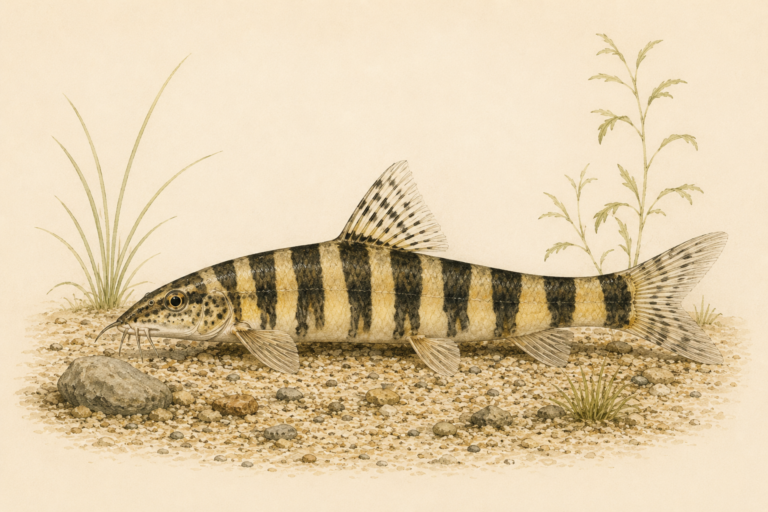
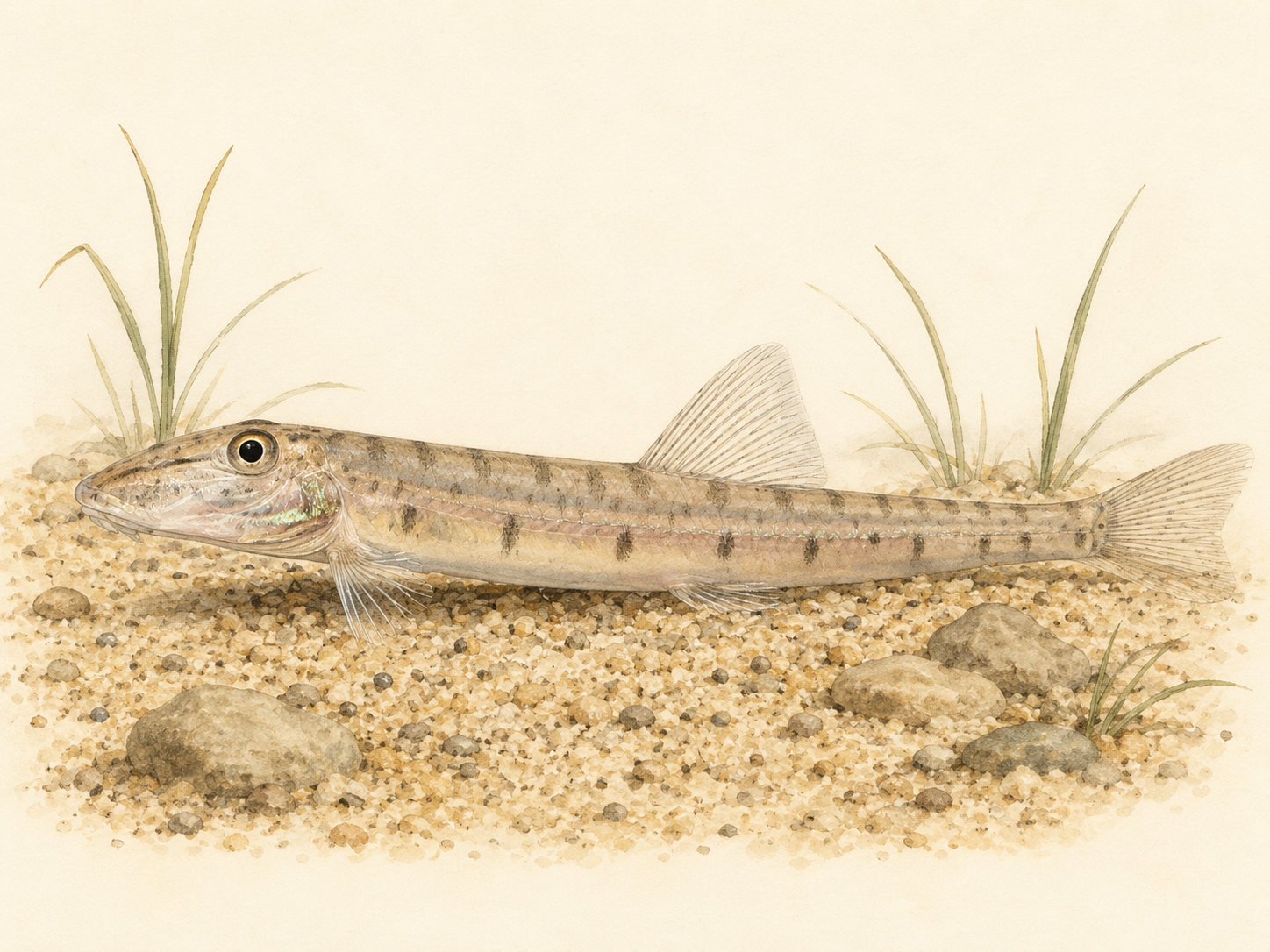
The most immediately striking feature of the Horsefaced Loach is its elongated, somewhat flattened head and protruding tubular snout. The mouth is positioned on the underside of the head, flanked by several pairs of short barbels that the fish uses to detect food particles buried in the substrate. The overall body shape is slender and somewhat cylindrical, tapering gently towards the caudal fin, giving the fish a streamlined profile well suited to life in flowing water and loose substrates.
Colouration is subtle but attractive. The base colour is typically a sandy beige to pale gold, overlaid with a series of irregular dark brown or olive blotches and saddle-shaped markings along the dorsal surface. A line of darker spots often runs along the lateral midline of the body, and the fins are generally clear to lightly spotted. This patterning provides remarkably effective camouflage against a sandy or gravelly riverbed, and in the aquarium the fish can seem to vanish entirely when it buries itself in an appropriate substrate.
Sexual dimorphism is minimal and difficult to discern outside of the breeding season. Mature females tend to be slightly fuller-bodied when viewed from above, particularly when carrying eggs. Males may be marginally slimmer and can sometimes develop slightly enlarged pectoral fins, though these differences are subtle and unreliable for sexing purposes in most aquarium settings. Adults typically reach between 18 and 22 centimetres in length, making them a medium-sized loach that requires a reasonably spacious aquarium.
It is worth noting that the taxonomy of the genus Acantopsis has undergone significant revision in recent years, and fish sold under the name Acantopsis choirorhynchos may in fact represent several closely related species. Slight variations in patterning, body proportions, and colouration between individuals from different collection localities are therefore common and do not necessarily indicate different care requirements.
Natural Habitat
The Horsefaced Loach is found across a broad swathe of mainland and insular Southeast Asia, inhabiting river systems in Thailand, Vietnam, Laos, Cambodia, Myanmar, peninsular Malaysia, and the Indonesian islands of Sumatra, Borneo, and Java. Its range encompasses a variety of river types, but the species shows a strong preference for moderately flowing rivers and streams with sandy or fine gravel substrates. It is most commonly encountered in lowland and foothill habitats rather than fast-flowing mountain torrents.
In the wild, these loaches inhabit the sandy margins and shallows of rivers, often in areas where the current is steady but not overly powerful. The substrate is typically composed of fine sand, sometimes mixed with small pebbles and leaf litter. Vegetation may be sparse or present depending on the specific habitat, but the key constant is a soft, loose substrate into which the fish can burrow. During daylight hours, Horsefaced Loaches spend much of their time buried in the sand, emerging more actively at dusk and dawn to forage.
Water conditions in their native habitats tend to be warm, slightly acidic to neutral, and relatively soft. Seasonal flooding can alter water chemistry, and these fish are exposed to a degree of fluctuation in parameters throughout the year. The rivers they inhabit are generally well-oxygenated, with moderate flow rates and relatively clear water. Understanding these natural conditions is essential for replicating a suitable environment in the home aquarium.
Tank Size and Setup
Given the adult size of the Horsefaced Loach and its need for a generous floor space in which to burrow and forage, a minimum tank size of 200 litres is recommended for a small group. Because these fish are primarily bottom-dwellers, the footprint of the aquarium matters more than its height. A tank measuring at least 120 centimetres in length and 40 centimetres in width provides a good foundation. If you intend to keep a group of three or more, which is advisable for their social wellbeing, then a tank of 250 litres or larger would be more appropriate.
The single most important aspect of the tank setup is the substrate. Horsefaced Loaches absolutely require fine, smooth sand as the primary substrate material. Sharp or coarse substrates such as aquatic gravel with angular edges can damage the fish’s delicate barbels and skin as it burrows. Play sand, pool filter sand, or purpose-made aquarium sands in a natural tone are all excellent choices. A depth of at least five to seven centimetres is needed to allow the fish to bury itself comfortably, and deeper beds of eight to ten centimetres are even better.
Beyond the substrate, the aquascape should include a selection of smooth rocks, driftwood, and perhaps some hardy plants to provide visual barriers and resting spots. While the Horsefaced Loach is unlikely to damage plants intentionally, its burrowing activity can uproot specimens with shallow root systems. Plants such as Java Fern, Anubias, and Bolbitis, which can be attached to hardscape rather than rooted in the substrate, are ideal companions. Vallisneria and Cryptocoryne species with robust root systems can also work well if given time to establish before the loaches are introduced.
Ensure there are some shaded areas created by overhanging wood or rock formations. Although the Horsefaced Loach’s primary hiding strategy is to bury itself in sand, it will also appreciate having physical hiding spots available, particularly during the initial settling-in period. Avoid overly cluttered layouts that reduce the available burrowing space on the tank floor. A balance of open sandy areas and scattered hardscape features creates the most naturalistic and functional environment for this species.
Water Parameters
The Horsefaced Loach is reasonably adaptable when it comes to water chemistry, but it thrives best in warm, slightly acidic to neutral, soft to moderately hard water. Stability is more important than hitting an exact target, so aim to maintain consistent parameters rather than chasing a specific number. The table below outlines the ideal ranges for long-term care.
| Temperature | 24–28 °C |
| pH | 6.0–7.5 |
| General hardness (GH) | 3–12 dGH |
| Carbonate hardness (KH) | 2–8 dKH |
| Ammonia | 0 ppm |
| Nitrite | 0 ppm |
| Nitrate | Below 20 ppm |
As with all loaches, the Horsefaced Loach is sensitive to poor water quality, particularly elevated ammonia and nitrite levels. The fish’s habit of burrowing into the substrate means it is in close contact with any detritus or waste that accumulates at the bottom of the tank, making regular substrate maintenance and diligent water changes essential. Aim for weekly water changes of 25–30 per cent to keep nitrate levels low and maintain overall water quality. When performing water changes, ensure the replacement water is temperature-matched and dechlorinated to avoid shocking the fish.
These loaches are also sensitive to many common aquarium medications, particularly those containing copper or formalin. If treatment becomes necessary, always use medications at half the standard dosage unless a product is specifically labelled as safe for scaleless or lightly scaled fish, and monitor the fish closely during treatment.
Filtration and Equipment
Good filtration is essential for the Horsefaced Loach, both for maintaining water quality and for providing the gentle to moderate flow that these fish appreciate. An external canister filter is the preferred option for tanks of the recommended size, as it provides excellent biological and mechanical filtration without taking up space inside the aquarium. Choose a filter rated for the volume of your tank or slightly above, and position the outlet to create a gentle current across the length of the tank. The Horsefaced Loach comes from flowing water habitats, so a degree of water movement is both natural and beneficial, but avoid creating excessively powerful currents that may stress the fish or disturb the sand substrate excessively.
If you use an internal filter or a hang-on-back model, ensure the intake is fitted with a fine pre-filter sponge. The burrowing activity of these loaches can stir up fine sand particles, which can be drawn into unprotected filter intakes and cause damage to impellers. A pre-filter sponge also prevents any small loaches from being trapped against the intake.
Heating should be provided via a reliable, thermostatically controlled aquarium heater. An external in-line heater fitted to the canister filter outlet is an excellent option, as it removes the risk of the loach burrowing against or disturbing an internal heater. If you must use an internal heater, choose one with a protective guard and position it where the fish is least likely to come into contact with it.
Lighting should be moderate. Horsefaced Loaches are largely crepuscular to nocturnal, and bright, unbroken lighting can discourage them from emerging during the day. If you keep live plants, provide enough light for plant growth but include shaded retreats and consider a gradual dimming period at dusk to encourage more visible activity from the loaches. An air stone or additional powerhead can be used to supplement oxygenation if needed, particularly in warmer tanks where dissolved oxygen levels tend to be lower.
Diet and Feeding
In the wild, the Horsefaced Loach is an opportunistic omnivore that feeds primarily on small invertebrates, insect larvae, worms, and organic matter sifted from the sandy substrate. It uses its sensitive barbels to detect food buried in the sand and its elongated snout to probe and extract morsels. In the aquarium, replicating this natural foraging behaviour is both important for the fish’s welfare and one of the most enjoyable aspects of keeping the species.
A varied diet forms the foundation of good nutrition for this loach. Sinking pellets and wafers designed for bottom-dwelling fish should form the staple diet. High-quality sinking granules with a blend of animal and vegetable protein work well, and most Horsefaced Loaches will also accept sinking algae wafers, though these should be supplementary rather than primary food. Frozen and live foods are eagerly consumed and should be offered regularly to maintain condition and encourage natural behaviour. Bloodworm, tubifex, daphnia, brine shrimp, and chopped earthworms are all excellent choices. Live blackworms are a particular favourite and provide an outstanding opportunity to observe the loach’s natural sifting behaviour as it roots through the sand for its prey.
Feed once or twice daily, offering only as much food as will be consumed within a few minutes. Because the Horsefaced Loach is a somewhat shy feeder, especially when first introduced to a new aquarium, it is important to ensure food reaches the bottom of the tank before more aggressive surface or mid-water feeders consume it all. Feeding after lights-out or during the dimming period can help ensure these loaches get their fair share. Over time, well-settled individuals will often learn to emerge during the day when food is offered, particularly if a routine feeding schedule is maintained.
Behaviour and Temperament
The Horsefaced Loach is a peaceful, reclusive species that poses no threat whatsoever to its tank mates. Its primary behavioural trait is its extraordinary burrowing habit. Given an appropriate sandy substrate, the fish will dive headfirst into the sand and wriggle its body until it is almost completely submerged, with only its eyes and the tip of its snout protruding. This can be alarming for new keepers who may believe the fish has escaped or died, but it is entirely normal and a sign that the loach feels comfortable enough to exhibit its natural behaviour.
These loaches are most active during the twilight hours and at night. During the day they tend to remain buried or hidden, venturing out briefly for food. As they settle into an aquarium over weeks and months, many individuals become bolder and may be seen resting on the substrate surface during daylight, particularly in tanks with subdued lighting and plenty of cover. They are not territorial and show little aggression towards conspecifics or other species, though they may occasionally startle a nearby fish by erupting from the sand without warning.
While not strictly a schooling fish, the Horsefaced Loach is more confident and displays a wider range of natural behaviours when kept in small groups of three or more. Solitary individuals often remain permanently hidden and may fail to thrive. In a group, these loaches will sometimes be seen resting in close proximity to one another, and their increased activity and visibility makes for a far more rewarding keeping experience. They are not known to interact socially in any complex way, but the presence of conspecifics clearly reduces stress.
One behaviour to be aware of is the Horsefaced Loach’s occasional tendency to leap from the water, particularly when startled or during periods of poor water quality. A tightly fitting lid or cover glass is essential to prevent losses. Ensure any gaps around filter pipes or heater cables are sealed, as these slender fish can exploit surprisingly small openings.
Tank Mates
The peaceful and retiring nature of the Horsefaced Loach makes it compatible with a broad range of community fish. The ideal tank mates are species that are similarly peaceful, occupy the mid-water or upper levels of the aquarium, and will not outcompete the loach for food at the bottom. Avoid keeping them with large, aggressive, or highly territorial bottom-dwellers that might bully or stress the loach.
Good tank mates
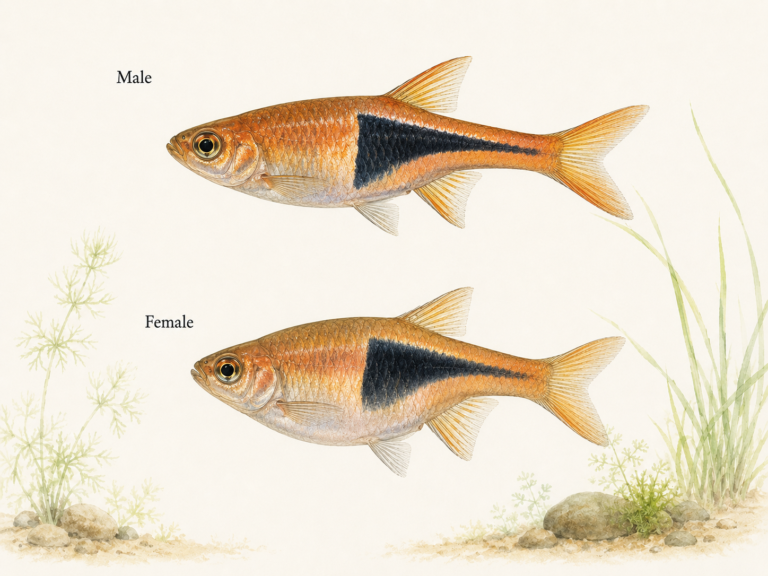
- Harlequin Rasbora — A peaceful, mid-water schooling fish from the same Southeast Asian habitats that will not compete with the loach for space or food.
- Pearl Gourami — A calm, elegant gourami that occupies the upper water column and thrives in the same warm, slightly acidic conditions.
- Kuhli Loach — A fellow peaceful cobitid that shares the Horsefaced Loach’s appreciation for sandy substrates and makes a delightful companion.
- Cherry Barb — A gentle, small barb species that schools attractively in the mid-water without bothering bottom-dwelling fish.
- Corydoras sterbai — A warm-water-tolerant Corydoras species that is peaceful and occupies a similar niche without being aggressive or overly competitive.
- Bristlenose Pleco — A small, hardy pleco that is non-aggressive and primarily feeds on algae and biofilm, leaving plenty of food for the loach.
- Cardinal Tetra — A classic community tetra that prefers soft, acidic water and stays in the middle layers of the tank.
- Rummy-nose Tetra — A tight-schooling, peaceful tetra that adds movement to the upper water column without disturbing the loaches.
- Siamese Algae Eater — A useful and generally peaceful algae grazer that coexists well with bottom-dwelling loaches in larger tanks.
Fish to avoid
- Oscar — A large, predatory cichlid that would view the Horsefaced Loach as potential prey or subject it to severe aggression.
- Red-tailed Black Shark — A highly territorial bottom-dweller that will aggressively chase and harass other bottom-dwelling species.
- Convict Cichlid — An aggressive cichlid, particularly when breeding, that would stress and potentially injure the timid loach.
- Tiger Barb — A notorious fin-nipper whose boisterous behaviour can stress shy, retiring species like the Horsefaced Loach.
- Green Terror — A large and aggressive South American cichlid completely unsuitable for a community containing peaceful loaches.
- Common Pleco — Grows far too large for most aquaria and can become territorial over bottom space, displacing smaller bottom-dwellers.
- African Rift Lake Cichlids — Require hard, alkaline water that is unsuitable for the Horsefaced Loach, and most species are aggressively territorial.
- Freshwater Pufferfish — Most puffers are nippy and aggressive, and their care requirements often differ significantly from those of the loach.
Breeding
Breeding the Horsefaced Loach in captivity is exceptionally rare and has not been reliably documented in the home aquarium hobby. The vast majority of specimens available in the trade are wild-caught. The reasons for the difficulty in breeding this species are not fully understood, but it is likely that the fish requires specific environmental triggers — such as seasonal changes in water temperature, flow rate, or chemistry associated with monsoon flooding — that are extremely difficult to replicate in a standard aquarium setting.
What little is known about the reproductive biology of Acantopsis species suggests they are egg scatterers. In the wild, spawning likely takes place in flowing water over sandy substrates during the rainy season, when rising water levels and increased flow provide both a stimulus and suitable conditions for egg dispersal and larval development. The eggs are probably scattered freely and left unattended, with no parental care provided.
If you wish to attempt breeding, the best approach would be to maintain a well-conditioned group of six or more adults in a spacious tank with a deep sand bed and excellent water quality. Gradually increasing the temperature, performing large cool water changes to simulate rainfall, and increasing the water flow may help to stimulate spawning behaviour. However, success is by no means guaranteed, and this should be considered an advanced to expert-level project. Should any spawning occur, the tiny fry would need to be reared on infusoria and very fine live foods such as freshly hatched brine shrimp nauplii, kept in a separate rearing tank to avoid predation.
Common Diseases
The Horsefaced Loach is a relatively hardy species once established in a suitable environment, but like all aquarium fish, it is susceptible to certain health problems, particularly when stressed or kept in suboptimal conditions. Because this species lacks the heavy scalation of many other fish, it is somewhat more vulnerable to skin infections and is highly sensitive to chemical treatments.
White spot disease, or ich, is one of the most common ailments seen in newly imported or stressed Horsefaced Loaches. The characteristic white cysts appear on the body and fins, and the fish may be seen flashing against the substrate. Treatment should be approached with caution; raise the water temperature gradually to 30 °C and use a half-dose of a mild ich remedy that is labelled as safe for scaleless fish. Salt baths at a low concentration can also be effective, but prolonged exposure to high salt levels should be avoided.
Bacterial infections, including fin rot and skin ulcers, can occur in tanks with poor water quality or abrasive substrates. Prevention is the best medicine — maintaining clean water, using smooth sand, and avoiding overstocking will go a long way towards preventing these issues. If bacterial infections do develop, broad-spectrum antibacterial treatments designed for sensitive fish should be used at reduced dosages, with careful monitoring.
Skinny disease, characterised by a wasting appearance despite the fish apparently eating, can occasionally affect Horsefaced Loaches. This is often caused by internal parasites, which are particularly common in wild-caught specimens. A course of anti-parasitic food or a suitable internal parasite treatment is usually effective if caught early. Quarantining all new arrivals for two to four weeks before adding them to the main display tank is strongly recommended to catch such issues before they spread.
The Horsefaced Loach’s burrowing habit means that any wounds or abrasions from rough substrate materials can quickly become sites of secondary infection. This is yet another reason why fine, smooth sand is a non-negotiable requirement for this species. Regularly check that the substrate has not become compacted or contaminated with sharp debris, and gently stir the surface during water changes to prevent the build-up of anaerobic pockets.
FAQs
Why is my Horsefaced Loach always buried in the sand?
This is completely normal behaviour. In the wild, Horsefaced Loaches spend a significant portion of the day buried in sandy substrates as a means of camouflage and protection from predators. In the aquarium, a fish that readily buries itself is displaying healthy, natural behaviour. Over time, and particularly in tanks with subdued lighting and a regular feeding routine, many individuals will become more confident and spend increasing amounts of time visible on the substrate surface, especially during feeding times and the evening hours.
Can I keep a Horsefaced Loach on gravel instead of sand?
This is strongly discouraged. The Horsefaced Loach’s burrowing behaviour is fundamental to its wellbeing, and coarse or angular gravel can damage its delicate skin, barbels, and gill covers as it attempts to bury itself. Without an appropriate substrate, the fish will be unable to perform its most basic natural behaviour, leading to chronic stress, increased susceptibility to disease, and a significantly reduced lifespan. Fine, smooth sand is an absolute requirement for this species.
How many Horsefaced Loaches should I keep together?
While the Horsefaced Loach is not a strictly social species in the way that some schooling fish are, it is noticeably more confident and active when kept in a small group. A group of three to five individuals is ideal for most appropriately sized community aquaria. Solitary specimens tend to remain permanently hidden and may not thrive. Keeping a group also increases the likelihood of having both sexes, which could be relevant should you wish to attempt breeding.
Is the Horsefaced Loach suitable for a planted aquarium?
Yes, with some caveats. The burrowing activity of these loaches can easily uproot plants with shallow root systems. The best approach is to use plants that attach to hardscape, such as Java Fern, Anubias, and various mosses, or robust rooted species like Cryptocorynes and Vallisneria that are planted in deeper substrate areas and given time to establish strong root systems. Floating plants can also be used to diffuse light and create the shaded conditions that the loach prefers.
Will a Horsefaced Loach eat snails or shrimp?
The Horsefaced Loach is not typically a dedicated predator of snails or shrimp, but very small invertebrates may occasionally be consumed, particularly if the loach encounters them whilst foraging through the substrate. Larger ornamental snails such as Nerite Snails and Mystery Snails are generally safe. Dwarf shrimp such as Cherry Shrimp may be at some risk, especially smaller individuals, though many keepers report successful cohabitation. If you prize your shrimp colony, it may be wise to provide ample hiding spots for the shrimp.
Related Guides
- Kuhli Loach Care Guide — Another popular cobitid loach with similar care requirements and a shared love of sandy substrates.
- Weather Loach Care Guide — A larger loach species with comparable burrowing behaviour and an engaging personality.
- Yoyo Loach Care Guide — A more active loach from South Asia that makes an interesting comparison species for loach enthusiasts.
- Corydoras Catfish Care Guide — Popular sand-dwelling bottom feeders that share the Horsefaced Loach’s need for smooth substrates and gentle tank mates.
- Choosing Sand Substrate for Your Freshwater Aquarium — A detailed guide to selecting and maintaining sandy substrates, essential reading for Horsefaced Loach keepers.