Quick summary
The Polar Parrot Cichlid is a hardy, moderately peaceful hybrid suited to intermediate keepers who can provide a 200+ litre tank, stable warm water, and cichlid-appropriate tankmates. It’s not ideal for total beginners or small setups, and if you’re hoping to breed it, be aware fertility is often low, especially in males.
🐠 Build a tank around this species
In this guide:
- Introduction
- Quick Stats
- Appearance
- Varieties and Morphs
- Natural Habitat
- Tank Size and Setup
- Water Parameters
- Filtration and Equipment
- Diet and Feeding
- Behaviour and Temperament
- Tank Mates
- Breeding
- Common Diseases
- FAQs
Introduction
The Polar Parrot Cichlid is one of the more intriguing and visually striking hybrid cichlids available in the freshwater aquarium trade. Created through selective crossbreeding, most commonly between the Polar Blue Parrot Cichlid (itself a hybrid of convict cichlid and blood parrot lineage) and other Central American cichlid stock, the Polar Parrot occupies a curious space in the hobby. It is not a naturally occurring species, has no wild population, and cannot be assigned a single valid scientific name. The parentage label Amphilophus citrinellus hybrid is used loosely in the trade, though the actual genetic background likely involves contributions from Amphilophus citrinellus, Paraneetroplus synspilus (the redhead cichlid), and Amatitlania nigrofasciata (the convict cichlid), among others. The precise cross varies between breeding facilities, particularly those in Southeast Asia where most commercial specimens originate.
Despite the controversy that sometimes surrounds hybrid fish, Polar Parrots have earned a devoted following thanks to their compact body shape, pale colouration, engaging personalities, and relative hardiness. They are generally peaceful by cichlid standards, making them accessible to intermediate keepers who want the character of a Central American cichlid without the full-blown aggression. This guide covers everything you need to know to keep Polar Parrot Cichlids healthy and thriving in the home aquarium, from tank setup and water chemistry to diet, breeding, and disease prevention.
Quick Stats
| Scientific name | Amphilophus citrinellus hybrid (exact parentage variable) |
|---|---|
| Common names | Polar Blue Parrot Cichlid, Snow White Parrot Cichlid, Polar Parrot Fish |
| Family | Cichlidae |
| Origin | Captive-bred hybrid, parent species from Central America |
| Adult size | 15 cm |
| Difficulty | Intermediate |
| Breeding difficulty | Advanced |
| Temperature | 21–26 °C |
| pH | 6.5–7.8 |
| GH | 5–25 dGH |
| Minimum tank size | 200 L |
| Conservation status | Not Evaluated (captive-bred hybrid) |
Appearance
Polar Parrot Cichlids possess the characteristically rounded, somewhat compressed body shape inherited from their blood parrot ancestry, though they tend to be noticeably smaller and slightly more streamlined than a full-sized blood parrot. The head is blunt, the mouth relatively small and slightly deformed in some specimens, a trait that can affect feeding efficiency and is worth checking when selecting fish at the shop. The dorsal fin is moderately tall and runs along much of the back, while the caudal fin is rounded to slightly fan-shaped.
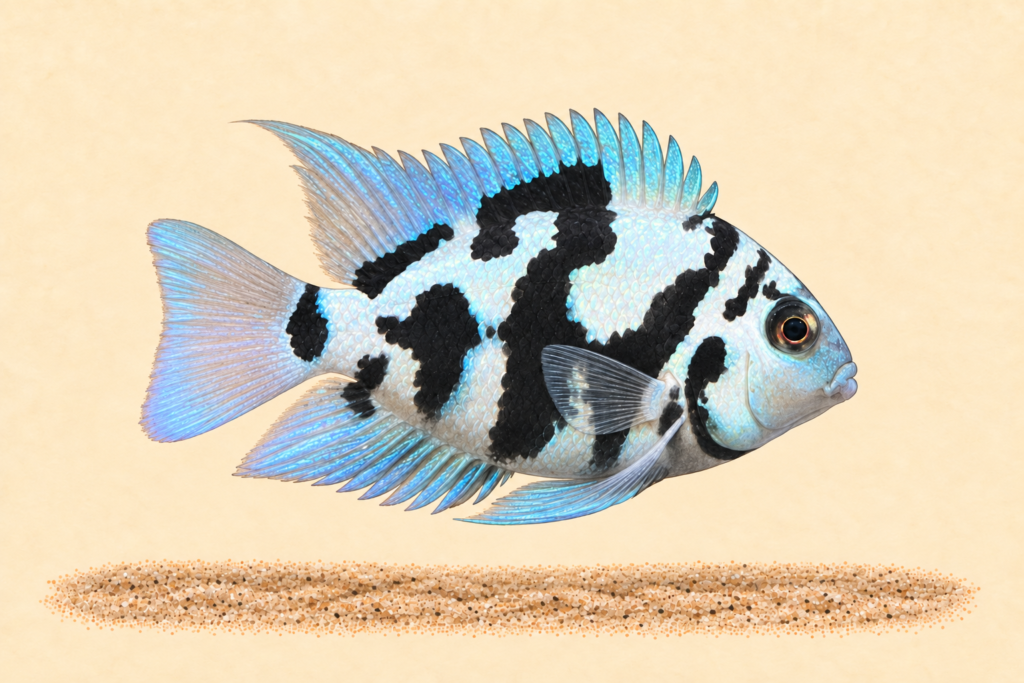
The hallmark feature of the Polar Parrot is its colouration. The base colour is a pale, almost ghostly white to cream, often overlaid with irregular patches or speckles of light blue, lavender, or grey. The intensity and distribution of these markings vary considerably between individuals. Some fish appear almost uniformly white with the faintest dusting of blue, while others display bold blue-grey mottling reminiscent of a convict cichlid’s barring, hinting at that genetic contribution. The eyes are typically dark, creating an appealing contrast against the pale body. Fins may be translucent to faintly blue-tinged.
Juveniles tend to be more uniformly pale and develop stronger patterning as they mature. During breeding condition or periods of heightened social interaction, colours can intensify noticeably. It is also worth noting that colouration can fade under stress, poor water quality, or an inadequate diet, so a washed-out Polar Parrot is often telling you something about its husbandry rather than simply displaying its natural palette.
Varieties and Morphs
Because Polar Parrots are themselves a product of selective hybridisation, the line between distinct morphs and normal variation can be blurry. Nevertheless, several trade names have become established, each describing a recognisable colour form or pattern. The exact genetic makeup behind these variants is rarely disclosed by Asian breeding farms, so names should be treated as commercial descriptors rather than formal classifications.
The standard Polar Parrot is the most commonly available form, exhibiting the classic white-to-cream base with variable blue-grey speckling. The Polar Blue Parrot is marketed as a more intensely blue variant, with heavier lavender-to-steel-blue patches covering a larger portion of the body; this form is sometimes sold as a separate fish altogether, though it sits on the same genetic spectrum. The Snow White Parrot is selected for minimal patterning, appearing almost entirely white or very pale cream with only the faintest trace of blue on the fins or operculum. The Platinum Parrot is another near-white variant with a slightly metallic sheen to the scales, giving it a lustrous, pearlescent appearance under aquarium lighting.
The Polar Jellybean Parrot is a smaller, more compact form, sometimes the result of a slightly different cross, that retains the pale colouration but in a stubbier body shape. Dyed or artificially coloured versions, tragically, do appear on the market; these fish have been injected with or dipped in chemical dyes to produce unnatural pinks, greens, or purples. These should be avoided on welfare grounds, as the process is stressful, often shortens lifespan, and the colour inevitably fades. If a Polar Parrot appears an unnaturally vivid hue not consistent with the forms described above, it has almost certainly been dyed.
Natural Habitat
Strictly speaking, the Polar Parrot Cichlid has no natural habitat. It is an entirely captive-bred hybrid that does not exist in the wild. However, understanding the environments of its parent species provides useful context for replicating appropriate conditions in the aquarium.
The midas cichlid (Amphilophus citrinellus) inhabits lakes and slow-moving rivers in Nicaragua and Costa Rica, where it occupies rocky substrates and areas with submerged wood. Water in these habitats is typically warm, moderately hard, and slightly alkaline. The convict cichlid (Amatitlania nigrofasciata), another likely contributor, is found across a wide range of Central American waterways, from Guatemala to Honduras, thriving in streams and rivers with rocky or sandy bottoms and moderate flow. The redhead cichlid (Paraneetroplus synspilus) comes from the rivers and lakes of southern Mexico, Belize, and Guatemala, favouring warm, hard, alkaline water with plenty of cover.
The common thread among these parent species is a preference for warm, moderately hard to hard water with a neutral to slightly alkaline pH, and environments that offer rock formations, caves, and driftwood for shelter and territorial boundaries. Replicating these elements in the aquarium will go a long way towards keeping Polar Parrots comfortable and behaviourally enriched.
Tank Size and Setup
A single Polar Parrot Cichlid can be housed in an aquarium of at least 200 litres, but if you plan to keep a pair or a small group, which is recommended to observe their social behaviour, you should aim for 300 litres or more. For a community tank containing Polar Parrots alongside other cichlids or robust tankmates, 400 litres and upwards will provide the space needed to reduce territorial disputes and give each fish adequate room to establish its own area.
The aquascape should incorporate plenty of visual barriers and hiding spots. Stacks of smooth river rocks, terracotta pots, bogwood, and caves formed from stone or ceramic are all excellent choices. These structures break up sightlines, which is critical for managing aggression in any cichlid tank. Polar Parrots will frequently claim a cave or sheltered overhang as their home base, and providing more hiding spots than there are fish helps prevent monopolisation by dominant individuals.
Substrate can be fine gravel or sand. Sand is often preferred because Polar Parrots enjoy sifting through it with their mouths, a natural foraging behaviour inherited from their parent species. Avoid sharp or coarse substrates that could damage their somewhat delicate mouths. Live plants can be included but choose robust, well-rooted species such as Anubias, Java fern, or Vallisneria, as Polar Parrots may uproot or nibble at more delicate vegetation. Attaching plants to hardscape rather than planting them in the substrate is a practical workaround.
Lighting should be moderate. Polar Parrots do not require intense illumination and may feel more at ease under subdued conditions, though standard LED aquarium lighting on a timer providing 8–10 hours of light per day is perfectly suitable. A secure lid or cover is advisable, as while Polar Parrots are not habitual jumpers, startled fish can occasionally leap.
Water Parameters
| Temperature | 24–28 °C |
| pH | 6.5–7.8 |
| General hardness (GH) | 6–18 dGH |
| Ammonia | 0 ppm |
| Nitrite | 0 ppm |
| Nitrate | Below 30 ppm |
Polar Parrots are reasonably adaptable in terms of water chemistry, a trait inherited from their hardy Central American parent species. They thrive in neutral to slightly alkaline water and tolerate a fairly broad range of hardness values. Stability is more important than hitting a precise number; sudden swings in pH or temperature are far more dangerous than a reading that sits slightly outside the ideal range. Aim for consistency above all else.
Ammonia and nitrite must always read zero in a cycled aquarium. Nitrate should be kept below 30 ppm through regular water changes, weekly changes of 25–30% are a sensible baseline. In a heavily stocked tank, you may need to increase both the frequency and volume of water changes. Use a reliable liquid test kit rather than strip tests for accuracy, and test at least weekly, especially when the tank is newly established or after adding new livestock.
Filtration and Equipment
Polar Parrots are messy eaters and produce a fair amount of waste relative to their size, so robust filtration is non-negotiable. An external canister filter rated for at least 1.5 times the tank’s volume is ideal. For a 300-litre setup, for example, look for a filter rated for 450 litres or more. Canister filters offer excellent biological, mechanical, and chemical filtration capacity, and their external placement keeps the interior of the tank uncluttered.
Supplementing the main filter with a sponge filter or an additional internal powerhead can provide extra biological filtration surface area and improve water circulation. Polar Parrots appreciate moderate flow, enough to keep the water well-oxygenated and prevent dead spots where detritus accumulates, but not so powerful that the fish are constantly battling a current. Directing the filter outlet against the back or side glass can help diffuse flow.
A reliable heater with a built-in thermostat is essential for maintaining the warm temperatures these fish require. In larger tanks, two heaters placed at opposite ends provide more even heat distribution and offer redundancy in case one fails. An air stone or surface agitation from the filter return is usually sufficient to maintain adequate dissolved oxygen levels, but in warmer climates or heavily stocked systems, an additional air pump can be a worthwhile investment.
Diet and Feeding
Polar Parrot Cichlids are omnivores with a hearty appetite. In the aquarium, they accept a wide variety of foods, which makes feeding them straightforward. The foundation of their diet should be a high-quality cichlid pellet formulated for medium-sized Central American or general New World cichlids. Choose pellets that list whole fish meal, spirulina, or insect meal as primary ingredients and avoid those heavy in fillers such as wheat or soy.
Supplement the staple pellet with frozen or live foods to provide variety and enrichment. Bloodworm, brine shrimp, daphnia, and mysis shrimp are all eagerly consumed. Blanched vegetables such as courgette (zucchini), shelled peas, and spinach offer valuable fibre and plant-based nutrition, helping to prevent digestive issues. Occasional treats of krill or chopped prawns can be offered but should not form a large part of the diet due to their high protein content.
It is important to note that some Polar Parrots have slightly deformed mouths that make it difficult for them to eat large or hard food items. Observe your fish at feeding time and adjust food size accordingly. Sinking pellets are generally better than floating ones, as the downward-oriented mouth typical of many specimens makes surface feeding awkward. Feed two to three small meals per day rather than one large feeding, as this reduces waste and gives less dominant fish a chance to eat. Remove any uneaten food after a few minutes to prevent water quality deterioration.
Behaviour and Temperament
One of the chief appeals of the Polar Parrot Cichlid is its personality. These fish are curious, interactive, and often develop a clear recognition of their keeper, approaching the front glass at feeding time or when someone enters the room. They display a range of social behaviours including mild chasing, lip-locking (a ritualised form of sparring), and territory defence, all of which make them endlessly entertaining to watch.
In terms of aggression, Polar Parrots sit in the mild-to-moderate range for cichlids. They are significantly less combative than pure convict cichlids or midas cichlids, but they are not pushovers either. Territorial behaviour increases during breeding periods or when space is limited. In a well-designed tank with ample hiding spots and visual barriers, aggression is usually manageable and rarely results in serious injury. Problems tend to arise in cramped conditions, understocked tanks where a single subordinate fish bears the brunt of all aggression, or when incompatible tankmates are chosen.
Polar Parrots are generally best kept in groups of three or more if the tank is large enough. This distributes aggression and allows a more natural social hierarchy to form. Keeping just two fish can sometimes lead to one bullying the other relentlessly, with no third party to deflect attention. If keeping a single specimen, ensure it has robust but non-aggressive tankmates to interact with.
Tank Mates
Choosing appropriate companions for Polar Parrots requires balancing their moderate temperament with their Central American cichlid heritage. Ideal tankmates are similarly sized, robust, and able to hold their own without being overly aggressive. Avoid very small, timid, or slow-moving species that could be bullied or outcompeted for food, and steer clear of highly aggressive cichlids that would dominate Polar Parrots.
Good tank mates
- Blood Parrot Cichlid, shares a similar temperament and body shape, making the two a natural pairing in larger tanks.
- Firemouth Cichlid, a moderately territorial Central American cichlid whose threat displays rarely escalate to actual harm, coexisting well with Polar Parrots.
- Rainbow Cichlid, one of the more peaceful Central American cichlids, it matches the Polar Parrot’s temperament and water requirements closely.
- Severum, a calm, mid-sized South American cichlid that tolerates overlapping parameter ranges and is unlikely to provoke or be provoked.
- Bristlenose Pleco, a hardy algae-eater that stays out of the Polar Parrot’s way and occupies different areas of the tank.
- Silver Dollar, a robust, schooling species that inhabits the mid-to-upper water column and is too large and fast to be harassed.
- Giant Danio, an active, fast-swimming dither fish that helps draw shy cichlids out into the open and is too quick to be caught.
- Clown Loach, a sociable bottom-dweller that thrives in similar temperatures and is large enough to coexist safely.
- Hoplo Catfish, a peaceful, well-armoured catfish that does well alongside moderate cichlids and helps clean up uneaten food.
Fish to avoid
- Oscar, grows far too large and aggressive, and would easily dominate or injure a Polar Parrot.
- Jaguar Cichlid, a highly predatory and territorial species that poses a serious threat to Polar Parrots.
- Neon Tetra, far too small and would likely be eaten or constantly stressed by the cichlids.
- Convict Cichlid, while genetically related, pure convicts are significantly more aggressive, especially when breeding, and tend to bully Polar Parrots.
- Flowerhorn Cichlid, another hybrid but one that is far more aggressive and territorial, making cohabitation dangerous.
- Betta, the slow-moving, long-finned betta would be an easy target for fin-nipping and harassment.
- Cherry Shrimp, would be treated as a live snack rather than a tankmate.
- African Rift Lake Cichlid (Mbuna), require different water chemistry and their rapid, relentless aggression would overwhelm Polar Parrots.
Breeding
Breeding Polar Parrot Cichlids is a challenge, primarily because many hybrid cichlids suffer from reduced fertility. Males in particular are frequently sterile, a common consequence of the genetic distance between the parent species involved in the cross. Females tend to be fertile more often, which is why some breeders pair a Polar Parrot female with a male from one of the contributing species, typically a convict cichlid, to produce offspring. However, the resulting fry will not be identical to the parents and may vary in appearance.
If you wish to attempt breeding, start by conditioning a group of young Polar Parrots together in a spacious tank and allowing pairs to form naturally. Sexing can be difficult; males are often slightly larger with a more pronounced nuchal hump as they mature, while females tend to be rounder-bodied when gravid. Once a pair forms, they will typically select a flat rock, the inside of a cave, or a cleaned section of substrate as a spawning site. Pre-spawning behaviour includes vigorous cleaning of the chosen surface, intensified colouration, and increased territorial aggression towards other tank inhabitants.
The female deposits rows of eggs on the prepared surface, and the male follows to fertilise them, though again, fertilisation rates may be very low or zero if the male is sterile. A successful spawn can produce anywhere from 100 to 300 eggs. Both parents typically guard the eggs and fan them to maintain water flow. Eggs that turn white are infertile and should be removed by the parents or by the keeper to prevent fungal spread. Fertile eggs hatch in approximately three to four days at 26–27 °C, and the wrigglers become free-swimming within another four to five days.
Free-swimming fry can be fed newly hatched brine shrimp, microworms, or finely crushed high-quality fry food. Parental care often continues for several weeks, with both adults shepherding the brood around the tank. During this period, the parents become significantly more aggressive, so tankmates may need to be separated if the breeding tank is not large enough to provide adequate buffer zones.
Common Diseases
Polar Parrot Cichlids are generally hardy but, like all aquarium fish, they are susceptible to a range of diseases, particularly when water quality lapses or stress levels rise. Ich (white spot disease), caused by the parasite Ichthyophthirius multifiliis, is one of the most frequently encountered problems. It manifests as small white cysts on the body and fins, accompanied by flashing (rubbing against surfaces) and lethargy. Treatment involves raising the temperature to 30 °C gradually over 24 hours and dosing with a proprietary ich medication. Early intervention is key, as severe infestations can be fatal.
Hole-in-the-head disease (HITH) is another condition to watch for, particularly in cichlids kept in suboptimal conditions. It presents as pitting erosions on the head and lateral line, and is associated with poor water quality, nutritional deficiency (especially a lack of vitamins and minerals), and possibly the flagellate parasite Hexamita. Improving water quality through more frequent changes, enriching the diet with vitamin-soaked foods, and treating with metronidazole if parasitic involvement is suspected are the standard approaches.
Swim bladder disorders are occasionally seen in Polar Parrots, likely owing to their compressed body shape placing additional pressure on internal organs. Affected fish may float abnormally, sink to the bottom, or swim at an unusual angle. Fasting for two to three days followed by offering blanched, shelled peas can resolve mild cases related to constipation or overfeeding. Persistent swim bladder issues may indicate a more serious internal problem and warrant veterinary attention.
Fin rot, columnaris, and general bacterial infections can occur when fish are stressed, injured, or exposed to poor water quality. Maintaining pristine conditions, avoiding overcrowding, and quarantining new arrivals for at least two weeks before adding them to an established tank are the best preventative measures. A hospital tank is an invaluable resource for treating sick individuals without exposing the entire community to medications.
FAQs
Are Polar Parrot Cichlids natural or man-made?
Polar Parrots are entirely man-made. They are hybrid fish created through selective breeding, primarily in commercial fish farms in Southeast Asia. They do not occur in the wild and have no natural range. Their parentage involves several Central American cichlid species, though exact crosses can vary between breeding facilities.
Can Polar Parrot Cichlids live with Blood Parrot Cichlids?
Yes, the two make generally excellent companions. Both share a similar temperament, comparable size range, and overlapping water parameter requirements. In a tank of 400 litres or more with adequate hiding spots, the two hybrid types coexist peacefully and often shoal together, creating an attractive display.
Why is my Polar Parrot Cichlid losing its colour?
Colour fading in Polar Parrots is most commonly a sign of stress, poor water quality, an inadequate diet, or illness. Test your water parameters immediately and perform a water change if nitrate is elevated. Ensure the diet includes colour-enhancing foods rich in carotenoids and spirulina. If the fish is also displaying lethargy, clamped fins, or other symptoms, investigate potential disease causes.
How can I tell if my Polar Parrot Cichlid is male or female?
Sexing Polar Parrots is notoriously difficult, especially in juveniles. As they mature, males tend to be slightly larger and may develop a modest nuchal hump on the forehead. Females are often rounder in the belly when carrying eggs. Venting, examining the genital papillae, is the most reliable method, but it requires experience and careful handling. Males have a smaller, more pointed papilla, while females display a broader, blunter one.
Do Polar Parrot Cichlids need to be kept in groups?
While they can be kept singly, Polar Parrots are more active, display a wider range of behaviours, and generally appear less stressed when kept in groups of three or more. A solitary specimen should be housed with other compatible community fish to prevent isolation-related stress. If keeping multiples, ensure the tank is large enough and well-structured with hiding spots to manage any territorial behaviour.
Related Guides
- Blood Parrot Cichlid Care Guide, an essential companion read, as the blood parrot is a close relative and frequent tankmate of the Polar Parrot.
- Convict Cichlid Care Guide, covers one of the Polar Parrot’s likely parent species, providing useful background on genetics and behaviour.
- Firemouth Cichlid Care Guide, a popular Central American cichlid that shares many care requirements and makes an excellent tankmate.
- Midas Cichlid Care Guide, details the other principal parent species, offering insight into the Polar Parrot’s heritage and behavioural tendencies.
- Central American Cichlid Tank Setup Guide, a broader guide to aquascaping and equipment selection for New World cichlid aquariums.