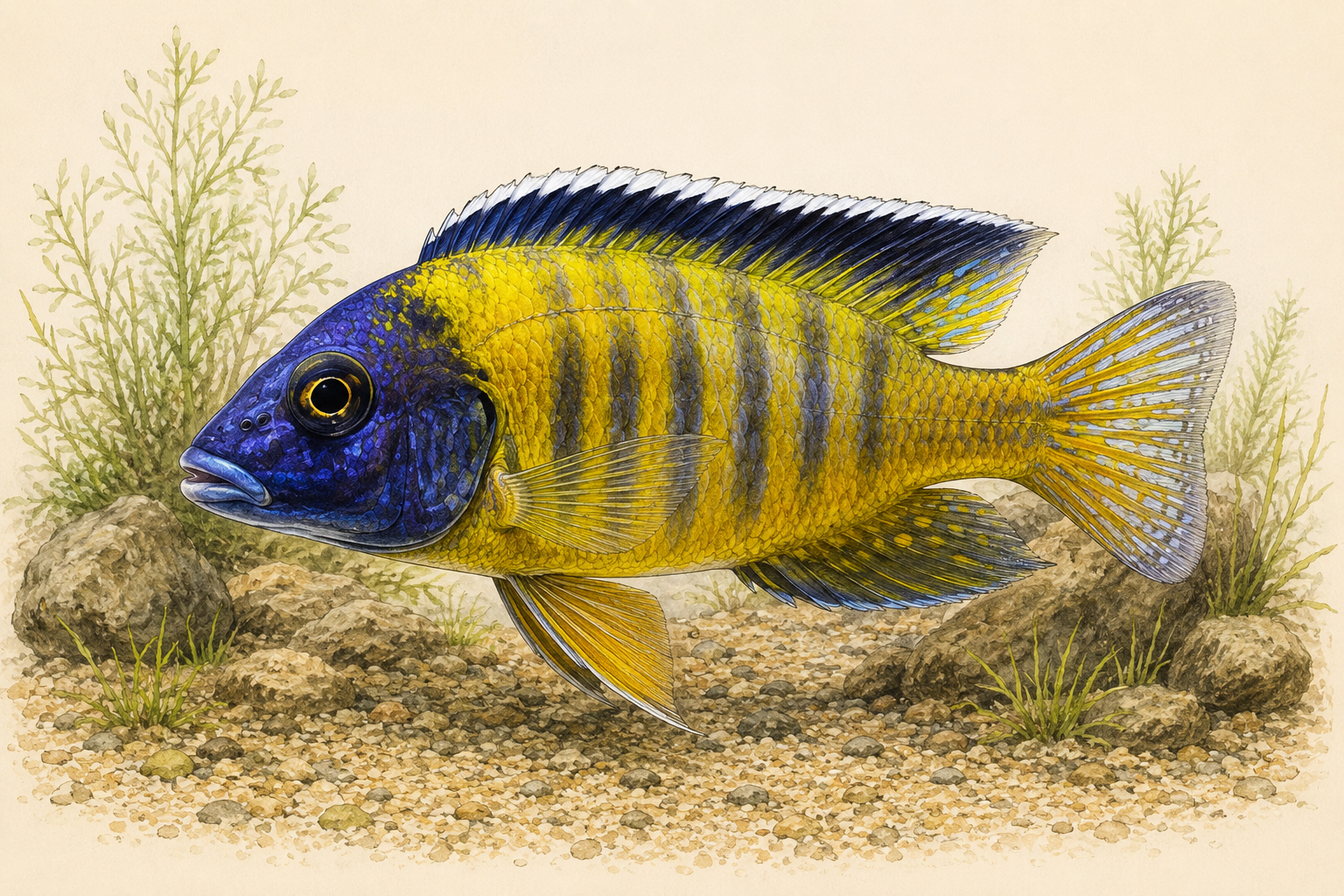
Flavescent Peacock Care Guide — Tank Setup, Feeding and Breeding
Introduction
The Flavescent Peacock is one of the most celebrated members of the Aulonocara genus, a group of cichlids collectively known as “peacock cichlids” for their dazzling, iridescent colouration. Native to the clear waters of Lake Malawi in East Africa, Aulonocara stuartgranti has earned a devoted following among aquarists thanks to its vivid palette of electric blues, sunny yellows, and warm oranges. Few freshwater fish can rival the visual impact of a fully mature male Flavescent Peacock cruising across a well-designed Malawi biotope.
Beyond its striking looks, this species is prized for its relatively mild temperament compared to many other African cichlids. While it is undeniably a cichlid — territorial during breeding and assertive around food — it lacks the relentless aggression of its mbuna cousins, making it a far more manageable proposition for intermediate hobbyists. Its willingness to breed in captivity, combined with the variety of geographical colour morphs available in the trade, means that keepers can enjoy an almost endless palette of natural colour forms without resorting to hybridisation.
This guide covers everything you need to know to keep and breed the Flavescent Peacock successfully, from water chemistry and tank design to diet, compatible species, and disease prevention. Whether you are setting up your first Lake Malawi display or adding a centrepiece fish to an established Haplochromis community, the information here will help you provide the best possible care.
Quick Stats
| Scientific name | Aulonocara stuartgranti |
| Common names | Flavescent Peacock, Stuart Grant’s Peacock, Usisya Peacock, Maleri Peacock, Ngara Flametail, Chipoka Peacock, Blue Neon Peacock |
| Family | Cichlidae |
| Origin | Lake Malawi, East Africa (Malawi, Mozambique, Tanzania) |
| Adult size | 12–15 cm (5–6 inches) |
| Lifespan | 6–10 years |
| Difficulty | Moderate |
| Breeding difficulty | Easy |
| Temperature | 24–28 °C |
| pH range | 7.5–8.8 |
| General hardness (GH) | 6–18 dGH |
| Carbonate hardness (KH) | 6–12 dKH |
| Minimum tank size | 250 litres |
| Conservation status | Least Concern (IUCN) |
Appearance
Aulonocara stuartgranti is a moderately sized, laterally compressed cichlid with a somewhat elongated body and a gently sloping forehead. Like all peacock cichlids, it possesses enlarged sensory pores along the lower jaw and across the face, which it uses to detect tiny invertebrates buried in the substrate — a feature that gives the genus its characteristic “sonar” hunting behaviour.
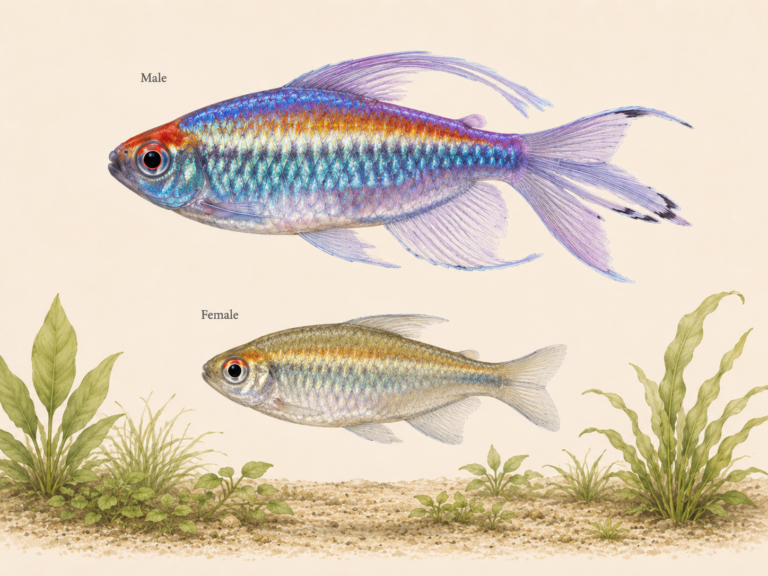
Sexual dimorphism in this species is pronounced. Mature males are the showstoppers, displaying a vivid metallic blue that covers the head, gill covers, and flanks, transitioning into warm yellow, gold, or orange across the posterior half of the body and into the caudal fin. The exact distribution and intensity of these colours varies enormously with locality, which has given rise to numerous geographical colour forms in the hobby. The dorsal fin typically carries a blue or white edging, while the anal fin may feature one or more egg spots — small ocelli that play a role in the species’ mouthbrooding reproductive strategy.
Females and subdominant males are far more restrained in colouration, displaying a silvery grey to brownish body with faint vertical barring. This cryptic coloration offers camouflage among the rocks and sand of their natural habitat. Juveniles of both sexes resemble females, and males usually begin to show colour at around five to seven centimetres, with full adult colouration developing by twelve months of age, depending on social conditions and diet.
Varieties and Morphs
One of the most fascinating aspects of Aulonocara stuartgranti is the remarkable diversity of colour forms found at different localities around Lake Malawi. These are not captive-bred hybrids but genuine geographic variants, each associated with a specific collection point. The hobby has given many of these forms distinct trade names, and responsible breeders take care to keep locality lines pure. Below are some of the most commonly encountered variants.
The Usisya variant is perhaps the most iconic, with males displaying a deep metallic blue head and chest that blends into a bright yellow body and tail. It is often sold simply as “Flavescent Peacock” and represents the type locality form that most aquarists picture when they hear the name.
The Ngara Flametail is another highly sought-after form, originating from Ngara on the Tanzanian shoreline. Males of this variety exhibit an intense blue forebody with a striking orange-red caudal fin and orange flanks, giving it a fiery appearance that is hard to mistake.
The Maleri Island variant features males with a blue face and bright golden-yellow flanks, sometimes with subtle orange tones along the ventral area. It is a consistently popular form owing to its clean, contrasting colour pattern.
The Chipoka variety tends to display a blue head with a lighter, more lemony yellow body, sometimes with a greenish shimmer along the flanks. It is somewhat less commonly available but prized by collectors seeking a subtler palette.
The Cobue form, collected near Cobue in Mozambique, showcases a particularly intense and deep blue that extends further along the body, with yellow or gold colouration often limited to the posterior third and tail fin.
The Mdoka variant shows a blend of blue and orange, with males often displaying an orange wash across the flanks that gradually deepens toward the tail, creating a warm, sunset-like gradient effect.
The Maulana or Maulana Bi-colour is noted for its sharply defined two-tone appearance, where the forward half of the body is a rich electric blue and the rear half shifts abruptly to a golden yellow or orange.
The Hongi Island variety, sometimes confused with mbuna of the same collection point, produces males with a blue face and a soft orange-gold body, often with subtle barring visible in certain lighting or moods.
Beyond these natural forms, some commercial breeders have selectively bred for enhanced colouration, producing line-bred strains that amplify the yellow, orange, or blue tones. While these are not hybrid fish, they may not precisely represent any single wild population, so buyers should always ask about provenance when purchasing breeding stock.
Natural Habitat
Aulonocara stuartgranti is endemic to Lake Malawi, one of the African Great Rift Lakes. It is widely distributed along the lake’s shoreline, occurring in Malawi, Mozambique, and Tanzania, which accounts for the extraordinary variety of colour forms found across its range. The species typically inhabits the intermediate zone where rocky outcrops meet open sandy substrates, at depths ranging from roughly five to twenty-five metres.
This transitional habitat is crucial to understanding the fish’s behaviour. Unlike the mbuna, which are rock-dwelling algae scrapers, A. stuartgranti is an open-water forager that hovers above sandy patches adjacent to rocky terrain. It uses its enlarged sensory pores to detect microscopic vibrations produced by tiny invertebrates — insect larvae, crustaceans, and worms — buried just beneath the surface of the sand. When prey is detected, the fish plunges its snout into the substrate and sifts out its meal, a behaviour that is frequently observed in captivity as well.
The water of Lake Malawi is famously clear, warm, and alkaline, with remarkably stable chemistry. The pH typically ranges from 7.7 to 8.6, general hardness sits between 4 and 8 dGH in some areas but can reach higher levels near certain rocky shores, and the temperature hovers around 24–27 °C throughout the year. Dissolved oxygen levels are high in the shallow zones where peacocks are found, and the water contains negligible amounts of ammonia and nitrite. Replicating these conditions in the aquarium is essential for long-term health and colour development.
Tank Size and Setup
A single male Flavescent Peacock with a small harem of females requires a minimum aquarium volume of 250 litres, though a tank of 340 litres or more is strongly recommended if you plan to keep a mixed Malawi community. The tank should be at least 120 cm in length, as lateral swimming space matters more than height or depth for a species that patrols territories along the substrate.
The substrate should consist of fine sand, ideally a pale coral sand or aragonite that will gently buffer the water toward an alkaline pH. Avoid sharp-edged gravel, as A. stuartgranti will actively sift the substrate through its gills when foraging, and rough material can damage its delicate sensory pores and gill membranes. A bed of sand approximately three to five centimetres deep is ideal.
Rock work should be arranged to create caves, overhangs, and territorial boundaries without consuming all available swimming space. Use inert limestone, ocean rock, or lava rock to build stable structures anchored directly to the glass rather than resting on sand, which cichlids can undermine. Position rocks along the back and sides of the tank, leaving the central and foreground areas as open sand flats where males can display and females can forage. This layout mirrors the natural intermediate zone and reduces aggression by providing both line-of-sight breaks and unobstructed display arenas.
Live plants are not essential and, indeed, most Malawi biotope enthusiasts forgo them. However, robust species such as Anubias barteri, Vallisneria, or Java Fern attached to rocks can add visual interest and extra cover without conflicting with the alkaline water chemistry. Avoid soft or delicate plants, which are likely to be uprooted or nibbled.
Lighting should be moderate. Intense overhead lighting can wash out the fish’s metallic colouration and may increase stress in subordinate individuals. A full-spectrum LED fixture on a timer providing eight to ten hours of light per day is adequate. Background colour is a matter of personal taste, though a dark background often makes the fish’s colours pop dramatically.
Water Parameters
| Temperature | 24–28 °C |
| pH | 7.5–8.8 |
| General hardness (GH) | 6–18 dGH |
| Carbonate hardness (KH) | 6–12 dKH |
| Ammonia | 0 ppm |
| Nitrite | 0 ppm |
| Nitrate | Below 20 ppm |
Stability is the golden rule with Malawi cichlids. Sudden fluctuations in pH or temperature are far more dangerous than a reading that sits slightly outside the ideal range. If your local tap water is soft and acidic, you can raise hardness and pH using aragonite substrate, crushed coral in the filter, or a commercial Rift Lake buffer salt mix. Test your water weekly and aim for consistency above all else. Nitrate should be kept as low as practically possible; while Lake Malawi fish tolerate moderate levels better than some tropical species, persistently high nitrate above 40 ppm will suppress colour, weaken immune function, and predispose fish to bloat.
Filtration and Equipment
Efficient biological filtration is non-negotiable for any cichlid aquarium. Peacock cichlids produce a moderate bioload, and a well-stocked Malawi tank can quickly overwhelm an undersized filter. Aim for a total turnover rate of at least eight to ten times the tank volume per hour. A large canister filter rated for the next tank size up is an excellent starting point, and many keepers supplement this with a secondary internal powerhead or a sponge filter to provide additional biological capacity and water movement.
Mechanical filtration should include coarse and fine media to trap particulate waste from substrate-sifting behaviour, which can cloud the water. Biological media such as ceramic rings, sintered glass, or high-surface-area plastic media should form the bulk of your filter volume. Chemical filtration with activated carbon is optional but useful for maintaining water clarity and removing dissolved organics between water changes.
Water movement should be moderate to brisk. In the wild, these fish inhabit areas with gentle currents, and good circulation helps keep oxygen levels high and prevents dead spots where detritus accumulates. Position filter outlets and powerheads to create a broad, even flow across the length of the tank rather than a single strong jet.
A reliable heater — ideally a titanium or shatterproof model, as cichlids can occasionally dislodge equipment — should be set to maintain a temperature of 25–26 °C. Use a separate thermometer to verify the heater’s accuracy. An air pump is not strictly necessary if surface agitation from the filter is adequate, but it provides a useful backup for oxygenation during hot weather or in the event of a filter failure.
Diet and Feeding
In Lake Malawi, Aulonocara stuartgranti is a micro-predator that feeds primarily on small benthic invertebrates such as insect larvae, ostracods, and tiny crustaceans detected in the sand using its sensory pores. This natural diet is high in protein and relatively low in vegetable matter, placing the Flavescent Peacock in the carnivorous-to-omnivorous category rather than the herbivorous camp occupied by many mbuna.
In the aquarium, a high-quality cichlid pellet formulated for Malawi peacocks or Haplochromis should form the staple diet. Look for pellets that list whole fish meal, krill, or insect meal as the primary ingredient and avoid those that rely heavily on cereal fillers. Pellet size should match the fish’s mouth — typically one to two millimetre pellets for sub-adults, and two to three millimetre pellets for mature fish.
Supplement the staple diet with frozen or live foods two to three times per week. Bloodworm, brine shrimp, mysis shrimp, daphnia, and cyclops are all excellent choices that closely approximate the natural prey items. Live blackworms are eagerly taken and stimulate natural foraging behaviour as they burrow into the sand. Avoid feeding mammalian proteins such as beef heart, which are difficult for cichlids to digest and have been linked to intestinal bloat.
Vegetable matter, while not a major component of the wild diet, can be offered occasionally in the form of blanched spinach, spirulina flakes, or spirulina-enriched pellets. This helps maintain gut health and provides micronutrients. Feed two to three small meals per day rather than one large feeding; this reduces aggression around food, prevents overeating, and keeps water quality more stable. Remove any uneaten food within a few minutes to prevent fouling.
Behaviour and Temperament
The Flavescent Peacock is often described as one of the more peaceful Malawi cichlids, and while this is broadly true in comparison to aggressive mbuna species, it would be misleading to call it a truly peaceful fish. Mature males are territorial, particularly during breeding, and will defend a chosen spawning site against rival males with vigour. Displays include lateral flaring, gill extension, colour intensification, and rapid chasing. In a tank that is too small or lacks sufficient structure, these encounters can escalate to fin nipping and sustained harassment.
The best approach to managing aggression is to keep one male with three to five females, a ratio that spreads the male’s attention and reduces pressure on any single individual. If you wish to keep multiple males in the same tank, the aquarium needs to be large enough — typically 450 litres or more — to support several distinct territories separated by line-of-sight barriers. Mixing males of different Aulonocara species or colour forms can work well in a spacious tank, as the fish tend to be less aggressive toward individuals that look markedly different from themselves.
Females are generally social and tolerant of one another, forming loose aggregations that roam the tank foraging. Subdominant males often suppress their colour and behave much like females to avoid provoking the dominant male. If the dominant male is removed, a subdominant male will typically begin to colour up within days, a fascinating demonstration of social dynamics in action.
Flavescent Peacocks spend much of their time in the lower third of the water column, hovering above the sand and methodically scanning for food. They are active during the day and appreciate a regular photoperiod. At night, or when startled, they may retreat to rocky cover. They are not jumpers under normal circumstances, but a tight-fitting lid is always advisable to prevent accidents.
Tank Mates
Good tank mates
- Yellow Lab Cichlid (Labidochromis caeruleus) — one of the least aggressive mbuna, it occupies a different niche and its bright yellow colour contrasts beautifully without provoking territorial disputes.
- Red Empress Cichlid (Protomelas taeniolatus) — a similarly tempered Haplochromis-type cichlid that shares compatible water requirements and rarely competes directly for territory.
- Blue Dolphin Cichlid (Cyrtocara moorii) — a gentle giant among Malawi cichlids that coexists peacefully with peacocks provided the tank is large enough.
- OB Peacock Cichlid (Aulonocara sp. “OB”) — shares the same care requirements and temperament, though care should be taken to avoid hybridisation if breeding is planned.
- Sunshine Peacock (Aulonocara baenschi) — another mild-mannered Aulonocara species whose yellow colouration differs enough from most stuartgranti forms to reduce male-to-male aggression.
- Bristlenose Pleco (Ancistrus sp.) — a hardy algae eater that tolerates hard, alkaline water well and is generally ignored by cichlids.
- Synodontis multipunctatus — a Lake Tanganyika catfish that thrives in similar water chemistry and adds bottom-dwelling activity without competing for the same resources.
- Copadichromis borleyi — a peaceful, open-water Haplochromis that adds colour to the upper water column and rarely clashes with peacocks.
Fish to avoid
- Auratus Cichlid (Melanochromis auratus) — an extremely aggressive mbuna that will relentlessly bully the more placid Flavescent Peacock.
- Red Zebra Cichlid (Maylandia estherae) — a boisterous mbuna that can overwhelm peacocks at feeding time and during territorial disputes.
- Bumblebee Cichlid (Pseudotropheus crabro) — large, aggressive, and a known egg predator that will cause significant stress to Aulonocara species.
- Jaguar Cichlid (Parachromis managuensis) — a large Central American predator that would view peacock cichlids as prey rather than companions.
- Oscar (Astronotus ocellatus) — incompatible in both temperament and water chemistry, far too large and aggressive for a Malawi community.
- Neon Tetra (Paracheirodon innesi) — a soft-water species that would not survive the alkaline conditions required by peacocks, and small enough to be eaten.
- Tropheus duboisi — a highly aggressive Tanganyikan herbivore with different dietary needs that will dominate and stress peacock cichlids.
- Venustus Cichlid (Nimbochromis venustus) — a large piscivorous Malawi predator that can grow to over 25 cm and may prey on smaller peacocks.
Breeding
Aulonocara stuartgranti is a maternal mouthbrooder, and breeding in captivity is remarkably straightforward once a compatible group is established. A single dominant male with three to five females is the ideal breeding unit. The male will select a flat rock or a cleared patch of sand as his spawning site and intensify his colouration dramatically to attract females, often adopting a shimmering lateral display accompanied by rapid quivering movements.
When a female is receptive, she approaches the spawning site, and the pair begins a circular courtship dance. The female deposits a small clutch of eggs — typically ten to fifty, depending on her size and maturity — and immediately gathers them into her mouth. She then mouths at the egg spots on the male’s anal fin, stimulating him to release milt, which she draws in to fertilise the eggs within her buccal cavity. This sequence may be repeated several times until all eggs are laid and fertilised.
The female carries the developing eggs and fry for approximately three weeks, during which time she does not eat. Her throat will appear visibly distended, and she may become reclusive, hiding among rocks and avoiding the attentions of the male. It is important not to disturb her during this period, as stress can cause her to spit or swallow the brood prematurely.
Experienced breeders often strip the eggs from the female’s mouth at around the two-week mark and transfer them to an egg tumbler, where they can develop without the risk of being swallowed. This approach also allows the female to recover and feed sooner. However, first-time mothers benefit from being allowed to carry to full term, as the experience of holding and releasing fry seems to improve brooding competence in subsequent spawns.
Free-swimming fry are approximately eight to ten millimetres long and can be fed newly hatched brine shrimp, micro-worms, or crushed high-quality fry food from the outset. Growth is steady under good conditions, and fry can be expected to reach saleable size — roughly three to four centimetres — within three to four months. Males typically begin to show colour at around five to seven centimetres, though full adult colouration may take up to twelve months to develop. To preserve the integrity of locality forms, avoid housing different variants of A. stuartgranti together in breeding tanks, as the resulting hybrids dilute the genetic distinctness that makes each form so appealing.
Common Diseases
Malawi bloat is the most feared ailment among keepers of Malawi cichlids, and while it is more commonly associated with herbivorous mbuna, A. stuartgranti is not immune. Bloat manifests as abdominal swelling, loss of appetite, white stringy faeces, and rapid breathing. It is often linked to dietary factors — particularly an excess of high-fat or inappropriate protein sources — as well as poor water quality and stress. Prevention is far more effective than treatment: maintain pristine water, feed a varied and appropriate diet, and avoid overcrowding. If caught early, treatment with metronidazole medicated food can be effective, but advanced cases are often fatal.
Ich (white spot disease) is another common concern, particularly in newly imported or stressed fish. The characteristic white cysts on the fins and body are caused by the protozoan parasite Ichthyophthirius multifiliis. Raising the temperature to 28–30 °C and treating with a proprietary white spot remedy containing malachite green or formalin usually resolves the infection within a week. Quarantining new arrivals for two to four weeks before adding them to the main display is the single most effective preventative measure.
Bacterial infections, including fin rot and columnaris, can occur in tanks with high organic loads or where fish have sustained injuries from aggression. These conditions present as frayed fins, ulceration, or cotton-like patches on the skin and are best treated with a broad-spectrum antibacterial medication and an immediate improvement in water quality.
Internal parasites, including tapeworms and roundworms, can occasionally affect wild-caught specimens or fish from less reputable suppliers. Symptoms include weight loss despite a healthy appetite, white faeces, and a pinched belly. Treatment with praziquantel or levamisole is usually effective. Maintaining a strict quarantine protocol and sourcing fish from trusted breeders will significantly reduce the risk of parasitic introduction.
FAQs
How can I tell male and female Flavescent Peacocks apart?
Sexing juvenile Aulonocara stuartgranti is notoriously difficult, as both sexes share the same silvery-grey colouration until the males begin to develop colour at around five to seven centimetres in length. Once mature, the difference is dramatic: males display vibrant blues, yellows, and oranges, while females remain a subdued grey-brown with faint vertical barring. The presence of egg spots on the anal fin is not a reliable sex indicator in this genus, as some females can also display faint ocelli. Venting — examining the genital papillae — is the most reliable method for sexing sub-adult fish before colour develops.
Can I keep Flavescent Peacocks with mbuna?
It is possible but requires careful species selection and a sufficiently large tank. Only the most mild-mannered mbuna, such as Labidochromis caeruleus, are suitable companions. Most mbuna are too aggressive, too fast at feeding time, and too territorial to coexist peacefully with the relatively gentle Flavescent Peacock. In mixed tanks, peacocks frequently become stressed, lose colour, and fail to thrive. A dedicated peacock and Haplochromis community is almost always a better choice.
Why has my male lost his colour?
Colour loss in male Aulonocara stuartgranti is usually a sign of stress, subordination, or poor water quality. If a more dominant male is present, subordinate males will deliberately suppress their colouration as a survival strategy. Other causes include excessively bright or inconsistent lighting, inadequate diet, elevated nitrate levels, disease, or recent relocation. Identifying and addressing the underlying cause — whether social, environmental, or health-related — typically results in a gradual return of colour over days to weeks.
How many Flavescent Peacocks should I keep together?
The recommended minimum group is one male with three to five females. This ratio distributes the male’s breeding attention and reduces harassment of any single female. If you wish to keep multiple males, you will need a tank of at least 450 litres with abundant rock work to establish separate territories. Keeping two males in a smaller tank almost invariably results in the dominant male suppressing or injuring the subordinate, which is stressful for both fish.
Do Flavescent Peacocks need sand substrate?
While it is technically possible to keep them on fine gravel, sand is strongly preferred and highly recommended. In the wild, A. stuartgranti feeds by sifting sand through its gills to extract buried invertebrates, and they readily perform this behaviour in captivity. Using a sand substrate allows the fish to express natural foraging behaviour, which enriches their daily routine and reduces stress. Sharp or coarse substrates can damage their sensitive sensory pores and gill rakers, so a smooth, fine-grained sand such as pool filter sand, coral sand, or aragonite is the ideal choice.
Related Guides
- Sunshine Peacock (Aulonocara baenschi) Care Guide — a closely related Aulonocara species with similar care requirements and a stunning golden-yellow coloration.
- Yellow Lab Cichlid (Labidochromis caeruleus) Care Guide — one of the best mbuna companions for peacock cichlid communities, with overlapping water parameter needs.
- Red Empress Cichlid (Protomelas taeniolatus) Care Guide — a popular Haplochromis-group tankmate often kept alongside Aulonocara in mixed Malawi displays.
- Blue Dolphin Cichlid (Cyrtocara moorii) Care Guide — another gentle Malawi species that pairs well with peacocks in larger aquaria.
- Lake Malawi Biotope Tank Setup Guide — a comprehensive guide to designing and maintaining an authentic Malawi rift lake aquarium.