Cobalt Blue Goby Care Guide — Tank Setup, Feeding and Breeding
Quick summary
The Cobalt Blue Goby is a stunning but demanding species best suited to experienced aquarists who can provide a mature, biofilm-rich tank with strong current and pristine, well-oxygenated water. It is not a good fit for standard community tanks or beginners, since it requires specialised feeding on algae and biofilm rather than typical fish foods, and breeding it at home is essentially not achievable.
🐠 Build a tank around this fish
In this guide:
- Introduction
- Quick Stats
- Appearance
- Natural Habitat
- Tank Size and Setup
- Water Parameters
- Filtration and Equipment
- Diet and Feeding
- Behaviour and Temperament
- Tank Mates
- Breeding
- Common Diseases
- FAQs
Introduction
The Cobalt Blue Goby is one of the most visually striking freshwater gobies available in the aquarium hobby, prized for its intense metallic blue colouration that seems almost too vivid to belong to a freshwater fish. Scientifically described as Stiphodon semoni by Max Weber in 1895, this diminutive goby hails from fast-flowing tropical streams across parts of Indonesia and Papua New Guinea, where it clings to rocks and grazes on biofilm in crystal-clear, oxygen-rich waters.
Despite its small size, typically reaching no more than five centimetres, the Cobalt Blue Goby commands attention in any aquarium fortunate enough to house it. Males in breeding condition display a breathtaking cobalt to electric blue sheen across the entire body, making them one of the most sought-after species within the Stiphodon genus. However, their beauty comes with specific care requirements that prospective keepers must understand and commit to. These are stream-dwelling fish that demand clean, well-oxygenated water, strong current, and a diet centred on biofilm and algae, conditions that differ markedly from the typical tropical community aquarium.
This care guide will walk you through everything you need to know about successfully keeping Stiphodon semoni, from replicating their natural habitat to understanding the nuances of their diet, social behaviour, and the considerable challenges of breeding them in captivity. Whether you are a seasoned aquarist looking to set up a dedicated hillstream biotope or a curious hobbyist drawn in by their remarkable colouration, the information below will help you provide the best possible care for these fascinating gobies.
Quick Stats
| Scientific name | Stiphodon semoni |
| Common names | Cobalt Blue Goby, Neon Blue Goby, Blue Neon Stiphodon, Cobalt Stiphodon Goby |
| Family | Gobiidae (subfamily Sicydiinae) |
| Origin | Indonesia (Sulawesi, Halmahera, Papua), Papua New Guinea |
| Adult size | 4–5 cm |
| Lifespan | 3–5 years |
| Difficulty | Moderate |
| Breeding difficulty | Expert |
| Temperature | 22–28 °C |
| pH range | 6.5–7.8 |
| General hardness (GH) | 4–12 dGH |
| Carbonate hardness (KH) | 2–8 dKH |
| Minimum tank size | 60 litres |
| Conservation status | Least Concern (IUCN) |
Appearance
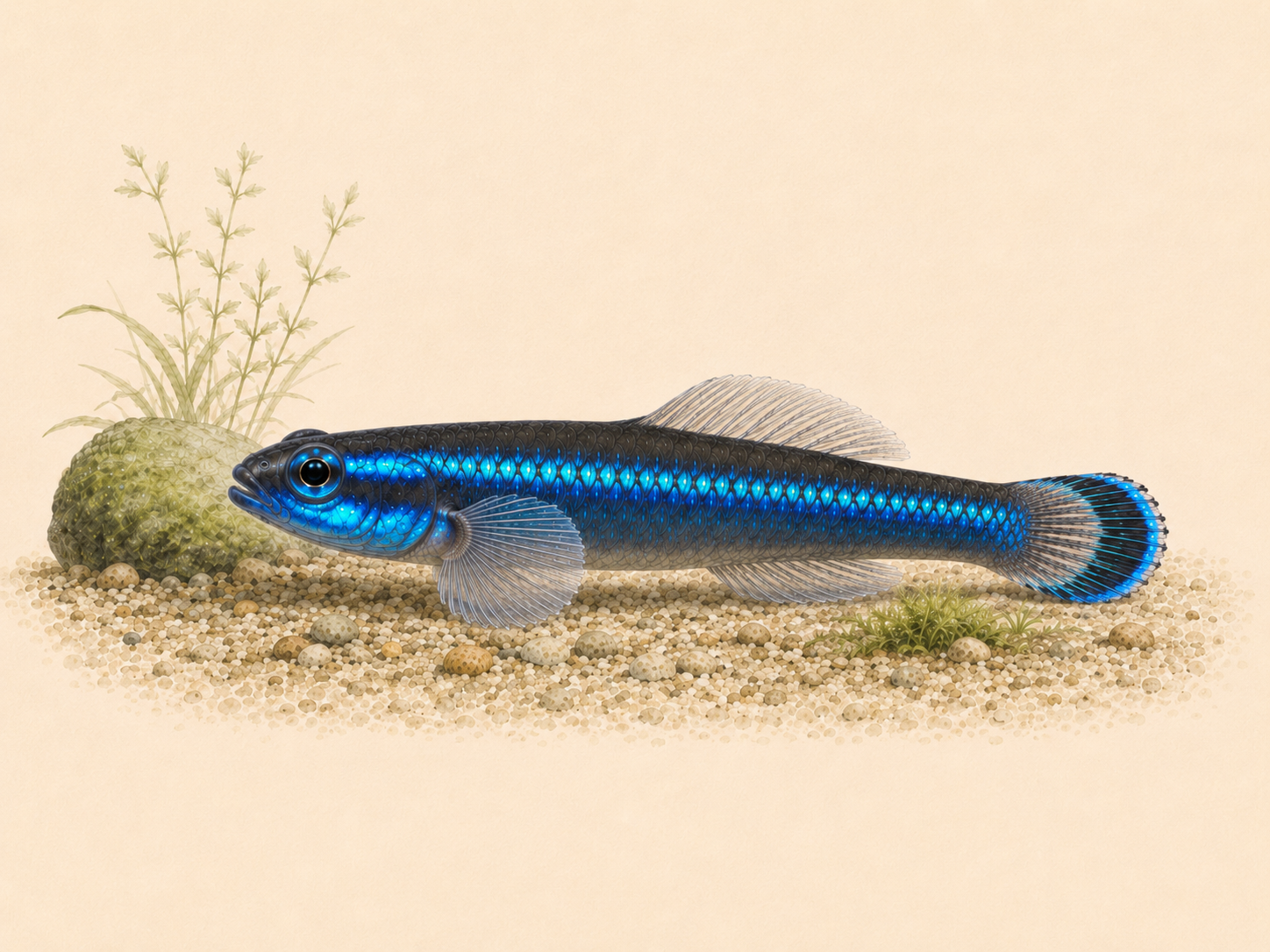
Stiphodon semoni is a compact, torpedo-shaped goby with a flattened ventral profile, a body plan typical of species that spend their lives clinging to rocks in fast-flowing water. The pelvic fins are fused into a characteristic sucker disc, a hallmark of the family that allows the fish to anchor itself firmly against strong currents. The head is broad and slightly depressed, with large eyes positioned high on the skull, giving the fish excellent all-round vision to watch for both predators and rivals.
The most remarkable aspect of this species is, of course, its colour. Mature males develop an extraordinary cobalt to electric blue colouration that covers the head, flanks, and dorsal region. This blue is overlaid with a subtle iridescent sheen that shifts depending on the angle of light, sometimes appearing almost purple or teal. The dorsal fins often display deeper blue or dark markings, and when a dominant male is in full breeding dress, the intensity of the colour can be truly spectacular. The first dorsal fin is taller and more flag-like in males, often raised in displays to rival males or potential mates.
Females, by contrast, are considerably more subdued. They tend to be beige, tan, or pale olive, with a series of darker horizontal stripes or blotchy markings along the flanks. This sexual dimorphism is pronounced and can make it easy to sex adults, though juvenile males may closely resemble females before they begin to colour up. It is worth noting that newly imported fish of both sexes are often pale and stressed, and males may take several weeks of good care before they reveal their true colours. Patience is essential when assessing new arrivals.
The body rarely exceeds five centimetres in total length, making this one of the smaller Stiphodon species. Despite their modest stature, they possess a surprising amount of presence in the aquarium, particularly when a dominant male stakes out a favourite rock and defends it with vigour.
Natural Habitat
In the wild, Stiphodon semoni inhabits clear, fast-flowing freshwater streams and rivers on volcanic islands across the Indonesian archipelago and into Papua New Guinea. These waterways are typically found in forested upland regions, where the substrate is composed of smooth cobbles, gravel, and boulders. The water is shallow, highly oxygenated, and relatively cool compared to lowland tropical habitats, with a moderate to strong current flowing over the rocks at all times.
Like all members of the genus Stiphodon, this species is amphidromous. This means that while the adults live and breed in freshwater, the newly hatched larvae are swept downstream to the sea, where they spend a period developing in brackish or marine coastal waters before migrating back upstream to freshwater as juveniles. This complex life cycle is one of the principal reasons the species is so difficult to breed in captivity, a topic covered in detail in the breeding section below.
The streams these gobies call home are typically well-lit, promoting the growth of diatoms, green algae, and a complex biofilm layer across every available rock surface. This biofilm, a living mat of algae, bacteria, microorganisms, and organic detritus, forms the primary food source for Stiphodon semoni. The fish spend the vast majority of their time rasping at rock surfaces with their specialised mouthparts, slowly moving from spot to spot as they graze. Understanding this natural feeding behaviour is absolutely critical to keeping them successfully in the aquarium.
The water chemistry in their native streams is generally soft to moderately hard and close to neutral pH, though some populations occur in slightly alkaline conditions depending on the local geology. There is minimal dissolved organic waste, and nitrate levels are essentially zero. These are pristine environments, and replicating that water quality in the home aquarium should be a top priority for any keeper.
Tank Size and Setup
A minimum tank size of 60 litres is recommended for a small group of Stiphodon semoni, though a larger aquarium of 80 to 120 litres will provide more grazing surface area, more stable water conditions, and room for the territorial behaviour of males to play out without excessive aggression. A longer, shallower tank is preferable to a tall, narrow one, as these gobies are entirely bottom-dwelling and will not use the upper water column. A footprint of at least 60 by 30 centimetres should be considered the minimum.
The substrate should consist of a mix of smooth river cobbles, pebbles, and fine gravel. Avoid sharp-edged rocks or crushed coral, as these can damage the delicate ventral sucker disc. Large, flat river stones and rounded boulders should be arranged to create a natural streambed appearance, providing plenty of surfaces for biofilm to colonise and for males to establish territories. Leaving some open areas between rock clusters allows the fish to move freely while also offering line-of-sight breaks that reduce stress from territorial disputes.
Live plants can be included but are not essential to the setup and may struggle in the high-flow conditions that these gobies require. Hardy species such as Anubias, Java Fern, and various mosses attached to rocks or driftwood tend to work well, as they tolerate strong current and do not require planting in the substrate. Driftwood can also be included and will serve as an additional surface for biofilm growth, though it should be secured in place so that the current does not dislodge it.
Lighting should be moderate to moderately strong, as this encourages the growth of the diatoms and green algae that form the base of the biofilm the gobies feed upon. An aquarium that looks slightly “messy” with a healthy coating of biofilm on the hardscape is actually in ideal condition for these fish. Resist the urge to scrub rocks clean during maintenance, that biofilm is their food supply.
Water Parameters
Maintaining excellent water quality is arguably the single most important aspect of keeping Stiphodon semoni. These gobies come from some of the cleanest freshwater habitats on earth, and they are intolerant of elevated waste levels. The water should be soft to moderately hard, close to neutral or slightly alkaline in pH, and impeccably clean at all times. Regular water changes of 25 to 30 per cent weekly are strongly recommended, and more frequent changes may be necessary in smaller tanks or those with a higher bioload.
| Temperature | 22–28 °C |
| pH | 6.5–7.8 |
| General hardness (GH) | 4–12 dGH |
| Carbonate hardness (KH) | 2–8 dKH |
| Ammonia | 0 ppm |
| Nitrite | 0 ppm |
| Nitrate | Below 20 ppm |
Temperature is worth discussing in more detail. While the species tolerates a range of 22 to 28 °C, many experienced keepers find that the lower to middle end of this range, around 23 to 26 °C, produces the best results in terms of activity, colouration, and longevity. Higher temperatures increase metabolic rate and oxygen demand while simultaneously reducing the water’s capacity to hold dissolved oxygen, a problematic combination for a species that depends on high oxygen levels. If you live in a warm climate, ensuring adequate cooling and aeration during summer months is essential.
Filtration and Equipment
Strong filtration and vigorous water movement are non-negotiable for this species. In the wild, Stiphodon semoni lives in fast-flowing streams, and replicating this environment is essential for their health and well-being. A canister filter rated for at least twice the tank volume, combined with an additional powerhead or wavemaker, is the ideal setup. The goal is to create a noticeable current across the bottom of the tank where the gobies reside, without producing dead spots where detritus can accumulate.
Sponge filters can serve as supplementary filtration and have the added benefit of providing a surface for biofilm growth that the gobies will graze upon, but they are generally insufficient as the sole filtration method for this species. A hang-on-back filter with a strong flow rate can work in smaller setups, though the spray bar or outlet should be positioned to direct flow across the rockwork at the bottom of the tank.
An air pump with an airstone is a worthwhile addition to any Stiphodon tank. The additional surface agitation increases gas exchange and helps maintain the high dissolved oxygen levels that these gobies require. This is particularly important in warmer conditions or during the summer months when dissolved oxygen naturally drops. Some keepers also use small internal circulation pumps positioned to create a directional flow pattern that mimics a natural stream.
A heater set to the lower end of the acceptable range is recommended in cooler climates, while hobbyists in tropical or subtropical regions may not need supplementary heating at all. A reliable thermometer should be used to monitor temperature consistently. A tight-fitting lid or cover is advisable, as gobies in general can be surprisingly adept at finding their way out of open-topped aquariums, particularly when startled or stressed.
Diet and Feeding
Feeding is perhaps the most commonly misunderstood aspect of Stiphodon semoni care, and it is the area where the majority of husbandry failures occur. These gobies are specialised aufwuchs grazers, meaning they feed primarily on the biofilm, a complex community of diatoms, green algae, cyanobacteria, microorganisms, and organic detritus, that coats rock surfaces in their natural habitat. They are not omnivorous scavengers, and they are emphatically not suited to a diet of conventional flake food, pellets, or frozen bloodworms.
The aquarium must be mature enough to support a robust biofilm layer before Stiphodon semoni are introduced. A newly set up tank with clean, sterile surfaces will not provide adequate food, and the fish may slowly starve even if supplementary foods are offered. As a general rule, the tank should be running for at least two to three months with lighting that encourages algae and diatom growth on the hardscape before these gobies are added.
Supplementary feeding can and should be provided, particularly in tanks where the biofilm cannot keep pace with the grazing pressure. Blanched vegetables such as courgette, cucumber, and spinach can be offered on a clip or weighted down near the substrate. High-quality algae wafers and spirulina-based sinking tablets are also accepted by most individuals, though it may take newly imported fish some time to recognise these as food. Repashy Soilent Green and similar gel-based foods formulated for herbivorous and aufwuchs-grazing species are excellent choices and can be smeared onto rocks to mimic the natural feeding behaviour.
It is critically important not to overfeed with protein-rich foods. Stiphodon semoni has a long digestive tract adapted for processing plant matter and biofilm, not high-protein fare. Offering bloodworms, brine shrimp, or meat-based pellets as regular food can lead to digestive problems and reduced lifespan. While the occasional small amount of protein may be consumed incidentally within the biofilm, the diet should remain overwhelmingly plant-based and biofilm-focused.
Observe your gobies carefully. Healthy, well-fed individuals will have slightly rounded bellies and spend the vast majority of their time actively rasping at surfaces. Sunken bellies and listless behaviour are warning signs that the fish are not receiving adequate nutrition, and immediate intervention, such as increasing supplementary feeding or reducing the number of competing grazers, is warranted.
Behaviour and Temperament
Stiphodon semoni is a generally peaceful species, but it would be a mistake to describe it as entirely docile. Males are territorial and will defend favoured grazing spots and potential spawning sites from rival males with impressive displays. A dominant male will raise his first dorsal fin like a flag, intensify his blue colouration, and posture aggressively towards intruders. Physical confrontations do occur but are typically brief and rarely result in injury, particularly in tanks with sufficient space and ample line-of-sight breaks provided by the rockwork.
Females are considerably less territorial and tend to roam more freely across the tank, grazing cooperatively and largely ignoring one another. Keeping a group with more females than males, at a ratio of roughly one male to two or three females, helps distribute aggression and allows for more natural social dynamics. A solitary individual can be kept successfully but will not display the full range of interesting behaviours that a group provides.
These gobies are exclusively bottom-dwelling and will spend virtually all of their time on or among the rocks. They are diurnal and most active during the day, grazing methodically across surfaces in a slow, deliberate fashion. Occasionally, a startled individual may dart across the tank with surprising speed, but in general their movements are measured and calm. They are not shy fish and will often graze confidently in the open, making them rewarding to observe despite their small size.
One behaviour worth noting is their tendency to perch on elevated surfaces, particularly the tops of smooth boulders. A male sitting atop a rock in full colour, surveying his territory, is one of the most charming sights in the freshwater aquarium hobby. Providing rocks of varying heights gives them opportunities to exhibit this natural behaviour.
Tank Mates
Choosing appropriate tank mates for Stiphodon semoni requires careful consideration. The ideal companions are peaceful species that occupy different areas of the water column, tolerate the same high-flow, well-oxygenated conditions, and will not outcompete the gobies for food. Avoid large, boisterous, or aggressive fish, as well as any species that may view these small gobies as prey. It is equally important to avoid housing them with other heavy biofilm grazers that could deplete the food supply faster than it can regenerate.
Good tank mates
- White Cloud Mountain Minnow, a peaceful, cool-water schooling fish that occupies the mid to upper water column and thrives in similar high-flow conditions.
- Celestial Pearl Danio, a small, gentle species that stays in the mid-water and poses no competitive threat to bottom-dwelling gobies.
- Endler’s Livebearer, a tiny, peaceful livebearer that remains in the upper water column and tolerates a wide range of water conditions.
- Kuhli Loach, a nocturnal, peaceful bottom-dweller that feeds on different food sources and is unlikely to compete directly with Stiphodon.
- Ember Tetra, a diminutive, calm schooling species that adds colour to the mid-water without disturbing the gobies below.
- Hillstream Loach (Sewellia spp.), another rheophilic species that thrives in identical high-flow setups, though careful monitoring of grazing competition is advised.
- Cherry Shrimp, a popular invertebrate that coexists peacefully and helps with detritus cleanup, though it may compete marginally for biofilm.
- Otocinclus Catfish, a gentle algae grazer that occupies a slightly different niche, though stocking numbers should be managed to avoid overgrazing.
Fish to avoid
- Oscar, a large, predatory cichlid that would readily consume small gobies and requires entirely different water conditions.
- Common Pleco, grows far too large, produces excessive waste, and would dominate grazing surfaces, starving the gobies of food.
- Tiger Barb, a notorious fin-nipper with a boisterous temperament that would stress and harass small gobies.
- Convict Cichlid, an aggressive, territorial cichlid that would bully and potentially injure or kill Stiphodon semoni.
- Chinese Algae Eater, becomes aggressive with age and would compete directly for the same biofilm food source.
- Red Tail Shark, highly territorial towards bottom-dwelling fish and would dominate the substrate zone, causing severe stress.
- Jack Dempsey, a large, aggressive cichlid entirely unsuitable for housing with small, peaceful gobies.
- Goldfish, requires cooler water, produces excessive waste, and would compete for algae while creating water quality issues.
Breeding
Breeding Stiphodon semoni in captivity is exceptionally challenging and has only been accomplished on very rare occasions by specialist breeders. The primary obstacle is the species’ amphidromous life cycle. In nature, adult fish spawn in freshwater, typically in small caves or crevices beneath rocks. The male courts the female with intense colour displays and fin-flaring, luring her into a chosen spawning site. The female deposits tiny adhesive eggs on the ceiling or walls of the cave, and the male fertilises them before assuming sole responsibility for guarding the clutch.
The eggs are extremely small, and upon hatching, the larvae are minute, essentially planktonic. In the wild, these newly hatched larvae are carried downstream by the current to the sea, where they spend weeks or possibly months drifting and feeding on marine plankton before metamorphosing into juveniles and migrating back upstream into freshwater. This transition through marine and brackish environments is the crux of the difficulty in captive breeding. Without access to appropriate marine or brackish conditions and suitably tiny live foods such as marine rotifers and phytoplankton, the larvae will perish within days of hatching.
Spawning behaviour itself can be observed in well-maintained aquaria with mature, healthy fish. Males will intensify their colouration, display vigorously, and attempt to lead receptive females to their preferred cave. If eggs are successfully laid, the male will fan and guard them diligently. However, unless the keeper has prepared a separate rearing system with brackish or marine water and a reliable culture of appropriately sized live foods, raising the larvae is essentially impossible.
For those interested in attempting to breed Stiphodon species, extensive research into the amphidromous rearing protocols developed by researchers in Japan and elsewhere is strongly recommended. This is a frontier area of the hobby that requires considerable expertise, dedicated facilities, and a willingness to accept a very high rate of failure. The vast majority of Stiphodon semoni in the trade are wild-caught, and this is likely to remain the case for the foreseeable future.
Common Diseases
Stiphodon semoni is a reasonably robust species when kept in appropriate conditions, but it is vulnerable to a number of health issues, many of which are directly related to suboptimal husbandry. The most common problem encountered by keepers is starvation, which manifests as a progressively sunken belly, lethargy, faded colouration, and eventual death. This is almost always the result of insufficient biofilm in the aquarium or excessive competition from other grazers. Prevention is straightforward: ensure the tank is mature, the biofilm is well-established, and supplementary foods are offered regularly.
Ich, also known as white spot disease, caused by the protozoan Ichthyophthirius multifiliis, can affect Stiphodon semoni, particularly in newly imported or stressed fish. It presents as small white cysts on the body and fins. Treatment with a gradual temperature increase to around 28 °C combined with a half-dose of a malachite green or formalin-based medication is usually effective, though care must be taken with medication dosing, as gobies can be sensitive to certain chemicals. Avoid copper-based treatments if invertebrates are present in the tank.
Bacterial infections can occur in fish kept in poor water quality or those that have sustained injuries from aggressive tank mates. Red streaks on the body, frayed fins, or ulcers are typical signs. Improving water quality through increased water changes and, if necessary, treating with a broad-spectrum antibacterial medication, usually resolves these issues. Internal parasites are a concern with wild-caught specimens and may cause weight loss despite apparent feeding activity. A course of treatment with a praziquantel-based dewormer can be administered prophylactically following import if parasites are suspected.
Stress is perhaps the most insidious threat to the health of Stiphodon semoni, as it suppresses the immune system and makes the fish vulnerable to opportunistic infections. Sources of stress include poor water quality, inadequate current, lack of appropriate food, aggressive tank mates, and sudden changes in water parameters. Maintaining stable, clean, well-oxygenated water and providing a suitable environment goes a long way towards preventing the vast majority of health problems.
FAQs
Can Cobalt Blue Gobies be kept in a standard tropical community tank?
They can be, but only if the tank meets their specific requirements. Standard community setups with gentle filtration and warm, still water are not suitable. The tank must have strong current, high dissolved oxygen levels, and ample biofilm growth on the hardscape. If these conditions are met and the tank mates are peaceful and non-competitive, Stiphodon semoni can coexist with other species. However, a dedicated hillstream or rheophilic biotope tank is the ideal approach and will yield the best results in terms of health, colouration, and natural behaviour.
How many Cobalt Blue Gobies should I keep together?
A small group of four to six individuals works well in a 60 to 80 litre tank, with a ratio of one male to two or three females. This distributes territorial aggression among males and allows for more interesting social interactions. Keeping a single male with several females is also a viable approach if space is limited. Avoid keeping two males in a very small tank without adequate visual barriers, as the dominant male may persistently harass the subordinate.
Why has my Cobalt Blue Goby lost its blue colour?
Colour loss is common in newly imported fish and is usually caused by stress from transportation and adjustment to a new environment. Males may take several weeks to regain full colouration once settled. Persistent colour loss in an established fish can indicate stress, poor water quality, inadequate diet, or subordinate status in the tank hierarchy. Check your water parameters, ensure biofilm is abundant, and observe whether the fish is being bullied by tank mates. Females naturally lack the vivid blue colouration, so it is also worth confirming that the fish in question is indeed male.
Do Cobalt Blue Gobies eat regular algae wafers?
Many individuals will accept high-quality algae wafers and spirulina-based sinking tablets, though some newly imported fish may initially ignore them. Gel-based foods such as Repashy Soilent Green are often more readily accepted and can be applied directly to rocks to encourage natural grazing behaviour. However, these supplementary foods should complement, not replace, a well-established biofilm. The biofilm provides not only algae but also essential microorganisms and nutrients that prepared foods cannot fully replicate.
Is it possible to breed Cobalt Blue Gobies at home?
Triggering spawning behaviour in a well-maintained aquarium is achievable with healthy, mature fish. However, successfully rearing the larvae is extraordinarily difficult due to the species’ amphidromous life cycle, which requires the larvae to transition through marine or brackish water and feed on microscopic planktonic organisms. Without specialist equipment, live marine plankton cultures, and considerable expertise, raising the fry to the juvenile freshwater stage is not realistically possible for the typical home aquarist. Almost all specimens available in the trade are wild-caught.
Related Guides
- Stiphodon Goby Species Overview, a broader look at the Stiphodon genus, covering other popular species and their shared care requirements.
- Hillstream Loach Care Guide, another rheophilic species that thrives in similar high-flow setups and makes an excellent companion for Stiphodon gobies.
- Otocinclus Catfish Care Guide, a fellow biofilm grazer with overlapping care needs that is often kept alongside small gobies.
- How to Set Up a Hillstream Aquarium, a detailed guide to creating the high-flow, oxygen-rich environment that Stiphodon semoni and other stream-dwelling species require.
- Freshwater Goby Care Guide, an overview of popular freshwater gobies in the aquarium hobby, including care tips applicable across multiple species.