Compressiceps Cichlid Care Guide — Tank Setup, Feeding and Breeding
Introduction
The Compressiceps Cichlid, known scientifically as Altolamprologus compressiceps, is one of the most distinctive and fascinating cichlids found in Lake Tanganyika. Its dramatically laterally compressed body and predatory nature have earned it a devoted following among cichlid enthusiasts worldwide. Often referred to simply as the “Comp,” this species embodies the remarkable evolutionary adaptations that make the cichlids of the East African rift lakes so captivating to keep and observe.
Unlike many of the boisterous and openly aggressive cichlids from the African Great Lakes, Altolamprologus compressiceps is a calculated and patient predator. Its paper-thin body allows it to slip into narrow crevices among the rocky shorelines of Lake Tanganyika, where it ambushes small fish and invertebrates with surprising speed. In the home aquarium, this translates to a fish that is simultaneously bold and cautious, territorial yet not overtly aggressive in the manner of many mbuna or Tropheus species. Keeping this species successfully requires an understanding of its specialised needs, but it rewards the dedicated aquarist with years of intriguing behaviour and striking beauty.
This guide covers everything you need to know to provide excellent care for Altolamprologus compressiceps, from tank setup and water chemistry to breeding strategies and compatible tank mates. Whether you are setting up a dedicated Tanganyikan biotope or considering adding a Comp to an existing community of rift lake cichlids, the information below will help you make informed decisions and keep your fish thriving.
Quick Stats
| Scientific name | Altolamprologus compressiceps |
| Common names | Compressiceps Cichlid, Comp, Compressed Cichlid |
| Family | Cichlidae |
| Origin | Lake Tanganyika, East Africa (Democratic Republic of the Congo, Tanzania, Burundi, Zambia) |
| Adult size | Males up to 15 cm; females 8–10 cm |
| Lifespan | 8–12 years |
| Difficulty | Moderate |
| Breeding difficulty | Moderate |
| Temperature | 24–27 °C |
| pH range | 7.8–9.0 |
| General hardness (GH) | 10–25 dGH |
| Carbonate hardness (KH) | 10–18 dKH |
| Minimum tank size | 150 litres |
| Conservation status | Least Concern (IUCN) |
Appearance
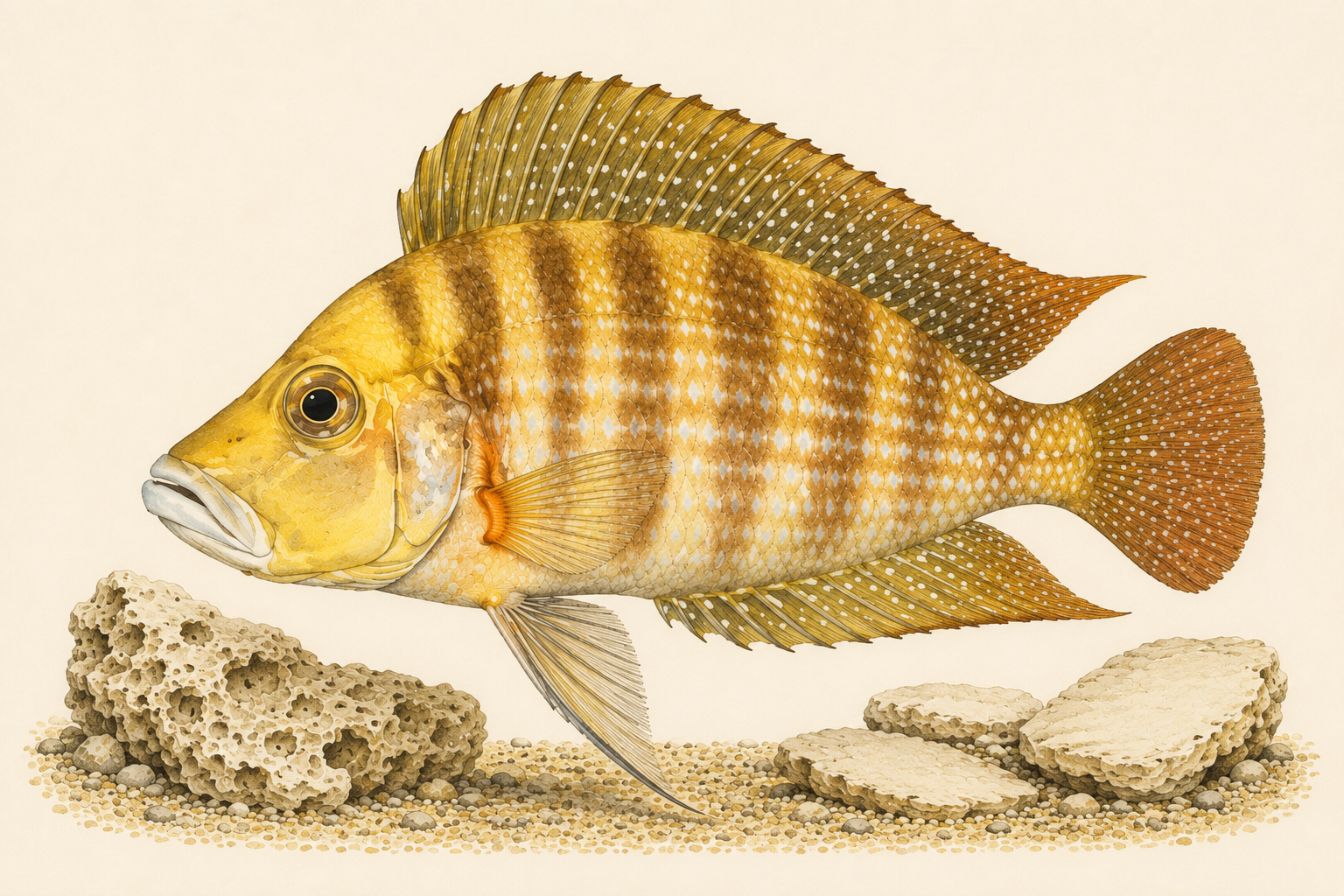
Altolamprologus compressiceps is immediately recognisable thanks to its extreme lateral compression. When viewed head-on, the body appears almost impossibly thin, yet from the side it displays a tall, deep profile with a steeply sloping forehead and a large, upturned mouth. This body shape is a direct adaptation to its rocky habitat, enabling the fish to navigate tight spaces between stones and within crevices that would be inaccessible to more conventionally shaped species. The head is proportionally large, armoured with thick, bony plates that provide protection against the defensive nips of prey species guarding their own fry.
The base colouration varies considerably depending on the collection locality, ranging from golden-yellow to deep brown, dark grey, or near-black. Most variants display a series of darker vertical bars along the flanks, though these may be more or less prominent depending on mood and locale. The fins are typically adorned with a fine pattern of spots or speckles, and the dorsal fin extends impressively along the length of the back. The scales are notably thick and rough, giving the fish an almost armoured appearance and providing additional protection in its rocky environment.
Sexual dimorphism is pronounced in this species. Males grow considerably larger than females, often reaching 13–15 cm in total length, whilst females typically remain around 8–10 cm. Males also tend to develop a more elongated body and a steeper cranial profile. The size difference between the sexes is among the most dramatic of any Tanganyikan cichlid, and this has important implications for breeding, as the female must be small enough to enter shell or cave spawning sites that the male cannot access.
Varieties and Morphs
Altolamprologus compressiceps is collected from numerous locations around Lake Tanganyika, and many of these geographical variants are available in the aquarium trade under specific locality names. While these are not captive-bred morphs in the traditional sense, they represent distinct colour forms that are maintained as separate breeding lines by dedicated hobbyists and breeders. The following are among the most commonly encountered variants.
The “Gold Head” or “Goldhead Compressiceps” is arguably the most popular variant. Originating from the Kasanga and Mutondwe Island areas, this form features a striking golden-yellow head and upper body that contrasts beautifully with the darker lower flanks. It is widely bred in captivity and commands a premium price.
The “Red Fin” variant, collected from around Kigoma in Tanzania, displays warm reddish-orange tones in the fins, particularly the dorsal and caudal fins, set against a brownish body. It is a subtly beautiful form that has a strong following.
The “Sumbu Shell” or “Sumbu Dwarf” from the Sumbu region of Zambia is a notably smaller variant that readily spawns in shells, making it an excellent choice for smaller aquaria. Its colouration tends towards a warm tan or gold with clear vertical barring.
The “Chaitika” variant from the Zambian coastline is characterised by a darker overall body colour with prominent barring and attractive blue or purple iridescence on the scales. It is a popular choice for those seeking a more sombre, dramatic appearance.
The “Muzi” or “Congo” form hails from the western shore of the lake and tends towards a darker base colour, sometimes appearing nearly black, with contrasting lighter barring. These are less commonly available but highly sought after.
The “Kasanga” variant, separate from the Gold Head form, shows a rich golden-brown colouration with well-defined bars and is a robust, attractive fish that breeds readily in captivity.
It is worth noting that Altolamprologus compressiceps is closely related to Altolamprologus calvus, and the two species are sometimes confused in the trade. While they share the same laterally compressed body plan, A. calvus generally has a less steep forehead, fewer scales on the cheek, and a somewhat different overall profile. Responsible hobbyists take care not to hybridise locality variants or the two species.
Natural Habitat
Altolamprologus compressiceps is endemic to Lake Tanganyika, the second deepest lake in the world and the longest freshwater lake on the planet. Lake Tanganyika is situated in the western arm of the East African Rift Valley and is shared by four countries: the Democratic Republic of the Congo, Tanzania, Burundi, and Zambia. The lake’s waters are characterised by exceptional clarity, high mineral content, alkaline pH, and remarkable stability in terms of temperature and chemistry. These conditions have persisted for millions of years, allowing an extraordinary radiation of cichlid species, each finely adapted to its particular ecological niche.
Within the lake, A. compressiceps inhabits the rocky littoral zone, typically at depths of 3 to 30 metres. This zone is characterised by tumbled boulders, rock piles, and scattered rubble that create an intricate labyrinth of crevices, caves, and narrow passages. The Comp exploits this environment superbly, using its compressed body to slip into gaps where it hunts small fish fry, shrimp, and invertebrates. It is a sit-and-wait predator, often hovering motionless near a crevice entrance before striking with a rapid lunge when prey ventures too close.
The water in Lake Tanganyika is consistently warm, typically ranging from 24 to 27 °C, with a pH between 8.6 and 9.5 depending on the location and depth. The lake is very hard, with high levels of dissolved carbonates and other minerals. Aquarists keeping Tanganyikan cichlids must replicate these stable, alkaline, and hard water conditions to maintain their fish in optimal health.
Tank Size and Setup
A single pair of Altolamprologus compressiceps can be housed in a tank of 150 litres, but a larger aquarium of 200 litres or more is preferable, particularly if you intend to keep them as part of a Tanganyikan community. For a group containing one male and two or three females, or for mixed-species setups, a tank of 300 litres or above is strongly recommended. The footprint of the tank is more important than height, as the fish spend the majority of their time among the rocks in the lower and middle portions of the water column.
The aquascape should aim to replicate the rocky shoreline habitat of Lake Tanganyika. Use a combination of smooth river rocks, limestone, and ocean rock to build stable piles with plenty of caves, overhangs, and narrow crevices. It is essential that the rockwork is arranged securely, as any collapse could injure or kill these relatively delicate fish. Many aquarists place rocks directly on the glass base of the tank rather than on top of the substrate to prevent undermining. Silicone adhesive can also be used to bond rock structures together for additional safety.
The substrate should consist of fine sand, ideally coral sand or aragonite, which helps to buffer the water and maintain the high pH and hardness that Tanganyikan cichlids require. If you are keeping a Sumbu Shell or other dwarf variant, scatter several empty Neothauma or escargot shells across the sand, as these will serve as potential spawning sites. Even standard-sized Comps may use larger shells or tight caves for breeding, so providing a variety of refuge sizes is beneficial.
Live plants are not a feature of the typical rocky Tanganyikan biotope, and most aquatic plants struggle in the hard, alkaline water these fish require. However, hardy species such as Anubias and Java fern can be attached to rocks for aesthetic purposes, and Vallisneria species tolerate hard water well. These are entirely optional and do not replicate the natural environment, but they can help create a visually appealing display.
Water Parameters
Maintaining stable, alkaline, and hard water is the single most important aspect of Compressiceps care. Lake Tanganyika is renowned for the consistency of its water chemistry, and the cichlids that have evolved there are poorly adapted to fluctuating conditions. Sudden changes in pH, hardness, or temperature can cause stress, illness, and even death. Aim for the following parameters and, crucially, keep them as stable as possible through consistent maintenance routines.
| Temperature | 24–27 °C |
| pH | 7.8–9.0 |
| General hardness (GH) | 10–25 dGH |
| Carbonate hardness (KH) | 10–18 dKH |
| Ammonia | 0 ppm |
| Nitrite | 0 ppm |
| Nitrate | Below 20 ppm |
If your tap water is naturally soft or acidic, you will need to use a rift lake buffer or mineral salt mix to achieve and maintain appropriate hardness and pH. Several commercial products are available specifically for this purpose, and many experienced Tanganyikan keepers prepare their own blends using a combination of sodium bicarbonate, Epsom salt, and marine salt mix. Coral sand or crushed coral in the substrate or filter also helps buffer pH upward. Test your water regularly, particularly in the first few months of establishing a tank, to ensure stability.
Filtration and Equipment
Altolamprologus compressiceps requires excellent water quality, so robust filtration is essential. An external canister filter rated for the tank volume or above is the preferred choice for most Tanganyikan setups. These filters provide ample biological, mechanical, and chemical filtration capacity and are easy to maintain without disturbing the tank’s inhabitants. For larger aquaria, running two filters or supplementing a canister filter with an internal sponge filter provides additional biological filtration and a margin of safety in the event of equipment failure.
Water flow should be moderate. While Lake Tanganyika does experience wave action and currents, the rocky littoral zone where Comps are found is relatively sheltered. Excessively strong currents will stress these fish, so position filter outlets to create gentle circulation throughout the tank without producing powerful jets. Spray bars are useful for distributing flow evenly.
A reliable heater with a built-in thermostat is necessary to maintain the stable temperatures these fish require. In larger tanks, using two smaller heaters rather than a single large unit provides redundancy and more even heat distribution. Place the heater near the filter outlet for optimal circulation of warmed water.
Lighting requirements are modest. Standard LED aquarium lighting is perfectly adequate, and the fish will display their best colours under moderate illumination. Excessively bright lighting can make these somewhat cautious fish feel exposed, so providing shaded areas through the rockwork or floating plants is beneficial. A timed lighting schedule of 8 to 10 hours per day establishes a natural photoperiod.
Diet and Feeding
In the wild, Altolamprologus compressiceps is a carnivorous predator that feeds primarily on small fish fry, crustaceans, insect larvae, and other invertebrates found among the rocks. Its large mouth and laterally compressed body are specifically adapted for extracting prey from narrow crevices. In captivity, this predatory nature must be respected through an appropriate diet rich in protein.
A high-quality cichlid pellet formulated for carnivorous species should form the staple diet. Choose a pellet size appropriate for the fish’s mouth, bearing in mind that females are considerably smaller than males and may need a smaller pellet. Supplement this staple with regular offerings of frozen foods such as brine shrimp, mysis shrimp, krill, and cyclops. Live foods including brine shrimp, daphnia, and blackworms are eagerly accepted and can be used to condition breeding pairs. Avoid feeding mammalian proteins such as beefheart, as these are difficult for cichlids to digest and can contribute to fatty liver disease and bloat.
Compressiceps are notoriously slow eaters. They tend to stalk their food carefully before striking, rather than rushing to the surface in the manner of more competitive feeders. This deliberate feeding behaviour means they can easily be outcompeted by faster or more aggressive tank mates. When keeping Comps in a community, it is often necessary to target-feed them using tongs or a turkey baster, or to feed the tank in multiple locations simultaneously so that the Comps have a chance to eat without competition. Feeding two to three times daily in small portions is generally more effective than a single large feeding.
Behaviour and Temperament
Altolamprologus compressiceps is a territorial but generally not overly aggressive cichlid. Males will establish and defend a territory centred around a favoured rock pile or cave, but their aggression is typically measured and restrained compared to many other Tanganyikan species. Confrontations between males usually involve lateral displays, gill flaring, and slow, circling movements rather than full-blown physical combat. That said, a dominant male in a confined space can and will harass subordinate males to the point of serious stress or death, so it is advisable to keep only one male per tank unless the aquarium is very large with multiple distinct territories.
One of the most captivating aspects of keeping Comps is observing their predatory behaviour. They are patient ambush predators that will often hover motionless near a rock face, their compressed bodies almost invisible when viewed from certain angles, before lunging at passing prey items. In the aquarium, this behaviour manifests as the fish carefully approaching and inspecting potential food items before striking. New keepers sometimes worry that their Comp is not eating because it does not immediately rush to food, but this deliberate approach is entirely normal.
Compressiceps are not especially shy once settled, but they do require a period of acclimatisation during which they may hide extensively. Providing ample rockwork and refuges helps them feel secure, and over time they will become bolder and spend more time in the open. They are relatively slow-moving fish that spend much of their time patrolling their territory at a leisurely pace, pausing frequently to investigate crevices and overhangs.
It is important to note that Comps are opportunistic predators of small fish. Any fish small enough to fit into a Comp’s surprisingly capacious mouth is at risk of being eaten. This includes juvenile cichlids, small shell dwellers, and any fry present in the tank. While this is simply natural behaviour, it must be taken into account when selecting tank mates.
Tank Mates
Selecting appropriate tank mates for Altolamprologus compressiceps requires careful consideration of the fish’s specialised needs and temperament. Ideal companions are other Tanganyikan cichlids that occupy different ecological niches within the tank, thereby minimising territorial overlap and competition. Avoid pairing Comps with species that are overly aggressive, excessively fast at feeding, or small enough to be consumed.
Good tank mates
- Julidochromis marlieri — A rock-dwelling cichlid that occupies a similar habitat but is fast enough to avoid predation and not aggressive enough to bully Comps.
- Neolamprologus leleupi — This slender, bright yellow cichlid inhabits rocky areas and generally coexists peacefully with Compressiceps in suitably sized tanks.
- Cyprichromis leptosoma — An open-water schooling cichlid that occupies the upper water column, providing activity and colour without competing for territory.
- Neolamprologus brichardi — The Princess of Burundi occupies rocky caves and crevices but is generally compatible, provided the tank is large enough for both species to establish territories.
- Altolamprologus calvus — The close relative of Compressiceps occupies the same niche but can coexist in a large, well-structured tank with sufficient territories, though hybridisation must be avoided.
- Synodontis petricola — A small, peaceful Tanganyikan catfish that adds interest to the lower levels and generally does not interact negatively with Comps.
- Xenotilapia flavipinnis — A sand-dwelling cichlid that occupies a completely different niche, making territorial conflicts unlikely.
- Lamprologus ocellatus — A shell-dwelling species that is feisty enough to defend itself against Comps, though very small individuals may be at risk.
Fish to avoid
- Tropheus moorii — An extremely active and competitive herbivore that will easily outcompete the slow-feeding Compressiceps for food.
- Cyphotilapia frontosa — While sometimes kept with Comps, large Frontosa can intimidate and dominate them, and they require significantly larger tanks.
- Neolamprologus tretocephalus — A highly aggressive, territorial cichlid that will bully or kill the more reserved Compressiceps.
- Malawi Mbuna species — Mbuna are from a different lake with different water chemistry requirements and are far too aggressive and competitive for Comps.
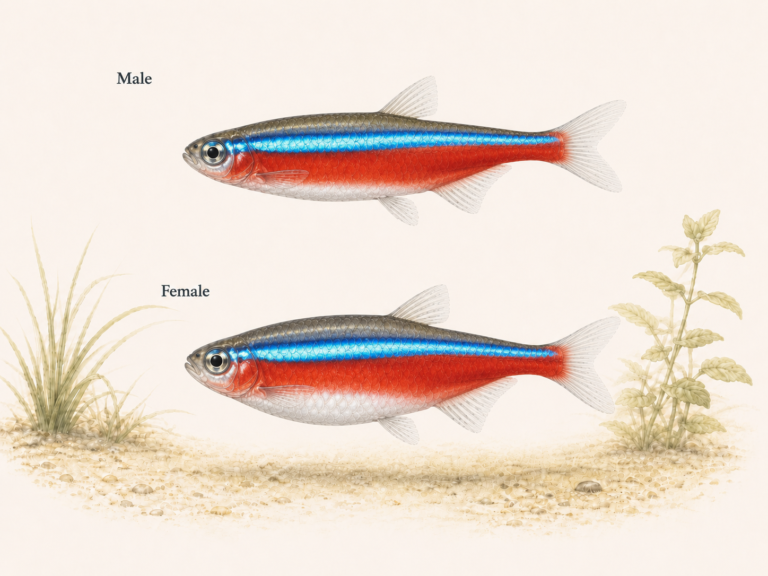
- Neon Tetra — Far too small and from completely incompatible water chemistry; they would be quickly consumed.
- Petrochromis trewavasae — An intensely territorial rock-dwelling herbivore that would dominate territory and outcompete Comps relentlessly.
- Lobochilotes labiatus — A large, powerful Tanganyikan cichlid that grows far too big and aggressive to be housed safely with Compressiceps.
- Guppy — Entirely incompatible in terms of water chemistry and would be quickly consumed by adult Comps.
Breeding
Breeding Altolamprologus compressiceps in captivity is achievable for aquarists with moderate experience and represents one of the most rewarding aspects of keeping this species. The breeding behaviour is fascinating, as it takes full advantage of the extreme sexual size dimorphism that characterises the species.
Compressiceps are cave spawners, with the female depositing eggs inside a narrow cavity that the larger male cannot enter. In the aquarium, suitable spawning sites include empty snail shells (particularly Neothauma shells or large escargot shells), narrow PVC pipes, or purpose-made ceramic caves with entrances small enough to exclude the male. The female enters the cavity and deposits her eggs on the inner surfaces, while the male fertilises them by releasing sperm at the entrance, which is drawn inside by water currents.
To encourage breeding, maintain a group consisting of one male and two or three females in a tank with multiple potential spawning sites. Condition the fish with a varied, protein-rich diet including live and frozen foods. Water quality should be impeccable, with parameters within the ideal ranges described above. Slight increases in feeding frequency and small, regular water changes can sometimes trigger spawning behaviour.
The female guards the eggs and tends to them throughout the incubation period, which typically lasts 10 to 14 days depending on temperature. The fry are tiny upon hatching and remain inside the spawning cavity for several days while they absorb their yolk sacs. Once free-swimming, the fry emerge and stay close to the spawning site, where the female continues to guard them. The male defends the broader territory but does not participate directly in fry care.
Raising the fry requires careful attention to feeding. Newly free-swimming fry are very small and require appropriately sized first foods such as freshly hatched brine shrimp nauplii, microworms, or commercially available liquid fry foods. Growth is slow compared to many other cichlid species, and it may take several months before the young fish are large enough to be safely introduced into a community tank. In a community setting, fry survival will be low unless the tank is heavily structured with ample hiding places, as other fish and even the male Comp may consume them.
For those serious about raising broods, removing the shell or cave containing the eggs and hatching them in a separate, well-filtered rearing tank is the most reliable approach. Maintain identical water parameters in the rearing tank and ensure gentle water circulation without strong currents that could harm the delicate fry.
Common Diseases
Altolamprologus compressiceps is generally a hardy species when maintained in appropriate water conditions, but like all fish, it is susceptible to a range of diseases, particularly when stressed by poor water quality, sudden parameter changes, or aggressive tank mates.
Bloat, sometimes referred to as Malawi bloat despite also affecting Tanganyikan species, is one of the most serious conditions to watch for. It manifests as abdominal swelling, loss of appetite, lethargy, and rapid breathing. The exact cause is debated, but it is frequently associated with poor diet, internal parasites, or bacterial infections exacerbated by stress. Prevention is the best approach, centring on maintaining excellent water quality, avoiding inappropriate foods, and minimising stress. Treatment typically involves the use of metronidazole-based medications, ideally administered in food.
White spot disease, caused by the protozoan parasite Ichthyophthirius multifiliis, can affect Comps, particularly during periods of stress or following temperature fluctuations. The characteristic white cysts on the body and fins are easily identified. Treatment involves raising the water temperature slightly (to around 28 °C) and using a suitable white spot remedy. Tanganyikan cichlids can be sensitive to some medications, particularly those containing copper, so always check compatibility before treating.
Skin and gill flukes are external parasites that can cause irritation, flashing behaviour (where the fish rubs against objects), and laboured breathing. Treatment with praziquantel-based medications is generally effective and well-tolerated by Tanganyikan cichlids.
Fin rot and bacterial infections can occur in tanks with poor water quality or where the fish have sustained injuries from aggression or sharp decor. Maintaining pristine water conditions is often sufficient to prevent and even resolve mild cases. More severe infections may require treatment with antibacterial medications. Ensuring that all rockwork has smooth edges and that territorial disputes do not escalate to the point of physical injury will help prevent these issues.
Regular observation is key to early disease detection. Take time each day to watch your fish carefully, noting their behaviour, appetite, and physical appearance. Early intervention is always more successful than attempting to treat advanced disease.
FAQs
What is the difference between Altolamprologus compressiceps and Altolamprologus calvus?
The two species are closely related and share the same laterally compressed body plan, but they differ in several respects. Altolamprologus compressiceps generally has a steeper, more rounded forehead and a deeper body profile, while A. calvus has a more gently sloping head and tends to have fewer scales on the cheek region, giving it a slightly “bald” appearance — hence the name calvus, which means bald in Latin. The two species occupy similar niches in the wild and should not be hybridised in captivity. When viewed side by side, the differences in head shape and scaling are quite apparent.
Can Altolamprologus compressiceps be kept with shell dwellers?
Yes, Comps can be kept with shell-dwelling cichlids such as Lamprologus ocellatus or Neolamprologus multifasciatus in appropriately sized tanks. However, it is important to recognise that adult Compressiceps are predators and may consume very small shell dwellers or their fry. Choosing larger, more assertive shell-dwelling species and providing plenty of shells and rockwork to create distinct territories helps reduce the risk. In a well-structured tank, the two groups generally coexist successfully, as shell dwellers are remarkably bold defenders of their territories despite their small size.
Why is my Compressiceps not eating?
Newly acquired Compressiceps commonly refuse food for several days or even a couple of weeks while they settle into their new environment. This is normal behaviour for a cautious, slow-moving species. Ensure the fish has plenty of hiding places and that it is not being harassed or outcompeted by tank mates. Offering tempting live or frozen foods such as brine shrimp or daphnia can help coax a reluctant feeder. If the fish continues to refuse food for more than two weeks, or if it shows signs of weight loss, sunken belly, or other symptoms, investigate potential health issues or stressors in the tank.
How fast do Compressiceps grow?
Altolamprologus compressiceps is one of the slowest-growing cichlid species commonly kept in aquaria. Fry grow at a notably slow rate, and it can take 18 months to two years or more for a juvenile to reach sexual maturity. Males, which grow substantially larger than females, may continue growing for three to four years. This slow growth rate can be frustrating for impatient aquarists, but it also means that Comps are long-lived fish that provide years of enjoyment. Providing optimal water quality and a varied, nutritious diet will support the best possible growth rates.
Do Compressiceps need to be kept in groups?
Compressiceps do not form schools or shoals and are not a social species in the way that, for example, Cyprichromis are. They can be kept singly, in pairs, or in small harems consisting of one male and two to three females. Keeping multiple males in the same tank is possible only in very large aquaria with abundant rockwork that allows each male to establish a distinct territory. In most home aquaria, a single male with one or two females is the most practical and harmonious arrangement.
Related Guides
- Altolamprologus calvus Care Guide — The close relative of Compressiceps with similar care requirements, ideal for keepers interested in comparing the two species.
- Neolamprologus leleupi Care Guide — A popular and colourful Tanganyikan rock dweller that makes an excellent companion for Compressiceps.
- Cyprichromis leptosoma Care Guide — An open-water schooling cichlid that adds movement and colour to the upper levels of a Tanganyikan community.
- Lake Tanganyika Biotope Setup Guide — A comprehensive guide to creating an authentic Tanganyikan biotope aquarium suitable for Comps and their companions.
- Synodontis petricola Care Guide — A charming Tanganyikan catfish that coexists peacefully with Compressiceps and adds bottom-dwelling interest to the tank.