Quick summary
The MBU Puffer is an expert-only fish that can grow over 50cm and needs a minimum 1,900 litre tank, heavy-duty filtration, and a diet of hard-shelled foods to keep its beak worn down. It’s not suitable for beginners or casual owners due to its enormous space, cost, and maintenance demands, though experienced keepers who can meet these needs will get an intelligent, interactive pet in return.
🐠 Build a tank around this species
Grows large. Read this before buying. The Mbu Puffer is usually sold as a small juvenile and is easy to keep at that size, but a healthy adult reaches around 60 cm. A juvenile will be happy in a standard tank for its first year or so. An adult needs something in the region of 1,900 litres, which in practice means a purpose-built plywood-and-glass tank rather than anything off the shelf. Decide now whether you will build for the adult, or have a realistic rehoming plan, because public aquaria and specialist keepers are often full. It is a superb fish for the keeper who plans for it and a sad one for everyone else.
In this guide:
- Introduction
- Quick Stats
- Appearance
- Natural Habitat
- Tank Size and Setup
- Water Parameters
- Filtration and Equipment
- Diet and Feeding
- Behaviour and Temperament
- Tank Mates
- Breeding
- Common Diseases
- FAQs
Introduction
The MBU Puffer is one of the most impressive and challenging freshwater fish available in the aquarium hobby. Known scientifically as Tetraodon mbu, this gentle giant of the pufferfish world hails from the river systems and lakes of Central and East Africa, where it can grow to truly remarkable proportions. Reaching lengths of up to 67 centimetres in the wild and often exceeding 50 centimetres in captivity, the MBU Puffer is the largest purely freshwater pufferfish in the world, and it demands a level of commitment that few other aquarium species can match.
Despite its size, the MBU Puffer has earned a devoted following among experienced fishkeepers, largely because of its extraordinary personality. These fish are exceptionally intelligent, quickly learning to recognise their keepers and often displaying behaviours that can only be described as interactive. They will follow their owner’s movements around a room, beg for food, and even allow gentle physical contact once trust has been established. This combination of intelligence, personality, and striking appearance makes the MBU Puffer one of the most rewarding species to keep, but prospective owners must fully understand the enormous investment of space, time, and resources required to house one properly.
This care guide aims to provide everything you need to know before committing to an MBU Puffer. These are fish that can live for over a decade, grow to the size of a football, and produce waste on a scale that rivals many cichlids twice their number. They are not impulse purchases, and sadly, many end up rehomed or kept in inadequate conditions because their new owners underestimated the challenge. If you have the resources and dedication, however, keeping an MBU Puffer can be one of the most uniquely fulfilling experiences the freshwater hobby has to offer.
Quick Stats
| Scientific name | Tetraodon mbu |
|---|---|
| Common names | MBU Puffer, Giant Freshwater Puffer, Giant Green Puffer, Congo Puffer |
| Family | Tetraodontidae |
| Origin | Central and East Africa, Congo River basin and Lake Tanganyika |
| Adult size | 60 cm |
| Lifespan | 10–15 years |
| Difficulty | Advanced |
| Breeding difficulty | Advanced |
| Temperature | 24–28 °C |
| pH | 7–8 |
| GH | 5–20 dGH |
| KH | 5–15 dKH |
| Minimum tank size | 1900 L |
| Conservation status | Least Concern (IUCN) |
Appearance
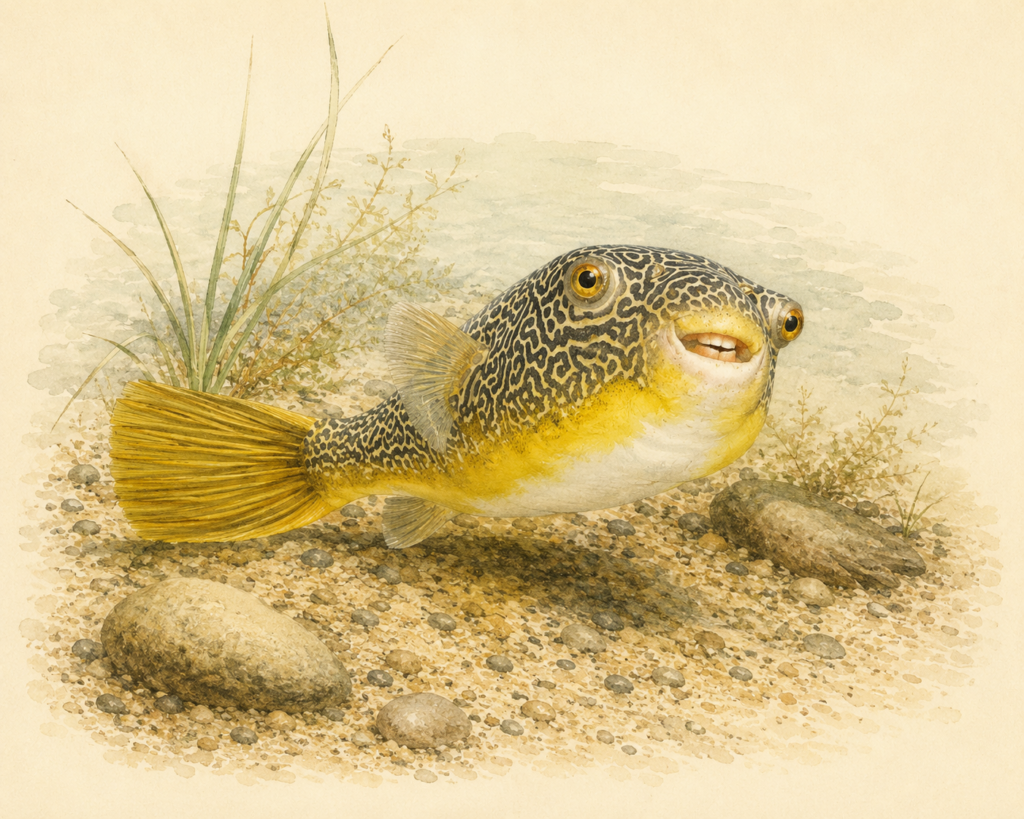
The MBU Puffer is a stout, powerfully built fish with a broad, rounded body and a blunt head dominated by large, expressive eyes. Like all pufferfish, it possesses the ability to inflate itself by swallowing water or air when stressed or threatened, ballooning to several times its normal girth as a defensive mechanism. This inflation ability, while fascinating, should never be deliberately provoked, as it places significant physiological stress on the animal.
The base colouration of the MBU Puffer is an olive to dark green across the dorsal surface, overlaid with an intricate maze-like pattern of dark brown or black markings that create a reticulated or worm-like design. This patterning is unique to each individual, much like a fingerprint, and it extends across the back and flanks before giving way to a creamy white or pale yellow belly. Juveniles tend to display brighter, more vivid patterning with higher contrast, while adults may darken somewhat with age, though they retain their distinctive markings throughout their lives.
The fins are relatively small in proportion to the body, and the fish relies primarily on its pectoral fins for precise, hovering locomotion. The caudal fin provides bursts of speed when needed, but the MBU Puffer is not built for sustained rapid swimming. Its mouth houses a powerful beak formed from four fused teeth, two upper and two lower, which gives the family Tetraodontidae its name (meaning “four teeth”). This beak is designed for crushing hard-shelled prey and grows continuously throughout the fish’s life, a fact that has significant implications for its diet in captivity.
The skin of the MBU Puffer is rough and scaleless, covered instead with tiny spines called spinules that become more pronounced when the fish inflates. Its eyes move independently and are remarkably perceptive, tracking objects and people in the room with an awareness that is quite unlike most fish. Many keepers describe the MBU Puffer’s gaze as uncannily intelligent, and it is this quality, combined with its impressive size and striking patterning, that makes it such a charismatic aquarium inhabitant.
Natural Habitat
The MBU Puffer is native to the freshwater systems of Central and East Africa, with its primary range centred on the vast Congo River basin, including its tributaries, floodplains, and associated lakes. It is also found in Lake Tanganyika, one of the African Great Lakes, where it inhabits the shallower, more vegetated margins rather than the deep, open waters. The species has been recorded across a wide geographical area, from the Democratic Republic of the Congo through to parts of Tanzania, Burundi, and Zambia.
In the wild, MBU Puffers inhabit a range of habitats, from slow-moving river channels and backwaters to lake shores and flooded forest areas. They tend to favour areas with moderate current, abundant cover in the form of submerged wood, rocks, and aquatic vegetation, and access to a rich supply of their preferred prey, primarily snails, mussels, crabs, and other hard-shelled invertebrates. The substrate in their natural environment is typically sandy or muddy, and the water ranges from clear to moderately turbid depending on the season and location.
Water conditions across the MBU Puffer’s range vary considerably, but they generally experience warm, slightly alkaline to neutral water with moderate hardness. In Lake Tanganyika, the water tends to be harder and more alkaline, while in the Congo River system, conditions can be softer and closer to neutral. This adaptability to a range of water chemistry is a modest advantage for aquarists, but the sheer volume of water required and the sensitivity of these fish to poor water quality remain the primary challenges.
Tank Size and Setup
There is no gentle way to state this: the MBU Puffer requires an enormous aquarium. A minimum tank size of 1,900 litres is recommended for a single adult, and many experienced keepers advocate for even larger systems of 2,500 litres or more when possible. Juvenile MBU Puffers are often sold at sizes of 5 to 10 centimetres, and it can be tempting to house them temporarily in smaller tanks, but their growth rate is rapid, they can add several centimetres per month under good conditions, and upgrading must be planned from the outset. A tank measuring at least 240 centimetres in length, 75 centimetres in width, and 60 centimetres in height should be considered a practical starting point for a long-term home, though wider and deeper tanks are always preferable.
The aquascape for an MBU Puffer should strike a balance between open swimming space and areas of shelter. Large pieces of driftwood, smooth boulders, and robust PVC pipe structures can provide the fish with places to rest and hide, which helps to reduce stress. Live plants are generally not practical, as MBU Puffers will uproot, chew, and destroy most vegetation. If you wish to include any greenery, hardy species attached to hardscape, such as Anubias or Java Fern secured to driftwood, may survive, though even these are not guaranteed to remain unscathed.
The substrate should ideally be fine sand, which is gentle on the puffer’s soft belly and allows for natural foraging behaviours. Avoid sharp gravel or rough substrates, as pufferfish are scaleless and therefore more susceptible to abrasions and secondary infections. Some keepers opt for a bare-bottom tank to simplify cleaning, which is a perfectly valid approach given the prodigious amount of waste these fish produce.
Ensure that all equipment within the tank is either protected behind guards or positioned outside the tank entirely. MBU Puffers are curious and destructive, and they have been known to bite through heater elements, airline tubing, and silicone sealant. Heaters should be housed in protective guards or placed in a sump. Intake strainers on filters should be robust enough to prevent the fish from biting or becoming trapped.
Water Parameters
Maintaining pristine water quality is absolutely critical for the MBU Puffer. These are large, messy fish that produce a great deal of waste, and they are surprisingly sensitive to the build-up of nitrogenous compounds. Ammonia and nitrite must be kept at zero at all times, and nitrate levels should be managed aggressively through regular large water changes. Many experienced MBU keepers perform water changes of 30 to 50 per cent weekly, and some even more frequently depending on their filtration capacity and stocking.
| Temperature | 24–28 °C |
| pH | 7.0–8.0 |
| General hardness (GH) | 5–20 dGH |
| Carbonate hardness (KH) | 5–15 dKH |
| Ammonia | 0 ppm |
| Nitrite | 0 ppm |
| Nitrate | Below 20 ppm |
Temperature stability is important. While the MBU Puffer tolerates a reasonable range, sudden fluctuations can cause stress and increase susceptibility to disease. A reliable, appropriately sized heating system, ideally with a backup unit, is essential for a tank of this volume. Similarly, pH should remain stable. If your tap water falls within the acceptable range, avoid unnecessary chemical adjustments, as consistency matters more than hitting a precise number.
Filtration and Equipment
Filtration for an MBU Puffer tank must be robust, heavily over-specified, and capable of handling the substantial bioload these fish produce. As a general rule, aim for a total filtration turnover of at least eight to ten times the tank volume per hour. For a 2,000-litre system, this means filtration equipment capable of moving 16,000 to 20,000 litres per hour. This is most practically achieved using a large sump system, which also provides additional water volume and a convenient place to house heaters, media reactors, and other equipment safely away from the fish’s powerful beak.
Canister filters rated for large aquaria can supplement a sump or serve as the primary filtration in setups where a sump is not feasible, but multiple units will almost certainly be required. Biological filtration should be the priority, with ample ceramic media, sintered glass, or similar high-surface-area materials to support the bacterial colonies needed to process the heavy waste output. Mechanical pre-filtration using coarse and fine sponges or filter floss will help to capture the considerable particulate waste before it breaks down and contributes to ammonia spikes.
Water movement should be moderate. MBU Puffers are not strong swimmers and do not appreciate powerful currents directed at them, but adequate circulation is necessary to prevent dead spots where waste can accumulate. Positioning return outlets and powerheads to create a gentle, broad flow pattern across the tank is ideal. Some keepers add supplementary aeration through air stones or surface agitation to ensure dissolved oxygen levels remain high, which is especially important in warmer water.
A UV steriliser is a worthwhile addition to any MBU Puffer system. These fish are prone to certain parasitic infections, and a UV unit provides an extra layer of protection by reducing free-floating pathogens in the water column. Ensure the UV unit is appropriately sized for the tank volume and flow rate to be effective.
Diet and Feeding
Feeding the MBU Puffer correctly is one of the most important, and most demanding, aspects of its care. The single greatest dietary concern is the maintenance of the fish’s beak. Like all pufferfish, the MBU Puffer has continuously growing dental plates that must be worn down through the regular consumption of hard-shelled foods. If the beak becomes overgrown, the fish will be unable to eat and will require manual trimming under anaesthetic, a stressful and risky procedure for both the fish and the keeper.
The foundation of the MBU Puffer’s diet should be whole, shell-on invertebrates. Pond snails, ramshorn snails, Malaysian trumpet snails, mussels, cockles, clams, and crayfish are all excellent staple foods. Many keepers breed their own snail colonies specifically to supply their puffer, which is a practical and cost-effective approach. Whole shell-on prawns and crab legs are also valuable for beak maintenance. The fish should be offered these hard foods at every feeding to ensure consistent beak wear.
Supplementary foods can include earthworms, bloodworms (for juveniles), chopped fish fillet, squid, and the occasional piece of whitebait. While these softer foods provide nutritional variety, they should not form the bulk of the diet, as they do nothing to wear down the beak. Avoid feeding mammalian meat such as beef heart, as this is not part of the species’ natural diet and can contribute to fatty deposits and organ problems over time. Similarly, dried or processed foods are generally refused and offer little nutritional value for this species.
Juvenile MBU Puffers should be fed daily, offering as much as they will consume in a few minutes. As the fish matures and its growth rate slows, feeding frequency can be reduced to every other day or three to four times per week for full-sized adults. Overfeeding is a genuine concern, as MBU Puffers are enthusiastic eaters and will readily gorge themselves if given the opportunity, leading to obesity and associated health problems. Monitor the fish’s body condition regularly and adjust portions accordingly, a healthy MBU Puffer should appear well-rounded but not distended.
Behaviour and Temperament
The MBU Puffer is widely regarded as one of the most intelligent and personable fish in the freshwater hobby. Keepers consistently report behaviours that go far beyond what is typically expected of fish, including recognising individual people, responding to visual cues, displaying apparent excitement at feeding time, and even seeming to sulk or become moody when environmental conditions are not to their liking. While it is important not to anthropomorphise excessively, there is no denying that MBU Puffers exhibit a level of awareness and interactivity that sets them apart from the vast majority of aquarium species.
Despite their charming personalities, MBU Puffers are not always easy-going tank inhabitants. They can be territorial and aggressive, particularly towards other puffers and towards fish that intrude on their preferred resting spots. Their powerful beak can inflict serious damage on tank mates, and even large, robust fish are not immune from being bitten. Aggression levels vary significantly between individuals, some MBU Puffers coexist peacefully with appropriate tank mates for years, while others become increasingly intolerant as they mature. There is no reliable way to predict an individual’s temperament in advance, so any community setup involving an MBU Puffer should be approached with caution and a contingency plan.
MBU Puffers are predominantly diurnal, being most active during the day and resting in sheltered spots at night. They are curious explorers and will investigate every corner of their enclosure, rearranging lightweight décor and testing the durability of anything within reach. This inquisitive nature is part of their appeal, but it also means the tank must be thoroughly puffer-proofed to prevent damage to equipment or injury to the fish.
One behaviour worth noting is stress-related darkening, where the fish’s colouration becomes noticeably darker or its markings become muted. This can indicate poor water quality, illness, social stress, or boredom. MBU Puffers that are kept in barren, under-stimulating environments may become lethargic and prone to health problems. Providing environmental enrichment, such as rearranging décor periodically, introducing novel food items, or even placing objects outside the tank for the fish to observe, can help to keep these intelligent animals mentally stimulated.
Tank Mates
Choosing tank mates for an MBU Puffer is a decision that should be made with extreme caution. Many keepers opt to house their MBU Puffer as the sole occupant of its tank, and this is often the safest and most straightforward approach. However, some individuals do coexist successfully with other large, robust fish, provided the tank is spacious enough and the puffer’s temperament allows it. Any tank mate must be too large to be eaten, fast enough to evade occasional aggression, and tolerant of the same water parameters. It is essential to have a backup plan for removing tank mates if the puffer decides it no longer wishes to share its space.
Good tank mates
- Bichir (Polypterus species), their tough, armoured scales and bottom-dwelling habits help them coexist with puffers in sufficiently large tanks.
- Silver Arowana, a large, fast-moving surface dweller that occupies a different zone of the tank and is typically too large to be targeted.
- Common Pleco (Hypostomus plecostomus), their heavy armour plating and nocturnal habits reduce the likelihood of conflict.
- Silver Dollar (Metynnis species), when kept in a large school, these fast, deep-bodied fish can sometimes work as dither fish in very spacious tanks.
- African Knifefish (Xenomystus nigri), a robust, nocturnal species that tends to stay hidden during the day and avoids confrontation.
- Datnoid (Datnioides species), Large, sturdy fish that are generally fast enough to avoid aggression and share similar water parameter preferences.
- Flagtail Prochilodus, an active, resilient species that is typically too fast and robust to be seriously harassed.
- Tinfoil Barb, In groups, these large, fast-swimming barbs can work in very spacious setups, though monitoring is always necessary.
Fish to avoid
- Neon Tetra, far too small and would be instantly consumed as food.
- Guppy, their small size and slow swimming make them easy prey for any pufferfish.
- Angelfish, their trailing fins and relatively slow movement make them vulnerable to biting and harassment.
- Oscar, while large, Oscars are territorial and slow enough that confrontations with an MBU Puffer can result in serious injury to either fish.
- Corydoras Catfish, far too small and would be quickly consumed or fatally injured.
- Dwarf Gourami, Much too small and delicate to survive alongside a large pufferfish.
- Goldfish, Incompatible water temperature preferences and far too slow to evade a puffer’s beak.
- Flowerhorn Cichlid, highly territorial and aggressive, creating a recipe for serious conflict and mutual injury.
Breeding
Breeding the MBU Puffer in captivity is extraordinarily rare and has only been achieved on a handful of occasions under highly specialised conditions. The species has not been commercially bred in the aquarium trade, and virtually all specimens available for sale are wild-caught. This rarity is due to a combination of factors, including the enormous space requirements, the difficulty of sexing individuals, and the poorly understood reproductive behaviours of the species.
Sexing MBU Puffers is notoriously difficult, as there are no reliable external sexual dimorphisms. Males and females are virtually identical in appearance, and no consistent differences in body shape, colouration, or fin structure have been identified. Some keepers have speculated that males may develop a slightly broader head or more robust build, but these observations are anecdotal and unreliable. The most certain method of determining sex would be through endoscopy or ultrasound, procedures that require veterinary expertise and are impractical for most hobbyists.
In the wild, MBU Puffers are believed to be substrate spawners, laying their eggs on flat surfaces in sheltered areas. The male is thought to guard the eggs until hatching, though detailed observations of wild spawning behaviour are scarce. The few reported captive spawnings have involved very large systems with multiple individuals, carefully controlled water conditions, and often a degree of luck. Replicating the seasonal changes in water flow, temperature, and chemistry that may trigger spawning in the wild is extremely challenging in a captive setting.
For the vast majority of hobbyists, breeding MBU Puffers is not a realistic goal. The focus should instead be on providing the best possible care for a single specimen over its long lifespan. Those with a serious interest in attempting to breed the species should connect with public aquaria and specialist pufferfish communities, where the collective knowledge and resources may eventually make captive breeding more achievable.
Common Diseases
MBU Puffers are generally hardy fish when kept in optimal conditions, but they are susceptible to several health issues that keepers should be aware of. As scaleless fish, they are more vulnerable to skin infections, parasitic infestations, and the toxic effects of many common aquarium medications. Treatments containing copper, formalin, or malachite green should be used with extreme caution, if at all, and always at reduced dosages. Always consult a veterinarian experienced with fish or a specialist pufferfish community before administering any medication.
Ich, or white spot disease, caused by the parasite Ichthyophthirius multifiliis, can affect MBU Puffers, particularly during periods of stress or following introduction to a new tank. Raising the temperature gradually to 30 °C and adding aquarium salt at a conservative dose can help to manage mild outbreaks without resorting to harsh chemical treatments. A UV steriliser can also assist in reducing the free-swimming stages of the parasite.
Internal parasites are a common concern with wild-caught MBU Puffers, as nearly all specimens arrive with some degree of parasitic load. Prophylactic treatment with an appropriate anti-parasitic medication, guided by veterinary advice, is recommended during the quarantine period. Symptoms of internal parasites include weight loss despite a healthy appetite, white or stringy faeces, and lethargy.
Beak overgrowth is one of the most significant health risks for MBU Puffers in captivity. If the fish is not regularly consuming hard-shelled foods, its dental plates will grow unchecked, eventually preventing the fish from eating altogether. An overgrown beak is a serious medical issue that requires manual trimming under anaesthetic, a procedure that carries inherent risks. Prevention through proper diet is far preferable to treatment.
Bacterial infections, including fin rot and skin ulcers, can occur in MBU Puffers kept in poor water conditions. These are almost always secondary to environmental stress and are best prevented by maintaining excellent water quality. If a bacterial infection does develop, broad-spectrum antibiotics administered under veterinary guidance are typically the most effective treatment. Fungal infections may also occur, particularly on abraded skin, and can be treated with antifungal medications at reduced dosages appropriate for scaleless fish.
FAQs
How fast do MBU Puffers grow?
MBU Puffers grow rapidly during their first two to three years, often gaining several centimetres per month under good conditions with a nutritious diet. Growth rate slows as the fish matures, but even so, a juvenile purchased at 8 centimetres can reach 30 centimetres or more within the first 18 months. This rapid growth rate is one of the primary reasons why prospective keepers must plan for their full adult size from the very beginning, rather than assuming they can upgrade tanks gradually as the fish grows.
Can I keep two MBU Puffers together?
Keeping two MBU Puffers together is theoretically possible but extremely risky and requires a colossal amount of space, realistically, a system of 4,000 litres or more with ample visual barriers. MBU Puffers are generally solitary and territorial, and even in very large tanks, aggression between individuals can escalate suddenly and result in severe injuries or death. Most experienced keepers strongly recommend housing them singly unless you have the resources of a public aquarium.
Do MBU Puffers need brackish water?
No, the MBU Puffer is an entirely freshwater species and does not require any salt in its water under normal circumstances. This is a common point of confusion, as many other pufferfish species in the trade, such as the Green Spotted Puffer and Figure Eight Puffer, do require brackish conditions. The MBU Puffer thrives in standard freshwater with slightly alkaline to neutral pH and moderate hardness.
What should I do if my MBU Puffer’s beak is overgrown?
An overgrown beak is a serious issue that typically requires manual trimming. This procedure involves anaesthetising the fish using clove oil or a veterinary-grade fish anaesthetic and then carefully filing or clipping the beak back to an appropriate length using a rotary tool or specialised clippers. This should ideally be performed by an aquatic veterinarian or a very experienced keeper. Going forward, the diet must be adjusted to include a much higher proportion of hard-shelled foods to prevent recurrence.
Are MBU Puffers poisonous?
Like many pufferfish, MBU Puffers can produce tetrodotoxin, a potent neurotoxin, in certain organs, particularly the liver, ovaries, and skin. In captivity, the level of toxin produced is thought to be significantly lower than in wild specimens, as toxin production is linked in part to dietary intake of toxin-producing bacteria. Nonetheless, the fish should never be consumed, and keepers should wash their hands thoroughly after handling the fish or any water or equipment from the tank. The toxin poses no risk during normal fishkeeping activities, provided basic hygiene is observed.
Related Guides
- Fahaka Puffer Care Guide, another large African freshwater pufferfish with similar care requirements, useful for comparison when choosing a species.
- Figure Eight Puffer Care Guide, a much smaller, brackish-water puffer that serves as a more accessible introduction to pufferfish keeping.
- Green Spotted Puffer Care Guide, a popular brackish puffer species often confused with freshwater species, helpful for understanding the diversity of pufferfish in the hobby.
- Large Aquarium Filtration Guide, Essential reading for anyone setting up the high-capacity filtration systems required for monster fish like the MBU Puffer.
- Bichir Care Guide, one of the more commonly recommended tank mates for large pufferfish, worth understanding in detail if considering a community setup.