Quick summary
The German Blue Ram is a stunning but delicate dwarf cichlid best suited to fishkeepers with some experience, since it demands warm, soft, acidic water and stable conditions to avoid the poor health common in commercially bred stock. If you can maintain precise water parameters and are prepared to source fish from a reputable breeder, it can be a rewarding centerpiece, but it is not forgiving of beginner mistakes or a newly cycled tank.
🐠 Build a tank around this species
In this guide:
- Introduction
- Quick Stats
- Appearance
- Varieties and Morphs
- Natural Habitat
- Tank Size and Setup
- Water Parameters
- Filtration and Equipment
- Diet and Feeding
- Behaviour and Temperament
- Tank Mates
- Breeding
- Common Diseases
- FAQs
Introduction
The German Blue Ram is one of the most visually striking and enduringly popular dwarf cichlids in the freshwater aquarium hobby. With its electric blue spangling, warm golden-orange body, and bold black markings, this small South American cichlid has captivated fishkeepers for decades. Despite its common name referencing Germany, a nod to the country’s early and prolific breeding programmes, the species hails from the warm, slow-moving waters of the Orinoco River basin in Venezuela and Colombia.
Mikrogeophagus ramirezi occupies a special place in the hobby as a cichlid that can thrive in a peaceful community aquarium without the aggression or space demands of its larger relatives. However, its reputation as a delicate fish is well earned. German Blue Rams are notably sensitive to poor water quality, temperature fluctuations, and the stresses of transport and acclimatisation. Many hobbyists have experienced the disappointment of losing newly purchased specimens within the first few weeks, a common issue with intensively line-bred commercial stock, which tends to be more fragile than wild-caught fish.
This guide aims to give you a thorough understanding of what German Blue Rams need to flourish, from tank setup and water chemistry to diet, breeding, and disease prevention. With the right conditions and a little patience, these jewel-like cichlids can be a rewarding centrepiece for a thoughtfully planned aquarium.
Quick Stats
| Scientific name | Mikrogeophagus ramirezi |
|---|---|
| Common names | German Blue Ram, Blue Ram, Butterfly Cichlid, Ramirez's Dwarf Cichlid |
| Family | Cichlidae |
| Origin | Orinoco River basin, Venezuela and Colombia |
| Adult size | 4 cm |
| Difficulty | Intermediate |
| Breeding difficulty | Moderate |
| Temperature | 26–30 °C |
| pH | 4–7 |
| GH | 1–8 dGH |
| Minimum tank size | 75 L |
| Conservation status | Least Concern (IUCN) |
Appearance
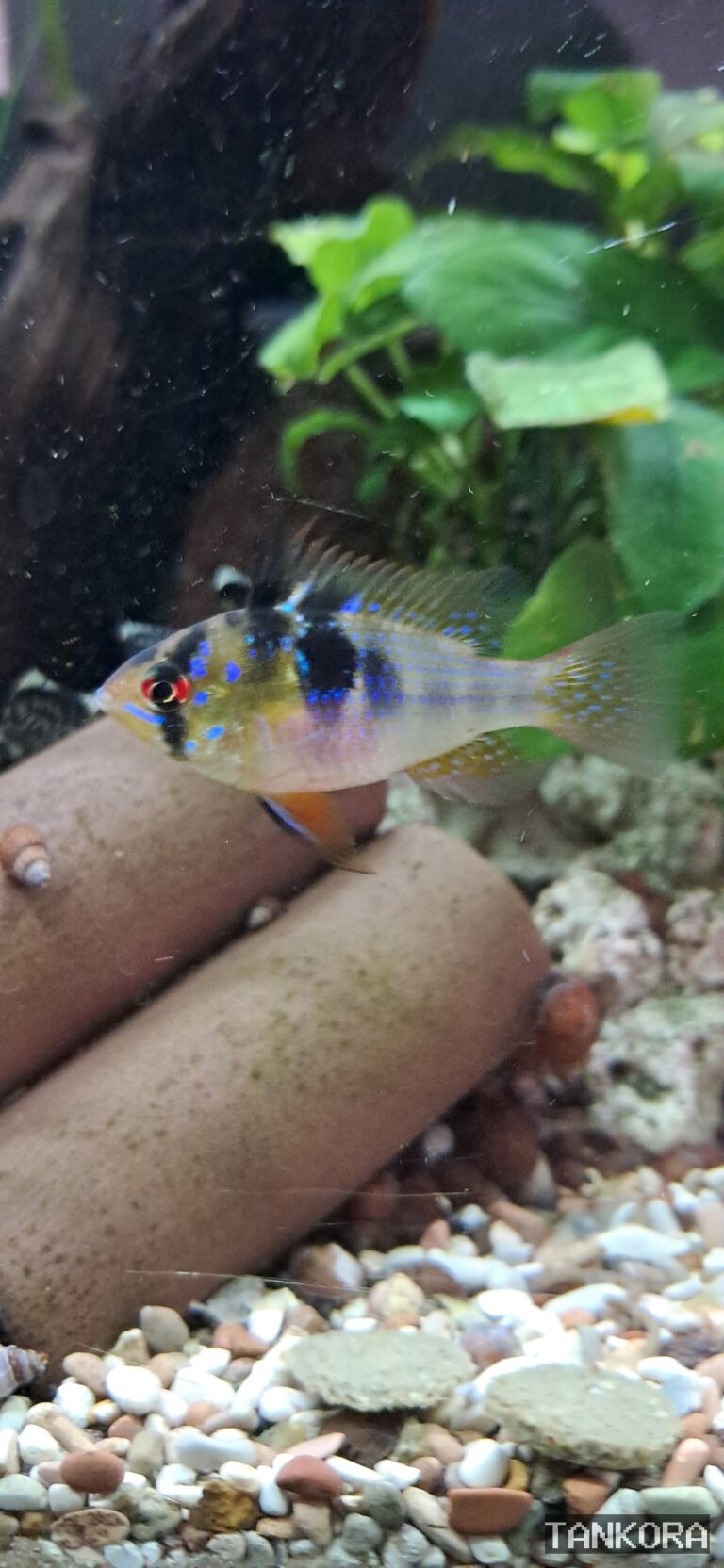
The German Blue Ram is a compact, deep-bodied dwarf cichlid with an oval profile and elegantly elongated dorsal and pelvic fins. The base body colour is typically a warm yellow to golden-orange, overlaid with iridescent blue-green spangles that extend across the flanks, head, and finnage. A prominent black vertical bar runs through the eye, and a dark blotch, sometimes ringed with iridescence, sits on the mid-flank just below the dorsal fin. The first few rays of the dorsal fin are often jet black and taller than the rest, giving the fin a spiked, crown-like appearance that is one of the species’ most recognisable features.
Males tend to be slightly larger than females, with more extended dorsal and anal fin filaments. Their overall colouration is often more intense, though this can vary considerably depending on the strain. Females are typically a touch smaller and rounder in the belly, and they almost always display a pinkish to rosy-violet flush on the abdomen, which becomes particularly vivid when they are in breeding condition. Both sexes possess striking red eyes, though the intensity of this trait varies between individuals and breeding lines.
When stressed, German Blue Rams will dramatically pale, losing much of their vibrancy. This colour-fading response is entirely normal and can serve as a useful visual indicator of the fish’s wellbeing. A healthy, settled specimen kept in appropriate conditions will display deep, saturated colours that are genuinely breathtaking in a well-lit aquarium.


Varieties and Morphs
Decades of selective breeding, particularly in Germany and Southeast Asia, have produced a number of distinct colour morphs and fin variants that are widely available in the trade. While all belong to the same species, they can look remarkably different from one another and from wild-type specimens.
The standard German Blue Ram is the most common form, featuring the classic golden-orange body with blue spangles and black markings described above. This form is the baseline from which most other varieties have been developed and remains the most popular.
The Electric Blue Ram is arguably the most commercially successful variant, displaying an almost entirely metallic sky-blue body with minimal yellow or orange tones. This morph was developed primarily in Southeast Asian breeding facilities and is strikingly beautiful, though it is often regarded as somewhat more delicate than the standard form due to the intensity of the selective breeding involved.
The Gold Ram, sometimes sold as the Golden Ram, lacks much of the blue iridescence and dark markings of the standard form, instead presenting a bright, uniform golden-yellow body. It retains the red eye and basic fin shape but appears far more understated in terms of patterning.
The Balloon Ram is a body-shape variant rather than a colour morph, characterised by a shortened, rounded body caused by selective breeding for spinal deformity. It is available in several colour forms including blue and gold. This variant is controversial among hobbyists due to the welfare concerns associated with its exaggerated body shape, which can affect swimming ability and organ function.
The Long-Fin Ram features dramatically elongated dorsal, anal, and caudal finnage. It is available in both standard blue and electric blue colour forms. These extended fins give the fish an ethereal appearance but can be prone to fin damage in tanks with sharp décor or nippy tank mates.
The Black Ram, sometimes called the Dark Knight Ram, is a relatively newer morph with a deep, near-black body overlaid with blue iridescence. It is a striking variant that has gained popularity in recent years, particularly among aquascapers seeking a dramatic focal point.
The Electric Blue Balloon Ram combines the electric blue colouration with the shortened balloon body shape. It is widely available in the trade but carries the same welfare concerns as other balloon variants.
The German Gold Longfin Ram combines the golden colour morph with elongated finnage, producing a fish that is pale gold with flowing, delicate fins. It is less commonly seen than some other variants but is available from specialist breeders.
Wild-type specimens, while less frequently encountered in shops, are occasionally available through specialist importers. These fish tend to be hardier than their captive-bred counterparts and display a more natural, somewhat subtler colour palette with stronger dark markings and a more olive-toned base colour.
Natural Habitat
In the wild, Mikrogeophagus ramirezi is found in the llanos, the vast tropical grassland plains, of the Orinoco River basin in Venezuela and Colombia. These fish inhabit shallow, slow-moving streams, pools, and flooded savannah areas where the water is warm, soft, and acidic. The substrate in their native habitat is typically sandy, often scattered with leaf litter, fallen branches, and submerged vegetation.
Water temperatures in these habitats are consistently high, often ranging from 26 to 34 °C depending on the season and exposure to sunlight. The water is typically stained brown by tannins from decomposing organic matter, resulting in low visibility and a pH that can drop well below 6.0. Dissolved mineral content is extremely low, with general hardness often negligible. This warm, soft, acidic environment is fundamental to understanding the care requirements of this species in captivity.
German Blue Rams are benthic feeders in nature, sifting through fine sediment and leaf litter for small invertebrates, insect larvae, and organic detritus. They occupy the lower levels of the water column and are typically found in pairs or loose groups, establishing small territories around flat stones, submerged wood, or patches of open substrate.
Tank Size and Setup
A single pair of German Blue Rams can be housed in a tank of at least 75 litres, though a larger aquarium of 100 litres or more is preferable and provides greater stability in water parameters. If you wish to keep multiple pairs or house them in a community setting, a tank of 150 litres or above is strongly recommended to allow each pair to establish a territory without constant conflict.
The substrate should ideally be fine sand, which allows the fish to exhibit their natural sifting behaviour and is gentler on their delicate mouths than coarser gravels. A layer of dried leaf litter, Indian almond leaves, oak leaves, or similar, is highly beneficial, as it releases tannins that soften and acidify the water while also providing a natural, comfortable aesthetic and surfaces for microfauna to colonise.
Provide plenty of visual barriers and hiding spots using driftwood, smooth stones, and live plants. Rams appreciate a tank that offers both open swimming areas along the bottom and sheltered retreats where they can escape the gaze of tank mates. Flat stones or terracotta pots placed among the décor make excellent potential spawning sites. Dense planting along the back and sides of the tank, with species such as Cryptocoryne, Echinodorus, and Java Fern, creates a sense of security and helps break up sight lines in a community setting.
Lighting should be moderate. German Blue Rams come from shaded, tannin-stained waters and can appear washed out or stressed under very bright illumination. Floating plants such as Amazon Frogbit or Salvinia are excellent for diffusing light and providing dappled shade that closely replicates their natural environment.
Water Parameters
| Temperature | 26–30 °C |
| pH | 4.0–7.0 |
| General hardness (GH) | 1–8 dGH |
| Ammonia | 0 ppm |
| Nitrite | 0 ppm |
| Nitrate | Below 20 ppm |
Temperature is arguably the single most critical parameter for German Blue Rams. These fish evolved in some of the warmest freshwater habitats on earth, and they genuinely need elevated temperatures to thrive. A minimum of 26 °C is essential, with 27–29 °C being the ideal range for long-term health. Keeping them at temperatures below 25 °C significantly increases their susceptibility to disease and can shorten their lifespan. This high temperature requirement is an important consideration when selecting tank mates, as many common community species prefer cooler conditions.
Soft, acidic water is strongly preferred. While commercially bred specimens may tolerate a neutral pH and moderate hardness, they will display better colour, stronger immune function, and more natural behaviour in softer, more acidic conditions. If your tap water is hard and alkaline, consider using reverse osmosis water remineralised with an appropriate GH buffer, or blending RO water with tap water to achieve a suitable chemistry. Peat filtration and botanicals such as Indian almond leaves can help lower pH naturally and add beneficial tannins.
Rams are exceptionally sensitive to dissolved nitrogenous waste. The tank must be fully cycled before any specimens are introduced, and ammonia and nitrite must always remain at zero. Nitrate should be kept as low as possible through regular partial water changes and efficient biological filtration. Weekly water changes of 20–30% are a good baseline, though more frequent changes may be necessary in smaller or more heavily stocked tanks.
Filtration and Equipment
Gentle but efficient filtration is the goal for a German Blue Ram aquarium. These fish are not strong swimmers and do not appreciate powerful currents. A sponge filter is an excellent choice for smaller or breeding-focused setups, as it provides good biological filtration with minimal flow and poses no risk of trapping fry. In larger community tanks, a small external canister filter or hang-on-back filter with an adjustable flow rate works well. If using a canister filter, consider fitting a spray bar to diffuse the output and reduce current strength across the tank.
A reliable, high-quality heater is essential given the species’ need for consistently warm water. A heater with a precise thermostat is well worth the investment, as even brief temperature drops can stress these fish and trigger illness. In larger tanks or in homes where ambient temperatures fluctuate significantly, using two smaller heaters rather than one large unit provides a safety net, if one fails, the other maintains some warmth while you address the problem.
An accurate thermometer, placed away from the heater for a true reading, should be considered standard equipment. A liquid-based or digital test kit for monitoring pH, ammonia, nitrite, nitrate, GH, and KH is equally important, particularly during the initial weeks after setup and whenever new fish are introduced.
An air pump is not strictly necessary if your filter provides adequate surface agitation for gas exchange, but it can be useful as a backup or during hot weather when dissolved oxygen levels drop. Avoid creating strong bubble currents directly in the fish’s territory.
Diet and Feeding
German Blue Rams are omnivorous with a strong preference for protein-rich foods. In the wild, they feed primarily on small invertebrates, insect larvae, and organic matter sifted from the substrate. In captivity, a varied diet that includes both high-quality prepared foods and regular offerings of live or frozen fare will keep them in optimal condition.
A good-quality micro pellet or small granule food designed for dwarf cichlids makes an excellent daily staple. Look for products with whole fish or invertebrate ingredients listed first and minimal fillers. Supplement this with frozen foods such as bloodworm, brine shrimp, daphnia, and cyclops several times per week. Live foods, including newly hatched brine shrimp, grindal worms, and micro worms, are particularly valuable for conditioning breeding pairs and are eagerly accepted.
Rams feed primarily from the substrate and mid-water levels, so sinking pellets or granules are generally more suitable than flake foods, which tend to float at the surface. Feed small amounts two to three times daily rather than one large meal, as this more closely mimics their natural grazing behaviour and reduces the risk of uneaten food fouling the water. Remove any food that is not consumed within a few minutes.
Newly acquired specimens may be reluctant to eat for the first day or two as they acclimatise. Offering live or frozen foods during this period can help entice them. If a fish consistently refuses food beyond the first few days, it may be an indication of stress, illness, or incompatible water conditions that need to be investigated.
Behaviour and Temperament
German Blue Rams are not generally recommended for the general community aquarium despite how they are often marketed: they are a poor competitor for food and need consistently excellent water quality, so more assertive or hardier tankmates can easily outcompete or stress them. In a carefully chosen, calm setup they are typically mild-mannered and territorial only during breeding, and can coexist with a range of similarly sized, non-aggressive species. They spend much of their time in the lower third of the water column, exploring the substrate, sifting through sand, and investigating hiding spots among décor.
Pairs form strong bonds, and a mated pair will often swim together, claim a small territory, and engage in charming courtship displays that include fin flaring, lateral displays, and gentle circling. Aggression is generally limited to their immediate territory and is usually expressed through posturing and chasing rather than physical harm. However, during active spawning and fry-guarding, even normally docile Rams can become surprisingly assertive towards nearby fish that venture too close to their nest site.
It is generally best to keep German Blue Rams either as a single pair or in a group large enough that aggression is dispersed, provided the tank is spacious enough to support multiple territories. Keeping two pairs in a small tank often leads to one pair being persistently bullied by the dominant pair. Solitary individuals can sometimes be kept successfully, though they tend to be shyer and less confident without a companion of the same species.
Rams are intelligent and can learn to recognise their keeper, often approaching the front of the tank at feeding time. They display a wide range of colour changes and body language signals that make them particularly engaging to observe. A stressed or subordinate Ram will pale, clamp its fins, and retreat to a corner, while a confident, healthy individual will display full, vibrant colouration and erect finnage.
Tank Mates
Good tank mates
- Cardinal Tetra, a classic companion that shares the Ram’s preference for warm, soft, acidic water and swims primarily in the mid to upper water column.
- Rummy-Nose Tetra, another warm-water tetra that tolerates the high temperatures Rams require and adds lively movement to the middle of the tank.
- Ember Tetra, a tiny, peaceful tetra that thrives in warm, soft water and is far too small and fast to pose any threat or competition.
- Corydoras sterbai, one of the few Corydoras species that genuinely tolerates the higher temperatures Rams need, making it an ideal bottom-dwelling companion.
- Bristlenose Pleco, a peaceful algae eater that largely ignores Rams and occupies different niches within the tank, though ensure sufficient space.
- Harlequin Rasbora, a gentle, shoaling fish that inhabits the middle water layers and appreciates the same soft, slightly acidic conditions.
- Otocinclus, a small, unobtrusive algae grazer that stays out of the Ram’s way and benefits from the warm, clean water this setup demands.
- Kuhli Loach, a nocturnal bottom-dweller that is unlikely to come into conflict with Rams during the day and enjoys similar water chemistry.
- Dwarf Gourami, Occupies the upper water column and is generally peaceful, though monitor for any territorial overlap during breeding periods.
- Amano Shrimp, Large enough to avoid predation by adult Rams and useful as part of a clean-up crew, though very small shrimp may be eaten.
Fish to avoid
- Oscar, far too large and predatory; an Oscar would view a German Blue Ram as food.
- Convict Cichlid, highly aggressive and territorial, this Central American cichlid would bully and likely injure a Ram.
- Tiger Barb, a notorious fin nipper that would harass Rams, particularly long-finned varieties, causing stress and physical damage.
- African Rift Lake Cichlids, Require hard, alkaline water that is completely incompatible with the soft, acidic conditions Rams need.
- Chinese Algae Eater, Becomes increasingly territorial and aggressive with age and may attach itself to the flanks of slow-moving fish.
- Red-Tail Shark, Aggressively territorial towards bottom-dwelling fish and would relentlessly chase Rams from the lower areas of the tank.
- Common Pleco, Grows far too large for the typical Ram aquarium and produces copious waste that would compromise water quality.
- Jaguar Cichlid, a large, highly predatory cichlid that is entirely incompatible in terms of both temperament and size.
- Buenos Aires Tetra, a robust, sometimes nippy tetra that prefers cooler water and can be boisterous enough to intimidate Rams.
- Green Terror, an aggressive, medium-to-large cichlid that would dominate and endanger any dwarf cichlid sharing its space.
Breeding
German Blue Rams are one of the more accessible cichlids to breed in captivity, and watching a pair care for their eggs and fry is one of the most rewarding experiences the hobby has to offer. They are open spawners that typically lay their eggs on a flat surface such as a smooth stone, a broad leaf, or even a cleaned patch of substrate.
To encourage breeding, start by ensuring you have a true pair. Sexing can be done with reasonable confidence in mature specimens: females are slightly smaller, have a rounder belly, and display the characteristic pink or violet abdominal patch. The first few rays of the female’s dorsal fin are typically shorter than those of the male, which often extend beyond the rest of the fin membrane. Purchasing a small group of juveniles and allowing them to pair off naturally is often the most reliable approach.
Condition the pair with frequent offerings of high-quality live and frozen foods such as bloodworm, brine shrimp, and daphnia. Maintain the water temperature at the upper end of the recommended range, around 28–30 °C, and ensure the water is soft and slightly acidic, ideally with a pH between 5.5 and 6.5 and a GH below 5 dGH. These conditions closely replicate the environmental triggers that prompt spawning in the wild.
When ready to spawn, the pair will intensify their colours and begin cleaning a chosen site meticulously. The female deposits rows of small, adhesive eggs, typically between 100 and 300, on the chosen surface, and the male follows closely behind to fertilise them. Both parents take turns fanning the eggs to maintain water flow and picking off any that develop fungus.
Eggs typically hatch within 48 to 72 hours at optimal temperatures. The fry are initially immobile and survive on their yolk sacs for a further three to four days before becoming free-swimming. At this stage, they require extremely small foods such as infusoria, commercially available liquid fry food, or freshly hatched brine shrimp nauplii. The parents will often herd the free-swimming fry into a tight group and defend them vigorously against perceived threats.
First-time parents frequently eat their eggs or abandon the brood. This is common in cichlid breeding and should not be cause for alarm. With successive attempts, most pairs improve their parenting skills. If egg predation by tank mates is a concern, the spawning pair can be given their own dedicated breeding tank, or the eggs can be carefully removed to a separate hatching container with gentle aeration and a few drops of methylene blue to inhibit fungal growth.
Common Diseases
German Blue Rams are unfortunately more susceptible to disease than many commonly kept freshwater species. This vulnerability is partly inherent to the species and partly a consequence of the intensive breeding and, in some cases, hormone treatment that commercially produced specimens undergo. Maintaining pristine water quality, stable temperatures, and a stress-free environment is the single most effective form of disease prevention.
Ich, or white spot disease, caused by the protozoan Ichthyophthirius multifiliis, is one of the most frequently encountered illnesses. It presents as small white cysts on the body and fins and is often triggered by temperature drops or sudden changes in water conditions. Raising the temperature to 30–32 °C and treating with an appropriate ich medication usually resolves the issue, though Rams can be sensitive to some chemical treatments, so always use medications at the recommended dosage and monitor closely.
Hole-in-the-head disease and lateral line erosion are another concern for this species, associated with poor water quality, inadequate diet, and stress; the exact cause is debated, though the flagellate Spironucleus is often implicated alongside these environmental factors. Symptoms include loss of appetite, white stringy faeces, pitting or small holes around the head and sensory pores, and general wasting. It is strongly associated with poor water quality and nutritional deficiencies. Treatment typically involves metronidazole administered in food or dissolved in the water, alongside immediate improvements to water quality and diet.
Bacterial infections, including fin rot and columnaris, can occur when fish are stressed or when water quality deteriorates. Fin rot presents as fraying, discolouration, or recession of the fin edges, while columnaris may appear as white or greyish patches on the body, often around the mouth or dorsal area. Prompt treatment with an appropriate antibacterial medication and a thorough review of tank conditions are essential.
Gill flukes and other external parasites can sometimes affect Rams, particularly wild-caught or recently imported specimens. Symptoms include rapid breathing, gill flaring, scratching against objects, and general lethargy. Anti-parasitic treatments containing praziquantel are typically effective.
It is worth noting that intensive commercial line-breeding, particularly from large-scale Southeast Asian farms, can produce stock that is less robust than wild-type or carefully bred fish. Some overseas farms are also known to use hormones to intensify colour and stimulate egg production before shipping, which can leave affected fish short-lived and often infertile. This can result in individuals that appear healthy in the shop but decline rapidly once placed in a home aquarium. Sourcing fish from reputable breeders, or seeking out locally bred specimens, can significantly improve your chances of acquiring robust, healthy individuals.
FAQs
Can German Blue Rams be kept in a planted tank?
Absolutely, and in fact a well-planted aquarium is one of the best environments for them. Live plants help maintain water quality by absorbing nitrates, provide natural hiding spots and visual barriers, and create the shaded, complex habitat that Rams feel most comfortable in. Species such as Cryptocoryne, Java Fern, Anubias, and various stem plants all work well. The Rams’ gentle substrate-sifting behaviour is unlikely to uproot well-established plants, though newly planted specimens may need time to anchor themselves.
Why did my German Blue Ram die shortly after purchase?
This is regrettably common and can be caused by several factors. Commercially bred Rams can be weakened by the stress of transport and sudden changes in water chemistry after purchase, so a slow acclimatisation and a quarantine period are worth the extra care. Ensuring your tank is fully cycled, maintaining the correct temperature and soft water conditions, and acclimatising new fish slowly and carefully all help. Purchasing from reputable sources that breed healthy, un-medicated stock is also strongly advisable. Quarantining new arrivals in a separate tank for two to three weeks before adding them to your main display is an excellent precaution.
How many German Blue Rams can I keep together?
In a 75-litre tank, a single pair is generally the maximum. For multiple pairs, you will need a significantly larger aquarium, at least 150 litres for two pairs, with ample décor to break up sight lines and allow each pair to establish its own territory. In tanks that are too small or too sparsely decorated, the dominant pair will relentlessly harass subordinate fish. A group of five or six in a large, well-structured tank can work well, as aggression is spread more evenly and no single fish bears the brunt of territorial behaviour.
Do German Blue Rams need to be kept in pairs?
They do not strictly need a partner, and a single specimen can be kept in a community tank. However, they are naturally social fish that form pair bonds, and a lone individual may be shyer and less confident. If you do wish to keep a single Ram, ensure the tank has plenty of hiding places and compatible, non-threatening tank mates to provide a sense of activity and security. That said, much of the species’ most interesting behaviour, courtship, spawning, and parental care, is only observed when a compatible pair is kept together.
Are German Blue Rams suitable for beginners?
They are generally considered a moderate-difficulty species rather than a beginner fish. Their sensitivity to water quality, their need for consistently warm and soft water, and the fragility of many commercially bred specimens mean they are best suited to fishkeepers who have some experience maintaining stable aquarium conditions. A beginner who is prepared to invest in proper equipment, test water parameters regularly, and source healthy stock from a reputable breeder can certainly succeed, but this is not a fish that will tolerate neglect or a hastily cycled tank.
Related Guides
- Bolivian Ram Care Guide, a closely related and somewhat hardier dwarf cichlid that makes an excellent alternative for those who find German Blue Rams too demanding.
- Apistogramma cacatuoides Care Guide, another popular South American dwarf cichlid with similar water requirements and temperament, ideal for those who enjoy the Ram’s character.
- Cardinal Tetra Care Guide, one of the best companion species for German Blue Rams, sharing their preference for warm, soft, acidic water.
- Corydoras sterbai Care Guide, a warm-water Corydoras that pairs beautifully with Rams in a community setup.
- How to Lower Aquarium pH, a practical guide to achieving and maintaining the soft, acidic water conditions that German Blue Rams require.
- Understanding the Nitrogen Cycle, Essential reading for anyone keeping sensitive species like German Blue Rams, covering the fundamentals of biological filtration and tank cycling.