Quick summary
The Aru Rainbowfish suits intermediate aquarists with a 200+ litre tank, stable water conditions, and patience, since juveniles look plain and take a year or more to develop their striking adult colours. It’s a peaceful, hardy shoaling fish best kept in groups of six or more, making it rewarding but not ideal for beginners or those wanting instant colour.
🐠 Build a tank around this species
In this guide:
- Introduction
- Quick Stats
- Appearance
- Natural Habitat
- Tank Size and Setup
- Water Parameters
- Filtration and Equipment
- Diet and Feeding
- Behaviour and Temperament
- Tank Mates
- Breeding
- Common Diseases
- FAQs
Introduction
The Aru Rainbowfish (Melanotaenia picta) is a striking and relatively uncommon freshwater species hailing from the remote Aru Islands of eastern Indonesia. Found specifically on Kobroor Island, this medium-sized rainbowfish has captured the attention of dedicated aquarists who appreciate the remarkable transformation these fish undergo as they mature. Juveniles appear drab and unremarkable, but with patience and proper care, adult males develop vivid colouration that rivals some of the most popular rainbowfish in the hobby.
As a shoaling species, Melanotaenia picta thrives when kept in groups, displaying its best colours and most natural behaviours when surrounded by conspecifics. The interplay between males vying for the attention of females creates a dynamic and visually rewarding display that few other freshwater species can match. Despite its relative rarity in the trade compared to more commonly available rainbowfish such as the Boesemani or Turquoise Rainbowfish, the Aru Rainbowfish has developed a loyal following among rainbowfish enthusiasts and specialist breeders.
This species is well suited to intermediate aquarists who have experience maintaining stable water conditions and who are willing to invest time in watching their fish develop. The transformation from nondescript juvenile to fully coloured adult is one of the most rewarding aspects of keeping this species, though it does require patience – full colouration may take a year or more to develop. In this comprehensive care guide, we cover everything you need to know about keeping, feeding, breeding, and maintaining healthy Aru Rainbowfish in your home aquarium.
Quick Stats
| Scientific name | Melanotaenia picta |
|---|---|
| Common names | Painted Rainbowfish |
| Family | Melanotaeniidae |
| Origin | Kobroor Island, Aru Islands, Indonesia |
| Adult size | 12 cm |
| Lifespan | 5–8 years |
| Difficulty | Intermediate |
| Breeding difficulty | Moderate |
| Temperature | 24–30 °C |
| pH | 6.5–8 |
| GH | 8–20 dGH |
| KH | 5–15 dKH |
| Minimum tank size | 200 L |
| Conservation status | Least Concern (IUCN, assessed 2019) |
Appearance
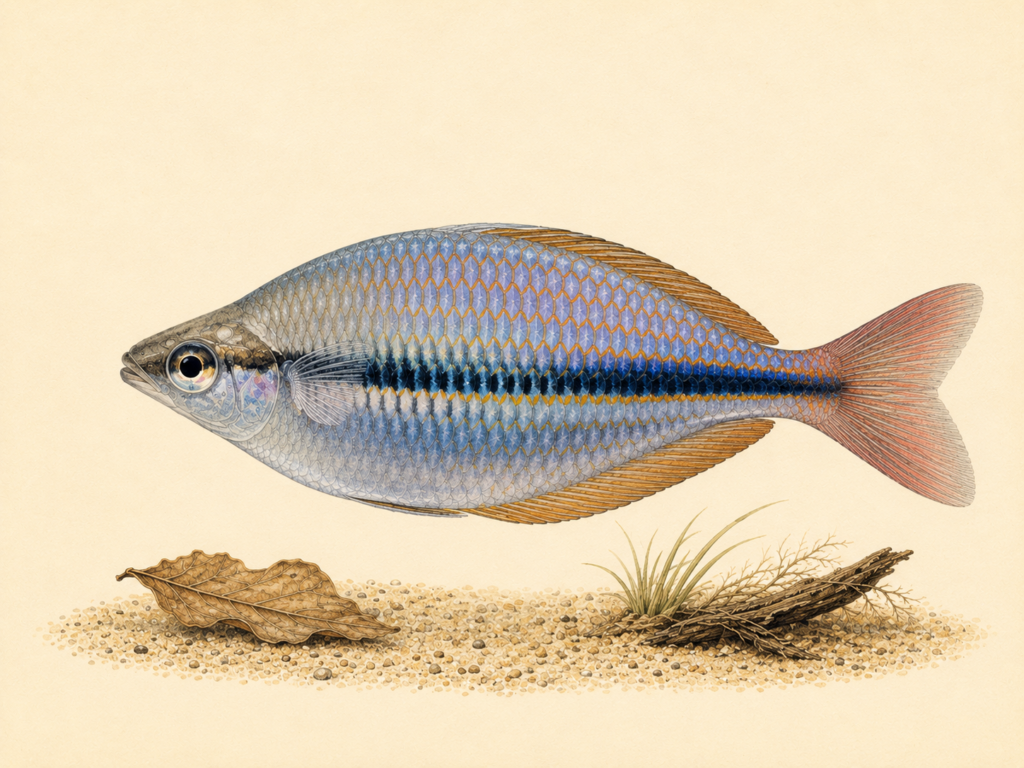
Melanotaenia picta is a classically shaped rainbowfish with a laterally compressed, deep body and a distinctly arched back profile that becomes more pronounced in mature males. Adults typically reach 10 to 12 cm in total length, with males tending towards the larger end of that range. The body shape is quintessentially that of the Melanotaenia genus – elongated yet deep, with a small head, relatively large eyes, and two dorsal fins separated by a small gap.
One of the most notable aspects of this species is the dramatic difference between juvenile and adult colouration. Juveniles are remarkably plain, displaying a silvery-grey to olive base colour with faint horizontal striping. This drab appearance often leads inexperienced aquarists to overlook them at retailers, not realising the potential these fish hold. As the fish mature, typically from around six to twelve months of age, a stunning transformation begins. Males gradually develop rich, warm tones across their flanks, with colours ranging from golden-yellow to deep orange and reddish hues depending on the population and individual genetics.
Mature males display a complex pattern of horizontal striping, with alternating rows of scales exhibiting different colour intensities. The fins take on deeper pigmentation, with the dorsal fins and anal fin often developing orange to red edges. The caudal fin may show a subtle yellowish or orange wash. A dark midlateral stripe is often present, running from behind the eye to the caudal peduncle, and this can intensify or fade depending on the fish’s mood and social context.
Females are noticeably less colourful than males, retaining more of the juvenile silvery-olive appearance throughout their lives, though they may develop a subtle golden sheen. They are also slightly smaller and less deep-bodied than males. Sexual dimorphism becomes increasingly apparent as the fish age, with mature males being easily distinguishable by their deeper bodies, more vivid colours, and extended fin rays.
During courtship displays, males can intensify their colouration dramatically. Early morning is often the best time to observe peak colouration, as males display vigorously at dawn in an attempt to attract females. This “morning display” is characteristic of many rainbowfish species and is one of the most captivating behaviours to observe in the home aquarium.
Natural Habitat
The Aru Rainbowfish is endemic to the Aru Islands, a remote archipelago situated in the Arafura Sea between Australia and New Guinea, within the Maluku province of eastern Indonesia. Specifically, Melanotaenia picta has been documented from freshwater habitats on Kobroor Island, one of the larger islands in the Aru group. The Aru Islands are geologically interesting as they sit on the Australian continental shelf and were connected to mainland New Guinea and Australia during periods of lower sea levels in the Pleistocene, which explains the Australasian affinities of their freshwater fish fauna.
On Kobroor Island, this species inhabits a range of freshwater environments including slow-moving streams, creeks, and pools within lowland tropical forest. The water in these habitats tends to be clear to slightly tannin-stained, flowing over substrates of sand, gravel, and leaf litter. Riparian vegetation provides dappled shade, and submerged roots, fallen branches, and aquatic plants offer shelter and foraging opportunities.
The tropical climate of the Aru Islands means water temperatures remain warm year-round, typically ranging from the mid-twenties to around 30 degrees Celsius. The geology of the islands contributes to water that is moderately hard and slightly alkaline in many locations, though conditions can vary between different waterways and seasons. Rainfall is significant, and seasonal flooding can alter water chemistry and habitat structure.
The relatively isolated nature of the Aru Islands means that the freshwater fish fauna is limited in diversity, and Melanotaenia picta occupies an important ecological niche as a mid-water omnivore. In its natural habitat, it feeds on a combination of small invertebrates, insect larvae, algae, and plant matter that falls into the water. The species is typically found in loose shoals, foraging together in areas where gentle current brings food items downstream.
Due to the remoteness of the Aru Islands, relatively little detailed ecological research has been conducted on this species in the wild. The conservation status of Melanotaenia picta has not been formally evaluated by the IUCN, though like many island-endemic species, it could be vulnerable to habitat degradation from logging, agricultural development, and other human activities. Captive breeding efforts by dedicated rainbowfish enthusiasts play an important role in maintaining genetically diverse populations of this species outside its natural range.
Tank Size and Setup
Given the active, shoaling nature of Melanotaenia picta and its adult size of up to 12 cm, a minimum tank volume of 200 litres is recommended, with larger aquaria of 300 litres or more being preferable if you wish to keep a sizeable group and observe the most natural behaviour. Rainbowfish are active swimmers that utilise the full length of the aquarium, so a tank that prioritises horizontal swimming space over height is ideal. A standard 120 cm long aquarium provides excellent dimensions for a group of six to eight individuals.
The aquascape should aim to replicate elements of the species’ natural habitat while still providing ample open swimming space. Use a substrate of fine gravel or sand in natural tones – a darker substrate can help enhance the fish’s colouration by reducing glare and providing a contrasting backdrop. Arrange pieces of driftwood and smooth river stones to create visual barriers and territorial boundaries without cluttering the tank. These structures also provide resting spots and areas where subordinate fish can retreat from dominant males.
Live plants are highly recommended and serve multiple purposes in an Aru Rainbowfish aquarium. They improve water quality by absorbing nitrates, provide shelter for less dominant individuals and juveniles, and create a more natural aesthetic. Hardy, robust species are best suited as rainbowfish can be somewhat boisterous. Vallisneria, Java fern (Microsorum pteropus), Anubias species, and various Cryptocoryne species all work well. Floating plants such as Amazon frogbit or water sprite can help diffuse lighting and create the dappled shade that mimics the fish’s forest stream habitat.
Leave a generous area of open water in the centre and front of the tank for swimming. Rainbowfish spend most of their time in the mid-water column and appreciate being able to swim back and forth freely. Densely planted areas along the sides and back of the tank create a visually appealing arrangement while maximising available swimming space.
A secure, well-fitting lid is essential. Rainbowfish are known jumpers, particularly when startled or during spirited courtship displays. Even a small gap in the cover can result in fish escaping the aquarium, so ensure all openings around filter inlets and heater cables are adequately covered.
Lighting should be moderate. Excessively bright lighting can wash out the fish’s colours and cause stress, while too little light will limit plant growth. A quality LED light on a timer set for 8 to 10 hours per day provides a good balance. The morning period shortly after the lights come on is when you will typically observe the most vibrant courtship displays.
Water Parameters
Melanotaenia picta is a reasonably adaptable species when it comes to water chemistry, but providing stable conditions within its preferred range will ensure the best health, colouration, and longevity. The warm tropical waters of the Aru Islands inform the ideal parameters for this species in captivity.
| Temperature | 24-30 °C |
| pH | 6.5-8.0 |
| General hardness (GH) | 8-20 dGH |
| Carbonate hardness (KH) | 5-15 dKH |
| Ammonia | 0 ppm |
| Nitrite | 0 ppm |
| Nitrate | Below 20 ppm |
A temperature around 26-28 °C represents the sweet spot for this species, promoting good activity levels and appetite without the metabolic stress that can accompany the extremes of their tolerance range. A pH in the neutral to slightly alkaline range of 7.0 to 7.5 works well for most captive populations. The species tolerates moderately hard to hard water, which makes it suitable for many municipal water supplies without the need for extensive modification.
Consistency is more important than hitting an exact number. Sudden fluctuations in temperature, pH, or hardness are far more stressful and potentially harmful than keeping the fish at a stable value that sits slightly outside the optimal range. Use a reliable thermometer to monitor temperature daily, and test water chemistry weekly, especially in newer setups or when any changes are made to the system.
Regular partial water changes are the cornerstone of good water quality management. Aim for weekly changes of 25-30% of the tank volume, using dechlorinated water matched as closely as possible to the tank temperature. Consistent water changes help keep nitrate levels low and replenish essential minerals and trace elements that are gradually depleted between changes.
Filtration and Equipment
Effective filtration is crucial for maintaining the clean, well-oxygenated water that Melanotaenia picta requires. As active fish with healthy appetites, rainbowfish produce a moderate bioload, and the filter must be capable of handling the waste produced by a group of six or more individuals plus any tank mates.
An external canister filter is the preferred choice for an Aru Rainbowfish aquarium. Canister filters offer excellent mechanical, biological, and chemical filtration capacity, and their placement outside the tank keeps the aquarium interior uncluttered. Choose a model rated for your tank volume or slightly above – for a 200-litre setup, a filter rated for 300 to 400 litres provides a comfortable margin. The outflow can be directed to create a gentle current across the length of the tank, which rainbowfish appreciate as it mimics the slow to moderate flow of their natural stream habitats.
If a canister filter is not feasible, a large hang-on-back filter or a suitably sized internal power filter can serve as alternatives, though they are generally less efficient for tanks of this size. Sponge filters can be used as supplementary filtration but are unlikely to provide adequate primary filtration for a group of medium-sized rainbowfish on their own.
A reliable aquarium heater is necessary to maintain the warm temperatures this species requires. A heater rated at approximately 1 watt per litre of tank volume is a good starting point. In larger aquaria, using two smaller heaters rather than a single large one provides redundancy – if one fails, the other continues to prevent a catastrophic temperature drop. Position the heater near the filter outflow to ensure even heat distribution throughout the tank.
An air pump with an airstone or a spray bar on the filter return can help maintain high dissolved oxygen levels, which is particularly important at the warmer end of this species’ temperature range, as warmer water holds less dissolved oxygen. Good surface agitation is usually sufficient to ensure adequate gas exchange.
A digital thermometer provides accurate, at-a-glance temperature monitoring and is a worthwhile investment. Stick-on liquid crystal thermometers can be inaccurate and are best avoided as your sole temperature monitoring device.
Diet and Feeding
Melanotaenia picta is an omnivore with a healthy and generally unfussy appetite. In the wild, it feeds on a varied diet of small aquatic invertebrates, insect larvae, algae, and plant matter. Replicating this dietary diversity in captivity is straightforward and essential for maintaining good health, vibrant colouration, and breeding condition.
A high-quality flake or micro-pellet food designed for tropical or omnivorous fish should form the staple diet. Look for products that list whole fish meal, spirulina, or other quality protein sources as the primary ingredients. Rainbowfish-specific foods are available from some manufacturers and can be an excellent choice. The food particles should be appropriately sized for the fish’s relatively small mouths – despite their body size, rainbowfish have modest gapes.
Supplement the staple diet regularly with frozen and live foods to provide essential nutrients and promote natural foraging behaviour. Excellent choices include frozen or live brine shrimp, daphnia, mosquito larvae, bloodworm (chironomid larvae), and Mysis shrimp. These protein-rich foods are particularly important for conditioning fish for breeding and for encouraging the development of full adult colouration. Offering live foods also stimulates natural hunting behaviour and provides enrichment.
Vegetable matter should not be overlooked. Blanched spinach, shelled peas, spirulina-based foods, and algae wafers (broken into small pieces) all help ensure the fish receive adequate plant-based nutrition. Some keepers find that regular inclusion of spirulina or astaxanthin-rich foods enhances the warm tones in the fish’s colouration.
Feed two to three times daily in small portions that the fish can consume within two to three minutes. Overfeeding is one of the most common mistakes in fishkeeping and leads to poor water quality, obesity, and associated health problems. It is better to feed small amounts frequently than to offer one large meal per day. Remove any uneaten food promptly to prevent it from decomposing and fouling the water.
Newly acquired juveniles may be shy feeders initially. Offering a variety of foods and feeding at consistent times helps build confidence. Once settled, Aru Rainbowfish are typically enthusiastic feeders that will eagerly come to the surface at feeding time.
Behaviour and Temperament
The Aru Rainbowfish is a peaceful, active, and social species that is at its best when kept in a group. A minimum group of six individuals is recommended, with eight to ten or more being ideal. Larger groups allow for more natural social dynamics and result in better colour displays as males compete for female attention.
Within a group, a loose hierarchy develops among males. The dominant male will typically display the most intense colouration and will actively court females, particularly during the early morning hours. Subordinate males may show slightly muted colours but will still attempt to display when the dominant male is occupied. This social interplay is fascinating to observe and is one of the primary rewards of keeping this species.
The morning courtship display is a hallmark behaviour of rainbowfish. Shortly after the aquarium lights come on – or at dawn if the tank receives natural light – males will intensify their colours, flare their fins, and swim alongside females in a shimmering, vibrating display. Two males may also display side by side in a parallel swimming behaviour that establishes dominance without physical aggression. These displays are generally harmless, though very occasionally a particularly dominant male may chase subordinates. Providing adequate space and visual barriers in the form of plants and decor minimises any issues.
Throughout the rest of the day, Aru Rainbowfish are active swimmers that move through the mid-water column in a loose, flowing shoal. They are curious fish that will investigate new additions to their environment and will quickly learn to associate their keeper with feeding time. They are not shy once established, spending most of their time in open water rather than hiding among decor.
Aggression is rare in this species. Occasional fin-nipping can occur between males, particularly if the group is too small or the tank too cramped, but this is unusual in a properly sized aquarium with an adequate number of fish. Melanotaenia picta is not territorial in any meaningful sense and does not defend feeding areas or specific locations within the tank.
It is worth noting that rainbowfish can be somewhat skittish when first introduced to a new environment. They may dash about erratically or hide for the first few days. This behaviour subsides as they acclimate, especially if the tank is well-planted and the lighting is not excessively bright. Adding new rainbowfish to a tank that already contains settled individuals can help newcomers gain confidence more quickly.
Tank Mates
Melanotaenia picta is a peaceful community fish that coexists well with a wide range of similarly sized, non-aggressive species. When selecting tank mates, consider fish that share similar water parameter requirements and that will not be intimidated by the rainbowfish’s active swimming behaviour. Avoid very small or slow-moving species that might be stressed by the rainbowfish’s boisterous nature, and steer clear of aggressive or territorial species that could bully the rainbowfish. Bottom-dwelling species make particularly good companions as they occupy a different zone of the tank and rarely interact with mid-water swimmers.
Good tank mates
- Boesemani Rainbowfish – A fellow Melanotaenia species with similar care requirements and a compatible temperament, making them excellent companions in a rainbowfish community.
- Turquoise Rainbowfish – Another robust rainbowfish species that thrives in the same water conditions and adds complementary colour to the display.
- Bristlenose Pleco – A peaceful bottom-dwelling algae eater that occupies a completely different niche and helps keep the tank clean.
- Corydoras sterbai – A warm-water-tolerant Corydoras species that peacefully scavenges the substrate without competing with mid-water swimmers.
- Cherry Barb – A small, peaceful barb that adds colour to the lower and mid-water levels without causing any compatibility issues.
- Kuhli Loach – A gentle, reclusive bottom dweller that stays out of the rainbowfish’s way and makes use of hiding spots among decor.
- Threadfin Rainbowfish – A smaller, peaceful rainbowfish that can coexist well provided the tank is large enough to accommodate both species comfortably.
- Rummy-nose Tetra – A tight-schooling tetra that adds dynamic movement and contrasts nicely with the rainbowfish in a spacious community tank.
Fish to avoid
- Oscar – A large, predatory cichlid that would view Aru Rainbowfish as potential prey and requires vastly different tank conditions.
- Red Tail Black Shark – A territorial and aggressive bottom dweller that can harass tank mates relentlessly, particularly in smaller aquaria.
- Tiger Barb – A notorious fin-nipper that can cause stress and physical damage to rainbowfish, especially if kept in insufficient numbers.
- Convict Cichlid – An aggressive cichlid that becomes highly territorial when breeding and can injure or kill peaceful community fish.
- Betta – The active swimming and flashy displays of rainbowfish can stress a Betta, while the Betta’s aggression can lead to conflict.
- Green Terror – A large, aggressive South American cichlid that is wholly incompatible with peaceful community species like rainbowfish.
- Neon Tetra – While not aggressive, Neon Tetras prefer cooler, softer, and more acidic water than Aru Rainbowfish and may be stressed by the warmer conditions.
- Flowerhorn – A large, highly aggressive hybrid cichlid that should only be kept alone or with equally robust species.
Breeding
Breeding Melanotaenia picta in captivity is an achievable goal for aquarists with some experience. Like most rainbowfish, this species is an egg scatterer that deposits adhesive eggs among fine-leaved plants or artificial spawning media over an extended period. With proper conditioning and a suitable setup, spawning can occur regularly.
To condition a breeding group, provide a varied, high-quality diet with an emphasis on live and frozen foods such as brine shrimp, daphnia, and bloodworm for several weeks prior to the intended breeding attempt. Slightly raising the water temperature to 27-28 °C and performing a large water change with slightly cooler water can help trigger spawning behaviour, simulating the onset of a rainy season.
A separate breeding tank of 60 to 80 litres is ideal. Furnish it with spawning mops made from acrylic wool or fine-leaved plants such as Java moss (Taxiphyllum barbieri). These materials provide surfaces for the adhesive eggs to attach to and allow for easy collection. The breeding tank should have gentle filtration – a sponge filter is perfect as it provides biological filtration without generating currents strong enough to damage eggs or trap fry.
Spawning typically occurs in the early morning. The male will display intensely beside the female, his colours at their most vivid. If the female is receptive, the pair will swim side by side into the spawning medium, where the female releases a small number of eggs that the male fertilises. Unlike many egg-scattering species, rainbowfish tend to spawn in small batches over consecutive days rather than in one large spawning event. A healthy pair may produce 10 to 30 eggs per day over the course of a week or more.
Adults will readily consume their own eggs and fry, so it is essential to remove either the spawning medium with attached eggs or the adults from the breeding tank. Many breeders use a rotation system, transferring spawning mops to a separate hatching container and replacing them with fresh mops in the breeding tank.
Eggs hatch in approximately 7 to 10 days at 27 °C, depending on temperature. The newly hatched fry are tiny and require very fine foods such as infusoria, liquid fry food, or commercially available powdered fry foods for the first week or two. As they grow, they can be transitioned to freshly hatched baby brine shrimp (Artemia nauplii), which is one of the best foods for promoting rapid, healthy growth in rainbowfish fry. Finely crushed flake food can be introduced as the fry grow larger.
Fry growth can be somewhat slow, and it may take several months before the young fish begin to show any colour. Maintaining excellent water quality through frequent small water changes is critical during the rearing phase, as fry are more sensitive to poor conditions than adults. A light air-driven sponge filter in the rearing tank helps maintain water quality without posing a risk to the tiny fry.
Common Diseases
Melanotaenia picta is a generally hardy species that is not especially susceptible to any particular disease. However, like all aquarium fish, it can fall prey to common freshwater ailments, particularly when water quality is poor or the fish are stressed by inappropriate conditions, overcrowding, or poor diet.
White spot disease (Ichthyophthirius multifiliis), commonly known as ich, is one of the most frequently encountered diseases in freshwater aquaria. It presents as small white cysts on the fins and body. Ich is often triggered by temperature fluctuations or the introduction of new, unquarantined fish. Treatment involves gradually raising the water temperature to 30 °C and adding aquarium salt or a proprietary ich medication. The warm-water tolerance of Melanotaenia picta makes the heat treatment method particularly effective for this species.
Bacterial infections, including fin rot and columnaris, can occur when water quality deteriorates or when fish sustain injuries. Symptoms include frayed or eroding fins, white or greyish patches on the body, and lethargy. Prompt improvement of water conditions through water changes is the first step in treatment, supplemented by antibacterial medications if necessary.
Mycobacterial infections (fish tuberculosis) can occasionally affect rainbowfish. This chronic bacterial disease causes wasting, spinal deformities, and lethargy. Unfortunately, it is difficult to treat and can be transmitted to other fish. Affected individuals should be isolated, and strict hygiene should be observed when maintaining the aquarium. Prevention through good husbandry is the best approach.
Internal parasites may be a concern, particularly in wild-caught specimens. Signs include weight loss despite a good appetite, white or stringy faeces, and a sunken belly. Anti-parasitic medications containing praziquantel or levamisole are commonly used for treatment. Quarantining new arrivals for two to four weeks before introducing them to an established tank is strongly recommended to prevent the introduction of parasites and other pathogens.
Maintaining excellent water quality, providing a balanced diet, avoiding overcrowding, and quarantining new fish are the most effective measures for preventing disease in your Aru Rainbowfish. Regular observation of your fish during feeding allows you to spot early signs of illness before they become serious.
FAQs
How many Aru Rainbowfish should I keep together?
A minimum group of six is recommended, but eight to ten or more will produce more natural behaviour and better colour displays. In a group of this size, the social hierarchy develops naturally, males display more vigorously, and stress on any individual fish is reduced. Aim for a ratio of roughly two females to every male to prevent any single female from receiving excessive attention during courtship.
Why are my Aru Rainbowfish so dull in colour?
There are several possible reasons. Most commonly, the fish may simply be juveniles that have not yet matured sufficiently to show their adult colouration – this can take a year or more. Other factors that can suppress colour include stress from poor water quality, overcrowding, inadequate diet, excessively bright lighting, or the absence of conspecifics to stimulate display behaviour. Providing optimal conditions, a varied diet rich in carotenoids and proteins, and a suitable group size will encourage the best colouration over time.
Can I keep Aru Rainbowfish in a planted tank?
Absolutely. Melanotaenia picta is well suited to planted aquaria. While they may occasionally nibble on very soft or fine-leaved plants, they are not destructive herbivores. Hardy plant species such as Vallisneria, Anubias, Java fern, and Cryptocoryne are ideal choices. Plants provide shelter, improve water quality, and create a more natural environment that encourages the fish to display their best behaviour and colours.
Do Aru Rainbowfish jump out of the tank?
Yes, like most rainbowfish species, Melanotaenia picta is capable of jumping and may do so when startled, during vigorous courtship displays, or if water conditions are poor. A well-fitting lid or cover glass is essential. Ensure that any gaps around filter pipes, heater cables, or other equipment are sealed or covered to prevent escape.
Can I keep Aru Rainbowfish with other rainbowfish species?
Yes, Melanotaenia picta is compatible with most other rainbowfish species of similar size and temperament. Mixed rainbowfish communities are popular and visually stunning. However, be aware that closely related Melanotaenia species can potentially hybridise if they spawn in the same tank. If you are breeding your rainbowfish with the goal of maintaining pure species lines, it is best to keep only one Melanotaenia species per breeding setup.
Related Guides
- Boesemani Rainbowfish – One of the most popular rainbowfish species in the hobby, sharing similar care requirements and making an excellent companion for Aru Rainbowfish.
- Turquoise Rainbowfish – Another stunning Melanotaenia species from New Guinea with comparable husbandry needs and a complementary colour palette.
- Threadfin Rainbowfish – A smaller, delicately finned rainbowfish species that can coexist with Melanotaenia picta in larger community setups.
- Red Rainbowfish – A vibrant and hardy rainbowfish species from Irian Jaya that thrives in similar water conditions and tank setups.
- Celebes Rainbowfish – A smaller, shimmering species from Sulawesi that offers an interesting comparison in terms of behaviour,