Quick Summary
The Black Morpho Tetra is a small fish of about 5 cm that needs specialist care and is not recommended for beginners.
🐠 Build a tank around this species
In this guide:
- Introduction
- Quick Stats
- Appearance
- Natural Habitat
- Tank Size and Setup
- Water Parameters
- Filtration and Equipment
- Diet and Feeding
- Behaviour and Temperament
- Tank Mates
- Breeding
- Common Diseases
- FAQs
- Related Guides
Introduction
The Black Morpho Tetra is also known as the Black Darter Tetra, and it sits in the family Crenuchidae. The species was first described scientifically in 1965. Even experienced aquarists find it a challenge. Its conservation status is Least Concern, as assessed in 2020.
Quick Stats
| Scientific name | Poecilocharax weitzmani |
|---|---|
| Common names | Weitzman's Tetra, Black Darter Tetra |
| Family | Crenuchidae |
| Origin | South America: upper Solimões, upper Negro and upper Orinoco River basins (Brazil, Colombia, Peru and Venezuela) |
| Adult size | 5 cm |
| Difficulty | Advanced |
| Breeding difficulty | Advanced |
| Temperature | 21–28 °C |
| pH | 3–6.5 |
| GH | 0–5 dGH |
| Minimum tank size | 41 L |
| Conservation status | Least Concern (IUCN, assessed 2020) |
Appearance
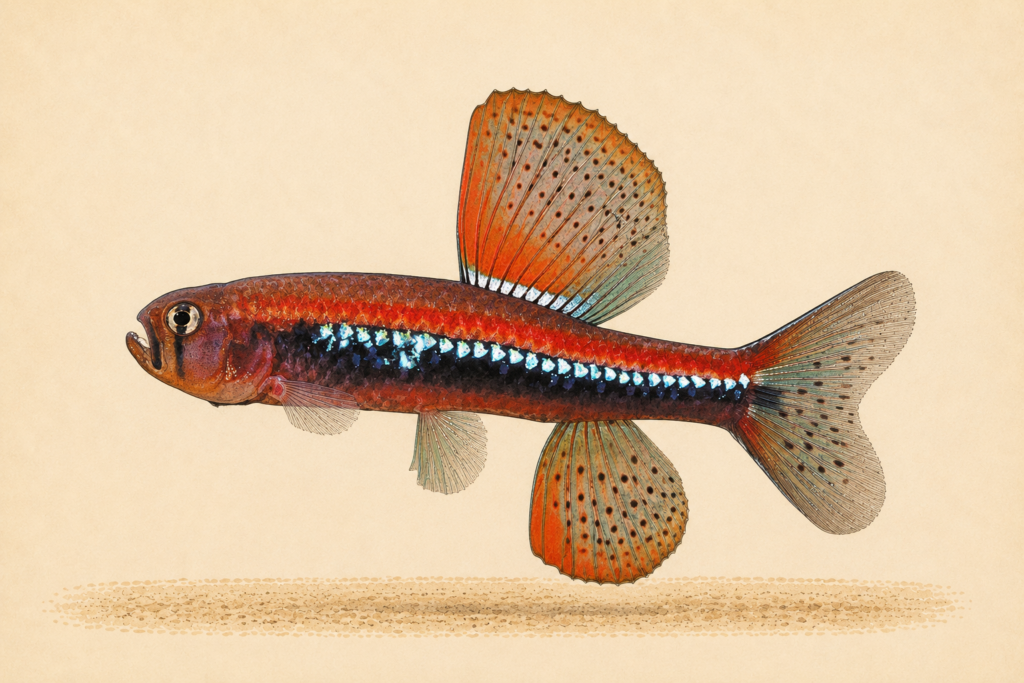
Males carry much stronger colour, run slightly larger, and with age develop drawn-out dorsal and anal fins. Only some males grow those long fins, and the difference does not appear to be linked to which fish is dominant. Fish from Colombia and Brazil tend to show stronger colours, and some variants are particularly vivid. Adults reach about 5 cm.
Natural Habitat
Wild fish have been recorded across Brazil, Colombia, Peru and Venezuela, and collectors have taken them from the upper stretches of several large river systems, among them the Negro, the Orinoco and the Solimões. The Peruvian populations may be a separate, undescribed species. It is most often found in slow forest streams where the water is stained brown, the bottom is mud or sand, and leaf litter and submerged roots or branches are plentiful. Dense forest overhead and plants along the banks typically cast shade over the places where the fish lives. Tannins and organic acids released by rotting plant material give the water a tea colour, and it generally holds hardly any dissolved minerals and is poorly buffered.
A collector found the fish in 1997 in a small stream of the upper Negro, living alongside a mix of small fish, including some that were never identified.
Tank Size and Setup
You need a tank of at least 41 litres for this species. A pair, or one male with several females, can live in a tank with a base of 45 cm by 30 cm or equivalent. If you want more than one male, give each at least 30 cm by 30 cm, because weaker males that cannot escape rivals can suffer serious fin damage.
Choose a soft, sandy substrate, since the fish does most of its feeding from the bottom. A few driftwood roots and branches arranged to create shady spots add structure, and dried beech, oak or Ketapang almond leaves give extra cover while helping to mimic natural conditions. Some keepers also add plastic pipes of a suitable diameter for cover and as possible spawning sites.
Fairly dim lighting is best, and floating or surface plants can soften the light from artificial sources. Cryptocoryne, Java fern and Java moss are plants that may suit these dim, shaded conditions.
Water Parameters
| Temperature | 21 – 28 C |
| pH | 3.0 – 6.5 |
| General hardness (GH) | 0 – 5 dGH |
| Ammonia | 0 ppm |
| Nitrite | 0 ppm |
| Nitrate | Below 10 ppm |
Water conditions must stay stable, so never put this fish into an aquarium that has not matured biologically.
Aim for a temperature of 21 to 28 °C, a pH of 3.0 to 6.5 and hardness of 0 to 5 dGH. Other published figures are narrower, at 24 to 28 °C and a pH of 5.2 to 6.5, with hardness again no higher than 5 dGH.
Filtration and Equipment
A gentle filter is all this fish needs, and an air-driven one suits it best. We recommend a filter that turns the water over four to five times an hour for a tank of at least 41 litres, and a heater to hold the temperature within 21 to 28 degrees Celsius.
Diet and Feeding
Its wild diet is believed to be insect larvae, crustaceans and worms, and it may take some fish fry as well. In the aquarium it is very reluctant to accept dried foods. Because the fish tends to ship quite poorly, keepers usually need to build it up after import with daily live food, with examples being Daphnia, brine shrimp, grindal worm, micro worm and chopped bloodworm. Freeze-dried bloodworm, freeze-dried brine shrimp and a good quality dried food are also on the list of suitable foods.
Behaviour and Temperament
Males claim a patch of the tank for themselves and act aggressively towards other males. Keeping just one pair is possible in theory, but you will see more of the lively rivalry between males if you keep two or more of them. Buy more females than males if you can, so that individuals are not harassed excessively.
Because the Black Morpho Tetra is a poor competitor even though it hunts live prey, it does best as the main attraction of a community tank. Other bottom-dwellers, especially territorial ones, are best avoided. The best companions are fishes of similar size that stay in the upper levels of the tank, such as pencilfish, hatchetfish and some of the smaller tetras. Small suckermouth catfish such as otos should also make suitable companions.
Tank Mates
Selecting tank mates for the Black Morpho Tetra requires careful thought. The ideal companions are small, peaceful species that share a preference for soft, acidic water and will not outcompete Poecilocharax weitzmani for food or create excessive activity in the tank. Avoid large, fast-moving, or aggressive species, and steer clear of anything that might view these tiny fish as prey. In truth, a species-only setup is the simplest and often the most rewarding approach, but a carefully chosen blackwater community can work beautifully.
Good tank mates
- Cardinal Tetra – A classic blackwater species that thrives in the same soft, acidic conditions and occupies the mid-water column, leaving the bottom for the Morpho Tetras.
- Green Neon Tetra – Small and unobtrusive, sharing very similar water chemistry requirements from overlapping Rio Negro habitats.
- Ember Tetra – Tiny and peaceful, adding a splash of warm colour to the mid-water without disturbing bottom-dwelling species.
- Beckford’s Pencilfish – A gentle surface-to-mid-water dweller that tolerates blackwater conditions well and poses no competitive threat.
- Dwarf Pencilfish – One of the smallest pencilfish species, ideal for nano-scale blackwater communities alongside Morpho Tetras.
- Otocinclus – Peaceful algae grazers that can tolerate softer water and will not interact with bottom-dwelling tetras in any meaningful way.
- Pygmy Corydoras – Miniature catfish that share the lower water column peacefully and appreciate the same gentle conditions.
- Chocolate Gourami – Another blackwater specialist that is calm and slow-moving, making it a compatible companion in well-maintained setups.
Fish to avoid
- Tiger Barb – Active, nippy, and requires harder water, making it incompatible on every level.
- Convict Cichlid – Highly territorial and aggressive, posing a direct physical threat to these delicate tetras.
- Angelfish – Large enough to eat adult Morpho Tetras and far too imposing for a small blackwater setup.
- Guppy – Requires hard, alkaline water and would suffer in the extreme blackwater conditions this species needs.
- African Cichlids – Incompatible in terms of water chemistry, temperament, and tank setup.
- Common Pleco – Grows far too large and produces excessive waste for the small, pristine environment required.
- Buenos Aires Tetra – A large, boisterous tetra that would easily outcompete and stress Morpho Tetras at feeding time.
Breeding
Home breeding is uncommon but achievable. Provide caves or lengths of plastic tubing, which are essential, and feed plenty of small live foods to get the fish ready to spawn. The water for breeding should be acidic, at a pH of 4.0 to 5.0, and very soft with very low conductivity.
Each male chooses a territory that holds at least one cave and defends it from rival males. He becomes more intensely coloured and shows thick white tips on his pelvic fins. Females darken and develop an intensely red anal fin, and once ripe they check out the males’ territories and possible spawning sites before courtship starts. Clutches normally number 50 to 100 eggs, with hatching about four to five days later.
While the eggs incubate, the male stays on guard, fanning them with his tail fin and clearing away any that are infertile. A male apparently often takes a second female while the first clutch is still in his care, and the original eggs remain unharmed. If that happens, siphon the first batch out once it is visibly free swimming, or few of the second are liable to survive.
At the point where the fry swim freely, the male loses interest in looking after them, and the youngsters are big enough to eat brine shrimp nauplii straight away. Remove either the adults or the fry at this point so the fry are not eaten. Offer the male plenty of food, as he does not usually eat while looking after the brood.
Common Diseases
White spot (ich) can turn up in any freshwater fish, especially when a fish is stressed or when a newly added fish brings it into the tank.
FAQs
Is the Black Morpho Tetra good for beginners?
No, because it needs specialist care and even advanced aquarists find it a challenge.
How big does it get?
Adults reach about 5 cm, with males slightly larger than females.
Can I keep more than one male?
Yes, but males are aggressively territorial towards each other, so allow at least 30 cm by 30 cm per male and provide places for weaker fish to retreat.
What should I feed it?
Live foods such as Daphnia, brine shrimp and chopped bloodworm are usually needed at first, because it is very reluctant to accept dried foods.
Related Guides
- Cardinal Tetra Care Guide – Another iconic blackwater species from the Rio Negro, often kept alongside Morpho Tetras in biotope setups.
- Chocolate Gourami Care Guide – A fellow soft-water specialist with similarly exacting water parameter requirements and a calm temperament.
- Green Neon Tetra Care Guide – A tiny, peaceful tetra from the same blackwater habitats, making it a natural companion species.
- Pygmy Corydoras Care Guide – Miniature bottom-dwellers that can share the lower water column peacefully in a soft-water community.
- Dwarf Pencilfish Care Guide – A delicate nano species well suited to the same dimly lit, tannin-rich environments favoured by Morpho Tetras.