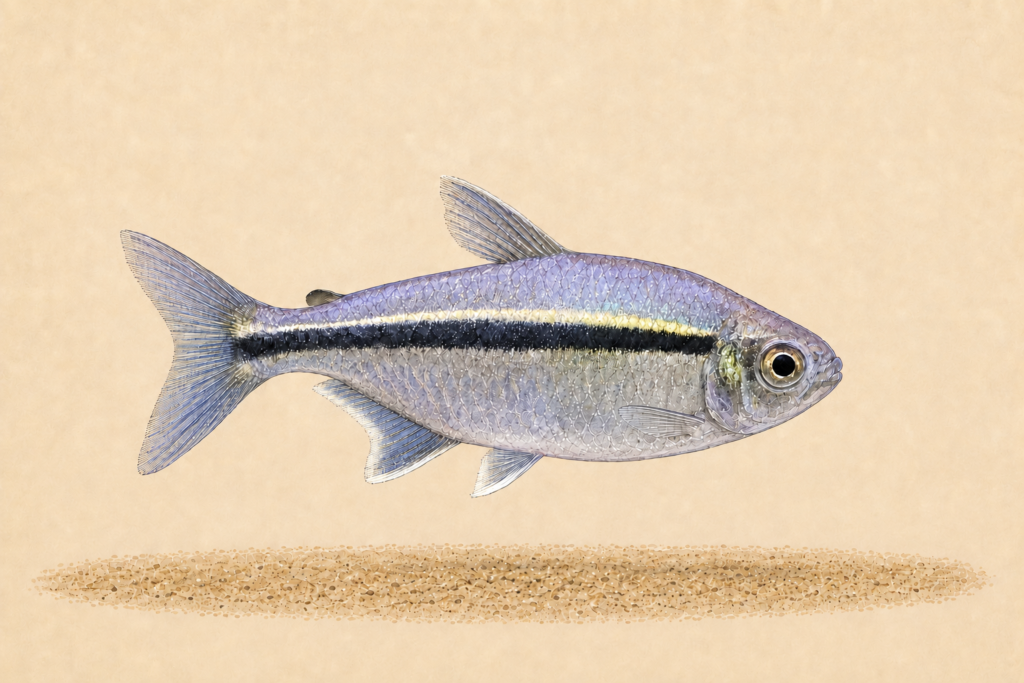
Quick Summary
The Blackline Tetra is a shoaling tetra that reaches about 4 cm.
🐠 Build a tank around this species
In this guide:
- Introduction
- Quick Stats
- Appearance
- Natural Habitat
- Tank Size and Setup
- Water Parameters
- Filtration and Equipment
- Diet and Feeding
- Behaviour and Temperament
- Tank Mates
- Breeding
- Common Diseases
- FAQs
- Related Guides
Introduction
The Blackline Tetra was first described scientifically in 1937. It is sold commercially for the aquarium trade. Its conservation status is Data Deficient, assessed in 2021.
Quick Stats
| Scientific name | Hyphessobrycon scholzei |
|---|---|
| Common names | Black Line Tetra, Scholze's Tetra |
| Family | Acestrorhamphidae (formerly Characidae) |
| Origin | South America: coastal Caribbean drainages and Portuguesa River drainage, lower Orinoco River basin (northern Venezuela) |
| Adult size | 4 cm |
| Difficulty | Easy |
| Breeding difficulty | Moderate |
| Temperature | 22–28 °C |
| pH | 6.8–8 |
| GH | 3–8 dGH |
| Minimum tank size | 60 L |
| Conservation status | Data Deficient (IUCN, assessed 2021) |
Appearance
Adults reach about 4 cm. Mature females look fuller in the body.
Natural Habitat
The Blackline Tetra lives in freshwater, using both the bottom and the open water. Its range is listed as coastal Caribbean drainages and the Portuguesa River drainage in the lower Orinoco basin of northern Venezuela. The species was described from an aquarium import said to have come from the Amazon at Pará in Brazil.
The Amazon origin is thought to be an error, with northern Venezuela the probable true locality. Other published sources, however, place the fish in the lower Amazon basin. Reports suggest wild groups are most numerous in streams and seasonally flooded places where aquatic plants give cover.
Tank Size and Setup
We recommend a tank of at least 60 litres. Include some cover so the fish have places to hide, and keep the tank spacious.
Water Parameters
The hardness range is listed with an upper figure of 25 dH and no stated lower limit.
| Temperature | 22-28 C |
| pH | 6.8-8.0 |
| General hardness (GH) | 3-8 dGH |
| Ammonia | 0 ppm |
| Nitrite | 0 ppm |
| Nitrate | Below 30 ppm |
Aim for 22 to 28 °C and a pH of 6.8 to 8. Other published figures are 24 to 28 °C and a pH of 5.5 to 7.0, in soft, acidic water.
Filtration and Equipment
We recommend a filter that turns the water over four to five times an hour for a tank of at least 60 litres, and a heater to hold the temperature within 22 to 28 degrees Celsius.
Diet and Feeding
Among the foods listed for the Blackline Tetra are granules and frozen foods. A few accounts say these fish may nibble delicate, feathery plants, so you might think twice before adding such plants to a planted tank.
Behaviour and Temperament
Shoaling fish like these feel most at ease in a big group.
Tank Mates
The Blackline Tetra’s peaceful nature and broad water parameter tolerance make it compatible with a very wide range of community fish. The main considerations are to avoid species large enough to eat them, species that are highly aggressive or territorial, and species that require vastly different water conditions. Beyond those basic rules, the Blackline Tetra is one of the most accommodating community fish available.
Good tank mates
- Neon Tetra – A similarly sized, peaceful tetra that shares the same water parameter preferences and occupies the same water column without conflict.
- Cardinal Tetra – Another classic community tetra that coexists beautifully alongside Blackline Tetras in a planted setup.
- Rummy-Nose Tetra – A tight-shoaling species that adds visual contrast and complements the Blackline Tetra’s more relaxed schooling style.
- Harlequin Rasbora – A gentle, hardy rasbora that thrives in the same conditions and adds warm copper tones to the tank.
- Peppered Corydoras – A peaceful bottom-dweller that occupies a different zone of the tank and helps clean up uneaten food.
- Bristlenose Pleco – A calm, algae-eating catfish that stays out of the tetra’s way and tolerates the same water conditions.
- Cherry Barb – A mild-mannered barb that is colourful, hardy, and entirely non-aggressive towards tetras.
- Kuhli Loach – A nocturnal bottom-dweller that poses no threat and adds interest to the lower levels of the aquarium.
- Honey Gourami – A gentle, slow-moving centrepiece fish that coexists peacefully with small tetras.
- Amano Shrimp – Hardy algae-eating shrimp that are too large for Blackline Tetras to predate and make useful clean-up crew members.
Fish to avoid
- Oscar – A large, predatory cichlid that will readily eat any fish small enough to fit in its mouth, including Blackline Tetras.
- Jack Dempsey – An aggressive, territorial cichlid far too large and belligerent to house with small tetras.
- Convict Cichlid – Highly territorial, especially when breeding, and likely to harass or kill small community fish.
- Red-Tail Catfish – A massive predatory catfish entirely unsuitable for community tanks and capable of swallowing Blackline Tetras whole.
- Tiger Barb – A boisterous fin-nipper that can stress and harass more placid species, especially in insufficient numbers of its own kind.
- Green Terror – A large, aggressive South American cichlid that poses an obvious predation and aggression risk to small tetras.
Breeding
Breeding in captivity is uncommon, though it is reportedly simple to do. Use a breeding tank prepared for the purpose, filled with live plants and soft water below pH 6.5, and put a conditioned pair in it. The eggs are laid at random. Hatching is given as about 30 hours in one account and 24 hours in another. Remove the parents after spawning.
Common Diseases
White spot (ich) can turn up in any freshwater fish, especially when a fish is stressed or when a newly added fish brings it into the tank.
FAQs
How big does the Blackline Tetra get?
Adults reach about 4 cm.
How many Blackline Tetras should I keep?
Large numbers suit them best.
Will the Blackline Tetra eat my plants?
A few accounts say these fish may nibble delicate, feathery plants, so you might think twice before adding such plants to a planted tank.
Related Guides
- Black Neon Tetra – A similarly coloured tetra with a black and gold stripe pattern that makes an excellent companion species in community setups.
- Neon Tetra – The most popular tetra in the hobby and a natural tank mate for Blackline Tetras in a South American community.
- Ember Tetra – A tiny, warm-toned tetra suited to nano and planted tanks that shares the Blackline Tetra’s peaceful disposition.
- Lemon Tetra – Another hardy, underrated Hyphessobrycon species that thrives under similar conditions.
- Peppered Corydoras – A robust bottom-dwelling catfish that pairs beautifully with Blackline Tetras in a beginner-friendly community.