Quick summary
The Clown Knife Fish is an advanced-level pet only suited to experienced keepers with a huge aquarium, growing 60-100 cm and needing a minimum of 950 litres, so it is not right for beginners or anyone without space for a tank of that scale. It is also a dedicated predator that will eat any tank mate small enough to swallow, so careful planning around tank size and companions is essential before buying one.
🐠 Build a tank around this species
Grows large. Read this before buying. The Clown Knife Fish is usually sold as a small juvenile and is easy to keep at that size, but a healthy adult reaches around 80 cm. A juvenile will be happy in a standard tank for its first year or so. An adult needs a very large tank, six feet long or more, and the water changes to match. Decide now whether you will build for the adult, or have a realistic rehoming plan, because public aquaria and specialist keepers are often full. It is a superb fish for the keeper who plans for it and a sad one for everyone else.
In this guide:
- Introduction
- Quick Stats
- Appearance
- Natural Habitat
- Tank Size and Setup
- Water Parameters
- Filtration and Equipment
- Diet and Feeding
- Behaviour and Temperament
- Tank Mates
- Breeding
- Common Diseases
- FAQs
Introduction
The Clown Knife Fish (Chitala ornata) is one of the most visually striking and recognisable freshwater predators available in the aquarium trade. Native to the rivers and floodplains of Southeast Asia and southern China, this species is celebrated for its elongated, blade-like body shape, silvery colouration, and the distinctive row of eyespots (ocelli) that adorn its flanks. It is a fish that commands attention in any aquarium, and its unusual swimming style – a graceful, undulating ripple of the anal fin – only adds to its appeal.
However, the Clown Knife Fish is emphatically not a beginner’s fish. It grows very large, regularly reaching 60 cm in captivity and potentially exceeding 100 cm in the wild. It is a dedicated predator that will consume any fish small enough to fit in its surprisingly capacious mouth. Its long lifespan, enormous space requirements, and specialised dietary needs mean that only experienced aquarists with access to suitably large aquaria should consider keeping this species. When those requirements are met, however, the Clown Knife Fish rewards its keeper with a genuinely unique and engaging pet that can become remarkably tame over time, often learning to accept food directly from the hand.
In its native range, Chitala ornata is an important food fish and has been introduced to waterways far beyond its original distribution, including parts of Florida in the United States, where it has become an established invasive species. In the aquarium hobby, it has been popular since the mid-20th century, though a significant proportion of specimens sold as small juveniles in shops are sadly destined for tanks that are far too small. This guide aims to provide a thorough and honest overview of the species’ care requirements so that prospective keepers can make an informed decision before purchasing.
Quick Stats
| Scientific name | Chitala ornata |
|---|---|
| Common names | Clown Featherback, Spotted Knife Fish |
| Family | Notopteridae |
| Origin | Southeast Asia and southern China |
| Adult size | 80 cm |
| Lifespan | 10–15 years |
| Difficulty | Advanced |
| Breeding difficulty | Advanced |
| Temperature | 24–28 °C |
| pH | 6–7.5 |
| GH | 2–15 dGH |
| KH | 2–10 dKH |
| Minimum tank size | 950 L |
| Conservation status | Least Concern (IUCN) |
Appearance
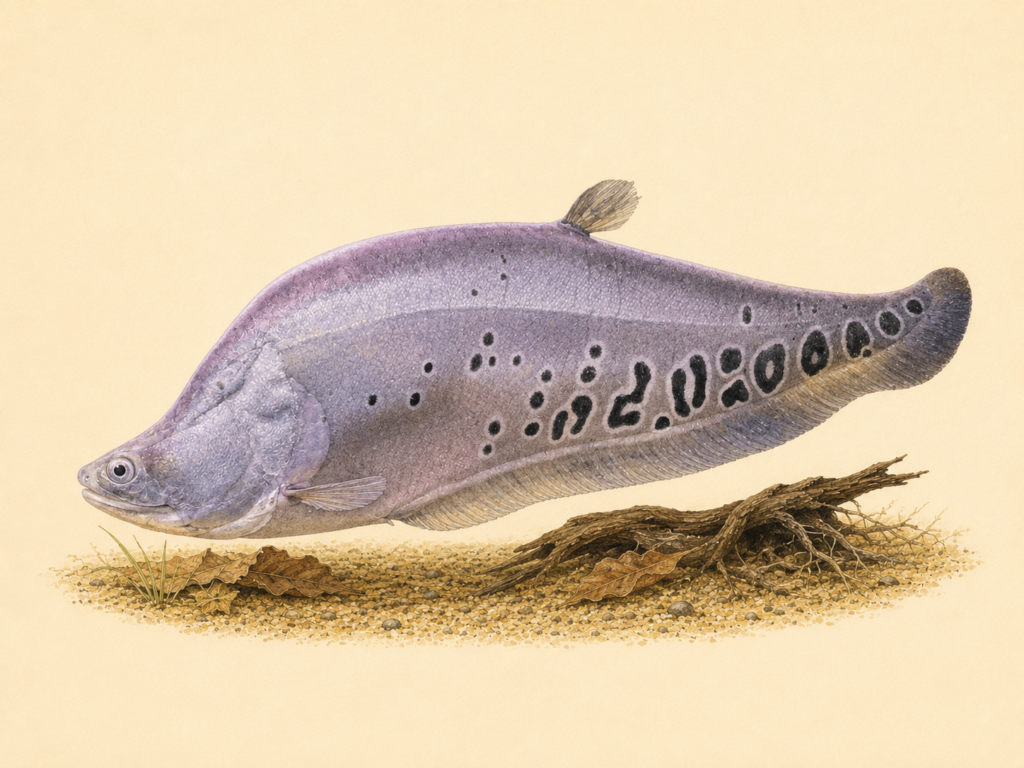
The Clown Knife Fish possesses one of the most distinctive body plans in freshwater fishkeeping. The body is strongly laterally compressed and elongated, tapering to a narrow caudal peduncle that gives the fish its characteristic knife or feather-like silhouette. The dorsal profile is gently arched, with a small, feather-like dorsal fin positioned roughly midway along the back – a hallmark of the family Notopteridae. The anal fin is extraordinarily long, running almost the entire length of the ventral surface from just behind the pelvic region to the tail, and it is this fin that provides the primary means of locomotion. The fish can move forwards, backwards, and hover in place using a mesmerising undulating wave motion of the anal fin, a trait that never fails to captivate observers.
The base colouration is a metallic silver-grey, often with a slightly olive or brownish tinge along the dorsal surface. The defining feature is a series of large, round ocelli (eyespots) arranged in a horizontal row along the posterior half of the flanks. These spots are typically black with a white or pale ring, and they vary considerably in number, size, and spacing between individuals. Some specimens display five or six large, well-defined spots, while others may have a dozen or more smaller, somewhat irregular markings. Juveniles are often more uniform in colour, with the eyespots becoming more prominent and numerous as the fish grows. Very young specimens may display vertical barring rather than distinct spots.
The head is relatively small in proportion to the body, with a large, upturned mouth that can open to a remarkable gape. The eyes are relatively large and positioned high on the head, giving the fish good vision even in dim conditions. The scales are very small and cycloid, giving the body a smooth, almost scaleless appearance to the casual observer. Overall, the combination of the blade-shaped body, undulating locomotion, and bold eyespot pattern makes the Clown Knife Fish one of the most instantly recognisable species in the hobby.
Natural Habitat
Chitala ornata is native to the Mekong and Chao Phraya river basins in mainland Southeast Asia, with its range encompassing Thailand, Cambodia, Laos, and Vietnam. It has also been introduced to a number of regions outside its native range, including Myanmar, Singapore, the Philippines, and notably southern Florida in the United States, where breeding populations have established themselves in canals and waterways.
In the wild, Clown Knife Fish inhabit slow-moving rivers, canals, floodplain lakes, swamps, and backwaters. They show a strong preference for areas with abundant cover, including submerged tree roots, overhanging vegetation, fallen timber, and dense aquatic plant growth. During the day, they tend to be secretive, sheltering in shaded or heavily structured areas and becoming more active as twilight approaches. They are primarily crepuscular and nocturnal feeders.
The waters they inhabit are typically warm, slightly acidic to neutral, and often turbid or tea-stained with tannins from decomposing organic matter. Seasonal flooding plays a significant role in their ecology, providing access to expanded foraging grounds and spawning sites during the wet season. The substrate in their natural habitats is generally composed of mud, silt, and sand, often strewn with leaf litter and decaying wood. Understanding these conditions is key to replicating a suitable environment in captivity.
Tank Size and Setup
A minimum tank volume of 950 litres is recommended for a single adult Clown Knife Fish, and larger is always better. This is not a species where corners can be cut on tank size. A 60 cm juvenile may appear manageable in a smaller aquarium, but growth can be rapid under good conditions, and the fish will quickly outgrow anything below the recommended minimum. Ideally, the tank should have a footprint of at least 240 cm x 60 cm (length x depth), as the length of the tank is far more important than height for this species. Clown Knife Fish need room to turn and cruise, and a tank that is too short relative to the fish’s body length will cause chronic stress and physical deformity over time.
The aquascape should prioritise large hiding places. Pieces of driftwood arranged to form caves, sections of large-diameter PVC pipe, or purpose-built structures from inert materials all work well. The fish will select a favourite retreat and return to it repeatedly, especially during daylight hours. Having multiple shelters is advisable, particularly if more than one large fish shares the tank. Live plants are generally impractical in a Clown Knife Fish tank due to the species’ size and strength, though robust species such as Anubias or Java Fern attached to hardscape may survive. Floating plants can be useful for diffusing overhead light, which the fish appreciates.
Substrate choice is not critical. Fine sand or smooth gravel both work well and are easy to maintain. Avoid sharp or rough substrates, as the fish may rest on the bottom and could abrade its ventral surface. Lighting should be subdued; Clown Knife Fish are naturally crepuscular and will be more active and less stressed under dim conditions. A timed lighting schedule that provides a gentle dawn and dusk transition is ideal.
A secure, tight-fitting lid or cover is essential. Clown Knife Fish are capable of jumping, particularly when startled, and a fish of this size launching itself out of an open-topped aquarium can cause serious injury to both itself and anything nearby. Ensure that any gaps around filter inlets, outlets, or cable entries are sealed.
Water Parameters
| Temperature | 24-28 °C |
| pH | 6.0-7.5 |
| General hardness (GH) | 2-15 dGH |
| Carbonate hardness (KH) | 2-10 dKH |
| Ammonia | 0 ppm |
| Nitrite | 0 ppm |
| Nitrate | Below 30 ppm |
Clown Knife Fish are reasonably adaptable regarding water chemistry, but they do best in soft to moderately hard water with a slightly acidic to neutral pH. Consistency is more important than hitting a specific number; avoid sudden swings in temperature or pH. The species is sensitive to dissolved metabolic waste, and given its size and the volume of food it consumes, nitrate levels can climb quickly if maintenance is neglected. Regular water changes of 25-30% weekly are strongly recommended.
Temperature stability is important. Use a reliable heater rated appropriately for the tank volume, and consider using two heaters for redundancy in very large systems. A sudden temperature drop can trigger stress-related illness. Aeration should be adequate, as warmer water holds less dissolved oxygen and a large predatory fish has a correspondingly high metabolic demand.
Filtration and Equipment
Filtration is arguably the single most important equipment consideration when keeping a Clown Knife Fish. This is a large, messy, carnivorous fish that produces a substantial bioload. A high-quality canister filter – or ideally a pair of canister filters, or a sump-based system – is the minimum standard. The total filtration turnover should be at least six to eight times the tank volume per hour. Biological filtration capacity must be generous, as the ammonia output from a large predator’s protein-rich diet is significant.
Mechanical filtration is equally important, as uneaten food particles, waste, and debris can foul the water rapidly. Pre-filter sponges on canister intakes help to extend the intervals between deep filter cleans. Chemical filtration in the form of activated carbon can be useful for maintaining water clarity and removing odours, but it is not a substitute for adequate biological and mechanical stages.
Powerheads or additional circulation pumps can be beneficial for ensuring even water flow and preventing dead spots, but the current should not be excessively strong. Clown Knife Fish naturally inhabit slow-moving water and will become stressed if constantly buffeted by powerful flow. Aim for a gentle, broad current rather than a focused jet.
A reliable heater of suitable wattage is essential. For tanks of 950 litres and above, a titanium heater or an inline heater connected to the canister filter outlet is preferable to a standard glass heater, which can be broken by a large, startled fish. Heater guards are a wise precaution regardless of heater type. A separate thermometer should be used to verify the heater’s accuracy.
Diet and Feeding
In the wild, Clown Knife Fish are opportunistic predators that feed primarily on small fish, crustaceans, aquatic insects, and insect larvae. In captivity, they should be offered a varied, protein-rich diet. Juveniles typically accept a range of live and frozen foods readily, including bloodworm, brine shrimp, and small feeder shrimp. As they grow, the diet should transition to include larger items such as prawns, earthworms, mussel, cockle, lance fish, and smelt.
Avoid using feeder fish from pet shops as a staple food source. Feeder fish are frequently carriers of parasites and disease, and their nutritional profile is poor compared to purpose-prepared foods. If live fish are offered, they should be home-bred or quarantined beforehand. Many keepers successfully wean their Clown Knife Fish onto high-quality carnivore pellets (such as Hikari Massivore or similar), which provide a balanced nutritional profile and reduce the risk of disease introduction. Weaning onto pellets is easier when started with young fish, and patience may be required; some individuals can be stubborn.
Feed juveniles once or twice daily. As the fish matures and reaches adult size, feeding can be reduced to every other day or three to four times per week. Overfeeding is a common issue with large predators and leads to water quality problems, fatty liver disease, and obesity. Offer only as much food as the fish will consume in a few minutes, and remove any uneaten items promptly.
Supplementation with vitamin-enriched foods or the occasional offering of gut-loaded live insects can help ensure nutritional completeness. Variety is key; a diet consisting solely of one food type, no matter how convenient, is likely to lead to nutritional deficiencies over time.
Behaviour and Temperament
Clown Knife Fish are fascinating to observe behaviourally. They are primarily nocturnal or crepuscular in the wild, and this tendency persists to varying degrees in captivity. Newly introduced specimens will often hide for most of the day, emerging only in the dim hours around dawn and dusk or when the lights are off. Over time, as the fish becomes accustomed to its environment and associates its keeper with food, it will typically become bolder, often appearing at the front of the tank during the day, especially around feeding time.
Despite being a large predator, the Clown Knife Fish is not inherently aggressive towards fish of comparable size. It is, however, an extremely efficient piscivore, and any fish small enough to be swallowed – and its gape is remarkably large relative to its head – will eventually be eaten. This is predation rather than aggression, and the distinction is important when planning tank mates. Towards tank mates too large to eat, the Clown Knife Fish is generally indifferent or mildly territorial, particularly around its chosen hiding spot.
Conspecific aggression can be an issue. While juveniles are sometimes kept in groups, adults tend to become increasingly intolerant of one another unless the tank is exceptionally large with ample visual barriers. In most home aquaria, a single specimen is the safest approach. When stressed or threatened, Clown Knife Fish may produce audible grunting or clicking sounds, a trait shared with other notopterids.
One of the most endearing traits of this species is its capacity for what can only be described as personality. Long-term keepers frequently report that their Clown Knife Fish recognises them, responds differently to familiar versus unfamiliar people, and can be hand-fed with patience. This level of interaction is unusual among freshwater fish and is one of the primary reasons the species retains its popularity despite its demanding care requirements.
Tank Mates
Choosing appropriate tank mates for a Clown Knife Fish requires careful consideration of two fundamental factors: the tank mate must be too large to be swallowed, and it must not be so aggressive as to harass or injure the knife fish. Clown Knife Fish, despite their size, can be surprisingly timid and are easily stressed by highly territorial or belligerent species. The tank must also be large enough to accommodate the combined bioload and spatial needs of all inhabitants. In practice, this means that only keepers with very large aquaria – well above the minimum recommended for a single Clown Knife Fish – should consider community setups.
Good tank mates
- Silver Arowana – A similarly sized, surface-dwelling species that generally occupies a different water column level and coexists peacefully.
- Common Pleco – A robust bottom-dweller that is large enough to avoid predation and typically ignores the knife fish entirely.
- Sailfin Pleco – Another large plecostomus species that is well-armoured and peaceful, making it a safe companion.
- Bala Shark – A large, active, and generally peaceful cyprinid that is too fast and sizeable to be eaten once adult.
- Tinfoil Barb – A robust shoaling species that reaches a substantial size, making it compatible provided it is not small enough to be a meal.
- Giant Gourami – A large, generally docile species that can share space with a Clown Knife Fish in a suitably oversized aquarium.
- Fire Eel – A large spiny eel that occupies the bottom of the tank and is typically left alone by knife fish.
- Iridescent Shark – A large catfish that is compatible in terms of temperament and water requirements, though both species need enormous tanks.
Fish to avoid
- Oscar – While sometimes kept with knife fish, Oscars can be territorial and may harass or damage a Clown Knife Fish’s delicate fins.
- Red-bellied Piranha – Gregarious fin-nippers that pose a serious risk of physical injury to the knife fish.
- Flowerhorn – Extremely territorial and aggressive cichlids that will relentlessly bully a Clown Knife Fish.
- Neon Tetra – Far too small; these will be treated as nothing more than live food.
- Guppy – Much too small and slow to survive alongside a predator of this size.
- Jack Dempsey – An aggressive cichlid that is likely to cause stress and physical injury through territorial disputes.
- Red Devil Cichlid – One of the most aggressive cichlids commonly kept in captivity, entirely unsuitable as a companion.
- Cherry Shrimp – These tiny invertebrates would be consumed immediately and offer no value as tank mates.
Breeding
Breeding Clown Knife Fish in captivity is exceptionally difficult and is very rarely achieved in home aquaria. The primary obstacles are the sheer space required to house a breeding pair and the difficulty of sexing adult fish. There are no reliable external sexual dimorphisms in Chitala ornata; males and females are essentially identical in appearance, though gravid females may appear slightly fuller in the abdominal region when carrying eggs.
In the wild, spawning occurs during the wet season. The female deposits adhesive eggs on submerged hard surfaces such as rocks, submerged logs, or even the walls of canals. Clutch sizes can be substantial, often numbering in the thousands. The male guards the eggs and fans them to maintain water circulation and prevent fungal growth. This parental care by the male is a notable feature of the species’ reproductive biology.
In captivity, successful breeding has been reported primarily in very large ponds or public aquarium facilities rather than in standard home aquaria. Triggers for spawning are believed to include simulated seasonal changes – a gradual drop in water level followed by a refill with slightly cooler, softer water to mimic the onset of the rainy season. A varied, high-quality diet in the months leading up to a breeding attempt is also considered important for conditioning.
Should spawning occur, the eggs typically hatch within five to seven days at tropical temperatures. The fry are relatively large and can accept newly hatched brine shrimp and microworms from the outset. Growth is rapid given adequate food and space. However, given the rarity of captive breeding events, most specimens in the aquarium trade are wild-caught or commercially farmed in large outdoor facilities in Southeast Asia.
Common Diseases
Clown Knife Fish are reasonably hardy when maintained in good conditions, but their size and predatory diet can predispose them to certain health issues. One of the most common problems is Ich (white spot disease), caused by the protozoan Ichthyophthirius multifiliis. Knife fish are considered somewhat sensitive to this parasite, and outbreaks often follow episodes of temperature instability or stress from transport. Treatment with raised temperature (to 30 °C) and aquarium salt can be effective, but care must be taken, as Clown Knife Fish can be sensitive to some chemical medications, particularly those containing copper or formalin. Always use medications at half the recommended dose initially and monitor the fish closely for adverse reactions.
Bacterial infections, including fin rot and ulcerations, can occur when water quality is allowed to deteriorate. Given the large bioload produced by this species, these conditions are most commonly the result of inadequate filtration or infrequent water changes. Prevention through diligent maintenance is far preferable to treatment.
Internal parasites are a concern, particularly for wild-caught specimens or those that have been fed live feeder fish. Symptoms may include weight loss despite a good appetite, stringy or white faeces, and lethargy. Treatment with appropriate antiparasitic medications (such as praziquantel for tapeworms or metronidazole for flagellates) is usually effective when administered promptly.
Fatty liver disease (hepatic lipidosis) is a risk for captive Clown Knife Fish that are overfed or offered a diet excessively high in fat (such as a staple of oily feeder fish). Symptoms are often vague and may include abdominal swelling, lethargy, and loss of appetite. Prevention involves feeding a varied diet in appropriate quantities and avoiding overreliance on fatty food items.
Hole-in-the-head disease (HITH), characterised by pitting erosions on the head and lateral line, has been reported in large captive knife fish. The exact cause is debated but is believed to be linked to poor water quality, nutritional deficiencies (particularly a lack of vitamins C and D), and possibly flagellate parasites such as Hexamita. Improving water quality and diet is the cornerstone of treatment.
FAQs
How big does a Clown Knife Fish get in captivity?
In a suitably large aquarium with good care, a Clown Knife Fish will typically reach 60 to 80 cm in length. Some individuals may grow even larger given sufficient space and an excellent diet. Growth is relatively rapid in the first few years of life, with the fish potentially reaching 30 cm or more within the first 12 to 18 months. It is essential to plan for the adult size from the outset rather than purchasing a small juvenile with the intention of upgrading the tank later, as upgrades of this magnitude are often impractical and expensive.
Can I keep a Clown Knife Fish in a 200-litre tank?
No. A 200-litre tank is completely inadequate for this species at any stage of its life beyond the very earliest juvenile phase. Even a 20 cm juvenile will quickly outgrow a tank of this size. Keeping a Clown Knife Fish in an undersized aquarium will result in stunted growth, chronic stress, spinal deformities, a weakened immune system, and a dramatically shortened lifespan. The minimum recommended tank size is 950 litres, and larger is always preferable.
Will a Clown Knife Fish eat my other fish?
Almost certainly, if the other fish are small enough to fit in its mouth. The Clown Knife Fish is an obligate predator, and it has a surprisingly large gape relative to its body size. Fish up to roughly one-third of the knife fish’s body length may be at risk. This means that as the knife fish grows, tank mates that were previously safe may suddenly become prey. Only keep it with species that are large enough at adult size to be completely safe from predation.
Is the Clown Knife Fish nocturnal?
In the wild, Chitala ornata is primarily crepuscular and nocturnal, being most active during dawn, dusk, and the hours of darkness. In captivity, this behaviour often persists, especially in newly introduced specimens. However, as the fish settles in and associates its keeper with food, it frequently becomes more active during daylight hours. Subdued lighting and ample hiding places will encourage the fish to emerge more confidently during the day.
Can Clown Knife Fish be kept in groups?
While juvenile Clown Knife Fish are sometimes kept together, adults tend to become increasingly territorial and intolerant of conspecifics. In most home aquaria, keeping a single specimen is the safest and most practical approach. Maintaining a group of adults would require an extraordinarily large system with numerous visual barriers and hiding places. Even then, aggression cannot be guaranteed to remain at manageable levels. Most experienced keepers opt for a solitary individual.
Related Guides
- African Knife Fish – A smaller, more manageable knifefish species that shares many care similarities but is better suited to modest-sized aquaria.
- Black Ghost Knife Fish – Another popular knifefish that is often confused with Chitala ornata but is significantly smaller and has different care requirements.
- Silver Arowana – A large predatory species frequently kept alongside Clown Knife Fish in monster fish community setups.
- Giant Gourami – A compatible large species that shares similar water parameter requirements and can coexist peacefully.
- Fire Eel – A large spiny eel that is often housed with Clown Knife Fish and has overlapping habitat preferences.