Quick summary
The Red Devil Cichlid is a large, highly intelligent but aggressive and destructive fish best suited to experienced keepers who can provide a tank of 450 litres or more, usually as the sole occupant. It is not a good fit for beginners or community aquariums, and prospective owners should be prepared for a demanding, long-term commitment lasting 10 to 15 years.
🐠 Build a tank around this species
In this guide:
- Introduction
- Quick Stats
- Appearance
- Varieties and Morphs
- Natural Habitat
- Tank Size and Setup
- Water Parameters
- Filtration and Equipment
- Diet and Feeding
- Behaviour and Temperament
- Tank Mates
- Breeding
- Common Diseases
- FAQs
Introduction
The Red Devil Cichlid is one of the most charismatic and demanding freshwater fish available in the aquarium hobby. Known for its striking coloration, formidable personality, and remarkable intelligence, Amphilophus labiatus has earned both its common name and a devoted following among experienced cichlid keepers. This Central American species commands attention in any aquarium it inhabits, often becoming the centrepiece of a display tank and developing a genuine bond with its owner that few other fish can match.
Despite its undeniable appeal, the Red Devil Cichlid is not a fish to be taken on lightly. Its aggressive temperament, large adult size, and territorial nature mean that careful planning is essential before bringing one home. Novice fishkeepers are frequently drawn to the vivid colours and interactive behaviour of juvenile specimens in pet shops, only to find themselves overwhelmed as the fish matures into a powerful, tank-dominating predator. With proper housing, appropriate tank mates (or none at all), and a commitment to long-term care, however, the Red Devil Cichlid can be an extraordinarily rewarding pet that may live well over a decade.
It is worth noting that considerable confusion exists between Amphilophus labiatus and its close relative Amphilophus citrinellus, the Midas Cichlid. Both species are frequently sold under the “Red Devil” label in the aquarium trade, and hybridisation between the two is common. True Amphilophus labiatus can generally be distinguished by its more elongated body shape and characteristically thick, fleshy lips, which are believed to be an adaptation for extracting invertebrates from rocky crevices in the wild. Lip size is influenced by both heredity and environment, however, so it is not sufficient by itself to certify aquarium stock as A. labiatus; fish sold as Red Devils may be A. labiatus, A. citrinellus, or hybrids of the two.
Quick Stats
| Scientific name | Amphilophus labiatus |
|---|---|
| Common names | Red Devil, Thick-lipped Cichlid |
| Family | Cichlidae |
| Origin | Lake Managua and Lake Nicaragua, Nicaragua, Central America |
| Adult size | 30 cm |
| Difficulty | Advanced |
| Breeding difficulty | Moderate |
| Temperature | 21–26 °C |
| pH | 6–8 |
| GH | 5–25 dGH |
| Minimum tank size | 450 L |
| Conservation status | Not Evaluated |
Appearance
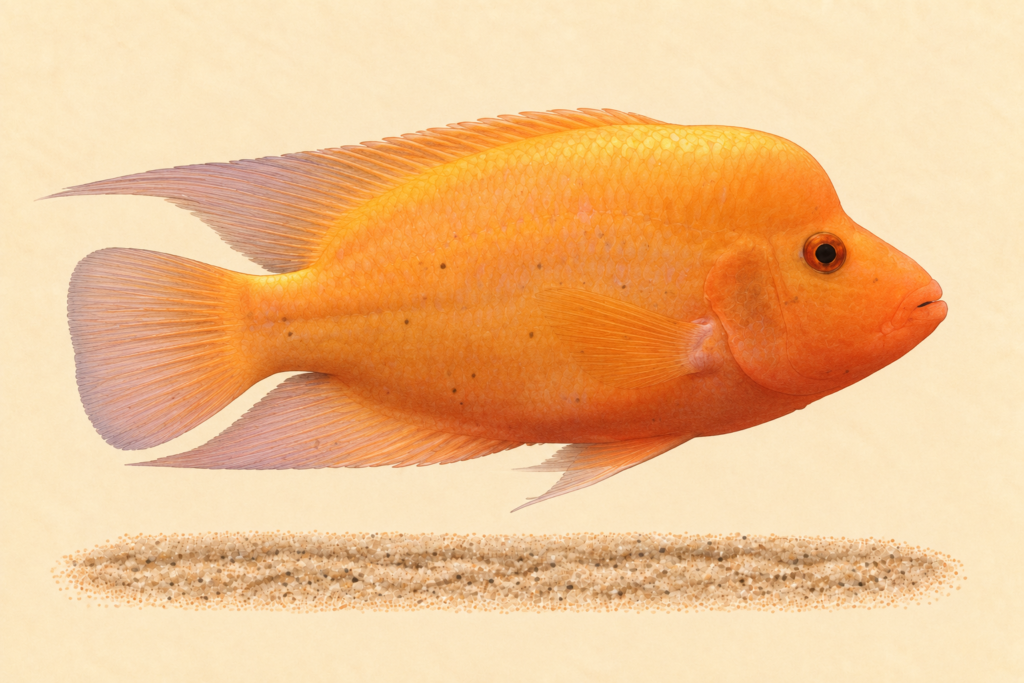
The Red Devil Cichlid is a large, powerfully built fish with a stocky, laterally compressed body that conveys an immediate sense of strength. Adults typically reach between 25 and 30 centimetres in length, with males tending to grow slightly larger than females. The most distinctive physical feature of Amphilophus labiatus is its pronounced, fleshy lips, which are noticeably thicker and more rubbery than those of most other Central American cichlids. These hypertrophied lips are thought to aid in foraging among rocks and crevices, although interestingly, their size can vary between individuals and may even reduce in captivity when the fish is fed soft foods exclusively.
Wild specimens are predominantly dark grey to brownish in colour, but captive-bred individuals are most commonly seen in vivid shades of red, orange, and yellow. Some specimens display a pure, solid coloration across the entire body and fins, whilst others may show areas of white or have irregular dark markings. The fins are well-developed and can become quite flowing in mature males, particularly the dorsal and anal fins, which may extend into elegant trailing points.
Mature males frequently develop a prominent nuchal hump, or cranial protuberance, on the forehead. This fleshy growth is composed of fatty tissue and can become remarkably large in dominant individuals, giving the fish a distinctive and somewhat imposing profile. Females may develop a smaller hump, but it is generally far less pronounced. Both sexes possess strong, well-defined jaws equipped with robust teeth, a reminder of the fish’s predatory capabilities and its ability to inflict damage on tank mates, equipment, and even unwary hands during maintenance.
Varieties and Morphs
While the Red Devil Cichlid does not have as many formally named varieties as some other popular cichlid species, captive breeding over several decades has produced a range of colour forms that are regularly encountered in the aquarium trade. It should be noted that many fish sold as Red Devils are actually Midas Cichlids or hybrids between the two species, which further complicates the identification of distinct morphs.
The most commonly available form is the classic red morph, which displays a rich, deep red to orange-red coloration across the entire body and fins. This is the variety most people picture when they hear the name “Red Devil,” and selectively bred specimens can exhibit an exceptionally intense, almost luminous shade of red. The orange morph is closely related, with individuals showing a warm, bright orange rather than true red, and many fish fall somewhere on the spectrum between the two colours.
The yellow morph presents a clean, golden-yellow body colour that can range from pale lemon to a rich, saturated gold. These specimens are sometimes marketed as “Gold Red Devils” and are quite popular among keepers who prefer a brighter, more eye-catching fish. A white morph also exists, displaying a creamy white to pinkish-white body with little or no darker pigmentation. These fish can be particularly striking under aquarium lighting and are sometimes confused with albino specimens.
True albino Red Devils lack melanin pigmentation entirely, resulting in a pale body with distinctive pink or red eyes. They are less commonly available than the standard colour morphs but are sought after by collectors. A barred or marked morph retains some of the wild-type patterning, with vertical dark bars or irregular blotches overlaid on a lighter base colour of red, orange, or yellow. Some hobbyists specifically seek out these patterned individuals for their more natural appearance.
Natural Habitat
Amphilophus labiatus is endemic to Nicaragua, where it is found primarily in the large rift lakes of Lake Managua (Lake Xolotlán) and Lake Nicaragua (Lake Cocibolca). These are substantial bodies of water, Lake Nicaragua is the largest lake in Central America, with warm, moderately hard, and slightly alkaline conditions. The lakes feature a variety of substrates including volcanic rock, sand, and mud, with rocky shorelines and boulder fields providing important habitat for the species.
In the wild, Red Devil Cichlids inhabit areas with abundant rocky cover, where they establish territories among crevices and overhangs. The fleshy lips that characterise the species are well-suited to probing into gaps between rocks to extract snails, insect larvae, and other invertebrates. The lakes’ waters are typically warm year-round, with temperatures generally ranging from 24 to 28 degrees Celsius, and visibility can vary considerably depending on the specific location and season.
The volcanic origins of these Nicaraguan lakes contribute to the moderately hard and alkaline water chemistry that the species has adapted to over millennia. The substrate in many areas is composed of dark volcanic rock and sand, which provides excellent contrast against the brighter colour morphs when they occur in wild populations, although it should be noted that the vivid reds and oranges so common in captivity are relatively rare in wild fish, where the cryptic dark grey-brown coloration predominates. Wild populations face some pressure from habitat degradation and pollution, particularly in Lake Managua, and the species has not currently been assessed by the IUCN Red List.
Tank Size and Setup
The Red Devil Cichlid requires a spacious aquarium that can accommodate both its considerable adult size and its highly territorial nature. A single specimen should be housed in at least a 180 × 60 cm footprint (roughly 450 litres), and a pair needs substantially more space still, along with a divider and the capacity to separate the fish immediately, since no volume guarantees compatibility between a breeding pair or a mixed community. Underestimating the space requirements of this species is one of the most common mistakes made by new keepers and inevitably leads to stress, aggression, and health problems.
The aquarium should be set up with careful consideration of the Red Devil’s destructive tendencies. This is a fish that actively rearranges its environment, digging extensively into the substrate, uprooting plants, and moving or overturning decorations. A sand or fine gravel substrate is the safest choice, as it allows the fish to dig without injuring itself. Coarse or sharp substrates should be avoided, as the fish’s persistent digging behaviour could lead to abrasions on its lips and body.
Large rocks and pieces of driftwood can be used to create visual barriers and territorial boundaries within the tank, but these must be secured firmly to the glass base of the aquarium to prevent the fish from undermining and toppling them. Silicone adhesive or stacking techniques that ensure stability from the bottom of the tank are essential. Live plants are generally impractical in a Red Devil tank, as the fish will uproot or destroy them almost immediately. If greenery is desired, robust species such as Anubias or Java Fern attached firmly to rocks or wood may survive, though this is by no means guaranteed.
Adequate cover in the form of caves, overhangs, and sheltered areas is important, particularly if more than one fish is housed in the tank. These structures allow subordinate fish to escape the line of sight of the dominant individual, reducing stress and the frequency of aggressive encounters. The tank should have a sturdy, well-fitting lid, as Red Devils are capable of jumping, particularly when startled or during aggressive episodes.
Water Parameters
Maintaining stable, clean water conditions is essential for the health and longevity of the Red Devil Cichlid. While this species is reasonably adaptable and can tolerate a range of water chemistry, it thrives best when conditions approximate those found in its native Nicaraguan lakes. Consistency is more important than hitting an exact number, and sudden fluctuations in temperature, pH, or hardness should be avoided at all costs.
| Temperature | 21–26 °C |
| pH | 6.0–8.0 |
| General hardness (GH) | 5–25 dGH |
| Ammonia | 0 ppm |
| Nitrite | 0 ppm |
| Nitrate | Below 30 ppm |
Given the substantial bioload produced by such a large and messy eater, keeping nitrate levels under control requires diligent maintenance. Weekly water changes of 25 to 40 per cent are strongly recommended, and many experienced keepers perform even larger changes to maintain optimal water quality. Testing water parameters regularly with a reliable liquid test kit is essential, particularly in the months following initial setup or whenever the bioload of the tank changes.
Filtration and Equipment
Robust, oversized filtration is non-negotiable for a Red Devil Cichlid tank. This is a large, messy fish that produces a considerable amount of waste, and the filtration system must be capable of processing this bioload efficiently whilst maintaining strong mechanical, biological, and chemical filtration. A large external canister filter rated for at least 1.5 times the actual tank volume is the minimum recommendation, and many experienced keepers run two filters simultaneously for redundancy and additional capacity.
Sump-based filtration systems are an excellent choice for Red Devil setups, as they provide a large volume of additional water, extensive biological filtration media capacity, and the ability to house heaters and other equipment away from the fish’s reach. Red Devils are notorious for attacking and damaging equipment within the tank, including heaters, intake tubes, and thermometers. Wherever possible, equipment should be protected with guards or placed in areas that are inaccessible to the fish. Inline heaters or heaters housed within a sump are far preferable to standard submersible heaters placed inside the display tank, as a broken heater can be catastrophic.
Water flow should be moderate to strong, reflecting the conditions of the fish’s native lake habitat. Powerheads or wavemakers can be used to supplement the flow from the main filter, but again, these should be positioned or protected so that the fish cannot damage them. An air pump and airstone can provide additional oxygenation, which is beneficial given the high bioload. Lighting requirements are not demanding, standard LED aquarium lighting is perfectly adequate, and the fish does not require any specialised spectrum or intensity. A timer to maintain a consistent photoperiod of around 10 to 12 hours is good practice.
Diet and Feeding
The Red Devil Cichlid is an omnivore with a strong predatory streak, and providing a varied, nutritionally balanced diet is key to maintaining vibrant coloration, good health, and a strong immune system. In the wild, the species feeds on a diverse range of food items including small fish, snails, insect larvae, worms, and plant material. In captivity, this dietary breadth should be replicated as closely as possible.
A high-quality cichlid pellet should form the staple of the diet. Pellets designed for large Central or South American cichlids are widely available and provide a good nutritional foundation. These should be supplemented regularly with fresh and frozen foods such as prawns, earthworms, mussels, cockles, and blanched vegetables including peas, courgette, and spinach. The inclusion of plant matter in the diet is important, as it aids digestion and provides essential vitamins and fibre.
Many keepers feed live feeder fish to their Red Devils, but this practice carries significant risks including the introduction of parasites and disease. If live food is offered, it is far safer to use home-cultured invertebrates such as earthworms or river shrimp rather than feeder fish of uncertain provenance. Freeze-dried foods such as krill or bloodworm can be offered as occasional treats but should not form a significant proportion of the diet due to their relatively low nutritional density.
Adult Red Devil Cichlids should be fed once or twice daily, offering only as much food as the fish can consume within a few minutes. Overfeeding is a common problem with large cichlids and contributes to poor water quality and obesity. Juveniles can be fed two to three times per day to support their rapid growth. It is advisable to include one fasting day per week for adult fish, which can aid digestion and help prevent the build-up of internal fat deposits.
Behaviour and Temperament
The Red Devil Cichlid fully earns its common name through its bold, aggressive, and often destructive behaviour. This is one of the most pugnacious cichlid species commonly kept in aquaria, and its territorial aggression can be extreme, particularly during breeding. Red Devils will not hesitate to attack and injure or kill tank mates that they perceive as rivals or intruders, regardless of the size of the other fish. They are also highly destructive to their environment, constantly digging, moving substrate, and rearranging or demolishing decorations.
Despite this fearsome reputation, the Red Devil Cichlid is also one of the most intelligent and interactive aquarium fish available. Individual fish frequently develop a strong recognition of their owner, greeting them at the glass, begging for food, and even allowing gentle physical contact during feeding. Many keepers describe their Red Devils as having genuine personalities, with individual fish displaying distinct preferences, moods, and behaviours. This level of interaction is a major part of the species’ appeal and is rarely matched by other freshwater fish.
Aggression in this species is not random or mindless, it is highly territorial and context-dependent. A Red Devil will be most aggressive within the boundaries of its established territory, and the intensity of aggressive behaviour tends to increase dramatically during breeding and parental care. In smaller tanks, the entire aquarium effectively becomes the fish’s territory, making cohabitation with other species extremely difficult or impossible. In larger setups with carefully arranged line-of-sight breaks, aggression can sometimes be managed to a degree, but the keeper must always be prepared to separate fish at short notice.
Red Devils are also known for their tendency to “redecorate” their tank to their own liking, and many keepers learn to accept that the carefully crafted aquascape they spent hours creating will be comprehensively dismantled within hours. This behaviour is entirely natural and should not be discouraged, as it provides essential enrichment and exercise for the fish. Providing items that the fish can safely interact with, such as smooth rocks and sturdy pieces of driftwood, is far preferable to attempting to create a permanent, fixed layout.
Tank Mates
Selecting tank mates for a Red Devil Cichlid is one of the most challenging aspects of keeping this species, and many experienced keepers ultimately conclude that a single-specimen setup is the safest and most practical approach.
A single adult in a dedicated aquarium is usually safest. A pair may become incompatible without warning, especially around spawning. Mixed large-cichlid displays should not be recommended as routine home husbandry.
Good tank mates
- None recommended; a species-only tank is safest.
Fish to avoid
- Midas Cichlid – similar appearance and behaviour encourage fighting and accidental hybridisation.
- Oscar – often less aggressive and vulnerable to repeated attack.
- Jaguar Cichlid – another powerful territorial predator creates a severe injury risk.
- Green Terror – smaller and likely to be overwhelmed.
- Jack Dempsey Cichlid – smaller and unable to rely on hiding indefinitely.
- Firemouth Cichlid – too small and comparatively restrained.
- Convict Cichlid – breeding aggression can trigger conflict, but it cannot match the adult Red Devil’s size.
- Sailfin Pleco – armour does not make it safe from biting or harassment.
Breeding
Breeding the Red Devil Cichlid is a realistic goal for dedicated hobbyists, though the process requires careful management, a very large tank, and a willingness to deal with extreme levels of aggression. The species is a substrate spawner that forms monogamous pairs, and both parents participate actively in the care and defence of eggs and fry. The challenge lies primarily in pairing the fish successfully without one killing the other, and in managing the pair’s heightened aggression during the breeding cycle.
The most reliable method of establishing a compatible pair is to raise a group of six or more juveniles together in a very large tank and allow them to pair off naturally as they mature. Attempting to introduce two unfamiliar adults into the same tank frequently results in severe injury or death, as the fish may refuse to accept each other as mates and instead treat each other as territorial rivals. Once a pair has formed, the remaining fish should be removed or separated, as the pair will become increasingly hostile towards any other inhabitants.
When ready to spawn, the pair will select and meticulously clean a flat surface, typically a large rock, a piece of slate, or even the bare glass bottom of the tank. The female deposits rows of adhesive eggs on the chosen surface, and the male follows to fertilise them. A typical clutch numbers around 600 to 700 eggs, depending on the size and condition of the female. Both parents then guard the eggs fiercely, fanning them to maintain water flow and removing any that develop fungus.
The eggs usually hatch within two to three days at temperatures around 25 to 26 degrees Celsius. The parents may move the wriggling larvae to pre-dug pits in the substrate, where they continue to guard them attentively. The fry become free-swimming approximately five to seven days after hatching and can be fed newly hatched brine shrimp, microworms, or finely crushed high-quality flake food. The parents will continue to defend and shepherd the fry for several weeks, and their aggression towards anything approaching the brood will be at its most intense during this period. It is not uncommon for a breeding pair to kill tank mates, damage equipment, or even injure the keeper’s hand during routine maintenance.
A tank divider can be a useful tool during the breeding process, particularly if the male begins to show aggression towards the female after spawning. In some cases, males redirect their territorial aggression towards their mate once the eggs are laid, and having a clear divider on hand to separate the pair while still allowing visual and chemical contact can prevent serious injury.
Common Diseases
The Red Devil Cichlid is a generally hardy species that is not particularly susceptible to disease when maintained in clean water with a proper diet. However, like all aquarium fish, it can fall victim to a range of common ailments, particularly if water quality is allowed to deteriorate or the fish becomes stressed through overcrowding, poor nutrition, or incompatible tank mates.
Start by checking ammonia, nitrite, nitrate, temperature and recent changes in stocking or maintenance. Isolate an affected fish when practical and improve water quality and aeration. Similar signs can have different causes, so identify the likely disease before medicating. For suspected white spot, confirm that the signs fit Ichthyophthirius multifiliis, then use a licensed freshwater treatment exactly as its label directs for the full life cycle. Do not combine medicines, salt or heat unless the product instructions or a suitably qualified aquatic veterinarian specifically support that combination. Persistent ulcers, rapid breathing, wasting, abnormal faeces or head and lateral-line erosion warrant expert diagnosis. Antimicrobials should be selected for a diagnosed bacterial infection, ideally following culture and sensitivity testing. Head and lateral-line erosion is multifactorial and incompletely understood; Hexamita, nitrate, vitamin deficiency and activated carbon have all been proposed as contributing factors, but none should be presented as a proven single cause.
Internal parasites can be an issue, particularly in wild-caught specimens or fish that have been fed live feeder fish. Symptoms may include weight loss despite a good appetite, white or stringy faeces, and a general decline in condition. Antiparasitic medications containing praziquantel or levamisole are commonly used for treatment, ideally after consultation with a veterinarian experienced in fish health.
FAQs
What is the difference between a Red Devil Cichlid and a Midas Cichlid?
The Red Devil Cichlid (Amphilophus labiatus) and the Midas Cichlid (Amphilophus citrinellus) are closely related but distinct species that are frequently confused in the aquarium trade. Lip size is often mentioned as a distinguishing feature, with A. labiatus typically having thicker, more pronounced fleshy lips than A. citrinellus, but this trait is variable and unreliable, especially in tank-bred fish which often lack the large lips seen in wild specimens; build and the nuchal hump are more consistent indicators. Additionally, A. labiatus tends to have a slightly more elongated body shape compared to the deeper-bodied Midas Cichlid. In practice, many fish sold in shops are hybrids between the two species, making definitive identification difficult without expert knowledge of the subtle morphological differences.
Can a Red Devil Cichlid be kept in a community tank?
Keeping a Red Devil in a true community tank is generally not recommended due to the species’ extreme territorial aggression. In a very large aquarium of 800 litres or more, it is sometimes possible to house a Red Devil alongside other large, robust cichlid species, provided there are ample territories and line-of-sight breaks. However, the keeper must always be prepared for the possibility that the Red Devil will not tolerate any tank mates, and a backup plan for separating fish should be in place at all times. Many experienced keepers ultimately find that a single-specimen setup is the most practical and humane approach.
Why does my Red Devil Cichlid rearrange its tank?
Digging, moving substrate, and rearranging décor are entirely normal behaviours for this species. In the wild, Red Devils excavate pits and clear areas of substrate as part of their territorial and breeding behaviour, and they continue to do so enthusiastically in captivity. This activity provides essential physical and mental stimulation for the fish, and attempting to prevent it would be counterproductive. The best approach is to secure all heavy décor to the tank base, use a sand or fine gravel substrate that the fish can dig in safely, and accept that the fish, not the keeper, will ultimately determine the layout of the aquarium.
How can I tell if my Red Devil Cichlid is male or female?
Sexing Red Devil Cichlids can be challenging, particularly in juveniles and sub-adults. Mature males are generally larger, develop a more prominent nuchal hump on the forehead, and tend to have slightly more elongated and pointed dorsal and anal fins. Females are typically smaller with a less pronounced or absent nuchal hump. The most reliable method of sexing is to examine the genital papillae near the vent: the female’s ovipositor is broader and more blunt, while the male’s is narrower and more pointed. This difference becomes most apparent when the fish are in breeding condition.
How long do Red Devil Cichlids live?
With proper care, a Red Devil Cichlid can live for 10 to 15 years in captivity, and some individuals have been reported to exceed this range. Longevity is closely linked to the quality of care provided, including water quality, diet, tank size, and stress levels. Fish that are kept in cramped, poorly maintained conditions or subjected to chronic stress from incompatible tank mates will inevitably have a reduced lifespan. Providing a spacious, clean environment with a varied diet and minimal stress is the best way to ensure a long and healthy life for this impressive fish.
Related Guides
- Midas Cichlid (Amphilophus citrinellus) Care Guide, the Red Devil’s closest relative, frequently confused with it in the aquarium trade, with very similar care requirements.
- Jaguar Cichlid (Parachromis managuensis) Care Guide, another large, aggressive Central American cichlid from the same native lakes that makes a potential, if risky, tank mate.
- Oscar Cichlid (Astronotus ocellatus) Care Guide, a similarly intelligent and interactive large cichlid species that appeals to the same type of dedicated fishkeeper.
- Convict Cichlid (Amatitlania nigrofasciata) Care Guide, a smaller but equally feisty Central American cichlid that serves as an excellent introduction to the group.
- Large Cichlid Tank Setup Guide, Comprehensive advice on designing and equipping aquariums for big, aggressive cichlid species.