Common Whiptail Catfish Care Guide – Tank Setup, Feeding and Breeding
Quick summary
The Common Whiptail Catfish is a peaceful, hardy bottom-dweller best suited to intermediate keepers who can provide a fine sand substrate, clean warm water, and a 75+ litre tank, ideally kept in small groups. It’s not a strong algae eater, but it’s easy-going with most community fish and can even be bred at home with some patience.
🐠 Build a tank around this fish
In this guide:
- Introduction
- Quick Stats
- Appearance
- Natural Habitat
- Tank Size and Setup
- Water Parameters
- Filtration and Equipment
- Diet and Feeding
- Behaviour and Temperament
- Tank Mates
- Breeding
- Common Diseases
- FAQs
Introduction
The Common Whiptail Catfish (Rineloricaria lanceolata) is one of the most widely available and easily recognisable members of the Loricariidae family. Known also as the Lanceolate Whiptail Catfish or Chocolate Whiptail Catfish, this slender, elongated bottom-dweller has earned a devoted following among aquarists who appreciate its understated elegance and peaceful demeanour. Originating from the river systems of South America, it is a true armoured catfish, covered in bony plates rather than traditional scales, and equipped with a distinctive extended caudal filament that gives the genus its common “whiptail” designation.
Rineloricaria lanceolata has been a mainstay in the freshwater aquarium trade for decades. Its manageable adult size, tolerance of a range of water conditions, and generally undemanding nature make it an excellent choice for intermediate hobbyists seeking something a little different from the more ubiquitous Corydoras or Ancistrus catfish. While it is not as flamboyant as some of its tropical companions, the Whiptail’s cryptic colouration, fascinating behaviour, and propensity for breeding in captivity more than compensate for what it may lack in visual drama.
In the wild, these catfish inhabit sandy and silty substrates in slow to moderately flowing rivers and tributaries. They spend much of their time resting motionless on the bottom, relying on their superb camouflage to avoid predation. This natural behaviour translates seamlessly into the aquarium, where they can often be observed lying flat against driftwood, leaves, or the substrate itself, barely distinguishable from their surroundings. For aquarists willing to observe patiently rather than demand constant activity, the Common Whiptail Catfish is an endlessly rewarding species to keep.
This care guide covers everything you need to know to maintain Rineloricaria lanceolata successfully in the home aquarium, from tank setup and water parameters to diet, breeding, and compatible tank mates.
Quick Stats
| Scientific name | Rineloricaria lanceolata |
| Common names | Common Whiptail Catfish, Lanceolate Whiptail Catfish, Chocolate Whiptail Catfish |
| Family | Loricariidae |
| Origin | South America – Amazon, Orinoco, and Paraguay river basins (Peru, Bolivia, Brazil, Paraguay, Argentina) |
| Adult size | 10-13 cm (excluding caudal filaments) |
| Lifespan | 5-8 years |
| Difficulty | Moderate |
| Breeding difficulty | Moderate |
| Temperature | 22-28 °C |
| pH range | 6.0-7.5 |
| General hardness (GH) | 2-15 dGH |
| Carbonate hardness (KH) | 1-10 dKH |
| Minimum tank size | 75 litres |
| Conservation status | Not Evaluated |
Appearance
Rineloricaria lanceolata possesses one of the most distinctive body plans in the freshwater aquarium hobby. The body is extremely flattened dorso-ventrally, creating a profile that is remarkably thin when viewed from the side yet broad when seen from above. This depressed body shape is a superb adaptation for life on the river bottom, allowing the fish to press itself against the substrate and reduce its profile in the current. The entire body, including the head, is encased in rows of bony scutes – the armoured plating characteristic of the Loricariidae family – giving the fish a rigid, somewhat angular appearance.
The base colouration is typically a sandy brown to chocolate brown, overlaid with a series of darker brown or blackish bands and mottled markings. These markings vary considerably between individuals and can appear more or less distinct depending on the fish’s mood, health, and the colour of its surroundings. When resting on a pale sandy substrate, the fish often lightens noticeably; on dark wood or leaf litter, it may darken to near-black. The ventral surface is generally paler, ranging from cream to light tan.
The head is broad and flattened, equipped with a subterminal sucker mouth typical of loricariids. Unlike the more robust sucker mouths of Ancistrus or Hypostomus species, the Whiptail’s mouth is relatively delicate and adapted more for sifting through fine substrates than for rasping hard surfaces. The eyes are positioned dorsally and are relatively small in proportion to the head. Mature males develop short, bristle-like odontodes (small tooth-like structures) along the sides of the snout and on the pectoral fin spines, particularly during the breeding season. These are less prominent than those seen in Ancistrus but are still a useful sexing characteristic.
The fins are translucent to lightly pigmented, often displaying faint banding that echoes the patterns on the body. The dorsal fin is relatively tall and triangular. The pectoral fins are broad and wing-like, held flat against the substrate when the fish is at rest. The most striking morphological feature is the caudal fin, which tapers into elongated filaments – the “whiptail” for which the genus is named. These filaments can extend several centimetres beyond the main fin membrane and are proportionally longer in males. The overall body length, excluding these caudal extensions, typically reaches 10 to 13 centimetres, though total length including the filaments may approach 15 centimetres or more in well-developed specimens.
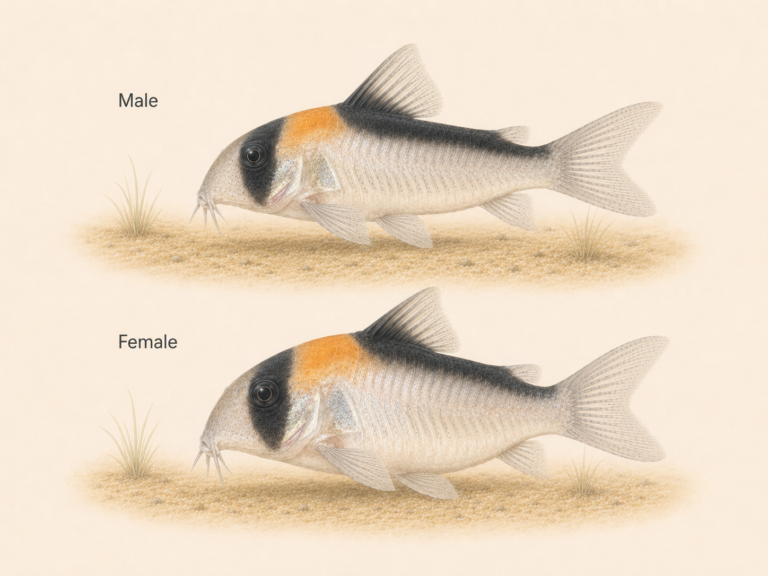
Sexual dimorphism is subtle but discernible in mature individuals. Males tend to be slightly broader across the head and possess more pronounced odontodes on the snout margins and pectoral spines. During breeding condition, males may also develop a slightly thicker, more robust appearance to the head region. Females are generally a touch fuller in the body when carrying eggs, though this can be difficult to assess given the compressed body shape.
Natural Habitat
Rineloricaria lanceolata is widely distributed across several major river systems in South America, including the Amazon basin, the upper Orinoco drainage, and the Paraguay-Parana system. This broad distribution spans portions of Peru, Bolivia, Brazil, Paraguay, and northern Argentina. Within these watersheds, the species occupies a variety of lowland habitats, from the main channels of larger rivers to smaller tributaries, flooded forest margins, and quiet backwaters.
The preferred microhabitat is invariably characterised by sandy or silty substrates. In the wild, these catfish are most commonly found resting on open patches of fine sand, amongst fallen leaf litter, or along submerged woody debris such as branches and root tangles. They favour areas with moderate to gentle water flow rather than fast-moving rapids, though they can tolerate a range of current strengths. The water in their native habitats varies from clear to moderately tannin-stained, depending on the specific locality and season.
Water chemistry across their range is typically soft to moderately hard, slightly acidic to neutral, and warm. During the wet season, extensive flooding brings seasonal changes to water depth, flow patterns, and dissolved organic content. These fluctuations are thought to play a role in triggering breeding behaviour in wild populations. The substrates of their habitats are often enriched with decomposing plant matter, which supports the biofilm, algae, and microorganism communities upon which the fish feed.
In their natural environment, Common Whiptail Catfish are primarily nocturnal or crepuscular, becoming most active during the hours of low light. During the day, they rely on their exceptional camouflage to remain undetected, lying flat against the bottom and blending almost seamlessly with their surroundings. This cryptic lifestyle is a key survival strategy, as their relatively slender build and sedentary habits would otherwise make them vulnerable to larger predatory fish and wading birds.
Tank Size and Setup
A minimum tank volume of 75 litres is recommended for a small group of Common Whiptail Catfish. However, given that these fish are best kept in groups of three to five or more, and that they appreciate ample floor space, a tank of 100 to 150 litres or larger is preferable. Because Rineloricaria lanceolata is a strictly bottom-dwelling species, the footprint of the tank is far more important than its height. A long, shallow tank with a generous surface area of substrate is ideal.
Substrate choice is critically important for this species. Fine, smooth sand is by far the best option. Whiptail catfish spend the vast majority of their time in direct contact with the substrate, and coarse or sharp-edged gravels can damage their delicate ventral surfaces, leading to abrasions and bacterial infections. A layer of fine play sand, pool filter sand, or purpose-made aquarium sand in a natural tan or light brown shade will closely replicate their wild habitat and allow for natural foraging behaviour. The fish will frequently sift through the sand with their mouths, searching for food particles, and this behaviour is only possible with an appropriately fine substrate.
Decor should include plenty of driftwood, particularly pieces with flat surfaces where the catfish can rest. Bogwood, mopani wood, and Malaysian driftwood are all suitable choices. In addition to providing resting spots, driftwood releases tannins that gently acidify the water and stain it a light amber, mimicking the blackwater conditions found in parts of the species’ natural range. Dried leaf litter – Indian almond leaves, oak leaves, or beech leaves – can be scattered across the substrate to further enhance the naturalistic aesthetic and provide additional surfaces for biofilm growth.
For breeding purposes, it is essential to include narrow tubes or pipes. PVC pipes, ceramic spawning tubes, or sections of bamboo with an internal diameter of approximately 2 to 3 centimetres work well. The male will select and defend a suitable tube as a spawning site, so providing several options in different locations around the tank will reduce competition and increase the likelihood of successful reproduction.
Live plants are not strictly necessary but are beneficial for water quality and aesthetics. Hardy, low-light species such as Java fern, Anubias, Java moss, and Cryptocoryne are all compatible. Floating plants can be used to diffuse overhead lighting, which helps to encourage the catfish to emerge during daylight hours. Rineloricaria lanceolata does not damage plants and can be housed safely in planted aquaria.
Lighting should be subdued. These catfish are naturally most active in dim conditions, and bright, unshaded lighting may cause them to remain hidden for extended periods. A moderate LED fixture with a timer set for 8 to 10 hours, combined with floating plants or tannin-stained water, will create comfortable conditions.
Water Parameters
Rineloricaria lanceolata is reasonably adaptable when it comes to water chemistry, which is one of the reasons it has become so popular in the hobby. Nevertheless, maintaining stable, clean water within the recommended ranges is essential for long-term health. The species is sensitive to elevated levels of nitrogenous waste, particularly nitrate, and benefits from a consistent maintenance schedule that includes regular partial water changes.
| Temperature | 22-28 °C |
| pH | 6.0-7.5 |
| General hardness (GH) | 2-15 dGH |
| Carbonate hardness (KH) | 1-10 dKH |
| Ammonia | 0 ppm |
| Nitrite | 0 ppm |
| Nitrate | Below 20 ppm |
An ideal temperature for general maintenance is around 24-26 °C. Slightly cooler water within the acceptable range can be used to simulate dry-season conditions, while a gradual warm-up paired with increased water changes can help trigger breeding behaviour. The pH should ideally be kept slightly acidic to neutral; values between 6.5 and 7.0 are optimal for most specimens. While the species can tolerate moderately hard water, softer conditions are preferable and more closely reflect its natural habitat.
Excellent water quality is non-negotiable for this species. Ammonia and nitrite must be maintained at zero at all times, and nitrate should be kept as low as practically possible – ideally below 20 ppm and certainly never allowed to exceed 40 ppm. Weekly water changes of 25 to 30 per cent are recommended as a baseline, with more frequent changes advisable in heavily stocked tanks or during breeding attempts.
Filtration and Equipment
Effective biological and mechanical filtration is essential for keeping Common Whiptail Catfish healthy. As bottom-dwelling fish that live in constant contact with the substrate, they are among the first to suffer when water quality deteriorates. An appropriately sized canister filter or a reliable hang-on-back filter with sufficient biological media capacity is recommended. The filter should be rated for the full volume of the tank, or ideally slightly over-rated, to ensure thorough processing of waste.
Water movement should be moderate. In the wild, Rineloricaria lanceolata inhabits areas with gentle to moderate current, and replicating a similar flow pattern in the aquarium is beneficial. Positioning the filter outlet to create a gentle linear flow across the length of the tank is ideal. Avoid creating excessively strong currents, as these fish are not adapted for high-energy swimming and may become stressed if forced to constantly fight the flow. Conversely, completely stagnant water should also be avoided, as it can lead to poor oxygen distribution and localised waste accumulation.
A heater with a built-in thermostat, appropriately rated for the tank volume, should be used to maintain a stable temperature. An external or inline heater is preferable in tanks with particularly active or curious fish, as it eliminates the risk of contact burns, although Whiptail catfish rarely interact with heaters positioned vertically against the glass.
Supplementary aeration via an air stone or sponge filter is beneficial, particularly during warmer months or in densely stocked tanks. Well-oxygenated water supports the overall health of these catfish and helps to prevent the anaerobic conditions that can develop in the lower water column of poorly circulated tanks. A sponge filter can also serve as a secondary biological filter and is particularly useful in breeding setups, where it provides gentle filtration without posing a risk to fry.
Lighting equipment should be selected with the species’ preference for subdued conditions in mind. A dimmable LED fixture is ideal, as it allows you to adjust intensity to suit both the fish and any live plants in the tank. A timer ensures a consistent photoperiod, which helps to regulate the fish’s natural activity cycles.
Diet and Feeding
Rineloricaria lanceolata is primarily a detritivore and biofilm grazer in the wild, feeding on a mixture of organic detritus, aufwuchs (the community of algae, bacteria, and microorganisms that colonise submerged surfaces), and small invertebrates encountered whilst sifting through the substrate. In captivity, this diet should be replicated as closely as possible through a varied feeding regime that combines sinking prepared foods with fresh and frozen offerings.
High-quality sinking wafers and pellets designed for bottom-feeding catfish should form the dietary staple. Look for products with a balanced nutritional profile that includes both plant-based and protein-based ingredients. Spirulina-based wafers, algae wafers, and catfish-specific sinking pellets are all well accepted. It is important to use sinking foods rather than floating or mid-water formulations, as Whiptail catfish feed exclusively from the substrate and will rarely, if ever, rise to the surface to eat.
Supplement the prepared diet with regular offerings of frozen or live foods. Bloodworm, daphnia, brine shrimp, and tubifex are all eagerly consumed and provide essential protein. These protein-rich foods are particularly important for conditioning breeding pairs. Fresh vegetable matter should also be offered periodically; blanched courgette (zucchini) slices, cucumber, spinach, and shelled peas are all suitable. These should be weighted down so they remain on the substrate and removed after 12 to 24 hours to prevent fouling the water.
Feeding should ideally take place in the evening or shortly after lights-out, as this aligns with the species’ natural crepuscular and nocturnal activity patterns. While Whiptail catfish will learn to feed during daylight hours in the aquarium, they are typically more enthusiastic feeders when the lighting is dim. Avoid the temptation to overfeed; these are relatively small fish with modest appetites, and excess food left on the substrate can rapidly degrade water quality. A small amount of food once or twice daily is usually sufficient.
Despite being frequently sold as “algae eaters,” Rineloricaria lanceolata is not a particularly efficient algae consumer compared to species such as Ancistrus or Otocinclus. While it will graze on soft biofilm and diatom films, it should not be relied upon as a primary algae control measure in the aquarium.
Behaviour and Temperament
The Common Whiptail Catfish is a remarkably peaceful and retiring species. It poses no threat to any tank mate and spends the majority of its time resting motionless on the substrate, driftwood, or plant leaves. Its camouflage is so effective that newcomers to the hobby may initially struggle to locate their fish in a well-decorated tank. This sedentary lifestyle is entirely normal and should not be a cause for concern; it is the species’ natural resting posture, evolved over millennia to avoid detection by predators.
Activity levels increase noticeably during the evening and overnight hours. As the lights dim, Whiptail catfish begin to forage across the substrate, methodically sifting through the sand in search of food particles. This foraging behaviour is one of the most endearing aspects of the species and is best observed under dim blue or moonlight LEDs. During peak activity, the fish may traverse the entire length of the tank floor, investigating every corner and crevice.
Rineloricaria lanceolata is a social species that benefits from being kept in small groups. While it is not a shoaling fish in the conventional sense, individuals kept in groups of three or more tend to display more natural behaviour and are less inclined to hide permanently. Intraspecific aggression is minimal, though males may engage in mild territorial disputes over preferred resting spots or spawning sites. These interactions rarely escalate beyond brief chases or posturing and do not result in physical harm.
One particularly noteworthy behaviour is the species’ response to perceived threats. When startled, a Whiptail catfish may remain completely motionless, relying on its camouflage, or it may perform a rapid, darting escape to the nearest shelter. This startle response is most pronounced in newly introduced fish and typically diminishes as the animal acclimatises to its surroundings and daily routine.
During the breeding season, males become noticeably more territorial, selecting and defending a tube or cave as a potential spawning site. The male will clean the interior of his chosen tube meticulously and may be observed positioned partially inside it, tail extending outward, in an apparent display to attract passing females. This parental behaviour continues after spawning, with the male assuming sole responsibility for guarding and fanning the eggs until they hatch.
Tank Mates
Rineloricaria lanceolata is one of the most peaceable aquarium fish available, making it compatible with a wide array of community species. The primary considerations when selecting tank mates are to avoid aggressive or overly boisterous species that might outcompete the Whiptail for food or harass it, and to choose fish that share broadly similar water parameter requirements. Because the Whiptail catfish occupies exclusively the bottom stratum of the tank, mid-water and surface-dwelling species are particularly good companions, as they minimise direct competition for space and resources.
Good tank mates
- Cardinal Tetra – A peaceful, small-bodied shoaling fish that occupies the mid-water column, posing no competition or threat to bottom-dwelling Whiptails.
- Rummy-nose Tetra – Shares a preference for warm, soft, slightly acidic water and stays in the middle to upper levels of the tank.
- Ember Tetra – A tiny, gentle tetra that thrives in the same warm, dimly lit conditions favoured by Whiptail catfish.
- Corydoras sterbai – A compatible bottom-dweller that is peaceful and tolerant of warm temperatures, coexisting well without territorial disputes.
- Otocinclus – A small, non-competitive algae grazer that shares similar water requirements and occupies glass and plant surfaces rather than the substrate.
- Kuhli Loach – Another gentle bottom-dweller that prefers sandy substrates and dim lighting, making it a natural companion.
- Dwarf Gourami – A calm, mid-to-upper-level dweller that is unlikely to interact with or disturb Whiptail catfish on the tank floor.
- Harlequin Rasbora – A hardy, peaceful shoaling species that stays in the mid-water and thrives in similar soft, slightly acidic conditions.
- Bristlenose Pleco – Another loricariid that generally coexists peacefully with Whiptails, though ample space and hiding spots should be provided to prevent territorial overlap.
Fish to avoid
- Oscar – A large, predatory cichlid that would view a Whiptail catfish as potential prey or subject it to severe harassment.
- Red-tail Catfish – A massive predatory catfish entirely incompatible with any small to medium-sized tank mate.
- Jaguar Cichlid – A highly aggressive, territorial cichlid that would dominate the tank floor and likely injure or kill Whiptail catfish.
- Green Terror – An assertive cichlid with strong territorial instincts that would harass and outcompete the docile Whiptail.
- Tiger Barb – A notorious fin-nipper that may target the Whiptail’s delicate caudal filaments, causing stress and physical damage.
- Common Pleco – Grows far too large for most Whiptail setups and may compete aggressively for territory on the tank floor.
- African Cichlids (Mbuna) – Require hard, alkaline water incompatible with Whiptail preferences and display highly aggressive territorial behaviour.
- Convict Cichlid – A pugnacious, breeding-prone cichlid that will aggressively defend territory and endanger slow-moving bottom-dwellers.
Breeding
Rineloricaria lanceolata is one of the more readily bred loricariid species in captivity, and successful reproduction is well within the reach of hobbyists with some experience. The breeding behaviour is fascinating to observe and follows a pattern of male-initiated courtship, tube spawning, and exclusive paternal care of the eggs.
To condition a breeding group, maintain a ratio of one male to two or three females in a tank with multiple spawning tubes. Feed generously with high-protein frozen and live foods such as bloodworm and brine shrimp for several weeks prior to a breeding attempt. Water quality should be impeccable, with nitrate levels kept as low as possible.
Breeding can often be triggered by simulating the onset of the rainy season. Perform a large water change of 40 to 50 per cent with slightly cooler water (2-3 °C below the normal tank temperature), then gradually raise the temperature back to 26-28 °C over the following days. Reducing the photoperiod slightly and softening the water through the addition of reverse osmosis or rainwater can further encourage spawning. Some breeders also report success by increasing the frequency of water changes to every other day for a week or two.
When ready to spawn, the male will intensify his cleaning of the chosen tube and begin courting passing females by positioning himself at the entrance with his head protruding. A receptive female will enter the tube and deposit a clutch of adhesive eggs on the interior surface. Clutch sizes typically range from 20 to 60 eggs, depending on the female’s size and condition. The eggs are relatively large for a loricariid, pale green to amber in colour, and are deposited in a tightly packed cluster.
After spawning, the male assumes sole responsibility for the eggs. He will remain inside the tube, fanning the eggs with his pectoral fins to maintain water circulation and prevent fungal growth, and guarding them against intruders. The female plays no further parental role and should not be disturbed. The incubation period is typically 7 to 12 days, depending on temperature, after which the fry emerge with large yolk sacs attached.
Newly hatched fry are relatively large and can be fed immediately with crushed spirulina wafers, powdered fry food, or freshly hatched brine shrimp nauplii. They will also graze on biofilm that develops naturally on surfaces within the tank. Growth is steady but not rapid, and the fry will begin to resemble miniature adults within a few weeks. Maintaining excellent water quality is paramount during the rearing phase, as the fry are sensitive to ammonia and nitrite spikes. A thin layer of sand, gentle sponge filtration, and frequent small water changes provide the best conditions for raising young Whiptails.
Common Diseases
Rineloricaria lanceolata is generally a hardy species when maintained in appropriate conditions, but like all aquarium fish, it is susceptible to a number of common ailments. Prevention through excellent water quality, a balanced diet, and low-stress husbandry is always preferable to treatment.
Bacterial infections are perhaps the most frequently encountered health issue. These often manifest as reddened or ulcerated patches on the ventral surface, particularly if the fish is kept on rough or dirty substrate. The belly and the bases of the pectoral fins are especially vulnerable. Treatment involves improving water quality, switching to a fine sand substrate if one is not already in use, and administering a broad-spectrum antibacterial medication as directed. Keeping the substrate clean through regular gravel vacuuming is essential for prevention.
White spot disease (Ichthyophthirius multifiliis, commonly known as ich) can affect Whiptail catfish, particularly following temperature fluctuations or the introduction of new, unquarantined fish. Symptoms include small white cysts on the body and fins, flashing behaviour, and lethargy. Treatment with a proprietary ich medication is effective, though care should be taken with dosage, as loricariids can be sensitive to certain chemicals. Half-dose treatments are often recommended for scaleless or armoured catfish; always read the product label and research compatibility before dosing.
Fungal infections may occur on damaged skin, fin tips, or on eggs during breeding. These appear as white, cotton-like growths. Maintaining pristine water quality and ensuring adequate water circulation around spawning tubes will help prevent fungal issues. Antifungal medications are available if treatment becomes necessary.
Internal parasites can be introduced through live foods or new fish. Symptoms may include weight loss despite adequate feeding, white or stringy faeces, and a general decline in condition. Antiparasitic medications formulated for internal worms and protozoa can be used, though prevention through quarantine protocols and sourcing food from reputable suppliers is the best approach.
Malnutrition and wasting can occur if Whiptail catfish are kept in community tanks where more aggressive feeders consume all the food before it reaches the bottom. Ensuring that sinking foods are provided and that the Whiptails are visibly eating is important. Target feeding with a turkey baster or pipette can help ensure food reaches the catfish directly.
FAQs
Are Common Whiptail Catfish good algae eaters?
While Rineloricaria lanceolata will graze on soft biofilm and diatom films, it is not an efficient algae cleaner compared to dedicated algae-eating species such as Otocinclus or Bristlenose Plecos. Its diet in the wild is primarily detritus and microorganisms obtained by sifting through sand, so it should not be purchased with the sole expectation that it will control algae growth in your tank. A varied diet of sinking wafers, frozen foods, and blanched vegetables is essential.
Can I keep a single Whiptail Catfish, or do they need a group?
A single specimen can be kept and will survive perfectly well on its own. However, Common Whiptail Catfish are noticeably more confident and display more natural behaviour when kept in a small group of at least three to five individuals. In a group, they are more likely to emerge during the daytime and will exhibit their full repertoire of social and foraging behaviours. A group also increases the likelihood of obtaining both sexes for potential breeding.
What substrate is best for Whiptail Catfish?
Fine, smooth sand is the only truly appropriate substrate for this species. Whiptail catfish spend virtually their entire lives lying on or sifting through the substrate, and coarse gravel or sharp materials can cause abrasions and infections on their delicate undersides. Natural-coloured play sand or aquarium sand is ideal. Avoid brightly coloured or dyed substrates, which may contain coatings that are harmful to sensitive bottom-dwellers.
How can I tell males from females?
Sexing Rineloricaria lanceolata can be challenging, particularly with juvenile or subadult fish. In mature specimens, males typically develop small bristle-like odontodes along the margins of the snout and on the leading edges of the pectoral fin spines. Males also tend to have a slightly broader head when viewed from above. During breeding condition, these differences become more pronounced. Females carrying eggs may appear slightly fuller in the abdominal region, though this is often subtle.
Why does my Whiptail Catfish never move?
This is entirely normal behaviour for the species. Rineloricaria lanceolata is naturally a sedentary, crepuscular to nocturnal fish that relies on camouflage and stillness as its primary defence mechanism. During daylight hours, it is perfectly normal for your Whiptail to remain motionless on the substrate, a piece of driftwood, or a plant leaf for extended periods. Activity typically increases significantly once the tank lights are turned off. If your fish is not eating or appears emaciated, however, this may indicate a health problem or that it is being outcompeted for food by more assertive tank mates.