Quick Summary
The False Bandit Corydoras is a peaceful, attractively marked bottom-dweller that thrives in groups of six or more on soft substrate. It is well suited to community aquariums kept by beginners and experienced hobbyists alike, provided the water is kept clean and slightly acidic to neutral.
🐠 Build a tank around this species
In this guide:
- Introduction
- Quick Stats
- Appearance
- Natural Habitat
- Tank Size and Setup
- Water Parameters
- Diet and Feeding
- Behaviour and Temperament
- Tank Mates
- Breeding
Introduction
The False Bandit Corydoras, Hoplisoma melini, is one of the hobby’s quieter charmers – a small, sociable catfish whose bold dark mask and dorsal stripe give it a striking resemblance to the true Bandit Corydoras group (most often associated with Hoplisoma metae). The common name “false bandit” exists precisely because of this visual similarity, though the two species are not especially close relatives within the genus. Aquarists who learn to tell them apart often develop a preference for H. melini thanks to its slightly broader mask and the way its dark dorsal stripe extends further along the body.
Taxonomically, this species was long placed in the catch-all genus Corydoras and you will still see it labelled Corydoras melini in many shops and databases. Following the major 2024 revision of the Corydoradinae, it has been reassigned to the genus Hoplisoma. For practical fishkeeping purposes the care requirements remain identical to what hobbyists have always known as “standard cory care,” but it is worth being aware of the updated taxonomy when researching the species online or ordering from suppliers.
False Bandit Corydoras have been available in the hobby since the mid-twentieth century, though they have never been as widely bred commercially as some of the more common corydoras species such as the Bronze or Peppered Cory. Most specimens in the trade are wild-caught from South American river systems. They reward the keeper with endearing behaviour – shuffling across the substrate in tight groups, periodically darting to the surface to gulp air, and engaging in what can only be described as playful chasing during spawning season.
Quick Stats
| Scientific name | Corydoras melini |
|---|---|
| Common names | False Bandit Corydoras, False Bandit Cory, Melini Corydoras, Melini Cory, Corydoras melini |
| Family | Callichthyidae |
| Origin | Upper Rio Negro and Rio Meta basins, Colombia and Brazil |
| Adult size | 4.5 cm |
| Lifespan | 5–8 years |
| Difficulty | Easy |
| Breeding difficulty | Moderate |
| Temperature | 23–27 °C |
| pH | 5.5–7.2 |
| GH | 1–6 dGH |
| KH | 0–3 dKH |
| Minimum tank size | 75 L |
| Conservation status | Least Concern (IUCN, assessed 2020) |
Appearance
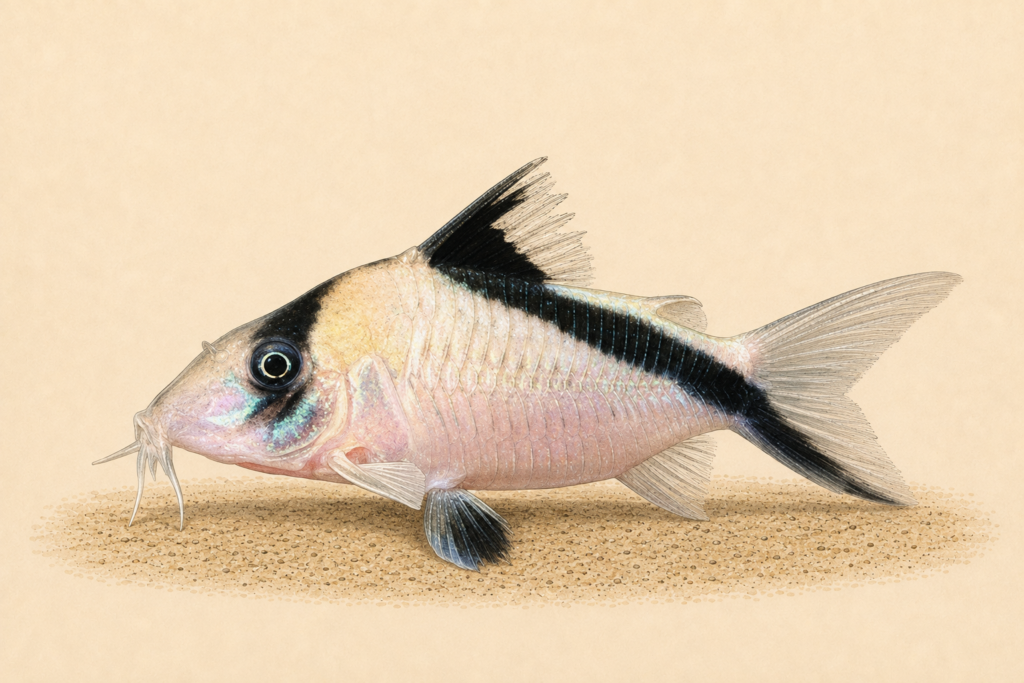
At first glance, the False Bandit Corydoras is easy to confuse with its namesake, the true Bandit Cory (Hoplisoma metae). Both species share a pale cream-to-beige base colour and a prominent dark band that runs through the eye like a mask – the feature that gives the “bandit” group its name. However, careful observation reveals reliable differences. In H. melini, the dark eye band tends to be broader and sometimes less sharply defined at the edges. More distinctively, H. melini possesses a bold dark stripe that runs along the back from the rear of the dorsal fin to the base of the caudal fin, often thickening towards the tail. This dorsal stripe is the key distinguishing mark; in H. metae, the equivalent dark pigment is typically confined to a saddle-like patch around the dorsal fin area rather than extending as a continuous stripe.
The body shape is typical of the genus – compact, laterally compressed, and armoured with two rows of overlapping bony scutes (modified scales) along each flank. The ventral profile is flat, reflecting a life spent in constant contact with the substrate. The head is rounded with a slightly downturned mouth flanked by two pairs of short, sensitive barbels used to probe sand and fine gravel for food particles. The eyes are relatively large and mobile, giving the fish an alert, inquisitive expression.
Fins are translucent to lightly tinted with a faint yellowish or pinkish wash, and the dorsal fin may carry a small dark blotch near its leading edge. Males are typically slightly smaller and slimmer than females when viewed from above, while mature females develop a noticeably rounder belly, especially when carrying eggs. Colouration can intensify or fade depending on mood, health, and water conditions; fish kept in soft, slightly acidic water over a dark substrate often display the richest contrast between the pale body and dark markings.
Natural Habitat
The False Bandit Corydoras hails from the upper reaches of the Rio Negro drainage and parts of the Rio Meta basin in Colombia and Brazil. These are classic blackwater and clearwater environments: slow-moving tributaries, flooded forest margins, and shallow creeks with sandy or muddy bottoms blanketed by a layer of decomposing leaf litter. The water is typically warm, soft, and acidic, stained a deep amber-brown by tannins leaching from fallen leaves, branches, and other organic material.
In these habitats, H. melini is found in loose aggregations over sandy substrates, often sheltering beneath submerged roots, fallen branches, and dense tangles of aquatic and semi-aquatic vegetation. Light levels tend to be low, filtered by the forest canopy above and the tannin-stained water itself. The substrate is usually fine sand or a mixture of sand and silt, occasionally scattered with small pebbles. The fish’s barbels are perfectly adapted to this soft substrate, allowing it to sift through the sand for small invertebrates, insect larvae, and organic detritus without risk of damage.
The seasonal flood cycle plays an important role in the ecology of these fish. During the wet season, river levels rise dramatically, flooding surrounding forest and creating vast areas of shallow, food-rich habitat. It is during or shortly after these seasonal changes that many corydoras species, including H. melini, are thought to spawn in the wild, triggered by the influx of cooler, oxygen-rich rainwater. This natural cycle can be mimicked in the aquarium to encourage breeding.
Tank Size and Setup
A group of six False Bandit Corydoras can be comfortably housed in a tank of 60 litres or more. Larger groups – and groups of eight to twelve are strongly encouraged – will need proportionally more floor space. Because corydoras spend the vast majority of their time on and near the bottom, the footprint of the tank matters more than its height. A standard rectangular aquarium with a generous base area is ideal; tall, narrow designs are less suitable.
Substrate choice is critical for this species. Fine, smooth sand is the best option. The fish feed by plunging their barbels and mouths into the substrate to sift for food, and coarse, sharp-edged gravel can abrade and erode the delicate barbels over time, leading to infection and reduced foraging ability. Play sand, pool filter sand, or purpose-made aquarium sand in a natural colour all work well. A layer of two to three centimetres is sufficient.
Decoration should aim to replicate the cluttered, shaded environment of a South American forest stream. Driftwood, bogwood, and pieces of twisted root provide both shelter and a natural source of tannins. Dried Indian almond leaves (also known as catappa leaves) or oak leaves scattered over the substrate serve a dual purpose: they release beneficial tannins that soften and acidify the water, and they provide a surface for biofilm growth that the corydoras will graze on. Smooth river stones and terracotta pots or coconut shells can offer additional hiding spots.
Live plants are a welcome addition, though not strictly essential. Species that tolerate soft, acidic water do best – Java Fern, Anubias species, Cryptocoryne species, and various mosses are all suitable. Floating plants such as Amazon Frogbit or Salvinia help to diffuse overhead light and create the subdued conditions these fish prefer.
Lighting should be moderate to low. Intense illumination can make the fish feel exposed and reduce their activity levels during the day. If the tank requires strong lighting for plant growth, floating plants or tall background plants can be used to provide shaded areas on the substrate.
Water Parameters
The False Bandit Corydoras originates from soft, acidic waters and will look and behave its best when kept in similar conditions in the aquarium. That said, captive specimens – whether wild-caught and acclimatised or tank-bred – usually adapt well to a moderate range of parameters provided extremes are avoided and stability is maintained. Sudden swings in pH or temperature are far more dangerous than a reading that sits slightly outside the textbook ideal.
| Temperature | 23-27 C |
| pH | 5.5-7.2 |
| General hardness (GH) | 1-10 dGH |
| Carbonate hardness (KH) | 1-6 dKH |
| Ammonia | 0 ppm |
| Nitrite | 0 ppm |
| Nitrate | Below 20 ppm |
Ammonia and nitrite must be maintained at zero at all times; corydoras are sensitive to dissolved nitrogenous waste, and even brief spikes can cause stress or gill damage. Nitrate should be kept as low as possible, ideally below 20 ppm, through regular partial water changes. A weekly change of 25-30% is a good baseline, though tanks with higher stocking levels or less filtration may require more frequent changes.
If your tap water is moderately hard and alkaline, you can soften and acidify it by blending with reverse osmosis (RO) or demineralised water, or by using a generous quantity of driftwood and leaf litter in the tank. Peat filtration is another traditional method. Always remineralise RO water with a suitable product before use, as completely mineral-free water is harmful.
Filtration and Equipment
Good filtration is essential for keeping corydoras healthy, but the flow rate should be appropriate for a species that lives on the bottom and is not a strong swimmer. A hang-on-back filter, a small canister filter, or a sponge filter are all suitable for a tank of 60 to 120 litres. Sponge filters are particularly popular among corydoras keepers because they provide gentle, even flow, excellent biological filtration, and pose no risk of trapping small fish or fry.
If using a canister or hang-on-back filter with a stronger output, position the outlet so that the current is diffused across the surface rather than blasting directly down onto the substrate. A spray bar or lily pipe can help distribute flow more gently. Aim for a turnover rate of roughly four to six times the tank volume per hour as a guideline.
A heater is necessary to maintain a stable temperature within the recommended 23-27 C range. Use a reliable, thermostat-controlled heater rated for the tank volume, and consider placing a heater guard around it to prevent the corydoras from resting against it and burning themselves – a real risk with bottom-dwelling fish that like to wedge themselves into tight spots.
An air pump and airstone are not strictly required if the filter provides adequate surface agitation, but many keepers find that gentle aeration benefits corydoras. These fish are facultative air-breathers, meaning they will periodically dart to the surface to gulp atmospheric air, which is absorbed through the intestinal lining. Occasional surface visits are normal and not a sign of distress. However, if the fish are making frequent, frantic trips to the surface, it may indicate low dissolved oxygen or poor water quality that needs addressing.
A tight-fitting lid or cover glass is recommended. Although corydoras are not habitual jumpers, their rapid dashes to the surface for air can occasionally carry them out of the water, especially in shallow tanks or during moments of fright.
Diet and Feeding
The False Bandit Corydoras is an omnivore with a diet that, in the wild, consists primarily of small benthic invertebrates, insect larvae, worms, and organic detritus sifted from the substrate. In the aquarium, it is thoroughly unfussy and will accept a wide range of prepared, frozen, and live foods.
A high-quality sinking pellet or wafer designed for bottom-feeding catfish should form the dietary staple. These foods are formulated to sink quickly and hold their shape on the substrate long enough for the corydoras to find and consume them. Avoid relying solely on flake food that floats or disintegrates before reaching the bottom – the corydoras may not get a fair share, especially in a community tank where mid-water fish intercept food first.
Supplement the staple diet regularly with frozen or live foods. Bloodworm, daphnia, brine shrimp, tubifex worms, and mosquito larvae are all eagerly accepted and provide valuable protein and variety. Live foods in particular seem to stimulate natural foraging behaviour and can help condition breeding adults. Blanched vegetables such as courgette (zucchini) medallions, cucumber slices, or shelled peas can be offered occasionally, though most corydoras show less enthusiasm for plant matter than for meaty foods.
Feed once or twice daily, offering only as much as the group can consume within a few minutes. Uneaten food should be removed promptly to prevent it from fouling the water. It is a common misconception that corydoras are “clean-up crew” fish that survive on scraps and algae. While they will happily scavenge, they require targeted feeding to thrive. A well-fed False Bandit Cory will have a gently rounded belly; a concave or pinched belly indicates underfeeding.
Behaviour and Temperament
Like all members of the genus, the False Bandit Corydoras is a gregarious, peaceful species that should always be kept in a group. A minimum group size of six is recommended, and larger groups of ten or more will result in bolder, more natural behaviour. Solitary or pair-kept corydoras often become withdrawn, stressed, and prone to illness.
Within the group, the fish maintain a loose shoal, often resting together in a favourite spot beneath a piece of driftwood or among plant roots. When active, they move across the substrate in a characteristically endearing shuffling motion, probing the sand with their barbels in search of food. Activity levels tend to peak around dawn and dusk, though in a dimly lit, well-planted tank they may be active throughout the day.
The periodic dash to the surface to gulp air is a hallmark corydoras behaviour and is perfectly normal. In a healthy tank with good oxygenation, you might see this happen a few times per hour. It is thought to supplement gill respiration, particularly in the warm, oxygen-poor waters these fish encounter in the wild.
False Bandit Corydoras are entirely non-aggressive. They pose no threat to other fish, invertebrates, or plants. They do not nip fins, defend territories, or compete aggressively for food. Their only defence mechanism is the sharp, mildly venomous spine at the leading edge of each pectoral fin and the dorsal fin – something to be aware of when netting the fish, as a spine can become entangled in a fine mesh net. Use a container or a coarse-mesh net to move corydoras safely.
Tank Mates
The False Bandit Corydoras is an ideal community fish, compatible with a broad range of small, peaceful species. The key requirements for suitable tank mates are that they should not be large enough to eat the corydoras, should not be aggressive or territorial enough to bully them, and should ideally share a preference for soft, slightly acidic water. Avoid housing them with boisterous or nippy species, large cichlids, or anything that might out-compete them for food at the bottom of the tank.
Good tank mates
- Cardinal Tetra – A classic blackwater companion that shares the same water parameter preferences and occupies the mid-water column, leaving the bottom to the corydoras.
- Rummy-Nose Tetra – Another soft-water tetra that schools beautifully in the middle and upper levels without bothering bottom-dwellers.
- Ember Tetra – A tiny, peaceful tetra whose warm orange colour contrasts nicely with the corydoras; too small to pose any competitive threat.
- Harlequin Rasbora – A gentle, adaptable shoaling fish that thrives in similar water conditions and adds lively colour to the mid-water zone.
- Otocinclus Catfish – A fellow peaceful bottom-dweller and algae grazer that coexists happily alongside corydoras without competition for the same food sources.
- Kuhli Loach – A shy, nocturnal bottom-dweller that shares the substrate peacefully and enjoys the same soft, sandy conditions.
- Honey Gourami – A calm, unassuming labyrinth fish that occupies the upper water column and poses no threat to corydoras.
- Pygmy Corydoras – A smaller relative that can share the same tank without aggression, though it tends to hover in mid-water more than true bottom-dwelling corydoras.
Fish to avoid
- Oscar – Far too large and predatory; would view a small corydoras as food.
- Tiger Barb – Notorious fin nipper that can harass slower bottom-dwellers and create a stressful environment.
- Jack Dempsey – A large, aggressive cichlid that would bully or eat the corydoras.
- Red-Tail Catfish – Grows to an enormous size and is a voracious predator of anything that fits in its mouth.
- African Cichlids (Mbuna) – Require hard, alkaline water and are highly territorial, making them incompatible on both behavioural and water chemistry grounds.
- Common Pleco – While not aggressive, it grows very large and produces substantial waste, often overwhelming the filtration in tanks suited to small corydoras.
Breeding
Breeding the False Bandit Corydoras in captivity is achievable but requires some deliberate effort, placing it in the moderate difficulty category. Success is most likely when a well-conditioned group of at least six adults (ideally with a ratio of two males to every female) is maintained in excellent water quality with a varied, protein-rich diet.
To condition the group, increase the proportion of live and frozen foods – bloodworm, brine shrimp, and daphnia – in the weeks leading up to a breeding attempt. Females in spawning condition will become noticeably plumper when viewed from above.
Spawning can often be triggered by simulating the onset of the rainy season. The most commonly used technique is a large, cool water change: replace 30-50% of the tank water with fresh, slightly cooler (by two to three degrees Celsius) dechlorinated water. Some breeders also reduce the water level slightly for a few days beforehand and then refill with the cooler water, mimicking a flood event. Lowering the barometric pressure (which naturally accompanies storms) has been anecdotally linked to spawning, though this is difficult to control artificially. Performing the water change in the evening may coincide with the fish’s natural crepuscular activity patterns.
When spawning is imminent, males will become visibly excited, chasing females around the tank and nudging their flanks. The classic corydoras “T-position” will be observed: the female clamps the male’s pelvic fin area with her pectoral fins while he releases sperm, which is thought to pass over the eggs held in the female’s cupped ventral fins. After fertilisation, the female swims to a chosen surface – the aquarium glass, a broad leaf, or a smooth piece of decor – and carefully presses a small cluster of adhesive eggs onto it. This process is repeated multiple times with different males, resulting in clutches of 50 to 150 or more eggs scattered across various surfaces.
The eggs are small, round, and initially translucent to pale cream. Fertile eggs will darken slightly over the following 24-48 hours, while infertile eggs typically turn white and develop fungus. Many breeders remove the eggs to a separate hatching container – a small, aerated tank or a floating breeder box – to protect them from being eaten by the adults or other tank mates. Adding a few drops of methylene blue to the hatching water can help prevent fungal growth on the eggs.
At a temperature of around 25 C, the eggs usually hatch within three to five days. The newly hatched fry are tiny and will initially absorb their yolk sacs over the first day or two. Once free-swimming, they can be fed with infusoria, commercially available liquid fry food, or very finely powdered dry food. After a few days, they will accept freshly hatched baby brine shrimp (Artemia nauplii), which is widely regarded as the best food for raising healthy corydoras fry. Maintain impeccable water quality in the rearing tank with frequent small water changes, and the fry should grow steadily, developing their characteristic markings over the first few weeks of life.
Common Diseases
The False Bandit Corydoras is reasonably hardy when kept in appropriate conditions, but like all aquarium fish, it is susceptible to certain illnesses, particularly when water quality deteriorates or stress levels are elevated.
Barbel erosion is one of the most frequently seen problems in corydoras and is almost always caused by keeping the fish on rough or sharp substrate. Damaged barbels are vulnerable to bacterial and fungal infection, which can spread to the surrounding tissue. Prevention is straightforward: use fine, smooth sand. If barbel damage is already present, improving substrate conditions and water quality will usually allow the barbels to regenerate over time, provided secondary infection is treated.
Ich (white spot disease), caused by the protozoan Ichthyophthirius multifiliis, is a common affliction in community tanks. It presents as small white spots on the body and fins, accompanied by flashing (rubbing against surfaces) and lethargy. Corydoras are sensitive to some ich medications, particularly those containing copper or malachite green at full strength. Half-dose treatments or heat-based protocols (gradually raising the temperature to 30 C while increasing aeration) are often recommended for scaleless and armoured catfish, though care must be taken not to exceed the species’ temperature tolerance for prolonged periods.
Bacterial infections, including fin rot and skin ulcers, can occur in tanks with poor water quality or following physical injury. These typically respond well to broad-spectrum antibacterial treatments or salt baths, though again, corydoras can be more sensitive to medications than many other freshwater fish. Always research the specific product and dosage for use with catfish before treating.
Internal parasites can be a concern with wild-caught specimens. Signs include weight loss despite a good appetite, white or stringy faeces, and a generally lethargic demeanour. Anti-parasitic foods or treatments containing praziquantel or levamisole are commonly used.
The single best defence against disease in False Bandit Corydoras is prevention through good husbandry: stable water parameters, regular water changes, a soft substrate, a balanced diet, and the social security of a properly sized group.
FAQs
What is the difference between the False Bandit Corydoras and the true Bandit Corydoras?
The False Bandit Corydoras (Hoplisoma melini) and the true Bandit Corydoras (Hoplisoma metae) share a similar dark eye band, which gives both species the “bandit” name. The key visual difference is a dark stripe running along the back of H. melini from the dorsal fin to the caudal fin base, which is absent or much reduced in H. metae. In the true Bandit Cory, the dark pigment is typically limited to a saddle-like mark around the dorsal fin area. Despite the naming similarity, they are distinct species, not different colour forms of the same fish.
How many False Bandit Corydoras should I keep together?
A minimum group of six is recommended, but more is always better. Groups of eight to twelve or more will display the most confident, natural behaviour. Corydoras are highly social fish, and keeping them in insufficient numbers leads to chronic stress, reduced activity, and greater susceptibility to illness.
Can I keep False Bandit Corydoras on gravel?
Fine, smooth-edged gravel is acceptable in a pinch, but fine sand is strongly preferred. Corydoras feed by plunging their faces into the substrate and sifting material through their gills. Rough or sharp gravel can damage their delicate barbels, leading to erosion, infection, and impaired foraging ability. Sand also allows the fish to exhibit their full range of natural feeding behaviours, which is both healthier and more entertaining to watch.
Why do my corydoras keep darting to the surface?
Corydoras are facultative air-breathers and will periodically swim to the surface to gulp atmospheric air, which is absorbed through the intestinal lining. Occasional trips to the surface – a few times per hour – are completely normal. However, if the behaviour becomes constant or frantic, it may indicate low dissolved oxygen levels, poor water quality, or high water temperature. Check your water parameters and ensure adequate surface agitation or aeration.
Is the False Bandit Corydoras the same as Corydoras melini?
Yes. Following the 2024 taxonomic revision of the Corydoradinae subfamily, the species formerly known as Corydoras melini has been reclassified into the genus Hoplisoma and is now correctly referred to as Hoplisoma melini. You will still see the older name used widely in shops, online forums, and older reference books. The care requirements are unchanged – only the genus name has been updated to reflect a more accurate understanding of the evolutionary relationships within this large group of catfish.
Related Guides
- Bandit Corydoras (Hoplisoma metae) – The true Bandit Cory makes a natural comparison species; learn how its care and appearance differ from the False Bandit.
- Bronze Corydoras (Corydoras aeneus) – One of the most widely kept corydoras species and an excellent introduction to the group for beginners.
- Pygmy Corydoras (Corydoras pygmaeus) – A much smaller relative that occupies mid-water more than the bottom; a popular choice for nano community tanks.
- Sterbai Corydoras (Corydoras sterbai) – A beautifully patterned corydoras that tolerates slightly warmer water, making it a good companion for discus tanks.
- Cardinal Tetra – A classic blackwater community fish that pairs perfectly with False Bandit Corydoras in soft, acidic setups.