Quick summary
The Head and Tail Light Tetra is a lively, quite colourful freshwater fish from the rivers of South America.
🐠 Build a tank around this species
- Introduction
- Quick Stats
- Appearance
- Varieties and Morphs
- Natural Habitat
- Tank Size and Setup
- Water Parameters
- Filtration and Equipment
- Diet and Feeding
- Behaviour and Temperament
- Tank Mates
- Breeding
- Common Diseases
- FAQs
- Related Guides
Introduction
The original description of the Head and Tail Light Tetra dates from 1882. The fish sits within the group known as the American tetras. Its conservation status is Least Concern, as assessed in March 2021.
Quick Stats
| Scientific name | Holopristis ocellifera |
|---|---|
| Common names | Head and Tail Light Tetra, Beacon Tetra |
| Family | Acestrorhamphidae (formerly Characidae) |
| Origin | South America: Amazon River basin (Ecuador, Guyana, Suriname, French Guiana, Peru, Bolivia, Colombia and Brazil) |
| Adult size | 4.5 cm |
| Difficulty | Easy |
| Breeding difficulty | Moderate |
| Temperature | 24–28 °C |
| pH | 5.5–7.5 |
| GH | 5–20 dGH |
| Minimum tank size | 68 L |
| Conservation status | Least Concern (IUCN, assessed 2021) |
Appearance
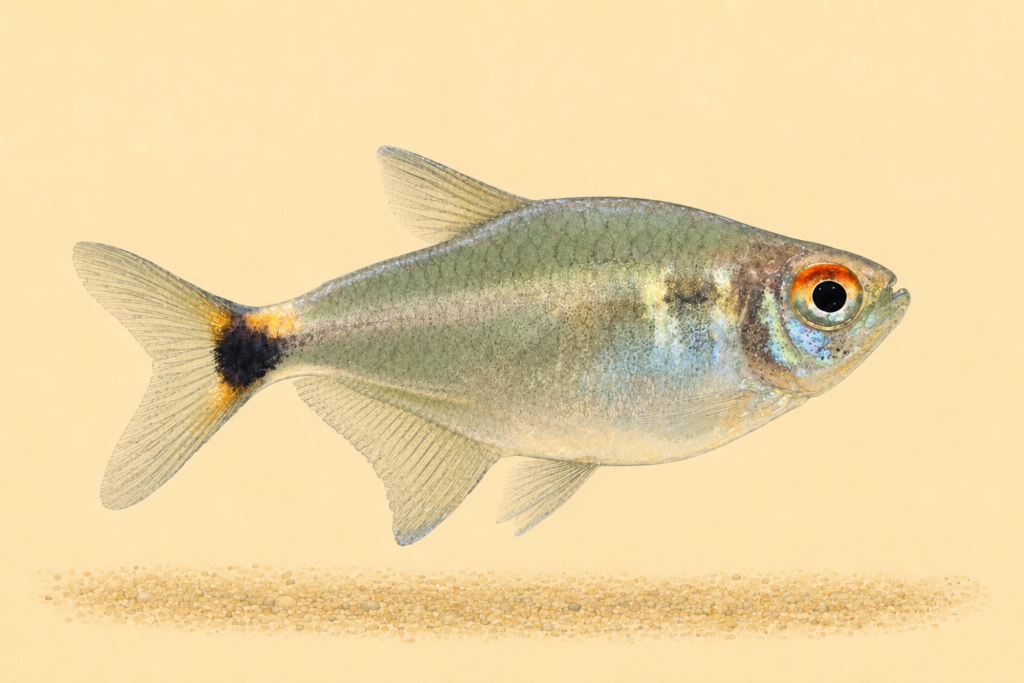
Adults reach up to 4.5 cm, not counting the tail fin. Adult females usually have a slightly bigger, bulkier body than the males. Males and females can apparently be told apart by the swim bladder, which shows through the skin: it is pointed in males and rounded in females. On a dark substrate, the spots on the shoulder and tail seem to glow.
Varieties and Morphs
Breeders have produced an albino version of this tetra through selective breeding. Care for the albino version is the same as for the standard fish.
Natural Habitat
The Head and Tail Light Tetra comes from the Amazon River basin, in Ecuador, Guyana, Suriname, French Guiana, Peru, Bolivia, Colombia and Brazil. Its home waters are slowly flowing rivers, their tributaries and floodplain lakes.
Tank Size and Setup
We recommend a tank of at least 68 litres. The fish is adaptable, and most aquarium setups suit it well. Dense planting shows the fish off especially well, though it can look somewhat washed out in very sparse setups.
Setting up a biotope tank is another option. Some handfuls of dried beech or oak leaves would finish off the natural look. Keep the lighting fairly dim.
Water Parameters
Aim for a temperature of 24 to 28 °C. The pH can run from 5.5 to 7.5, and hardness from 5 to 20 dGH, which is a measure of how hard the water is.
| Temperature | 24 to 28 °C |
| pH | 5.5 – 7.5 |
| General hardness (GH) | 5 – 20 dGH |
| Ammonia | 0 ppm |
| Nitrite | 0 ppm |
| Nitrate | Below 20 ppm |
Within that pH range, water below neutral is preferable. Colours are at their best towards the lower end of the hardness range.
Filtration and Equipment
A small net bag of peat that is safe for aquariums can be placed in the filter to help copy blackwater conditions. We recommend a filter that turns the water over four to five times an hour for a tank of at least 68 litres, and a heater to hold the temperature within 24 to 28 degrees Celsius.
Diet and Feeding
Almost any food offered is taken readily. Regular meals of live or frozen bloodworm, Daphnia and brine shrimp, all in small sizes, alongside flakes and granules, bring out the best condition and colour. Worms, small insects, crustaceans and plants are also among the foods the fish feeds on.
Behaviour and Temperament
The fish is lively and peaceful. Shoaling comes naturally to the fish, and it does much better when kept with others of its own kind. A group of 6 or more is the minimum, and 10 or more is better.
Tank Mates
This is an ideal community fish that gets along with a wide range of peaceful, similarly sized species. Avoid anything large enough to eat it, anything overly aggressive or territorial, and fast, boisterous feeders that will outcompete it at mealtimes. As a general rule, if a potential tank mate is peaceful and roughly similar in size, it will probably work.
Good tank mates
- Cardinal tetra, a classic pairing with similar water requirements and peaceful temperament
- Rummy-nose tetra, another soft-water shoaler that occupies a similar niche without conflict
- Ember tetra, a tiny, peaceful species that adds warm colour to the lower mid-water
- Harlequin rasbora, a calm, adaptable rasbora that mixes beautifully with small tetras
- Panda corydoras, a gentle bottom-dweller that stays out of the tetra’s way
- Bronze corydoras, another excellent bottom-dwelling companion for community tanks
- Kuhli loach, a peaceful, nocturnal loach that occupies the substrate level
- Honey gourami, a gentle, slow-moving surface dweller that complements tetras well
- Otocinclus, a small algae eater that is completely peaceful and shares similar water preferences
- Cherry shrimp, safe with adult tetras in a well-planted tank, though very small shrimplets may occasionally be taken
Fish to avoid
- Oscar, far too large and predatory for any small tetra
- Jaguar cichlid, a large, aggressive predator that will eat small tetras
- Convict cichlid, territorial and aggressive, especially when breeding
- Tiger barb, a notorious fin nipper that can harass slower, gentler tetras
- Red-tail black shark, territorial and can bully smaller fish relentlessly
- Green terror, a large, aggressive cichlid completely unsuitable for small tetra communities
- Flowerhorn, an aggressive hybrid cichlid that should never be kept with small community fish
- African butterfly fish, a surface predator capable of swallowing small tetras
- Bucktooth tetra, despite being a tetra itself, it is a scale-eating predator
- Common pleco, not aggressive but grows far too large for the tank sizes suited to this tetra.
Breeding
Raising a decent number of fry needs a separate tank. A breeding tank of around 18 by 10 by 10 inches is suitable. Add clumps of plants with fine leaves in that tank, for example java moss or spawning mops, so the fish have a place to lay eggs. Alternatively, the base can be covered with mesh whose holes are big enough for eggs to fall through but too small for the adults to get at them. Peat filtration is useful, and so is RO (reverse osmosis) water.
Spawning in a group is possible, and six fish of each sex is a good number. Before spawning, give the group plenty of small live foods to bring them into condition. Pairs are an alternative, with males and females conditioned in separate groups and tanks beforehand. When the females look full of eggs and the males are in their finest colours, choose the plumpest female and the best-coloured male and move them to the spawning tank that evening; they should spawn the following morning.
Eggs get eaten by the adults whenever they have the opportunity, so take the parents out as soon as eggs are seen. Eggs hatch in 24 to 36 hours, and the fry swim freely 3 to 4 days after that. For the first few days, feed foods of the infusoria type, then move to microworm or brine shrimp nauplii once the fry are big enough. Eggs and young fry are sensitive to light early on, so the tank should be kept dark if possible.
Common Diseases
The Head and Tail Light Tetra can be affected by white spot, a parasitic infestation. The fish can also be affected by fin rot, in its early or late stages, and by bacterial infections generally.
FAQs
How big does the Head and Tail Light Tetra grow?
Growth tops out at 4.5 cm, not counting the tail fin.
How many Head and Tail Light Tetras should be kept together?
A group of at least 6 is advised, with 10 or more preferred, because the fish does much better among its own kind.
What do Head and Tail Light Tetras eat?
Almost any food is accepted, and regular small live or frozen foods such as bloodworm and Daphnia, plus flakes and granules, are suggested for the best condition and colour.
Related Guides
- Cardinal tetra care guide
- Neon tetra care guide
- Rummy-nose tetra care guide
- Ember tetra care guide
- Glowlight tetra care guide
- Black neon tetra care guide
- Lemon tetra care guide
- Honey gourami care guide.