Quick Summary
The January Tetra is a peaceful, hardy shoaling fish that thrives in most community aquariums, making it an excellent choice for beginners and experienced fishkeepers alike who want an attractive, low-maintenance tetra with a distinctive glowing lateral stripe.
🐠 Build a tank around this species
In this guide:
- Introduction
- Quick Stats
- Appearance
- Natural Habitat
- Tank Size and Setup
- Water Parameters
- Diet and Feeding
- Behaviour and Temperament
- Tank Mates
- Breeding
Introduction
The January Tetra (Hemigrammus hyanuary) is a charming and undemanding freshwater fish hailing from the slow-moving tributaries and floodplain lakes of the Amazon basin. Named after Lake Hyanuary (also spelled Janauari) near Manaus in Brazil, this species has been a staple of the community aquarium hobby for decades. It belongs to the large and popular Hemigrammus genus, which includes many well-known aquarium tetras, and it shares the easy-going temperament and robust constitution that makes this group so appealing to fishkeepers of all experience levels.
Despite being overshadowed in popularity by some of its flashier relatives such as the Neon Tetra or Cardinal Tetra, the January Tetra has a quiet elegance that rewards closer observation. Its understated silver-green body is punctuated by a luminous green-gold lateral stripe that catches the light beautifully, especially under subdued aquarium lighting against a dark substrate. When kept in a well-planted tank with a sizeable group, these fish display confident shoaling behaviour and develop richer colouration than when kept in sparse setups or small numbers.
One of the greatest strengths of the January Tetra is its adaptability. It tolerates a broad range of water parameters, accepts virtually all standard aquarium foods without fuss, and coexists peacefully with the vast majority of commonly kept community species. For anyone seeking a dependable, attractive shoaling fish that will not cause problems in a mixed-species aquarium, the January Tetra is a thoroughly reliable choice.
Quick Stats
| Scientific name | Hemigrammus hyanuary |
|---|---|
| Common names | Green Neon Tetra, Costello Tetra |
| Family | Characidae |
| Origin | Amazon basin, Brazil |
| Adult size | 4 cm |
| Lifespan | 3–5 years |
| Difficulty | Easy |
| Breeding difficulty | Moderate |
| Temperature | 23–27 °C |
| pH | 6–7 |
| GH | 2–15 dGH |
| KH | 1–4 dKH |
| Minimum tank size | 70 L |
| Conservation status | Least Concern (IUCN, assessed 2021) |
Appearance
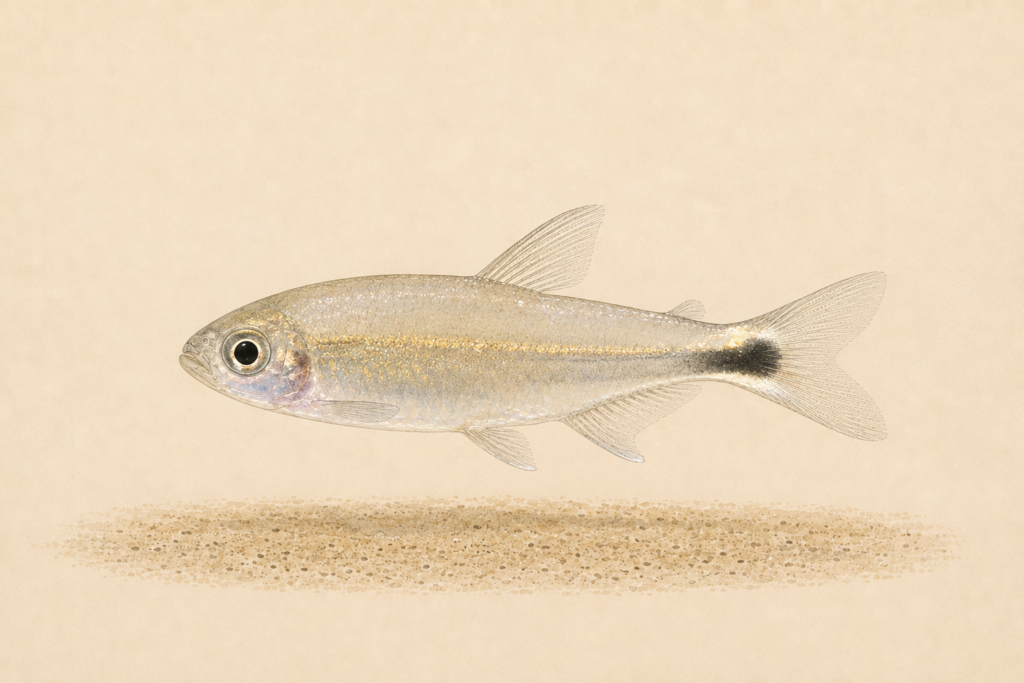
The January Tetra is a small, laterally compressed fish with a classic tetra body shape – streamlined and slightly deeper than some of the more slender-bodied characins. Adults typically reach around 4 cm in total length, making them one of the moderately sized members of the Hemigrammus genus. The body is translucent to silvery-green, with an overall subtle iridescence that changes depending on the angle of light and the fish’s mood.
The most distinctive feature of this species is the brilliant green-gold horizontal stripe that runs along the lateral line from behind the gill cover to the base of the caudal fin. This stripe is particularly vivid under dim or angled lighting and gives the fish a glowing, almost luminescent appearance. It is this shining stripe that often leads to the species being confused at first glance with the Green Neon Tetra (Paracheirodon simulans), though the two are quite different upon closer inspection. The January Tetra lacks the red ventral colouration characteristic of Paracheirodon species and has a generally more robust, deeper body.
At the base of the caudal fin, there is typically a dark spot or blotch, sometimes bordered above by a lighter patch. The fins are largely transparent and colourless, though in well-conditioned specimens a faint yellowish or greenish tinge may be visible, particularly on the dorsal and anal fins. The eye is relatively large and can appear reddish or coppery in the upper half, adding a further point of visual interest.
Males and females are not dramatically different in appearance, but with experience the sexes can be distinguished. Females tend to be slightly plumper and deeper-bodied, particularly when carrying eggs. Males are generally a touch more slender and may display slightly more intense colouration along the lateral stripe, though this difference is subtle and most easily observed when the fish are in breeding condition.
Natural Habitat
Hemigrammus hyanuary is native to the Amazon basin in Brazil, with the type locality being Lake Hyanuary (Lago Janauari), a floodplain lake situated just south of Manaus at the confluence of the Rio Negro and the Rio Solimoes. This region is characterised by an extraordinary diversity of freshwater fish species and a complex mosaic of aquatic habitats that shift seasonally with the dramatic flood cycle of the Amazon.
In the wild, January Tetras inhabit slow-moving or still waters, particularly the margins of floodplain lakes, seasonally inundated forest areas (igapo and varzea), and quiet tributaries. These environments are often heavily shaded by overhanging vegetation and the forest canopy, resulting in relatively dim lighting conditions. The water is frequently stained dark brown by tannins leached from decomposing leaves and wood, creating the classic blackwater or tea-coloured conditions for which the Rio Negro system is famous.
The substrate in these habitats is typically composed of fallen leaves, submerged branches, roots, and fine sediment. Aquatic plants may or may not be present in significant numbers depending on the specific habitat, but there is generally an abundance of submerged woody structure and leaf litter that provides cover and foraging opportunities. The water chemistry tends to be soft and acidic, with pH values often ranging between 4.0 and 6.5 and very low mineral content, though January Tetras are also found in slightly less extreme conditions than the most acidic blackwater streams.
Understanding this natural habitat helps explain why January Tetras look and behave their best in aquariums that incorporate elements of their wild environment – soft, slightly acidic water, subdued lighting, dark substrates, and plenty of natural cover in the form of plants, driftwood, and leaf litter.
Tank Size and Setup
A group of January Tetras can be comfortably housed in an aquarium of 60 litres or more. Since these are active shoaling fish that benefit greatly from being kept in groups of at least eight to ten individuals, a tank of this size provides enough swimming space while still allowing room for decor and plants. For larger groups, or for community setups with multiple species, a tank of 80-120 litres or above is preferable and will result in more natural behaviour and a more impressive display.
The ideal aquascape for January Tetras draws inspiration from their natural habitat. A dark substrate – whether fine gravel, sand, or specialised planted tank soil – is strongly recommended, as it encourages the fish to display their best colouration and reduces stress by mimicking the dim conditions of the Amazonian floodplain. Against a pale substrate, these fish tend to look washed out and may behave more nervously.
Planting the tank moderately to heavily along the sides and back, while leaving an open swimming area in the centre and front, provides the best balance of cover and activity space. Suitable plants include Java Fern, Anubias, Cryptocoryne species, Vallisneria, and floating plants such as Amazon Frogbit or Salvinia, which help diffuse overhead light and create the shaded conditions January Tetras prefer. The fish do not eat or damage live plants, so even delicate species are safe.
Driftwood and bogwood are excellent additions, both for aesthetic reasons and because they slowly release tannins into the water, subtly lowering pH and adding a natural amber tint that these fish appreciate. Adding a scattering of dried Indian almond leaves (Catappa) or oak leaves to the substrate further replicates natural conditions and provides a gentle source of beneficial tannins. These leaves can be replaced as they decompose over the course of a few weeks.
A secure-fitting lid or cover glass is advisable. While January Tetras are not notorious jumpers in the way that some other tetras are, they can occasionally leap when startled, and a covered tank also helps maintain stable water temperature and reduce evaporation.
Water Parameters
One of the January Tetra’s greatest assets as an aquarium fish is its tolerance for a wide range of water conditions. While it originates from soft, acidic Amazonian waters, captive-bred specimens adapt readily to moderately hard and neutral water, making this species accessible to fishkeepers in most parts of the United Kingdom and Europe without needing to extensively modify their tap water.
| Temperature | 23-27 C |
| pH | 6.0-7.0 |
| General hardness (GH) | 2-15 dGH |
| Carbonate hardness (KH) | 1-10 dKH |
| Ammonia | 0 ppm |
| Nitrite | 0 ppm |
| Nitrate | Below 20 ppm |
The ideal temperature range for everyday maintenance is 24-26 C, which sits comfortably within the typical tropical community aquarium range. Temperatures towards the higher end of the range (27-28 C) may be appropriate during breeding attempts but should not be sustained indefinitely as warmer water holds less dissolved oxygen and can accelerate metabolism, potentially shortening the fish’s lifespan.
Ammonia and nitrite must always be maintained at 0 ppm. Like all fish, January Tetras are sensitive to these toxic compounds, and any detectable levels indicate a problem with the biological filtration or an issue such as overfeeding or overstocking. Nitrate should be kept below 20 ppm through regular partial water changes, typically 20-30% per week.
While the fish will tolerate a pH up to around 7.5, they tend to show the most vibrant colouration and the most relaxed behaviour in slightly acidic to neutral water (pH 6.0-7.0). If you wish to encourage breeding, softer and more acidic conditions (pH 5.5-6.5, GH 2-6 dGH) are recommended, as this more closely mirrors the natural spawning environment.
Stability of water parameters is more important than hitting an exact target number. Sudden swings in pH, temperature, or hardness are far more harmful than keeping the fish in slightly harder or more alkaline water than their theoretical optimum, provided conditions remain consistent. When performing water changes, ensure the replacement water is close in temperature and chemistry to the tank water to avoid shocking the fish.
Filtration and Equipment
January Tetras do not require particularly powerful filtration, and in fact they prefer gentle to moderate water flow that replicates the slow-moving or still waters of their natural habitat. An internal filter, hang-on-back filter, or small canister filter rated for the tank size is perfectly adequate. If using a filter with an adjustable flow rate, consider setting it to a lower output to avoid creating excessive current, which can stress these relatively small fish and force them to expend unnecessary energy swimming against the flow.
Sponge filters are an excellent choice for tanks housing January Tetras, particularly in breeding setups. They provide effective biological filtration with a very gentle water flow and eliminate any risk of fry being sucked into the filter intake. In a general community tank, a sponge filter can be used as the primary filtration for smaller aquariums or as supplementary filtration alongside a powered filter in larger setups.
A reliable aquarium heater with an adjustable thermostat is essential for maintaining the tropical temperatures this species requires. Choose a heater rated appropriately for the tank volume – typically around 1 watt per litre is a useful guideline. A separate thermometer (digital or glass) placed at the opposite end of the tank from the heater allows you to verify that the temperature is stable and consistent throughout the aquarium.
Lighting should be moderate to subdued. January Tetras come from shaded environments and display their best colours under softer lighting. If you are growing live plants that require higher light levels, the use of floating plants to create dappled shade beneath the surface is an effective compromise. The fish will appreciate having areas of the tank where they can retreat from direct light.
An air pump is not strictly necessary if the filter provides adequate surface agitation for gas exchange, but a gentle airstone can be a useful addition in warmer weather or in densely stocked tanks where dissolved oxygen levels might otherwise dip.
Diet and Feeding
Feeding January Tetras is straightforward, as they are unfussy omnivores that accept virtually all common aquarium foods. In the wild, their diet consists primarily of small invertebrates, insect larvae, micro-crustaceans, algae, and organic detritus. In captivity, this natural dietary breadth translates into a willingness to eat just about anything offered.
A high-quality micro-pellet or flake food formulated for tropical community fish should form the staple of the diet. Choose products with a good proportion of protein from whole fish or invertebrate sources rather than those heavily padded with fillers and grain. Crushing flakes or selecting appropriately small pellets is important, as the January Tetra’s mouth is relatively small and it may struggle with larger food items.
Supplementing the staple diet with regular offerings of live or frozen foods significantly enhances colour, condition, and overall vitality. Excellent choices include baby brine shrimp (Artemia nauplii), daphnia, cyclops, micro-worms, and finely chopped bloodworm. Frozen foods are a convenient and widely available alternative to live foods and are readily accepted. Offering variety across the week – perhaps flake or pellet on most days, with frozen or live food two or three times a week – ensures the fish receive a broad nutritional profile.
Feed small amounts once or twice daily, providing only as much as the fish can consume within two to three minutes. Overfeeding is one of the most common mistakes in fishkeeping and leads to water quality problems, excess nitrate, and potential health issues. January Tetras are not greedy feeders by nature, so observe them during feeding to gauge the correct quantity. Any uneaten food should be removed promptly to prevent it from decaying and fouling the water.
In a planted tank, January Tetras will also pick at biofilm, algae, and microorganisms growing on leaves, driftwood, and substrate throughout the day. This natural grazing behaviour is healthy and does not indicate that the fish are underfed.
Behaviour and Temperament
The January Tetra is a quintessential peaceful community fish. It is non-aggressive, non-territorial, and shows no interest in fin-nipping or harassing other species. Its calm and sociable nature makes it one of the safest choices for mixed-species community aquariums, and it can be kept alongside virtually any other peaceful fish of a similar size.
This is an obligate shoaling species and must be kept in a group of at least six, though eight to ten or more is strongly recommended. In smaller numbers, January Tetras become visibly stressed, spending much of their time hiding, displaying faded colours, and showing erratic or skittish behaviour. In an appropriately sized group, the fish are noticeably more confident, spending more time in open water and displaying their full range of natural behaviours, including the loose, flowing shoal formation that is one of their most appealing visual qualities.
Within the shoal, you may observe occasional brief chasing or sparring between males, particularly if the group contains a preponderance of males or if the fish are in breeding condition. This behaviour is normal and harmless, rarely if ever resulting in injury. It is part of the natural social hierarchy and mating dynamics of the species.
January Tetras are mid-water swimmers by preference, occupying the middle third of the water column for most of the day. They may venture to the surface to feed and will occasionally explore the lower regions of the tank, particularly if there is leaf litter or other cover at the bottom, but they are not bottom-dwellers by habit. This mid-water preference makes them excellent companions for bottom-dwelling species such as Corydoras catfish and surface-oriented species such as hatchetfish, as they occupy complementary zones within the tank.
Activity levels are moderate. They are not hyperactive or constantly darting around like some smaller tetras, but nor are they sluggish. They tend to cruise through the tank in a relaxed, purposeful manner, occasionally accelerating in brief bursts when startled or during feeding. Under subdued lighting and in well-planted tanks, they are at their most relaxed and natural.
Tank Mates
The January Tetra’s peaceful, non-aggressive temperament and small adult size make it compatible with a very wide range of community aquarium species. The key considerations when selecting tank mates are to avoid large or aggressive fish that might prey upon or intimidate the tetras, and to choose species with broadly similar water parameter requirements. Given that the January Tetra thrives in soft to moderately hard water at tropical temperatures, most popular community species are suitable companions.
Good tank mates
- Cardinal Tetra – A fellow Amazonian tetra with near-identical water requirements and a peaceful temperament that complements the January Tetra beautifully.
- Rummy-nose Tetra – Another tight-shoaling Amazonian species that occupies a similar mid-water zone and adds striking visual contrast.
- Ember Tetra – A diminutive, peaceful nano tetra that coexists harmoniously and adds warm colour to the lower-mid water column.
- Corydoras sterbai – A sociable bottom-dwelling catfish that occupies a different zone and shares a preference for warm, soft water.
- Bronze Corydoras – A hardy, peaceful bottom-dweller that complements the January Tetra without competing for space or food.
- Otocinclus – A small, gentle algae-eating catfish ideally suited to the same planted community setups that January Tetras enjoy.
- Kuhli Loach – A peaceful, nocturnal bottom-dweller that stays out of the January Tetra’s way and adds interest at substrate level.
- Honey Gourami – A gentle, slow-moving surface and mid-water dweller that coexists peacefully in a well-planted tank.
- Harlequin Rasbora – A similarly sized, peaceful shoaling species from Southeast Asia with compatible water parameter needs in captivity.
- Amano Shrimp – A large, algae-eating shrimp that is too big for the tetras to bother and contributes to a clean tank.
Fish to avoid
- Oscar – A large, predatory cichlid that would readily consume January Tetras.
- Jaguar Cichlid – A highly aggressive and predatory species completely incompatible with small tetras.
- Red-tail Catfish – An enormous predatory catfish that would eat January Tetras without hesitation.
- Convict Cichlid – An aggressive, territorial cichlid, particularly during breeding, that would bully and stress the tetras.
- Green Terror – A large, aggressive cichlid unsuitable for any community with small, peaceful fish.
- Tiger Barb – A notorious fin-nipper that can harass and stress small tetras, especially in insufficient numbers.
- Bucktooth Tetra – Despite being a tetra, this species is a scale-eater and highly aggressive towards smaller tank mates.
Breeding
Breeding January Tetras in captivity is achievable but requires some deliberate effort to replicate suitable conditions. Like most Hemigrammus species, they are egg-scattering free spawners that offer no parental care, and the adults will readily consume their own eggs and fry if given the opportunity. For this reason, a separate breeding tank is essential for any serious attempt at raising young.
Set up a small breeding tank of around 20-30 litres with soft, acidic water (pH 5.5-6.5, GH 2-5 dGH) at a temperature of 26-28 C. The tank should be very dimly lit, as both the eggs and newly hatched fry are highly sensitive to light. Use a mature sponge filter for gentle filtration and include spawning mops, fine-leaved plants such as Java Moss, or a mesh grid positioned just above the substrate to allow eggs to fall through and out of reach of the adults.
Condition a pair or a small group of males and females with frequent offerings of high-quality live or frozen foods for one to two weeks prior to the spawning attempt. Well-conditioned females will appear noticeably rounder when viewed from above. Introduce the chosen fish to the breeding tank in the evening, and spawning often occurs the following morning, triggered by the first dim light of day.
During spawning, the male and female engage in a brief courtship, swimming side by side with trembling movements before the female scatters a batch of small, semi-adhesive eggs among the plants or spawning medium. A single spawning may yield anywhere from 50 to 200 eggs. Remove the adults immediately after spawning is complete, as they will consume the eggs if left in the tank.
The eggs hatch within approximately 24-36 hours, and the tiny fry initially remain attached to the surfaces where they hatched, absorbing their yolk sacs. After a further two to three days, the fry become free-swimming and will need to be fed. First foods should be extremely small – infusoria, commercially available liquid fry food, or paramecium cultures are appropriate for the first week or so, after which the fry can graduate to freshly hatched baby brine shrimp (Artemia nauplii) and microworms.
Growth is gradual, and the fry are delicate during the first few weeks of life. Maintaining excellent water quality with very frequent, small water changes is critical during this period. Keep the breeding tank dimly lit for the first week or two, gradually increasing light levels as the fry grow and become more robust. With diligent care, young January Tetras typically reach a size where they can be introduced to the main community tank at around eight to ten weeks of age.
Common Diseases
January Tetras are generally hardy and resistant to disease when kept in clean, well-maintained water with appropriate parameters. Most health issues in this species arise not from inherent fragility but from poor husbandry – inadequate water quality, overcrowding, poor diet, or stressful tank conditions. Prevention through good aquarium management is always far more effective than treating disease after it has taken hold.
Ich (white spot disease) is perhaps the most commonly encountered ailment in aquarium tetras, including the January Tetra. It presents as small white cysts on the body and fins and is caused by the protozoan parasite Ichthyophthirius multifiliis. Ich is typically triggered by temperature fluctuations, stress from transport or introduction to a new tank, or generally compromised immune function. Treatment involves gradually raising the water temperature to 28-30 C and administering a proprietary white spot medication according to the manufacturer’s instructions. Early treatment is usually highly effective.
Neon Tetra Disease (NTD), caused by the microsporidian parasite Pleistophora hyphessobryconis, can occasionally affect Hemigrammus species despite its common name. Symptoms include loss of colouration, fading of the lateral stripe, restlessness, difficulty swimming, and eventual emaciation. Unfortunately, there is no effective treatment for this disease, and affected fish should be humanely euthanised and removed from the tank promptly to prevent transmission to others.
Fin rot is another condition that may occur, usually as a secondary infection resulting from physical damage (from aggressive tank mates or sharp decor) or persistently poor water quality. Frayed, whitened, or reddening fin edges are the typical signs. Improving water quality and treating with an appropriate antibacterial medication usually resolves the issue if caught early.
Columnaris (cotton-wool disease) is a bacterial infection that can present as white or greyish patches on the body, fins, or mouth. It is more common in stressed or immunocompromised fish and can spread rapidly in a tank with poor water quality. Treatment with antibacterial medications and immediate attention to water conditions is necessary.
Maintaining a consistent routine of weekly water changes, avoiding overfeeding, quarantining new fish before adding them to an established community, and providing a stress-free environment with appropriate tank mates and decor are the most effective strategies for keeping January Tetras healthy throughout their lifespan.
FAQs
How many January Tetras should I keep together?
A minimum of six is generally cited, but eight to ten or more is strongly recommended for the best results. In larger groups, January Tetras display more confident, natural behaviour and show noticeably better colouration. Small groups of three or four tend to be nervous and may hide constantly, missing out on the attractive shoaling display that makes this species so appealing in the first place.
Are January Tetras the same as Green Neon Tetras?
No, although the two species are sometimes confused. The Green Neon Tetra (Paracheirodon simulans) belongs to a different genus and has distinct physical characteristics, including the red ventral stripe typical of Paracheirodon species. The January Tetra (Hemigrammus hyanuary) lacks this red colouration and has a generally deeper, more robust body shape. Both share a glowing greenish lateral stripe, which is likely the source of the confusion, but they are quite different fish upon close inspection.
Can January Tetras live in a tank without a heater?
In most situations, no. January Tetras are tropical fish that require water temperatures of 23-28 C. In the United Kingdom and similar temperate climates, room temperature is typically too low and too variable to maintain these conditions reliably. A thermostatically controlled aquarium heater is considered essential equipment for this species.
Do January Tetras nip fins?
January Tetras are not fin-nippers. They are among the most peaceful and well-behaved community tetras available. They can be safely kept with long-finned species such as guppies, Siamese fighting fish (in appropriate setups), and angelfish without any concern about fin damage. Any very occasional chasing observed within the group is normal social interaction and does not extend to other species.
What is the best way to bring out the January Tetra’s colours?
The single most effective step is to use a dark substrate and provide subdued lighting, either through low-output lights or by using floating plants to filter the light. Against a dark background and under gentle illumination, the green-gold lateral stripe becomes strikingly vivid. A varied diet that includes live or frozen foods also enhances colouration, as does maintaining slightly soft, acidic water. Finally, keeping the fish in a sufficiently large group in a well-planted tank reduces stress and allows them to display their full range of natural colours.
Related Guides
- Cardinal Tetra Care Guide – Another classic Amazonian tetra with overlapping care requirements, ideal for comparison if choosing between species.
- Rummy-nose Tetra Care Guide – A superb companion species that thrives in the same soft, warm water setups as the January Tetra.
- Ember Tetra Care Guide – A popular nano tetra option for smaller planted tanks, often kept alongside Hemigrammus species.
- Corydoras sterbai Care Guide – An excellent bottom-dwelling companion for Amazonian tetra communities.
- Honey Gourami Care Guide – A gentle centrepiece fish that pairs well with peaceful shoaling tetras like the January Tetra.